Bone - 2
Dr Pasha Shahbaz
Shahid Sadoughi university of medical science
1
Bone Tumors
2
• In general, plain film radiography is the best imaging technique for making a diagnosis.
• MRI or CT delineate the :
• Full extent of a tumor
• Surrounding structures
• Relationship to the neurovascular bundle
• The main role for radionuclide bone scanning is to diagnose metastatic bone disease
3
Primary malignant tumors
On plain films :
• poorly defined margins
• wide zone of transition
• may destroy the cortex of the bone
• A periosteal reaction is often present
• soft tissue mass may be seen.
Radionuclide bone scans show substantially increased activity in the lesion.
MRI is the most accurate technique for showing the local extent of the tumor using multiplanar
views.
4
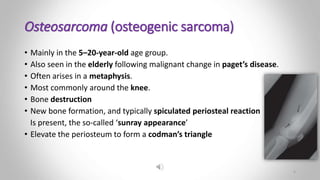
Osteosarcoma (osteogenic sarcoma)
• Mainly in the 5–20-year-old age group.
• Also seen in the elderly following malignant change in paget’s disease.
• Often arises in a metaphysis.
• Most commonly around the knee.
• Bone destruction
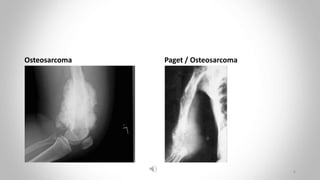
• New bone formation, and typically spiculated periosteal reaction
Is present, the so-called ‘sunray appearance’
• Elevate the periosteum to form a codman’s triangle
5
Osteosarcoma Paget / Osteosarcoma
6
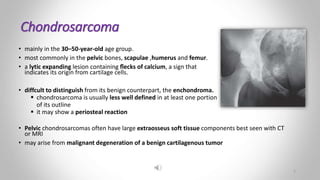
Chondrosarcoma
• mainly in the 30–50-year-old age group.
• most commonly in the pelvic bones, scapulae ,humerus and femur.
• a lytic expanding lesion containing flecks of calcium, a sign that
indicates its origin from cartilage cells.
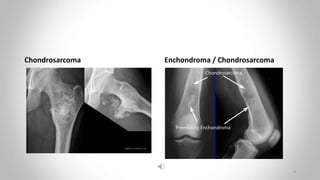
• diffcult to distinguish from its benign counterpart, the enchondroma.
 chondrosarcoma is usually less well defined in at least one portion
of its outline
 it may show a periosteal reaction
• Pelvic chondrosarcomas often have large extraosseus soft tissue components best seen with CT
or MRI
• may arise from malignant degeneration of a benign cartilagenous tumor
7
Chondrosarcoma Enchondroma / Chondrosarcoma
8
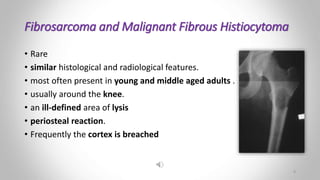
Fibrosarcoma and Malignant Fibrous Histiocytoma
• Rare
• similar histological and radiological features.
• most often present in young and middle aged adults .
• usually around the knee.
• an ill-defined area of lysis
• periosteal reaction.
• Frequently the cortex is breached
9
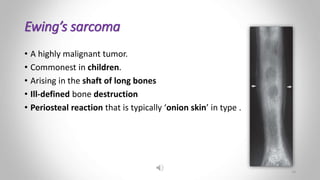
Ewing’s sarcoma
• A highly malignant tumor.
• Commonest in children.
• Arising in the shaft of long bones
• Ill-defined bone destruction
• Periosteal reaction that is typically ‘onion skin’ in type .
10
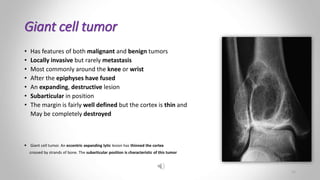
Giant cell tumor
• Has features of both malignant and benign tumors
• Locally invasive but rarely metastasis
• Most commonly around the knee or wrist
• After the epiphyses have fused
• An expanding, destructive lesion
• Subarticular in position
• The margin is fairly well defined but the cortex is thin and
May be completely destroyed
 Giant cell tumor. An eccentric expanding lytic lesion has thinned the cortex
crossed by strands of bone. The subarticular position is characteristic of this tumor
11
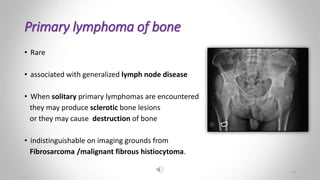
Primary lymphoma of bone
• Rare
• associated with generalized lymph node disease
• When solitary primary lymphomas are encountered
they may produce sclerotic bone lesions
or they may cause destruction of bone
• indistinguishable on imaging grounds from
Fibrosarcoma /malignant fibrous histiocytoma.
12
Benign tumors and tumor-like conditions
• an edge that is well demarcated by a sclerotic rim.
• cause expansion but rarely breach the cortex.
• There is no soft tissue mass
• Periosteal reaction is unusual unless there has been a fracture .
• Radionuclide scans in benign tumors usually show little or no increase in activity, unless a fracture has occurred.
13
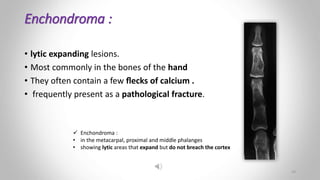
Enchondroma :
• lytic expanding lesions.
• Most commonly in the bones of the hand
• They often contain a few flecks of calcium .
• frequently present as a pathological fracture.
 Enchondroma :
• in the metacarpal, proximal and middle phalanges
• showing lytic areas that expand but do not breach the cortex
14
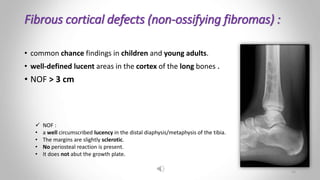
Fibrous cortical defects (non-ossifying fibromas) :
• common chance findings in children and young adults.
• well-defined lucent areas in the cortex of the long bones .
• NOF > 3 cm
 NOF :
• a well circumscribed lucency in the distal diaphysis/metaphysis of the tibia.
• The margins are slightly sclerotic.
• No periosteal reaction is present.
• It does not abut the growth plate.
15
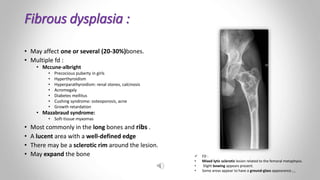
Fibrous dysplasia :
• May affect one or several (20-30%)bones.
• Multiple fd :
• Mccune-albright
• Precocious puberty in girls
• Hyperthyroidism
• Hyperparathyroidism: renal stones, calcinosis
• Acromegaly
• Diabetes mellitus
• Cushing syndrome: osteoporosis, acne
• Growth retardation
• Mazabraud syndrome:
• Soft-tissue myxomas
• Most commonly in the long bones and ribs .
• A lucent area with a well-defined edge
• There may be a sclerotic rim around the lesion.
• May expand the bone  FD :
• Mixed lytic sclerotic lesion related to the femoral metaphysis.
• Slight bowing appears present.
• Some areas appear to have a ground-glass appearance.16
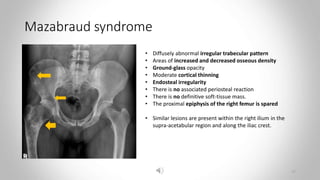
Mazabraud syndrome
• Diffusely abnormal irregular trabecular pattern
• Areas of increased and decreased osseous density
• Ground-glass opacity
• Moderate cortical thinning
• Endosteal irregularity
• There is no associated periosteal reaction
• There is no definitive soft-tissue mass.
• The proximal epiphysis of the right femur is spared
• Similar lesions are present within the right ilium in the
supra-acetabular region and along the iliac crest.
17
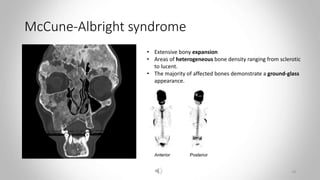
McCune-Albright syndrome
• Extensive bony expansion
• Areas of heterogeneous bone density ranging from sclerotic
to lucent.
• The majority of affected bones demonstrate a ground-glass
appearance.
18
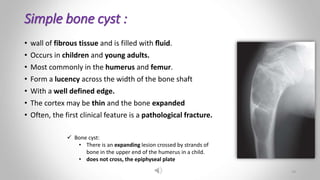
Simple bone cyst :
• wall of fibrous tissue and is filled with fluid.
• Occurs in children and young adults.
• Most commonly in the humerus and femur.
• Form a lucency across the width of the bone shaft
• With a well defined edge.
• The cortex may be thin and the bone expanded
• Often, the first clinical feature is a pathological fracture.
 Bone cyst:
• There is an expanding lesion crossed by strands of
bone in the upper end of the humerus in a child.
• does not cross, the epiphyseal plate
19
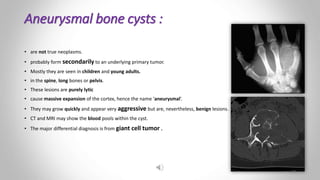
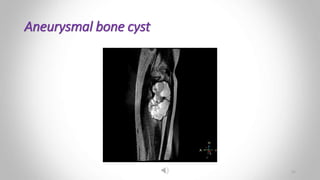
Aneurysmal bone cysts :
• are not true neoplasms.
• probably form secondarily to an underlying primary tumor.
• Mostly they are seen in children and young adults.
• in the spine, long bones or pelvis.
• These lesions are purely lytic
• cause massive expansion of the cortex, hence the name ‘aneurysmal’.
• They may grow quickly and appear very aggressive but are, nevertheless, benign lesions.
• CT and MRI may show the blood pools within the cyst.
• The major differential diagnosis is from giant cell tumor .
20
Aneurysmal bone cyst
21
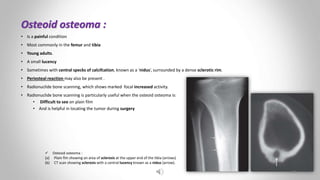
Osteoid osteoma :
• Is a painful condition
• Most commonly in the femur and tibia
• Young adults.
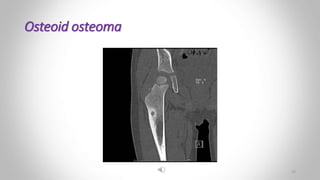
• A small lucency
• Sometimes with central specks of calcifcation, known as a ‘nidus’, surrounded by a dense sclerotic rim.
• Periosteal reaction may also be present .
• Radionuclide bone scanning, which shows marked focal increased activity.
• Radionuclide bone scanning is particularly useful when the osteoid osteoma is:
• Difficult to see on plain film
• And is helpful in locating the tumor during surgery
 Osteoid osteoma :
(a) Plain flm showing an area of sclerosis at the upper end of the tibia (arrows)
(b) CT scan showing sclerosis with a central lucency known as a nidus (arrow).
22
Osteoid osteoma
23
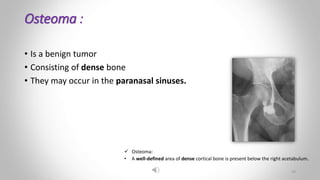
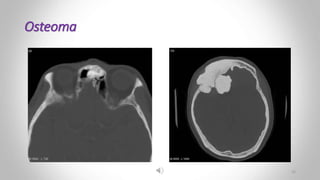
Osteoma :
• Is a benign tumor
• Consisting of dense bone
• They may occur in the paranasal sinuses.
 Osteoma:
• A well-defined area of dense cortical bone is present below the right acetabulum.
24
Osteoma
25
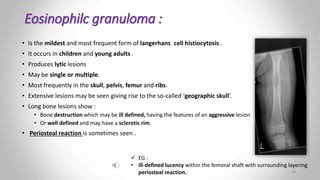
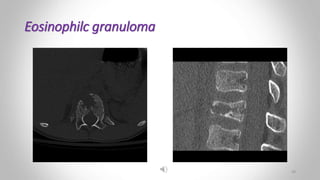
Eosinophilc granuloma :
• Is the mildest and most frequent form of langerhans cell histiocytosis .
• It occurs in children and young adults .
• Produces lytic lesions
• May be single or multiple.
• Most frequently in the skull, pelvis, femur and ribs.
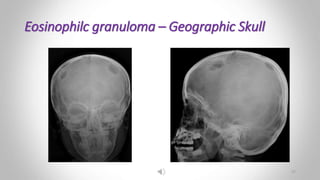
• Extensive lesions may be seen giving rise to the so-called ‘geographic skull’.
• Long bone lesions show :
• Bone destruction which may be ill defined, having the features of an aggressive lesion
• Or well defined and may have a sclerotic rim.
• Periosteal reaction is sometimes seen .
 EG :
• ill-defined lucency within the femoral shaft with surrounding layering
periosteal reaction. 26
Eosinophilc granuloma – Geographic Skull
27
Eosinophilc granuloma
28

Bone 2.ppsxپومکومککککککککگگگگکگکگکککککککگ

  • 1.
    Bone - 2 DrPasha Shahbaz Shahid Sadoughi university of medical science 1
  • 2.
  • 3.
    • In general,plain film radiography is the best imaging technique for making a diagnosis. • MRI or CT delineate the : • Full extent of a tumor • Surrounding structures • Relationship to the neurovascular bundle • The main role for radionuclide bone scanning is to diagnose metastatic bone disease 3
  • 4.
    Primary malignant tumors Onplain films : • poorly defined margins • wide zone of transition • may destroy the cortex of the bone • A periosteal reaction is often present • soft tissue mass may be seen. Radionuclide bone scans show substantially increased activity in the lesion. MRI is the most accurate technique for showing the local extent of the tumor using multiplanar views. 4
  • 5.
    Osteosarcoma (osteogenic sarcoma) •Mainly in the 5–20-year-old age group. • Also seen in the elderly following malignant change in paget’s disease. • Often arises in a metaphysis. • Most commonly around the knee. • Bone destruction • New bone formation, and typically spiculated periosteal reaction Is present, the so-called ‘sunray appearance’ • Elevate the periosteum to form a codman’s triangle 5
  • 6.
    Osteosarcoma Paget /Osteosarcoma 6
  • 7.
    Chondrosarcoma • mainly inthe 30–50-year-old age group. • most commonly in the pelvic bones, scapulae ,humerus and femur. • a lytic expanding lesion containing flecks of calcium, a sign that indicates its origin from cartilage cells. • diffcult to distinguish from its benign counterpart, the enchondroma.  chondrosarcoma is usually less well defined in at least one portion of its outline  it may show a periosteal reaction • Pelvic chondrosarcomas often have large extraosseus soft tissue components best seen with CT or MRI • may arise from malignant degeneration of a benign cartilagenous tumor 7
  • 8.
  • 9.
    Fibrosarcoma and MalignantFibrous Histiocytoma • Rare • similar histological and radiological features. • most often present in young and middle aged adults . • usually around the knee. • an ill-defined area of lysis • periosteal reaction. • Frequently the cortex is breached 9
  • 10.
    Ewing’s sarcoma • Ahighly malignant tumor. • Commonest in children. • Arising in the shaft of long bones • Ill-defined bone destruction • Periosteal reaction that is typically ‘onion skin’ in type . 10
  • 11.
    Giant cell tumor •Has features of both malignant and benign tumors • Locally invasive but rarely metastasis • Most commonly around the knee or wrist • After the epiphyses have fused • An expanding, destructive lesion • Subarticular in position • The margin is fairly well defined but the cortex is thin and May be completely destroyed  Giant cell tumor. An eccentric expanding lytic lesion has thinned the cortex crossed by strands of bone. The subarticular position is characteristic of this tumor 11
  • 12.
    Primary lymphoma ofbone • Rare • associated with generalized lymph node disease • When solitary primary lymphomas are encountered they may produce sclerotic bone lesions or they may cause destruction of bone • indistinguishable on imaging grounds from Fibrosarcoma /malignant fibrous histiocytoma. 12
  • 13.
    Benign tumors andtumor-like conditions • an edge that is well demarcated by a sclerotic rim. • cause expansion but rarely breach the cortex. • There is no soft tissue mass • Periosteal reaction is unusual unless there has been a fracture . • Radionuclide scans in benign tumors usually show little or no increase in activity, unless a fracture has occurred. 13
  • 14.
    Enchondroma : • lyticexpanding lesions. • Most commonly in the bones of the hand • They often contain a few flecks of calcium . • frequently present as a pathological fracture.  Enchondroma : • in the metacarpal, proximal and middle phalanges • showing lytic areas that expand but do not breach the cortex 14
  • 15.
    Fibrous cortical defects(non-ossifying fibromas) : • common chance findings in children and young adults. • well-defined lucent areas in the cortex of the long bones . • NOF > 3 cm  NOF : • a well circumscribed lucency in the distal diaphysis/metaphysis of the tibia. • The margins are slightly sclerotic. • No periosteal reaction is present. • It does not abut the growth plate. 15
  • 16.
    Fibrous dysplasia : •May affect one or several (20-30%)bones. • Multiple fd : • Mccune-albright • Precocious puberty in girls • Hyperthyroidism • Hyperparathyroidism: renal stones, calcinosis • Acromegaly • Diabetes mellitus • Cushing syndrome: osteoporosis, acne • Growth retardation • Mazabraud syndrome: • Soft-tissue myxomas • Most commonly in the long bones and ribs . • A lucent area with a well-defined edge • There may be a sclerotic rim around the lesion. • May expand the bone  FD : • Mixed lytic sclerotic lesion related to the femoral metaphysis. • Slight bowing appears present. • Some areas appear to have a ground-glass appearance.16
  • 17.
    Mazabraud syndrome • Diffuselyabnormal irregular trabecular pattern • Areas of increased and decreased osseous density • Ground-glass opacity • Moderate cortical thinning • Endosteal irregularity • There is no associated periosteal reaction • There is no definitive soft-tissue mass. • The proximal epiphysis of the right femur is spared • Similar lesions are present within the right ilium in the supra-acetabular region and along the iliac crest. 17
  • 18.
    McCune-Albright syndrome • Extensivebony expansion • Areas of heterogeneous bone density ranging from sclerotic to lucent. • The majority of affected bones demonstrate a ground-glass appearance. 18
  • 19.
    Simple bone cyst: • wall of fibrous tissue and is filled with fluid. • Occurs in children and young adults. • Most commonly in the humerus and femur. • Form a lucency across the width of the bone shaft • With a well defined edge. • The cortex may be thin and the bone expanded • Often, the first clinical feature is a pathological fracture.  Bone cyst: • There is an expanding lesion crossed by strands of bone in the upper end of the humerus in a child. • does not cross, the epiphyseal plate 19
  • 20.
    Aneurysmal bone cysts: • are not true neoplasms. • probably form secondarily to an underlying primary tumor. • Mostly they are seen in children and young adults. • in the spine, long bones or pelvis. • These lesions are purely lytic • cause massive expansion of the cortex, hence the name ‘aneurysmal’. • They may grow quickly and appear very aggressive but are, nevertheless, benign lesions. • CT and MRI may show the blood pools within the cyst. • The major differential diagnosis is from giant cell tumor . 20
  • 21.
  • 22.
    Osteoid osteoma : •Is a painful condition • Most commonly in the femur and tibia • Young adults. • A small lucency • Sometimes with central specks of calcifcation, known as a ‘nidus’, surrounded by a dense sclerotic rim. • Periosteal reaction may also be present . • Radionuclide bone scanning, which shows marked focal increased activity. • Radionuclide bone scanning is particularly useful when the osteoid osteoma is: • Difficult to see on plain film • And is helpful in locating the tumor during surgery  Osteoid osteoma : (a) Plain flm showing an area of sclerosis at the upper end of the tibia (arrows) (b) CT scan showing sclerosis with a central lucency known as a nidus (arrow). 22
  • 23.
  • 24.
    Osteoma : • Isa benign tumor • Consisting of dense bone • They may occur in the paranasal sinuses.  Osteoma: • A well-defined area of dense cortical bone is present below the right acetabulum. 24
  • 25.
  • 26.
    Eosinophilc granuloma : •Is the mildest and most frequent form of langerhans cell histiocytosis . • It occurs in children and young adults . • Produces lytic lesions • May be single or multiple. • Most frequently in the skull, pelvis, femur and ribs. • Extensive lesions may be seen giving rise to the so-called ‘geographic skull’. • Long bone lesions show : • Bone destruction which may be ill defined, having the features of an aggressive lesion • Or well defined and may have a sclerotic rim. • Periosteal reaction is sometimes seen .  EG : • ill-defined lucency within the femoral shaft with surrounding layering periosteal reaction. 26
  • 27.
    Eosinophilc granuloma –Geographic Skull 27
  • 28.