Dhrumil Patel
3rdYear Orthopaedic
Resident
CUBITUS VARUS
Cubitus Varus
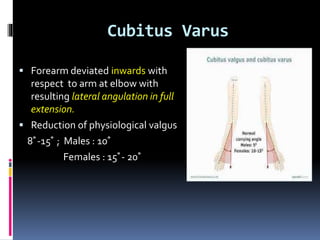
 Forearm deviated inwards with
respect to arm at elbow with
resulting lateral angulation in full
extension.
 Reduction of physiological valgus
8 ̊-15 ̊ ; Males : 10 ̊
Females : 15 ̊- 20 ̊
 Normally forearm is aligned in valgus with
respect to arm in full extension with medial
angulation.
 Decrease in valgus with neutral alignment
(loss of angulation) is called “Cubitus Rectus”.
It is still a deformity as it deviates from the
normal for population.
CUBITUS VARUS
Varus deformity at elbow
(CubitusVarus)
Causes
1. Post traumatic malunited s/c humerus fracture (most
common)
2. Congenital (progressive)
3. Malunited fracture lateral condyle (progressive if due to
hyperemia and overgrowth)
4. Trochlear Osteonecrosis (static)
5. Malunited intercondylar fracture (static)
6. Malunited medial condyle fracture (static)
Types
 Static (Non progressive)
 Progressive
ON EXAMINATION
Inspection
•Hyperextension deformity
•Limited flexion
•Medial tilt and lateral angulation at elbow
•Prominence of lateral condyle humerus
•Wasting of muscles
•No scars/sinuses/redness
 PALPATION:
• No local warmth/tenderness
•Thickening and irregularity of supracondylar ridges
• 3 point bony relationship maintained
• Medial epicondyle tip higher
• Hyperextension at elbow
• No widening of intercondylar region
• Internal rotation deformity with increased internal
rotation (Yamamoto test )
• Decreased external rotation which is compensated by
much more mobile shoulder joint (so often goes unnoticed
by patients/relatives)
DISPLACEMENTS THAT OCCUR AT
ELBOW JOINT
•Medial displacement
•Medial tilt
•Internal rotation
•Posterior displacement
•Posterior tilt
•Proximal migration
DISTAL FRAGMENT
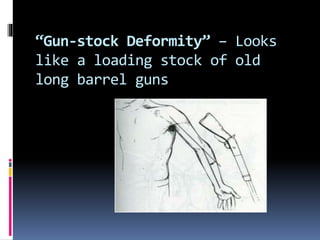
“Gun-stock Deformity” – Looks
like a loading stock of old
long barrel guns
MEASUREMENTS ON XRAY :- AP VIEW
•Decrease in normal physiological valgus
•Increase in Baumann’sAngle
(Normal – 64 ̊to 81 ̊)
•Metaphyseo-diaphyseal
angle
(Klebb-Sherman)
Normally- 90
>Normal-Varus
deformity
<Normal-Valgus
deformity
•Humero-Ulno angle
(Oppenheim)
Decreased
Most accurate
LATERAL VIEW
•Normally no overlap between the
lateral condylar epiphysis and
olecranon epiphysis
•If significant tilt of distal fragment
occurs, there is overlap between
the two which appears like a
crescent → ‘Crescent Sign”
CRESCENT SIGN
TREATMENT :- 3 MODALITIES
1. Observation with expected remodeling
2. Hemiepiphysiodesis and growth alteration
3. Corrective osteotomy
Treatment is primarily “Cosmetic Correction”
1. OBSERVATION
•Generally not appropriate
•Because, although hyperextension may remodel in a young
child; in an older child, little remodeling occurs even in the
plane of function of the joint
2. HEMIEPIPHYSIODESIS
•Hemiepiphysiodesis of distal humerus is rarely of value
•Only to prevent varus deformity with clear medial growth
arrest or trochlear osteonecrosis
•If untreated, deformity will progress because of medial
growth arrest and lateral overgrowth
•Lateral epiphysiodesis will not correct the deformity but
will prevent it from increasing
3. Corrective Osteotomy
 Pre-requisites
1. Atleast 1 year following fracture (Bone
remodeling and tissue equilibrium)
2. Patient demanding surgery
3. Calculation of wedge to be
removed→Normal side Xray→
Wedge angle =Varus + Normal physiological
Valgus
(Metal wedge autoclaved)
3 Basic Types
 Lateral closing wedge osteotomy
Easiest
Safest
Most stable inherently
 Medial open wedge osteotomy with bone
graft
 Oblique osteotomy with derotation
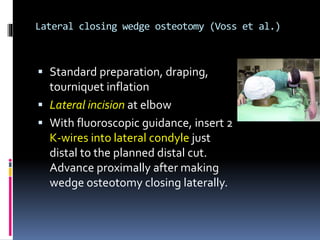
Lateral closing wedge osteotomy (Voss et al.)
 Standard preparation, draping,
tourniquet inflation
 Lateral incision at elbow
 With fluoroscopic guidance, insert 2
K-wires into lateral condyle just
distal to the planned distal cut.
Advance proximally after making
wedge osteotomy closing laterally.
 Keep medial cortex intact;
weaken it by multiple drill
holes and a Apply forceful
valgus stress to complete
the osteotomy .Close the
osteotomy and advance the
K-wires into the medial
cortex of proximal
fragment. Leave the wires
buried under the skin. A
third wire can be used if
necessary for stability.
 Close the wound in layers;
splint the arm in 90 ̊ flexion
and full pronation.
FRENCH OSTEOTOMY
•Posterior approach
•Lateral closing wedge osteotomy with 2 guide pins
and 2 screws inserted proximal and distal to the pins
parallel to them.
•Medial cortex broken
•Only periosteum intact
•Approximately the wedge till the 2 screws are
parallel
•Hold this position withTBW
French Osteotomy Modified French Osteotomy
(Bellemore)
 Post. Longitudinal
approach
 Detach whole of triceps
 Ulnar nerve explored
 Medial cortex broken
 Posterolateral approach
 Lateral half of triceps
detached
 Ulnar nerve Not explored
 Medial cortex intact so
more stability
STEP-CUT OSTEOTOMY
(DEROSA & GRAZIANO)
•A modification of lateral closing wedge osteotomy
•Using a template constructed preoperatively, make
a lateral closing wedge osteotomy in the
metaphyseal region superior to the olecranon fossa.
•Make the osteotomy leaving a lateral spike of bone
distally
•Trim lateral portion of proximal fragment for close
approximation.
•Correct the medial tilt, rotational malalignment,
hyperextension and fix with crossed K-wires
•Then, use a lag screw from lateral portion of distal
fragment to proximal fragment
•Close the wound and apply posterior splint for 4
weeks.
STEP-CUT TRANSLATION OSTEOTOMY
WITH A Y-SHAPED HUMERAL PLATE
•Posterior approach to distal humerus.
•Incise the capsule to expose medial and lateral condyles
•Basic step-cut osteotomy involves osteotomy with a triangular template
0.5 cm proximal to olecranon fossa with base of triangle perpendicular to
humeral shaft and apex directed proximally.
•Remove wedge of bone.
•In cubitus varus, rotate distal fragment so as to fix its lateral border intoV-
shaped apex of proximal fragment.
•In cubitus valgus, do fit the medial border of distal
fragment into apex of proximal fragment leading to
lateralization of the apex.
•This basic step-cut translational osteotomy corrects
deformity only in coronal plane.
•Rotational deformity corrected in same operation by
excising a piece of bone from posterior aspect ofV-shaped
proximal fragment. Correct rotation when angle of rotation
differs by 10 ̊from normal.
•Temporarily fix the correction by K-wires. Smoothen the
sharp edges of medial and lateral columns.
•Fix with 3.5mm plate with 5 screws distally and 2 screws
proximally.
OBLIQUE OSTEOTOMY WITH DEROTATION
(AMSPACHER & MESSENBAUGH)
•Patient prone and pneumatic tourniquet in place.
•Posterior elbow exposure through a longitudinal incision; divide triceps in
line with its muscle fibres, expose the s/c part of humerus subperiosteally
protecting the radial and ulnar nerves.
•Oscillating saw used to make an oblique osteotomy about 3.8cm proximal
to distal end of humerus directing it posteriorly above to anteriorly below.
Complete it anteriorly with osteotome.Tilt and rotate the distal fragment
until cubitus varus and internal rotation have been corrected.
•With fragments in position, fix them with a screw inserted across the
middle of osteotomy.
•Arm is immobilized in a long arm cast or splint until union at 4-6 weeks.
DOME OSTEOTOMY WITH
DEROTATION
(UCHIDA ET AL)
•A type of osteotomy with derotation
• Preferred in mild cubitus varus
•2 semicircular cuts made from lateral to medial
•2 domes rotated and aligned to correct the
deformity
•Corrects lateral prominence of condyle
MEDIAL OPEN WEDGE OSTEOTOMY WITH BONE
GRAFTING
(KING & SECOR)
•Requires BG
•Gains length→ inherent instability
•May stretch the ulnar nerve- transferred anteriorly to avoid this
COMPLICATIONS OF OSTEOTOMY
1. Stiffness
2. Nerve injury
3. Persistent deformity (under correction)
4. Recurrent deformity
5. Non-union
6. Osteomyelitis
7. Skin sloughing
CUBITUS VALGUS
Increased physiological valgus with lateral tilt and medial
angulation
Causes
•Non-union fracture lateral condyle(>3months)
•Malunited S/C fracture humerus
•Osteonecrosis of lateral trochlea
•Malunited intercondylar fracture
•Radial head fracture dislocation
•Medial epiphyseal injury and growth stimulation
Pseudo Cubitus Varus
Lateral spur formation in lateral condyle
humerus fracture due to elevation of
periosteum and new bone formation
leads to lateral bulge with normal
carrying angle
ThankYou
Next topic: Non-union by Dr. Sagar

Cubitus varus by Dhrumil Patel

  • 1.
  • 2.
    Cubitus Varus  Forearmdeviated inwards with respect to arm at elbow with resulting lateral angulation in full extension.  Reduction of physiological valgus 8 ̊-15 ̊ ; Males : 10 ̊ Females : 15 ̊- 20 ̊
  • 3.
     Normally forearmis aligned in valgus with respect to arm in full extension with medial angulation.  Decrease in valgus with neutral alignment (loss of angulation) is called “Cubitus Rectus”. It is still a deformity as it deviates from the normal for population.
  • 4.
    CUBITUS VARUS Varus deformityat elbow (CubitusVarus)
  • 5.
    Causes 1. Post traumaticmalunited s/c humerus fracture (most common) 2. Congenital (progressive) 3. Malunited fracture lateral condyle (progressive if due to hyperemia and overgrowth) 4. Trochlear Osteonecrosis (static) 5. Malunited intercondylar fracture (static) 6. Malunited medial condyle fracture (static)
  • 7.
    Types  Static (Nonprogressive)  Progressive
  • 8.
    ON EXAMINATION Inspection •Hyperextension deformity •Limitedflexion •Medial tilt and lateral angulation at elbow •Prominence of lateral condyle humerus •Wasting of muscles •No scars/sinuses/redness
  • 10.
     PALPATION: • Nolocal warmth/tenderness •Thickening and irregularity of supracondylar ridges • 3 point bony relationship maintained • Medial epicondyle tip higher
  • 11.
    • Hyperextension atelbow • No widening of intercondylar region • Internal rotation deformity with increased internal rotation (Yamamoto test ) • Decreased external rotation which is compensated by much more mobile shoulder joint (so often goes unnoticed by patients/relatives)
  • 12.
    DISPLACEMENTS THAT OCCURAT ELBOW JOINT •Medial displacement •Medial tilt •Internal rotation •Posterior displacement •Posterior tilt •Proximal migration DISTAL FRAGMENT
  • 13.
    “Gun-stock Deformity” –Looks like a loading stock of old long barrel guns
  • 14.
    MEASUREMENTS ON XRAY:- AP VIEW •Decrease in normal physiological valgus •Increase in Baumann’sAngle (Normal – 64 ̊to 81 ̊)
  • 15.
  • 17.
    LATERAL VIEW •Normally nooverlap between the lateral condylar epiphysis and olecranon epiphysis •If significant tilt of distal fragment occurs, there is overlap between the two which appears like a crescent → ‘Crescent Sign”
  • 18.
  • 19.
    TREATMENT :- 3MODALITIES 1. Observation with expected remodeling 2. Hemiepiphysiodesis and growth alteration 3. Corrective osteotomy Treatment is primarily “Cosmetic Correction”
  • 20.
    1. OBSERVATION •Generally notappropriate •Because, although hyperextension may remodel in a young child; in an older child, little remodeling occurs even in the plane of function of the joint
  • 21.
    2. HEMIEPIPHYSIODESIS •Hemiepiphysiodesis ofdistal humerus is rarely of value •Only to prevent varus deformity with clear medial growth arrest or trochlear osteonecrosis •If untreated, deformity will progress because of medial growth arrest and lateral overgrowth •Lateral epiphysiodesis will not correct the deformity but will prevent it from increasing
  • 23.
    3. Corrective Osteotomy Pre-requisites 1. Atleast 1 year following fracture (Bone remodeling and tissue equilibrium) 2. Patient demanding surgery 3. Calculation of wedge to be removed→Normal side Xray→ Wedge angle =Varus + Normal physiological Valgus (Metal wedge autoclaved)
  • 25.
    3 Basic Types Lateral closing wedge osteotomy Easiest Safest Most stable inherently  Medial open wedge osteotomy with bone graft  Oblique osteotomy with derotation
  • 26.
    Lateral closing wedgeosteotomy (Voss et al.)  Standard preparation, draping, tourniquet inflation  Lateral incision at elbow  With fluoroscopic guidance, insert 2 K-wires into lateral condyle just distal to the planned distal cut. Advance proximally after making wedge osteotomy closing laterally.
  • 28.
     Keep medialcortex intact; weaken it by multiple drill holes and a Apply forceful valgus stress to complete the osteotomy .Close the osteotomy and advance the K-wires into the medial cortex of proximal fragment. Leave the wires buried under the skin. A third wire can be used if necessary for stability.  Close the wound in layers; splint the arm in 90 ̊ flexion and full pronation.
  • 29.
    FRENCH OSTEOTOMY •Posterior approach •Lateralclosing wedge osteotomy with 2 guide pins and 2 screws inserted proximal and distal to the pins parallel to them. •Medial cortex broken •Only periosteum intact •Approximately the wedge till the 2 screws are parallel •Hold this position withTBW
  • 30.
    French Osteotomy ModifiedFrench Osteotomy (Bellemore)  Post. Longitudinal approach  Detach whole of triceps  Ulnar nerve explored  Medial cortex broken  Posterolateral approach  Lateral half of triceps detached  Ulnar nerve Not explored  Medial cortex intact so more stability
  • 31.
    STEP-CUT OSTEOTOMY (DEROSA &GRAZIANO) •A modification of lateral closing wedge osteotomy •Using a template constructed preoperatively, make a lateral closing wedge osteotomy in the metaphyseal region superior to the olecranon fossa. •Make the osteotomy leaving a lateral spike of bone distally •Trim lateral portion of proximal fragment for close approximation. •Correct the medial tilt, rotational malalignment, hyperextension and fix with crossed K-wires •Then, use a lag screw from lateral portion of distal fragment to proximal fragment •Close the wound and apply posterior splint for 4 weeks.
  • 33.
    STEP-CUT TRANSLATION OSTEOTOMY WITHA Y-SHAPED HUMERAL PLATE •Posterior approach to distal humerus. •Incise the capsule to expose medial and lateral condyles •Basic step-cut osteotomy involves osteotomy with a triangular template 0.5 cm proximal to olecranon fossa with base of triangle perpendicular to humeral shaft and apex directed proximally. •Remove wedge of bone. •In cubitus varus, rotate distal fragment so as to fix its lateral border intoV- shaped apex of proximal fragment.
  • 35.
    •In cubitus valgus,do fit the medial border of distal fragment into apex of proximal fragment leading to lateralization of the apex. •This basic step-cut translational osteotomy corrects deformity only in coronal plane. •Rotational deformity corrected in same operation by excising a piece of bone from posterior aspect ofV-shaped proximal fragment. Correct rotation when angle of rotation differs by 10 ̊from normal. •Temporarily fix the correction by K-wires. Smoothen the sharp edges of medial and lateral columns. •Fix with 3.5mm plate with 5 screws distally and 2 screws proximally.
  • 37.
    OBLIQUE OSTEOTOMY WITHDEROTATION (AMSPACHER & MESSENBAUGH) •Patient prone and pneumatic tourniquet in place. •Posterior elbow exposure through a longitudinal incision; divide triceps in line with its muscle fibres, expose the s/c part of humerus subperiosteally protecting the radial and ulnar nerves. •Oscillating saw used to make an oblique osteotomy about 3.8cm proximal to distal end of humerus directing it posteriorly above to anteriorly below. Complete it anteriorly with osteotome.Tilt and rotate the distal fragment until cubitus varus and internal rotation have been corrected. •With fragments in position, fix them with a screw inserted across the middle of osteotomy. •Arm is immobilized in a long arm cast or splint until union at 4-6 weeks.
  • 39.
    DOME OSTEOTOMY WITH DEROTATION (UCHIDAET AL) •A type of osteotomy with derotation • Preferred in mild cubitus varus •2 semicircular cuts made from lateral to medial •2 domes rotated and aligned to correct the deformity •Corrects lateral prominence of condyle
  • 40.
    MEDIAL OPEN WEDGEOSTEOTOMY WITH BONE GRAFTING (KING & SECOR) •Requires BG •Gains length→ inherent instability •May stretch the ulnar nerve- transferred anteriorly to avoid this
  • 41.
    COMPLICATIONS OF OSTEOTOMY 1.Stiffness 2. Nerve injury 3. Persistent deformity (under correction) 4. Recurrent deformity 5. Non-union 6. Osteomyelitis 7. Skin sloughing
  • 42.
    CUBITUS VALGUS Increased physiologicalvalgus with lateral tilt and medial angulation Causes •Non-union fracture lateral condyle(>3months) •Malunited S/C fracture humerus •Osteonecrosis of lateral trochlea •Malunited intercondylar fracture •Radial head fracture dislocation •Medial epiphyseal injury and growth stimulation
  • 43.
    Pseudo Cubitus Varus Lateralspur formation in lateral condyle humerus fracture due to elevation of periosteum and new bone formation leads to lateral bulge with normal carrying angle
  • 44.