European Exploration and 
Colonization
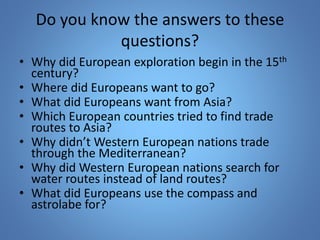
Do you know the answers to these 
questions? 
• Why did European exploration begin in the 15th 
century? 
• Where did Europeans want to go? 
• What did Europeans want from Asia? 
• Which European countries tried to find trade 
routes to Asia? 
• Why didn’t Western European nations trade 
through the Mediterranean? 
• Why did Western European nations search for 
water routes instead of land routes? 
• What did Europeans use the compass and 
astrolabe for?
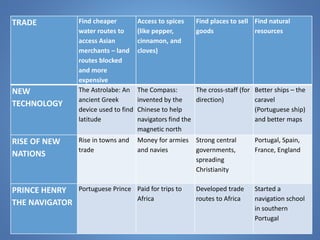
TRADE Find cheaper 
water routes to 
access Asian 
merchants – land 
routes blocked 
and more 
expensive 
Access to spices 
(like pepper, 
cinnamon, and 
cloves) 
Find places to sell 
goods 
Find natural 
resources 
NEW 
TECHNOLOGY 
The Astrolabe: An 
ancient Greek 
device used to find 
latitude 
The Compass: 
invented by the 
Chinese to help 
navigators find the 
magnetic north 
The cross-staff (for 
direction) 
Better ships – the 
caravel 
(Portuguese ship) 
and better maps 
RISE OF NEW 
NATIONS 
Rise in towns and 
trade 
Money for armies 
and navies 
Strong central 
governments, 
spreading 
Christianity 
Portugal, Spain, 
France, England 
PRINCE HENRY 
THE NAVIGATOR 
Portuguese Prince Paid for trips to 
Africa 
Developed trade 
routes to Africa 
Started a 
navigation school 
in southern 
Portugal
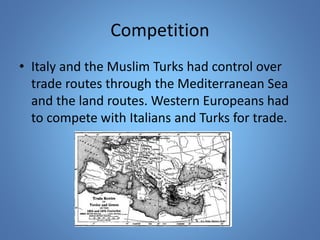
Competition 
• Italy and the Muslim Turks had control over 
trade routes through the Mediterranean Sea 
and the land routes. Western Europeans had 
to compete with Italians and Turks for trade.
Remember the 3 G’s!! 
 God – spread of Christianity 
 Gold – to trade and become wealthy 
(gold and spices) 
 Glory – explorers were seen as heroes if 
they discovered new lands
Vocabulary 
• Exploration: people leaving home to see new 
places and returning to tell their home 
countries 
• Colonization: people leaving home to start a 
new community and life by taking over 
another part of the world 
• Imperialism: a country gets many colonies 
and builds an empire where they completely 
control other parts of the world.
Colony and Market 
• A “colony” is a land or region controlled by a 
foreign power. 
– Example: Britain established colonies in the 
Americas. 
• A “market” is a geographic region in which 
things may be sold. 
– Example: America is a market for Chinese goods 
because we buy goods from China.
Colony or Market? 
• Jamestown was under the laws of England 
even though it was located in the Americas. 
• Canada buys goods from the United States. 
• In the 16th century, Spain conquered Peru. 
They made Spanish the official language 
there. 
• China began to trade with Europe through the 
Silk Road.
Exploration and Discovery 
• Although explorers 
were looking for 
trade routes to Asia, 
they discovered new 
lands in the 
Americas, Africa, and 
Asia.
Colonies 
• European countries established colonies in the 
Americas, Africa, and Asia.
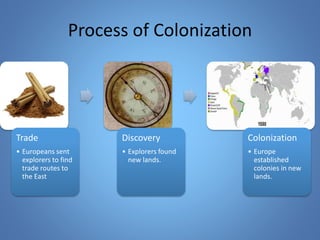
Process of Colonization 
Trade 
• Europeans sent 
explorers to find 
trade routes to 
the East 
Discovery 
• Explorers found 
new lands. 
Colonization 
• Europe 
established 
colonies in new 
lands.
What were the benefits of 
establishing colonies?
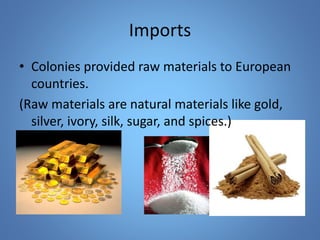
Imports 
• Colonies provided raw materials to European 
countries. 
(Raw materials are natural materials like gold, 
silver, ivory, silk, sugar, and spices.)
Exports 
• Colonies bought goods from the home 
country. 
In other words… 
• Colonies became markets for European goods.
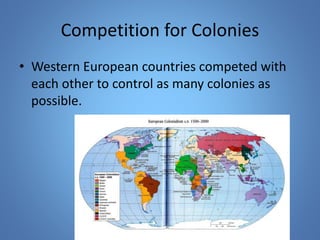
Competition for Colonies 
• Western European countries competed with 
each other to control as many colonies as 
possible.
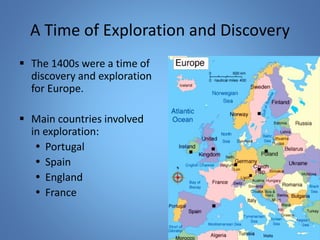
A Time of Exploration and Discovery 
 The 1400s were a time of 
discovery and exploration 
for Europe. 
 Main countries involved 
in exploration: 
 Portugal 
 Spain 
 England 
 France
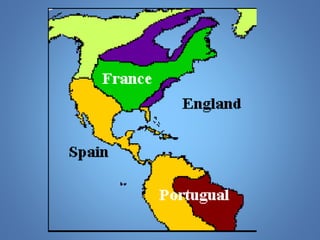
PORTUGAL 
 1st Europeans to explore the unknown New 
World 
 1st to sail around the tip of Africa to Asia 
 Also wanted to spread Christianity and to stop 
the expanding Muslim empire 
 Mainly explored what is now Brazil in the New 
World--this is why Brazilian culture today is 
heavily influenced by Portugal
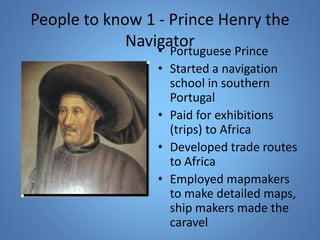
People to know 1 - Prince Henry the 
Navigator 
• Portuguese Prince 
• Started a navigation 
school in southern 
Portugal 
• Paid for exhibitions 
(trips) to Africa 
• Developed trade routes 
to Africa 
• Employed mapmakers 
to make detailed maps, 
ship makers made the 
caravel
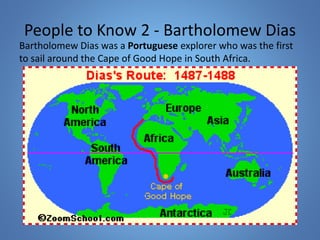
People to Know 2 - Bartholomew Dias 
Bartholomew Dias was a Portuguese explorer who was the first 
to sail around the Cape of Good Hope in South Africa.
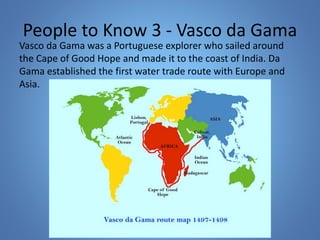
People to Know 3 - Vasco da Gama 
Vasco da Gama was a Portuguese explorer who sailed around 
the Cape of Good Hope and made it to the coast of India. Da 
Gama established the first water trade route with Europe and 
Asia.
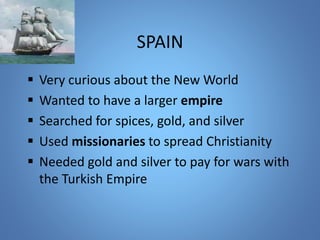
SPAIN 
 Very curious about the New World 
 Wanted to have a larger empire 
 Searched for spices, gold, and silver 
 Used missionaries to spread Christianity 
 Needed gold and silver to pay for wars with 
the Turkish Empire
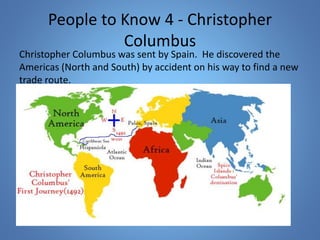
People to Know 4 - Christopher 
Columbus 
Christopher Columbus was sent by Spain. He discovered the 
Americas (North and South) by accident on his way to find a new 
trade route.
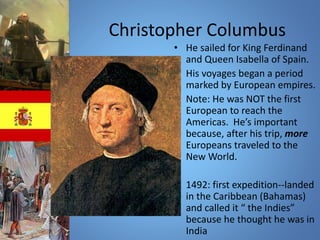
Christopher Columbus 
• He sailed for King Ferdinand 
and Queen Isabella of Spain. 
• His voyages began a period 
marked by European empires. 
• Note: He was NOT the first 
European to reach the 
Americas. He’s important 
because, after his trip, more 
Europeans traveled to the 
New World. 
• 1492: first expedition--landed 
in the Caribbean (Bahamas) 
and called it “ the Indies” 
because he thought he was in 
India
People to Know 5 - Ferdinand 
Magellan 
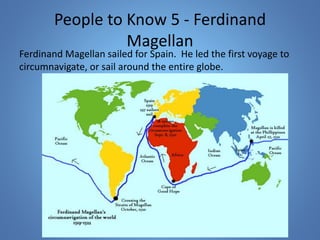
Ferdinand Magellan sailed for Spain. He led the first voyage to 
circumnavigate, or sail around the entire globe.
Conquistadors 
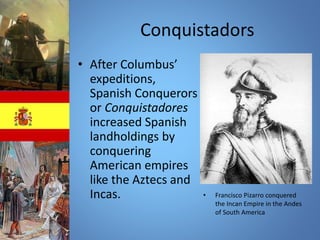
• After Columbus’ 
expeditions, 
Spanish Conquerors 
or Conquistadores 
increased Spanish 
landholdings by 
conquering 
American empires 
like the Aztecs and 
Incas. • Francisco Pizarro conquered 
the Incan Empire in the Andes 
of South America
Spain’s Empire 
 Through exploration Spain acquired a vast 
empire that contained areas of North and 
South America 
 They ruled there for hundreds of years
English Exploration 
• Rivalry between Spain and England led 
England to send English privateers (fancy word 
for pirates) to attack Spanish ships and ports, 
and steal Spanish treasure from the Americas.
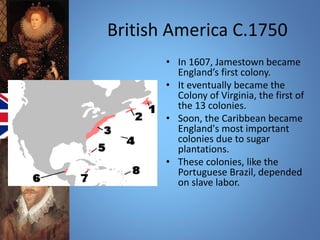
British America C.1750 
• In 1607, Jamestown became 
England’s first colony. 
• It eventually became the 
Colony of Virginia, the first of 
the 13 colonies. 
• Soon, the Caribbean became 
England's most important 
colonies due to sugar 
plantations. 
• These colonies, like the 
Portuguese Brazil, depended 
on slave labor.
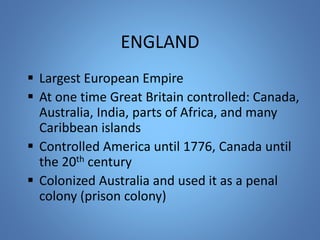
ENGLAND 
 Largest European Empire 
 At one time Great Britain controlled: Canada, 
Australia, India, parts of Africa, and many 
Caribbean islands 
 Controlled America until 1776, Canada until 
the 20th century 
 Colonized Australia and used it as a penal 
colony (prison colony)
The Sun Never Sets 
• Eventually, after colonizing parts of 
Africa and Asia, the British Empire 
became the largest empire in history. 
• At the peak of its power, it was often 
said that “The sun never sets on the 
British Empire" because it was so big 
that the sun was always shining on at 
least one of its many colonies.
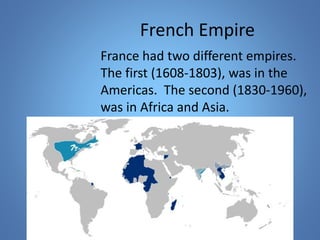
French Empire 
France had two different empires. 
The first (1608-1803), was in the 
Americas. The second (1830-1960), 
was in Africa and Asia.
• In 1608, French explorer Samuel de Champlain 
founded Quebec City in present-day Canada 
with the intention of making the area part of 
the French colonial empire. 
• Quebec’s people traded their furs for many French 
goods such as metal objects, guns, alcohol, and 
clothing. 
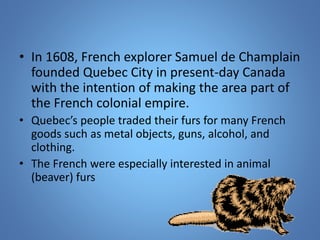
• The French were especially interested in animal 
(beaver) furs
France’s Empire 
 In 16th and 17th centuries, had colonies in 
the Indian, Pacific, and Atlantic Oceans 
 Heavy influence on parts of Canada 
(Quebec)
European Slave Trade 
• By the time Europeans arrived in Africa in 
the 15th and 16th centuries, the slave trade 
was a well-established feature in Africa. 
• It had been in place for over 500 years. 
• The Portuguese were the first Europeans to 
participate in the slave trade. 
• The Portuguese participated in the slave 
trade and created a huge market for slaves. 
• With the arrival of the Europeans and the 
demand for slaves in the Americas 
(specifically Brazil, the Caribbean, and the 
Southern United States), the slave trade 
expanded dramatically.
Results of Exploration 
• Disease – Many died of small pox and 
measles brought by Europeans 
• Spread of European Culture – Widespread 
Christianity 
• New Trade – between the “Old World” and 
the “New World”
Maybe - 15th Century Entrepreneur! 
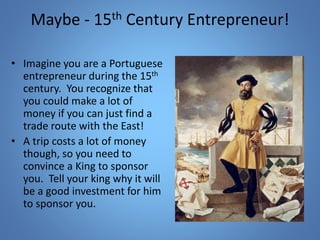
• Imagine you are a Portuguese 
entrepreneur during the 15th 
century. You recognize that 
you could make a lot of 
money if you can just find a 
trade route with the East! 
• A trip costs a lot of money 
though, so you need to 
convince a King to sponsor 
you. Tell your king why it will 
be a good investment for him 
to sponsor you.

Exploration & Colonization Presentation

  • 1.
  • 2.
    Do you knowthe answers to these questions? • Why did European exploration begin in the 15th century? • Where did Europeans want to go? • What did Europeans want from Asia? • Which European countries tried to find trade routes to Asia? • Why didn’t Western European nations trade through the Mediterranean? • Why did Western European nations search for water routes instead of land routes? • What did Europeans use the compass and astrolabe for?
  • 3.
    TRADE Find cheaper water routes to access Asian merchants – land routes blocked and more expensive Access to spices (like pepper, cinnamon, and cloves) Find places to sell goods Find natural resources NEW TECHNOLOGY The Astrolabe: An ancient Greek device used to find latitude The Compass: invented by the Chinese to help navigators find the magnetic north The cross-staff (for direction) Better ships – the caravel (Portuguese ship) and better maps RISE OF NEW NATIONS Rise in towns and trade Money for armies and navies Strong central governments, spreading Christianity Portugal, Spain, France, England PRINCE HENRY THE NAVIGATOR Portuguese Prince Paid for trips to Africa Developed trade routes to Africa Started a navigation school in southern Portugal
  • 4.
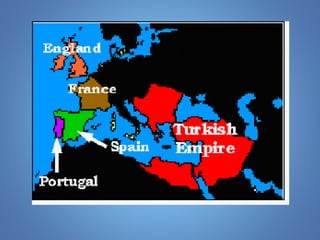
    Competition • Italyand the Muslim Turks had control over trade routes through the Mediterranean Sea and the land routes. Western Europeans had to compete with Italians and Turks for trade.
  • 5.
    Remember the 3G’s!!  God – spread of Christianity  Gold – to trade and become wealthy (gold and spices)  Glory – explorers were seen as heroes if they discovered new lands
  • 6.
    Vocabulary • Exploration:people leaving home to see new places and returning to tell their home countries • Colonization: people leaving home to start a new community and life by taking over another part of the world • Imperialism: a country gets many colonies and builds an empire where they completely control other parts of the world.
  • 7.
    Colony and Market • A “colony” is a land or region controlled by a foreign power. – Example: Britain established colonies in the Americas. • A “market” is a geographic region in which things may be sold. – Example: America is a market for Chinese goods because we buy goods from China.
  • 8.
    Colony or Market? • Jamestown was under the laws of England even though it was located in the Americas. • Canada buys goods from the United States. • In the 16th century, Spain conquered Peru. They made Spanish the official language there. • China began to trade with Europe through the Silk Road.
  • 9.
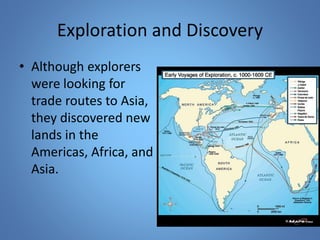
    Exploration and Discovery • Although explorers were looking for trade routes to Asia, they discovered new lands in the Americas, Africa, and Asia.
  • 10.
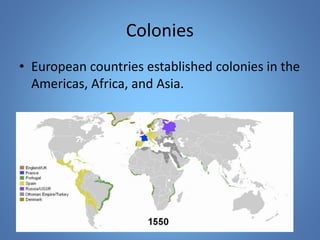
    Colonies • Europeancountries established colonies in the Americas, Africa, and Asia.
  • 13.
    Process of Colonization Trade • Europeans sent explorers to find trade routes to the East Discovery • Explorers found new lands. Colonization • Europe established colonies in new lands.
  • 14.
    What were thebenefits of establishing colonies?
  • 15.
    Imports • Coloniesprovided raw materials to European countries. (Raw materials are natural materials like gold, silver, ivory, silk, sugar, and spices.)
  • 16.
    Exports • Coloniesbought goods from the home country. In other words… • Colonies became markets for European goods.
  • 17.
    Competition for Colonies • Western European countries competed with each other to control as many colonies as possible.
  • 18.
    A Time ofExploration and Discovery  The 1400s were a time of discovery and exploration for Europe.  Main countries involved in exploration:  Portugal  Spain  England  France
  • 19.
    PORTUGAL  1stEuropeans to explore the unknown New World  1st to sail around the tip of Africa to Asia  Also wanted to spread Christianity and to stop the expanding Muslim empire  Mainly explored what is now Brazil in the New World--this is why Brazilian culture today is heavily influenced by Portugal
  • 20.
    People to know1 - Prince Henry the Navigator • Portuguese Prince • Started a navigation school in southern Portugal • Paid for exhibitions (trips) to Africa • Developed trade routes to Africa • Employed mapmakers to make detailed maps, ship makers made the caravel
  • 21.
    People to Know2 - Bartholomew Dias Bartholomew Dias was a Portuguese explorer who was the first to sail around the Cape of Good Hope in South Africa.
  • 22.
    People to Know3 - Vasco da Gama Vasco da Gama was a Portuguese explorer who sailed around the Cape of Good Hope and made it to the coast of India. Da Gama established the first water trade route with Europe and Asia.
  • 23.
    SPAIN  Verycurious about the New World  Wanted to have a larger empire  Searched for spices, gold, and silver  Used missionaries to spread Christianity  Needed gold and silver to pay for wars with the Turkish Empire
  • 24.
    People to Know4 - Christopher Columbus Christopher Columbus was sent by Spain. He discovered the Americas (North and South) by accident on his way to find a new trade route.
  • 25.
    Christopher Columbus •He sailed for King Ferdinand and Queen Isabella of Spain. • His voyages began a period marked by European empires. • Note: He was NOT the first European to reach the Americas. He’s important because, after his trip, more Europeans traveled to the New World. • 1492: first expedition--landed in the Caribbean (Bahamas) and called it “ the Indies” because he thought he was in India
  • 26.
    People to Know5 - Ferdinand Magellan Ferdinand Magellan sailed for Spain. He led the first voyage to circumnavigate, or sail around the entire globe.
  • 27.
    Conquistadors • AfterColumbus’ expeditions, Spanish Conquerors or Conquistadores increased Spanish landholdings by conquering American empires like the Aztecs and Incas. • Francisco Pizarro conquered the Incan Empire in the Andes of South America
  • 28.
    Spain’s Empire Through exploration Spain acquired a vast empire that contained areas of North and South America  They ruled there for hundreds of years
  • 29.
    English Exploration •Rivalry between Spain and England led England to send English privateers (fancy word for pirates) to attack Spanish ships and ports, and steal Spanish treasure from the Americas.
  • 30.
    British America C.1750 • In 1607, Jamestown became England’s first colony. • It eventually became the Colony of Virginia, the first of the 13 colonies. • Soon, the Caribbean became England's most important colonies due to sugar plantations. • These colonies, like the Portuguese Brazil, depended on slave labor.
  • 31.
    ENGLAND  LargestEuropean Empire  At one time Great Britain controlled: Canada, Australia, India, parts of Africa, and many Caribbean islands  Controlled America until 1776, Canada until the 20th century  Colonized Australia and used it as a penal colony (prison colony)
  • 32.
    The Sun NeverSets • Eventually, after colonizing parts of Africa and Asia, the British Empire became the largest empire in history. • At the peak of its power, it was often said that “The sun never sets on the British Empire" because it was so big that the sun was always shining on at least one of its many colonies.
  • 33.
    French Empire Francehad two different empires. The first (1608-1803), was in the Americas. The second (1830-1960), was in Africa and Asia.
  • 34.
    • In 1608,French explorer Samuel de Champlain founded Quebec City in present-day Canada with the intention of making the area part of the French colonial empire. • Quebec’s people traded their furs for many French goods such as metal objects, guns, alcohol, and clothing. • The French were especially interested in animal (beaver) furs
  • 35.
    France’s Empire In 16th and 17th centuries, had colonies in the Indian, Pacific, and Atlantic Oceans  Heavy influence on parts of Canada (Quebec)
  • 36.
    European Slave Trade • By the time Europeans arrived in Africa in the 15th and 16th centuries, the slave trade was a well-established feature in Africa. • It had been in place for over 500 years. • The Portuguese were the first Europeans to participate in the slave trade. • The Portuguese participated in the slave trade and created a huge market for slaves. • With the arrival of the Europeans and the demand for slaves in the Americas (specifically Brazil, the Caribbean, and the Southern United States), the slave trade expanded dramatically.
  • 37.
    Results of Exploration • Disease – Many died of small pox and measles brought by Europeans • Spread of European Culture – Widespread Christianity • New Trade – between the “Old World” and the “New World”
  • 38.
    Maybe - 15thCentury Entrepreneur! • Imagine you are a Portuguese entrepreneur during the 15th century. You recognize that you could make a lot of money if you can just find a trade route with the East! • A trip costs a lot of money though, so you need to convince a King to sponsor you. Tell your king why it will be a good investment for him to sponsor you.