Ways of Acquiring Knowledge and Solving Problems
Learning Objectives:Learning Objectives:
Identify the component of an investigatory
process.
Describe what is meant by fair test.
Recognize that the design of an
investigation should show fair testing.
Something to Ponder…
“The formulation of the problem is
often more essential than its
solution, which may be merely a
matter of mathematical or
experimental skill.”
Albert Einstein
Biblical Integration…
“A simple man believes
anything, but a prudent man
gives thought to his steps.”
Proverbs 14:13
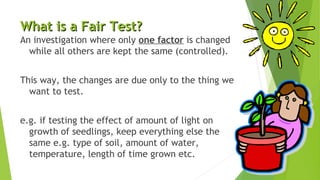
What is a Fair Test?What is a Fair Test?
An investigation where only one factor is changed
while all others are kept the same (controlled).
This way, the changes are due only to the thing we
want to test.
e.g. if testing the effect of amount of light on
growth of seedlings, keep everything else the
same e.g. type of soil, amount of water,
temperature, length of time grown etc.
Variables
The things that can change in an experiment are
called variables.
e.g. in the seedling experiment, variables were
amount of light, amount of water, temp, soil type….
There are different
types of variables in a fair test:
 Independent variable: the thing that is
changed on purpose
 Dependent variable: the thing that is
measured
 Controlled variables: all other changeable
factors that must be kept the same to
ensure a fair test
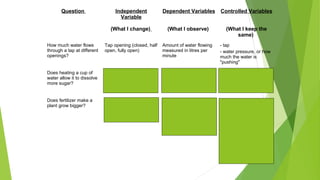
Question Independent
Variable
(What I change)
Dependent Variables
(What I observe)
Controlled Variables
(What I keep the
same)
How much water flows
through a tap at different
openings?
Tap opening (closed, half
open, fully open)
Amount of water flowing
measured in litres per
minute
- tap
- water pressure, or how
much the water is
"pushing"
Does heating a cup of
water allow it to dissolve
more sugar?
Temperature of the water
measured in degrees
Centigrade
Amount of sugar that
dissolves completely
measured in grams
- stirring
- type of sugar
Does fertilizer make a
plant grow bigger?
Amount of fertilizer
measured in grams
Growth of the plant
measured by its height
AND / OR
Growth of the plant
measured by the number
of leaves
•Same size pot for each
plant
•Same type of plant in
each pot
•Same type and amount
of soil in each pot
•Same amount of water
and light
•Make measurements of
growth for each plant at
the same time
COMPONENTS OF AN INVESTIGATORY
PROCESS
Research problem
Gathering Preliminary Data
Formulating the Hypothesis
Testing the Hypothesis
Analysing the Data
Drawing Conclusion
Writing the Research Report
Doing an Investigatory Project
 Thinking about a practical problem motivates a research question which
defines a research problem which finds a research answer which helps to
solve the practical problem.
 A question raised for inquiry, consideration or solution.
 Statement about an area of concern
 Condition to be improved
 Difficulty to be eliminated, or a troubling question that exists
 Points to the need for meaningful understanding and deliberate
investigation.
 Does not specifically state how to do something
 Does not offer a vague or broad proposition
 Does not present a bias statement/question.
 “The greatest challenge to any thinker is stating the problem in a way
that will allow a solution.” –Bertrand Russell British author, mathematician, & philosopher (1872 -
1970)
Specific, Measurable, Attainable, Relevant, and Time-based
 The necessity to be prepared before heading to the field!
 Find out about what you want to investigate. Read books, articles,
journals, magazines or ask professionals to learn about the effect
or area of study. Keep track of where you got your information
from.
 Data-collection methods are the identification of the broad
problem area, preliminary information gathering, especially
through unstructured and structured interviews and literature
survey and problem definition.
 Formulating a hypothesis or educated guess helps by
defining an initial explanation to be tested in the
research process.
 Suggest a causal relationship involve at least one
independent variable and at least one dependent
variable; in other words, one variable which is presumed
to affect the other.
 Null hypothesis vs. Alternative hypothesis
 It is expressed verbally or in writing and states a theory
regarding an if-blank-then-blank situation.
 Understand the scope of study: while a hypothesis is
usually used for studying the sciences, it is not limited to
those disciplines.
 Design an experiment to test each hypothesis. Make a
step-by-step list of what you will do to answer each
question. This list is called an experimental procedure or
specific aims.
 Variables- things that can change in an experiment are
called variables.
 Independent variable: the thing that is changed on
purpose (what you change for a purpose)
 Dependent variable: the thing that is measured (what
you observe for occurrences of changes)
 Controlled variables: all other changeable factors that
must be kept the same to ensure a fair test (what you
keep the same)
 Interpreting the meaning of the data we have collected,
organized
 Displayed in the form of a table, bar chart, line graph, or
other representation.
 Looking for patterns—similarities, disparities, trends, and
other relationships—and thinking about what these
patterns might mean.
 The ability to make inferences and predictions based on
data is a critical skill students need to develop.
 Using the trends in your experimental data and your experimental observations, try to answer
your original questions. Is your hypothesis correct? Now is the time to pull together what
happened, and assess the experiments you did. Other things you can mention in the conclusion:
 If your hypothesis is not correct, what could be the answer to your question?
 Summarize any difficulties or problems you had doing the experiment.
 Do you need to change the procedure and repeat your experiment?
 What would you do different next time?
 List other things you learned
 Aim is to write clearly and concisely about your research topic so
that the reader can easily understand the purpose and results of
your research.
 General framework:
 Introduction
 Background of the Study
 Statement of the Problem
 Significance of the Study
 Scope and Limitation of the Study
 Review of Literature and Conceptual Framework
 Review of Literature
 Conceptual Framework
 Hypothesis
 Definition of Terms
 Methodology
 Results and Findings
 Summary, Conclusion and Recommendation
SAMPLE 1
SAMPLE 2
FORMAT
 Content
 Apply/demonstrate scientific principles or attempt to provide new
knowledge
 Be a result of continuing or parallel scientific research and
investigation & not a copy of any previous research;
 Have socio-economic significance and relevance to livelihood
development; and
 Contribute to the advancement of S&T and the development of the
community.
 Physical Set-up/Visual Display
 Attractive and informative.
 Interested spectators and judges should easily asses the study and
the results obtained.
 Use clear and concise displays.
 Make headings stand-out, draw graphs and diagrams clearly and
label them correctly.
 A one-page project abstract must be posted in one corner of the
booth. Be sure to adhere to the size limitations and safety rules
when preparing the display.
TRY THIS!
CHANGE ONLY ONE FACTOR AND KEEP OTHERS THE SAMECHANGE ONLY ONE FACTOR AND KEEP OTHERS THE SAME
SYSTEMATIC WAY OF ACQUIRING KNOWLEDGESYSTEMATIC WAY OF ACQUIRING KNOWLEDGE
QUESTION RAISED FOR INQUIRY AND STUDYQUESTION RAISED FOR INQUIRY AND STUDY
REFERRING TO WORKS DONE BY EXPERTSREFERRING TO WORKS DONE BY EXPERTS
EDUCATED GUESSEDUCATED GUESS
A FACTOR CHANGED FOR AN EXPERIMENTAL PURPOSEA FACTOR CHANGED FOR AN EXPERIMENTAL PURPOSE
TRY THIS!
INTERPRETING THE MEANING OF DATA COLLECTEDINTERPRETING THE MEANING OF DATA COLLECTED
COMPOSED OF DIFFERENT CHAPTERSCOMPOSED OF DIFFERENT CHAPTERS
FACTOR OBSERVED FOR OCCURENCES OF CHANGE/SFACTOR OBSERVED FOR OCCURENCES OF CHANGE/S
THE STANDARD FACTOR IN AN EXPERIMENTTHE STANDARD FACTOR IN AN EXPERIMENT
A PLANNED RESEARCH ACTIVITYA PLANNED RESEARCH ACTIVITY
STATEMENT THAT APPROVE OR DISPROVE THE HYPOTHESISSTATEMENT THAT APPROVE OR DISPROVE THE HYPOTHESIS
TRY THIS!
ACTION DONE TO BE PREPARED FOR THE RESEARCHACTION DONE TO BE PREPARED FOR THE RESEARCH
ACTIVITYACTIVITY
ACTION DONE TO TEST THE HYPOTHESISACTION DONE TO TEST THE HYPOTHESIS
PART OF RESEARCH REPORT WHERE EXPERIMENTALPART OF RESEARCH REPORT WHERE EXPERIMENTAL
PROCEDURES ARE FOUNDPROCEDURES ARE FOUND
TEST RESULTS CAN BE COMPARED WITHTEST RESULTS CAN BE COMPARED WITH
ORGANIZERS USED PRIOR TO DESCRIPTIVE ANALYSIS OFORGANIZERS USED PRIOR TO DESCRIPTIVE ANALYSIS OF
DATADATA
PART OF RESEARCH REPORT WHERE THE POSSIBLEPART OF RESEARCH REPORT WHERE THE POSSIBLE
COVERAGE AREA AND LIMITS ARE MADE MENTIONCOVERAGE AREA AND LIMITS ARE MADE MENTION

The investigatory process

  • 1.
    Ways of AcquiringKnowledge and Solving Problems
  • 2.
    Learning Objectives:Learning Objectives: Identifythe component of an investigatory process. Describe what is meant by fair test. Recognize that the design of an investigation should show fair testing.
  • 3.
    Something to Ponder… “Theformulation of the problem is often more essential than its solution, which may be merely a matter of mathematical or experimental skill.” Albert Einstein
  • 4.
    Biblical Integration… “A simpleman believes anything, but a prudent man gives thought to his steps.” Proverbs 14:13
  • 5.
    What is aFair Test?What is a Fair Test? An investigation where only one factor is changed while all others are kept the same (controlled). This way, the changes are due only to the thing we want to test. e.g. if testing the effect of amount of light on growth of seedlings, keep everything else the same e.g. type of soil, amount of water, temperature, length of time grown etc.
  • 6.
    Variables The things thatcan change in an experiment are called variables. e.g. in the seedling experiment, variables were amount of light, amount of water, temp, soil type….
  • 7.
    There are different typesof variables in a fair test:  Independent variable: the thing that is changed on purpose  Dependent variable: the thing that is measured  Controlled variables: all other changeable factors that must be kept the same to ensure a fair test
  • 8.
    Question Independent Variable (What Ichange) Dependent Variables (What I observe) Controlled Variables (What I keep the same) How much water flows through a tap at different openings? Tap opening (closed, half open, fully open) Amount of water flowing measured in litres per minute - tap - water pressure, or how much the water is "pushing" Does heating a cup of water allow it to dissolve more sugar? Temperature of the water measured in degrees Centigrade Amount of sugar that dissolves completely measured in grams - stirring - type of sugar Does fertilizer make a plant grow bigger? Amount of fertilizer measured in grams Growth of the plant measured by its height AND / OR Growth of the plant measured by the number of leaves •Same size pot for each plant •Same type of plant in each pot •Same type and amount of soil in each pot •Same amount of water and light •Make measurements of growth for each plant at the same time
  • 9.
    COMPONENTS OF ANINVESTIGATORY PROCESS Research problem Gathering Preliminary Data Formulating the Hypothesis Testing the Hypothesis Analysing the Data Drawing Conclusion Writing the Research Report Doing an Investigatory Project
  • 10.
     Thinking abouta practical problem motivates a research question which defines a research problem which finds a research answer which helps to solve the practical problem.  A question raised for inquiry, consideration or solution.  Statement about an area of concern  Condition to be improved  Difficulty to be eliminated, or a troubling question that exists  Points to the need for meaningful understanding and deliberate investigation.  Does not specifically state how to do something  Does not offer a vague or broad proposition  Does not present a bias statement/question.  “The greatest challenge to any thinker is stating the problem in a way that will allow a solution.” –Bertrand Russell British author, mathematician, & philosopher (1872 - 1970) Specific, Measurable, Attainable, Relevant, and Time-based
  • 11.
     The necessityto be prepared before heading to the field!  Find out about what you want to investigate. Read books, articles, journals, magazines or ask professionals to learn about the effect or area of study. Keep track of where you got your information from.  Data-collection methods are the identification of the broad problem area, preliminary information gathering, especially through unstructured and structured interviews and literature survey and problem definition.
  • 12.
     Formulating ahypothesis or educated guess helps by defining an initial explanation to be tested in the research process.  Suggest a causal relationship involve at least one independent variable and at least one dependent variable; in other words, one variable which is presumed to affect the other.  Null hypothesis vs. Alternative hypothesis  It is expressed verbally or in writing and states a theory regarding an if-blank-then-blank situation.  Understand the scope of study: while a hypothesis is usually used for studying the sciences, it is not limited to those disciplines.
  • 13.
     Design anexperiment to test each hypothesis. Make a step-by-step list of what you will do to answer each question. This list is called an experimental procedure or specific aims.  Variables- things that can change in an experiment are called variables.  Independent variable: the thing that is changed on purpose (what you change for a purpose)  Dependent variable: the thing that is measured (what you observe for occurrences of changes)  Controlled variables: all other changeable factors that must be kept the same to ensure a fair test (what you keep the same)
  • 14.
     Interpreting themeaning of the data we have collected, organized  Displayed in the form of a table, bar chart, line graph, or other representation.  Looking for patterns—similarities, disparities, trends, and other relationships—and thinking about what these patterns might mean.  The ability to make inferences and predictions based on data is a critical skill students need to develop.
  • 15.
     Using thetrends in your experimental data and your experimental observations, try to answer your original questions. Is your hypothesis correct? Now is the time to pull together what happened, and assess the experiments you did. Other things you can mention in the conclusion:  If your hypothesis is not correct, what could be the answer to your question?  Summarize any difficulties or problems you had doing the experiment.  Do you need to change the procedure and repeat your experiment?  What would you do different next time?  List other things you learned
  • 16.
     Aim isto write clearly and concisely about your research topic so that the reader can easily understand the purpose and results of your research.  General framework:  Introduction  Background of the Study  Statement of the Problem  Significance of the Study  Scope and Limitation of the Study  Review of Literature and Conceptual Framework  Review of Literature  Conceptual Framework  Hypothesis  Definition of Terms  Methodology  Results and Findings  Summary, Conclusion and Recommendation SAMPLE 1 SAMPLE 2 FORMAT
  • 17.
     Content  Apply/demonstratescientific principles or attempt to provide new knowledge  Be a result of continuing or parallel scientific research and investigation & not a copy of any previous research;  Have socio-economic significance and relevance to livelihood development; and  Contribute to the advancement of S&T and the development of the community.  Physical Set-up/Visual Display  Attractive and informative.  Interested spectators and judges should easily asses the study and the results obtained.  Use clear and concise displays.  Make headings stand-out, draw graphs and diagrams clearly and label them correctly.  A one-page project abstract must be posted in one corner of the booth. Be sure to adhere to the size limitations and safety rules when preparing the display.
  • 18.
    TRY THIS! CHANGE ONLYONE FACTOR AND KEEP OTHERS THE SAMECHANGE ONLY ONE FACTOR AND KEEP OTHERS THE SAME SYSTEMATIC WAY OF ACQUIRING KNOWLEDGESYSTEMATIC WAY OF ACQUIRING KNOWLEDGE QUESTION RAISED FOR INQUIRY AND STUDYQUESTION RAISED FOR INQUIRY AND STUDY REFERRING TO WORKS DONE BY EXPERTSREFERRING TO WORKS DONE BY EXPERTS EDUCATED GUESSEDUCATED GUESS A FACTOR CHANGED FOR AN EXPERIMENTAL PURPOSEA FACTOR CHANGED FOR AN EXPERIMENTAL PURPOSE
  • 19.
    TRY THIS! INTERPRETING THEMEANING OF DATA COLLECTEDINTERPRETING THE MEANING OF DATA COLLECTED COMPOSED OF DIFFERENT CHAPTERSCOMPOSED OF DIFFERENT CHAPTERS FACTOR OBSERVED FOR OCCURENCES OF CHANGE/SFACTOR OBSERVED FOR OCCURENCES OF CHANGE/S THE STANDARD FACTOR IN AN EXPERIMENTTHE STANDARD FACTOR IN AN EXPERIMENT A PLANNED RESEARCH ACTIVITYA PLANNED RESEARCH ACTIVITY STATEMENT THAT APPROVE OR DISPROVE THE HYPOTHESISSTATEMENT THAT APPROVE OR DISPROVE THE HYPOTHESIS
  • 20.
    TRY THIS! ACTION DONETO BE PREPARED FOR THE RESEARCHACTION DONE TO BE PREPARED FOR THE RESEARCH ACTIVITYACTIVITY ACTION DONE TO TEST THE HYPOTHESISACTION DONE TO TEST THE HYPOTHESIS PART OF RESEARCH REPORT WHERE EXPERIMENTALPART OF RESEARCH REPORT WHERE EXPERIMENTAL PROCEDURES ARE FOUNDPROCEDURES ARE FOUND TEST RESULTS CAN BE COMPARED WITHTEST RESULTS CAN BE COMPARED WITH ORGANIZERS USED PRIOR TO DESCRIPTIVE ANALYSIS OFORGANIZERS USED PRIOR TO DESCRIPTIVE ANALYSIS OF DATADATA PART OF RESEARCH REPORT WHERE THE POSSIBLEPART OF RESEARCH REPORT WHERE THE POSSIBLE COVERAGE AREA AND LIMITS ARE MADE MENTIONCOVERAGE AREA AND LIMITS ARE MADE MENTION