Teaching
Children
To Think
      Tony Ryan
  Learning Consultant
tony@tonyryan.com.au
This is a condensed
version of a workshop
that I offer to teachers
   around the world.


      These strategies can just as easily be used
       by parents; and by trainers / presenters
            who work with adult groups!
Four Key
                               Approaches To
   1. Develop positive        Teaching Kids To
dispositions for thinking
       and learning                Think

                     2. Generate the highest levels
                        of intellectual rigour and
                                  inquiry

 3. Combine proven frameworks,
with practical strategies that are in
              context

                  4. Enhance thinking with ICT
Develop positive
dispositions for
 thinking and
    learning
Positive dispositions for
 thinking and learning??
•   Skills are not enough. A disposition for wanting / needing to
    think is critical. Make thinking spicy!

•   Generate an enthusiasm for intellectual play and curiosity

•   Encourage explicit and direct reasoning

•   Give children time to think

•   Show them how to plan ahead and get organised

•   Help them to study the brain at both a physiological and
    psychological level
Teach students to self-talk
• Self-talk is a specific awareness of their own
  thinking
• For children, begin with an explicit lesson
• Write up words such as: “I’m a legend”
• Then ask them to self-talk those words, without
  any sound or without moving their lips
• Encourage them to do this self-talk when they are
  working on a mental task
Student Passions??!
•   Have you asked every one of your children
    about their passions in life?
•   What are the Big Three interests for the age
    group you’re teaching this year?
•   Where and how do you compile data about
    their interests?
•   Where specifically do you build those interests
    into the classroom environment?
Generate the
 highest levels of
intellectual rigour
    and inquiry
Here is a powerful process for developing an
     intellectually stimulating question

          It’s called the ‘Intellectual
                 Rubber Band’

1. Brainstorm the hardest question in
the world about the topic being studied
2. Now adjust it downwards until it can
be used with your class
Engage children
     in constant
    inquiry - get
        them
     wondering!


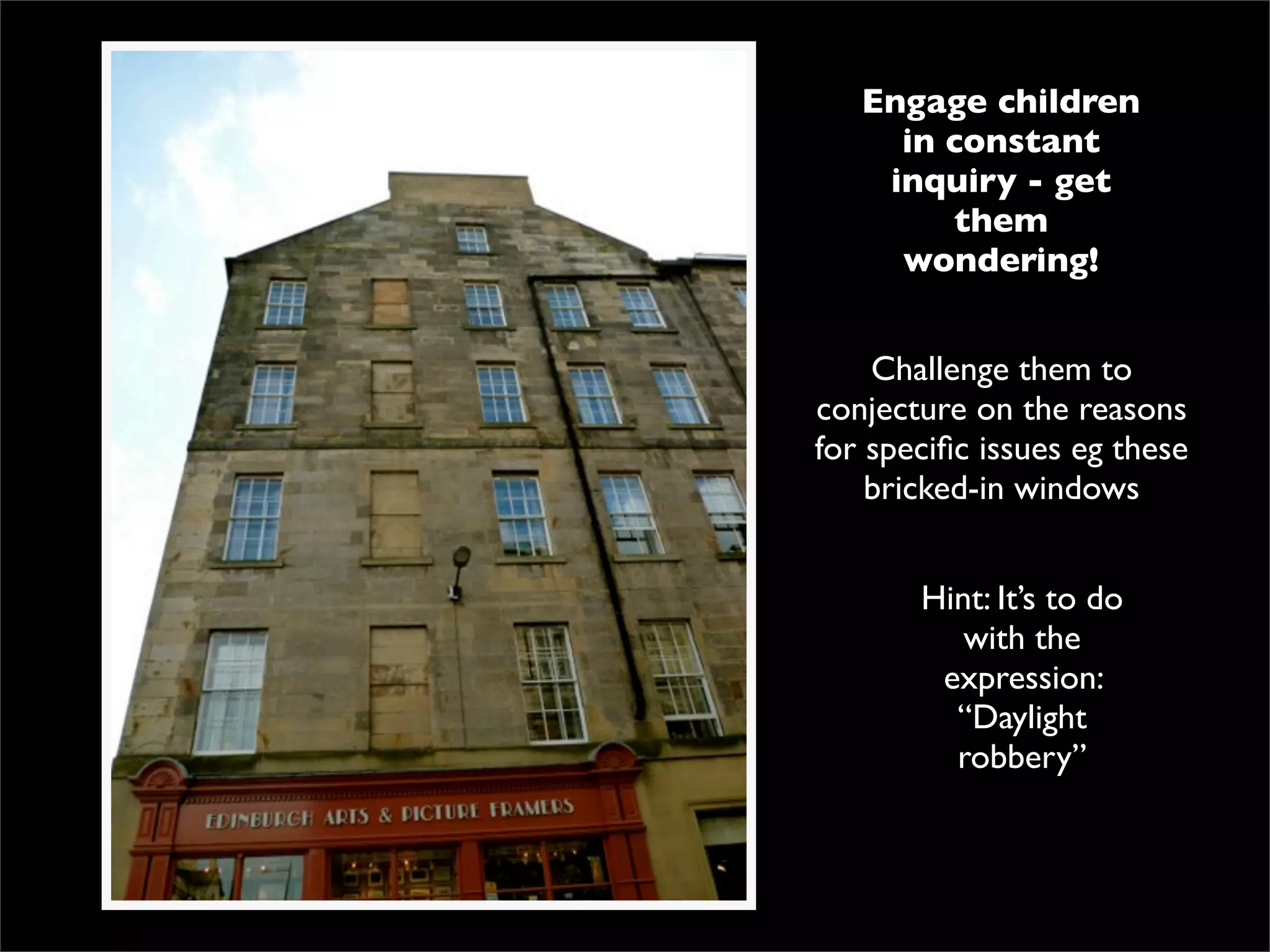
    Challenge them to
conjecture on the reasons
for specific issues eg these
    bricked-in windows


       Hint: It’s to do
          with the
        expression:
         “Daylight
         robbery”
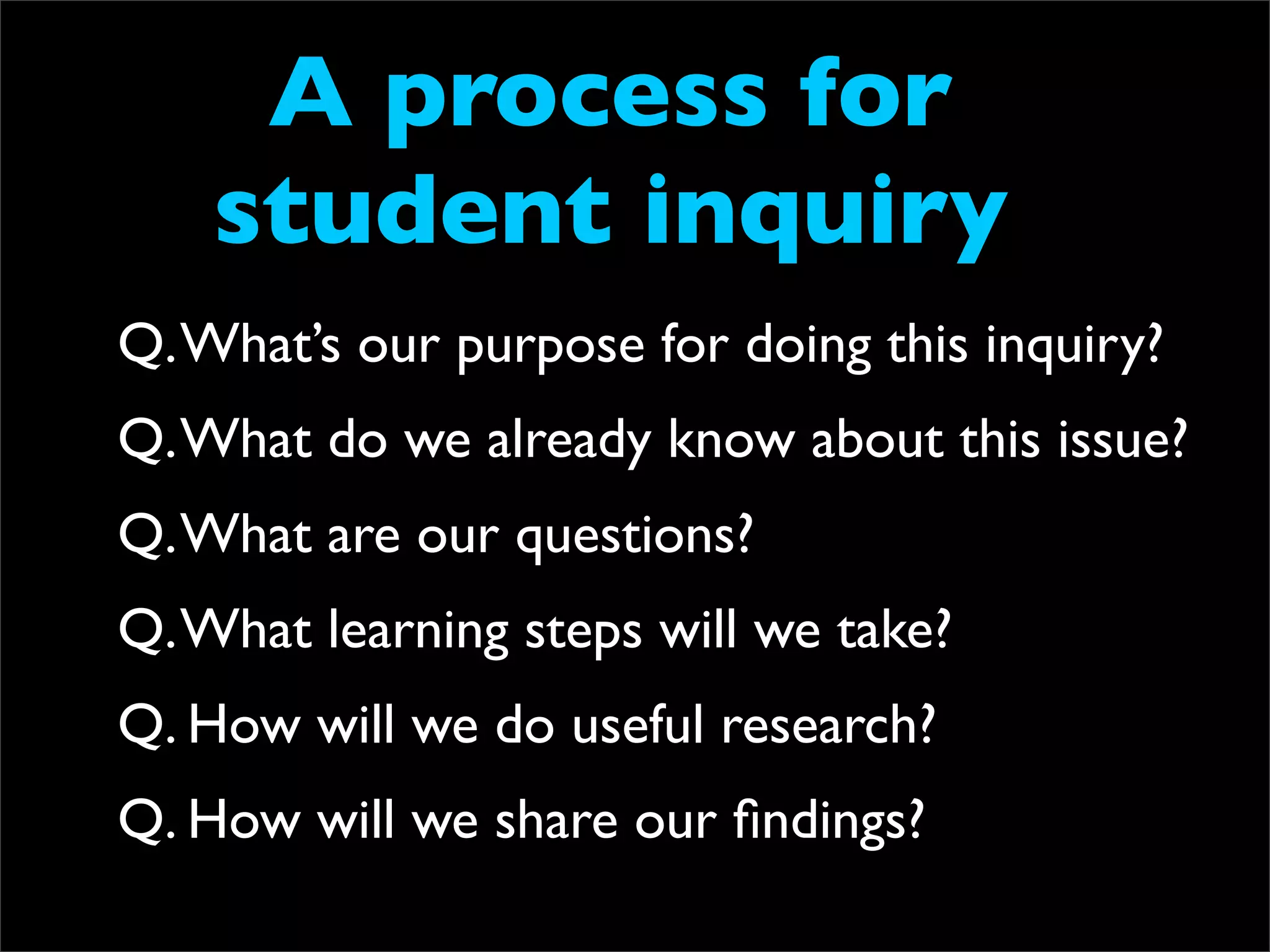
A process for
    student inquiry
Q. What’s our purpose for doing this inquiry?
Q. What do we already know about this issue?
Q. What are our questions?
Q. What learning steps will we take?
Q. How will we do useful research?
Q. How will we share our findings?
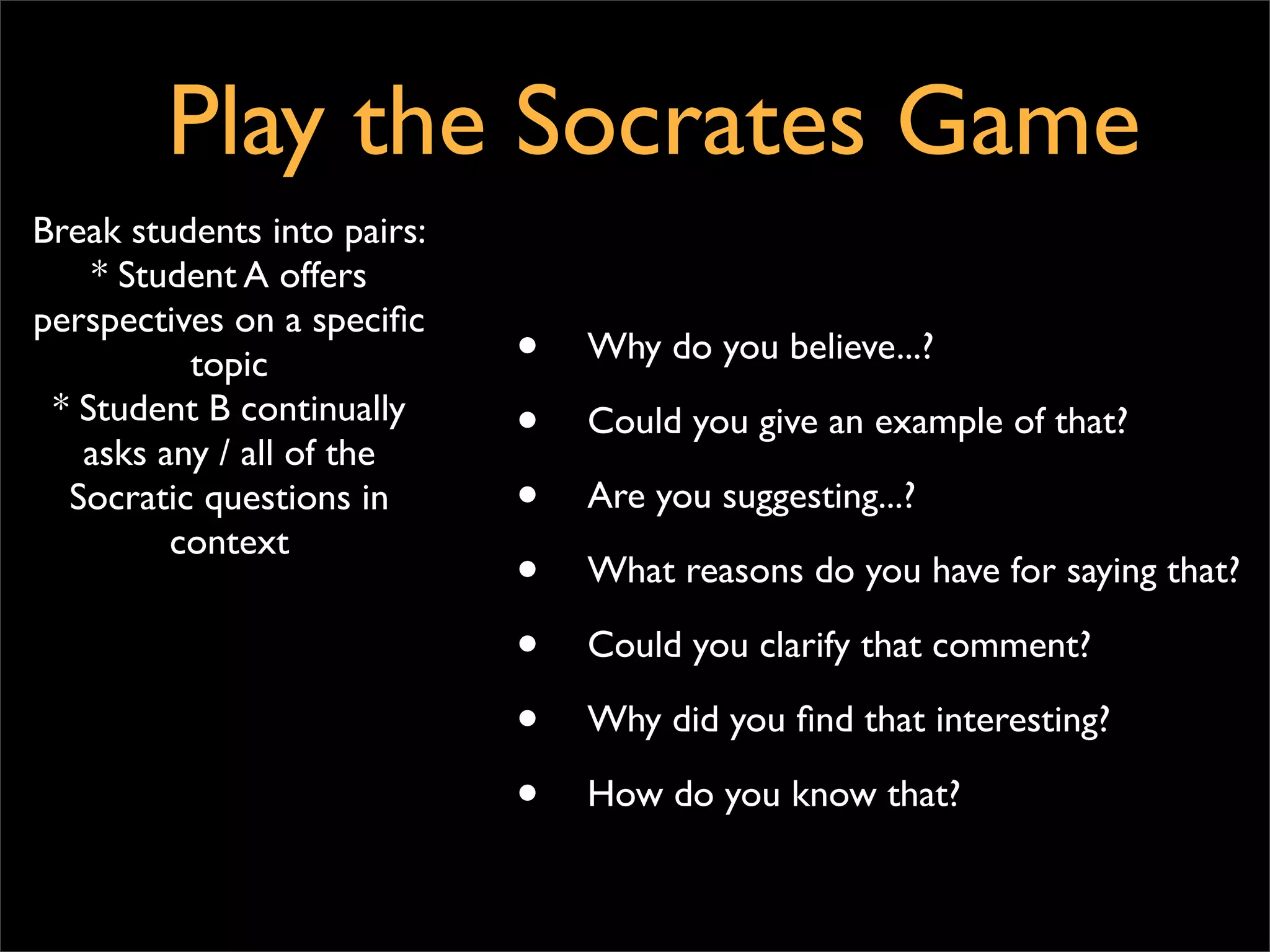
Play the Socrates Game
Break students into pairs:
    * Student A offers
perspectives on a specific
          topic              •   Why do you believe...?
 * Student B continually
   asks any / all of the
                             •   Could you give an example of that?

  Socratic questions in      •   Are you suggesting...?
         context
                             •   What reasons do you have for saying that?

                             •   Could you clarify that comment?

                             •   Why did you find that interesting?

                             •   How do you know that?
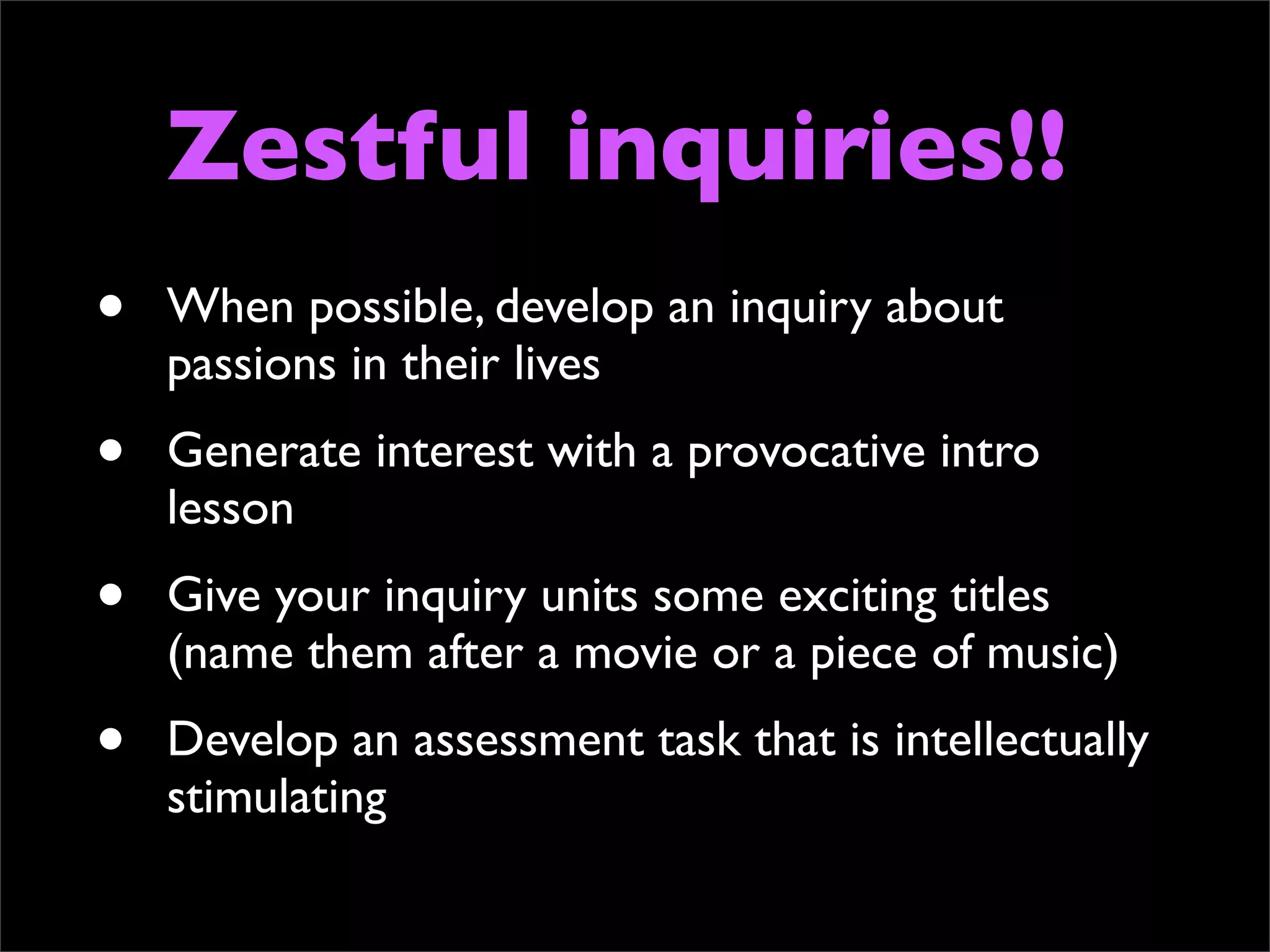
Zestful inquiries!!
•   When possible, develop an inquiry about
    passions in their lives
•   Generate interest with a provocative intro
    lesson
•   Give your inquiry units some exciting titles
    (name them after a movie or a piece of music)
•   Develop an assessment task that is intellectually
    stimulating
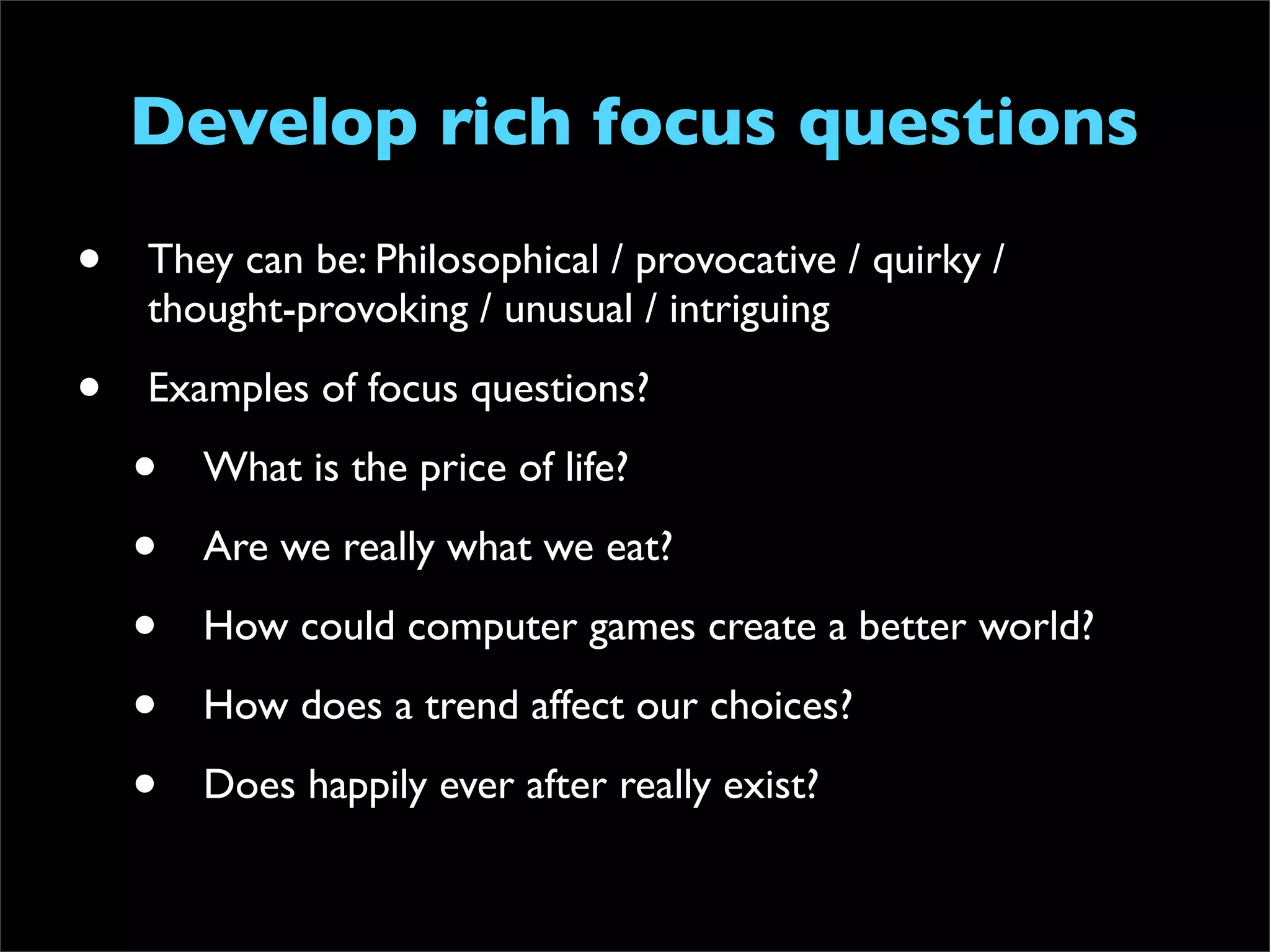
Develop rich focus questions
•   They can be: Philosophical / provocative / quirky /
    thought-provoking / unusual / intriguing

•   Examples of focus questions?

    •   What is the price of life?

    •   Are we really what we eat?

    •   How could computer games create a better world?

    •   How does a trend affect our choices?

    •   Does happily ever after really exist?
Combine
    proven
frameworks,
with practical
  strategies
 that are in
   context
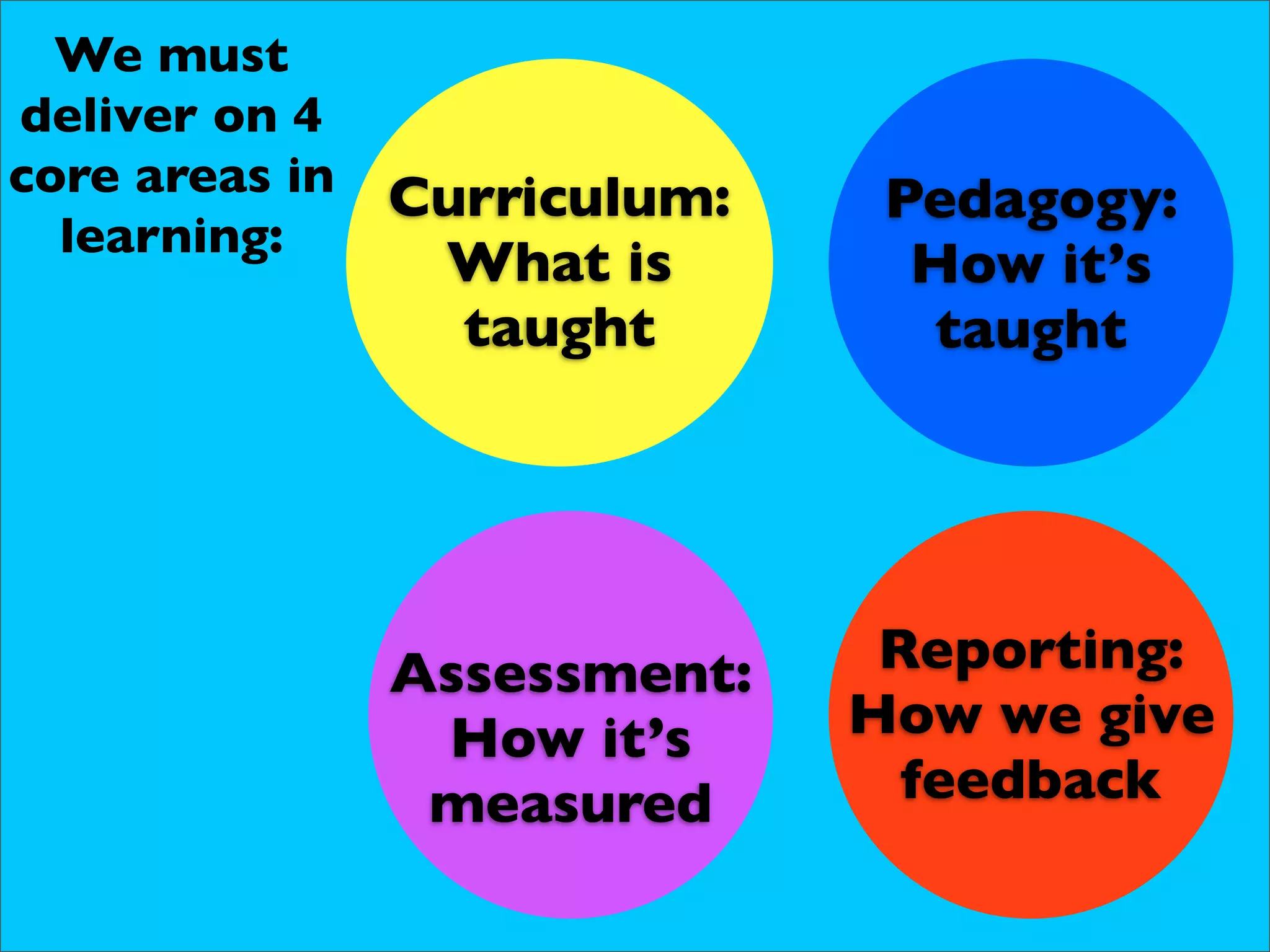
We must
deliver on 4


                                   Educational delivery mechanisms
core areas in   Curriculum:    Pedagogy:
  learning:
                 What is        How it’s
                  taught        taught


                Assessment:    Reporting:
                 How it’s     How we give
                 measured       feedback
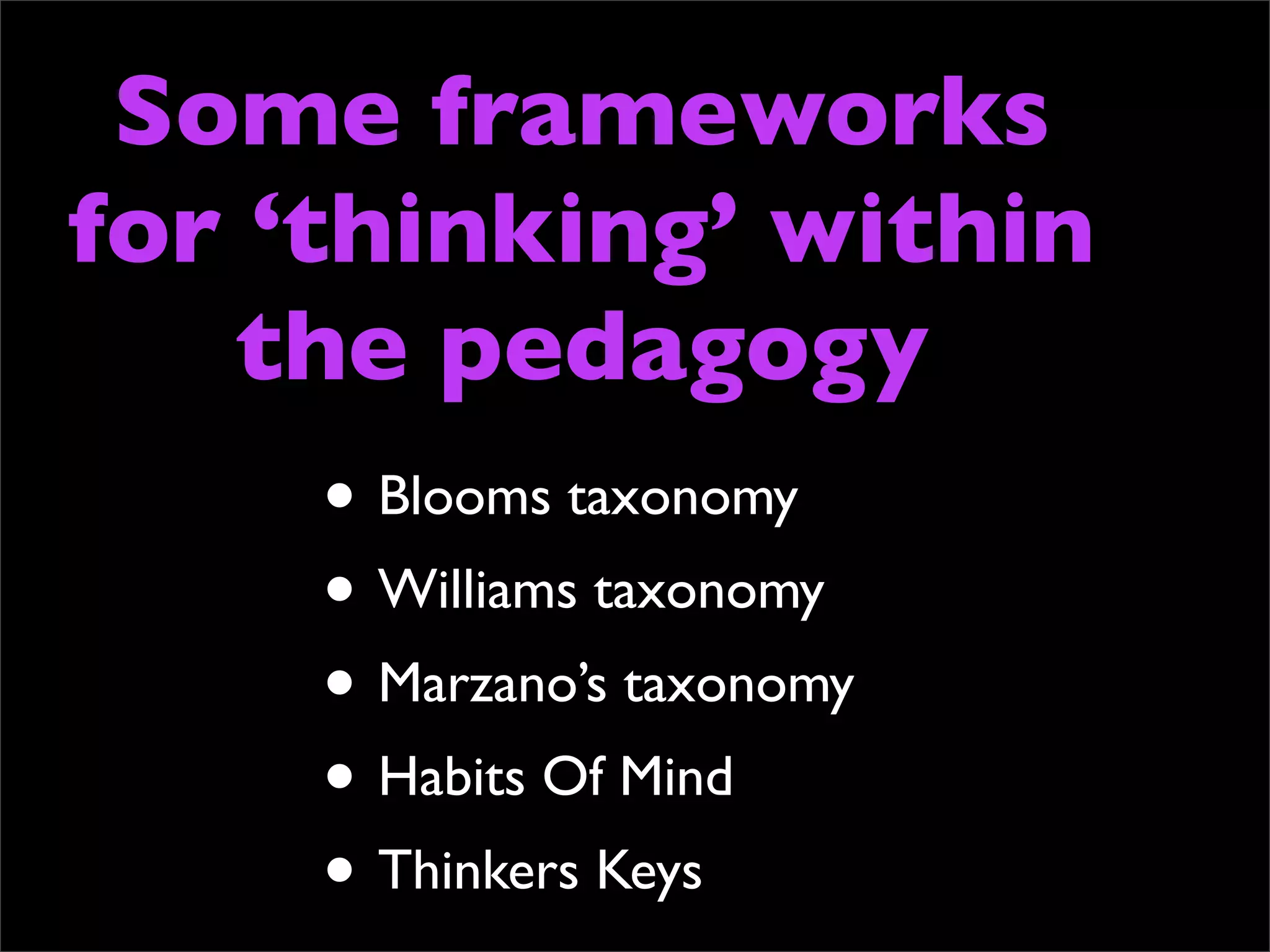
Some frameworks
for ‘thinking’ within
   the pedagogy
      • Blooms taxonomy
      • Williams taxonomy
      • Marzano’s taxonomy
      • Habits Of Mind
      • Thinkers Keys
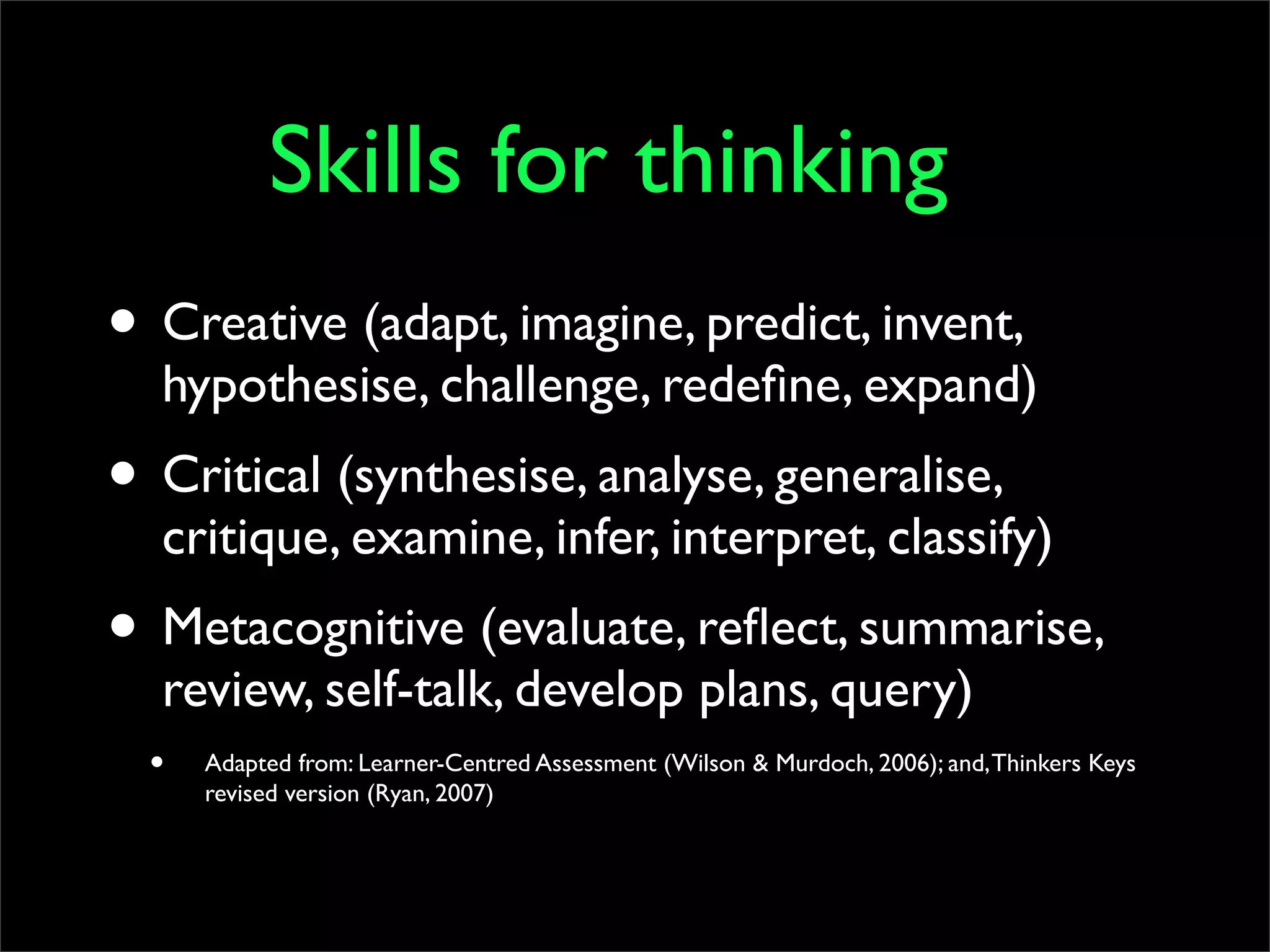
Skills for thinking
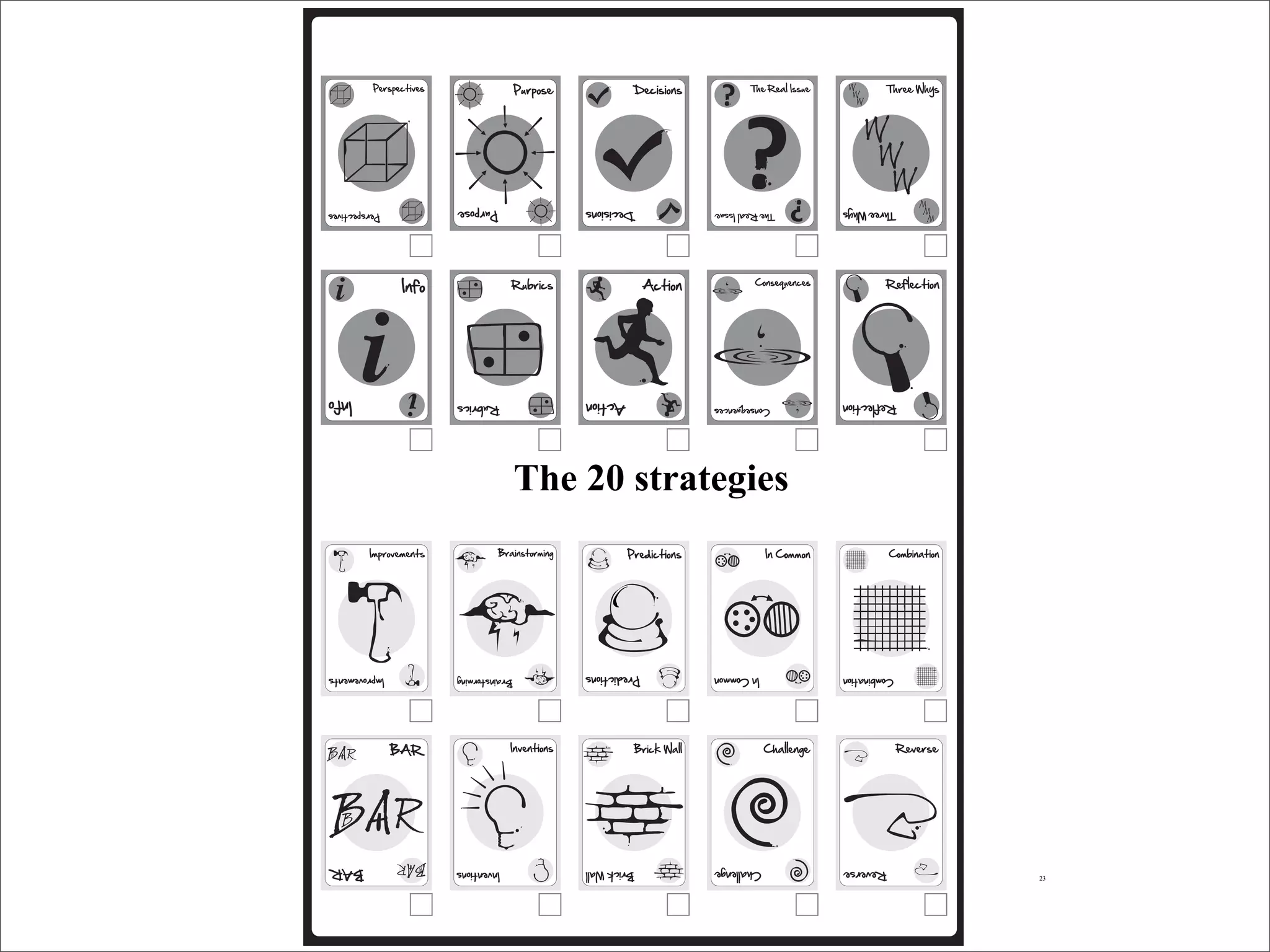
• Creative (adapt, imagine, predict, invent,
  hypothesise, challenge, redefine, expand)
• Critical (synthesise, analyse, generalise,
  critique, examine, infer, interpret, classify)
• Metacognitive (evaluate, reflect, summarise,
  review, self-talk, develop plans, query)
  •   Adapted from: Learner-Centred Assessment (Wilson & Murdoch, 2006); and, Thinkers Keys
      revised version (Ryan, 2007)
Key issues with
‘thinking’ in classrooms
• It’s not an optional extra!!
• It’s not just for smart kids!
• The quality of thinking will determine the quality
   of their learning retention
• Teacher modelling of quality thinking is a critical
   influence on student thinking
Thinkers
 Keys
20 practical thinking
    strategies for
 enhancing thinking
 (thinkerskeys.com)
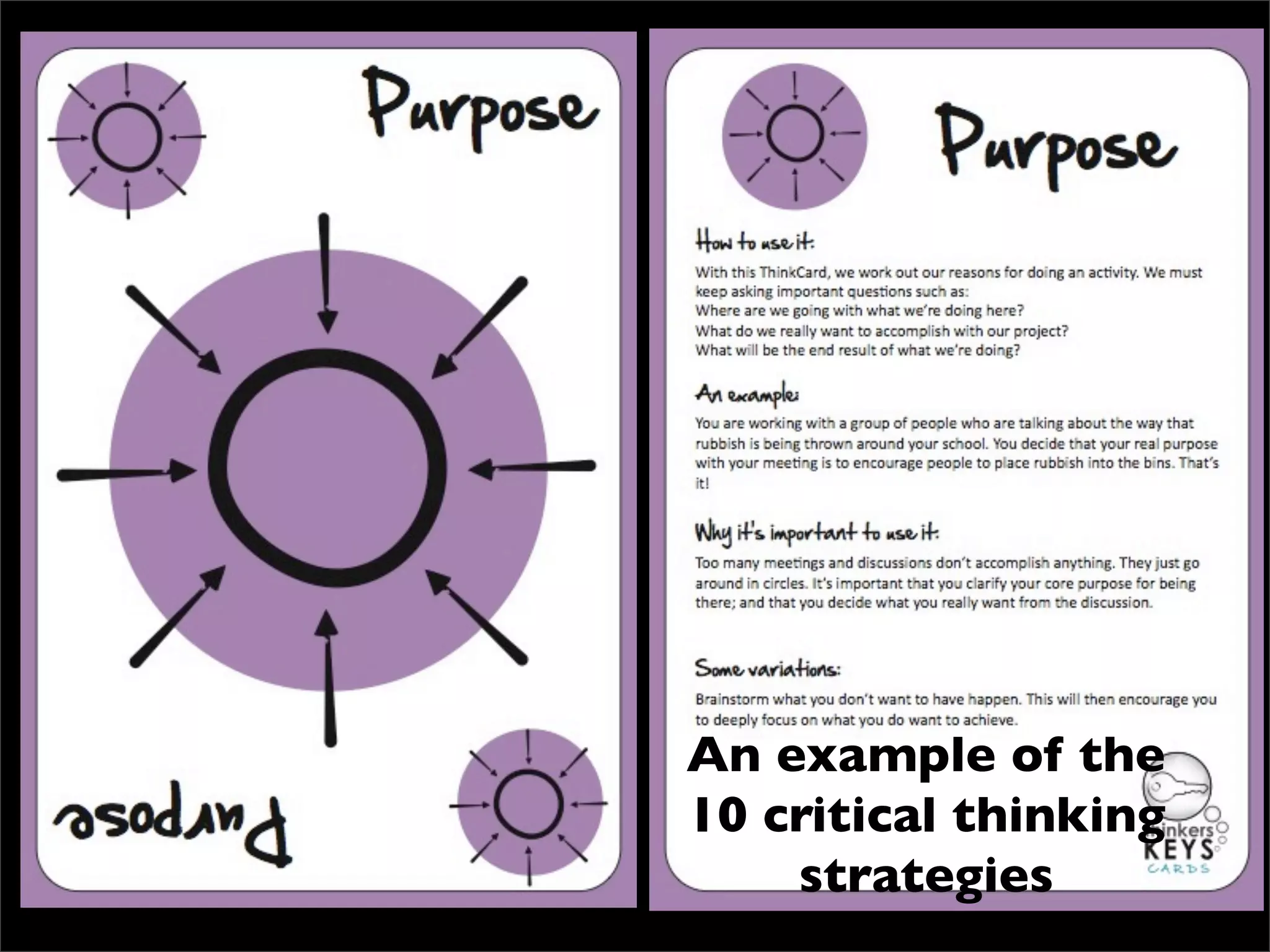
An example of the
10 critical thinking
    strategies
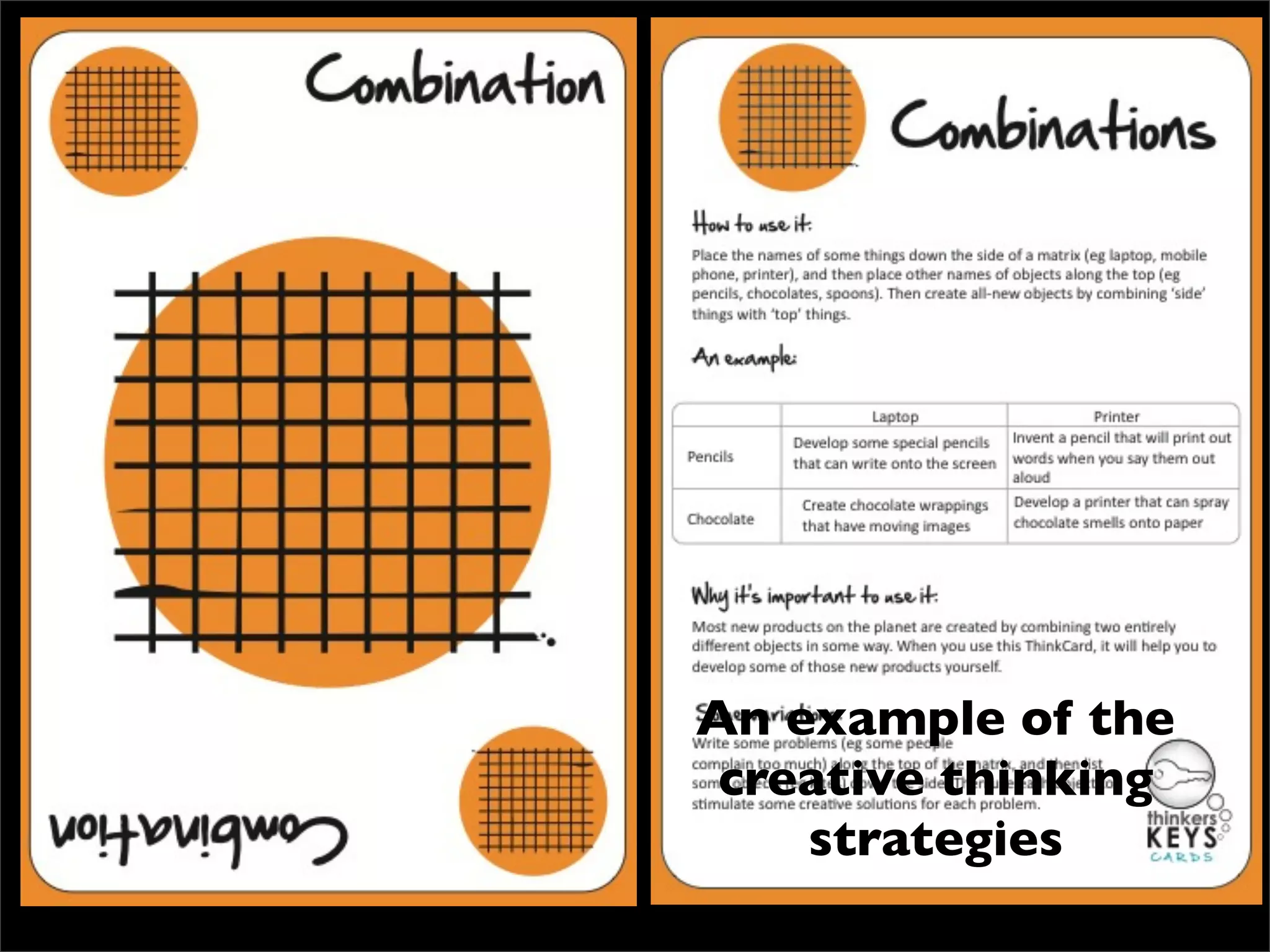
An example of the
 creative thinking
    strategies
The 20 strategies


                    23
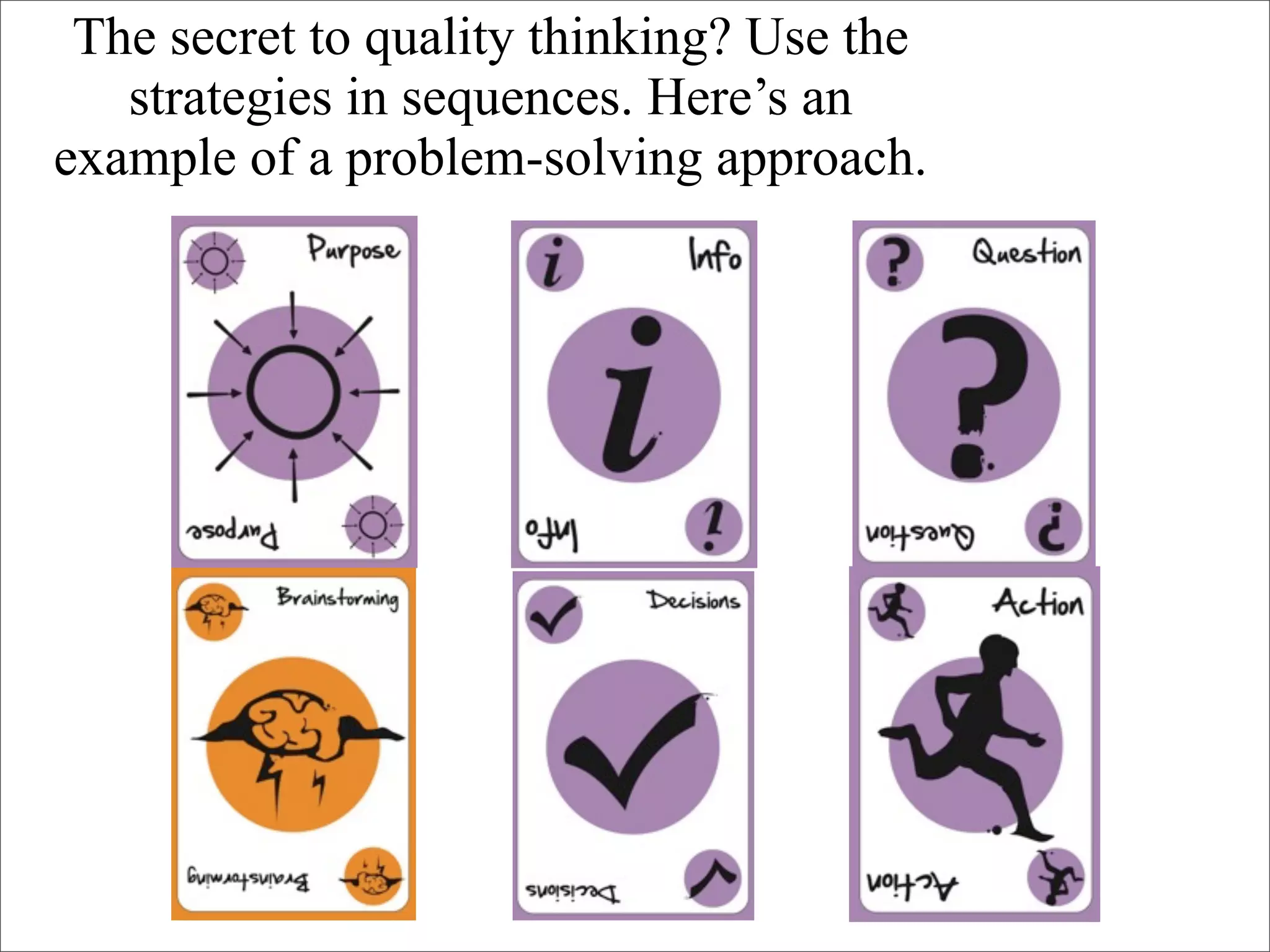
The secret to quality thinking? Use the
   strategies in sequences. Here’s an
example of a problem-solving approach.


                                           24
Enhance
thinking
with ICT
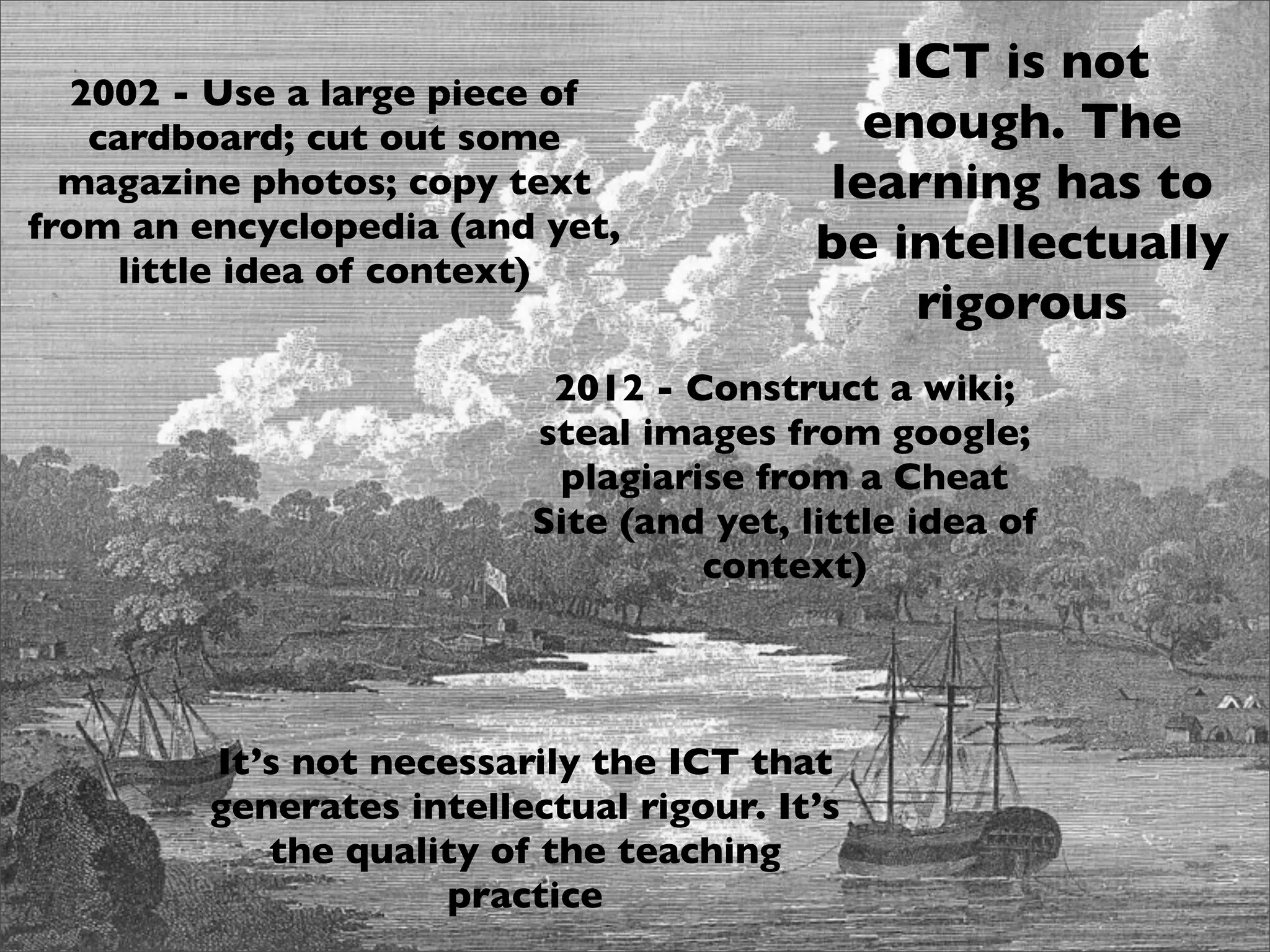
ICT is not
  2002 - Use a large piece of
   cardboard; cut out some                  enough. The
  magazine photos; copy text              learning has to
from an encyclopedia (and yet,
    little idea of context)
                                          be intellectually
                                              rigorous
                           2012 - Construct a wiki;
                          steal images from google;
                           plagiarise from a Cheat
                          Site (and yet, little idea of
                                   context)


         It’s not necessarily the ICT that
         generates intellectual rigour. It’s
            the quality of the teaching
                      practice
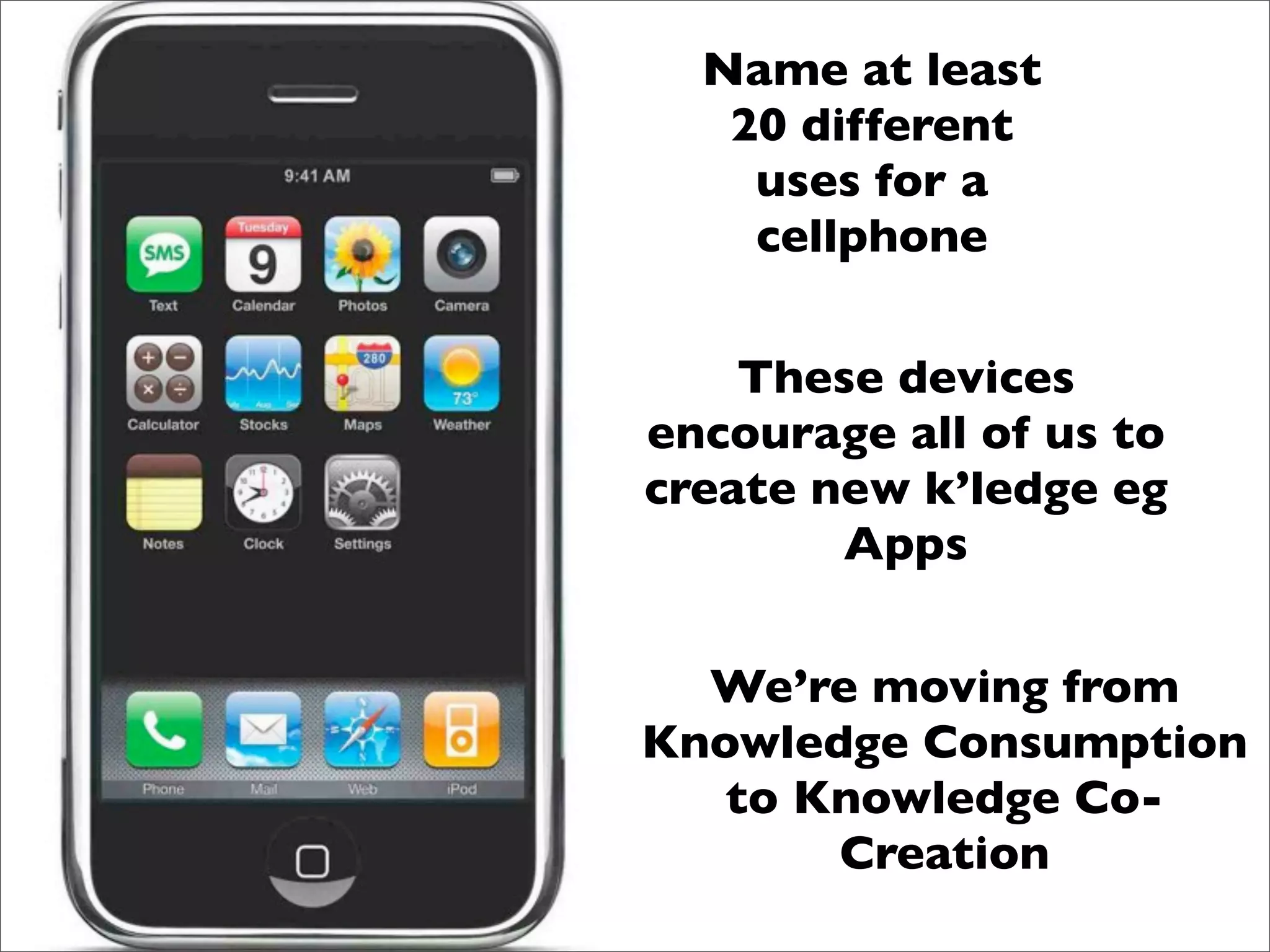
Name at least
   20 different
    uses for a
    cellphone

    These devices
encourage all of us to
create new k’ledge eg
        Apps


  We’re moving from
Knowledge Consumption
   to Knowledge Co-
       Creation
Using ICT tools
• How could you advance children’s
  thinking with your own cellphone?
• ... or with a camera being used by the
  children?
• ... or with a FlipCamera being used by
  the children?
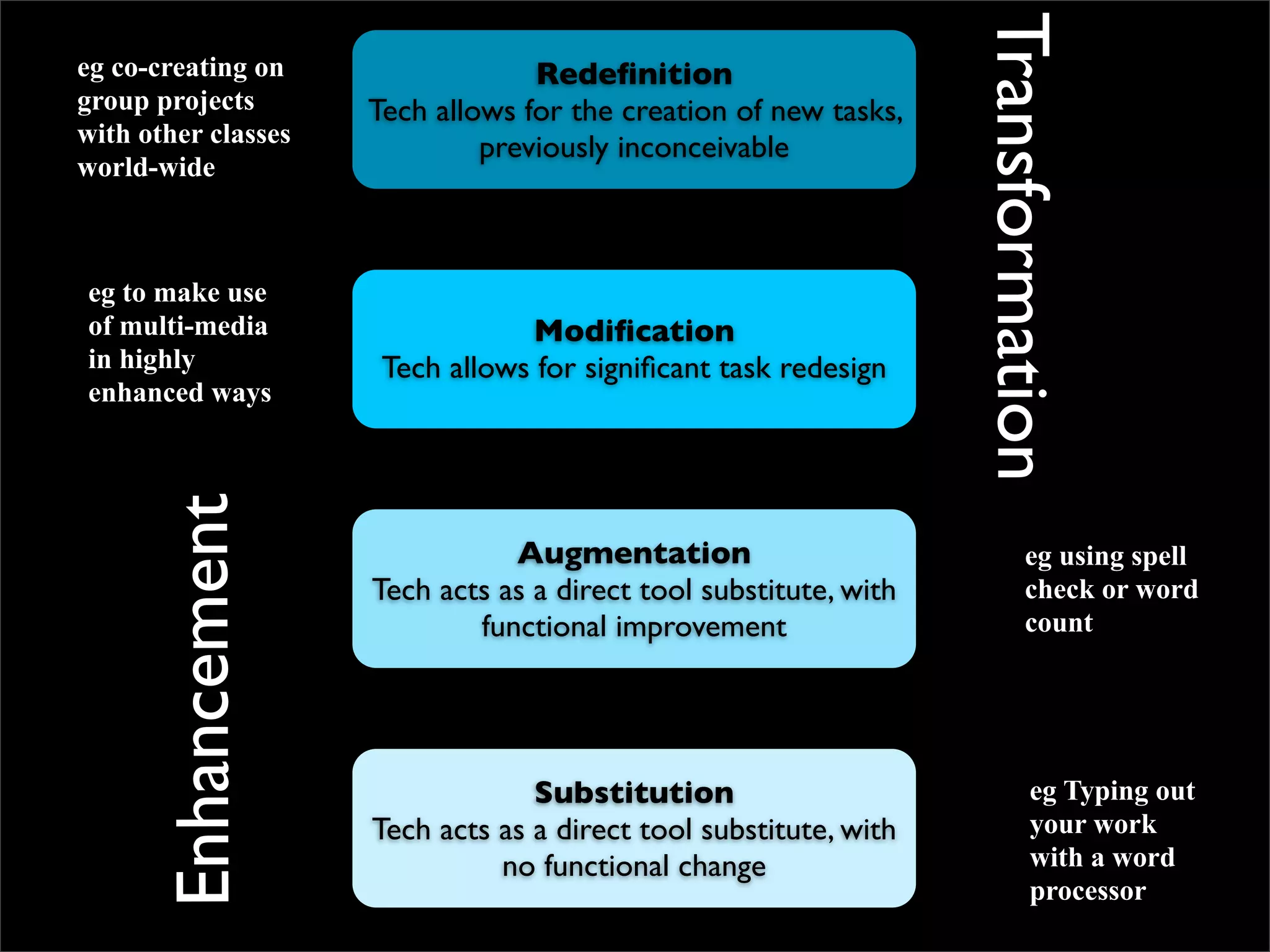
Transformation
eg co-creating on                 Redefinition
group projects       Tech allows for the creation of new tasks,
with other classes            previously inconceivable
world-wide


eg to make use
of multi-media                   Modification
in highly             Tech allows for significant task redesign
enhanced ways
      Enhancement


                                Augmentation                              eg using spell
                     Tech acts as a direct tool substitute, with          check or word
                             functional improvement                       count


                                  Substitution                            eg Typing out
                     Tech acts as a direct tool substitute, with          your work
                               no functional change                       with a word
                                                                          processor
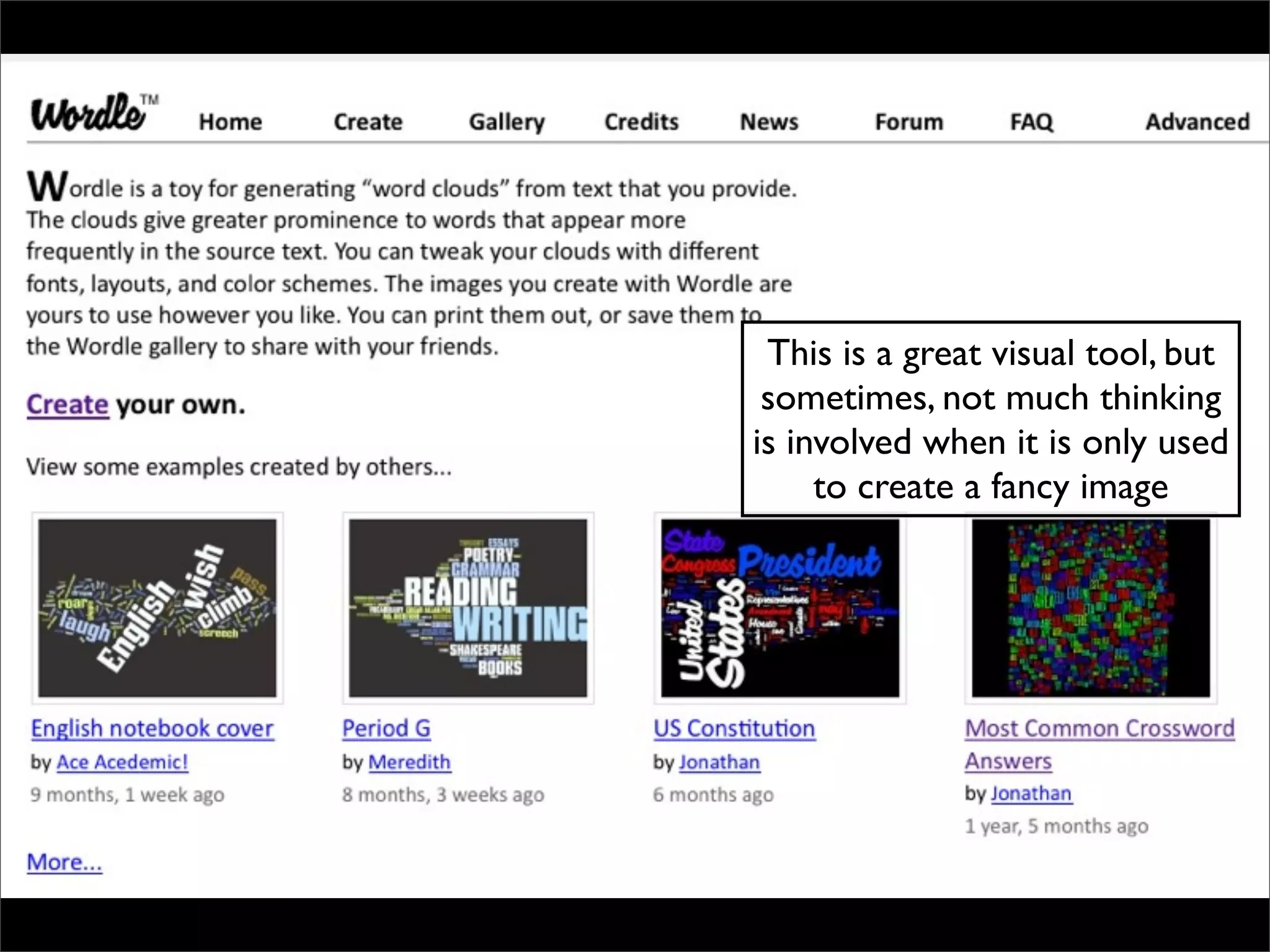
This is a great visual tool, but
 sometimes, not much thinking
is involved when it is only used
     to create a fancy image
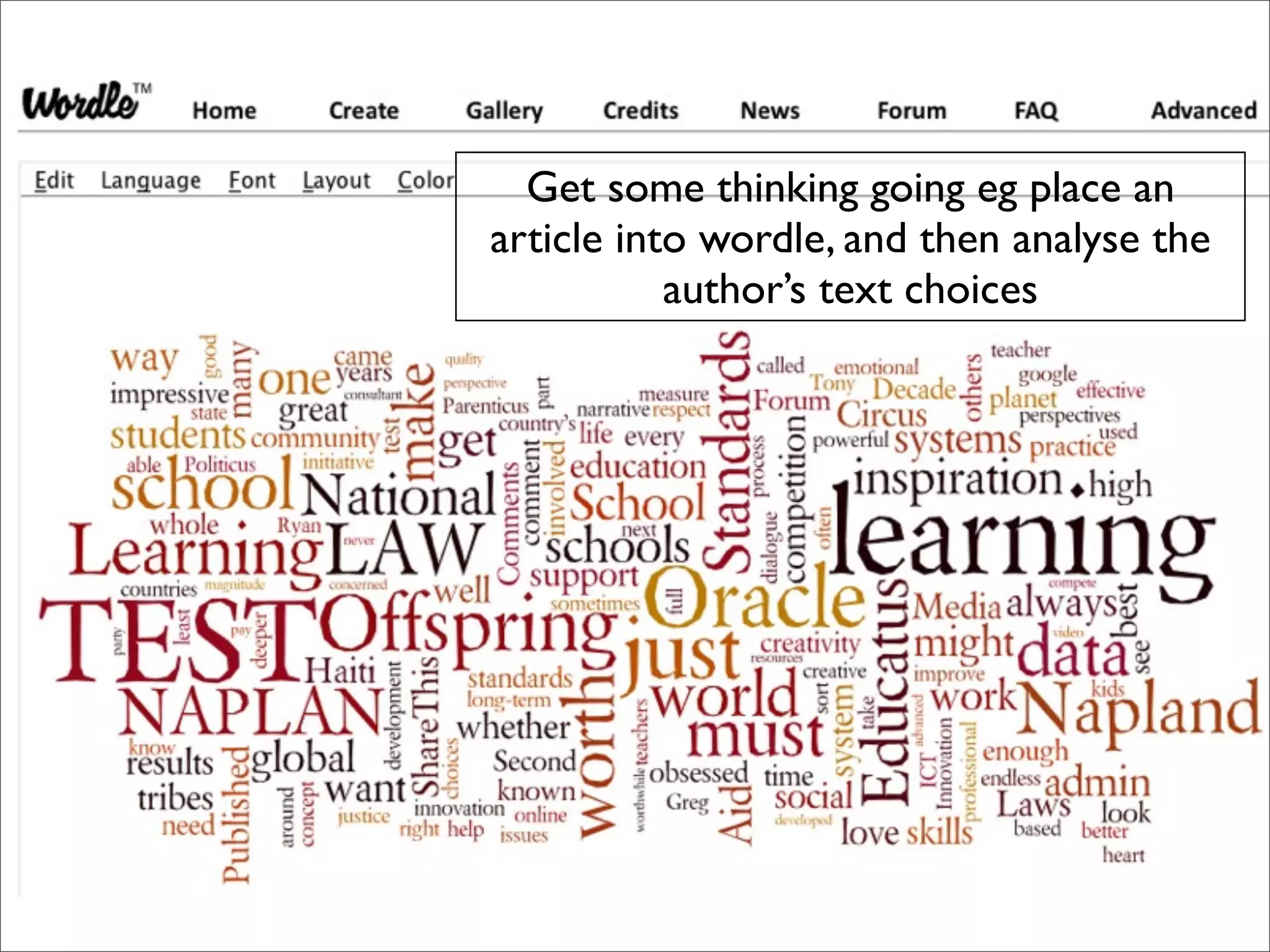
Get some thinking going eg place an
article into wordle, and then analyse the
           author’s text choices
21st C learning   •Behaviourism
  theories??      •Constructivism     How do you
                  •Instructivism       generate
                  •Cognitivism      ‘connectivism’?
                  •Connectivism
Visual Stimulus
•   Most (?!) of your students will be visual learners
•   Students process images up to 10 000 times faster
    than text
•   Powerful recall through image: 90% recall of images
    after 72 hrs; over 60% after one year
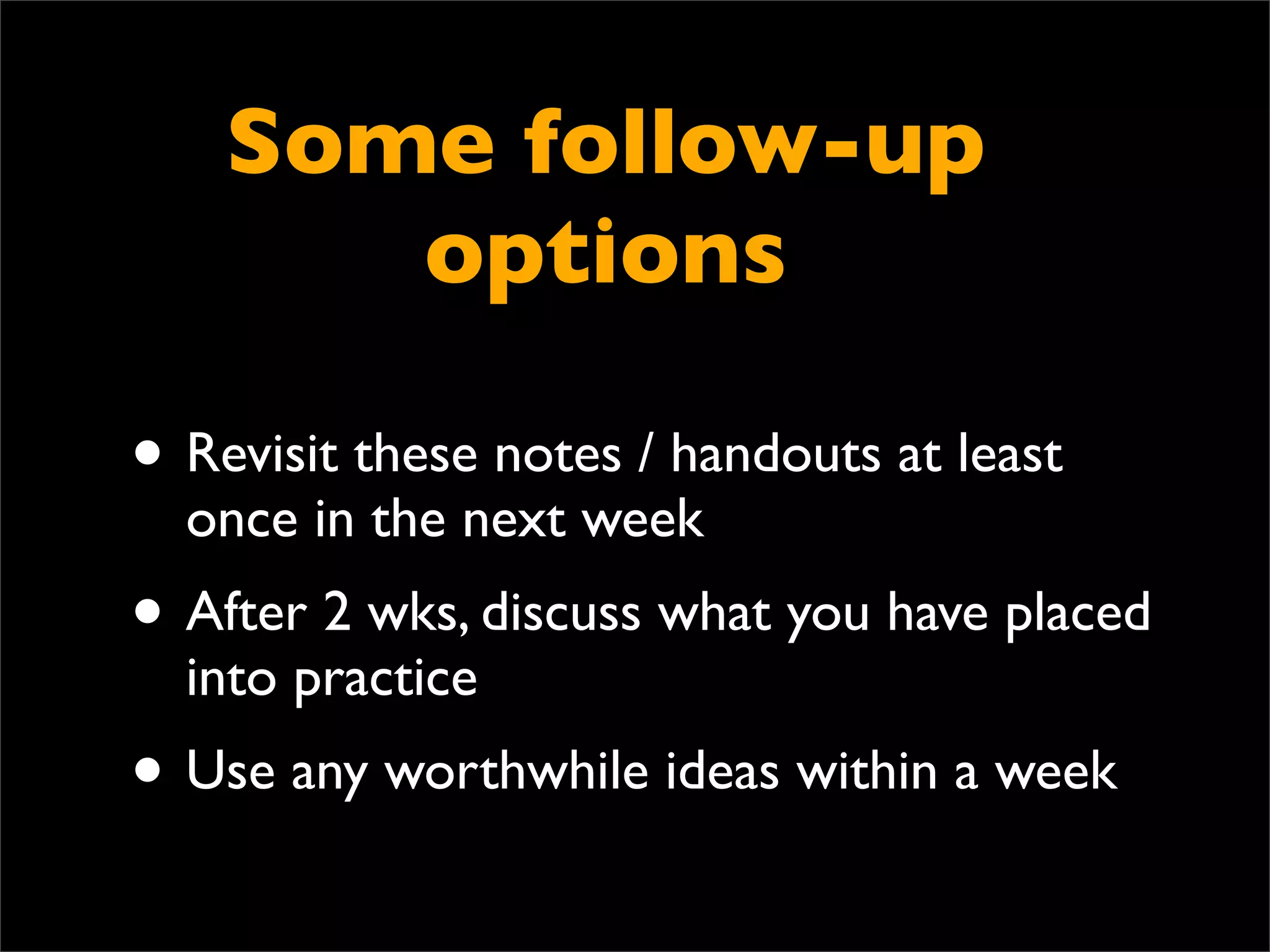
•   Develop a visual database of their ongoing
    achievements and / or daily learnings
One photo / day to
  represent the most
powerful learning that day
Some follow-up
       options

• Revisit these notes / handouts at least
  once in the next week
• After 2 wks, discuss what you have placed
  into practice
• Use any worthwhile ideas within a week

Teach children to think

  • 1.
    Teaching Children To Think Tony Ryan Learning Consultant tony@tonyryan.com.au
  • 2.
    This is acondensed version of a workshop that I offer to teachers around the world. These strategies can just as easily be used by parents; and by trainers / presenters who work with adult groups!
  • 3.
    Four Key Approaches To 1. Develop positive Teaching Kids To dispositions for thinking and learning Think 2. Generate the highest levels of intellectual rigour and inquiry 3. Combine proven frameworks, with practical strategies that are in context 4. Enhance thinking with ICT
  • 4.
  • 5.
    Positive dispositions for thinking and learning?? • Skills are not enough. A disposition for wanting / needing to think is critical. Make thinking spicy! • Generate an enthusiasm for intellectual play and curiosity • Encourage explicit and direct reasoning • Give children time to think • Show them how to plan ahead and get organised • Help them to study the brain at both a physiological and psychological level
  • 6.
    Teach students toself-talk • Self-talk is a specific awareness of their own thinking • For children, begin with an explicit lesson • Write up words such as: “I’m a legend” • Then ask them to self-talk those words, without any sound or without moving their lips • Encourage them to do this self-talk when they are working on a mental task
  • 7.
    Student Passions??! • Have you asked every one of your children about their passions in life? • What are the Big Three interests for the age group you’re teaching this year? • Where and how do you compile data about their interests? • Where specifically do you build those interests into the classroom environment?
  • 8.
    Generate the highestlevels of intellectual rigour and inquiry
  • 9.
    Here is apowerful process for developing an intellectually stimulating question It’s called the ‘Intellectual Rubber Band’ 1. Brainstorm the hardest question in the world about the topic being studied 2. Now adjust it downwards until it can be used with your class
  • 10.
    Engage children in constant inquiry - get them wondering! Challenge them to conjecture on the reasons for specific issues eg these bricked-in windows Hint: It’s to do with the expression: “Daylight robbery”
  • 11.
    A process for student inquiry Q. What’s our purpose for doing this inquiry? Q. What do we already know about this issue? Q. What are our questions? Q. What learning steps will we take? Q. How will we do useful research? Q. How will we share our findings?
  • 12.
    Play the SocratesGame Break students into pairs: * Student A offers perspectives on a specific topic • Why do you believe...? * Student B continually asks any / all of the • Could you give an example of that? Socratic questions in • Are you suggesting...? context • What reasons do you have for saying that? • Could you clarify that comment? • Why did you find that interesting? • How do you know that?
  • 13.
    Zestful inquiries!! • When possible, develop an inquiry about passions in their lives • Generate interest with a provocative intro lesson • Give your inquiry units some exciting titles (name them after a movie or a piece of music) • Develop an assessment task that is intellectually stimulating
  • 14.
    Develop rich focusquestions • They can be: Philosophical / provocative / quirky / thought-provoking / unusual / intriguing • Examples of focus questions? • What is the price of life? • Are we really what we eat? • How could computer games create a better world? • How does a trend affect our choices? • Does happily ever after really exist?
  • 15.
    Combine proven frameworks, with practical strategies that are in context
  • 16.
    We must deliver on4 Educational delivery mechanisms core areas in Curriculum: Pedagogy: learning: What is How it’s taught taught Assessment: Reporting: How it’s How we give measured feedback
  • 17.
    Some frameworks for ‘thinking’within the pedagogy • Blooms taxonomy • Williams taxonomy • Marzano’s taxonomy • Habits Of Mind • Thinkers Keys
  • 18.
    Skills for thinking •Creative (adapt, imagine, predict, invent, hypothesise, challenge, redefine, expand) • Critical (synthesise, analyse, generalise, critique, examine, infer, interpret, classify) • Metacognitive (evaluate, reflect, summarise, review, self-talk, develop plans, query) • Adapted from: Learner-Centred Assessment (Wilson & Murdoch, 2006); and, Thinkers Keys revised version (Ryan, 2007)
  • 19.
    Key issues with ‘thinking’in classrooms • It’s not an optional extra!! • It’s not just for smart kids! • The quality of thinking will determine the quality of their learning retention • Teacher modelling of quality thinking is a critical influence on student thinking
  • 20.
    Thinkers Keys 20 practicalthinking strategies for enhancing thinking (thinkerskeys.com)
  • 21.
    An example ofthe 10 critical thinking strategies
  • 22.
    An example ofthe creative thinking strategies
  • 23.
  • 24.
    The secret toquality thinking? Use the strategies in sequences. Here’s an example of a problem-solving approach. 24
  • 25.
  • 26.
    ICT is not 2002 - Use a large piece of cardboard; cut out some enough. The magazine photos; copy text learning has to from an encyclopedia (and yet, little idea of context) be intellectually rigorous 2012 - Construct a wiki; steal images from google; plagiarise from a Cheat Site (and yet, little idea of context) It’s not necessarily the ICT that generates intellectual rigour. It’s the quality of the teaching practice
  • 27.
    Name at least 20 different uses for a cellphone These devices encourage all of us to create new k’ledge eg Apps We’re moving from Knowledge Consumption to Knowledge Co- Creation
  • 28.
    Using ICT tools •How could you advance children’s thinking with your own cellphone? • ... or with a camera being used by the children? • ... or with a FlipCamera being used by the children?
  • 29.
    Transformation eg co-creating on Redefinition group projects Tech allows for the creation of new tasks, with other classes previously inconceivable world-wide eg to make use of multi-media Modification in highly Tech allows for significant task redesign enhanced ways Enhancement Augmentation eg using spell Tech acts as a direct tool substitute, with check or word functional improvement count Substitution eg Typing out Tech acts as a direct tool substitute, with your work no functional change with a word processor
  • 30.
    This is agreat visual tool, but sometimes, not much thinking is involved when it is only used to create a fancy image
  • 31.
    Get some thinkinggoing eg place an article into wordle, and then analyse the author’s text choices
  • 32.
    21st C learning •Behaviourism theories?? •Constructivism How do you •Instructivism generate •Cognitivism ‘connectivism’? •Connectivism
  • 33.
    Visual Stimulus • Most (?!) of your students will be visual learners • Students process images up to 10 000 times faster than text • Powerful recall through image: 90% recall of images after 72 hrs; over 60% after one year • Develop a visual database of their ongoing achievements and / or daily learnings
  • 34.
    One photo /day to represent the most powerful learning that day
  • 35.
    Some follow-up options • Revisit these notes / handouts at least once in the next week • After 2 wks, discuss what you have placed into practice • Use any worthwhile ideas within a week