WHAT IS THE
NATURE OF
SCIENCE?
WHAT IS THE NATURE OF SCIENCE?
• Please read the complete article
which is posted at my website for you
• There is also a PPT summary posted
at my website for you
• Please use them for your exam 1
review
THIS IS THETHIS IS THE
SCIENTIFIC WORLD VIEWSCIENTIFIC WORLD VIEW
1.1. The Universe Is Understandable.The Universe Is Understandable.
2.2. The Universe Is a Vast Single System InThe Universe Is a Vast Single System In
Which the Basic Rules Are EverywhereWhich the Basic Rules Are Everywhere
the Same.the Same.
3.3. Scientific Ideas Are Subject To Change.Scientific Ideas Are Subject To Change.
4.4. Scientific Knowledge Is Durable.Scientific Knowledge Is Durable.
5.5. Science Cannot Provide CompleteScience Cannot Provide Complete
Answers to All Questions.Answers to All Questions.
WHAT IS THE NATURE OF
SCIENTIFIC INQUIRY?
• Certain features of science make it
distinctive as a means of
understanding the world/universe
• Those features are especially
characteristic of the work of
professional scientists, but anyone
can use them to think scientifically
about many aspects of everyday life
Science Demands Evidence
• The validity of scientific claims is
settled by referring to observations of
phenomena
• Therefore, scientists concentrate on
getting accurate data
THE SCIENTIFIC METHOD
1. Observe and describe a phenomenon or group of
phenomena
2. Formulate hypotheses to explain the phenomena;
hypotheses often take the form of a proposed causal
mechanism or mathematical relationship
3. Use the hypotheses to predict the existence or
actions of other phenomena, or to predict
quantitatively the results of new observations
4. Perform additional data collection or repeat
experimental tests of the predictions by several
independent experimenters using properly performed
techniques or experiments
THE SCIENTIFIC METHOD
• Observations/Data Hypotheses Hypothesis➔ ➔
Testing Models Laws Theories➔ ➔ ➔
• At some point in time, each stage must be reported to
the larger scientific community by presentations or
publications
THE SCIENTIFIC METHOD
• The scientific method does not allow any
hypothesis to be proven true
• Hypotheses can be disproven, in which case
those hypothesis are rejected as false
• A hypothesis which withstands a test designed
to falsify it establishes a level of probability that
the hypothesis accurately explains data and
can be used for further predictions, subject to
further tests
Hypothesis Testing
SCIENTIFIC LAWS AND THEORIES
• A Scientific Theory is an explanation of a set or
system of related observations or events based
upon proven hypotheses and verified multiple
times by detached groups of unbiased
researchers
• (One scientist cannot create a theory; s/he can only
create hypotheses)
SCIENTIFIC LAWS AND THEORIES
• As a result of our confidence in the
Scientific method, both scientific laws and
broader scientific theories are accepted to
be “true” (accurate) by the scientific
community as a whole
• A scientific law or a scientific theory is
used to make predictions of events or
relationships among data sets
SCIENTIFIC LAWS AND THEORIES
• The biggest difference between a law and a
theory is that a theory is much more complex
and dynamic
• A law governs a single action or situation,
whereas a theory explains an entire group of
related phenomena (Mendel’s Laws versus
Darwin’s Theory of Evolution by Natural
Selection)
• [Note: Evolution is a Fact; Darwin’s Theory is
the scientifically accepted explanation for the
fact(s) and mechanisms of evolution.]
SCIENTIFIC LAWS AND THEORIES
• Genuine scientific theories must be falsifiable
by applying the scientific method (data
collection and hypothesis testing)
• If one cannot imagine a specific investigation or
experiment, based on predictions from the
theory, leading to results which can further
verify or refute the predictions, then the theory,
as an explanation, is not scientific
SCIENTIFIC LAWS AND THEORIES
• When the scientific community accepts a Law
or Theory, it represents the best understanding
of the explanations for the properties of a given
system at that point in time
• A Scientific Theory represents our best
understanding of the “truth” about some aspect
of the universe, even though it is not proven as
absolute and is still understood to be subject to
future revision, or even to rejection
THE EXPERIMENTAL METHOD
• The Experimental Method is usually considered
the most scientific of all methods, the “method
of choice”
• The main problem with all other non-
experimental methods is investigators have
less control over the situation and its
components
• The Experimental Method exerts the most
THE EXPERIMENTAL METHOD
• An experiment is a study of cause and effect
• It differs from non-experimental methods in that
it involves the deliberate manipulation of one
variable, while trying to keep all other variables
constant
• Experiments must be properly designed and
include controls
HYPOTHESIS GENERATION
• The use of logic and the close examination of
evidence are necessary but not usually
sufficient for the advancement of science
• Scientific concepts do not emerge automatically
from data or from any amount of analysis alone
• Inventing hypotheses or theories to imagine
how the world works and then figuring out how
they can be put to the test of reality is a
creative thought process
SCIENCE EXPLAINS AND PREDICTS
• Scientists try to make sense of observations by
constructing explanations for observations that
are consistent with currently accepted scientific
principles
• Such explanations—theories—may be either
sweeping or restricted, but they must be
logically sound and incorporate a significant
body of scientifically valid observations
• The credibility of scientific theories often comes
from their ability to show relationships among
phenomena that previously seemed unrelated
SCIENCE EXPLAINS AND PREDICTS
• It is not enough for scientific theories
to explain the observations that are
already known
• Theories should also explain
additional observations that were not
used in formulating the theories in the
first place; that is, theories should
have predictive power
SCIENTISTS TRY TO
IDENTIFY AND TO AVOID BIAS
• When faced with a claim that something is true,
scientists respond by asking what evidence
supports it
• But scientific evidence can be biased in how
the data are interpreted, recorded or reported,
or even in the choice of what data are
considered in the first place
• A scientist’s nationality, culture, gender, ethnic
origin, age, political convictions, etc., may
incline him or her to look for or emphasize one
kind of evidence or interpretation over another
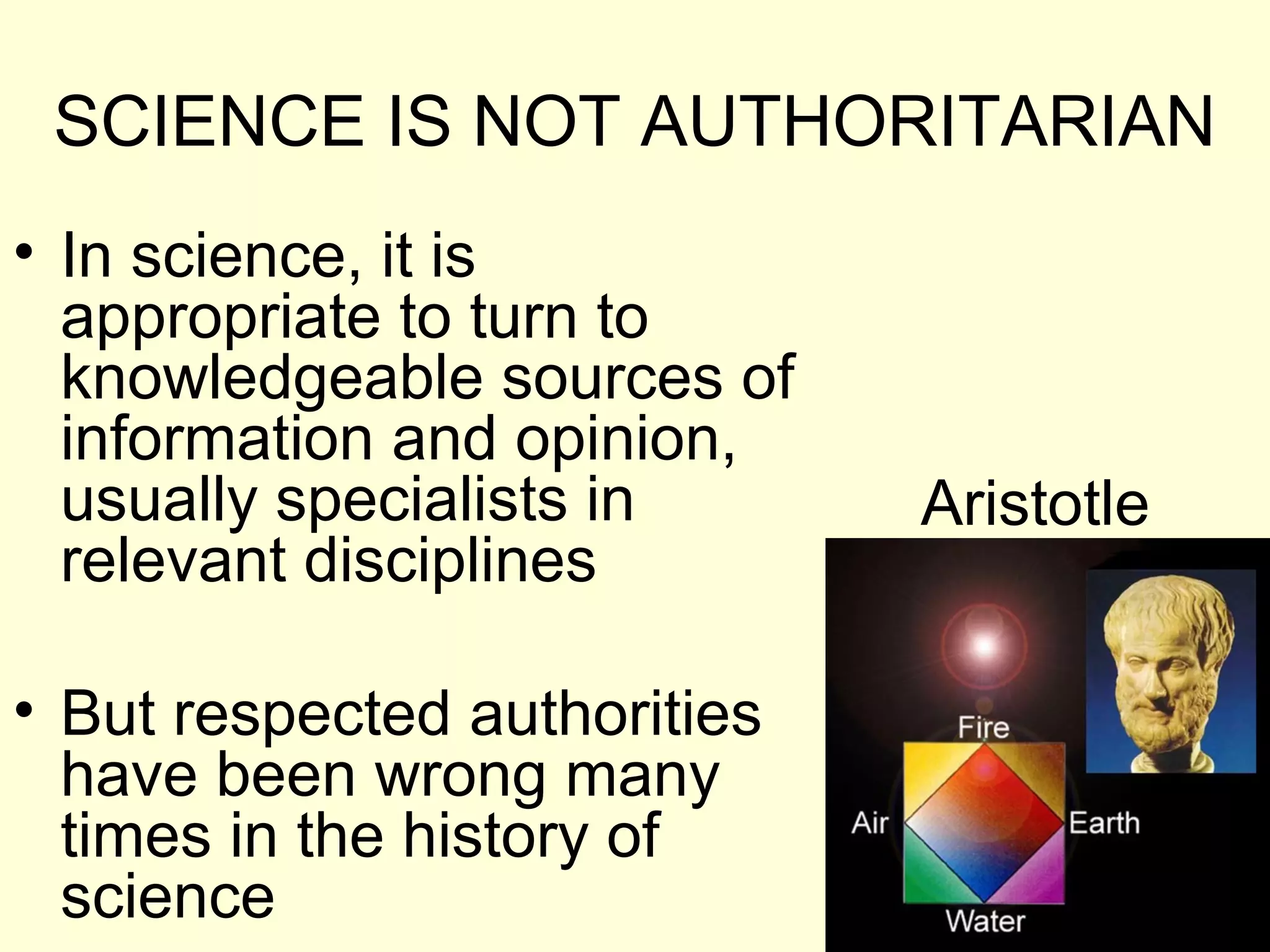
SCIENCE IS NOT AUTHORITARIAN
• In science, it is
appropriate to turn to
knowledgeable sources of
information and opinion,
usually specialists in
relevant disciplines
• But respected authorities
have been wrong many
times in the history of
science
Aristotle
SCIENCE IS SELF CORRECTING
AND PROGRESSIVE
• In the short run, new ideas that do not agree
well with mainstream ideas may encounter
vigorous criticism, and scientists investigating
such ideas may have difficulty obtaining
support for their research
• Challenges to new ideas are the legitimate
business of science in building valid knowledge
SCIENCE IS SELF CORRECTING
AND PROGRESSIVE
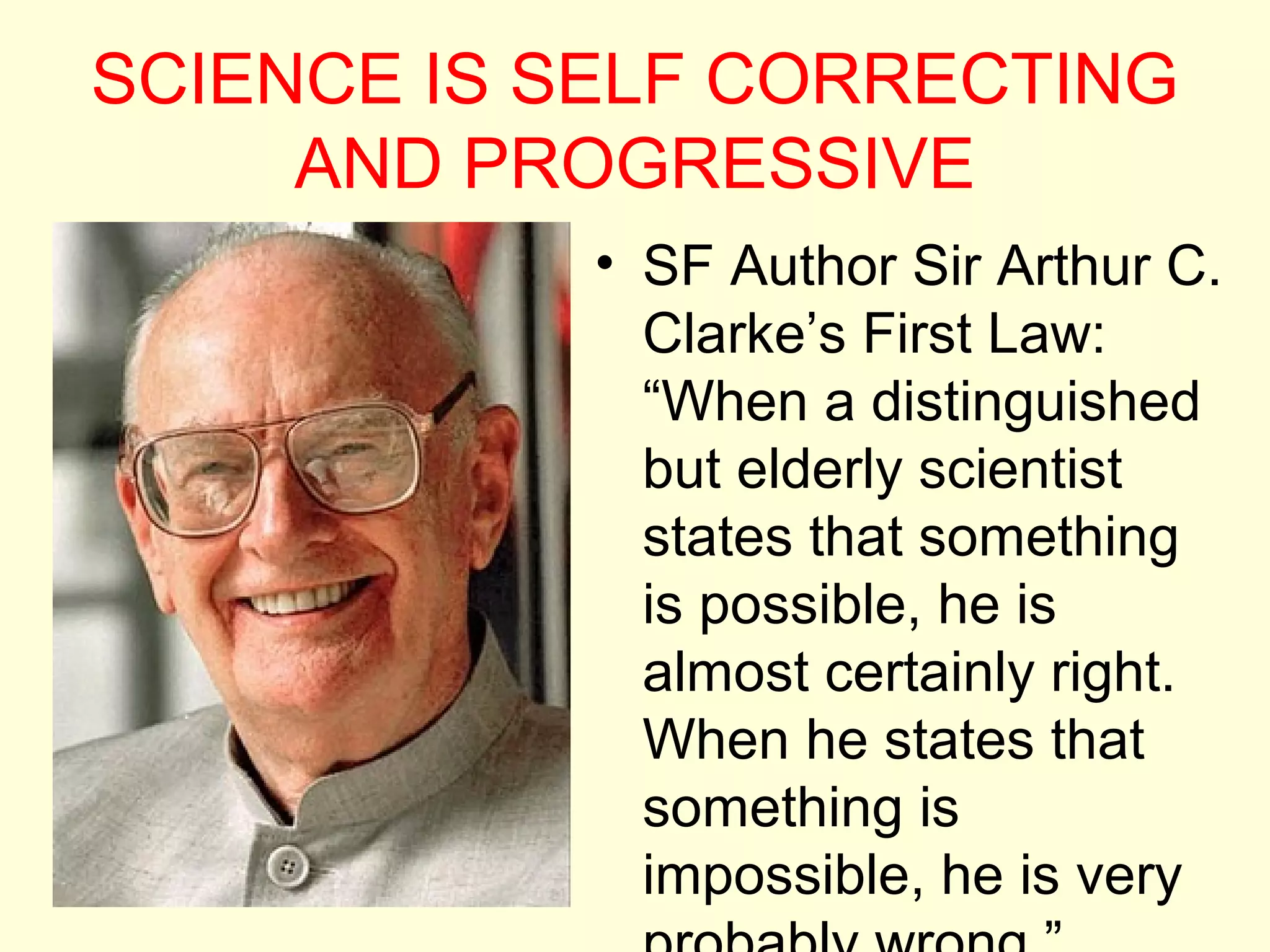
• SF Author Sir Arthur C.
Clarke’s First Law:
“When a distinguished
but elderly scientist
states that something
is possible, he is
almost certainly right.
When he states that
something is
impossible, he is very
SCIENCE AS A WAY OF KNOWING
1. The Universe Is Understandable
2. The Universe Is a Vast Single System In Which the Basic
Rules Are Everywhere the Same
3. Scientific Ideas Are Subject To Change
4. Scientific Knowledge Is Durable
5. Science Cannot Provide Complete Answers to All Questions
Scientific ideas are developed by particular ways of
observing, thinking, experimenting, and validating
Observations/Data Hypotheses Hypothesis➔ ➔
Testing Models Laws Theories➔ ➔ ➔
Principles and Processes
of Evolution
• For the rest of the semester, we will
examine the fact(s) of Evolution and
the evidence that supports
Darwin’s/Biology’s Theory of
Evolution by Natural Selection
• We will also expose “Intelligent
Design” as an unsatisfactory
alternative explanation of causation
WHAT IS THE NATURE OF
SCIENCE?
END

What is the Nature of Science?

  • 1.
    WHAT IS THE NATUREOF SCIENCE?
  • 2.
    WHAT IS THENATURE OF SCIENCE? • Please read the complete article which is posted at my website for you • There is also a PPT summary posted at my website for you • Please use them for your exam 1 review
  • 3.
    THIS IS THETHISIS THE SCIENTIFIC WORLD VIEWSCIENTIFIC WORLD VIEW 1.1. The Universe Is Understandable.The Universe Is Understandable. 2.2. The Universe Is a Vast Single System InThe Universe Is a Vast Single System In Which the Basic Rules Are EverywhereWhich the Basic Rules Are Everywhere the Same.the Same. 3.3. Scientific Ideas Are Subject To Change.Scientific Ideas Are Subject To Change. 4.4. Scientific Knowledge Is Durable.Scientific Knowledge Is Durable. 5.5. Science Cannot Provide CompleteScience Cannot Provide Complete Answers to All Questions.Answers to All Questions.
  • 4.
    WHAT IS THENATURE OF SCIENTIFIC INQUIRY? • Certain features of science make it distinctive as a means of understanding the world/universe • Those features are especially characteristic of the work of professional scientists, but anyone can use them to think scientifically about many aspects of everyday life
  • 5.
    Science Demands Evidence •The validity of scientific claims is settled by referring to observations of phenomena • Therefore, scientists concentrate on getting accurate data
  • 6.
    THE SCIENTIFIC METHOD 1.Observe and describe a phenomenon or group of phenomena 2. Formulate hypotheses to explain the phenomena; hypotheses often take the form of a proposed causal mechanism or mathematical relationship 3. Use the hypotheses to predict the existence or actions of other phenomena, or to predict quantitatively the results of new observations 4. Perform additional data collection or repeat experimental tests of the predictions by several independent experimenters using properly performed techniques or experiments
  • 7.
    THE SCIENTIFIC METHOD •Observations/Data Hypotheses Hypothesis➔ ➔ Testing Models Laws Theories➔ ➔ ➔ • At some point in time, each stage must be reported to the larger scientific community by presentations or publications
  • 8.
    THE SCIENTIFIC METHOD •The scientific method does not allow any hypothesis to be proven true • Hypotheses can be disproven, in which case those hypothesis are rejected as false • A hypothesis which withstands a test designed to falsify it establishes a level of probability that the hypothesis accurately explains data and can be used for further predictions, subject to further tests
  • 9.
  • 10.
    SCIENTIFIC LAWS ANDTHEORIES • A Scientific Theory is an explanation of a set or system of related observations or events based upon proven hypotheses and verified multiple times by detached groups of unbiased researchers • (One scientist cannot create a theory; s/he can only create hypotheses)
  • 11.
    SCIENTIFIC LAWS ANDTHEORIES • As a result of our confidence in the Scientific method, both scientific laws and broader scientific theories are accepted to be “true” (accurate) by the scientific community as a whole • A scientific law or a scientific theory is used to make predictions of events or relationships among data sets
  • 12.
    SCIENTIFIC LAWS ANDTHEORIES • The biggest difference between a law and a theory is that a theory is much more complex and dynamic • A law governs a single action or situation, whereas a theory explains an entire group of related phenomena (Mendel’s Laws versus Darwin’s Theory of Evolution by Natural Selection) • [Note: Evolution is a Fact; Darwin’s Theory is the scientifically accepted explanation for the fact(s) and mechanisms of evolution.]
  • 13.
    SCIENTIFIC LAWS ANDTHEORIES • Genuine scientific theories must be falsifiable by applying the scientific method (data collection and hypothesis testing) • If one cannot imagine a specific investigation or experiment, based on predictions from the theory, leading to results which can further verify or refute the predictions, then the theory, as an explanation, is not scientific
  • 14.
    SCIENTIFIC LAWS ANDTHEORIES • When the scientific community accepts a Law or Theory, it represents the best understanding of the explanations for the properties of a given system at that point in time • A Scientific Theory represents our best understanding of the “truth” about some aspect of the universe, even though it is not proven as absolute and is still understood to be subject to future revision, or even to rejection
  • 15.
    THE EXPERIMENTAL METHOD •The Experimental Method is usually considered the most scientific of all methods, the “method of choice” • The main problem with all other non- experimental methods is investigators have less control over the situation and its components • The Experimental Method exerts the most
  • 16.
    THE EXPERIMENTAL METHOD •An experiment is a study of cause and effect • It differs from non-experimental methods in that it involves the deliberate manipulation of one variable, while trying to keep all other variables constant • Experiments must be properly designed and include controls
  • 18.
    HYPOTHESIS GENERATION • Theuse of logic and the close examination of evidence are necessary but not usually sufficient for the advancement of science • Scientific concepts do not emerge automatically from data or from any amount of analysis alone • Inventing hypotheses or theories to imagine how the world works and then figuring out how they can be put to the test of reality is a creative thought process
  • 19.
    SCIENCE EXPLAINS ANDPREDICTS • Scientists try to make sense of observations by constructing explanations for observations that are consistent with currently accepted scientific principles • Such explanations—theories—may be either sweeping or restricted, but they must be logically sound and incorporate a significant body of scientifically valid observations • The credibility of scientific theories often comes from their ability to show relationships among phenomena that previously seemed unrelated
  • 20.
    SCIENCE EXPLAINS ANDPREDICTS • It is not enough for scientific theories to explain the observations that are already known • Theories should also explain additional observations that were not used in formulating the theories in the first place; that is, theories should have predictive power
  • 21.
    SCIENTISTS TRY TO IDENTIFYAND TO AVOID BIAS • When faced with a claim that something is true, scientists respond by asking what evidence supports it • But scientific evidence can be biased in how the data are interpreted, recorded or reported, or even in the choice of what data are considered in the first place • A scientist’s nationality, culture, gender, ethnic origin, age, political convictions, etc., may incline him or her to look for or emphasize one kind of evidence or interpretation over another
  • 22.
    SCIENCE IS NOTAUTHORITARIAN • In science, it is appropriate to turn to knowledgeable sources of information and opinion, usually specialists in relevant disciplines • But respected authorities have been wrong many times in the history of science Aristotle
  • 23.
    SCIENCE IS SELFCORRECTING AND PROGRESSIVE • In the short run, new ideas that do not agree well with mainstream ideas may encounter vigorous criticism, and scientists investigating such ideas may have difficulty obtaining support for their research • Challenges to new ideas are the legitimate business of science in building valid knowledge
  • 24.
    SCIENCE IS SELFCORRECTING AND PROGRESSIVE • SF Author Sir Arthur C. Clarke’s First Law: “When a distinguished but elderly scientist states that something is possible, he is almost certainly right. When he states that something is impossible, he is very
  • 25.
    SCIENCE AS AWAY OF KNOWING 1. The Universe Is Understandable 2. The Universe Is a Vast Single System In Which the Basic Rules Are Everywhere the Same 3. Scientific Ideas Are Subject To Change 4. Scientific Knowledge Is Durable 5. Science Cannot Provide Complete Answers to All Questions Scientific ideas are developed by particular ways of observing, thinking, experimenting, and validating Observations/Data Hypotheses Hypothesis➔ ➔ Testing Models Laws Theories➔ ➔ ➔
  • 26.
    Principles and Processes ofEvolution • For the rest of the semester, we will examine the fact(s) of Evolution and the evidence that supports Darwin’s/Biology’s Theory of Evolution by Natural Selection • We will also expose “Intelligent Design” as an unsatisfactory alternative explanation of causation
  • 27.
    WHAT IS THENATURE OF SCIENCE? END