Identifying
Variables
&
Designing
Investigations
3 Kinds of Variables
1.) Independent Variable
2.) Dependent
3.) Controlled (Constant)
1.) Independent Variable
Something that is
changed by the scientist.
What is tested
What is manipulated
2.) Dependent Variable
Something that might be
affected by the change and
measured.
 What is observed
 What is measured
 The data collected during the
investigation
3.) Controlled Variable
A variable that is not changed
and stays the same.
Also called constants
Allow for a “fair test”
Example # 1
Students of different
ages were given the
same jigsaw puzzle
to put together.
They were timed to
see how long it took
to finish the puzzle.
Identify the variables
in this investigation.
What was the
independent variable?
Ages of the students.
What was the
dependent variable?
The time it to put the
puzzle together.
What was a
controlled variable?
Same puzzle.
Example # 2
An investigation was done with
an electromagnetic system
made from a battery and wire
wrapped around a nail.
Different sizes of nails were
used. The number of paper clips
the electromagnet could pick up
was measured.
What are the variables
in this investigation?
Independent Variable:
Sizes of nails.
Dependent Variable:
Number of paper clips
picked up.
Controlled Variables:
Battery, wire, type of nail
(None of these items were changed)
Example # 3
The higher the
temperature of
water, the faster
an egg will boil.
Independent variable - -
temperature of water.
Dependent variable - -
time to cook an egg.
Controlled variable - -
type of egg.
Example # 4
The temperature of
water was measured
at different depths of
a pond.
Independent variable - -
depth of the water.
Dependent variable - -
temperature.
Controlled variable - -
thermometer.
Designing
Investigations
The greater the amount of soap in a
soap and water mixture, the bigger
a soap bubble can be blown.
 Design an investigation to test this
hypothesis.
 Identify the variables
 What exactly will be changed?
How will it be changed?
 What exactly will be measured?
How will it be measured?
The farther a ball drops, the
higher it will bounce.
 Design an investigation to test
this hypothesis.
 Identify the variables
 What exactly will be changed?
How will it be changed?
 What exactly will be
measured? How will it be
measured?
Will M&M color dissolve faster in
water or in another clear liquid?
VINEGAR
HYDROGEN PEROXIDE
ALCOHOL
Independent variable - -
type of clear liquid.
Dependent variable - -
time it takes for color to
dissolve.
Controlled variable - -
amount of liquid, color of
M&M.
What is the
scientific method?
Process
Answers
Is there only one
“scientific
method”?
Steps
Problem or a Question
Organized
What is a
hypothesis?
Educated Guess
What is data?
Information
1.) Identify the Problem
2.) Form a Hypothesis
3.) Design an Experiment
4.) Perform an Experiment
5.) Analyze the Data
[ Modify the Experiment ]
6.) Communicate the
Results
TITLE (PROBLEM):
Will M&M color
dissolve faster in
water or in another
clear liquid?
PURPOSE:
The purpose of this
experiment was to
find out which type of
clear liquid will
dissolve M&M color
fastest.
HYPOTHESIS:
I predict that the
water will dissolve
M&M color faster
than vinegar.
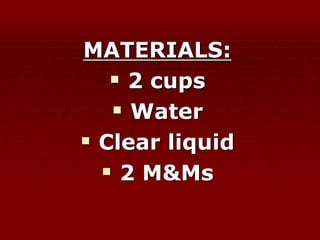
MATERIALS:
 2 cups
 Water
 Clear liquid
 2 M&Ms
PROCEDURE:
Step-by-Step
With pictures,
diagrams, & photos.
RESULTS:
Includes graphs,
Tables, & charts.
CONCLUSION:
CONCLUSION:
I conclude that my
hypothesis was
(correct , incorrect)
because . . .
SCIENCE FAIR
PROJECT
1.) Logbook
2.) Research Paper
[Formal Report]
3.) Display Triptych
4.) Oral Presentation

Identifying Variables .ppt