Scientific Attitudes
 scientific attitudes are predispositions
(tendency, inclination, mental set or habit
of mind) to think and act in a certain way—
approaches that define “scientific” &
“scientist”
 different from attitudes toward or about
science
Scientific Attitudes
 is an attitude that will tend to foster
scientific achievement. It is an
important aspect of a personality of
someone who wants to be successful
in the field of science.
 The methods and skills used by scientists
are intimately connected to a set of
attitudes common in the practice of
science.
Kinds of Scientific Attitudes
 Curiosity
 Intellectual honesty
 Open-mindedness
 Skepticism
 Objectivity
 Perseverance
 Rationality
Kinds of Scientific Attitudes
 Curiosity is an attitude that makes
you curios about the various thing
around you. An individual curiosity
wants to know what it’s all about, what
it’s for, how it’s done, how it works and
something else. He or she is looking
for the answers to the issues he or she
wants to learn.
Kinds of Scientific Attitudes
 Intellectual Honesty is an attitude
in which own should be truthful, for
example by respecting the information
sources. It is applied problem-solving
method characterized by an unbiased
and honest attitude.
- The pursuit of truth does not interfere with one’s
personal faith.
- Relevant facts and information are not deliberately
omitted even when things like this may contradict
one’s hypothesis.
Kinds of Scientific Attitudes
 Open-mindedness is where a
scientist listens to others thoughts,
and values them. He accepts
criticism and changes his mind if his
beliefs contradict reliable evidence. It
is attitude in which an individual
does not reject any knowledge that is
in conflict with his or her idea.
Kinds of Scientific Attitudes
 Skepticism is based upon
evidence-based logic and standards.
It is where the scientist doubts,
questions and considers conclusions.
The skeptical attitude pervades
science and is also applied to
scientific assertions.
Kinds of Scientific Attitudes
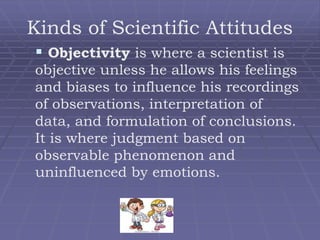
 Objectivity is where a scientist is
objective unless he allows his feelings
and biases to influence his recordings
of observations, interpretation of
data, and formulation of conclusions.
It is where judgment based on
observable phenomenon and
uninfluenced by emotions.
Kinds of Scientific Attitudes
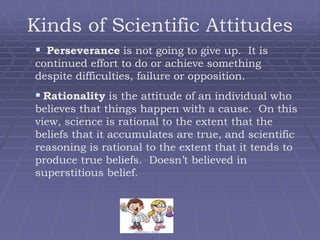
 Perseverance is not going to give up. It is
continued effort to do or achieve something
despite difficulties, failure or opposition.
 Rationality is the attitude of an individual who
believes that things happen with a cause. On this
view, science is rational to the extent that the
beliefs that it accumulates are true, and scientific
reasoning is rational to the extent that it tends to
produce true beliefs. Doesn’t believed in
superstitious belief.
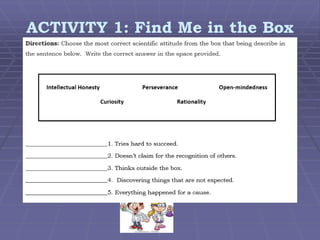
ACTIVITY 1: Find Me in the Box

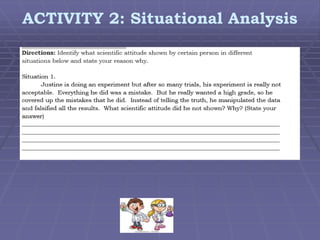
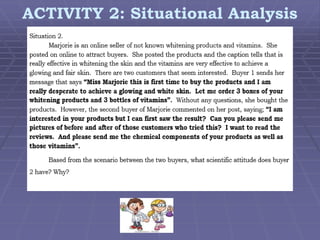
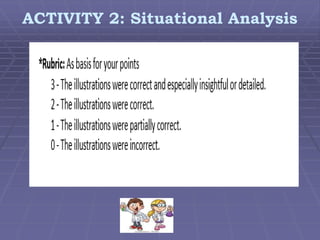
ACTIVITY 2: Situational Analysis

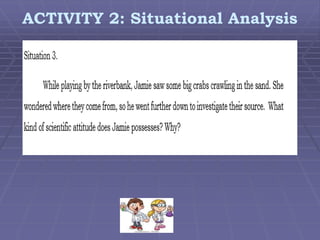
ACTIVITY 2: Situational Analysis

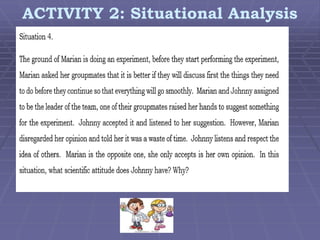
ACTIVITY 2: Situational Analysis

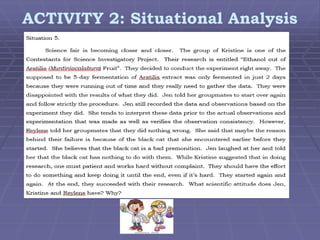
ACTIVITY 2: Situational Analysis

ACTIVITY 2: Situational Analysis

ACTIVITY 2: Situational Analysis

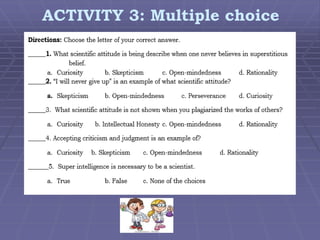
ACTIVITY 3: Multiple choice


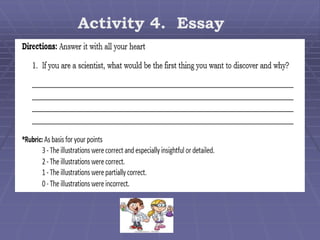
Activity 4. Essay

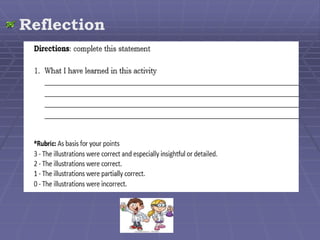
Reflection
THANK YOU AND KEEP
SAFE EVERYONE

Science-attitudes.ppt.Research1.STE.ppt

  • 1.
  • 2.
    Scientific Attitudes  scientificattitudes are predispositions (tendency, inclination, mental set or habit of mind) to think and act in a certain way— approaches that define “scientific” & “scientist”  different from attitudes toward or about science
  • 3.
    Scientific Attitudes  isan attitude that will tend to foster scientific achievement. It is an important aspect of a personality of someone who wants to be successful in the field of science.  The methods and skills used by scientists are intimately connected to a set of attitudes common in the practice of science.
  • 4.
    Kinds of ScientificAttitudes  Curiosity  Intellectual honesty  Open-mindedness  Skepticism  Objectivity  Perseverance  Rationality
  • 5.
    Kinds of ScientificAttitudes  Curiosity is an attitude that makes you curios about the various thing around you. An individual curiosity wants to know what it’s all about, what it’s for, how it’s done, how it works and something else. He or she is looking for the answers to the issues he or she wants to learn.
  • 6.
    Kinds of ScientificAttitudes  Intellectual Honesty is an attitude in which own should be truthful, for example by respecting the information sources. It is applied problem-solving method characterized by an unbiased and honest attitude. - The pursuit of truth does not interfere with one’s personal faith. - Relevant facts and information are not deliberately omitted even when things like this may contradict one’s hypothesis.
  • 7.
    Kinds of ScientificAttitudes  Open-mindedness is where a scientist listens to others thoughts, and values them. He accepts criticism and changes his mind if his beliefs contradict reliable evidence. It is attitude in which an individual does not reject any knowledge that is in conflict with his or her idea.
  • 8.
    Kinds of ScientificAttitudes  Skepticism is based upon evidence-based logic and standards. It is where the scientist doubts, questions and considers conclusions. The skeptical attitude pervades science and is also applied to scientific assertions.
  • 9.
    Kinds of ScientificAttitudes  Objectivity is where a scientist is objective unless he allows his feelings and biases to influence his recordings of observations, interpretation of data, and formulation of conclusions. It is where judgment based on observable phenomenon and uninfluenced by emotions.
  • 10.
    Kinds of ScientificAttitudes  Perseverance is not going to give up. It is continued effort to do or achieve something despite difficulties, failure or opposition.  Rationality is the attitude of an individual who believes that things happen with a cause. On this view, science is rational to the extent that the beliefs that it accumulates are true, and scientific reasoning is rational to the extent that it tends to produce true beliefs. Doesn’t believed in superstitious belief.
  • 11.
    ACTIVITY 1: FindMe in the Box 
  • 12.
  • 13.
  • 14.
  • 15.
  • 16.
  • 17.
  • 18.
  • 19.
  • 20.
  • 21.
    THANK YOU ANDKEEP SAFE EVERYONE