
Science and
Technology in
Education
Unit 1
5/19/2020PujaShrivastav
Introduction
• From the beginning of time, man has strived to
improve his way and quality of life.
• The caveman discovered how to make and use
tools, developed a logical sequence for activities,
devolved processes that added value to his life.
• We live in the age of science and technology
5/19/2020PujaShrivastav
Introduction
• Science and Technology are important for
economical well-being, but also seen from the
perspective of a broadly based liberal education.
• A nation without science and technology is
definitely a backward nation. Such nation will be
considered undeveloped.
• Science and technology is associated with
modernity and it is an essential tool for rapid
development.
5/19/2020PujaShrivastav
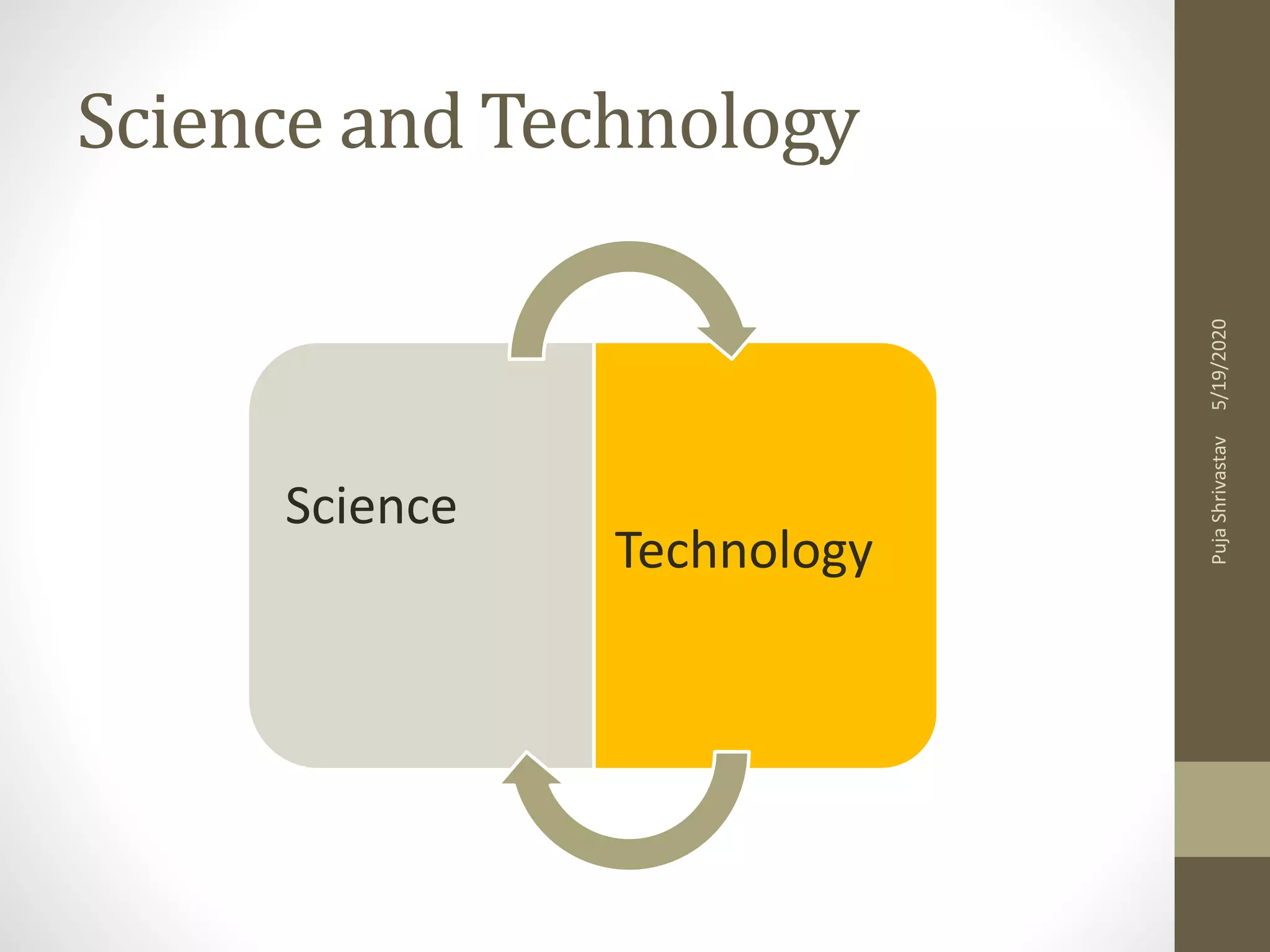
Science and Technology
Science
Technology
5/19/2020PujaShrivastav
Importance of Technology
• Growing trend towards globalization
• Increasing importance of technology in society.
• Students need to develop 21st century skill.
• Students of today have grown up with digital
technology.
5/19/2020PujaShrivastav
Contribution of Technology
• To Students Learning- Specific learning achieved
by development of skills and attitudes, students
motivation, relationship of students to
knowledge.
• Appropriate use of technology in teaching-
planning teaching, intervention with students
and assessment in learning.
5/19/2020PujaShrivastav
Current Educational Applications
of Technology
• Online blogs
• Online reference tools, OER
• Interactive white boards
• E books replacing textbooks
• Video clips
• MS Office
• Laptops to write, communicate and research
• E-learning
• MOOC
5/19/2020PujaShrivastav
MOOC
• The first MOOCs emerged from the open educational
resources (OER) movement.
• The term MOOC was coined in 2008 by Dave Cormier of
the University of Prince Edward Island
• A massive open online course (MOOC ) is an online
course aimed at unlimited participation and open access
via the web.
• In addition to traditional course materials such as filmed
lectures, readings, and problem sets, many MOOCs
provide interactive user forums to support community
interactions between students, professors, and teaching
assistants (TAs). MOOCs are a recent and widely
researched development in distance education.
5/19/2020PujaShrivastav
OER
• The term was firstly coined at UNESCO's 2002 Forum on
Open Courseware and designates.
• Open educational resources (OER) are freely accessible,
openly licensed documents and media that are useful for
teaching, learning, and assessing as well as for research
purposes.
• teaching, learning, and research resources that reside in
the public domain, free to use and re-purposing by
others.
• Open educational resources include full courses, course
materials, modules, textbooks, streaming videos, tests,
software, and any other tools, materials, or techniques
used to support access to knowledge.
5/19/2020PujaShrivastav
Barriers to Technology
Implementation
• Funding-infrastructure and maintenance
• Need for substantial professional development
• Integration with curriculum and overall
educational goals
• Lack of technological literacy
• Teachers attitudes
5/19/2020PujaShrivastav
Lifelong Learning
Unit 6 (c)
5/19/2020PujaShrivastav
Lifelong Learning?
• lifelong learning recognising that individuals
learn throughout a lifetime.
• Lifelong learning may be broadly defined as
learning that is pursued throughout life: learning
that is flexible, diverse and available at different
times and in different places.
• Lifelong learning crosses sectors, promoting
learning beyond traditional schooling and
throughout adult life.
5/19/2020PujaShrivastav
Lifelong Learning?
• Learning to know - mastering learning tools
rather than acquisition of structured knowledge.
• Learning to do – equipping people for the types
of work needed now and in the future including
innovation and adaptation of learning to future
work environments.
5/19/2020PujaShrivastav
Lifelong Learning?
• Learning to live together, and with others –
peacefully resolving conflict, discovering other
people and their cultures, fostering community
capability, individual competence and capacity,
economic resilience, and social inclusion.
• Learning to be – education contributing to a
person’s complete development: mind and body,
intelligence, sensitivity, aesthetic appreciation
and spirituality.
5/19/2020PujaShrivastav
Adult Learning/Education
• Adult education is a practice in which adults
engage in systematic and sustained self
educating activities in order to gain new forms of
knowledge, skills, attitudes, or values.
• In particular, adult education reflects a specific
philosophy about learning and teaching based
on the assumption that adults can and want to
learn, that they are able and willing to take
responsibility for that learning, and that the
learning itself should respond to their needs.
5/19/2020PujaShrivastav
Dimensions of Lifelong
learning
Formal learning
Non Formal learning
Informal learning
5/19/2020PujaShrivastav
Formal learning
• Structured learning that typically takes place in
an education or training institution, usually with
a set curriculum and carries credentials.
• Formal learning often leading to recognised
outcomes and qualifications.
5/19/2020PujaShrivastav
Non-formal learning
• Learning that is organized by educational
institutions but non credential.
• Non-formal learning opportunities may be
provided in the workplace and through the
activities of civil society organizations and groups
• The setting is outside dedicated learning
institutions, most often in places where learning
is not the primary business.
5/19/2020PujaShrivastav
Informal Learning
• Informal learning is distinguishable by intent.
• Learning that goes on all the time, resulting from
daily life activities related to work, family,
community or leisure (e.g. community baking
class)
• It can occur almost anywhere, but as a by-
product of other activities. It is often unplanned
and without explicit emphasis on learning, yet
may still lead to the acquisition of valuable skills,
knowledge and attitudes.
5/19/2020PujaShrivastav
Characteristics of Adult
Learning
• More self-directed, rather than relying on others
for help.
• Mature and therefore experienced with the
experience providing a rich source for learning
• An Adult's readiness to learn is linked to what
one needs to know
• Adult orientation to learn is problem centred
rather than subject centred
• Adult motivation to learn is internal.
5/19/2020PujaShrivastav
Purposes….
The general purposes of adult education can be
summarized as:
 Vocational
 Social
 Recreational
 Self-development
5/19/2020PujaShrivastav
Principles
• Adults cannot be made to learn. They will only learn
when they are internally motivated to do so.
• Adults will only learn what they feel they need to
learn. In other words, they are practical.
• Adults learn by doing. Active participation is
especially important to adult learners.
• Adult learning is problem-based and these
problems must be realistic. Adult learners like
finding solutions to problems.
5/19/2020PujaShrivastav
Principles
• Adult learning is affected by the experience each
adult brings.
• Adults learn best informally. Adults learn what
they feel they need to know, they don’t need a
curriculum.
• Adults want information that can help them
improve their situation.
5/19/2020PujaShrivastav
Barriers Towards Getting Education
• Lack of time balancing career and family
demands
• Finances,
• Transportation
• Confidence, or interest,
• Lack of information about opportunities to learn
5/19/2020PujaShrivastav
References
• Jenkins, Edgar (ed) (2002) Innovations in
Science and Technology Education Vol VIII Paris, UNESCO,
University of Oslo
• http://www.iuma.ulpgc.es/users/nunez/sjobergreportsciencet
ech.pdf
• http://folk.uio.no/sveinsj/STE_paper_Sjoberg_UNESCO2.htm
• http://www.llcq.org.au/01_cms/details.asp?ID=12
• Adult Education: Wikipedia
5/19/2020PujaShrivastav

Science and technology in education

  • 1.
  • 2.
    Introduction • From thebeginning of time, man has strived to improve his way and quality of life. • The caveman discovered how to make and use tools, developed a logical sequence for activities, devolved processes that added value to his life. • We live in the age of science and technology 5/19/2020PujaShrivastav
  • 3.
    Introduction • Science andTechnology are important for economical well-being, but also seen from the perspective of a broadly based liberal education. • A nation without science and technology is definitely a backward nation. Such nation will be considered undeveloped. • Science and technology is associated with modernity and it is an essential tool for rapid development. 5/19/2020PujaShrivastav
  • 4.
  • 5.
    Importance of Technology •Growing trend towards globalization • Increasing importance of technology in society. • Students need to develop 21st century skill. • Students of today have grown up with digital technology. 5/19/2020PujaShrivastav
  • 6.
    Contribution of Technology •To Students Learning- Specific learning achieved by development of skills and attitudes, students motivation, relationship of students to knowledge. • Appropriate use of technology in teaching- planning teaching, intervention with students and assessment in learning. 5/19/2020PujaShrivastav
  • 7.
    Current Educational Applications ofTechnology • Online blogs • Online reference tools, OER • Interactive white boards • E books replacing textbooks • Video clips • MS Office • Laptops to write, communicate and research • E-learning • MOOC 5/19/2020PujaShrivastav
  • 8.
    MOOC • The firstMOOCs emerged from the open educational resources (OER) movement. • The term MOOC was coined in 2008 by Dave Cormier of the University of Prince Edward Island • A massive open online course (MOOC ) is an online course aimed at unlimited participation and open access via the web. • In addition to traditional course materials such as filmed lectures, readings, and problem sets, many MOOCs provide interactive user forums to support community interactions between students, professors, and teaching assistants (TAs). MOOCs are a recent and widely researched development in distance education. 5/19/2020PujaShrivastav
  • 9.
  • 10.
    OER • The termwas firstly coined at UNESCO's 2002 Forum on Open Courseware and designates. • Open educational resources (OER) are freely accessible, openly licensed documents and media that are useful for teaching, learning, and assessing as well as for research purposes. • teaching, learning, and research resources that reside in the public domain, free to use and re-purposing by others. • Open educational resources include full courses, course materials, modules, textbooks, streaming videos, tests, software, and any other tools, materials, or techniques used to support access to knowledge. 5/19/2020PujaShrivastav
  • 11.
    Barriers to Technology Implementation •Funding-infrastructure and maintenance • Need for substantial professional development • Integration with curriculum and overall educational goals • Lack of technological literacy • Teachers attitudes 5/19/2020PujaShrivastav
  • 12.
    Lifelong Learning Unit 6(c) 5/19/2020PujaShrivastav
  • 13.
    Lifelong Learning? • lifelonglearning recognising that individuals learn throughout a lifetime. • Lifelong learning may be broadly defined as learning that is pursued throughout life: learning that is flexible, diverse and available at different times and in different places. • Lifelong learning crosses sectors, promoting learning beyond traditional schooling and throughout adult life. 5/19/2020PujaShrivastav
  • 14.
    Lifelong Learning? • Learningto know - mastering learning tools rather than acquisition of structured knowledge. • Learning to do – equipping people for the types of work needed now and in the future including innovation and adaptation of learning to future work environments. 5/19/2020PujaShrivastav
  • 15.
    Lifelong Learning? • Learningto live together, and with others – peacefully resolving conflict, discovering other people and their cultures, fostering community capability, individual competence and capacity, economic resilience, and social inclusion. • Learning to be – education contributing to a person’s complete development: mind and body, intelligence, sensitivity, aesthetic appreciation and spirituality. 5/19/2020PujaShrivastav
  • 16.
    Adult Learning/Education • Adulteducation is a practice in which adults engage in systematic and sustained self educating activities in order to gain new forms of knowledge, skills, attitudes, or values. • In particular, adult education reflects a specific philosophy about learning and teaching based on the assumption that adults can and want to learn, that they are able and willing to take responsibility for that learning, and that the learning itself should respond to their needs. 5/19/2020PujaShrivastav
  • 17.
    Dimensions of Lifelong learning Formallearning Non Formal learning Informal learning 5/19/2020PujaShrivastav
  • 18.
    Formal learning • Structuredlearning that typically takes place in an education or training institution, usually with a set curriculum and carries credentials. • Formal learning often leading to recognised outcomes and qualifications. 5/19/2020PujaShrivastav
  • 19.
    Non-formal learning • Learningthat is organized by educational institutions but non credential. • Non-formal learning opportunities may be provided in the workplace and through the activities of civil society organizations and groups • The setting is outside dedicated learning institutions, most often in places where learning is not the primary business. 5/19/2020PujaShrivastav
  • 20.
    Informal Learning • Informallearning is distinguishable by intent. • Learning that goes on all the time, resulting from daily life activities related to work, family, community or leisure (e.g. community baking class) • It can occur almost anywhere, but as a by- product of other activities. It is often unplanned and without explicit emphasis on learning, yet may still lead to the acquisition of valuable skills, knowledge and attitudes. 5/19/2020PujaShrivastav
  • 21.
    Characteristics of Adult Learning •More self-directed, rather than relying on others for help. • Mature and therefore experienced with the experience providing a rich source for learning • An Adult's readiness to learn is linked to what one needs to know • Adult orientation to learn is problem centred rather than subject centred • Adult motivation to learn is internal. 5/19/2020PujaShrivastav
  • 22.
    Purposes…. The general purposesof adult education can be summarized as:  Vocational  Social  Recreational  Self-development 5/19/2020PujaShrivastav
  • 23.
    Principles • Adults cannotbe made to learn. They will only learn when they are internally motivated to do so. • Adults will only learn what they feel they need to learn. In other words, they are practical. • Adults learn by doing. Active participation is especially important to adult learners. • Adult learning is problem-based and these problems must be realistic. Adult learners like finding solutions to problems. 5/19/2020PujaShrivastav
  • 24.
    Principles • Adult learningis affected by the experience each adult brings. • Adults learn best informally. Adults learn what they feel they need to know, they don’t need a curriculum. • Adults want information that can help them improve their situation. 5/19/2020PujaShrivastav
  • 25.
    Barriers Towards GettingEducation • Lack of time balancing career and family demands • Finances, • Transportation • Confidence, or interest, • Lack of information about opportunities to learn 5/19/2020PujaShrivastav
  • 26.
    References • Jenkins, Edgar(ed) (2002) Innovations in Science and Technology Education Vol VIII Paris, UNESCO, University of Oslo • http://www.iuma.ulpgc.es/users/nunez/sjobergreportsciencet ech.pdf • http://folk.uio.no/sveinsj/STE_paper_Sjoberg_UNESCO2.htm • http://www.llcq.org.au/01_cms/details.asp?ID=12 • Adult Education: Wikipedia 5/19/2020PujaShrivastav
  • 27.