CURRENT GLOBALTRENDSAND
CHALLENGESAHEAD FOR
QUALITYASSURANCE INTHE
FIELD OF OPEN ONLINE
LEARNINGAND ELEARNING
UNIVERSITY OF NICOSIA (UNIC), CYPRUS,
11-17 SEPTEMBER 2016
DR. EBBA OSSIANNILSSON, SWEDEN
Ebba Ossiannilsson@gmail.com
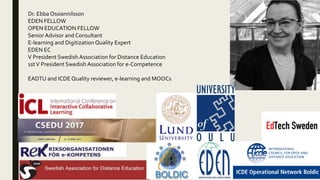
Dr. Ebba Ossiannilsson
EDEN FELLOW
OPEN EDUCATION FELLOW
Senior Advisor and Consultant
E-learning and DigitizationQuality Expert
EDEN EC
V President SwedishAssociation for Distance Education
1stV President Swedish Association for e-Competence
EADTU and ICDE Quality reviewer, e-learning and MOOCs
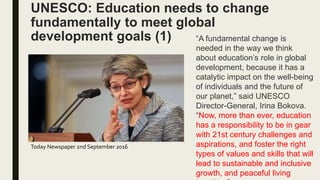
“A fundamental change is
needed in the way we think
about education’s role in global
development, because it has a
catalytic impact on the well-being
of individuals and the future of
our planet,” said UNESCO
Director-General, Irina Bokova.
“Now, more than ever, education
has a responsibility to be in gear
with 21st century challenges and
aspirations, and foster the right
types of values and skills that will
lead to sustainable and inclusive
growth, and peaceful living
UNESCO: Education needs to change
fundamentally to meet global
development goals (1)
Today Newspaper 2nd September 2016
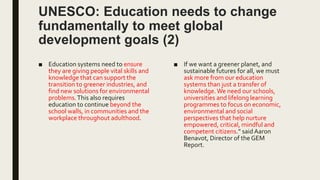
UNESCO: Education needs to change
fundamentally to meet global
development goals (2)
■ Education systems need to ensure
they are giving people vital skills and
knowledge that can support the
transition to greener industries, and
find new solutions for environmental
problems.This also requires
education to continue beyond the
school walls, in communities and the
workplace throughout adulthood.
■ If we want a greener planet, and
sustainable futures for all, we must
ask more from our education
systems than just a transfer of
knowledge.We need our schools,
universities and lifelong learning
programmes to focus on economic,
environmental and social
perspectives that help nurture
empowered, critical, mindful and
competent citizens.” said Aaron
Benavot, Director of the GEM
Report.
UNESCO
Education 2030:
The Incheon and Qingdao Declarations
Online, Open and Flexible Higher Education
for the future we want
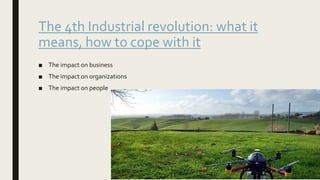
The 4th Industrial revolution: what it
means, how to cope with it
■ The impact on business
■ The impact on organizations
■ The impact on people
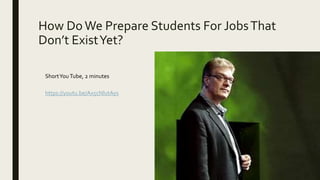
How DoWe Prepare Students For JobsThat
Don’t ExistYet?
https://youtu.be/Ax5cNlutAys
ShortYou Tube, 2 minutes
Preparing students…
■ … for changes in their professions due to
increased digitization
■ As well as in daily life as global digital
citizen
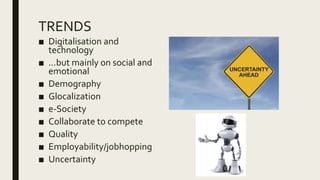
TRENDS
■ Digitalisation and
technology
■ …but mainly on social and
emotional
■ Demography
■ Glocalization
■ e-Society
■ Collaborate to compete
■ Quality
■ Employability/jobhopping
■ Uncertainty
Technology trends
■ Ubiquitous computing
■ Open data
■ Semantic search
■ Learning analytics
■ Collaborative technologies
■ Internet of things
■ Augemented reality
■ Social and emotional
■ Increased
personal learning
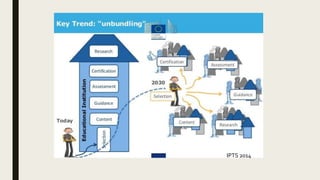
IPTS 2014
What’s the point of education if Google can tell
us anything?
UNESCO
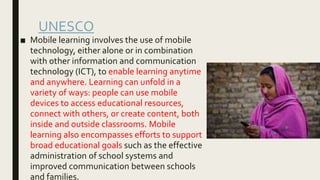
■ Mobile learning involves the use of mobile
technology, either alone or in combination
with other information and communication
technology (ICT), to enable learning anytime
and anywhere. Learning can unfold in a
variety of ways: people can use mobile
devices to access educational resources,
connect with others, or create content, both
inside and outside classrooms. Mobile
learning also encompasses efforts to support
broad educational goals such as the effective
administration of school systems and
improved communication between schools
and families.
UNESCO
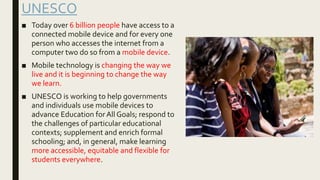
■ Today over 6 billion people have access to a
connected mobile device and for every one
person who accesses the internet from a
computer two do so from a mobile device.
■ Mobile technology is changing the way we
live and it is beginning to change the way
we learn.
■ UNESCO is working to help governments
and individuals use mobile devices to
advance Education forAll Goals; respond to
the challenges of particular educational
contexts; supplement and enrich formal
schooling; and, in general, make learning
more accessible, equitable and flexible for
students everywhere.
Mobile learning is bridging the GAP
UNESCO
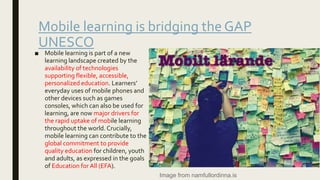
■ Mobile learning is part of a new
learning landscape created by the
availability of technologies
supporting flexible, accessible,
personalized education. Learners’
everyday uses of mobile phones and
other devices such as games
consoles, which can also be used for
learning, are now major drivers for
the rapid uptake of mobile learning
throughout the world. Crucially,
mobile learning can contribute to the
global commitment to provide
quality education for children, youth
and adults, as expressed in the goals
of Education for All (EFA).
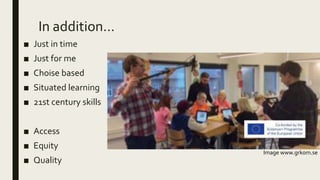
Image from namfullordinna.is
In addition…
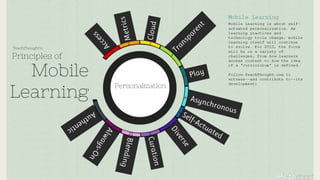
■ Just in time
■ Just for me
■ Choise based
■ Situated learning
■ 21st century skills
■ Access
■ Equity
■ Quality
Image www.grkom.se
SmartWays to Use Smartphones in Class
■ Collaborate
■ Communicate
■ Create
■ Coordinate
■ Curate/Coordinate
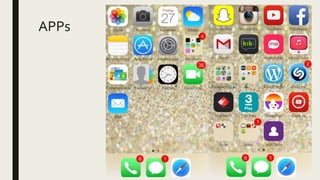
APPs
Personal vs Personalized learning
S Downes 17th February 2016
http://www.downes.ca/post/65065
■ Personal learning often begins informally, on an ad hoc basis, driven by the need to
complete some task or achieve some objective.The learning is a means to an end,
rather than the end in itself. Curricula and pedagogy are selected pragmatically. If the
need is short term and urgent, a simple learning resource may be provided. If the
person wants to understand at a deep level, then a course might be the best option.
■ Personalized learning is like being served at a restaurant. Someone else selects the
food and prepares it.There is some customization – you can tell the waiter how you
want your meat cooked – but essentially everyone at the restaurant gets the same
experience.
■ Personal learning is like shopping at a grocery store.You need to assemble the
ingredients yourself and create your own meals. It’s harder, but it’s a lot cheaper, and
you can have an endless variety of meals. Sure, you might not get the best meals
possible, but you control the experience, and you control the outcome
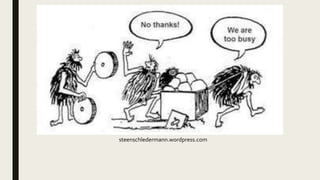
We can not educate today’s
students with methods from
the past century, for a future
we do not know anything
about.
steenschledermann.wordpress.com
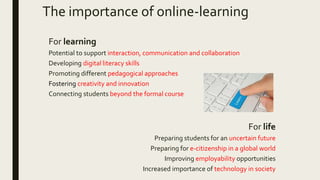
The importance of online-learning
For learning
Potential to support interaction, communication and collaboration
Developing digital literacy skills
Promoting different pedagogical approaches
Fostering creativity and innovation
Connecting students beyond the formal course
For life
Preparing students for an uncertain future
Preparing for e-citizenship in a global world
Improving employability opportunities
Increased importance of technology in society
Quality Assurance Agencies will become
sprawling education regulations
Quality Assurance Agencies will
become Increasingly irrelevant
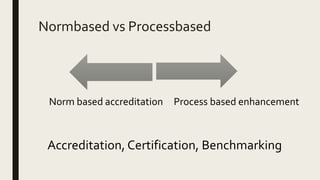
Norm based accreditation Process based enhancement
Normbased vs Processbased
Accreditation, Certification, Benchmarking
Quality is in the eye of the beholder
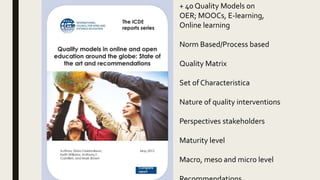
+ 40 Quality Models on
OER; MOOCs, E-learning,
Online learning
Norm Based/Process based
Quality Matrix
Set of Characteristica
Nature of quality interventions
Perspectives stakeholders
Maturity level
Macro, meso and micro level
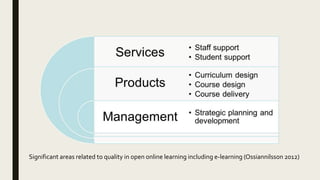
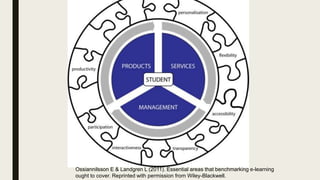
Significant areas related to quality in open online learning including e-learning (Ossiannilsson 2012)
Ossiannilsson E & Landgren L (2011). Essential areas that benchmarking e-learning
ought to cover. Reprinted with permission from Wiley-Blackwell.
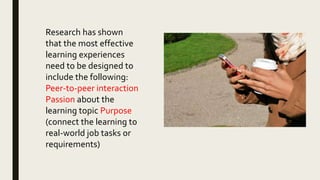
Research has shown
that the most effective
learning experiences
need to be designed to
include the following:
Peer-to-peer interaction
Passion about the
learning topic Purpose
(connect the learning to
real-world job tasks or
requirements)
Stephen Downes (2014)
Since each learner has
her/his own objectives and
success criteria, and the
success of the course
depends on each learner
meeting their own goals,
Downes (2014) offers four
key success factors for a
MOOC: autonomy,
diversity, openness and
interactivity. The success or
failure of a course depends
on how well it satisfies these
■ Framework
■ Openess to learners
■ Digital openess
■ Learner centred
■ Independent learning
■ Media supported learning
■ Quality focus
■ Spectrum of diversity
■ OpenupEd label
OpenupEd aims to be a
distinct quality brand
embracing a wide diversity of
(institutional) approaches to
open up education via the use
of MOOCs. As a
consequence, OpenupEd
partners agreed to develop a
quality label for MOOCs
tailored to both e-learning
and open education
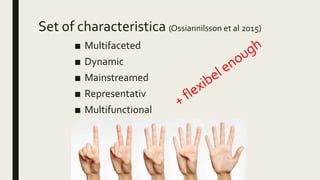
Set of characteristica (Ossiannilsson et al 2015)
■ Multifaceted
■ Dynamic
■ Mainstreamed
■ Representativ
■ Multifunctional
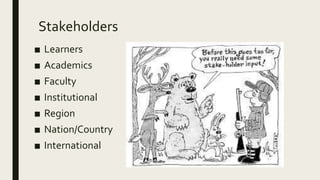
Stakeholders
■ Learners
■ Academics
■ Faculty
■ Institutional
■ Region
■ Nation/Country
■ International
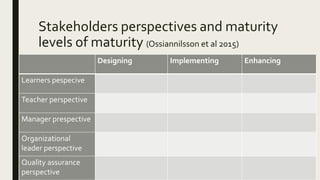
Stakeholders perspectives and maturity
levels of maturity (Ossiannilsson et al 2015)
Designing Implementing Enhancing
Learners pespecive
Teacher perspective
Manager prespective
Organizational
leader perspective
Quality assurance
perspective
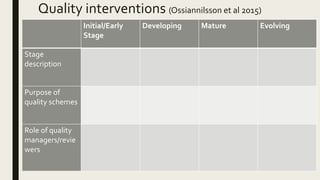
Quality interventions (Ossiannilsson et al 2015)
Initial/Early
Stage
Developing Mature Evolving
Stage
description
Purpose of
quality schemes
Role of quality
managers/revie
wers
TEL and Quality
■ Kirkwood and Price
(2016). Commonwealt of
learning
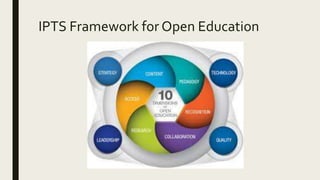
IPTS Framework for Open Education
What have we learned/can we learn from
MOOCs?
Choised based learning
Creelman, Ehlers & Ossiannilsson, 2014
C. Clark, 2013 Creative Commons: Some rights reserved
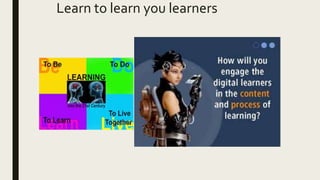
Learn to learn you learners
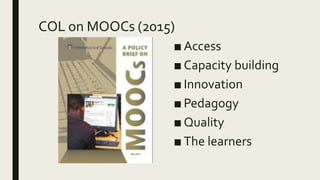
COL on MOOCs (2015)
■ Access
■ Capacity building
■ Innovation
■ Pedagogy
■ Quality
■ The learners
Business Models/vs Quality in MOOCs
What is paid by tax
money shoud be payed
back to tax payers
Democracy
Lifelong learning
GoodWill
Liberation
Teasers
SPOOCs, LOOCs,
NOOCs etc…… SUSTAINABILITY?
REG I ST RA T I O N O PEN : PREPA RI N GREG I ST RA T I O N O PEN : PREPA RI N G
H I G H ER ED U C A T I O N L EA D ERS T OH I G H ER ED U C A T I O N L EA D ERS T O
BEC O M E T H E C H A N G E M A K ER S O FBEC O M E T H E C H A N G E M A K ER S O F
T H E U N I V ERSI T Y O F T O M O RRO WT H E U N I V ERSI T Y O F T O M O RRO W
2 0 1 6 - 0 5 - 2 6 ,2 0 1 6 - 0 5 - 2 6 , Eva Szal m aEva Szal m a
D- TRANSFORMD- TRANSFORM ,, eventevent ,, out putout put ,,
The 1st D- TRANSFORM Leadership
School will t ake place in Barcelona, 14-
18 November 2016 at Universit at Obert a
de Cat alunya The 1st D- TRANSFORM leadership school will
be a unique opport unit y t o updat e leaders and senior
managers in European higher educat ion inst it ut ions wit h
knowledge, skills and at t it udes which t hey need t o have in
order t o make effect ive decisions […]
D -T RA N SFO RM PA RT N ERS M EET I ND -T RA N SFO RM PA RT N ERS M EET I N
ABO U T U SABO U T U S PART N ERSPART N ERS I ACI AC EV EN T SEV EN T S O U T PU T SO U T PU T S
LEAD ERSH I P SC H O O LSLEAD ERSH I P SC H O O LS LAN G U AG E:LAN G U AG E:
Leadership and Management
■ How do we define digital
leadership and does it
even matter?
■ Who are our digital
leaders and why are they
important?
■ What actions do these
leaders take to exploit
technologies, grow
business and influence
stakeholders?
Digital Leadership
■ Digital leadership is
the strategic use of a
company's digital
assets to achieve
business goals.
■ Digital leadership can be
addressed at both
organizational and
individual levels.
■ Changing
Paradigms for
ChangingTimes
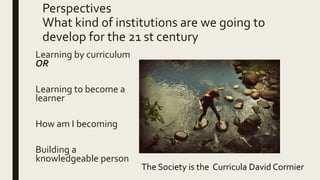
Perspectives
What kind of institutions are we going to
develop for the 21 st century
Learning by curriculum
OR
Learning to become a
learner
How am I becoming
Building a
knowledgeable person
The Society is the Curricula David Cormier
Short time impact, long time impact, and personal, social and community impact
THERE ARE MORE QUESTIONSTHAN
ANSWERS
IN CASE OF SOME ANSWERS, ITWILL CONCERN RETHINKING MOST OF
WHATWE ARE DOINGTODAY:
■ Pipeline courses
■ Curricula
■ Learning outcomes
■ Assessments
■ Leadership
■ Pedagogy vs
Padagogy
■ Roles
■ Ownership/power
■ Capacity building
■ Quality and Culture
■ Etc , etc
Rethinking quality -When the questions
are about …
■ Impact, short time impact, long time
impact, and personal, social and
community impact
■ Student engagement and
satisfaction
■ Tracing student activity and
achievements
■ Efficacy of learning
■ Interactivity
■ Knowldege, skills , capability and
competenceies as as result of
learning
■ Faculty satisfaction with their
conditions of pracice
■ Indicators of faculty engagement in
academic decison making
WHATS IN IT FOR UNIVERSITY OF NICOSIA
CYPRUS
Caring is sharing, sharing is caring
My Footprints

Unic erasmus expert_exchange2016_09_14

  • 1.
    CURRENT GLOBALTRENDSAND CHALLENGESAHEAD FOR QUALITYASSURANCEINTHE FIELD OF OPEN ONLINE LEARNINGAND ELEARNING UNIVERSITY OF NICOSIA (UNIC), CYPRUS, 11-17 SEPTEMBER 2016 DR. EBBA OSSIANNILSSON, SWEDEN Ebba Ossiannilsson@gmail.com
  • 2.
    Dr. Ebba Ossiannilsson EDENFELLOW OPEN EDUCATION FELLOW Senior Advisor and Consultant E-learning and DigitizationQuality Expert EDEN EC V President SwedishAssociation for Distance Education 1stV President Swedish Association for e-Competence EADTU and ICDE Quality reviewer, e-learning and MOOCs
  • 3.
    “A fundamental changeis needed in the way we think about education’s role in global development, because it has a catalytic impact on the well-being of individuals and the future of our planet,” said UNESCO Director-General, Irina Bokova. “Now, more than ever, education has a responsibility to be in gear with 21st century challenges and aspirations, and foster the right types of values and skills that will lead to sustainable and inclusive growth, and peaceful living UNESCO: Education needs to change fundamentally to meet global development goals (1) Today Newspaper 2nd September 2016
  • 4.
    UNESCO: Education needsto change fundamentally to meet global development goals (2) ■ Education systems need to ensure they are giving people vital skills and knowledge that can support the transition to greener industries, and find new solutions for environmental problems.This also requires education to continue beyond the school walls, in communities and the workplace throughout adulthood. ■ If we want a greener planet, and sustainable futures for all, we must ask more from our education systems than just a transfer of knowledge.We need our schools, universities and lifelong learning programmes to focus on economic, environmental and social perspectives that help nurture empowered, critical, mindful and competent citizens.” said Aaron Benavot, Director of the GEM Report.
  • 5.
    UNESCO Education 2030: The Incheonand Qingdao Declarations Online, Open and Flexible Higher Education for the future we want
  • 6.
    The 4th Industrialrevolution: what it means, how to cope with it ■ The impact on business ■ The impact on organizations ■ The impact on people
  • 7.
    How DoWe PrepareStudents For JobsThat Don’t ExistYet? https://youtu.be/Ax5cNlutAys ShortYou Tube, 2 minutes
  • 8.
    Preparing students… ■ …for changes in their professions due to increased digitization ■ As well as in daily life as global digital citizen
  • 9.
    TRENDS ■ Digitalisation and technology ■…but mainly on social and emotional ■ Demography ■ Glocalization ■ e-Society ■ Collaborate to compete ■ Quality ■ Employability/jobhopping ■ Uncertainty
  • 10.
    Technology trends ■ Ubiquitouscomputing ■ Open data ■ Semantic search ■ Learning analytics ■ Collaborative technologies ■ Internet of things ■ Augemented reality ■ Social and emotional ■ Increased personal learning
  • 11.
  • 12.
    What’s the pointof education if Google can tell us anything?
  • 13.
    UNESCO ■ Mobile learninginvolves the use of mobile technology, either alone or in combination with other information and communication technology (ICT), to enable learning anytime and anywhere. Learning can unfold in a variety of ways: people can use mobile devices to access educational resources, connect with others, or create content, both inside and outside classrooms. Mobile learning also encompasses efforts to support broad educational goals such as the effective administration of school systems and improved communication between schools and families.
  • 14.
    UNESCO ■ Today over6 billion people have access to a connected mobile device and for every one person who accesses the internet from a computer two do so from a mobile device. ■ Mobile technology is changing the way we live and it is beginning to change the way we learn. ■ UNESCO is working to help governments and individuals use mobile devices to advance Education forAll Goals; respond to the challenges of particular educational contexts; supplement and enrich formal schooling; and, in general, make learning more accessible, equitable and flexible for students everywhere.
  • 15.
    Mobile learning isbridging the GAP UNESCO ■ Mobile learning is part of a new learning landscape created by the availability of technologies supporting flexible, accessible, personalized education. Learners’ everyday uses of mobile phones and other devices such as games consoles, which can also be used for learning, are now major drivers for the rapid uptake of mobile learning throughout the world. Crucially, mobile learning can contribute to the global commitment to provide quality education for children, youth and adults, as expressed in the goals of Education for All (EFA). Image from namfullordinna.is
  • 17.
    In addition… ■ Justin time ■ Just for me ■ Choise based ■ Situated learning ■ 21st century skills ■ Access ■ Equity ■ Quality Image www.grkom.se
  • 18.
    SmartWays to UseSmartphones in Class ■ Collaborate ■ Communicate ■ Create ■ Coordinate ■ Curate/Coordinate
  • 19.
  • 20.
    Personal vs Personalizedlearning S Downes 17th February 2016 http://www.downes.ca/post/65065 ■ Personal learning often begins informally, on an ad hoc basis, driven by the need to complete some task or achieve some objective.The learning is a means to an end, rather than the end in itself. Curricula and pedagogy are selected pragmatically. If the need is short term and urgent, a simple learning resource may be provided. If the person wants to understand at a deep level, then a course might be the best option. ■ Personalized learning is like being served at a restaurant. Someone else selects the food and prepares it.There is some customization – you can tell the waiter how you want your meat cooked – but essentially everyone at the restaurant gets the same experience. ■ Personal learning is like shopping at a grocery store.You need to assemble the ingredients yourself and create your own meals. It’s harder, but it’s a lot cheaper, and you can have an endless variety of meals. Sure, you might not get the best meals possible, but you control the experience, and you control the outcome
  • 21.
    We can noteducate today’s students with methods from the past century, for a future we do not know anything about.
  • 22.
  • 23.
    The importance ofonline-learning For learning Potential to support interaction, communication and collaboration Developing digital literacy skills Promoting different pedagogical approaches Fostering creativity and innovation Connecting students beyond the formal course For life Preparing students for an uncertain future Preparing for e-citizenship in a global world Improving employability opportunities Increased importance of technology in society
  • 24.
    Quality Assurance Agencieswill become sprawling education regulations Quality Assurance Agencies will become Increasingly irrelevant
  • 25.
    Norm based accreditationProcess based enhancement Normbased vs Processbased Accreditation, Certification, Benchmarking
  • 26.
    Quality is inthe eye of the beholder
  • 27.
    + 40 QualityModels on OER; MOOCs, E-learning, Online learning Norm Based/Process based Quality Matrix Set of Characteristica Nature of quality interventions Perspectives stakeholders Maturity level Macro, meso and micro level
  • 28.
    Significant areas relatedto quality in open online learning including e-learning (Ossiannilsson 2012)
  • 29.
    Ossiannilsson E &Landgren L (2011). Essential areas that benchmarking e-learning ought to cover. Reprinted with permission from Wiley-Blackwell.
  • 30.
    Research has shown thatthe most effective learning experiences need to be designed to include the following: Peer-to-peer interaction Passion about the learning topic Purpose (connect the learning to real-world job tasks or requirements)
  • 31.
    Stephen Downes (2014) Sinceeach learner has her/his own objectives and success criteria, and the success of the course depends on each learner meeting their own goals, Downes (2014) offers four key success factors for a MOOC: autonomy, diversity, openness and interactivity. The success or failure of a course depends on how well it satisfies these
  • 33.
    ■ Framework ■ Openessto learners ■ Digital openess ■ Learner centred ■ Independent learning ■ Media supported learning ■ Quality focus ■ Spectrum of diversity ■ OpenupEd label OpenupEd aims to be a distinct quality brand embracing a wide diversity of (institutional) approaches to open up education via the use of MOOCs. As a consequence, OpenupEd partners agreed to develop a quality label for MOOCs tailored to both e-learning and open education
  • 34.
    Set of characteristica(Ossiannilsson et al 2015) ■ Multifaceted ■ Dynamic ■ Mainstreamed ■ Representativ ■ Multifunctional
  • 35.
    Stakeholders ■ Learners ■ Academics ■Faculty ■ Institutional ■ Region ■ Nation/Country ■ International
  • 36.
    Stakeholders perspectives andmaturity levels of maturity (Ossiannilsson et al 2015) Designing Implementing Enhancing Learners pespecive Teacher perspective Manager prespective Organizational leader perspective Quality assurance perspective
  • 37.
    Quality interventions (Ossiannilssonet al 2015) Initial/Early Stage Developing Mature Evolving Stage description Purpose of quality schemes Role of quality managers/revie wers
  • 38.
    TEL and Quality ■Kirkwood and Price (2016). Commonwealt of learning
  • 39.
    IPTS Framework forOpen Education
  • 40.
    What have welearned/can we learn from MOOCs? Choised based learning Creelman, Ehlers & Ossiannilsson, 2014
  • 41.
    C. Clark, 2013Creative Commons: Some rights reserved
  • 42.
    Learn to learnyou learners
  • 43.
    COL on MOOCs(2015) ■ Access ■ Capacity building ■ Innovation ■ Pedagogy ■ Quality ■ The learners
  • 44.
    Business Models/vs Qualityin MOOCs What is paid by tax money shoud be payed back to tax payers Democracy Lifelong learning GoodWill Liberation Teasers SPOOCs, LOOCs, NOOCs etc…… SUSTAINABILITY?
  • 46.
    REG I STRA T I O N O PEN : PREPA RI N GREG I ST RA T I O N O PEN : PREPA RI N G H I G H ER ED U C A T I O N L EA D ERS T OH I G H ER ED U C A T I O N L EA D ERS T O BEC O M E T H E C H A N G E M A K ER S O FBEC O M E T H E C H A N G E M A K ER S O F T H E U N I V ERSI T Y O F T O M O RRO WT H E U N I V ERSI T Y O F T O M O RRO W 2 0 1 6 - 0 5 - 2 6 ,2 0 1 6 - 0 5 - 2 6 , Eva Szal m aEva Szal m a D- TRANSFORMD- TRANSFORM ,, eventevent ,, out putout put ,, The 1st D- TRANSFORM Leadership School will t ake place in Barcelona, 14- 18 November 2016 at Universit at Obert a de Cat alunya The 1st D- TRANSFORM leadership school will be a unique opport unit y t o updat e leaders and senior managers in European higher educat ion inst it ut ions wit h knowledge, skills and at t it udes which t hey need t o have in order t o make effect ive decisions […] D -T RA N SFO RM PA RT N ERS M EET I ND -T RA N SFO RM PA RT N ERS M EET I N ABO U T U SABO U T U S PART N ERSPART N ERS I ACI AC EV EN T SEV EN T S O U T PU T SO U T PU T S LEAD ERSH I P SC H O O LSLEAD ERSH I P SC H O O LS LAN G U AG E:LAN G U AG E:
  • 47.
    Leadership and Management ■How do we define digital leadership and does it even matter? ■ Who are our digital leaders and why are they important? ■ What actions do these leaders take to exploit technologies, grow business and influence stakeholders?
  • 48.
    Digital Leadership ■ Digitalleadership is the strategic use of a company's digital assets to achieve business goals. ■ Digital leadership can be addressed at both organizational and individual levels. ■ Changing Paradigms for ChangingTimes
  • 49.
    Perspectives What kind ofinstitutions are we going to develop for the 21 st century Learning by curriculum OR Learning to become a learner How am I becoming Building a knowledgeable person The Society is the Curricula David Cormier
  • 51.
    Short time impact,long time impact, and personal, social and community impact
  • 52.
    THERE ARE MOREQUESTIONSTHAN ANSWERS IN CASE OF SOME ANSWERS, ITWILL CONCERN RETHINKING MOST OF WHATWE ARE DOINGTODAY: ■ Pipeline courses ■ Curricula ■ Learning outcomes ■ Assessments ■ Leadership ■ Pedagogy vs Padagogy ■ Roles ■ Ownership/power ■ Capacity building ■ Quality and Culture ■ Etc , etc
  • 53.
    Rethinking quality -Whenthe questions are about … ■ Impact, short time impact, long time impact, and personal, social and community impact ■ Student engagement and satisfaction ■ Tracing student activity and achievements ■ Efficacy of learning ■ Interactivity ■ Knowldege, skills , capability and competenceies as as result of learning ■ Faculty satisfaction with their conditions of pracice ■ Indicators of faculty engagement in academic decison making WHATS IN IT FOR UNIVERSITY OF NICOSIA CYPRUS
  • 54.
    Caring is sharing,sharing is caring My Footprints

Editor's Notes

  • #55 As my strong believe caring is sharing So my footprints and contact details My slides are available at slidshare where you can find my other presentations as well