










How to use technology in Education?

  Delhi Workshop - 23rd Dec 2011
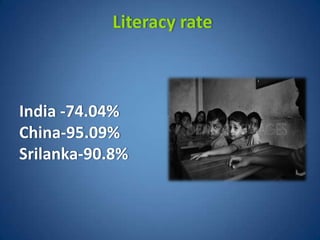
Literacy rate


India -74.04%
China-95.09%
Srilanka-90.8%
44% of children in India between
age 7 to 10 years could not even
read a simple paragraph.
(Annual status of education 2006)
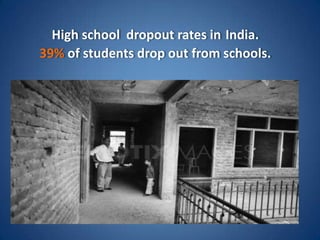
High school dropout rates in India.
39% of students drop out from schools.
Reasons for school dropouts of age
          5 to 14 years.
    Children not interested in studies.(37%)
    Parents not interested in child's education.(17%)
    Inability to cope up with studies.(11%)
    Work for wages.(5.6%)
    Participation in economic activities.(7.2%)
    Attend domestic duties.(6.3%)
    Financial constraints.(11.2%)
    Others(4.7%)
Addressing the Problem
 Use of innovating methods like story telling ,dancing, music and games.
 Child friendly and child centric school environment.
 Proactive teaching through use of audio visual aids.
 Assessing overall development of a child through merits given for every positive
step taken.
 Extra classes and tuitions
 Building child's self esteem ,confidence and satisfaction through points for extra
curricular activities.
 More practice and revision time for students with learning disorders.
 Economic support like scholarships, library facilities and rewards
 Better student teacher relationship.
 Teaching in the language understood by the students.
“….changing the environment or the
 approach taken by child's caretaker is
 more powerful than individual
 counseling and therapy for children”
Education is the manifestation of the
perfection already in man.
                  - Swami Vivekananda
Solution to the problem

   Motivating the child.
   Making education more practical oriented.
   Stress upon parents the importance of education
    and schooling.
   Free education to the needy.
   Proper use of technology.
   Assessing overall performance of the child
   Teaching in the language understood by the
    child.
   Better student teacher relationship .
World Has Moved On. Education
            System Hasn’t.


• New types of industries (eg. Nano technology)
• New kinds of jobs (eg: social media
  consultants)
• Different skill sets required (eg: creativity,
  critical thinking, collaborative skills)
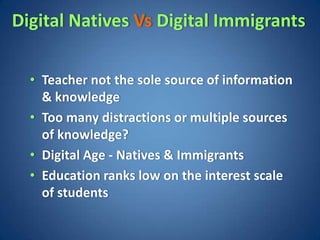
Digital Natives Vs Digital Immigrants

  • Teacher not the sole source of information
    & knowledge
  • Too many distractions or multiple sources
    of knowledge?
  • Digital Age - Natives & Immigrants
  • Education ranks low on the interest scale
    of students
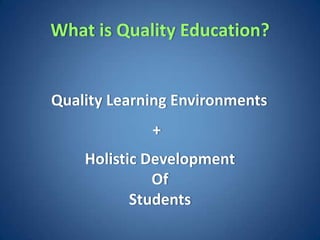
What is Quality Education?


Quality Learning Environments
             +
    Holistic Development
              Of
           Students
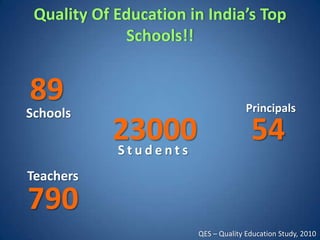
Quality Of Education in India’s Top
             Schools!!


89                                   Principals
Schools
           23000
           Students
                                      54
Teachers

790
                       QES – Quality Education Study, 2010
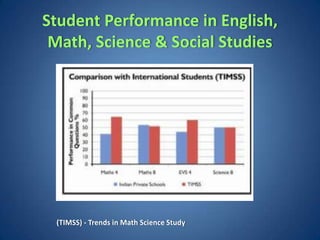
Student Performance in English,
 Math, Science & Social Studies


 (TIMSS) - Trends in Math Science Study
Student Performance in English,
 Math, Science & Social Studies


(SLIMS) – Student learning in metros study
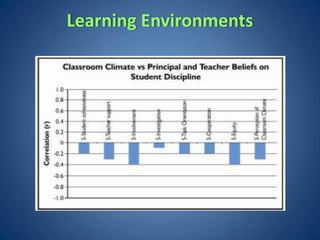
Learning Environments

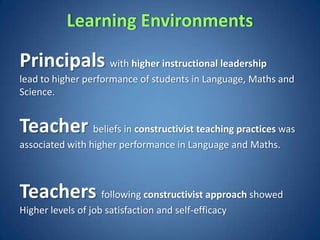
Principals with higher instructional leadership
lead to higher performance of students in Language, Maths and
Science.


Teacher beliefs in constructivist teaching practices was
associated with higher performance in Language and Maths.


Teachers following constructivist approach showed
Higher levels of job satisfaction and self-efficacy
Learning Environments


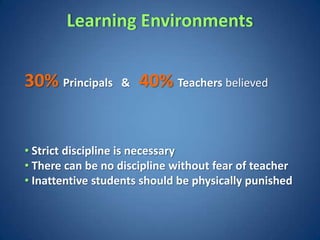
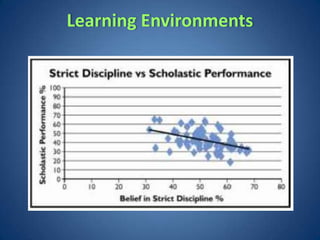
30% Principals    &   40% Teachers believed


• Strict discipline is necessary
• There can be no discipline without fear of teacher
• Inattentive students should be physically punished
Learning Environments
Key Messages From The Study


• Students in ‘Top Schools’ exhibit rote learning.
• Some students exhibit bias on issues of gender
  equality, acceptance of cultural/religious
  diversity.
• Principal’s instructional leadership & Teacher’s
  beliefs in constructivist learning practices has a
  positive impact on student performance
Teachers

• Availability of good quality teachers
• How do you help teachers improve?
• Stagnation in teachers’ growth after many
  years!!
• How do teachers bridge the disconnect with
  students of this digital age?
• How can teachers do more with less time?
E m p o w e r


HOW?
                         Engage
         I n v o l v e
Role of Technology in Education
Technology In Education

• How to use Technology to enable good quality
  education? Not replace teachers!!
• How to integrate Technology in a learning
  environment? Not as a supplementary, non-
  essential tool!!
• How to use Technology to aid in new learning
  methodologies and pedagogies?
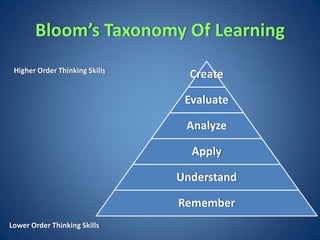
Bloom’s Taxonomy Of Learning
 Higher Order Thinking Skills
                                  Create

                                 Evaluate

                                 Analyze

                                  Apply

                                Understand

                                Remember
Lower Order Thinking Skills
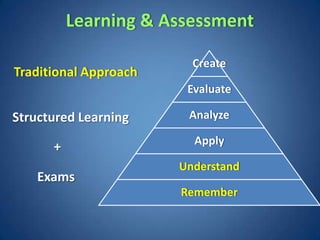
Learning & Assessment

                         Create
Traditional Approach
                        Evaluate

Structured Learning     Analyze

                         Apply
      +
                       Understand
    Exams
                       Remember
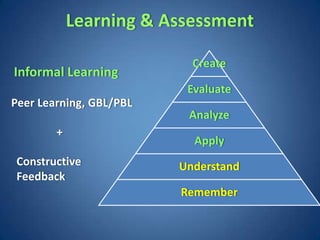
Learning & Assessment

                           Create
Informal Learning
                          Evaluate
Peer Learning, GBL/PBL
                          Analyze
        +
                           Apply
Constructive             Understand
Feedback
                         Remember
New age Methodologies
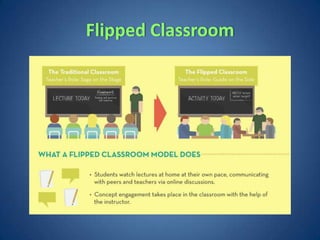
Flipped Classroom
Flipped Classroom
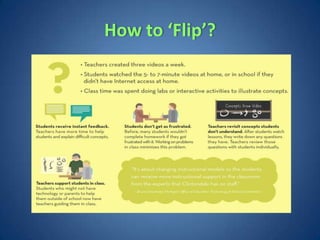
How to ‘Flip’?
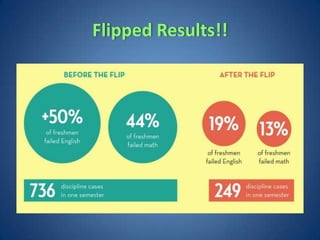
Flipped Results!!
Advantages of “Flipping” it


• Students learn at their own pace
• Learning is reinforced in class with practical
  applications with help of the teacher
• Enough time for teachers to pay attention to
  all kinds of learners in class
• Reuse content created for the class
Game Based Learning
Game-Based Learning (GBL)

• Using Game Design principles to provide a
  game like learning experience to students.
• Or using games to provide a learning
  experience.
• Or asking students to create their own games
  through activities like creating characters,
  defining rules of the game, mapping actions
  with results and testing the game.
Project Based Learning
Tools
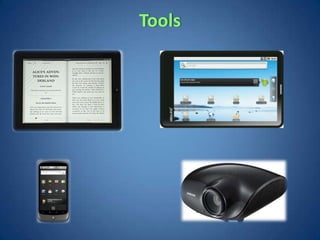
Tools
Tools for help
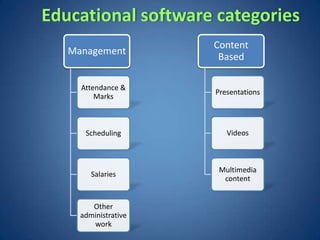
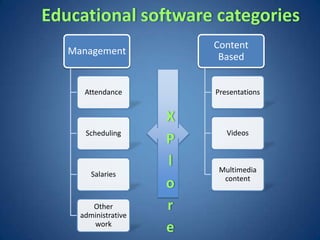
Educational software categories
                      Content
   Management
                       Based

     Attendance &
                      Presentations
         Marks


      Scheduling         Videos


                       Multimedia
        Salaries
                        content


        Other
     administrative
        work
Educational software categories
                          Content
   Management
                           Based


      Attendance          Presentations


                      X
      Scheduling             Videos
                      P
                      l    Multimedia
        Salaries
                            content
                      o
        Other         r
     administrative
        work
                      e
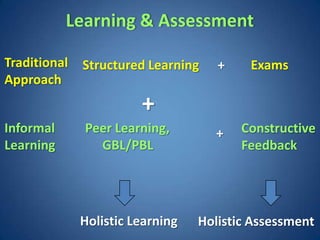
Learning & Assessment

Traditional   Structured Learning    +    Exams
Approach
                        +
Informal      Peer Learning,         +   Constructive
Learning        GBL/PBL                  Feedback


              Holistic Learning   Holistic Assessment
- A Social Learning Network


“A Social Learning Platform that seeks
to make learning Fun, Engaging &
Social! ”
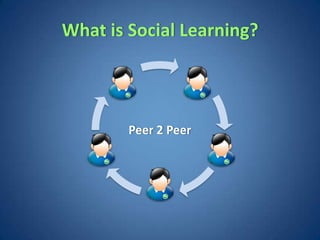
What is Social Learning?


        Peer 2 Peer
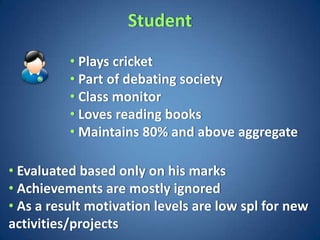
Student

          • Plays cricket
          • Part of debating society
          • Class monitor
          • Loves reading books
          • Maintains 80% and above aggregate

• Evaluated based only on his marks
• Achievements are mostly ignored
• As a result motivation levels are low spl for new
activities/projects
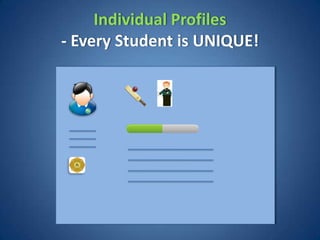
Individual Profiles
- Every Student is UNIQUE!
Teachers


• Able recognize only the TOP 3 achievers

• Only academic achievements are recognized

• Delay in recognition
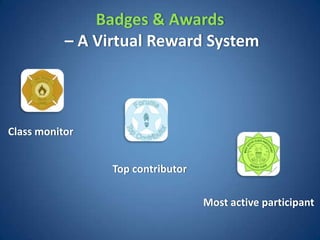
Badges & Awards
           – A Virtual Reward System


Class monitor


                 Top contributor

                                   Most active participant
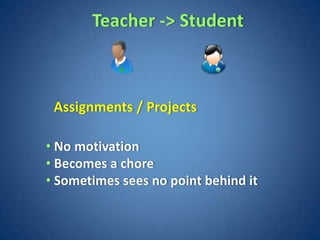
Teacher -> Student


 Assignments / Projects

• No motivation
• Becomes a chore
• Sometimes sees no point behind it
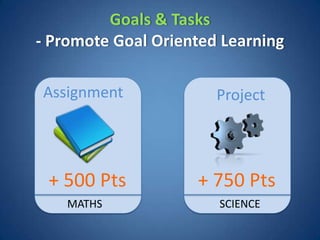
Goals & Tasks
- Promote Goal Oriented Learning

Assignment             Project

      d


 + 500 Pts          + 750 Pts
    MATHS              SCIENCE
Resource Hub
- Share & Engage with Rich Content


        Resource Hub
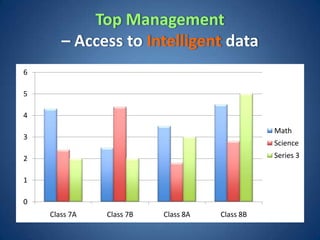
Top Management
       – Access to Intelligent data
6

5

4
                                                Math
3
                                                Science
2                                               Series 3


1

0
    Class 7A   Class 7B   Class 8A   Class 8B
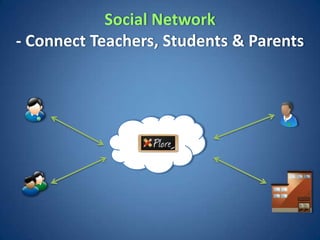
Social Network
- Connect Teachers, Students & Parents
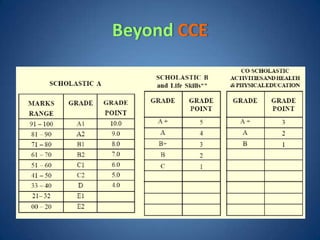
Beyond CCE
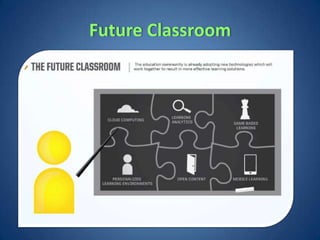
Future Classroom
Thank You

Education - Problems, Possible solutions, Technology aids & XPlore

  • 1.
    How to usetechnology in Education? Delhi Workshop - 23rd Dec 2011
  • 2.
  • 3.
    44% of childrenin India between age 7 to 10 years could not even read a simple paragraph. (Annual status of education 2006)
  • 4.
    High school dropoutrates in India. 39% of students drop out from schools.
  • 5.
    Reasons for schooldropouts of age 5 to 14 years.  Children not interested in studies.(37%)  Parents not interested in child's education.(17%)  Inability to cope up with studies.(11%)  Work for wages.(5.6%)  Participation in economic activities.(7.2%)  Attend domestic duties.(6.3%)  Financial constraints.(11.2%)  Others(4.7%)
  • 6.
    Addressing the Problem Use of innovating methods like story telling ,dancing, music and games.  Child friendly and child centric school environment.  Proactive teaching through use of audio visual aids.  Assessing overall development of a child through merits given for every positive step taken.  Extra classes and tuitions  Building child's self esteem ,confidence and satisfaction through points for extra curricular activities.  More practice and revision time for students with learning disorders.  Economic support like scholarships, library facilities and rewards  Better student teacher relationship.  Teaching in the language understood by the students.
  • 7.
    “….changing the environmentor the approach taken by child's caretaker is more powerful than individual counseling and therapy for children”
  • 8.
    Education is themanifestation of the perfection already in man. - Swami Vivekananda
  • 9.
    Solution to theproblem  Motivating the child.  Making education more practical oriented.  Stress upon parents the importance of education and schooling.  Free education to the needy.  Proper use of technology.  Assessing overall performance of the child  Teaching in the language understood by the child.  Better student teacher relationship .
  • 10.
    World Has MovedOn. Education System Hasn’t. • New types of industries (eg. Nano technology) • New kinds of jobs (eg: social media consultants) • Different skill sets required (eg: creativity, critical thinking, collaborative skills)
  • 11.
    Digital Natives VsDigital Immigrants • Teacher not the sole source of information & knowledge • Too many distractions or multiple sources of knowledge? • Digital Age - Natives & Immigrants • Education ranks low on the interest scale of students
  • 12.
    What is QualityEducation? Quality Learning Environments + Holistic Development Of Students
  • 13.
    Quality Of Educationin India’s Top Schools!! 89 Principals Schools 23000 Students 54 Teachers 790 QES – Quality Education Study, 2010
  • 14.
    Student Performance inEnglish, Math, Science & Social Studies (TIMSS) - Trends in Math Science Study
  • 15.
    Student Performance inEnglish, Math, Science & Social Studies (SLIMS) – Student learning in metros study
  • 16.
    Learning Environments Principals withhigher instructional leadership lead to higher performance of students in Language, Maths and Science. Teacher beliefs in constructivist teaching practices was associated with higher performance in Language and Maths. Teachers following constructivist approach showed Higher levels of job satisfaction and self-efficacy
  • 17.
    Learning Environments 30% Principals & 40% Teachers believed • Strict discipline is necessary • There can be no discipline without fear of teacher • Inattentive students should be physically punished
  • 18.
  • 19.
  • 20.
    Key Messages FromThe Study • Students in ‘Top Schools’ exhibit rote learning. • Some students exhibit bias on issues of gender equality, acceptance of cultural/religious diversity. • Principal’s instructional leadership & Teacher’s beliefs in constructivist learning practices has a positive impact on student performance
  • 21.
    Teachers • Availability ofgood quality teachers • How do you help teachers improve? • Stagnation in teachers’ growth after many years!! • How do teachers bridge the disconnect with students of this digital age? • How can teachers do more with less time?
  • 22.
    E m po w e r HOW? Engage I n v o l v e
  • 23.
    Role of Technologyin Education
  • 24.
    Technology In Education •How to use Technology to enable good quality education? Not replace teachers!! • How to integrate Technology in a learning environment? Not as a supplementary, non- essential tool!! • How to use Technology to aid in new learning methodologies and pedagogies?
  • 25.
    Bloom’s Taxonomy OfLearning Higher Order Thinking Skills Create Evaluate Analyze Apply Understand Remember Lower Order Thinking Skills
  • 26.
    Learning & Assessment Create Traditional Approach Evaluate Structured Learning Analyze Apply + Understand Exams Remember
  • 27.
    Learning & Assessment Create Informal Learning Evaluate Peer Learning, GBL/PBL Analyze + Apply Constructive Understand Feedback Remember
  • 28.
  • 29.
  • 30.
  • 31.
  • 32.
  • 34.
    Advantages of “Flipping”it • Students learn at their own pace • Learning is reinforced in class with practical applications with help of the teacher • Enough time for teachers to pay attention to all kinds of learners in class • Reuse content created for the class
  • 35.
  • 36.
    Game-Based Learning (GBL) •Using Game Design principles to provide a game like learning experience to students. • Or using games to provide a learning experience. • Or asking students to create their own games through activities like creating characters, defining rules of the game, mapping actions with results and testing the game.
  • 38.
  • 40.
  • 41.
  • 42.
  • 44.
    Educational software categories Content Management Based Attendance & Presentations Marks Scheduling Videos Multimedia Salaries content Other administrative work
  • 45.
    Educational software categories Content Management Based Attendance Presentations X Scheduling Videos P l Multimedia Salaries content o Other r administrative work e
  • 46.
    Learning & Assessment Traditional Structured Learning + Exams Approach + Informal Peer Learning, + Constructive Learning GBL/PBL Feedback Holistic Learning Holistic Assessment
  • 47.
    - A SocialLearning Network “A Social Learning Platform that seeks to make learning Fun, Engaging & Social! ”
  • 48.
    What is SocialLearning? Peer 2 Peer
  • 49.
    Student • Plays cricket • Part of debating society • Class monitor • Loves reading books • Maintains 80% and above aggregate • Evaluated based only on his marks • Achievements are mostly ignored • As a result motivation levels are low spl for new activities/projects
  • 50.
    Individual Profiles - EveryStudent is UNIQUE!
  • 51.
    Teachers • Able recognizeonly the TOP 3 achievers • Only academic achievements are recognized • Delay in recognition
  • 52.
    Badges & Awards – A Virtual Reward System Class monitor Top contributor Most active participant
  • 53.
    Teacher -> Student Assignments / Projects • No motivation • Becomes a chore • Sometimes sees no point behind it
  • 54.
    Goals & Tasks -Promote Goal Oriented Learning Assignment Project d + 500 Pts + 750 Pts MATHS SCIENCE
  • 55.
    Resource Hub - Share& Engage with Rich Content Resource Hub
  • 56.
    Top Management – Access to Intelligent data 6 5 4 Math 3 Science 2 Series 3 1 0 Class 7A Class 7B Class 8A Class 8B
  • 57.
    Social Network - ConnectTeachers, Students & Parents
  • 58.
  • 59.
  • 60.

Editor's Notes

  • #15 Performance is lower when compared to International standardsDrop in learning levels from the previous SLIMS (2006) studyPractical competencies (map reading, using good language while writing, general knowledge) not well developed
  • #16 Performance is lower when compared to International standardsDrop in learning levels from the previous SLIMS (2006) studyPractical competencies (map reading, using good language while writing, general knowledge) not well developed
  • #23 How do we empower teachers?How do we engage children??How do we involve parents ??
  • #50 Meet the student.He loves to play cricket, part of the debating society, he is the class monitor and loves reading books. Right now some of his achievements and interests are not given enough recognition. Hence sometimes the child feels demotivated in general to try out new things.
  • #51 Every child is unique and should be treated that way. Highlight there achievements though profile pages which serves as a visual Feedback of ones achievements and progress in the institution. 1)Talk about traditional approach and how the focus is on exams only. This leads to ignoring a child’s achievements other than scholastic ones. 2) All current softwares still treats students as mere numbers and not unique individuals.3) Xplore captures all data scholatic and non scholastic!4) Give one example
  • #53 Combine with flipped classroom.
  • #54 Scenario where a child gets an assignment and find it boring and less interestingWith softwares its still the same assignment. Its just digital. How do we make it more interesting? And make a child want to do the assignment!
  • #55 Traditional way more interesting + GBL + PBLIts more about what you learn from that activity. And not about just getting marks!
  • #57 If you have a chain of schools.