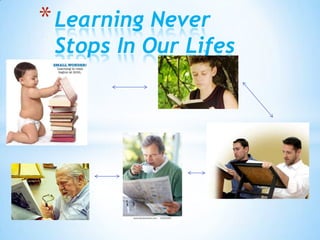
* Learning Never
 Stops In Our Lifes
Lifelong Learning is all
learning activity
undertaken throughout
life, whether formal or
informal
The concept is closely
linked to continuous
education and to
continuing education
and continuing
professional
development
Henry Ford once said ‘’Anyone who stops learning is
old, whether at twenty or eighty. Anyone who keeps
learning stays young . The most important thing in our
life is to keep our mind young.’’
   Lifelong learning is Wikipedia’s defines. It could be
Formal and informal.
*
Informal learning is one of three forms of learning defined by the
OECD. The other two are formal and non-formal learning. Informal
learning occurs in a variety of places, such as at home, work, and
through daily interactions. For many learners this includes language
acquisition, cultural norms and manners.
In the context of corporate training and education, the term informal
learning is widely used to describe the many forms of learning that
takes place independently from books, self-study
programs, performance support materials and systems.
* OECD   OECD


There are five key features of the lifelong learning approach, as conceived by
the OECD. First, it offers a systemic view of learning, since it examines the
demand for, and the supply of, learning opportunities, as part of a connected
system covering the whole lifecycle and comprising all forms of formal and
informal learning. Secondly, it emphasises the centrality of the learner and
the need for initiatives that cater for the diversity of learner needs.
*
To fully understand informal learning it is useful to define
the terms "formal" and "non-formal" education. Merriam
and others (2007), state: "The term non-formal has been
used most often to describe organized learning outside of
the formal education system. These offerings tend to be
short-term, voluntary, and have few if any prerequisites.
However they typically have a curriculum and often a
facilitator" (p. 30). Non-formal learning can also include
learning in the formal arena when concepts are adapted to
the unique needs of individual students (Burlin, 2009).
*
    Lifelong learning is the development of
    human potential through a continuously
    supportive process which stimulates and
    empowers individuals to acquire all the
    knowledge, values, skills, and
    understanding they will require throughout
    their lifetimes and to apply them with
    confidence, creativity and enjoyment in all
    roles, circumstances, and environments
We live in the knowledge age, which means that
the ability to apply the right knowledge
effectively is an important skill and the
cornerstone of our success. If you ever doubt
the strength of knowledge and learning, just ask
someone who hasn't used a computer in ten
years to find an article on the Internet.
Learning makes us more interesting. Knowledge enables a
different perspective, fascinating conversation and a deeper
understanding. It makes us a better people, allows us to make
better, informed decisions, and assists us in becoming more
successful in our careers.
Today with less defined
changes in life roles there is
need for new strategies to
motivate lifelong learning.


Age 0-5 years
In this age group, a lot of learning takes
place, providing a foundation for future learning
habits. This is probably the age group where the
greatest amount of informal learning occurs, as
children imitate almost everything from parents, peers
and their environment. Learning in this stage affects
the development of all other learning abilities later in
life.
*
Learning in the 6 – 24 age group
 primarily takes place in
educational institutions,
from primary and secondary
to tertiary levels. Family life,
 social organizations and
religious institutions can also play a role
 in non-formal and informal learning during this time. The objective of
learning in
 this period is the holistic
development of learners in
four aspects, namely: physical,
 intellectual, social
capacity, emotional
and mental development.
*
    Individuals in the 25 – 60 age
    group can learn informally
    during their working lives
    through the use of
    instructional media, mostly
    from their occupations, work-
    places, colleagues, touring, m
    ass media, information
    technologies, environment and
    nature. Adults learn from
    experiences and problem
    solving. They therefore need
    continuous development of
    intellect, capability and
    integrity
The challenge of seeking
new knowledge and teaching
themselves may result in a
sense of pride of accomplishment
and help maintain self-esteem.
*
Let’s step back a
moment and look
at the context we
all find ourselves
in and the
challenges we
face.
First , everyone
  of us recognizes
  that today’s kids
     , our students
     , are different
 from most of us .
 They have a new
       vernacular-a
digital vernacular.
                       *
*
*
*
*
*
*
*The
end

Lifelong learning

  • 1.
    * Learning Never Stops In Our Lifes
  • 2.
    Lifelong Learning isall learning activity undertaken throughout life, whether formal or informal The concept is closely linked to continuous education and to continuing education and continuing professional development
  • 3.
    Henry Ford oncesaid ‘’Anyone who stops learning is old, whether at twenty or eighty. Anyone who keeps learning stays young . The most important thing in our life is to keep our mind young.’’ Lifelong learning is Wikipedia’s defines. It could be Formal and informal.
  • 4.
    * Informal learning isone of three forms of learning defined by the OECD. The other two are formal and non-formal learning. Informal learning occurs in a variety of places, such as at home, work, and through daily interactions. For many learners this includes language acquisition, cultural norms and manners. In the context of corporate training and education, the term informal learning is widely used to describe the many forms of learning that takes place independently from books, self-study programs, performance support materials and systems.
  • 5.
    * OECD OECD There are five key features of the lifelong learning approach, as conceived by the OECD. First, it offers a systemic view of learning, since it examines the demand for, and the supply of, learning opportunities, as part of a connected system covering the whole lifecycle and comprising all forms of formal and informal learning. Secondly, it emphasises the centrality of the learner and the need for initiatives that cater for the diversity of learner needs.
  • 6.
    * To fully understandinformal learning it is useful to define the terms "formal" and "non-formal" education. Merriam and others (2007), state: "The term non-formal has been used most often to describe organized learning outside of the formal education system. These offerings tend to be short-term, voluntary, and have few if any prerequisites. However they typically have a curriculum and often a facilitator" (p. 30). Non-formal learning can also include learning in the formal arena when concepts are adapted to the unique needs of individual students (Burlin, 2009).
  • 7.
    * Lifelong learning is the development of human potential through a continuously supportive process which stimulates and empowers individuals to acquire all the knowledge, values, skills, and understanding they will require throughout their lifetimes and to apply them with confidence, creativity and enjoyment in all roles, circumstances, and environments
  • 8.
    We live inthe knowledge age, which means that the ability to apply the right knowledge effectively is an important skill and the cornerstone of our success. If you ever doubt the strength of knowledge and learning, just ask someone who hasn't used a computer in ten years to find an article on the Internet.
  • 9.
    Learning makes usmore interesting. Knowledge enables a different perspective, fascinating conversation and a deeper understanding. It makes us a better people, allows us to make better, informed decisions, and assists us in becoming more successful in our careers.
  • 10.
    Today with lessdefined changes in life roles there is need for new strategies to motivate lifelong learning. Age 0-5 years In this age group, a lot of learning takes place, providing a foundation for future learning habits. This is probably the age group where the greatest amount of informal learning occurs, as children imitate almost everything from parents, peers and their environment. Learning in this stage affects the development of all other learning abilities later in life.
  • 11.
    * Learning in the6 – 24 age group primarily takes place in educational institutions, from primary and secondary to tertiary levels. Family life, social organizations and religious institutions can also play a role in non-formal and informal learning during this time. The objective of learning in this period is the holistic development of learners in four aspects, namely: physical, intellectual, social capacity, emotional and mental development.
  • 12.
    * Individuals in the 25 – 60 age group can learn informally during their working lives through the use of instructional media, mostly from their occupations, work- places, colleagues, touring, m ass media, information technologies, environment and nature. Adults learn from experiences and problem solving. They therefore need continuous development of intellect, capability and integrity
  • 13.
    The challenge ofseeking new knowledge and teaching themselves may result in a sense of pride of accomplishment and help maintain self-esteem.
  • 14.
    * Let’s step backa moment and look at the context we all find ourselves in and the challenges we face.
  • 15.
    First , everyone of us recognizes that today’s kids , our students , are different from most of us . They have a new vernacular-a digital vernacular. *
  • 16.
  • 17.
  • 18.
  • 20.
  • 21.
  • 22.
  • 23.