An Investigation into the Awareness of
Differential Learning Needs of Students
among Pre-service Teacher Trainees
Research Department, Muktangan Education Trust
www.muktanganedu.org
NGO Muktangan
NGO Muktangan
Royston Anil Lobo, Puja Shrivastav and Valentine Borges
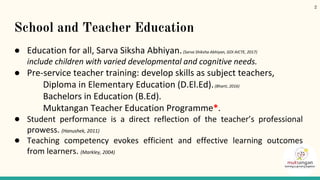
School and Teacher Education
● Education for all, Sarva Siksha Abhiyan.(Sarva Shiksha Abhiyan, GOI AICTE, 2017)
include children with varied developmental and cognitive needs.
● Pre-service teacher training: develop skills as subject teachers,
Diploma in Elementary Education (D.El.Ed).(Bharti, 2016)
Bachelors in Education (B.Ed).
Muktangan Teacher Education Programme*.
● Student performance is a direct reflection of the teacher’s professional
prowess. (Hanushek, 2011)
● Teaching competency evokes efficient and effective learning outcomes
from learners. (Markley, 2004)
2
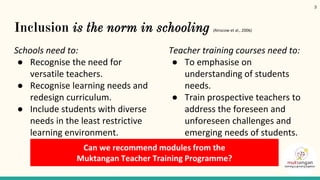
Inclusion is the norm in schooling (Ainscow et al., 2006)
Schools need to:
● Recognise the need for
versatile teachers.
● Recognise learning needs and
redesign curriculum.
● Include students with diverse
needs in the least restrictive
learning environment.
Teacher training courses need to:
● To emphasise on
understanding of students
needs.
● Train prospective teachers to
address the foreseen and
unforeseen challenges and
emerging needs of students.
Can we recommend modules from the
Muktangan Teacher Training Programme?
3
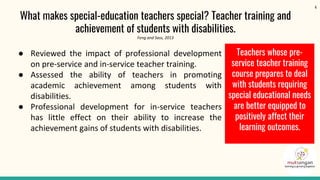
What makes special-education teachers special? Teacher training and
achievement of students with disabilities.
Feng and Sass, 2013
● Reviewed the impact of professional development
on pre-service and in-service teacher training.
● Assessed the ability of teachers in promoting
academic achievement among students with
disabilities.
● Professional development for in-service teachers
has little effect on their ability to increase the
achievement gains of students with disabilities.
Teachers whose pre-
service teacher training
course prepares to deal
with students requiring
special educational needs
are better equipped to
positively affect their
learning outcomes.
4
Maharashtra fared
miserably nationwide,
ranking 31st in primary
school enrollment and
28th level in the upper
primary with regards to
access to education in
2013-14 (Shinde, 2014).
5
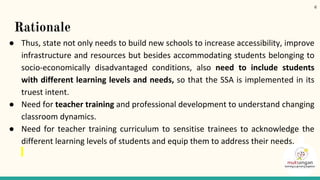
● Thus, state not only needs to build new schools to increase accessibility, improve
infrastructure and resources but besides accommodating students belonging to
socio-economically disadvantaged conditions, also need to include students
with different learning levels and needs, so that the SSA is implemented in its
truest intent.
● Need for teacher training and professional development to understand changing
classroom dynamics.
● Need for teacher training curriculum to sensitise trainees to acknowledge the
different learning levels of students and equip them to address their needs.
Rationale
6
Objectives of the Study
1. To assess whether are trainees equipped to teach students at different
learning levels?
2. Do they modify lesson plans to ensure better learning outcomes?
3. What factors affect students' academic progress, according to trainees?
4. Which methods are preferred by trainees to monitor and evaluate the
progress of students?
7
Methodology
● Informed consent.
● Demographic data - Google Forms.
● Qualitative data - Semi-structured interview.
● Each interview has been transcribed, coded, thematised and analysed - R
package for Qualitative Data Analysis (RQDA) (Huang, 2018)
● Curriculums were scrutinised.
8
Curriculum Introspection - B.Ed.
9
● 2-year, credit-based - MU, Secondary school teacher training.
● Year 1 papers focus on ‘Child development’, ‘Contemporary education in
India’, ‘Pedagogy of school subjects’, ‘Development of curriculum content
knowledge’, ‘Learning assessment and teaching’.
● Year 2 topics focus is on ‘Learning the pedagogy of subjects’, ‘Applications of
information and communication technology’, ‘Educational management’,
‘Creating an inclusive school’, Gender, School and society, Language across
the curriculum.
● Mandates activities like literacy awareness programmes in the community,
organise co-curricular activities in school, maintain a reflective journal on
internship activities and school-based action research.
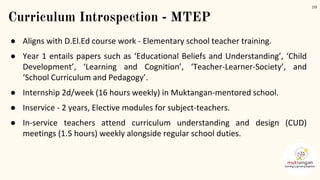
● Aligns with D.El.Ed course work - Elementary school teacher training.
● Year 1 entails papers such as ‘Educational Beliefs and Understanding’, ‘Child
Development’, ‘Learning and Cognition’, ‘Teacher-Learner-Society’, and
‘School Curriculum and Pedagogy’.
● Internship 2d/week (16 hours weekly) in Muktangan-mentored school.
● Inservice - 2 years, Elective modules for subject-teachers.
● In-service teachers attend curriculum understanding and design (CUD)
meetings (1.5 hours) weekly alongside regular school duties.
10
Curriculum Introspection - MTEP
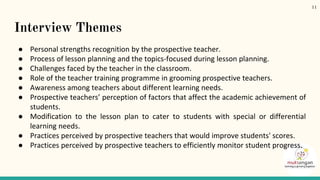
Interview Themes
● Personal strengths recognition by the prospective teacher.
● Process of lesson planning and the topics-focused during lesson planning.
● Challenges faced by the teacher in the classroom.
● Role of the teacher training programme in grooming prospective teachers.
● Awareness among teachers about different learning needs.
● Prospective teachers’ perception of factors that affect the academic achievement of
students.
● Modification to the lesson plan to cater to students with special or differential
learning needs.
● Practices perceived by prospective teachers that would improve students' scores.
● Practices perceived by prospective teachers to efficiently monitor student progress.
11
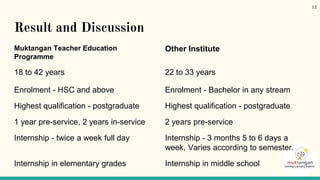
Result and Discussion
Muktangan Teacher Education
Programme
Other Institute
18 to 42 years 22 to 33 years
Enrolment - HSC and above Enrolment - Bachelor in any stream
Highest qualification - postgraduate Highest qualification - postgraduate
1 year pre-service, 2 years in-service 2 years pre-service
Internship - twice a week full day Internship - 3 months 5 to 6 days a
week, Varies according to semester.
Internship in elementary grades Internship in middle school
12
Result and Discussion
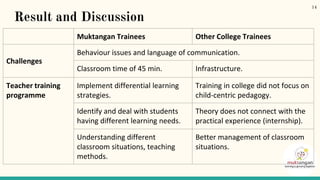
Muktangan Trainees Other College Trainees
Strengths No specific identified. Communication with the
students, creativity,
versatility and confidence.
Lesson planning A week on lesson planning. Less than a week.
Focus on lesson planning Inclusion,
Differential instruction, Child-
centric activities.
Overall structure. Child-
centric and differential
instruction were not evident.
None spoke about active-constructivism in lesson planning.
13
Result and Discussion
Muktangan Trainees Other College Trainees
Challenges
Behaviour issues and language of communication.
Classroom time of 45 min. Infrastructure.
Teacher training
programme
Implement differential learning
strategies.
Training in college did not focus on
child-centric pedagogy.
Identify and deal with students
having different learning needs.
Theory does not connect with the
practical experience (internship).
Understanding different
classroom situations, teaching
methods.
Better management of classroom
situations.
14
Result and Discussion
Muktangan Trainees Other College Trainees
Awareness of
different
learning needs
Aware of the different learning
needs and abilities.
Few were aware of differential
learning needs of students.
Routine classroom observations
was key to capacity building.
Exposure during the internship
was not sufficient to build the
capacity of intern.
Factors
affecting
Academic
achievements
Classroom teaching and teacher’s pedagogy influences the most.
Home-work, classroom participation, teacher appreciation seemed to
be of lesser importance.
15
Result and Discussion
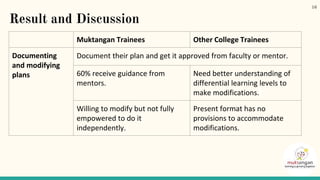
Muktangan Trainees Other College Trainees
Documenting
and modifying
plans
Document their plan and get it approved from faculty or mentor.
60% receive guidance from
mentors.
Need better understanding of
differential learning levels to
make modifications.
Willing to modify but not fully
empowered to do it
independently.
Present format has no
provisions to accommodate
modifications.
16
Result and Discussion
Muktangan Trainees Other College Trainees
Practices to improve
student scores
Learning level of students was the focus of both the groups.
Child-centric strategies or
activities.
Identify levels and apply
strategies.
Homework for different concepts
and parental engagement.
Remedial lessons for those
who need extra support.
Monitoring student
progress
Continuous formative assessment.
17
What literature says...
The linking of teachers' salaries and merit with students performance in standardised
examinations leads to the practice of rote-learning and memorisation. (Causton-Theoharis et al.,
2008).
New teachers generally face challenges such as managing behaviour issues and diverse
needs of students, time constraints and workload, and conflict with parents and other
adults. (Fantilli & McDougall, 2009)
It is important to realise that knowledge cannot be passed intact from a teacher or book to
a learner. (Akpan & Beard, 2016).
18
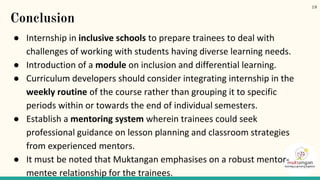
Result and Discussion
Conclusion
● Internship in inclusive schools to prepare trainees to deal with
challenges of working with students having diverse learning needs.
● Introduction of a module on inclusion and differential learning.
● Curriculum developers should consider integrating internship in the
weekly routine of the course rather than grouping it to specific
periods within or towards the end of individual semesters.
● Establish a mentoring system wherein trainees could seek
professional guidance on lesson planning and classroom strategies
from experienced mentors.
● It must be noted that Muktangan emphasises on a robust mentor-
mentee relationship for the trainees.
19
Limitations
● Sample size, with an unequal representation in each group.
● The data available doesn’t direct the researchers to identify a
particular module or paper that may be suggested to B.Ed.
curriculum developers. However, it highlights a need to introspect
the curriculum in more detail.
● The study falls short of actual inspection of a lesson plan and
classroom session observations by the researchers.
● The study completely relies on interview responses.
20
Interns from B.Ed. College Conducting Session
Teaching in a small group during internship at Muktangan.
21
Trainees conducting classroom sessions
22
Muktangan Interns Conducting a Session
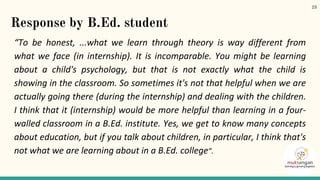
Response by B.Ed. student
“To be honest, ...what we learn through theory is way different from
what we face (in internship). It is incomparable. You might be learning
about a child's psychology, but that is not exactly what the child is
showing in the classroom. So sometimes it's not that helpful when we are
actually going there (during the internship) and dealing with the children.
I think that it (internship) would be more helpful than learning in a four-
walled classroom in a B.Ed. institute. Yes, we get to know many concepts
about education, but if you talk about children, in particular, I think that's
not what we are learning about in a B.Ed. college”.
23

Paper presentation on teacher training modules

  • 1.
    An Investigation intothe Awareness of Differential Learning Needs of Students among Pre-service Teacher Trainees Research Department, Muktangan Education Trust www.muktanganedu.org NGO Muktangan NGO Muktangan Royston Anil Lobo, Puja Shrivastav and Valentine Borges
  • 2.
    School and TeacherEducation ● Education for all, Sarva Siksha Abhiyan.(Sarva Shiksha Abhiyan, GOI AICTE, 2017) include children with varied developmental and cognitive needs. ● Pre-service teacher training: develop skills as subject teachers, Diploma in Elementary Education (D.El.Ed).(Bharti, 2016) Bachelors in Education (B.Ed). Muktangan Teacher Education Programme*. ● Student performance is a direct reflection of the teacher’s professional prowess. (Hanushek, 2011) ● Teaching competency evokes efficient and effective learning outcomes from learners. (Markley, 2004) 2
  • 3.
    Inclusion is thenorm in schooling (Ainscow et al., 2006) Schools need to: ● Recognise the need for versatile teachers. ● Recognise learning needs and redesign curriculum. ● Include students with diverse needs in the least restrictive learning environment. Teacher training courses need to: ● To emphasise on understanding of students needs. ● Train prospective teachers to address the foreseen and unforeseen challenges and emerging needs of students. Can we recommend modules from the Muktangan Teacher Training Programme? 3
  • 4.
    What makes special-educationteachers special? Teacher training and achievement of students with disabilities. Feng and Sass, 2013 ● Reviewed the impact of professional development on pre-service and in-service teacher training. ● Assessed the ability of teachers in promoting academic achievement among students with disabilities. ● Professional development for in-service teachers has little effect on their ability to increase the achievement gains of students with disabilities. Teachers whose pre- service teacher training course prepares to deal with students requiring special educational needs are better equipped to positively affect their learning outcomes. 4
  • 5.
    Maharashtra fared miserably nationwide, ranking31st in primary school enrollment and 28th level in the upper primary with regards to access to education in 2013-14 (Shinde, 2014). 5
  • 6.
    ● Thus, statenot only needs to build new schools to increase accessibility, improve infrastructure and resources but besides accommodating students belonging to socio-economically disadvantaged conditions, also need to include students with different learning levels and needs, so that the SSA is implemented in its truest intent. ● Need for teacher training and professional development to understand changing classroom dynamics. ● Need for teacher training curriculum to sensitise trainees to acknowledge the different learning levels of students and equip them to address their needs. Rationale 6
  • 7.
    Objectives of theStudy 1. To assess whether are trainees equipped to teach students at different learning levels? 2. Do they modify lesson plans to ensure better learning outcomes? 3. What factors affect students' academic progress, according to trainees? 4. Which methods are preferred by trainees to monitor and evaluate the progress of students? 7
  • 8.
    Methodology ● Informed consent. ●Demographic data - Google Forms. ● Qualitative data - Semi-structured interview. ● Each interview has been transcribed, coded, thematised and analysed - R package for Qualitative Data Analysis (RQDA) (Huang, 2018) ● Curriculums were scrutinised. 8
  • 9.
    Curriculum Introspection -B.Ed. 9 ● 2-year, credit-based - MU, Secondary school teacher training. ● Year 1 papers focus on ‘Child development’, ‘Contemporary education in India’, ‘Pedagogy of school subjects’, ‘Development of curriculum content knowledge’, ‘Learning assessment and teaching’. ● Year 2 topics focus is on ‘Learning the pedagogy of subjects’, ‘Applications of information and communication technology’, ‘Educational management’, ‘Creating an inclusive school’, Gender, School and society, Language across the curriculum. ● Mandates activities like literacy awareness programmes in the community, organise co-curricular activities in school, maintain a reflective journal on internship activities and school-based action research.
  • 10.
    ● Aligns withD.El.Ed course work - Elementary school teacher training. ● Year 1 entails papers such as ‘Educational Beliefs and Understanding’, ‘Child Development’, ‘Learning and Cognition’, ‘Teacher-Learner-Society’, and ‘School Curriculum and Pedagogy’. ● Internship 2d/week (16 hours weekly) in Muktangan-mentored school. ● Inservice - 2 years, Elective modules for subject-teachers. ● In-service teachers attend curriculum understanding and design (CUD) meetings (1.5 hours) weekly alongside regular school duties. 10 Curriculum Introspection - MTEP
  • 11.
    Interview Themes ● Personalstrengths recognition by the prospective teacher. ● Process of lesson planning and the topics-focused during lesson planning. ● Challenges faced by the teacher in the classroom. ● Role of the teacher training programme in grooming prospective teachers. ● Awareness among teachers about different learning needs. ● Prospective teachers’ perception of factors that affect the academic achievement of students. ● Modification to the lesson plan to cater to students with special or differential learning needs. ● Practices perceived by prospective teachers that would improve students' scores. ● Practices perceived by prospective teachers to efficiently monitor student progress. 11
  • 12.
    Result and Discussion MuktanganTeacher Education Programme Other Institute 18 to 42 years 22 to 33 years Enrolment - HSC and above Enrolment - Bachelor in any stream Highest qualification - postgraduate Highest qualification - postgraduate 1 year pre-service, 2 years in-service 2 years pre-service Internship - twice a week full day Internship - 3 months 5 to 6 days a week, Varies according to semester. Internship in elementary grades Internship in middle school 12
  • 13.
    Result and Discussion MuktanganTrainees Other College Trainees Strengths No specific identified. Communication with the students, creativity, versatility and confidence. Lesson planning A week on lesson planning. Less than a week. Focus on lesson planning Inclusion, Differential instruction, Child- centric activities. Overall structure. Child- centric and differential instruction were not evident. None spoke about active-constructivism in lesson planning. 13
  • 14.
    Result and Discussion MuktanganTrainees Other College Trainees Challenges Behaviour issues and language of communication. Classroom time of 45 min. Infrastructure. Teacher training programme Implement differential learning strategies. Training in college did not focus on child-centric pedagogy. Identify and deal with students having different learning needs. Theory does not connect with the practical experience (internship). Understanding different classroom situations, teaching methods. Better management of classroom situations. 14
  • 15.
    Result and Discussion MuktanganTrainees Other College Trainees Awareness of different learning needs Aware of the different learning needs and abilities. Few were aware of differential learning needs of students. Routine classroom observations was key to capacity building. Exposure during the internship was not sufficient to build the capacity of intern. Factors affecting Academic achievements Classroom teaching and teacher’s pedagogy influences the most. Home-work, classroom participation, teacher appreciation seemed to be of lesser importance. 15
  • 16.
    Result and Discussion MuktanganTrainees Other College Trainees Documenting and modifying plans Document their plan and get it approved from faculty or mentor. 60% receive guidance from mentors. Need better understanding of differential learning levels to make modifications. Willing to modify but not fully empowered to do it independently. Present format has no provisions to accommodate modifications. 16
  • 17.
    Result and Discussion MuktanganTrainees Other College Trainees Practices to improve student scores Learning level of students was the focus of both the groups. Child-centric strategies or activities. Identify levels and apply strategies. Homework for different concepts and parental engagement. Remedial lessons for those who need extra support. Monitoring student progress Continuous formative assessment. 17
  • 18.
    What literature says... Thelinking of teachers' salaries and merit with students performance in standardised examinations leads to the practice of rote-learning and memorisation. (Causton-Theoharis et al., 2008). New teachers generally face challenges such as managing behaviour issues and diverse needs of students, time constraints and workload, and conflict with parents and other adults. (Fantilli & McDougall, 2009) It is important to realise that knowledge cannot be passed intact from a teacher or book to a learner. (Akpan & Beard, 2016). 18 Result and Discussion
  • 19.
    Conclusion ● Internship ininclusive schools to prepare trainees to deal with challenges of working with students having diverse learning needs. ● Introduction of a module on inclusion and differential learning. ● Curriculum developers should consider integrating internship in the weekly routine of the course rather than grouping it to specific periods within or towards the end of individual semesters. ● Establish a mentoring system wherein trainees could seek professional guidance on lesson planning and classroom strategies from experienced mentors. ● It must be noted that Muktangan emphasises on a robust mentor- mentee relationship for the trainees. 19
  • 20.
    Limitations ● Sample size,with an unequal representation in each group. ● The data available doesn’t direct the researchers to identify a particular module or paper that may be suggested to B.Ed. curriculum developers. However, it highlights a need to introspect the curriculum in more detail. ● The study falls short of actual inspection of a lesson plan and classroom session observations by the researchers. ● The study completely relies on interview responses. 20
  • 21.
    Interns from B.Ed.College Conducting Session Teaching in a small group during internship at Muktangan. 21
  • 22.
    Trainees conducting classroomsessions 22 Muktangan Interns Conducting a Session
  • 23.
    Response by B.Ed.student “To be honest, ...what we learn through theory is way different from what we face (in internship). It is incomparable. You might be learning about a child's psychology, but that is not exactly what the child is showing in the classroom. So sometimes it's not that helpful when we are actually going there (during the internship) and dealing with the children. I think that it (internship) would be more helpful than learning in a four- walled classroom in a B.Ed. institute. Yes, we get to know many concepts about education, but if you talk about children, in particular, I think that's not what we are learning about in a B.Ed. college”. 23

Editor's Notes

  • #19 This is probably because newly appointed teachers are given the same level of work as experienced teachers. Students need to construct new knowledge by following instructions that are guided by the constructivist learning method that helps enhance student engagement and learning.