What is Adult Education
• Adult education is instructional and related
support services for adults. Adult Education
aims at extending educational options to
those adults, who have lost the opportunity
and have crossed the age of formal education,
but now feel a need for learning of any type,
including literacy, basic education, skill
development (Vocational Education) and
equivalency.
• Adult education in the widest sense is any
form of learning adults engage in beyond
traditional schooling. In the narrowest sense,
adult education is about literacy, about adults
learning to read the most basic materials. So
adult education encompasses everything from
basic literacy to personal fulfilment as a
lifelong learner, even the attainment of
advanced degrees.
Aims and objectives of Adult Education
• To develop students' potential, enabling them
to face the future with confidence and
determination.
• To prepare adult students for leadership and
service in their chosen vocation.
• To apply critical thinking and reasoning skills
to identify problems and to develop problem-
solving abilities.
• To apply theoretical knowledge to solve real-
life problems through teamwork within the
context of an active learning environment.
• To facilitate social development and
effectiveness in interpersonal relationships
through developing personal values and
constructive attitudes toward work, other
people, and the quality of life.
• To foster and promote a sense of democracy
ethics and values in their professional lives.
• To facilitate spiritual growth and utilisation of
leisure time properly.
• Develop written and oral communication
skills.
Characteristics of Adult Education
• More self-directed, rather than relying on
others for help
• Mature and therefore experienced with the
experience providing a rich source for learning
• An Adult's readiness to learn is linked to what
one needs to know
• Adult orientation to learn is problem centred
rather than subject centred
• Adult motivation to learn is internal.
Purposes of adult education
• Vocational
• Social
• Recreational
• Self-development
Adult Learning Principles
• Adult learners are goal oriented
Are practical and problem-centered
• Provide overviews, summaries, examples
• Use stories to link theory to practice
• Discuss/plan for direct application of new
information
• Use collaborative, authentic problem-solving
activities
• Less theory, more practice
Promote their positive self-esteem
• Provide low-risk activities in small group
settings
• Build individual success increasingly
• Become more effective and confident through
guided practice and establishing routines
• Readiness to learn depends on motivation
Allow for choice and self-direction
• Ask what they know already about the topic
• Ask what they would like to know about the
topic
• Compare desired behaviours (goals) & actual
behaviours
• Allow for options so they can easily shift if
needed
Integrate existing knowledge with new
ideas
• Capitalize on what is already known from prior
experience
• Create activities that use their experience and
knowledge
• Listen and collect data about participant needs before,
during and after the event
• Adjust time and build in options for topics to fit their
needs
• Suggest follow-up ideas and next steps for support and
implementation after the session
• Provide for the possible need to unlearn old habits or
confront inaccurate beliefs
Show respect to the learner
• Breaks, snacks, coffee, comfort
• Use everybody’s time effectively and
efficiently
• Provide a quality, well organized, experience
• Validate and affirm their knowledge,
contributions and successes
• Request feedback on your work, assumptions,
or ideas
Barriers in Adult Learning
• The lack of time balancing career and family
demands, finances, transportation. confidence, or
interest, lack of information about opportunities
to learn, scheduling problems, entrance
requirements and problems with child care.
• Other obstacles that prevent adults from
pursuing further education are fear, shyness, ego.
• Daily wagers are reluctant to join schools as by
joining these schools they lose their only source
of income
Continuing Education
• 'Lifelong learning' is the "ongoing, voluntary,
and self-motivated" pursuit of knowledge for
either personal or professional reasons.
Therefore, it not only enhances social
inclusion, active citizenship, and personal
development, but also self-sustainability,
rather than competitiveness and
employability.
• Lifelong learning may be broadly defined as
learning that is pursued throughout life:
learning that is flexible, diverse and available
at different times and in different places.
Lifelong learning crosses sectors, promoting
learning beyond traditional schooling and
throughout adult life (i.e post-compulsory
education).
This definition is based on Delors’ (1996) four
‘pillars’ of education for the future.
• Learning to know - mastering learning tools
rather than acquisition of structured
knowledge.
• Learning to do – equipping people for the
types of work needed now and in the future
including innovation and adaptation of
learning to future work environments.
• Learning to live together, and with others –
peacefully resolving conflict, discovering other
people and their cultures, fostering
community capability, individual competence
and capacity, economic resilience, and social
inclusion.
• Learning to be – education contributing to a
person’s complete development: mind and
body, intelligence, sensitivity, aesthetic
appreciation and spirituality.
Lifelong learning can instil creativity, initiative
and responsiveness in people thereby
enabling them to show adaptability in post-
industrial society through enhancing skills to:
manage uncertainty,
communicate across and within cultures, sub-
cultures, families and communities,
negotiate conflicts.
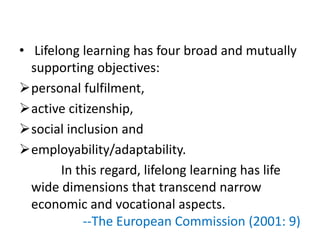
• Lifelong learning has four broad and mutually
supporting objectives:
personal fulfilment,
active citizenship,
social inclusion and
employability/adaptability.
In this regard, lifelong learning has life
wide dimensions that transcend narrow
economic and vocational aspects.
--The European Commission (2001: 9)
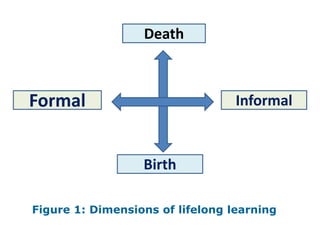
Figure 1: Dimensions of lifelong learning
Death
Informal
Formal
Birth
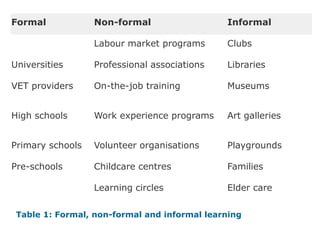
Table 1: Formal, non-formal and informal learning
Formal Non-formal Informal
Labour market programs Clubs
Universities Professional associations Libraries
VET providers On-the-job training Museums
High schools Work experience programs Art galleries
Primary schools Volunteer organisations Playgrounds
Pre-schools Childcare centres Families
Learning circles Elder care
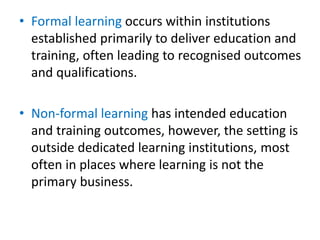
• Formal learning occurs within institutions
established primarily to deliver education and
training, often leading to recognised outcomes
and qualifications.
• Non-formal learning has intended education
and training outcomes, however, the setting is
outside dedicated learning institutions, most
often in places where learning is not the
primary business.
• Informal learning is distinguishable by intent.
It can occur almost anywhere, but as a by-
product of other activities. It is often
unplanned and without explicit emphasis on
learning, yet may still lead to the acquisition
of valuable skills, knowledge and attitudes.

adult edu.pptx

  • 2.
    What is AdultEducation • Adult education is instructional and related support services for adults. Adult Education aims at extending educational options to those adults, who have lost the opportunity and have crossed the age of formal education, but now feel a need for learning of any type, including literacy, basic education, skill development (Vocational Education) and equivalency.
  • 3.
    • Adult educationin the widest sense is any form of learning adults engage in beyond traditional schooling. In the narrowest sense, adult education is about literacy, about adults learning to read the most basic materials. So adult education encompasses everything from basic literacy to personal fulfilment as a lifelong learner, even the attainment of advanced degrees.
  • 4.
    Aims and objectivesof Adult Education • To develop students' potential, enabling them to face the future with confidence and determination. • To prepare adult students for leadership and service in their chosen vocation. • To apply critical thinking and reasoning skills to identify problems and to develop problem- solving abilities.
  • 5.
    • To applytheoretical knowledge to solve real- life problems through teamwork within the context of an active learning environment. • To facilitate social development and effectiveness in interpersonal relationships through developing personal values and constructive attitudes toward work, other people, and the quality of life.
  • 6.
    • To fosterand promote a sense of democracy ethics and values in their professional lives. • To facilitate spiritual growth and utilisation of leisure time properly. • Develop written and oral communication skills.
  • 7.
    Characteristics of AdultEducation • More self-directed, rather than relying on others for help • Mature and therefore experienced with the experience providing a rich source for learning • An Adult's readiness to learn is linked to what one needs to know • Adult orientation to learn is problem centred rather than subject centred • Adult motivation to learn is internal.
  • 8.
    Purposes of adulteducation • Vocational • Social • Recreational • Self-development
  • 9.
    Adult Learning Principles •Adult learners are goal oriented
  • 10.
    Are practical andproblem-centered • Provide overviews, summaries, examples • Use stories to link theory to practice • Discuss/plan for direct application of new information • Use collaborative, authentic problem-solving activities • Less theory, more practice
  • 12.
    Promote their positiveself-esteem • Provide low-risk activities in small group settings • Build individual success increasingly • Become more effective and confident through guided practice and establishing routines • Readiness to learn depends on motivation
  • 13.
    Allow for choiceand self-direction • Ask what they know already about the topic • Ask what they would like to know about the topic • Compare desired behaviours (goals) & actual behaviours • Allow for options so they can easily shift if needed
  • 14.
    Integrate existing knowledgewith new ideas • Capitalize on what is already known from prior experience • Create activities that use their experience and knowledge • Listen and collect data about participant needs before, during and after the event • Adjust time and build in options for topics to fit their needs • Suggest follow-up ideas and next steps for support and implementation after the session • Provide for the possible need to unlearn old habits or confront inaccurate beliefs
  • 15.
    Show respect tothe learner • Breaks, snacks, coffee, comfort • Use everybody’s time effectively and efficiently • Provide a quality, well organized, experience • Validate and affirm their knowledge, contributions and successes • Request feedback on your work, assumptions, or ideas
  • 16.
    Barriers in AdultLearning • The lack of time balancing career and family demands, finances, transportation. confidence, or interest, lack of information about opportunities to learn, scheduling problems, entrance requirements and problems with child care. • Other obstacles that prevent adults from pursuing further education are fear, shyness, ego. • Daily wagers are reluctant to join schools as by joining these schools they lose their only source of income
  • 17.
    Continuing Education • 'Lifelonglearning' is the "ongoing, voluntary, and self-motivated" pursuit of knowledge for either personal or professional reasons. Therefore, it not only enhances social inclusion, active citizenship, and personal development, but also self-sustainability, rather than competitiveness and employability.
  • 18.
    • Lifelong learningmay be broadly defined as learning that is pursued throughout life: learning that is flexible, diverse and available at different times and in different places. Lifelong learning crosses sectors, promoting learning beyond traditional schooling and throughout adult life (i.e post-compulsory education). This definition is based on Delors’ (1996) four ‘pillars’ of education for the future.
  • 19.
    • Learning toknow - mastering learning tools rather than acquisition of structured knowledge. • Learning to do – equipping people for the types of work needed now and in the future including innovation and adaptation of learning to future work environments.
  • 20.
    • Learning tolive together, and with others – peacefully resolving conflict, discovering other people and their cultures, fostering community capability, individual competence and capacity, economic resilience, and social inclusion. • Learning to be – education contributing to a person’s complete development: mind and body, intelligence, sensitivity, aesthetic appreciation and spirituality.
  • 21.
    Lifelong learning caninstil creativity, initiative and responsiveness in people thereby enabling them to show adaptability in post- industrial society through enhancing skills to: manage uncertainty, communicate across and within cultures, sub- cultures, families and communities, negotiate conflicts.
  • 22.
    • Lifelong learninghas four broad and mutually supporting objectives: personal fulfilment, active citizenship, social inclusion and employability/adaptability. In this regard, lifelong learning has life wide dimensions that transcend narrow economic and vocational aspects. --The European Commission (2001: 9)
  • 23.
    Figure 1: Dimensionsof lifelong learning Death Informal Formal Birth
  • 24.
    Table 1: Formal,non-formal and informal learning Formal Non-formal Informal Labour market programs Clubs Universities Professional associations Libraries VET providers On-the-job training Museums High schools Work experience programs Art galleries Primary schools Volunteer organisations Playgrounds Pre-schools Childcare centres Families Learning circles Elder care
  • 25.
    • Formal learningoccurs within institutions established primarily to deliver education and training, often leading to recognised outcomes and qualifications. • Non-formal learning has intended education and training outcomes, however, the setting is outside dedicated learning institutions, most often in places where learning is not the primary business.
  • 26.
    • Informal learningis distinguishable by intent. It can occur almost anywhere, but as a by- product of other activities. It is often unplanned and without explicit emphasis on learning, yet may still lead to the acquisition of valuable skills, knowledge and attitudes.