P U J A S H R I V A S T A V
Reflective Thinking and Action
Research
Introduction
 Teachers usually do what their teachers did in the
past and believe that they know what they and their
students should do in the classroom.
 The beliefs and perceptions of student teachers
admitted to the teacher education are likely to affect
their approach to teacher education programme.
2
Puja Shrivastav
Cont…
 Already existing perspectives and beliefs come in the
way of acquiring new knowledge and skills.
 This may involve the student teachers to re-examine
their existing beliefs and approaches.
 Teacher education gives importance to theory and
practical experience.
3
Puja Shrivastav
Cont…
 Learning and experience in the professional arena
becomes useful only when effective teaching and
learning is followed by reflection.
 This will help to crystallize the teaching and learning
experience.
4
Puja Shrivastav
Reflection
 “Reflection commences when one inquires into his or
her experiences and relevant knowledge to find
meaning in his or her beliefs. It enable teachers to
direct their activities with foresight and to plan
according to ends- in –view.” (John Dewey, 1933)
 There are two important aspects of reflection-
reflective thinking and reflective action.
5
Puja Shrivastav
Reflective Thinking
 Reflection is a processing phase where thinking and
learning take place.
 It involves personal consideration of one’s own
learning.
 Reflective thinking is an approach of self
observation. It is more than mere introspection.
 Reflection aids the learner in making connections
between the moral and social issues in the story.
6
Puja Shrivastav
Reflective Thinking Contd…
 Teacher education as a profession often requires
teacher educators and student teachers to reflect
upon their practices, link their reflections to
theories and communicate in writing an
understanding of the connection between the
reflection and theory.
 Teacher educators can expose student teachers to
reflect by sharing their own learning and
understanding regarding an educational issue or
classroom experiences.
7
Puja Shrivastav
Benefit of Reflective Thinking
 Develop a questioning attitude and new perspectives
 Become objective and critical of your own actions
 Identify areas for change and improvement
 Think of alternative explanations of events
 Make use of evidence from theories
 Respond effectively to new challenges
 Recognise that your own point of view will change
with time
8
Puja Shrivastav
Benefit of Reflective Thinking Contd…
 Discuss with others to deepen your insight and
explore a range of perspectives
 Ask questions such as what was I thinking and
feeling - did this influence me, and why? What were
the students thinking and feeling? What is the
evidence for this? What else could I have done?
 Generalise and apply what you have learned from
one situation to other situations
9
Puja Shrivastav
Forms of Reflection
 Reflection-in-action – Thinking about your practice.
 Reflection-on-action- Reflections of lessons or
events, carried out after lesson or event has occurred.
 Evaluation- Reflection after the lesson or
performance.
 Intra-professional verbalized- Reflections carried out
in the company of others in the same community
practice.
 Extra- Professional verbalized- Reflections carried
out in the company of selected support network.
10
Puja Shrivastav
Reflective Practice
 Reflective practice can be considered as ‘active
learning’
 Beginning of reflective practice in the area of
learning can be seen, where one question is
answered by another question so as to challenge the
subject under discussion.
11
Puja Shrivastav
Benefits of Reflective Practice
 Increased learning from an experience
 Promotion of deep learning
 Identification of personal and professional strengths and
areas for improvement
 Identification of educational needs
 Acquisition of new knowledge and skills
 Further understanding of own beliefs, attitudes and values
 Encouragement of self-motivation and self-directed learning
 Could act as a source of feedback
 Possible improvements of personal and clinical confidence
12
Puja Shrivastav
Limitations of Reflective Practice
 Not all practitioners understand the reflective
process
 One may feel uncomfortable challenging and
evaluating own practice
 Could be time consuming
 May have confusion as to which
situations/experiences to reflect upon
 May not be adequate to resolve educational problems
13
Puja Shrivastav
Reflective Practice in Teacher Education
 Refers to the process of the teacher educator studying his
or her own teaching methods and determining what
works best for the student teachers.
 It involves the consideration of the ethical consequences
of classroom procedures on students.
 Thus reflecting on different versions of teaching, and
reshaping past and current experiences will lead to
improvement in teaching practices.
 Reflective practice assists teachers in making the
professional knowledge, gained from their experience in
the classroom, part of their decision-making.
14
Puja Shrivastav
Action Research
 Action research is used synonymously and
interchangeably with teacher research or practitioner
research.
 Action research pursues action and research.
 The action research process is collaborative and
investigative where teachers work together to design
and follow through with research on practical
problems in their classrooms.
 Teachers are involved in the process of inquiry to
improve educational practice.
15
Puja Shrivastav
Action Research Contd…
 Action research involves inquiring into one’s own
practice through a cyclical process which involves
planning, acting, observing and reflecting (Kemmis
and McTaggart, 1988).
 It is most effective when the end result emerges from
the data.
 The conclusions emerge slowly over the course of the
study.
 Action research enables learning through the process
of critical reflection, meaningful experiences, and
self-directed inquiry.
16
Puja Shrivastav
Action Research Contd…
 The systematic action research process is a cyclical step-
by-step process.
 Teachers who engage in the action research process are
immersed in examining “what it means to make
disciplined—as opposed to intuitive—statements about
teaching” (Freeman, 1998, p. 9).
 Therefore, the teachers’ account is derived from evidence
that has been gathered through a systematic and
evaluative research process.
 In other words action research or teacher research is
characterized by uniting “the doing and wondering” of
the practice of teaching (Freeman 1998, p. 3).
17
Puja Shrivastav
Action Research Building the
Reflective Practitioner
 Action research is a form of staff development that
encourages and develops the skills of educators to
become more reflective practitioners, more
methodical problem solvers, and more thoughtful
decision makers (Sparks & Simmons, 1989).
 Sagor (2000) believed that an important purpose
for action research was “building the reflective
practitioner” . He explained that “when reflections
on the findings from each day’s work inform the
next day’s instruction, teachers can’t help but
develop greater mastery of the art and science of
teaching”.
18
Puja Shrivastav
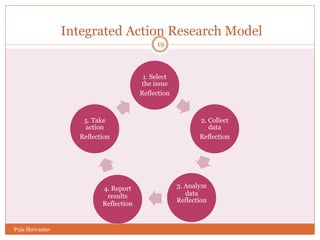
Integrated Action Research Model
1. Select
the issue
Reflection
2. Collect
data
Reflection
3. Analyze
data
Reflection
4. Report
results
Reflection
5. Take
action
Reflection
19
Puja Shrivastav
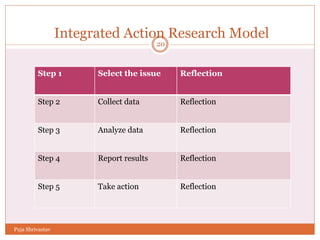
Integrated Action Research Model
Step 1 Select the issue Reflection
Step 2 Collect data Reflection
Step 3 Analyze data Reflection
Step 4 Report results Reflection
Step 5 Take action Reflection
20
Puja Shrivastav
Disadvantages
 Teachers find it difficult to devote time and engage in
action research.
 While teaching it is difficult to find enough time to
collect data, reflect, re-read, or share with
colleagues.
 Teacher researchers are not able to distance
themselves from the situation being researched and
thus objectivity becomes difficult.
 There are differences in teaching and researching.
Research hampers his/her teaching.
21
Puja Shrivastav
Cont…
 For example, a teacher that is focused on
investigating the impact of a new reading strategy on
student learning would spend instructional time
teaching that reading strategy, gathering evidence
about the students learning, analyzing the collected
data for evidence of student growth and reflecting on
the strategy’s overall impact on teaching and
learning. In this situation other curriculum and
instruction may be ignored or temporarily put to the
side in order to focus on the research.
22
Puja Shrivastav
Applications of Action Research
1. Teaching does change as a result of the research
conducted. The teacher is able to focus on specific areas
which need improvement.
2. Discussions with colleagues help develop ideas.
3. Action research projects and related practices allow
teachers to modify teaching practices and have an
impact on student achievement.
4. Teachers are able to use better strategies for facilitating
students to become better learners.
5. Teachers feel confident about themselves as
researchers and the research piece in general.
23
Puja Shrivastav
Applications of Action Research Contd..
6. Research supported practice leads to personal and
professional growth
7. 7. Action research allows some teachers the
opportunity to make connection between practice and
research.
8. 8. Teachers as adult learners transfer their knowledge
about action research to future teaching practices.
9. 9. Action research provides the teachers with the
needed practical skills.
10. 10. It gives them an opportunity to develop a
philosophy of education.
24
Puja Shrivastav
Applications of Action Research Contd..
11. Teacher action research can easily blend theory and
practice.
12. Action research formalizes a system that good
teachers must use it a constant basis.
13. It is an easy way to maintain professionalism.
14. On the basis of research data, the teaching program
can be modified to suit the learners.
25
Puja Shrivastav
Applications of Action Research Contd..
 Action research can make the teachers feel very
proud of their research. They find it as having an
added advantage even worthwhile mentioning in
their curriculum vitae and during job interviews. As
such teachers do recognize the significance of their
research.
 Different method for personal reflection, such as,
journal writing, mentally walking through the day,
jotting notes on her lesson plans, or talking to
colleagues helps.
26
Puja Shrivastav
Applications of Action Research Contd..…
16. Teacher reflection sometimes happens in fits and starts
and writing happens when there is tension.
17. Some teachers can reflect on what went well and what
did not and then note down about what can be done
differently. This indicates that being reflective is central
to teaching.
18. Action research has a significant impact on the
assessment practices of the teachers. Teachers use
different methods to gather information about students
such as tests, projects, group assignments, anecdotal
comments, observation checklists, one on one testing,
self evaluation, interviews, samples of student work,
and observation.
27
Puja Shrivastav
Conclusion
 It can be said that engaging in classroom research has a
positive influence.
 Teaching practices and student achievement are
influenced by teachers involved in action research
process.
 It should be noted that teachers need to internalize the
action research process in their conception of their
practice.
 The process of action research provides educators with a
disciplined way of studying about their profession.
 This process can encourage the teachers to be
introspective and work towards self-improvement.
28
Puja Shrivastav

Reflective Teaching and Action Research

  • 1.
    P U JA S H R I V A S T A V Reflective Thinking and Action Research
  • 2.
    Introduction  Teachers usuallydo what their teachers did in the past and believe that they know what they and their students should do in the classroom.  The beliefs and perceptions of student teachers admitted to the teacher education are likely to affect their approach to teacher education programme. 2 Puja Shrivastav
  • 3.
    Cont…  Already existingperspectives and beliefs come in the way of acquiring new knowledge and skills.  This may involve the student teachers to re-examine their existing beliefs and approaches.  Teacher education gives importance to theory and practical experience. 3 Puja Shrivastav
  • 4.
    Cont…  Learning andexperience in the professional arena becomes useful only when effective teaching and learning is followed by reflection.  This will help to crystallize the teaching and learning experience. 4 Puja Shrivastav
  • 5.
    Reflection  “Reflection commenceswhen one inquires into his or her experiences and relevant knowledge to find meaning in his or her beliefs. It enable teachers to direct their activities with foresight and to plan according to ends- in –view.” (John Dewey, 1933)  There are two important aspects of reflection- reflective thinking and reflective action. 5 Puja Shrivastav
  • 6.
    Reflective Thinking  Reflectionis a processing phase where thinking and learning take place.  It involves personal consideration of one’s own learning.  Reflective thinking is an approach of self observation. It is more than mere introspection.  Reflection aids the learner in making connections between the moral and social issues in the story. 6 Puja Shrivastav
  • 7.
    Reflective Thinking Contd… Teacher education as a profession often requires teacher educators and student teachers to reflect upon their practices, link their reflections to theories and communicate in writing an understanding of the connection between the reflection and theory.  Teacher educators can expose student teachers to reflect by sharing their own learning and understanding regarding an educational issue or classroom experiences. 7 Puja Shrivastav
  • 8.
    Benefit of ReflectiveThinking  Develop a questioning attitude and new perspectives  Become objective and critical of your own actions  Identify areas for change and improvement  Think of alternative explanations of events  Make use of evidence from theories  Respond effectively to new challenges  Recognise that your own point of view will change with time 8 Puja Shrivastav
  • 9.
    Benefit of ReflectiveThinking Contd…  Discuss with others to deepen your insight and explore a range of perspectives  Ask questions such as what was I thinking and feeling - did this influence me, and why? What were the students thinking and feeling? What is the evidence for this? What else could I have done?  Generalise and apply what you have learned from one situation to other situations 9 Puja Shrivastav
  • 10.
    Forms of Reflection Reflection-in-action – Thinking about your practice.  Reflection-on-action- Reflections of lessons or events, carried out after lesson or event has occurred.  Evaluation- Reflection after the lesson or performance.  Intra-professional verbalized- Reflections carried out in the company of others in the same community practice.  Extra- Professional verbalized- Reflections carried out in the company of selected support network. 10 Puja Shrivastav
  • 11.
    Reflective Practice  Reflectivepractice can be considered as ‘active learning’  Beginning of reflective practice in the area of learning can be seen, where one question is answered by another question so as to challenge the subject under discussion. 11 Puja Shrivastav
  • 12.
    Benefits of ReflectivePractice  Increased learning from an experience  Promotion of deep learning  Identification of personal and professional strengths and areas for improvement  Identification of educational needs  Acquisition of new knowledge and skills  Further understanding of own beliefs, attitudes and values  Encouragement of self-motivation and self-directed learning  Could act as a source of feedback  Possible improvements of personal and clinical confidence 12 Puja Shrivastav
  • 13.
    Limitations of ReflectivePractice  Not all practitioners understand the reflective process  One may feel uncomfortable challenging and evaluating own practice  Could be time consuming  May have confusion as to which situations/experiences to reflect upon  May not be adequate to resolve educational problems 13 Puja Shrivastav
  • 14.
    Reflective Practice inTeacher Education  Refers to the process of the teacher educator studying his or her own teaching methods and determining what works best for the student teachers.  It involves the consideration of the ethical consequences of classroom procedures on students.  Thus reflecting on different versions of teaching, and reshaping past and current experiences will lead to improvement in teaching practices.  Reflective practice assists teachers in making the professional knowledge, gained from their experience in the classroom, part of their decision-making. 14 Puja Shrivastav
  • 15.
    Action Research  Actionresearch is used synonymously and interchangeably with teacher research or practitioner research.  Action research pursues action and research.  The action research process is collaborative and investigative where teachers work together to design and follow through with research on practical problems in their classrooms.  Teachers are involved in the process of inquiry to improve educational practice. 15 Puja Shrivastav
  • 16.
    Action Research Contd… Action research involves inquiring into one’s own practice through a cyclical process which involves planning, acting, observing and reflecting (Kemmis and McTaggart, 1988).  It is most effective when the end result emerges from the data.  The conclusions emerge slowly over the course of the study.  Action research enables learning through the process of critical reflection, meaningful experiences, and self-directed inquiry. 16 Puja Shrivastav
  • 17.
    Action Research Contd… The systematic action research process is a cyclical step- by-step process.  Teachers who engage in the action research process are immersed in examining “what it means to make disciplined—as opposed to intuitive—statements about teaching” (Freeman, 1998, p. 9).  Therefore, the teachers’ account is derived from evidence that has been gathered through a systematic and evaluative research process.  In other words action research or teacher research is characterized by uniting “the doing and wondering” of the practice of teaching (Freeman 1998, p. 3). 17 Puja Shrivastav
  • 18.
    Action Research Buildingthe Reflective Practitioner  Action research is a form of staff development that encourages and develops the skills of educators to become more reflective practitioners, more methodical problem solvers, and more thoughtful decision makers (Sparks & Simmons, 1989).  Sagor (2000) believed that an important purpose for action research was “building the reflective practitioner” . He explained that “when reflections on the findings from each day’s work inform the next day’s instruction, teachers can’t help but develop greater mastery of the art and science of teaching”. 18 Puja Shrivastav
  • 19.
    Integrated Action ResearchModel 1. Select the issue Reflection 2. Collect data Reflection 3. Analyze data Reflection 4. Report results Reflection 5. Take action Reflection 19 Puja Shrivastav
  • 20.
    Integrated Action ResearchModel Step 1 Select the issue Reflection Step 2 Collect data Reflection Step 3 Analyze data Reflection Step 4 Report results Reflection Step 5 Take action Reflection 20 Puja Shrivastav
  • 21.
    Disadvantages  Teachers findit difficult to devote time and engage in action research.  While teaching it is difficult to find enough time to collect data, reflect, re-read, or share with colleagues.  Teacher researchers are not able to distance themselves from the situation being researched and thus objectivity becomes difficult.  There are differences in teaching and researching. Research hampers his/her teaching. 21 Puja Shrivastav
  • 22.
    Cont…  For example,a teacher that is focused on investigating the impact of a new reading strategy on student learning would spend instructional time teaching that reading strategy, gathering evidence about the students learning, analyzing the collected data for evidence of student growth and reflecting on the strategy’s overall impact on teaching and learning. In this situation other curriculum and instruction may be ignored or temporarily put to the side in order to focus on the research. 22 Puja Shrivastav
  • 23.
    Applications of ActionResearch 1. Teaching does change as a result of the research conducted. The teacher is able to focus on specific areas which need improvement. 2. Discussions with colleagues help develop ideas. 3. Action research projects and related practices allow teachers to modify teaching practices and have an impact on student achievement. 4. Teachers are able to use better strategies for facilitating students to become better learners. 5. Teachers feel confident about themselves as researchers and the research piece in general. 23 Puja Shrivastav
  • 24.
    Applications of ActionResearch Contd.. 6. Research supported practice leads to personal and professional growth 7. 7. Action research allows some teachers the opportunity to make connection between practice and research. 8. 8. Teachers as adult learners transfer their knowledge about action research to future teaching practices. 9. 9. Action research provides the teachers with the needed practical skills. 10. 10. It gives them an opportunity to develop a philosophy of education. 24 Puja Shrivastav
  • 25.
    Applications of ActionResearch Contd.. 11. Teacher action research can easily blend theory and practice. 12. Action research formalizes a system that good teachers must use it a constant basis. 13. It is an easy way to maintain professionalism. 14. On the basis of research data, the teaching program can be modified to suit the learners. 25 Puja Shrivastav
  • 26.
    Applications of ActionResearch Contd..  Action research can make the teachers feel very proud of their research. They find it as having an added advantage even worthwhile mentioning in their curriculum vitae and during job interviews. As such teachers do recognize the significance of their research.  Different method for personal reflection, such as, journal writing, mentally walking through the day, jotting notes on her lesson plans, or talking to colleagues helps. 26 Puja Shrivastav
  • 27.
    Applications of ActionResearch Contd..… 16. Teacher reflection sometimes happens in fits and starts and writing happens when there is tension. 17. Some teachers can reflect on what went well and what did not and then note down about what can be done differently. This indicates that being reflective is central to teaching. 18. Action research has a significant impact on the assessment practices of the teachers. Teachers use different methods to gather information about students such as tests, projects, group assignments, anecdotal comments, observation checklists, one on one testing, self evaluation, interviews, samples of student work, and observation. 27 Puja Shrivastav
  • 28.
    Conclusion  It canbe said that engaging in classroom research has a positive influence.  Teaching practices and student achievement are influenced by teachers involved in action research process.  It should be noted that teachers need to internalize the action research process in their conception of their practice.  The process of action research provides educators with a disciplined way of studying about their profession.  This process can encourage the teachers to be introspective and work towards self-improvement. 28 Puja Shrivastav