


Equality of Opportunity
Puja Shrivastav
Puja Shrivastav
Equality of Opportunity
 Equality refers to a state of affairs in which all people
within a specific society or group have the same status.
 Equality of opportunity is best expressed in the phrase —
career open to talents.
 No arbitrary obstacles should prevent people from
achieving those public positions which their talents fit and
which their values lead them to seek. Neither birth,
nationality, colour, religion, sex nor any other equivalent
characteristic should determine the public opportunities
that are open to a person — only talent and achievement.
Puja Shrivastav
Equality of Opportunity
 Equality of opportunity means freedom to
pursue one's private interest or vocation
without arbitrary restrictions based on
irrelevant personal characteristics.
 For example: We can ask students to
participate in some activities but we can
not force them for that.
Puja Shrivastav
Concept of Equality of Access,
Opportunity and outcomes
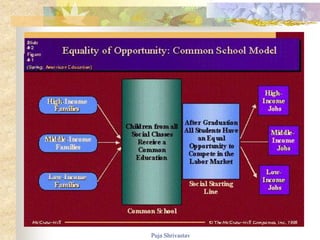
 Equality of Opportunity is a conception
generally describes fair competition for
important jobs and positions such that
contenders have equal chances to win such
positions,
 Applicants are not judged or hampered by
unfair or arbitrary discrimination.
Puja Shrivastav
Equality of Access
 Equity of access means that all people have the
information they need - regardless of age,
education, ethnicity, language, income, physical
limitations or geographic barriers.
 It means they are able to obtain information in a
variety of formats - electronic, as well as print.
 It also means they are free to exercise their right
to know without fear of censorship or reprisal
Puja Shrivastav
Equality of Outcome
 Equality of outcome can be defined as to think it
as "equality in the central and valuable things in
life.
 It describes a state in which people have
approximately the same material wealth or in
which the general economic conditions of their
lives are similar.
 It depend on the opportunity provided to the
individuals.
Puja Shrivastav
Puja Shrivastav
Formal Equality of Opportunity
 Formal equality of opportunity requires that
positions and posts that confer superior
advantages to all applicants.
 Applications are assessed on their merits, and the
applicant deemed most qualified according to
appropriate criteria is offered the position.
 Alternatively, applicants are winnowed by fair
competition, and the winner or winners get the
superior advantages
Puja Shrivastav
Formal Equality of Opportunity
 The ideal of formal equality of opportunity is
associated with the liberation of economic
practices and institutions from guild privileges
and restrictions and with the development of
competitive market economies.
 The slogan “careers open to talents” expresses the
aspiration to establish a world where government
posts go to the most qualified and economic
opportunities may be seized by anyone
independently of whether or not one's parents are
of noble blood or cronies of the king.
Puja Shrivastav
Substantive Equality of
Opportunity
 Substantive equality of opportunity prevails with
respect to some desirable position or ranked order
of positions just in case all members of society
are eligible to apply for the position
 Applications are fairly judged on their merits and
the most meritorious are selected, and sufficient
opportunity to develop the qualifications needed
for successful application is available to all.
Puja Shrivastav
Social Mobility and Equality of
Opportunity
 Social mobility is the movement of
individuals, families, households or other
categories of people within or between
social strata in a society.
 Mobility is most often quantitatively
measured in terms of change in economic
mobility such as changes in income or
wealth.
Puja Shrivastav
Human Rights Approach to
Equality
 Human rights also promise the engagement
of responsibilities
 Gender Equality
 Health Care and Social Care
 Empowerment
Puja Shrivastav
Affirmative Action and Equality
of Opportunity
 Affirmative action or Positive
Discrimination is the policy of favouring
members of disadvantaged group who
suffer from discrimination within a culture.
 In India Quota system is followed, where a
certain percentage of jobs or school
vacancies must be reserved for members of
certain group.
Puja Shrivastav
Equality of Opportunity and
Meritocracy
 Meritocracy means distribution of goods
and positions solely in accordance with
individual merit.
 Ex: job should be given to that applicant
who can do best in job.
Puja Shrivastav
The Value of an Education
 Education is simply a sorting device
 Educated people actually know something that is
valuable to employers
 There is an interaction between years of
schooling and aspirations. Motivated people stay
in school and staying in school motivates people
to achieve.
Puja Shrivastav
Class
 Class is based on Socio economic status.
 From a cultural point of view, schools represent
the values of the middle and upper classes.
 In a school that enrolls many middle class
children, more emphasis put on academic
achievement.
 However, a school that enrolls many higher class
children, put more emphasis on other activities
along with academic achievement
Puja Shrivastav
Gender
 In the last twenty years, gender differences
have been reduced, but still continue to
exist.
Puja Shrivastav
Minority Vs Non-Minority
 Minority people are getting chance to work
with non-minority.
 In every field there is reservation for
minority, so that they can bring themselves
at the equal plane.
Puja Shrivastav
Thank You!
Puja Shrivastav

Equalityof Opportunity

  • 1.
  • 2.
  • 3.
    Equality of Opportunity Equality refers to a state of affairs in which all people within a specific society or group have the same status.  Equality of opportunity is best expressed in the phrase — career open to talents.  No arbitrary obstacles should prevent people from achieving those public positions which their talents fit and which their values lead them to seek. Neither birth, nationality, colour, religion, sex nor any other equivalent characteristic should determine the public opportunities that are open to a person — only talent and achievement. Puja Shrivastav
  • 4.
    Equality of Opportunity Equality of opportunity means freedom to pursue one's private interest or vocation without arbitrary restrictions based on irrelevant personal characteristics.  For example: We can ask students to participate in some activities but we can not force them for that. Puja Shrivastav
  • 5.
    Concept of Equalityof Access, Opportunity and outcomes  Equality of Opportunity is a conception generally describes fair competition for important jobs and positions such that contenders have equal chances to win such positions,  Applicants are not judged or hampered by unfair or arbitrary discrimination. Puja Shrivastav
  • 6.
    Equality of Access Equity of access means that all people have the information they need - regardless of age, education, ethnicity, language, income, physical limitations or geographic barriers.  It means they are able to obtain information in a variety of formats - electronic, as well as print.  It also means they are free to exercise their right to know without fear of censorship or reprisal Puja Shrivastav
  • 7.
    Equality of Outcome Equality of outcome can be defined as to think it as "equality in the central and valuable things in life.  It describes a state in which people have approximately the same material wealth or in which the general economic conditions of their lives are similar.  It depend on the opportunity provided to the individuals. Puja Shrivastav
  • 8.
  • 9.
    Formal Equality ofOpportunity  Formal equality of opportunity requires that positions and posts that confer superior advantages to all applicants.  Applications are assessed on their merits, and the applicant deemed most qualified according to appropriate criteria is offered the position.  Alternatively, applicants are winnowed by fair competition, and the winner or winners get the superior advantages Puja Shrivastav
  • 10.
    Formal Equality ofOpportunity  The ideal of formal equality of opportunity is associated with the liberation of economic practices and institutions from guild privileges and restrictions and with the development of competitive market economies.  The slogan “careers open to talents” expresses the aspiration to establish a world where government posts go to the most qualified and economic opportunities may be seized by anyone independently of whether or not one's parents are of noble blood or cronies of the king. Puja Shrivastav
  • 11.
    Substantive Equality of Opportunity Substantive equality of opportunity prevails with respect to some desirable position or ranked order of positions just in case all members of society are eligible to apply for the position  Applications are fairly judged on their merits and the most meritorious are selected, and sufficient opportunity to develop the qualifications needed for successful application is available to all. Puja Shrivastav
  • 12.
    Social Mobility andEquality of Opportunity  Social mobility is the movement of individuals, families, households or other categories of people within or between social strata in a society.  Mobility is most often quantitatively measured in terms of change in economic mobility such as changes in income or wealth. Puja Shrivastav
  • 13.
    Human Rights Approachto Equality  Human rights also promise the engagement of responsibilities  Gender Equality  Health Care and Social Care  Empowerment Puja Shrivastav
  • 14.
    Affirmative Action andEquality of Opportunity  Affirmative action or Positive Discrimination is the policy of favouring members of disadvantaged group who suffer from discrimination within a culture.  In India Quota system is followed, where a certain percentage of jobs or school vacancies must be reserved for members of certain group. Puja Shrivastav
  • 15.
    Equality of Opportunityand Meritocracy  Meritocracy means distribution of goods and positions solely in accordance with individual merit.  Ex: job should be given to that applicant who can do best in job. Puja Shrivastav
  • 16.
    The Value ofan Education  Education is simply a sorting device  Educated people actually know something that is valuable to employers  There is an interaction between years of schooling and aspirations. Motivated people stay in school and staying in school motivates people to achieve. Puja Shrivastav
  • 17.
    Class  Class isbased on Socio economic status.  From a cultural point of view, schools represent the values of the middle and upper classes.  In a school that enrolls many middle class children, more emphasis put on academic achievement.  However, a school that enrolls many higher class children, put more emphasis on other activities along with academic achievement Puja Shrivastav
  • 18.
    Gender  In thelast twenty years, gender differences have been reduced, but still continue to exist. Puja Shrivastav
  • 19.
    Minority Vs Non-Minority Minority people are getting chance to work with non-minority.  In every field there is reservation for minority, so that they can bring themselves at the equal plane. Puja Shrivastav
  • 20.