Context of Adult Learning
by
Maria Boyd
Adult learning
• Education is continual throughout adult life
• Incorporates both visible and invisible
pressures
• Both the learning space and environment play
an important role in the learning process
Context of Learning
• Definiton of context =“the circumstances that
form the setting for an event, statement, or
idea, and in terms of which it can be fully
understood and assessed.”( Oxford dictionary)
• Definition of Context in Learning=“Learning
context is defined as the situation in which
something is learned or understood, a
situation that can impact how something is
learned or what is taught. (Oxford dictionary)
Examples of context in learning
• Variety of different contexts
• The following three will be represented;
• -informal versus formal learning
• -networked/distance learning
• -community based learning
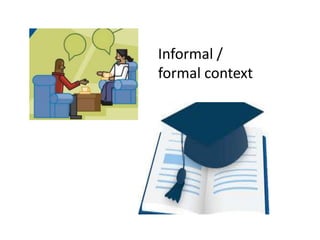
Informal /
formal context
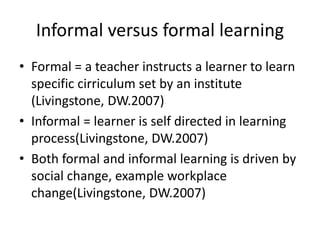
Informal versus formal learning
• Formal = a teacher instructs a learner to learn
specific cirriculum set by an institute
(Livingstone, DW.2007)
• Informal = learner is self directed in learning
process(Livingstone, DW.2007)
• Both formal and informal learning is driven by
social change, example workplace
change(Livingstone, DW.2007)
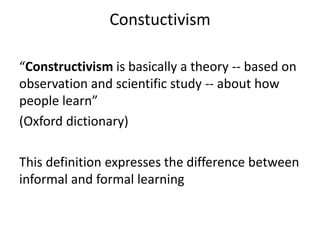
Constuctivism
“Constructivism is basically a theory -- based on
observation and scientific study -- about how
people learn”
(Oxford dictionary)
This definition expresses the difference between
informal and formal learning
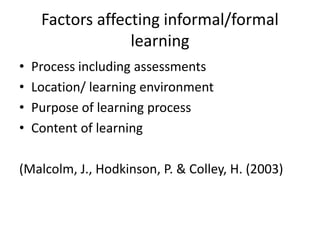
Factors affecting informal/formal
learning
• Process including assessments
• Location/ learning environment
• Purpose of learning process
• Content of learning
(Malcolm, J., Hodkinson, P. & Colley, H. (2003)
Process/Assessments
• Process of for formal learning is teacher
directed
• Process for informal learning is learner
directed
• Informal learning includes no assessment of
formative assessments
• Formal learning includes summative
assessment
Location/environment
• Presence of an institution as location for
learning = formal learning
• Workplace or community centers= informal
learning
(Malcolm, J., Hodkinson, P. & Colley, H. (2003)
Purpose
• Need for learning process determined and
initiated by learner themselves= informal
• Need for learning process designed and
determined by external person such as
teacher or government= formal
(Malcolm, J., Hodkinson, P. & Colley, H. (2003)
Content
• Learning from expert knowledge, vertical
knowledge= formal
• Learning something new, everyday practice
and work skills= informal
(Malcolm, J., Hodkinson, P. & Colley, H. (2003)
Network/
distance
Distance online learning
• Learning in an online environment tend to be
autonomous learners
• Environment plays an important role in this
learning process
• Time management, goal setting and time
availability are major factors affecting this
learning process
(Nesbit, T., Brigham, S.M., Taber, N. & Gibb, T.
(Eds.) (2013)
Factors affecting distance learning
• According to Bouchard, the following are factors
affecting online distance learning
• -conative=individual drive and motivation
• -algorithmic=sequence of events, objectives and
assessments
• -semiotic=delivery and resources
• -economy=value of learning to learner
(Nesbit, T., Brigham, S.M., Taber, N. & Gibb, T. (Eds.)
(2013)
Challenges of online learning
• -willingness of learners to participate and
engage
• -learners ability to direct their own
learning(literacies)
• -technology and demand on learner for
creativity(cloud computing)
• -visualization of data and interpretation
(Nesbit, T., Brigham, S.M., Taber, N. & Gibb, T.
(Eds.) (2013)
Connectivism
Connectivism is a hypothesis of learning which
emphasizes the role of social and cultural
context.(Oxford dictionary)
Connectism is also the “active engagement
between learners, rather then transfer of
knowledge between teacher and learner”
(Kop, R. and Fournier, H. (2011)
• Success of learner depends on;
• -learning environment
• -context
• -learner collaboration with other learners
Statements of online learning
• Ramble states;
“interactive communication must be in place”
otherwise there is no distinction between online
learning and reading a book
(Kop, R. and Fournier, H. (2011)
• Distance online learning also reflects informal
learning since it is learner directed
• Distance online learning also reflects formal
learning due to the fact that institutions
recognize the learning and provide credentials
Community learning
Community learning:purpose
• Is everyone’s right
• Improves community needs
• Addresses social needs
• Organization development to strengthen
community (example YMCA, community
centers)
(CUV (2005)
• Community needs affect learning objectives
• Learning activity is proactive when member
feel they belong or there is a sense of
community.
• Example of community group is community of
practice
Community of practice
• Defined as a” group of people who share a
concern of a passion for something they do and
learn how to do it better as they interact
regularly” ( Seaman, M 2008)
• - this is an informal platform of learning
• -leadership comes from within learning
community
• -exist to improve practice
• Community encourages learning as a social
change
Community learning; action theory
• According to Vygotksy “activity constitutes
and is constituted by social interaction,
acquisition of cultural tools and the formation
of new skills abilities” (Smolka, A. 2001)
• Community learning involves action from
learned knowledge
• Community members use gained knowledge
to affect social and community changes
Conclusion
• Adult education, is an ongoing life process
• Education exists in many forms in everyday life
• Informal learning must be recognized as a
form of education
• Community learning is also a learning
platform with action related results
• New technologies advance the environment
and process of adult learning
The future-personal view
• As with other aspects of life, advances
continue to occur. Society continues to
change. Education must be viewed openly and
understood for its various platforms.
• Education is our future. Methods of delivery
may change, role of instructors and learners
may change, but the quest for knowledge is
still the basis of all education
References
• http://www.oxforddictionaries.com/definition/english/context
• CUV (2005) Aiming high, quality in community learning,
guidance for partners, Community University of the Valleys
Partnership, Swansea, UK.
• Kop, R. and Fournier, H. (2011) ew Dimensions to self-directed
learning in an open networked learning environment,
International Journal of Self-Directed Learning 7, No 2 Fall 2010.
Pg. 1-20
•
REFERENCES
• Livingstone, D.W. (2007) Re-exploring the icebergs of adult learning:
comparative findings of the 1998 And 2004 Canadian surveys of
formal and informal learning practices, The Canadian Journal for the
Study of Adult Education 20, No. 2, 1-24.
•
• Malcolm, J., Hodkinson, P. & Colley, H. (2003) The interrelationships
between informal and formal learning, Journal of Workplace
Learning 15, No. 7/8, 313-318.
•
• Nesbit, T., Brigham, S.M., Taber, N. & Gibb, T. (Eds.) (2013) Building
on critical traditions: Adult education and learning in Canada.
Toronto: Thompson Educational Pub.

Presentation yorkville university

  • 1.
    Context of AdultLearning by Maria Boyd
  • 2.
    Adult learning • Educationis continual throughout adult life • Incorporates both visible and invisible pressures • Both the learning space and environment play an important role in the learning process
  • 3.
    Context of Learning •Definiton of context =“the circumstances that form the setting for an event, statement, or idea, and in terms of which it can be fully understood and assessed.”( Oxford dictionary) • Definition of Context in Learning=“Learning context is defined as the situation in which something is learned or understood, a situation that can impact how something is learned or what is taught. (Oxford dictionary)
  • 4.
    Examples of contextin learning • Variety of different contexts • The following three will be represented; • -informal versus formal learning • -networked/distance learning • -community based learning
  • 5.
  • 6.
    Informal versus formallearning • Formal = a teacher instructs a learner to learn specific cirriculum set by an institute (Livingstone, DW.2007) • Informal = learner is self directed in learning process(Livingstone, DW.2007) • Both formal and informal learning is driven by social change, example workplace change(Livingstone, DW.2007)
  • 7.
    Constuctivism “Constructivism is basicallya theory -- based on observation and scientific study -- about how people learn” (Oxford dictionary) This definition expresses the difference between informal and formal learning
  • 8.
    Factors affecting informal/formal learning •Process including assessments • Location/ learning environment • Purpose of learning process • Content of learning (Malcolm, J., Hodkinson, P. & Colley, H. (2003)
  • 9.
    Process/Assessments • Process offor formal learning is teacher directed • Process for informal learning is learner directed • Informal learning includes no assessment of formative assessments • Formal learning includes summative assessment
  • 10.
    Location/environment • Presence ofan institution as location for learning = formal learning • Workplace or community centers= informal learning (Malcolm, J., Hodkinson, P. & Colley, H. (2003)
  • 11.
    Purpose • Need forlearning process determined and initiated by learner themselves= informal • Need for learning process designed and determined by external person such as teacher or government= formal (Malcolm, J., Hodkinson, P. & Colley, H. (2003)
  • 12.
    Content • Learning fromexpert knowledge, vertical knowledge= formal • Learning something new, everyday practice and work skills= informal (Malcolm, J., Hodkinson, P. & Colley, H. (2003)
  • 13.
  • 14.
    Distance online learning •Learning in an online environment tend to be autonomous learners • Environment plays an important role in this learning process • Time management, goal setting and time availability are major factors affecting this learning process (Nesbit, T., Brigham, S.M., Taber, N. & Gibb, T. (Eds.) (2013)
  • 15.
    Factors affecting distancelearning • According to Bouchard, the following are factors affecting online distance learning • -conative=individual drive and motivation • -algorithmic=sequence of events, objectives and assessments • -semiotic=delivery and resources • -economy=value of learning to learner (Nesbit, T., Brigham, S.M., Taber, N. & Gibb, T. (Eds.) (2013)
  • 16.
    Challenges of onlinelearning • -willingness of learners to participate and engage • -learners ability to direct their own learning(literacies) • -technology and demand on learner for creativity(cloud computing) • -visualization of data and interpretation (Nesbit, T., Brigham, S.M., Taber, N. & Gibb, T. (Eds.) (2013)
  • 17.
    Connectivism Connectivism is ahypothesis of learning which emphasizes the role of social and cultural context.(Oxford dictionary) Connectism is also the “active engagement between learners, rather then transfer of knowledge between teacher and learner” (Kop, R. and Fournier, H. (2011)
  • 18.
    • Success oflearner depends on; • -learning environment • -context • -learner collaboration with other learners
  • 19.
    Statements of onlinelearning • Ramble states; “interactive communication must be in place” otherwise there is no distinction between online learning and reading a book (Kop, R. and Fournier, H. (2011)
  • 20.
    • Distance onlinelearning also reflects informal learning since it is learner directed • Distance online learning also reflects formal learning due to the fact that institutions recognize the learning and provide credentials
  • 21.
  • 22.
    Community learning:purpose • Iseveryone’s right • Improves community needs • Addresses social needs • Organization development to strengthen community (example YMCA, community centers) (CUV (2005)
  • 23.
    • Community needsaffect learning objectives • Learning activity is proactive when member feel they belong or there is a sense of community. • Example of community group is community of practice
  • 24.
    Community of practice •Defined as a” group of people who share a concern of a passion for something they do and learn how to do it better as they interact regularly” ( Seaman, M 2008) • - this is an informal platform of learning • -leadership comes from within learning community • -exist to improve practice • Community encourages learning as a social change
  • 25.
    Community learning; actiontheory • According to Vygotksy “activity constitutes and is constituted by social interaction, acquisition of cultural tools and the formation of new skills abilities” (Smolka, A. 2001) • Community learning involves action from learned knowledge • Community members use gained knowledge to affect social and community changes
  • 26.
    Conclusion • Adult education,is an ongoing life process • Education exists in many forms in everyday life • Informal learning must be recognized as a form of education • Community learning is also a learning platform with action related results • New technologies advance the environment and process of adult learning
  • 27.
    The future-personal view •As with other aspects of life, advances continue to occur. Society continues to change. Education must be viewed openly and understood for its various platforms. • Education is our future. Methods of delivery may change, role of instructors and learners may change, but the quest for knowledge is still the basis of all education
  • 28.
    References • http://www.oxforddictionaries.com/definition/english/context • CUV(2005) Aiming high, quality in community learning, guidance for partners, Community University of the Valleys Partnership, Swansea, UK. • Kop, R. and Fournier, H. (2011) ew Dimensions to self-directed learning in an open networked learning environment, International Journal of Self-Directed Learning 7, No 2 Fall 2010. Pg. 1-20 •
  • 29.
    REFERENCES • Livingstone, D.W.(2007) Re-exploring the icebergs of adult learning: comparative findings of the 1998 And 2004 Canadian surveys of formal and informal learning practices, The Canadian Journal for the Study of Adult Education 20, No. 2, 1-24. • • Malcolm, J., Hodkinson, P. & Colley, H. (2003) The interrelationships between informal and formal learning, Journal of Workplace Learning 15, No. 7/8, 313-318. • • Nesbit, T., Brigham, S.M., Taber, N. & Gibb, T. (Eds.) (2013) Building on critical traditions: Adult education and learning in Canada. Toronto: Thompson Educational Pub.