• What is Education?
• What is Philosophy?
• What is Educational Philosophy?
• What are the natures of Educational Philosophy?
• What are the Aims and scope of Educational
Philosophy?
• Relationship between Philosophy and Education.
• Significance of Philosophy on Education.
What Philosophy is ?
• It is the oldest intellectual Discipline of the
world.
• Philosophy is nothing but a deep state of
enquiry to find out the truth or reality.
• It is a process where deep thoughts, deep
concern or deep enquiry is done into a
problem to know its reality.
• Thales, the Greek philosopher of 7th century
B.C. is considered as the father of Western
Philosophy.
• The systematic interpretation to find out the
reality or truth of a problem is called
• Philosophy provides knowledge and
information to all subjects.
• It is rightly called as the mother of “all
Sciences & Arts” subjects.
In layman’s view ,Philosophy is nothing but
wisdom, knowledge, virtue etc.
Etymological Meaning:
• Philos + Sophia=(Love+ Wisdom)=Love for
Wisdom.
• It is a continuous seeking of insight into basic
realities on the physical world, life, mind,
society, knowledge & values.
• Philosophers are the persons who are curious
to learn new things always and never satisfy
in any particular answer.
• Definitions:
Weber, “Philosophy is an attempt at universal
explanation of nature of things, it looks into the
problem deeper and still deeper till it reaches
compression and meaningfulness.”
Fichte,-“Philosophy is the Science of Knowledge”.
DR.S. Radhakrishnan,- “Philosophy is a logical
enquiry into the nature of reality”.
Cisero,- “Philosophy is the mother of all arts and the
true medicine of mind”.
Aristotle,- “Philosophy is a Science, which discovers
the real nature of Supernatural elements”.
Findings:
• Philosophy is the truth or wisdom gain out of
human knowledge and experience.
• It is a rational way of thinking and living.
• It is the totality of human experiences,
comprehensive view of life.
• It is an attempt to answer the ultimate reality
of life.
• It is a search for knowledge, wisdom, reality
by logical reasoning.
In Hindi it is called as ‘Darshan’, through which
we can see or perceive truth.
Educational Philosophy
• Now, the combination of (Education +
Philosophy) =Educational Philosophy.
• It is a branch of Philosophy which answers all
educational questions or problems.
• Both are interrelated and complementary to
each others.
• “Philosophy without Education is Blind.
Education without Philosophy is Lame.”
• Philosophy gives direction to Education and
Education proceeds on right lines with the help
of Philosophy.
• Ross: “Philosophy and Education are two sides
of a same coin.”
Definitions of Educational Philosophy.
• John Dewey, “Educational Philosophy is the
most significant phase of Philosophy, for it is
through the process of Education that
knowledge is obtained”.
• G.E. Patridge, “ Philosophy is based upon
Education, as Education is based upon
Philosophy.”
 It is the application of philosophical principles
in the educational processes.
It relates philosophy to life through the
medium of education.
Nature of Educational
Philosophy.
• It related Philosophy to life through the medium
of Education.
• It helps to acquire knowledge and skills in
Education.
• It solves all educational issues and problems.
• It determines the aims of human life.
• It is a theoretical Science.
• It helps in achieving goals in human life.
• It determines the aim of education, curriculum,
methods of teaching, role of teachers, role of
the students, evaluation process etc.
Aims of Educational Philosophy.
1. To find solutions for various educational issues related with
students, teachers, curriculum, methods, discipline etc.
2. To make Education according to the need based life and
society.
3. To determine aim of human life that is, aim of survival.
4. To produce better citizens by fostering democratic attitudes
in behaviour.
5. To make teaching learning process more effective and
attractive.
6. To expand our knowledge & experiences & implement them
in the educational practices.
7. To bring out an all round personality development in child
and prepare him to stand on his own feet.
8. To make Education flexible in order to achieve the goals of a
country-national integration, international Understanding &
globalisation.
9. To develop Education as a powerful instrument to bring out
Scope of Educational Philosophy.
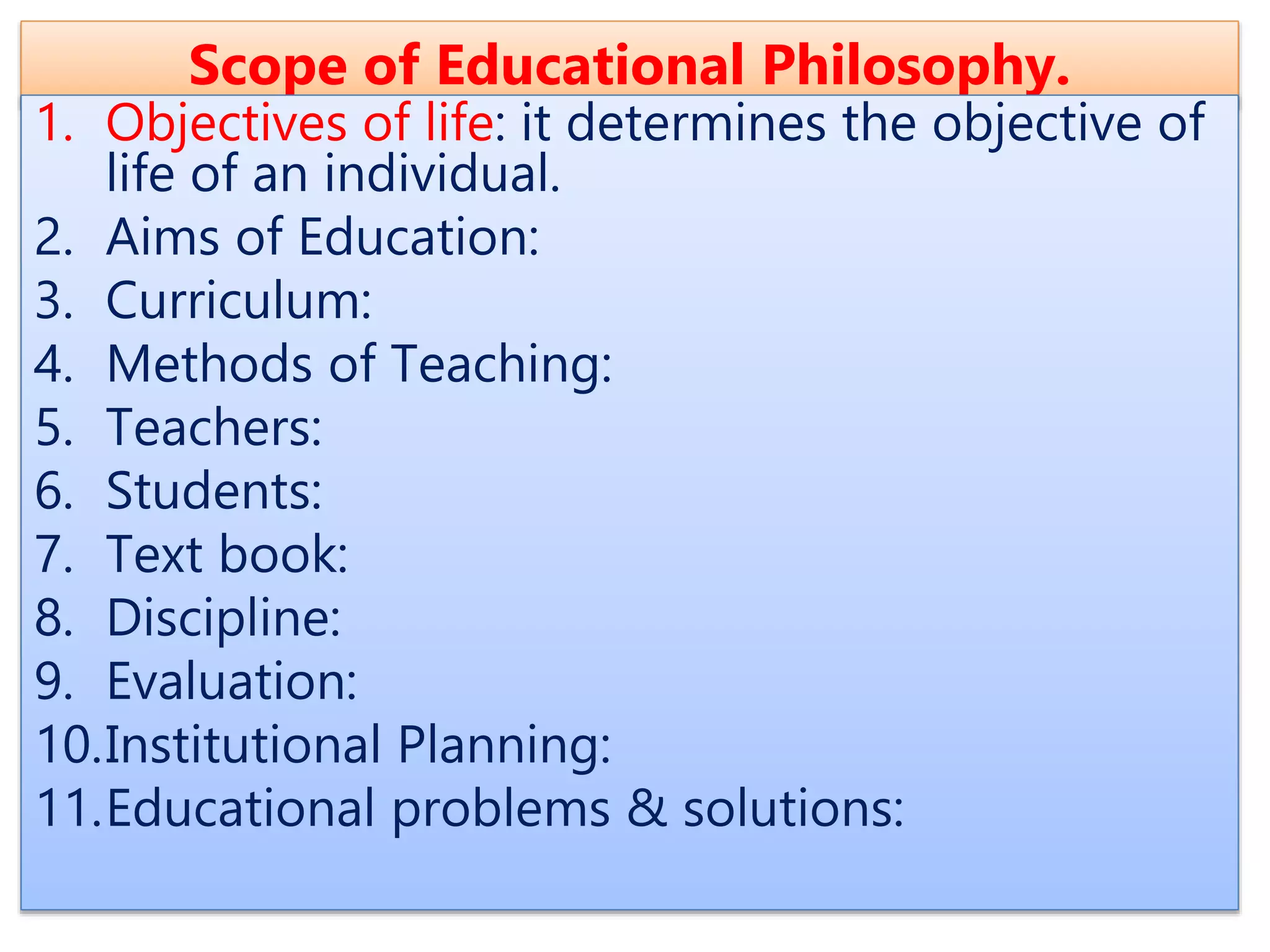
1. Objectives of life: it determines the objective of
life of an individual.
2. Aims of Education:
3. Curriculum:
4. Methods of Teaching:
5. Teachers:
6. Students:
7. Text book:
8. Discipline:
9. Evaluation:
10.Institutional Planning:
11.Educational problems & solutions:
Relationship between Philosophy and Education.
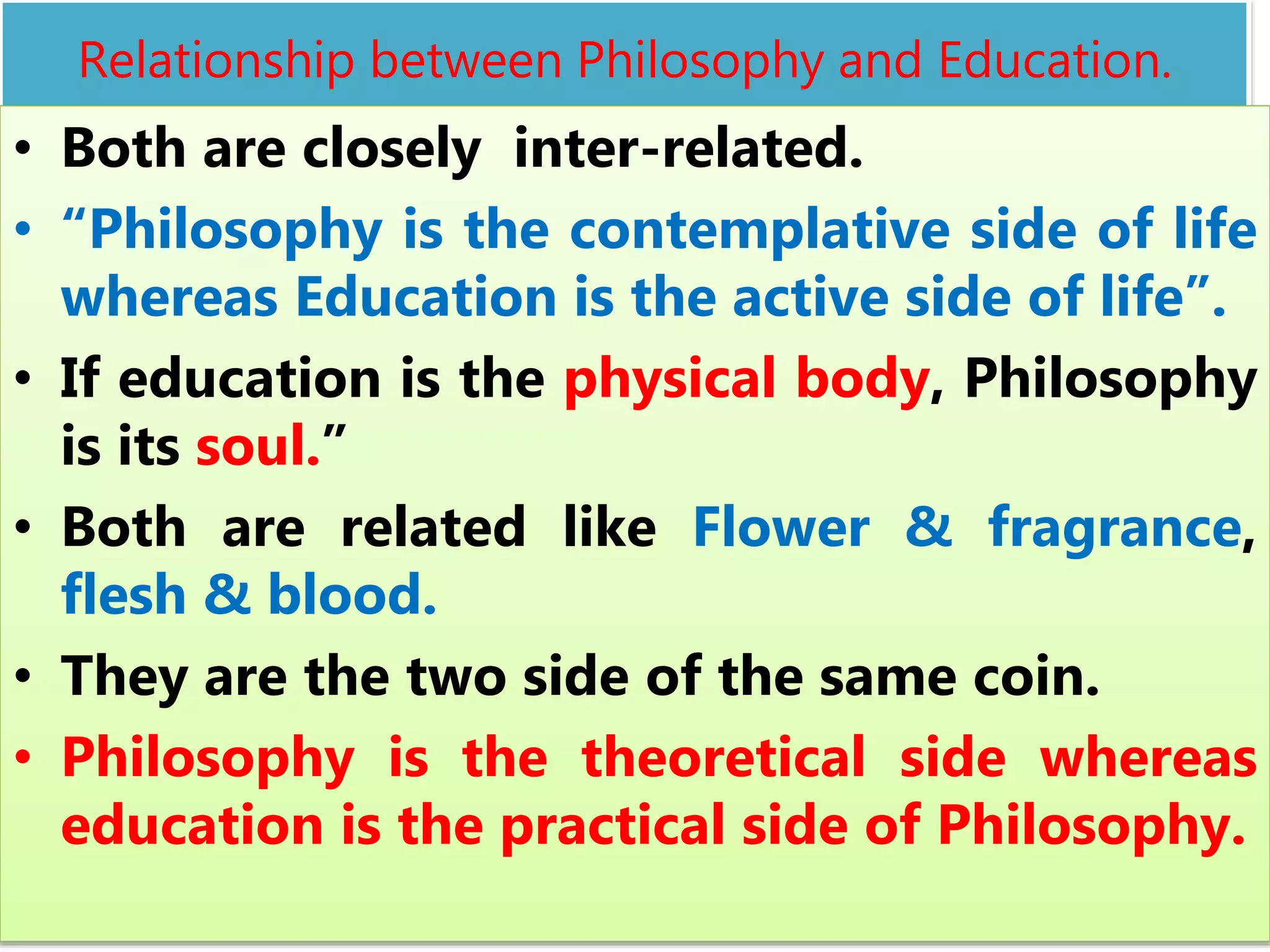
• Both are closely inter-related.
• “Philosophy is the contemplative side of life
whereas Education is the active side of life”.
• If education is the physical body, Philosophy
is its soul.”
• Both are related like Flower & fragrance,
flesh & blood.
• They are the two side of the same coin.
• Philosophy is the theoretical side whereas
education is the practical side of Philosophy.
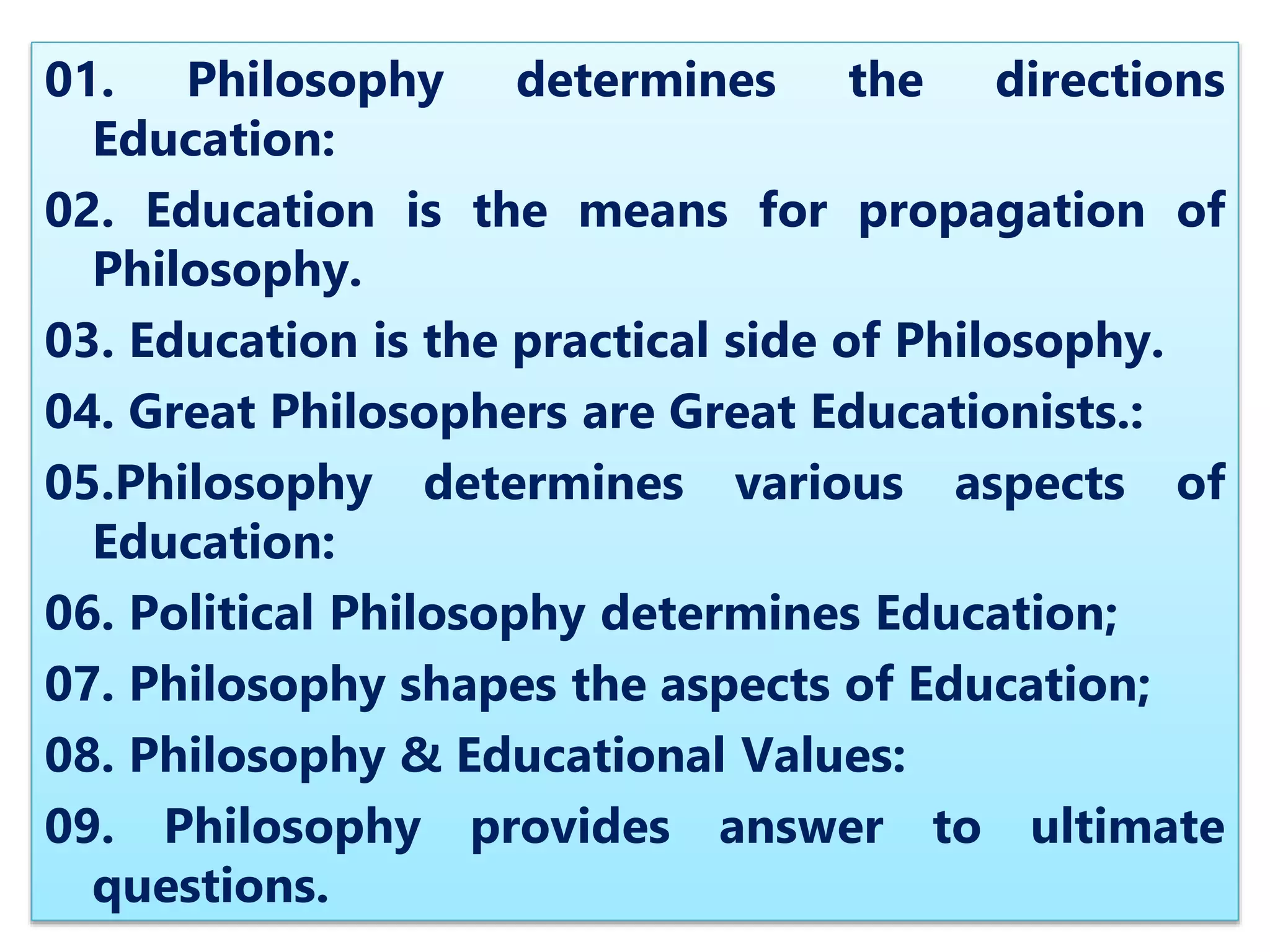
01. Philosophy determines the directions
Education:
02. Education is the means for propagation of
Philosophy.
03. Education is the practical side of Philosophy.
04. Great Philosophers are Great Educationists.:
05.Philosophy determines various aspects of
Education:
06. Political Philosophy determines Education;
07. Philosophy shapes the aspects of Education;
08. Philosophy & Educational Values:
09. Philosophy provides answer to ultimate
questions.
Significance of Philosophy for Educational
Practices.
( Impact of Philosophy on Education.)
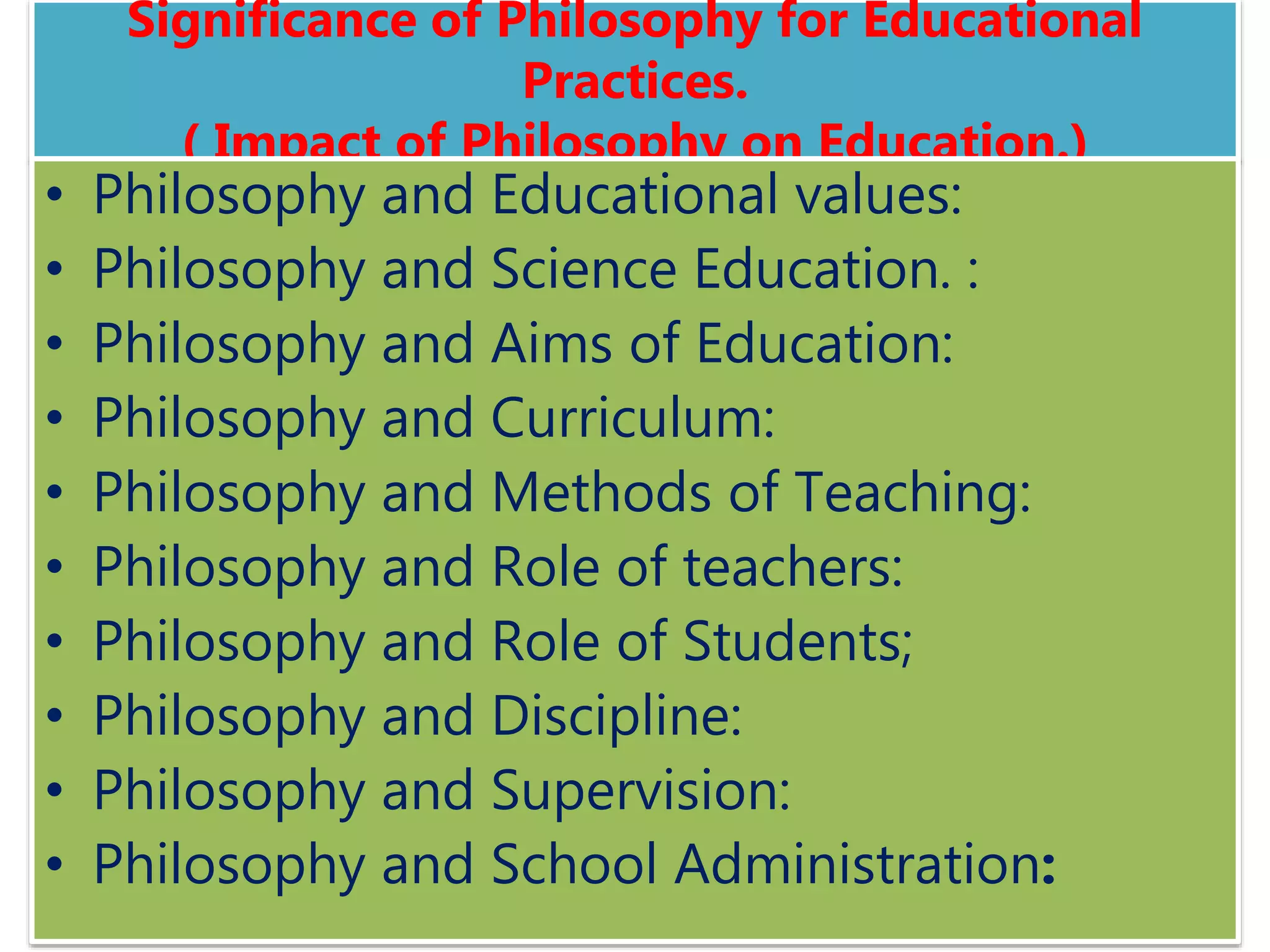
• Philosophy and Educational values:
• Philosophy and Science Education. :
• Philosophy and Aims of Education:
• Philosophy and Curriculum:
• Philosophy and Methods of Teaching:
• Philosophy and Role of teachers:
• Philosophy and Role of Students;
• Philosophy and Discipline:
• Philosophy and Supervision:
• Philosophy and School Administration:
Role of Philosophy Naturalism Idealism Pragmatism
1. Aims of
Education
Self-Expression Self-Realisation Social Efficiency
2. Curriculum Science Subjects based
on interest &
experiences. Based on
psychology of child.
Religious Subjects for
spiritual
development.
Ethics, Logic,
Literature
Practical Subject-
Electronics,
Automobiles Poly-
tech etc.
3. Methods of
Teaching
Learning by doing, Play
way,Child Centred,
Learning by self, Auto-
education.
Lecture , Question-
Answer , logical,
Discussion, Debate
Experimental,
Project, Problem-
solving, group activity
4. Discipline No Restriction, Self-
control.
Full Strict & Rigid Social Discipline.
5. Role of Teacher Spectator &Observer,
Passive
Active & Prime Friend, Guide &
Philosopher.
6. Role of Student Primary, Active Secondary Active Participant
7. School Building
Con.
Natural Environment Controlled
Environment
Social Environment.
8. Supervision Lenient Very Strict Democratic
&Friendly
9. Administration.

Educational Philosophy , nature and its function.. M.A pptx.pptx

  • 1.
    • What isEducation? • What is Philosophy? • What is Educational Philosophy? • What are the natures of Educational Philosophy? • What are the Aims and scope of Educational Philosophy? • Relationship between Philosophy and Education. • Significance of Philosophy on Education.
  • 2.
    What Philosophy is? • It is the oldest intellectual Discipline of the world. • Philosophy is nothing but a deep state of enquiry to find out the truth or reality. • It is a process where deep thoughts, deep concern or deep enquiry is done into a problem to know its reality. • Thales, the Greek philosopher of 7th century B.C. is considered as the father of Western Philosophy. • The systematic interpretation to find out the reality or truth of a problem is called
  • 3.
    • Philosophy providesknowledge and information to all subjects. • It is rightly called as the mother of “all Sciences & Arts” subjects. In layman’s view ,Philosophy is nothing but wisdom, knowledge, virtue etc. Etymological Meaning: • Philos + Sophia=(Love+ Wisdom)=Love for Wisdom. • It is a continuous seeking of insight into basic realities on the physical world, life, mind, society, knowledge & values. • Philosophers are the persons who are curious to learn new things always and never satisfy in any particular answer.
  • 4.
    • Definitions: Weber, “Philosophyis an attempt at universal explanation of nature of things, it looks into the problem deeper and still deeper till it reaches compression and meaningfulness.” Fichte,-“Philosophy is the Science of Knowledge”. DR.S. Radhakrishnan,- “Philosophy is a logical enquiry into the nature of reality”. Cisero,- “Philosophy is the mother of all arts and the true medicine of mind”. Aristotle,- “Philosophy is a Science, which discovers the real nature of Supernatural elements”.
  • 5.
    Findings: • Philosophy isthe truth or wisdom gain out of human knowledge and experience. • It is a rational way of thinking and living. • It is the totality of human experiences, comprehensive view of life. • It is an attempt to answer the ultimate reality of life. • It is a search for knowledge, wisdom, reality by logical reasoning. In Hindi it is called as ‘Darshan’, through which we can see or perceive truth.
  • 6.
    Educational Philosophy • Now,the combination of (Education + Philosophy) =Educational Philosophy. • It is a branch of Philosophy which answers all educational questions or problems. • Both are interrelated and complementary to each others. • “Philosophy without Education is Blind. Education without Philosophy is Lame.” • Philosophy gives direction to Education and Education proceeds on right lines with the help of Philosophy. • Ross: “Philosophy and Education are two sides of a same coin.”
  • 7.
    Definitions of EducationalPhilosophy. • John Dewey, “Educational Philosophy is the most significant phase of Philosophy, for it is through the process of Education that knowledge is obtained”. • G.E. Patridge, “ Philosophy is based upon Education, as Education is based upon Philosophy.”  It is the application of philosophical principles in the educational processes. It relates philosophy to life through the medium of education.
  • 8.
    Nature of Educational Philosophy. •It related Philosophy to life through the medium of Education. • It helps to acquire knowledge and skills in Education. • It solves all educational issues and problems. • It determines the aims of human life. • It is a theoretical Science. • It helps in achieving goals in human life. • It determines the aim of education, curriculum, methods of teaching, role of teachers, role of the students, evaluation process etc.
  • 9.
    Aims of EducationalPhilosophy. 1. To find solutions for various educational issues related with students, teachers, curriculum, methods, discipline etc. 2. To make Education according to the need based life and society. 3. To determine aim of human life that is, aim of survival. 4. To produce better citizens by fostering democratic attitudes in behaviour. 5. To make teaching learning process more effective and attractive. 6. To expand our knowledge & experiences & implement them in the educational practices. 7. To bring out an all round personality development in child and prepare him to stand on his own feet. 8. To make Education flexible in order to achieve the goals of a country-national integration, international Understanding & globalisation. 9. To develop Education as a powerful instrument to bring out
  • 10.
    Scope of EducationalPhilosophy. 1. Objectives of life: it determines the objective of life of an individual. 2. Aims of Education: 3. Curriculum: 4. Methods of Teaching: 5. Teachers: 6. Students: 7. Text book: 8. Discipline: 9. Evaluation: 10.Institutional Planning: 11.Educational problems & solutions:
  • 11.
    Relationship between Philosophyand Education. • Both are closely inter-related. • “Philosophy is the contemplative side of life whereas Education is the active side of life”. • If education is the physical body, Philosophy is its soul.” • Both are related like Flower & fragrance, flesh & blood. • They are the two side of the same coin. • Philosophy is the theoretical side whereas education is the practical side of Philosophy.
  • 12.
    01. Philosophy determinesthe directions Education: 02. Education is the means for propagation of Philosophy. 03. Education is the practical side of Philosophy. 04. Great Philosophers are Great Educationists.: 05.Philosophy determines various aspects of Education: 06. Political Philosophy determines Education; 07. Philosophy shapes the aspects of Education; 08. Philosophy & Educational Values: 09. Philosophy provides answer to ultimate questions.
  • 13.
    Significance of Philosophyfor Educational Practices. ( Impact of Philosophy on Education.) • Philosophy and Educational values: • Philosophy and Science Education. : • Philosophy and Aims of Education: • Philosophy and Curriculum: • Philosophy and Methods of Teaching: • Philosophy and Role of teachers: • Philosophy and Role of Students; • Philosophy and Discipline: • Philosophy and Supervision: • Philosophy and School Administration:
  • 14.
    Role of PhilosophyNaturalism Idealism Pragmatism 1. Aims of Education Self-Expression Self-Realisation Social Efficiency 2. Curriculum Science Subjects based on interest & experiences. Based on psychology of child. Religious Subjects for spiritual development. Ethics, Logic, Literature Practical Subject- Electronics, Automobiles Poly- tech etc. 3. Methods of Teaching Learning by doing, Play way,Child Centred, Learning by self, Auto- education. Lecture , Question- Answer , logical, Discussion, Debate Experimental, Project, Problem- solving, group activity 4. Discipline No Restriction, Self- control. Full Strict & Rigid Social Discipline. 5. Role of Teacher Spectator &Observer, Passive Active & Prime Friend, Guide & Philosopher. 6. Role of Student Primary, Active Secondary Active Participant 7. School Building Con. Natural Environment Controlled Environment Social Environment. 8. Supervision Lenient Very Strict Democratic &Friendly 9. Administration.