






















New learning
paradigms & technologies
Prof. dr. Frederik Questier, Vrije Universiteit Brussel
Guest lecture at Communications University of China, Higher Education Research Institute, 16/10/2010
This presentation can be found at
             http://questier.com
http://www.slideshare.net/Frederik_Questier
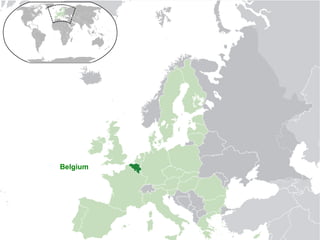
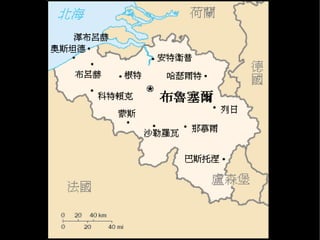
Belgium
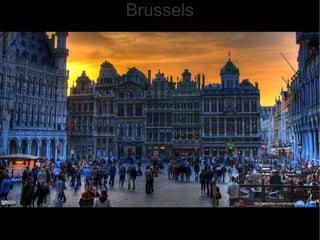
Brussels
Atomium building © www.atomium.be - SABAM 2010; photo CC-by-nc-sa by fatboyke Luc B
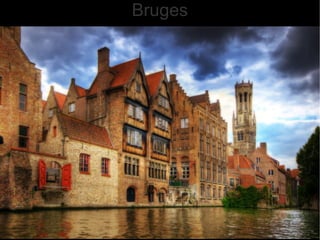
Bruges
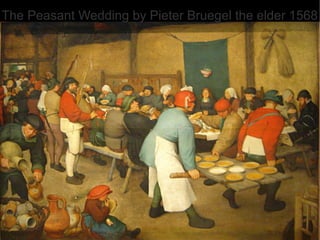
The Peasant Wedding by Pieter Bruegel the elder 1568
"Of all the Gauls,
   the Belgae
are the bravest."

 Julius Caesar,
Roman Emperor,
      50BC
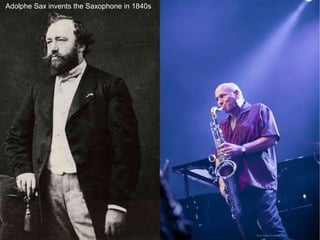
Adolphe Sax invents the Saxophone in 1840s
Carnaval de Binche
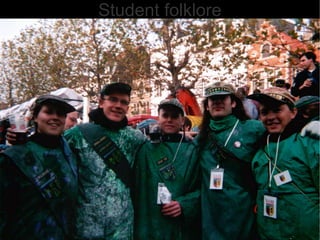
Student folklore
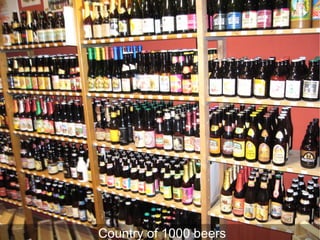
Country of 1000 beers
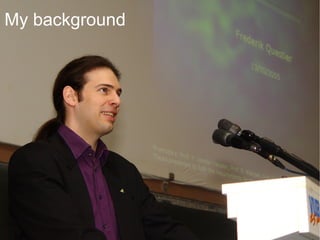
My background
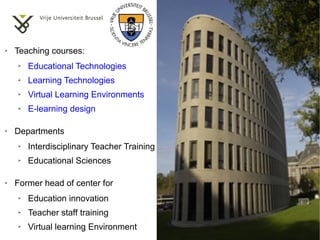
➢   Teaching courses:
    ➢   Educational Technologies
    ➢   Learning Technologies
    ➢   Virtual Learning Environments
    ➢   E-learning design

➢   Departments
    ➢   Interdisciplinary Teacher Training
    ➢   Educational Sciences

➢   Former head of center for
    ➢   Education innovation
    ➢   Teacher staff training
    ➢   Virtual learning Environment
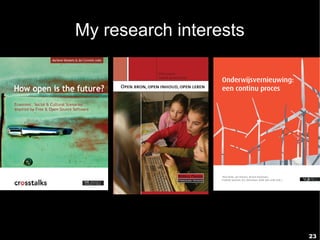
My research interests


                        23
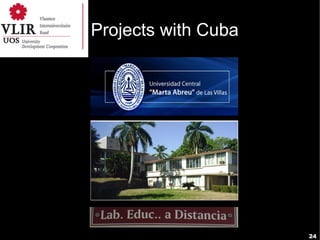
Projects with Cuba


                     24
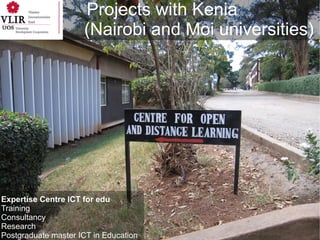
Projects with Kenia
                     (Nairobi and Moi universities)


Expertise Centre ICT for edu
Training
Consultancy
Research
Postgraduate master ICT in Education              25
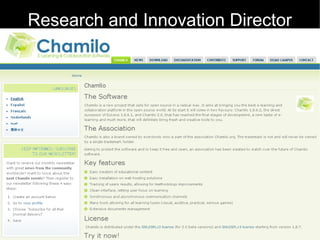
Research and Innovation Director


                                   26
One Laptop Per Child


                       27
Educational Innovation?
  Why change the way we teach and learn?

How to change the way we teach and learn?

              (with or without technologies)


                                           28
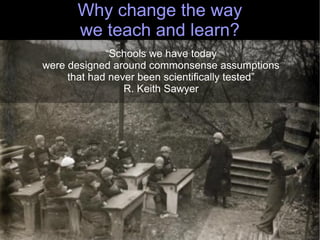
Why change the way
      we teach and learn?
             “Schools we have today
were designed around commonsense assumptions
     that had never been scientifically tested”
                 R. Keith Sawyer


                                                  29
Why change the way
    we teach and learn?


Because everything else is changing !


                                        30
Information Society ?


                   31
Knowledge Society


                    32
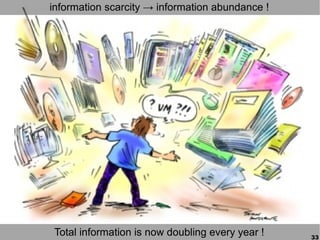
information scarcity → information abundance !


Total information is now doubling every year !   33
Evolution of the internet?

Web 2.0 (social and collaborative)

       Web 3.0 (semantic)

     Mobile and Ubiquitous

      The internet of things

   Global brain – intelligence


                                     34
Virtual reality gets photorealism


Crysis                                       35
Augmented Reality


               36
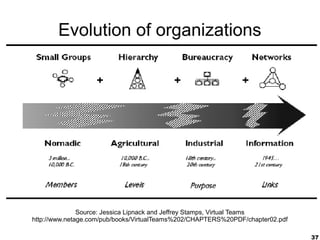
Evolution of organizations


               Source: Jessica Lipnack and Jeffrey Stamps, Virtual Teams
http://www.netage.com/pub/books/VirtualTeams%202/CHAPTERS%20PDF/chapter02.pdf

                                                                                37
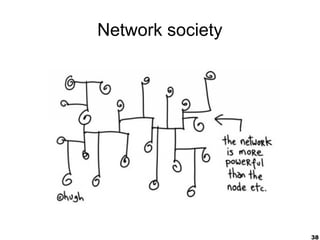
Network society


                  38
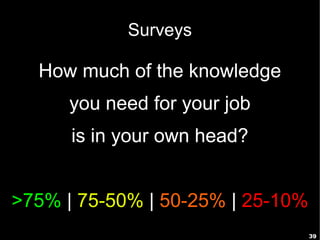
Surveys

  How much of the knowledge
      you need for your job
      is in your own head?


>75% | 75-50% | 50-25% | 25-10%
                                  39
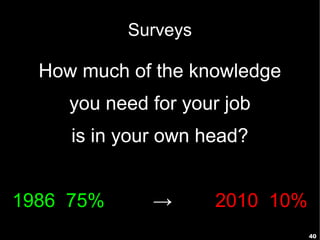
Surveys

  How much of the knowledge
     you need for your job
     is in your own head?


1986 75%      →      2010 10%
                                40
The longer one studies,
the more one comes to realize
how much one does not know      41
Frederik Questier at the MIT Miracle of Science Bar, 2009   42
43
44
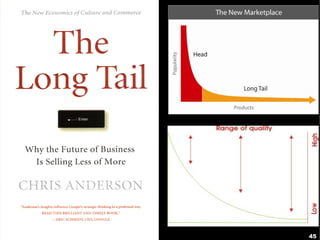
45
You will have to
 compete with
     free!


                   46
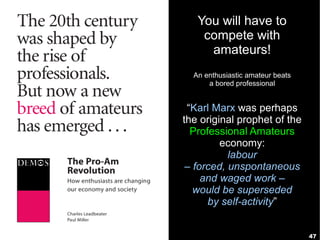
You will have to
    compete with
     amateurs!
  An enthusiastic amateur beats
      a bored professional


 “Karl Marx was perhaps
the original prophet of the
  Professional Amateurs
         economy:
           labour
 – forced, unspontaneous
     and waged work –
   would be superseded
      by self-activity”


                                  47
What can professionals do?


         Embrace or Die !
48
49
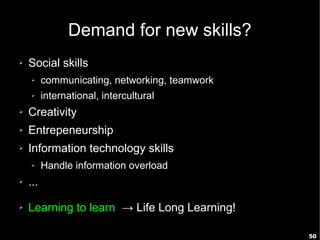
Demand for new skills?
➢   Social skills
    ➢     communicating, networking, teamwork
    ➢     international, intercultural
➢   Creativity
➢   Entrepeneurship
➢   Information technology skills
    ➢     Handle information overload
➢   ...
➢


➢   Learning to learn → Life Long Learning!

                                                50
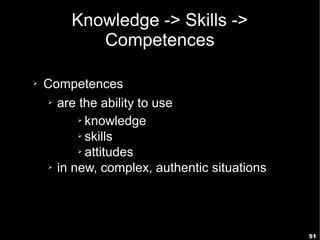
Knowledge -> Skills ->
           Competences

➢   Competences
    ➢ are the ability to use


          ➢ knowledge

          ➢ skills

          ➢ attitudes

    ➢ in new, complex, authentic situations


                                              51
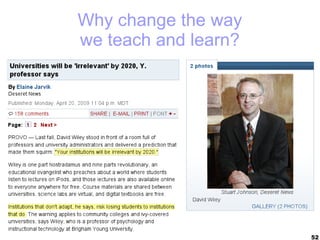
Why change the way
we teach and learn?


                      52
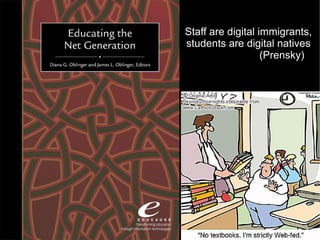
Staff are digital immigrants,
students are digital natives
                   (Prensky)


                            53
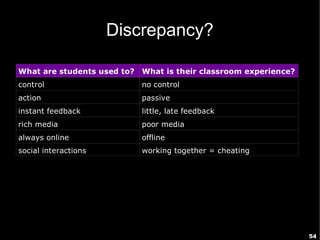
Discrepancy?

What are students used to?   What is their classroom experience?
control                      no control
action                       passive
instant feedback             little, late feedback
rich media                   poor media
always online                offline
social interactions          working together = cheating


                                                                   54
Why change the way
                  we teach and learn?


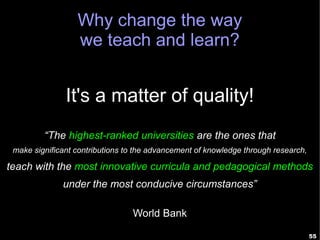
               It's a matter of quality!
         “The highest-ranked universities are the ones that
 make significant contributions to the advancement of knowledge through research,

teach with the most innovative curricula and pedagogical methods
              under the most conducive circumstances”

                                 World Bank

                                                                                    55
Why change the way
       we teach and learn?


We have new scientific knowledge
   about teaching and learning


                                   56
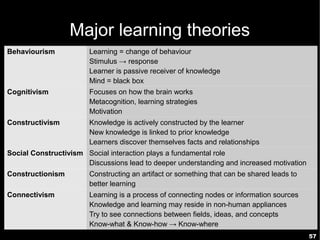
Major learning theories
Behaviourism           Learning = change of behaviour
                       Stimulus → response
                       Learner is passive receiver of knowledge
                       Mind = black box
Cognitivism            Focuses on how the brain works
                       Metacognition, learning strategies
                       Motivation
Constructivism         Knowledge is actively constructed by the learner
                       New knowledge is linked to prior knowledge
                       Learners discover themselves facts and relationships
Social Constructivism Social interaction plays a fundamental role
                      Discussions lead to deeper understanding and increased motivation
Constructionism        Constructing an artifact or something that can be shared leads to
                       better learning
Connectivism           Learning is a process of connecting nodes or information sources
                       Knowledge and learning may reside in non-human appliances
                       Try to see connections between fields, ideas, and concepts
                       Know-what & Know-how → Know-where
                                                                                           57
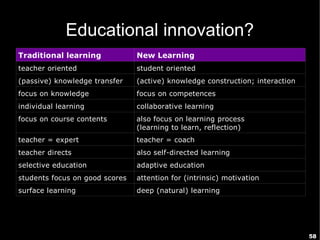
Educational innovation?
Traditional learning            New Learning
teacher oriented                student oriented
(passive) knowledge transfer    (active) knowledge construction; interaction
focus on knowledge              focus on competences
individual learning             collaborative learning
focus on course contents        also focus on learning process
                                (learning to learn, reflection)
teacher = expert                teacher = coach
teacher directs                 also self-directed learning
selective education             adaptive education
students focus on good scores   attention for (intrinsic) motivation
surface learning                deep (natural) learning


                                                                               58
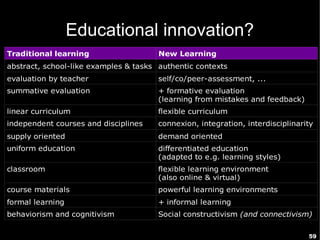
Educational innovation?
Traditional learning                   New Learning
abstract, school-like examples & tasks authentic contexts
evaluation by teacher                  self/co/peer-assessment, ...
summative evaluation                   + formative evaluation
                                       (learning from mistakes and feedback)
linear curriculum                      flexible curriculum
independent courses and disciplines    connexion, integration, interdisciplinarity
supply oriented                        demand oriented
uniform education                      differentiated education
                                       (adapted to e.g. learning styles)
classroom                              flexible learning environment
                                       (also online & virtual)
course materials                       powerful learning environments
formal learning                        + informal learning
behaviorism and cognitivism            Social constructivism (and connectivism)

                                                                                59
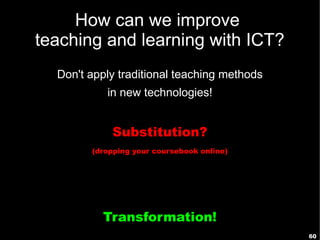
How can we improve
teaching and learning with ICT?
  Don't apply traditional teaching methods
           in new technologies!


            Substitution?
        (dropping your coursebook online)


          Transformation!
                                             60
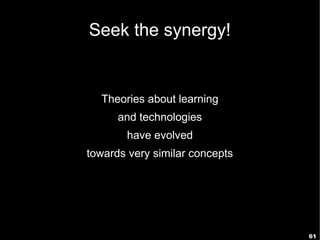
Seek the synergy!


  Theories about learning
      and technologies
       have evolved
towards very similar concepts


                                61
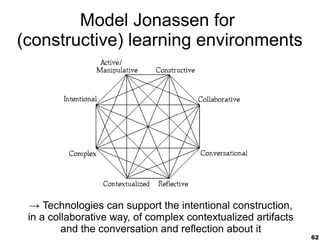
Model Jonassen for
(constructive) learning environments


  → Technologies can support the intentional construction,
 in a collaborative way, of complex contextualized artifacts
         and the conversation and reflection about it
                                                               62
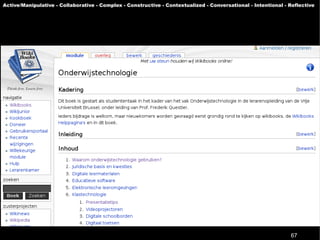
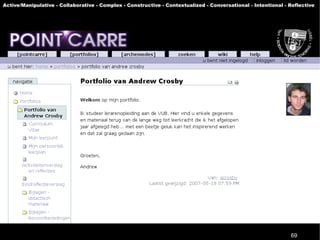
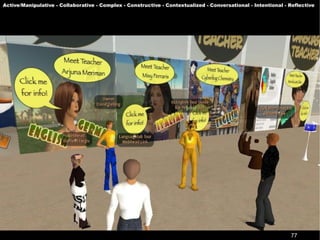
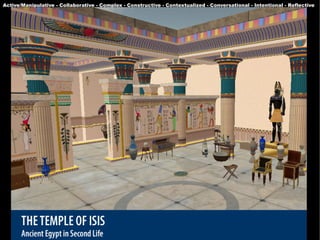
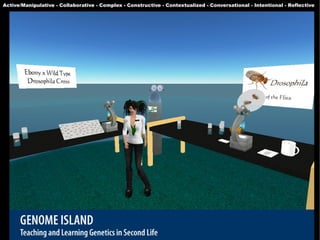
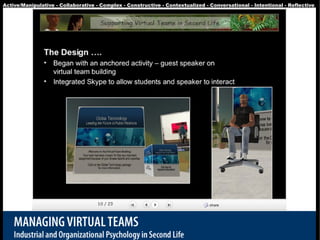
Exercise


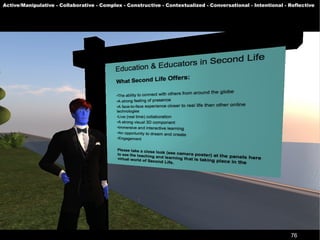
 Which characteristics of Jonassen's model
apply to the following learning environments?
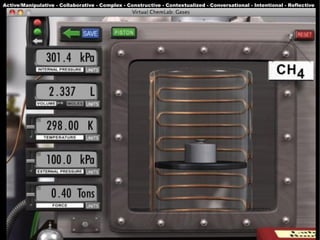
Active/Manipulative - Collaborative - Complex - Constructive - Contextualized - Conversational - Intentional - Reflective


                                                                                                               64
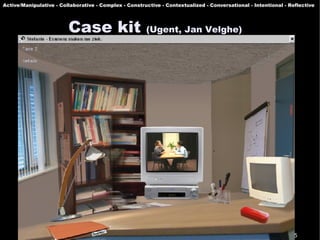
Active/Manipulative - Collaborative - Complex - Constructive - Contextualized - Conversational - Intentional - Reflective


                         Case kit (Ugent, Jan Velghe)


                                                                                                               65
Active/Manipulative - Collaborative - Complex - Constructive - Contextualized - Conversational - Intentional - Reflective


                                                                                                               66
Active/Manipulative - Collaborative - Complex - Constructive - Contextualized - Conversational - Intentional - Reflective


                                                                                                               67
Active/Manipulative - Collaborative - Complex - Constructive - Contextualized - Conversational - Intentional - Reflective


                                                                                                               68
Active/Manipulative - Collaborative - Complex - Constructive - Contextualized - Conversational - Intentional - Reflective


                                                                                                               69
Active/Manipulative - Collaborative - Complex - Constructive - Contextualized - Conversational - Intentional - Reflective

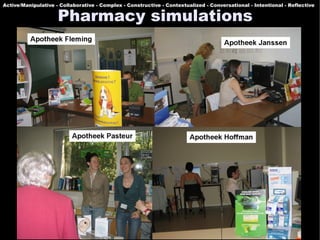
                     Pharmacy simulations


                                                                                                               70
Active/Manipulative - Collaborative - Complex - Constructive - Contextualized - Conversational - Intentional - Reflective

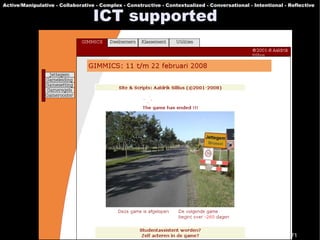
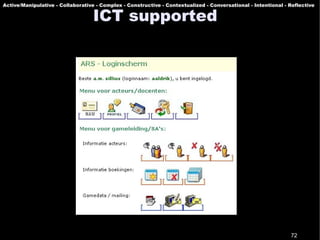
                                   ICT supported


                                                                                                               71
Active/Manipulative - Collaborative - Complex - Constructive - Contextualized - Conversational - Intentional - Reflective

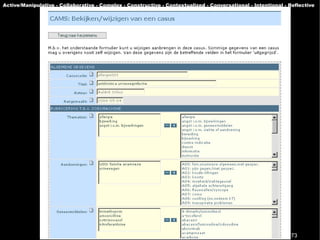
                                   ICT supported


                                                                                                               72
Active/Manipulative - Collaborative - Complex - Constructive - Contextualized - Conversational - Intentional - Reflective


                                                                                                               73
Active/Manipulative - Collaborative - Complex - Constructive - Contextualized - Conversational - Intentional - Reflective


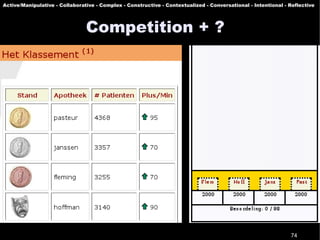
                                Competition + ?


                                                                                                               74
Active/Manipulative - Collaborative - Complex - Constructive - Contextualized - Conversational - Intentional - Reflective


                                                                                                               75
Active/Manipulative - Collaborative - Complex - Constructive - Contextualized - Conversational - Intentional - Reflective


                                                                                                               76
Active/Manipulative - Collaborative - Complex - Constructive - Contextualized - Conversational - Intentional - Reflective


                                                                                                               77
Active/Manipulative - Collaborative - Complex - Constructive - Contextualized - Conversational - Intentional - Reflective


                                                                                                               78
Active/Manipulative - Collaborative - Complex - Constructive - Contextualized - Conversational - Intentional - Reflective


                                                                                                               79
Active/Manipulative - Collaborative - Complex - Constructive - Contextualized - Conversational - Intentional - Reflective


                                                                                                               80
Active/Manipulative - Collaborative - Complex - Constructive - Contextualized - Conversational - Intentional - Reflective


                                                                                                               81
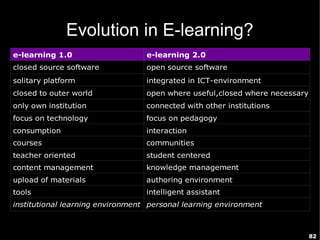
Evolution in E-learning?
e-learning 1.0                    e-learning 2.0
closed source software            open source software
solitary platform                 integrated in ICT-environment
closed to outer world             open where useful,closed where necessary
only own institution              connected with other institutions
focus on technology               focus on pedagogy
consumption                       interaction
courses                           communities
teacher oriented                  student centered
content management                knowledge management
upload of materials               authoring environment
tools                             intelligent assistant
institutional learning environment personal learning environment


                                                                             82
Is this ICT supported
 learning paradigm shift
    possible without
teacher learning/training?
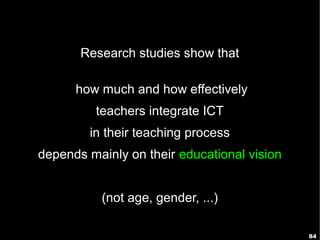
Research studies show that

      how much and how effectively
         teachers integrate ICT
        in their teaching process
depends mainly on their educational vision


          (not age, gender, ...)

                                             84
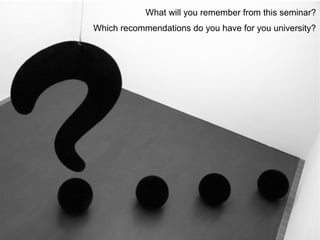
What will you remember from this seminar?
Which recommendations do you have for you university?


                                                   85
Copyright acknowledgements
➢   Belgium in EU Map CC-by-sa by NuclearVacuum
➢   Belgium map, Public Domain
➢   The Peasant Wedding by Pieter Bruegel the elder 1568
➢   http://en.wikipedia.org/wiki/File:Asterix_in_Belgium.jpg
➢   Atomium building © www.atomium.be - SABAM 2010; photo CC-by-nc-sa by fatboyke Luc B
➢   Atomium building © www.atomium.be - SABAM 2010; photo CC-by-sa by Emilio Garcia
➢   Gilles de Binche CC-by-nc-nd by Fabrice Huin
➢   Saxophone CC-by-nc-nd by Bruno Bollaert
➢   Graspop Metal Meeting Festival 2008 CC-by-sa by Jtesla16
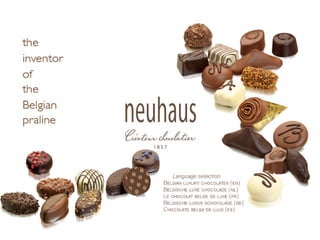
➢   Pralines, screenshot Neuhaus website
➢   Moules frites: CC-by-nc-sa by poluz – Nicola
➢   Belgian Beers: CC-by-nc-sa by Adam Lang
➢   Brussels Waffle CC-by-sa by David Monniaux
➢   Screenshot http://www.chamilo.org/
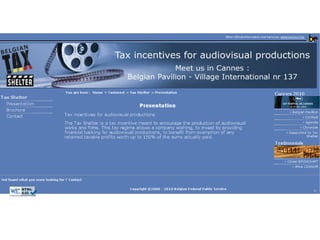
➢   Tax Shelter screenshot, http://minfin.fgov.be/portail2/belinvest/en/taxshelter/presentation.htm
➢   Figure study CC-by-nc-sa by Tony2 (NOT IN USE!)
➢   Embrace CC by Robbert van der Steeg
➢   Question! CC-by by Stefan Baudy
Active/Manipulative - Collaborative - Complex - Constructive - Contextualized - Conversational - Intentional - Reflective


                  Questions? Comments?
                           谢谢


                                                               See also http://questier.com

                                                                                                               87

New Learning Paradigms and Technologies

  • 1.
    New learning paradigms &technologies Prof. dr. Frederik Questier, Vrije Universiteit Brussel Guest lecture at Communications University of China, Higher Education Research Institute, 16/10/2010
  • 2.
    This presentation canbe found at http://questier.com http://www.slideshare.net/Frederik_Questier
  • 3.
  • 5.
  • 6.
    Atomium building ©www.atomium.be - SABAM 2010; photo CC-by-nc-sa by fatboyke Luc B
  • 8.
  • 9.
    The Peasant Weddingby Pieter Bruegel the elder 1568
  • 10.
    "Of all theGauls, the Belgae are the bravest." Julius Caesar, Roman Emperor, 50BC
  • 12.
    Adolphe Sax inventsthe Saxophone in 1840s
  • 14.
  • 15.
  • 18.
  • 21.
  • 22.
    Teaching courses: ➢ Educational Technologies ➢ Learning Technologies ➢ Virtual Learning Environments ➢ E-learning design ➢ Departments ➢ Interdisciplinary Teacher Training ➢ Educational Sciences ➢ Former head of center for ➢ Education innovation ➢ Teacher staff training ➢ Virtual learning Environment
  • 23.
  • 24.
  • 25.
    Projects with Kenia (Nairobi and Moi universities) Expertise Centre ICT for edu Training Consultancy Research Postgraduate master ICT in Education 25
  • 26.
  • 27.
  • 28.
    Educational Innovation? Why change the way we teach and learn? How to change the way we teach and learn? (with or without technologies) 28
  • 29.
    Why change theway we teach and learn? “Schools we have today were designed around commonsense assumptions that had never been scientifically tested” R. Keith Sawyer 29
  • 30.
    Why change theway we teach and learn? Because everything else is changing ! 30
  • 31.
  • 32.
  • 33.
    information scarcity →information abundance ! Total information is now doubling every year ! 33
  • 34.
    Evolution of theinternet? Web 2.0 (social and collaborative) Web 3.0 (semantic) Mobile and Ubiquitous The internet of things Global brain – intelligence 34
  • 35.
    Virtual reality getsphotorealism Crysis 35
  • 36.
  • 37.
    Evolution of organizations Source: Jessica Lipnack and Jeffrey Stamps, Virtual Teams http://www.netage.com/pub/books/VirtualTeams%202/CHAPTERS%20PDF/chapter02.pdf 37
  • 38.
  • 39.
    Surveys Howmuch of the knowledge you need for your job is in your own head? >75% | 75-50% | 50-25% | 25-10% 39
  • 40.
    Surveys Howmuch of the knowledge you need for your job is in your own head? 1986 75% → 2010 10% 40
  • 41.
    The longer onestudies, the more one comes to realize how much one does not know 41
  • 42.
    Frederik Questier atthe MIT Miracle of Science Bar, 2009 42
  • 43.
  • 44.
  • 45.
  • 46.
    You will haveto compete with free! 46
  • 47.
    You will haveto compete with amateurs! An enthusiastic amateur beats a bored professional “Karl Marx was perhaps the original prophet of the Professional Amateurs economy: labour – forced, unspontaneous and waged work – would be superseded by self-activity” 47
  • 48.
    What can professionalsdo? Embrace or Die ! 48
  • 49.
  • 50.
    Demand for newskills? ➢ Social skills ➢ communicating, networking, teamwork ➢ international, intercultural ➢ Creativity ➢ Entrepeneurship ➢ Information technology skills ➢ Handle information overload ➢ ... ➢ ➢ Learning to learn → Life Long Learning! 50
  • 51.
    Knowledge -> Skills-> Competences ➢ Competences ➢ are the ability to use ➢ knowledge ➢ skills ➢ attitudes ➢ in new, complex, authentic situations 51
  • 52.
    Why change theway we teach and learn? 52
  • 53.
    Staff are digitalimmigrants, students are digital natives (Prensky) 53
  • 54.
    Discrepancy? What are studentsused to? What is their classroom experience? control no control action passive instant feedback little, late feedback rich media poor media always online offline social interactions working together = cheating 54
  • 55.
    Why change theway we teach and learn? It's a matter of quality! “The highest-ranked universities are the ones that make significant contributions to the advancement of knowledge through research, teach with the most innovative curricula and pedagogical methods under the most conducive circumstances” World Bank 55
  • 56.
    Why change theway we teach and learn? We have new scientific knowledge about teaching and learning 56
  • 57.
    Major learning theories Behaviourism Learning = change of behaviour Stimulus → response Learner is passive receiver of knowledge Mind = black box Cognitivism Focuses on how the brain works Metacognition, learning strategies Motivation Constructivism Knowledge is actively constructed by the learner New knowledge is linked to prior knowledge Learners discover themselves facts and relationships Social Constructivism Social interaction plays a fundamental role Discussions lead to deeper understanding and increased motivation Constructionism Constructing an artifact or something that can be shared leads to better learning Connectivism Learning is a process of connecting nodes or information sources Knowledge and learning may reside in non-human appliances Try to see connections between fields, ideas, and concepts Know-what & Know-how → Know-where 57
  • 58.
    Educational innovation? Traditional learning New Learning teacher oriented student oriented (passive) knowledge transfer (active) knowledge construction; interaction focus on knowledge focus on competences individual learning collaborative learning focus on course contents also focus on learning process (learning to learn, reflection) teacher = expert teacher = coach teacher directs also self-directed learning selective education adaptive education students focus on good scores attention for (intrinsic) motivation surface learning deep (natural) learning 58
  • 59.
    Educational innovation? Traditional learning New Learning abstract, school-like examples & tasks authentic contexts evaluation by teacher self/co/peer-assessment, ... summative evaluation + formative evaluation (learning from mistakes and feedback) linear curriculum flexible curriculum independent courses and disciplines connexion, integration, interdisciplinarity supply oriented demand oriented uniform education differentiated education (adapted to e.g. learning styles) classroom flexible learning environment (also online & virtual) course materials powerful learning environments formal learning + informal learning behaviorism and cognitivism Social constructivism (and connectivism) 59
  • 60.
    How can weimprove teaching and learning with ICT? Don't apply traditional teaching methods in new technologies! Substitution? (dropping your coursebook online) Transformation! 60
  • 61.
    Seek the synergy! Theories about learning and technologies have evolved towards very similar concepts 61
  • 62.
    Model Jonassen for (constructive)learning environments → Technologies can support the intentional construction, in a collaborative way, of complex contextualized artifacts and the conversation and reflection about it 62
  • 63.
    Exercise Which characteristicsof Jonassen's model apply to the following learning environments?
  • 64.
    Active/Manipulative - Collaborative- Complex - Constructive - Contextualized - Conversational - Intentional - Reflective 64
  • 65.
    Active/Manipulative - Collaborative- Complex - Constructive - Contextualized - Conversational - Intentional - Reflective Case kit (Ugent, Jan Velghe) 65
  • 66.
    Active/Manipulative - Collaborative- Complex - Constructive - Contextualized - Conversational - Intentional - Reflective 66
  • 67.
    Active/Manipulative - Collaborative- Complex - Constructive - Contextualized - Conversational - Intentional - Reflective 67
  • 68.
    Active/Manipulative - Collaborative- Complex - Constructive - Contextualized - Conversational - Intentional - Reflective 68
  • 69.
    Active/Manipulative - Collaborative- Complex - Constructive - Contextualized - Conversational - Intentional - Reflective 69
  • 70.
    Active/Manipulative - Collaborative- Complex - Constructive - Contextualized - Conversational - Intentional - Reflective Pharmacy simulations 70
  • 71.
    Active/Manipulative - Collaborative- Complex - Constructive - Contextualized - Conversational - Intentional - Reflective ICT supported 71
  • 72.
    Active/Manipulative - Collaborative- Complex - Constructive - Contextualized - Conversational - Intentional - Reflective ICT supported 72
  • 73.
    Active/Manipulative - Collaborative- Complex - Constructive - Contextualized - Conversational - Intentional - Reflective 73
  • 74.
    Active/Manipulative - Collaborative- Complex - Constructive - Contextualized - Conversational - Intentional - Reflective Competition + ? 74
  • 75.
    Active/Manipulative - Collaborative- Complex - Constructive - Contextualized - Conversational - Intentional - Reflective 75
  • 76.
    Active/Manipulative - Collaborative- Complex - Constructive - Contextualized - Conversational - Intentional - Reflective 76
  • 77.
    Active/Manipulative - Collaborative- Complex - Constructive - Contextualized - Conversational - Intentional - Reflective 77
  • 78.
    Active/Manipulative - Collaborative- Complex - Constructive - Contextualized - Conversational - Intentional - Reflective 78
  • 79.
    Active/Manipulative - Collaborative- Complex - Constructive - Contextualized - Conversational - Intentional - Reflective 79
  • 80.
    Active/Manipulative - Collaborative- Complex - Constructive - Contextualized - Conversational - Intentional - Reflective 80
  • 81.
    Active/Manipulative - Collaborative- Complex - Constructive - Contextualized - Conversational - Intentional - Reflective 81
  • 82.
    Evolution in E-learning? e-learning1.0 e-learning 2.0 closed source software open source software solitary platform integrated in ICT-environment closed to outer world open where useful,closed where necessary only own institution connected with other institutions focus on technology focus on pedagogy consumption interaction courses communities teacher oriented student centered content management knowledge management upload of materials authoring environment tools intelligent assistant institutional learning environment personal learning environment 82
  • 83.
    Is this ICTsupported learning paradigm shift possible without teacher learning/training?
  • 84.
    Research studies showthat how much and how effectively teachers integrate ICT in their teaching process depends mainly on their educational vision (not age, gender, ...) 84
  • 85.
    What will youremember from this seminar? Which recommendations do you have for you university? 85
  • 86.
    Copyright acknowledgements ➢ Belgium in EU Map CC-by-sa by NuclearVacuum ➢ Belgium map, Public Domain ➢ The Peasant Wedding by Pieter Bruegel the elder 1568 ➢ http://en.wikipedia.org/wiki/File:Asterix_in_Belgium.jpg ➢ Atomium building © www.atomium.be - SABAM 2010; photo CC-by-nc-sa by fatboyke Luc B ➢ Atomium building © www.atomium.be - SABAM 2010; photo CC-by-sa by Emilio Garcia ➢ Gilles de Binche CC-by-nc-nd by Fabrice Huin ➢ Saxophone CC-by-nc-nd by Bruno Bollaert ➢ Graspop Metal Meeting Festival 2008 CC-by-sa by Jtesla16 ➢ Pralines, screenshot Neuhaus website ➢ Moules frites: CC-by-nc-sa by poluz – Nicola ➢ Belgian Beers: CC-by-nc-sa by Adam Lang ➢ Brussels Waffle CC-by-sa by David Monniaux ➢ Screenshot http://www.chamilo.org/ ➢ Tax Shelter screenshot, http://minfin.fgov.be/portail2/belinvest/en/taxshelter/presentation.htm ➢ Figure study CC-by-nc-sa by Tony2 (NOT IN USE!) ➢ Embrace CC by Robbert van der Steeg ➢ Question! CC-by by Stefan Baudy
  • 87.
    Active/Manipulative - Collaborative- Complex - Constructive - Contextualized - Conversational - Intentional - Reflective Questions? Comments? 谢谢 See also http://questier.com 87