DR. MUTHULAKSHMI C
Post graduate student
Department of Oral Pathology &
Microbiology
SRM Dental College,
Ramapuram, Chennai, India
MICROSCOPY:INTRODUCTION TO MICROSCOPY,
PROPERTIES OF LIGHT,COMPONENTS OF LIGHT MICROSCOPE(LENS
SYSTEM,MAGNIFICATION VALUES,ADJUSTING THE LIGHT FIELD)
SYNOPSIS
LIGHT AND INTRODUCTION TO LIGHT
PROPERTIES OF LIGHT
INTRODUCTION OF MICROSCOPE
PARTS OF MICROSCOPE
FORMATION OF AN IMAGE
MAGNIFICATION
CLASSIFICATION OF MICROSCOPY
DIFFERENT TYPES OF MICROSCOPY
SOURCE
OF
ENERGY
VISUALLY
PERCEIVED
RADIANT
ENERGY
VISIBLE LIGHT
The part of electromagnetic spectrum between
approximately 380 nm to 780 nm can be
perceived by human visual system is
called as VISIBLE LIGHT
PROPERTIES OF LIGHT:
 Interaction of light with matter.
 Absorption
 Transmission
 Scattering
 Reflection
 Refraction
 Dispersion
 Polarization
 Interference
 Diffraction
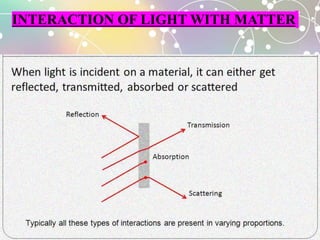
INTERACTION OF LIGHT WITH MATTER
ABSORPTION
 LIGHT is absorbed by the
medium through which it passes.
 This can reduce the amplitude or
energy level of the light.
 The medium through which light
passes can also have an effect on
actual speed at which light passes
through the material, referred as
retardation
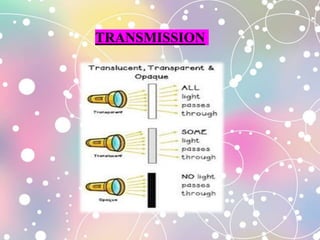
TRANSMISSION
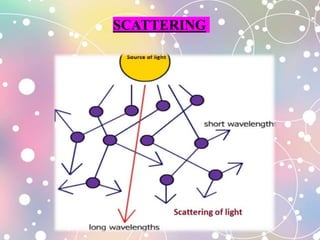
SCATTERING
REFLECTION OF LIGHT
REFLECTION
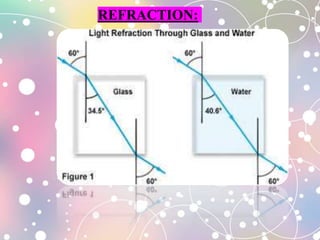
REFRACTION:
LAWS OF REFRACTION:
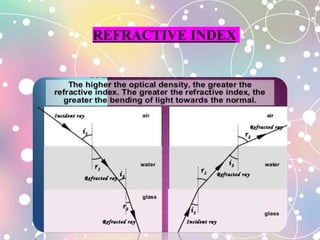
REFRACTIVE INDEX
REFRACTION THROUGH LENS:
TOTAL INTERNAL REFLECTION:
DISPERSION:
POLARIZATION:
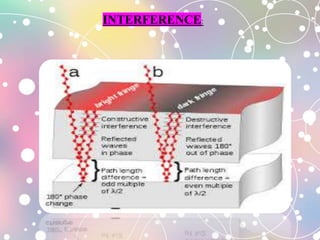
INTERFERENCE:
DIFFRACTION:
MICROSCOPE-INTRODUCTION
PARTS OF MICROSCOPE:
OPTICAL
COMPONENTS
• Eyepiece
(oculars)
• Objectives
MECHANICAL
COMPONENTS
• Body Tube
• Adjustment
• Stage
ILLUMINATION
COMPONENTS
• Sub stage
• Condenser
• Iris Diaphragm
• Filter Carrier
• Mirror
• Light Source
EYEPIECES (OCULARS)
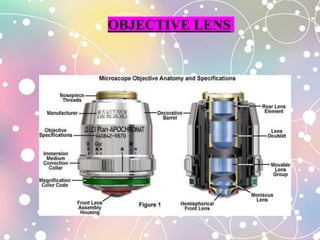
OBJECTIVE LENS
minimum amount of light from the object,
unite it ,
a high quality magnified real image.
The ability of an objective to resolve the detail is
indicated by its numerical aperture
The numerical aperture (NA) of the objective lens varies from 0.16 to 1.40
, depending on the type of lens.
The numerical aperture (NA) is expressed as a value and will be found
engraved on the body of the objective.
NA=nSinµ
’n’ is the refractive index of the medium between the Cover glass over the
object and the front lens of the objective
‘µ’ is the angle included between the optical axis of the lens and the
outermost ray that can enter the front lens.
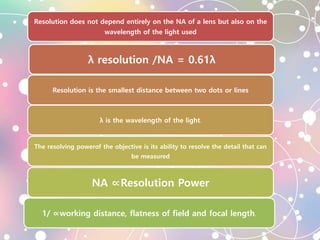
Resolution does not depend entirely on the NA of a lens but also on the
wavelength of the light used
λ resolution /NA = 0.61λ
Resolution is the smallest distance between two dots or lines
λ is the wavelength of the light.
The resolving powerof the objective is its ability to resolve the detail that can
be measured
NA ∝Resolution Power
1/ ∝working distance, flatness of field and focal length.
CLASSIFICATION OF THE OBJECTIVE LENS
Apochromatic
objectives
Achromatic
objectives
semiachromat
or Fluorite
objectives
Plan-
apochromat
objectives
Polarising
objectives
Phase
objectives
Different
sources of
light are
Tungsten-
Halogen
Lamps
Mercury
Arc
Lamps
Xenon
Arc
Lamps
Metal
Halide Arc
Lamps
Light-
Emitting
Diodes
MAGNIFICATION VALUE:
Total magnification is the product of the magnification values of the objective
and eyepiece ,provided the system is standardized to an optical tube length of
160 mm.
OPTICAL TUBE LENGTH X MAGNIFICATION OF FOCAL
LENGTH OF OBJECTIVE EYEPIECE
objective 40 x ,eyepiece 10 x, tube lens factor 1.25x gives a total magnification
value of 500x
CLASSIFICATION OF MICROSCOPY
PHASE CONTRAST MICROSCOPE
FLUORESCENCE MICROSCOPE
Light microscopy   dr muthulakshmi

Light microscopy dr muthulakshmi