Scanning Electron Microscopy
JUNAID AHMAD
MS PHYSICS
UNIVERSITY OF EDUCATION,LAHORE,PAKISTAN
INTRODUCTION
• Electron Microscopes are scientific instruments that use a beam of
highly energetic electrons to examine objects on a very fine scale.
• This examination can yield information about the topography ,
morphology, composition and crystallographic information.
• Mainly 2 types:
• Transmission Electron Microscope (TEM) - allows one the
study of the inner structures.
• Scanning Electron Microscope (SEM) - used to visualize the
• surface of objects.
History
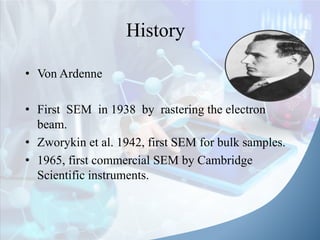
• Von Ardenne
• First SEM in 1938 by rastering the electron
beam.
• Zworykin et al. 1942, first SEM for bulk samples.
• 1965, first commercial SEM by Cambridge
Scientific instruments.
CHARACTERISTIC INFORMATIONS
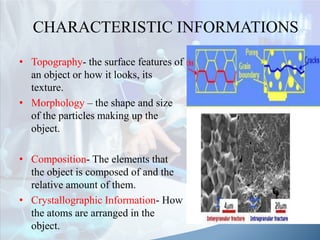
• Topography- the surface features of
an object or how it looks, its
texture.
• Morphology – the shape and size
of the particles making up the
object.
• Composition- The elements that
the object is composed of and the
relative amount of them.
• Crystallographic Information- How
the atoms are arranged in the
object.
1.Electron cannon.
2. Electro-magnetic
lenses to focus the
electron beam .
4.Opening to insert the
object into the high-
.
5. Operation panel with
focus, alignment and
magnification tools and
a joystick forpositioning
of the sample.
vacuum observation
chamber.
6. Screen for menu
and image display
3. Vacuum pumps
system
7.Cryo-unit to prepare
frozen material before
insertion in the
observation chamber
in Cryo-SEM mode
PARTS OF SEM
COMPONENTS OF SEM
Here comes your footer 
Page 5
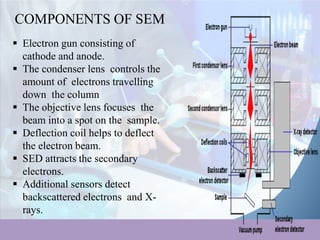
 Electron gun consisting of
cathode and anode.
 The condenser lens controls the
amount of electrons travelling
down the column
 The objective lens focuses the
beam into a spot on the sample.
 Deflection coil helps to deflect
the electron beam.
 SED attracts the secondary
electrons.
 Additional sensors detect
backscattered electrons and X-
rays.
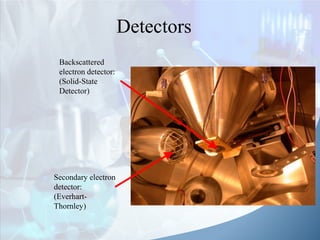
Detectors
Backscattered
electron detector:
(Solid-State
Detector)
Secondary electron
detector:
(Everhart-
Thornley)
SEM WORKING
• The electron gun produces an electron beam when tungsten wire is
heated by current.
• This beam is accelerated by the anode.
• The beam travels through electromagnetic fields and lenses, which
• focus the beam down toward the sample.
• A mechanism of deflection coils enables to guide the beam so that
it scans the surface of the sample in a rectangular frame.
• When the beam touches the surface of the sample, it produces:
• Secondary electrons (SE)
• Back scattered electrons (BSE)
• X - Rays...
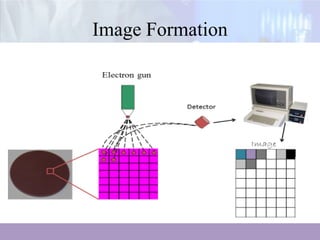
• The emitted SE is collected by SED and convert it into signal that is
• sent to a screen which produces final image.
• Additional detectors collect these X-rays, BSE and produce
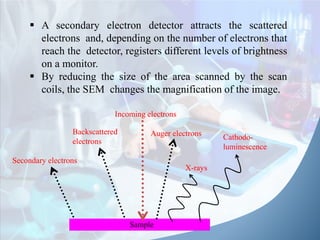
 A secondary electron detector attracts the scattered
electrons and, depending on the number of electrons that
reach the detector, registers different levels of brightness
on a monitor.
 By reducing the size of the area scanned by the scan
coils, the SEM changes the magnification of the image.
Sample
Cathodo-
luminescence
X-rays
Incoming electrons
Auger electronsBackscattered
electrons
Secondary electrons
Image Formation
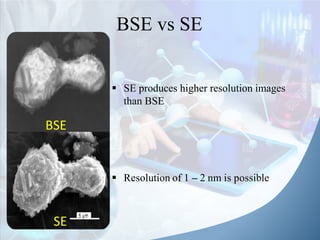
BSE vs SE
 SE produces higher resolution images
than BSE
 Resolution of 1 – 2 nm is possible
BSE
SE
SAMPLE REQUIREMENTS
 Liquids and materials containing water
and other volatile components cannot be
studied directly.
 No specimen holder and coated with a
thin conductive film by sputtering or
evaporation. Typical coating materials are
Au, Pt, Pd, their alloys, as well as carbon.
ADVANTAGES & DISADVANTAGES OF SEM
Advantages
 It gives detailed 3D and topographical imaging and the
versatile information garnered from different detectors.
 This instrument works very fast.
 Modern SEMs allow for the generation of data in digital
form.
 Most SEM samples require minimal preparation actions.
Disadvantages
 SEMs are expensive and large.
 Special training is required to operate an SEM.
 The preparation of samples can result in artifacts.
 SEMs are limited to solid samples.
 SEMs carry a small risk of radiation exposure associated
with the electrons that scatter from beneath the sample
surface.
BIOLOGICAL APPLICATIONS OF SEM
 Virology - for investigations of virus structure
 Cryo-electron microscopy – Images can be made of the
surface of frozen materials.
 3D tissue imaging -
• Helps to know how cells are organized in a 3D network
• Their organization determines how cells can interact.
Forensics - SEM reveals the presence of materials on
evidences that is otherwise undetectable
 SEM renders detailed 3-D images
• extremely small microorganisms
• anatomical pictures of insect, worm, spore, or other
organic structures

Scanning Electron Microscopy (SEM)

  • 1.
    Scanning Electron Microscopy JUNAIDAHMAD MS PHYSICS UNIVERSITY OF EDUCATION,LAHORE,PAKISTAN
  • 2.
    INTRODUCTION • Electron Microscopesare scientific instruments that use a beam of highly energetic electrons to examine objects on a very fine scale. • This examination can yield information about the topography , morphology, composition and crystallographic information. • Mainly 2 types: • Transmission Electron Microscope (TEM) - allows one the study of the inner structures. • Scanning Electron Microscope (SEM) - used to visualize the • surface of objects.
  • 3.
    History • Von Ardenne •First SEM in 1938 by rastering the electron beam. • Zworykin et al. 1942, first SEM for bulk samples. • 1965, first commercial SEM by Cambridge Scientific instruments.
  • 4.
    CHARACTERISTIC INFORMATIONS • Topography-the surface features of an object or how it looks, its texture. • Morphology – the shape and size of the particles making up the object. • Composition- The elements that the object is composed of and the relative amount of them. • Crystallographic Information- How the atoms are arranged in the object.
  • 5.
    1.Electron cannon. 2. Electro-magnetic lensesto focus the electron beam . 4.Opening to insert the object into the high- . 5. Operation panel with focus, alignment and magnification tools and a joystick forpositioning of the sample. vacuum observation chamber. 6. Screen for menu and image display 3. Vacuum pumps system 7.Cryo-unit to prepare frozen material before insertion in the observation chamber in Cryo-SEM mode PARTS OF SEM
  • 6.
    COMPONENTS OF SEM Herecomes your footer  Page 5  Electron gun consisting of cathode and anode.  The condenser lens controls the amount of electrons travelling down the column  The objective lens focuses the beam into a spot on the sample.  Deflection coil helps to deflect the electron beam.  SED attracts the secondary electrons.  Additional sensors detect backscattered electrons and X- rays.
  • 7.
  • 8.
    SEM WORKING • Theelectron gun produces an electron beam when tungsten wire is heated by current. • This beam is accelerated by the anode. • The beam travels through electromagnetic fields and lenses, which • focus the beam down toward the sample. • A mechanism of deflection coils enables to guide the beam so that it scans the surface of the sample in a rectangular frame. • When the beam touches the surface of the sample, it produces: • Secondary electrons (SE) • Back scattered electrons (BSE) • X - Rays... • The emitted SE is collected by SED and convert it into signal that is • sent to a screen which produces final image. • Additional detectors collect these X-rays, BSE and produce
  • 9.
     A secondaryelectron detector attracts the scattered electrons and, depending on the number of electrons that reach the detector, registers different levels of brightness on a monitor.  By reducing the size of the area scanned by the scan coils, the SEM changes the magnification of the image. Sample Cathodo- luminescence X-rays Incoming electrons Auger electronsBackscattered electrons Secondary electrons
  • 10.
  • 11.
    BSE vs SE SE produces higher resolution images than BSE  Resolution of 1 – 2 nm is possible BSE SE
  • 12.
    SAMPLE REQUIREMENTS  Liquidsand materials containing water and other volatile components cannot be studied directly.  No specimen holder and coated with a thin conductive film by sputtering or evaporation. Typical coating materials are Au, Pt, Pd, their alloys, as well as carbon.
  • 13.
    ADVANTAGES & DISADVANTAGESOF SEM Advantages  It gives detailed 3D and topographical imaging and the versatile information garnered from different detectors.  This instrument works very fast.  Modern SEMs allow for the generation of data in digital form.  Most SEM samples require minimal preparation actions. Disadvantages  SEMs are expensive and large.  Special training is required to operate an SEM.  The preparation of samples can result in artifacts.  SEMs are limited to solid samples.  SEMs carry a small risk of radiation exposure associated with the electrons that scatter from beneath the sample surface.
  • 14.
    BIOLOGICAL APPLICATIONS OFSEM  Virology - for investigations of virus structure  Cryo-electron microscopy – Images can be made of the surface of frozen materials.  3D tissue imaging - • Helps to know how cells are organized in a 3D network • Their organization determines how cells can interact. Forensics - SEM reveals the presence of materials on evidences that is otherwise undetectable  SEM renders detailed 3-D images • extremely small microorganisms • anatomical pictures of insect, worm, spore, or other organic structures