dr vasanthi v
Department of Oral Pathology
& Microbiology
SRM Dental College,
Ramapuram, Chennai, India
Introduction
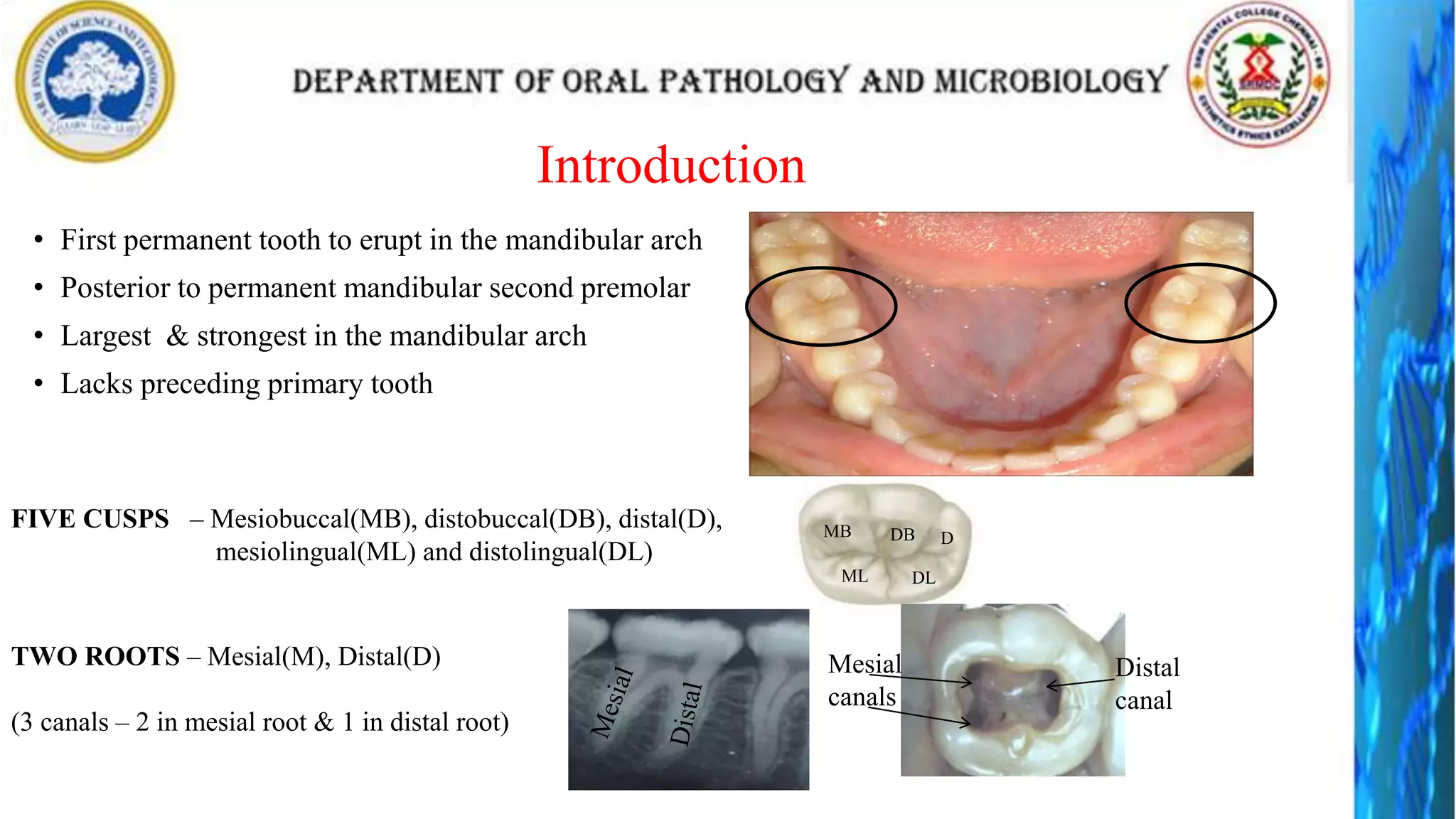
• First permanent tooth to erupt in the mandibular arch
• Posterior to permanent mandibular second premolar
• Largest & strongest in the mandibular arch
• Lacks preceding primary tooth
FIVE CUSPS – Mesiobuccal(MB), distobuccal(DB), distal(D),
mesiolingual(ML) and distolingual(DL)
MB DB D
ML DL
Distal
canal
TWO ROOTS – Mesial(M), Distal(D)
(3 canals – 2 in mesial root & 1 in distal root)
Mesial
canals
Tooth numbering system
Palmer/Zsigmondy system (Right – 6, , Left – 6 )
FDI system (Right – 46 , Left –36 )
Universal system (Right – 30, Left –19 )
Chronology
First evidence of calcification At birth
Enamel completion 2.5-3 years
Eruption 6-7 years
Root completion 9-10 years
Dimensions
Cervico-occlusal length of the crown 7.5 mm
Length of the root 14 mm
Mesiodistal diameter of the crown 11 mm
Mesiodistal diameter of the crown at cervix 9 mm
Buccolingual diameter of the crown 10.5 mm
Buccolingual diameter of the crown
at cervix
9 mm
Curvature of cervical line - Mesial 1 mm
Curvature of cervical line - Distal 0 mm
Importance of mandibular molars
• Anchorage - broad bifurcated root trunks, combined measurements of multiple roots
• Sum of MD width of mandibular molars > Sum of MD width of all teeth anterior to first molar upto midline
• Cervico-occlusal length of crown of molars < Cervico-occlusal length of crown of anterior teeth
• MD width of crown > BL width of crown
• Mastication – broader occlusal form
• Functional cusps – Lingual cusps
Buccal aspect
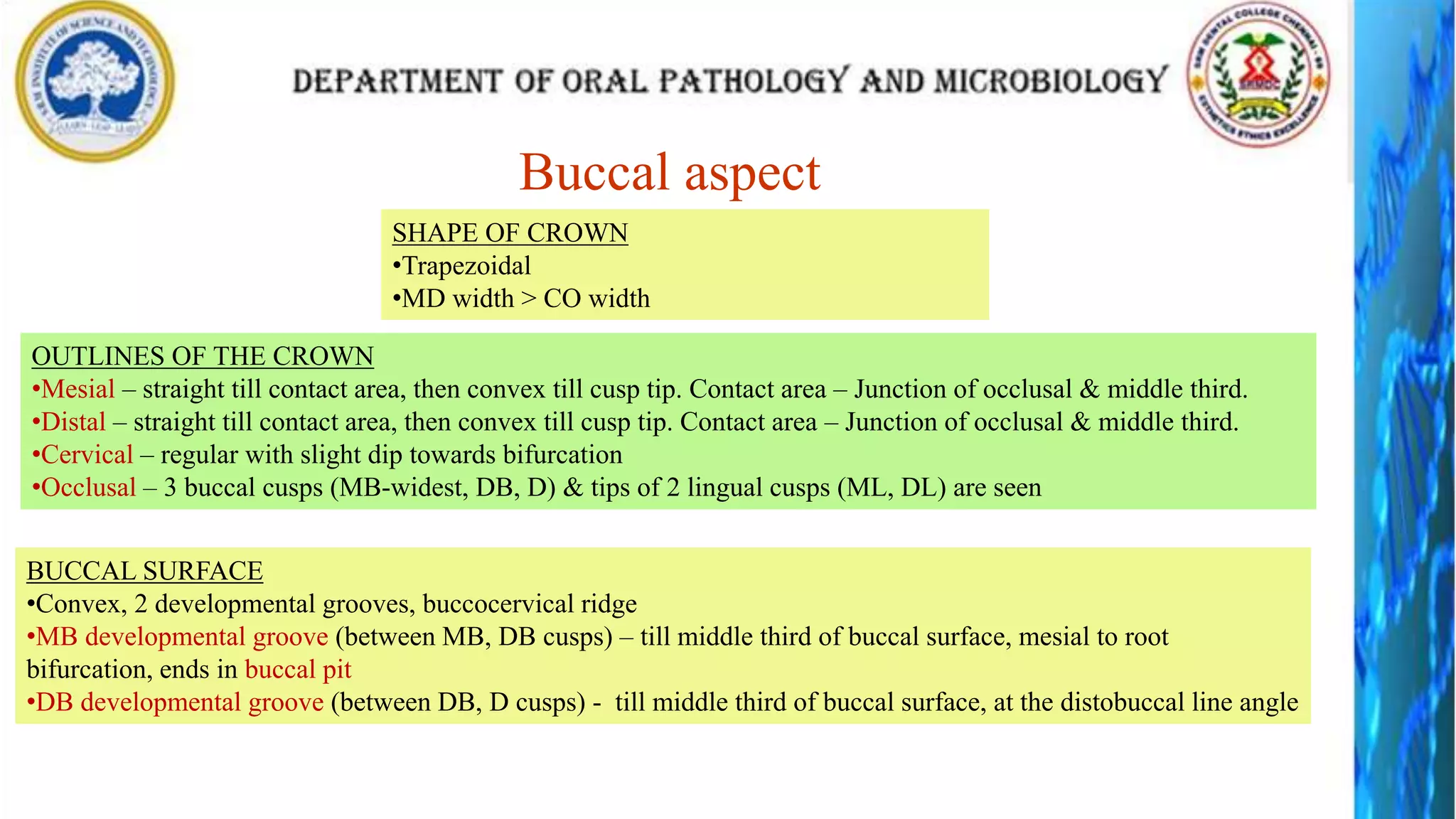
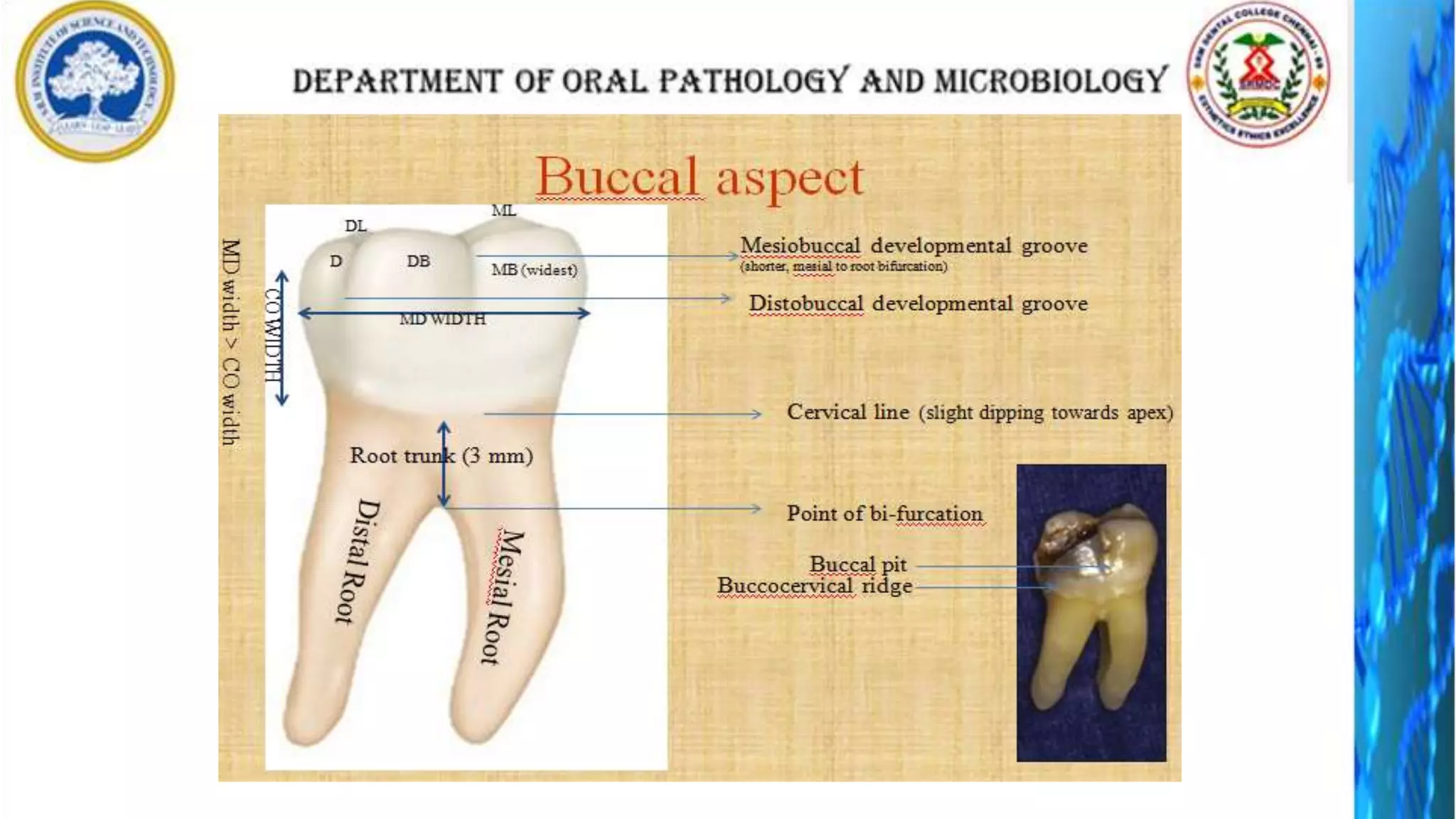
OUTLINES OF THE CROWN
•Mesial – straight till contact area, then convex till cusp tip. Contact area – Junction of occlusal & middle third.
•Distal – straight till contact area, then convex till cusp tip. Contact area – Junction of occlusal & middle third.
•Cervical – regular with slight dip towards bifurcation
•Occlusal – 3 buccal cusps (MB-widest, DB, D) & tips of 2 lingual cusps (ML, DL) are seen
SHAPE OF CROWN
•Trapezoidal
•MD width > CO width
BUCCAL SURFACE
•Convex, 2 developmental grooves, buccocervical ridge
•MB developmental groove (between MB, DB cusps) – till middle third of buccal surface, mesial to root
bifurcation, ends in buccal pit
•DB developmental groove (between DB, D cusps) - till middle third of buccal surface, at the distobuccal line angle
Buccal aspect
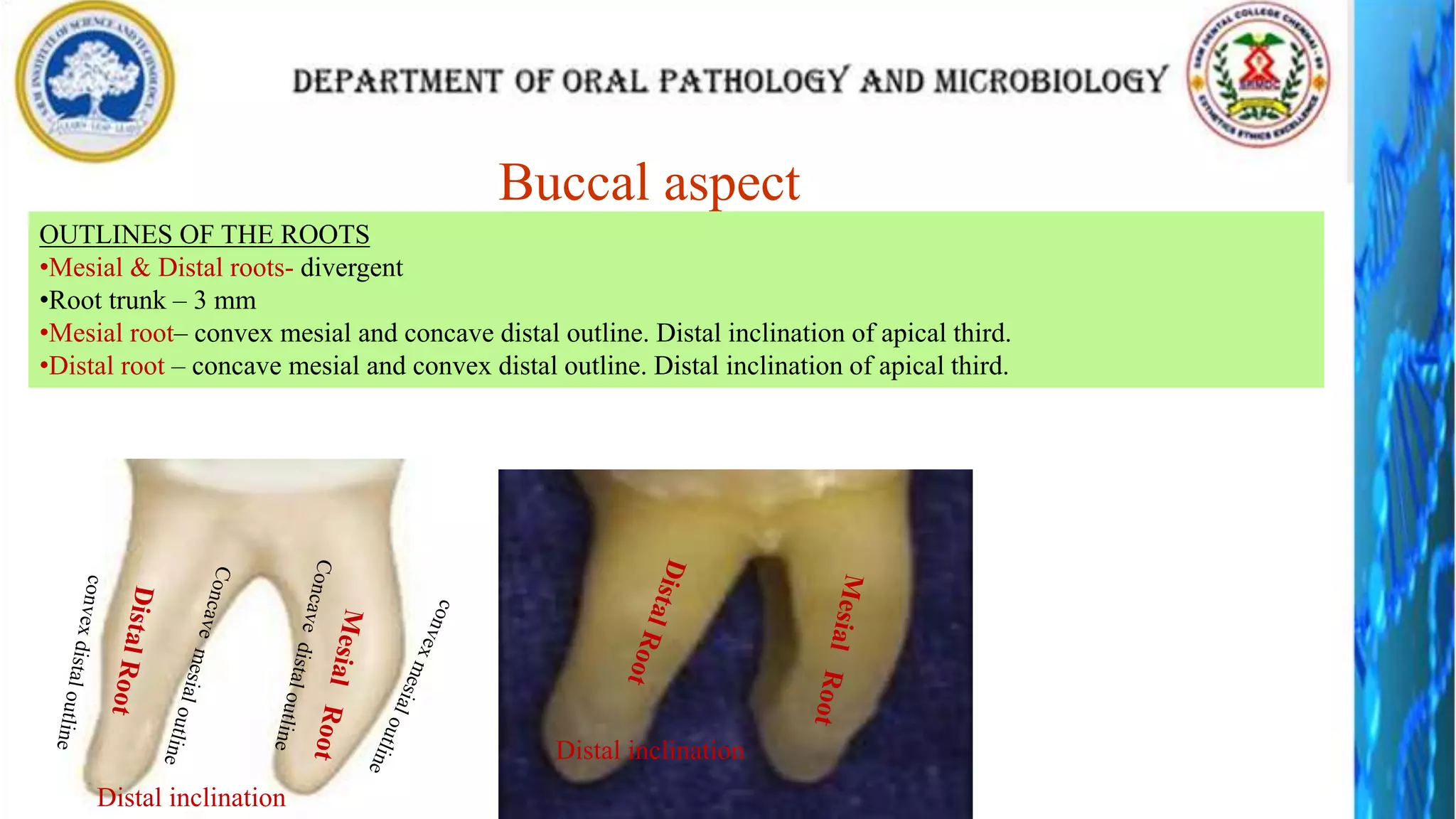
OUTLINES OF THE ROOTS
•Mesial & Distal roots- divergent
•Root trunk – 3 mm
•Mesial root– convex mesial and concave distal outline. Distal inclination of apical third.
•Distal root – concave mesial and convex distal outline. Distal inclination of apical third.
Distal inclination
Distal inclination
Lingual aspect
OUTLINES OF THE CROWN
•Mesial – straight. Contact area – Middle third
•Distal – convex from cervical line to cusp tip
•Cervical – straight
•Occlusal – lingual cusps (ML, DL) & part of distal (D) cusp
SHAPE OF CROWN
•Trapezoidal
LINGUAL SURFACE
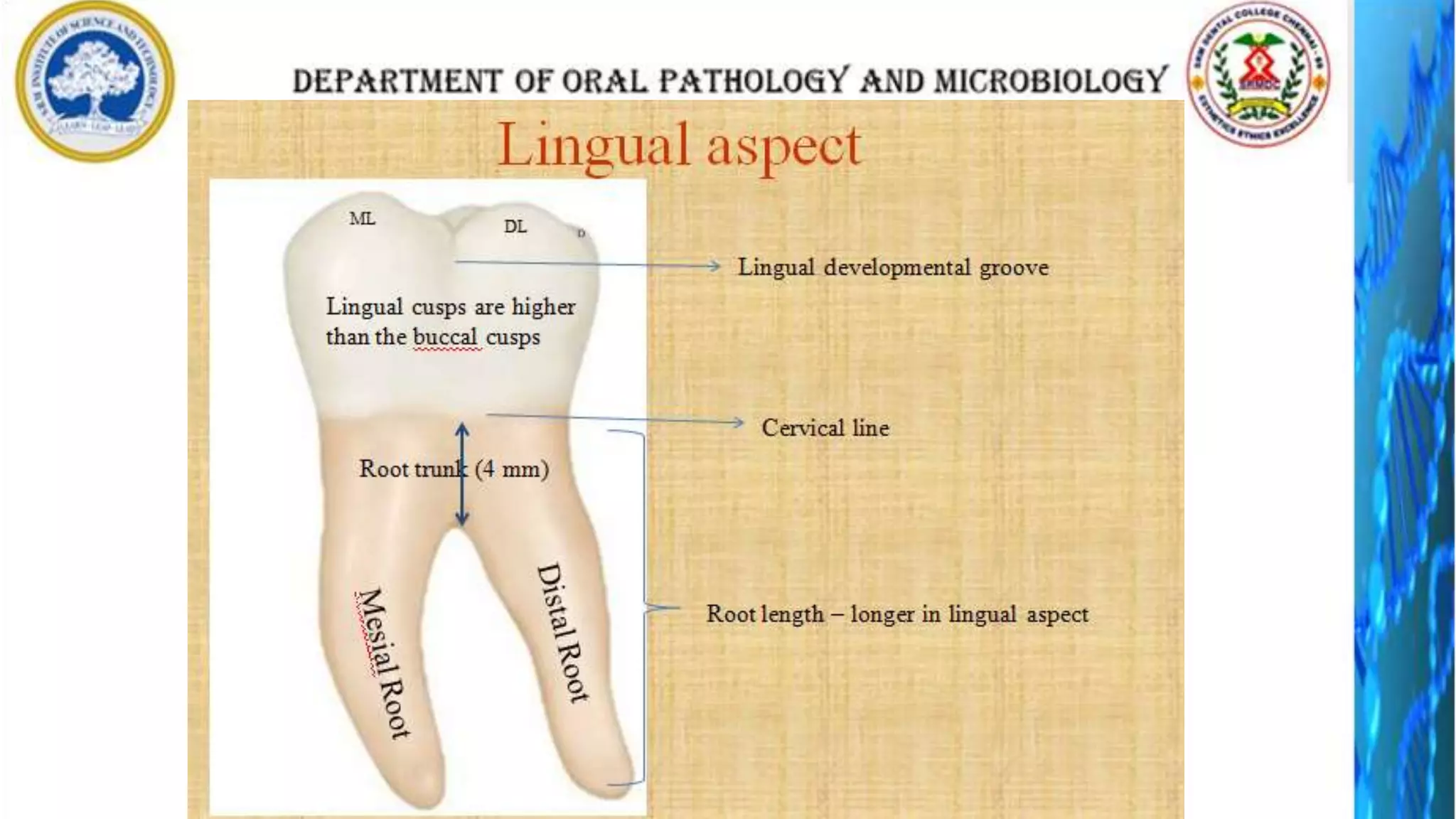
•Convex, developmental groove
•Lingual developmental groove - between
ML, DL cusps
OUTLINES OF THE ROOTS
•Mesial & Distal roots – longer in lingual aspect
•Root trunk – 4 mm, developmental depression from cervical line to bifurcation
•Mesial root– convex mesial and concave distal outline. Distal inclination of apical third.
•Distal root – straight mesial outline. Convex distal outline till middle third then concave till apical third.
Mesial aspect
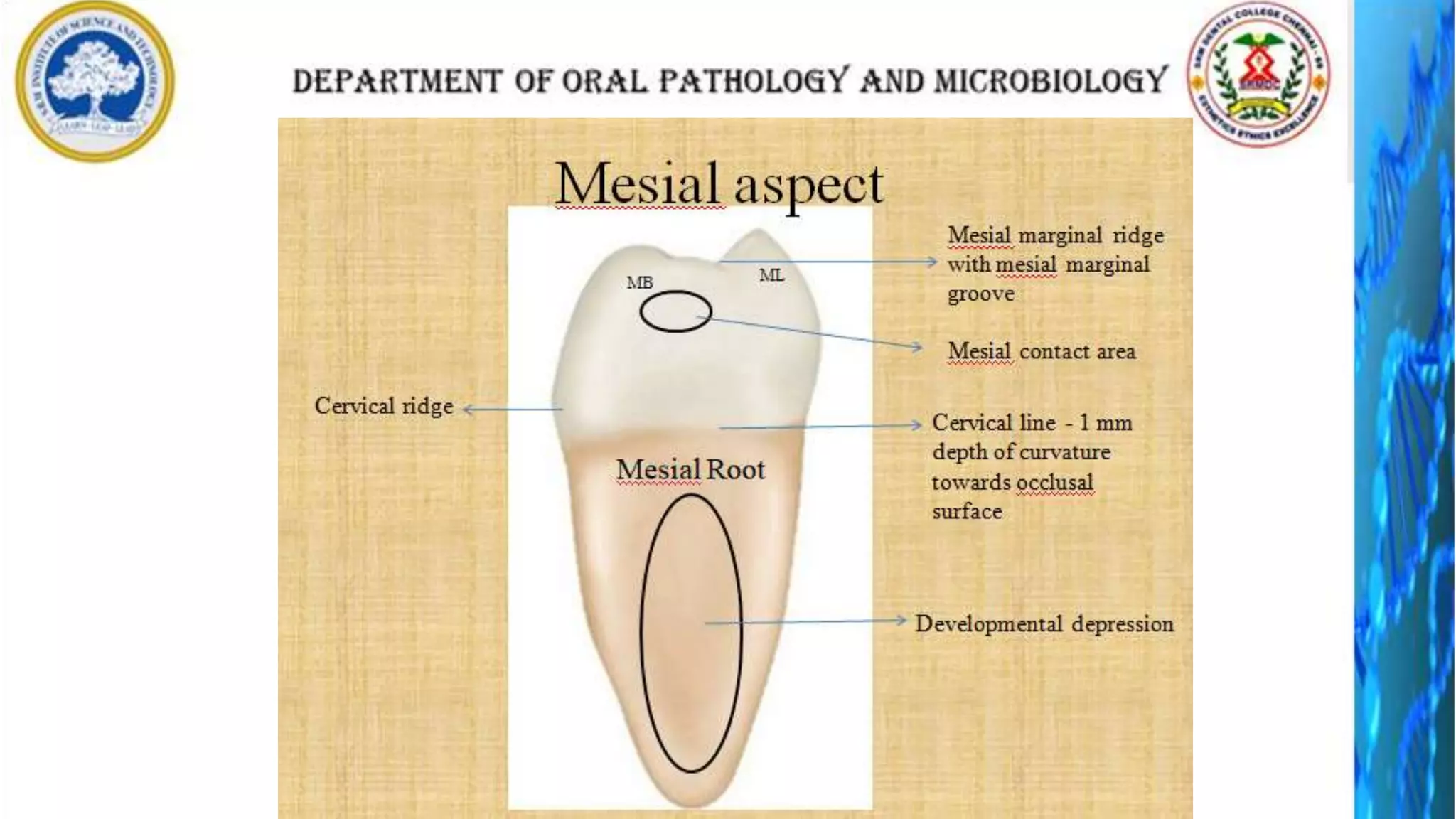
OUTLINES OF THE CROWN (Lingual inclination)
•Buccal – convex till middle third, then concave
•Lingual – straight till middle third then convex
•Cervical – straight. 1 mm depth of curvature towards occlusal surface
•Occlusal – MB, ML cusps. Higher mesial marginal ridge
SHAPE OF CROWN
•Rhomboidal
CONTACT AREA
•Junction of occlusal and middle third of
crown
OUTLINES OF THE ROOT
•Mesial root – wider buccolingually than distal root
•Convex buccal & lingual outline of mesial root
•Developmental depression – broad, concave. From cervical line to apex
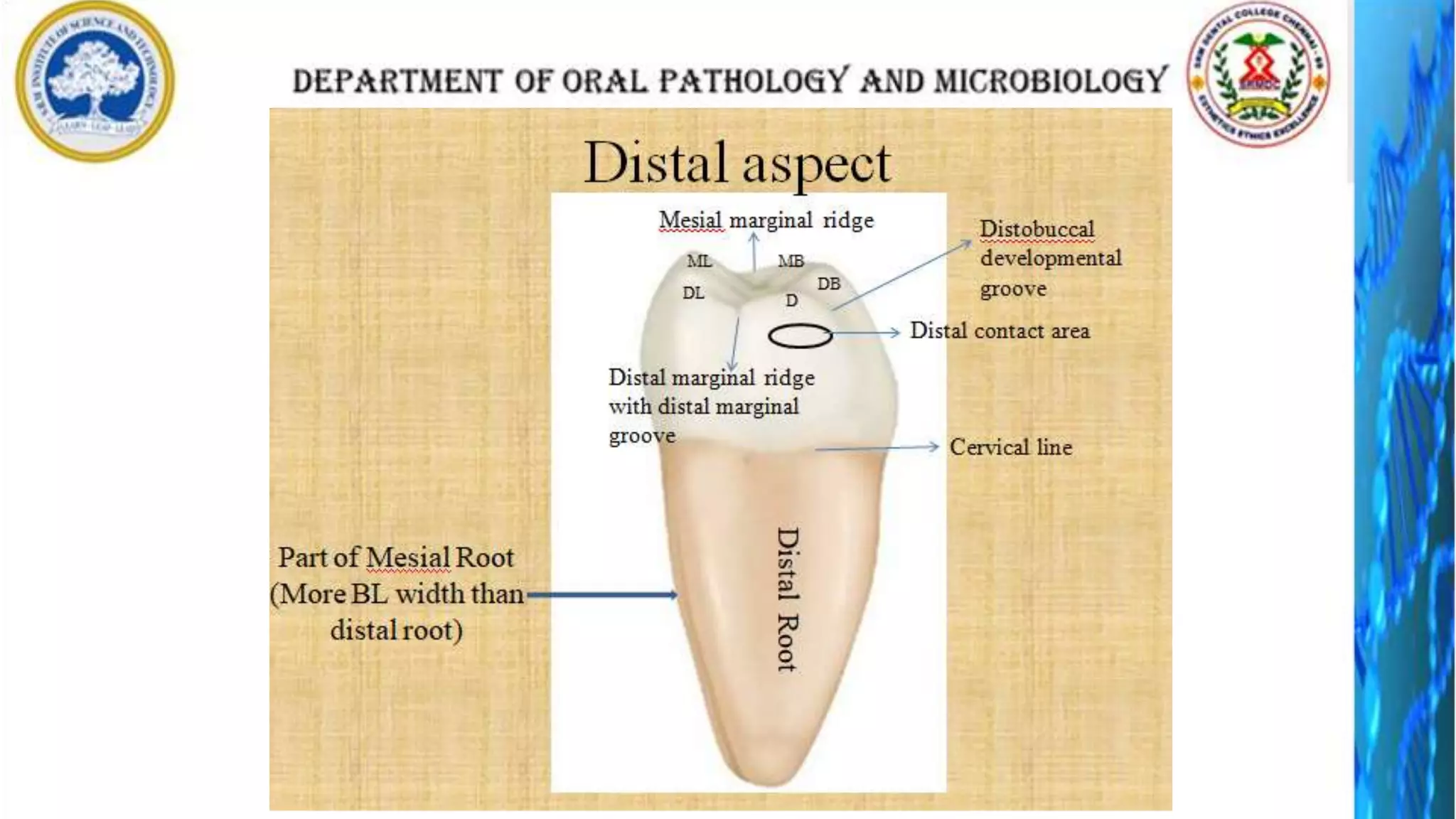
Distal aspect
OUTLINES OF THE CROWN (Lingual inclination)
•Buccal – slightly convex from cervical line till cusp tip
•Lingual – straight till middle third then convex
•Cervical – straight
•Occlusal – 5 cusps (MB, DB, D, MB, ML). Shorter distal marginal
ridge, distal convergence
SHAPE OF CROWN
•Rhomboidal
CONTACT AREA
•Junction of occlusal and middle third of
crown
OUTLINES OF THE ROOT
•Distal root, part of mesial root
•Convex buccal outline & straight lingual outline of distal root
• Smooth distal surface, developmental depression is rare.
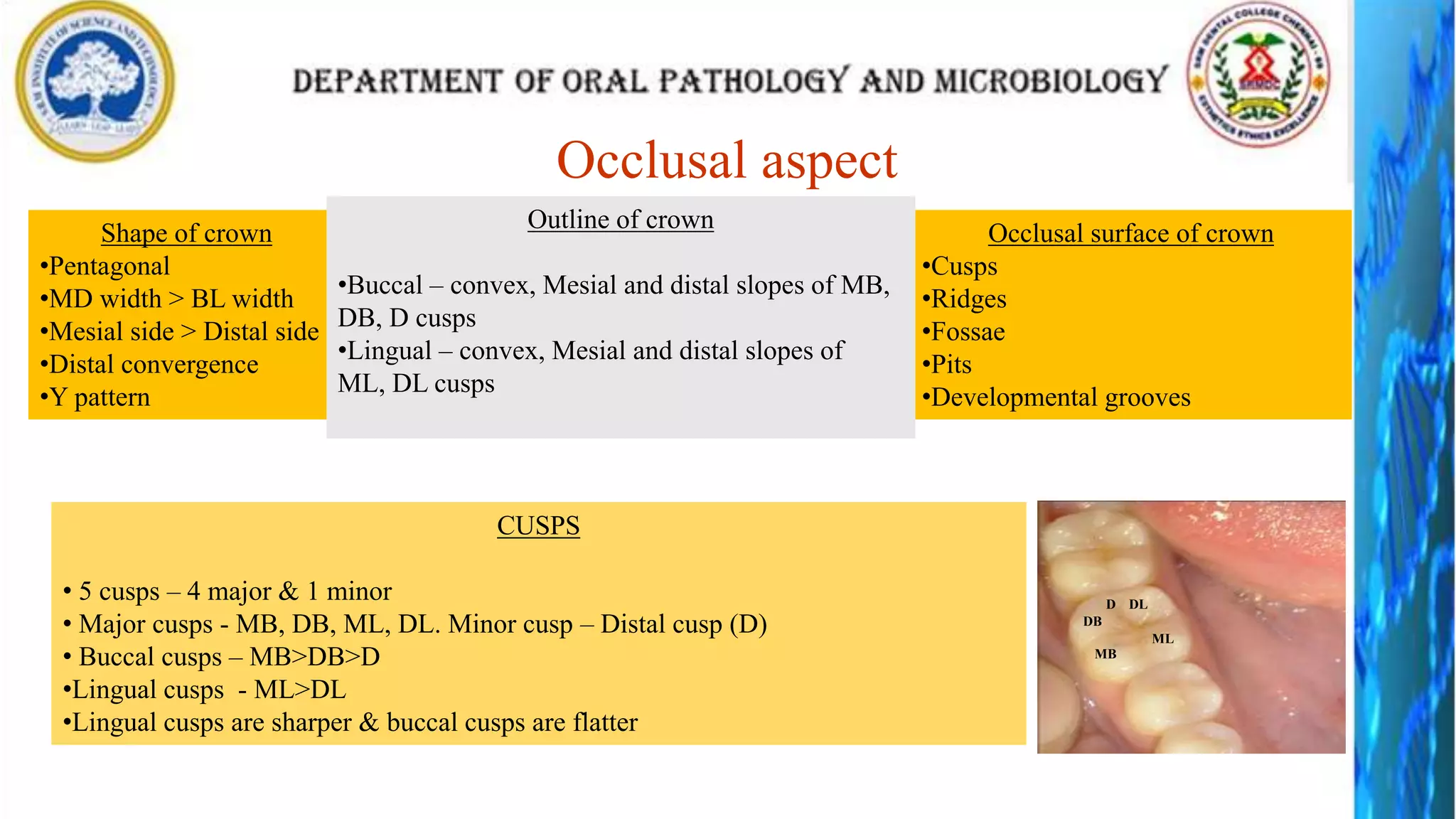
CUSPS
• 5 cusps – 4 major & 1 minor
• Major cusps - MB, DB, ML, DL. Minor cusp – Distal cusp (D)
• Buccal cusps – MB>DB>D
•Lingual cusps - ML>DL
•Lingual cusps are sharper & buccal cusps are flatter
Occlusal aspect
Shape of crown
•Pentagonal
•MD width > BL width
•Mesial side > Distal side
•Distal convergence
•Y pattern
Occlusal surface of crown
•Cusps
•Ridges
•Fossae
•Pits
•Developmental grooves
Outline of crown
•Buccal – convex, Mesial and distal slopes of MB,
DB, D cusps
•Lingual – convex, Mesial and distal slopes of
ML, DL cusps
D
MB
DB
ML
DL
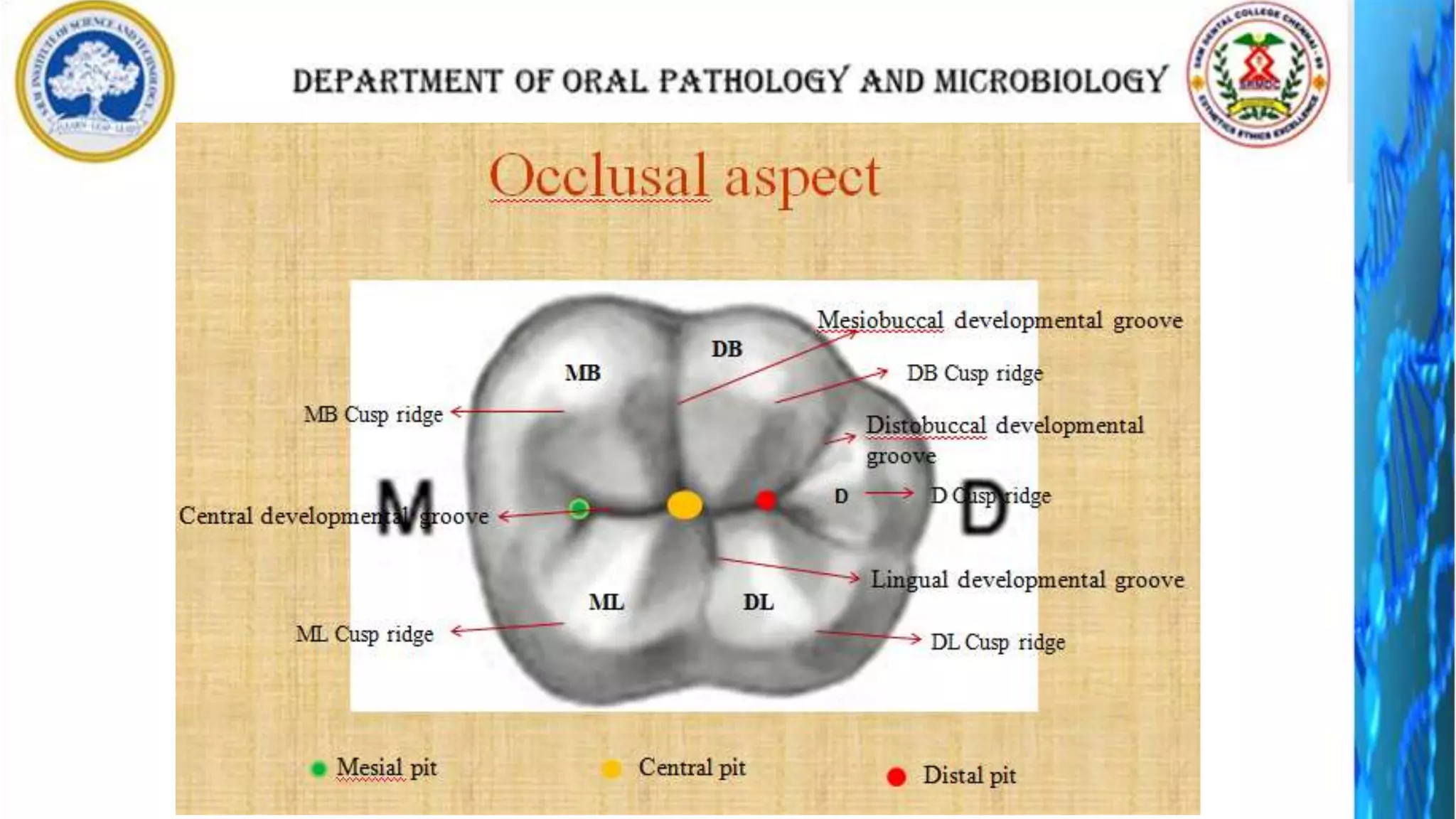
RIDGES
•Mesial Marginal ridge –mesial boundary
•Distal Marginal ridge – distal boundary
•Triangular ridge – from all 5 cusp tips to central fossae
• Cuspal ridge - occlusal outline on buccal & lingual aspect
Occlusal aspect
FOSSAE (1 Major fossa & 2 minor fossae)
• Central fossa – Major, circular depression at the centre
•Mesial triangular fossa- Smaller depression distal to mesial marginal ridge
•Distal triangular fossa- Smaller depression mesial to distal marginal ridge
PITS - 3 pits
•Central pit – narrow depression in central fossa
•Mesial pit – deeper part of mesial triangular fossa
•Distal pit – deeper part of distal triangular fossa
DEVELOPMENTAL GROOVES
•Central groove – from central pit to mesial & distal pit
•Mesiobuccal groove – between MB & DB cusps, from central pit to buccal surface
•Distobuccal groove – between DB & D cusps, from central pit to buccal surface
•Lingual groove – between ML & DL cusps, from central pit to lingual surface
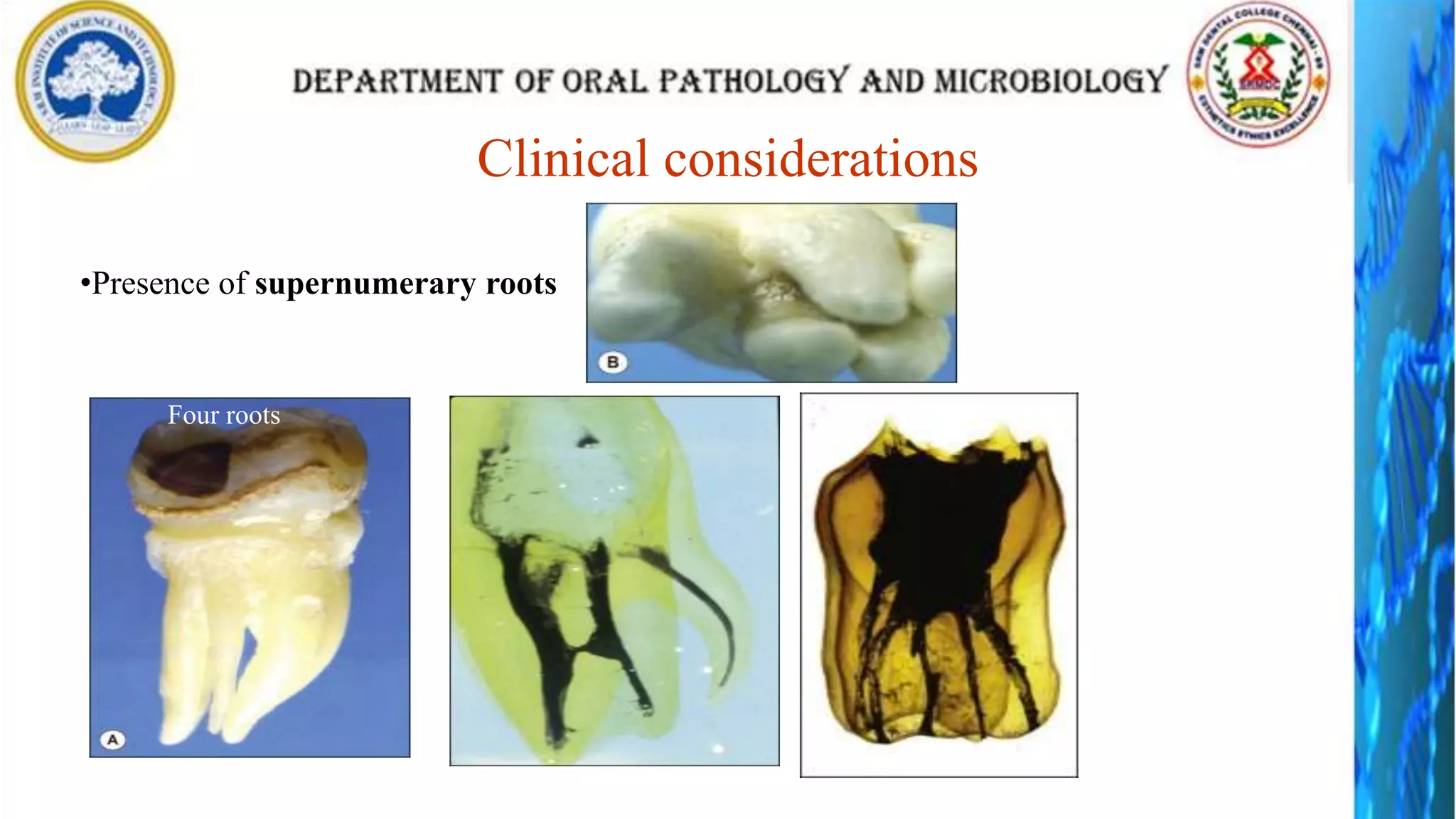
•Presence of supernumerary roots
Clinical considerations
Four roots
Five roots
Clinical considerations
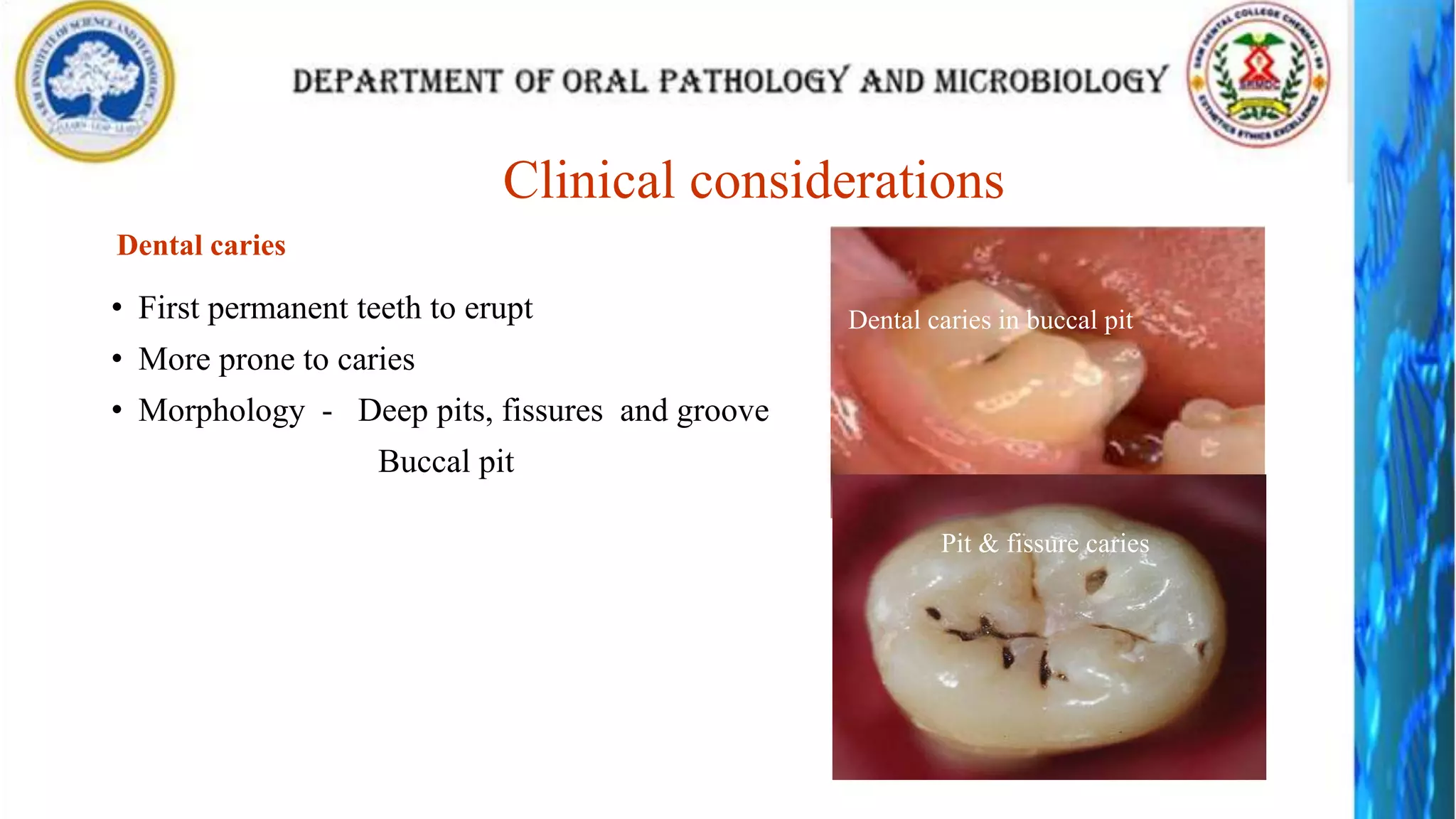
• First permanent teeth to erupt
• More prone to caries
• Morphology - Deep pits, fissures and groove
Buccal pit
Dental caries
Dental caries in buccal pit
Pit & fissure caries
Clinical considerations
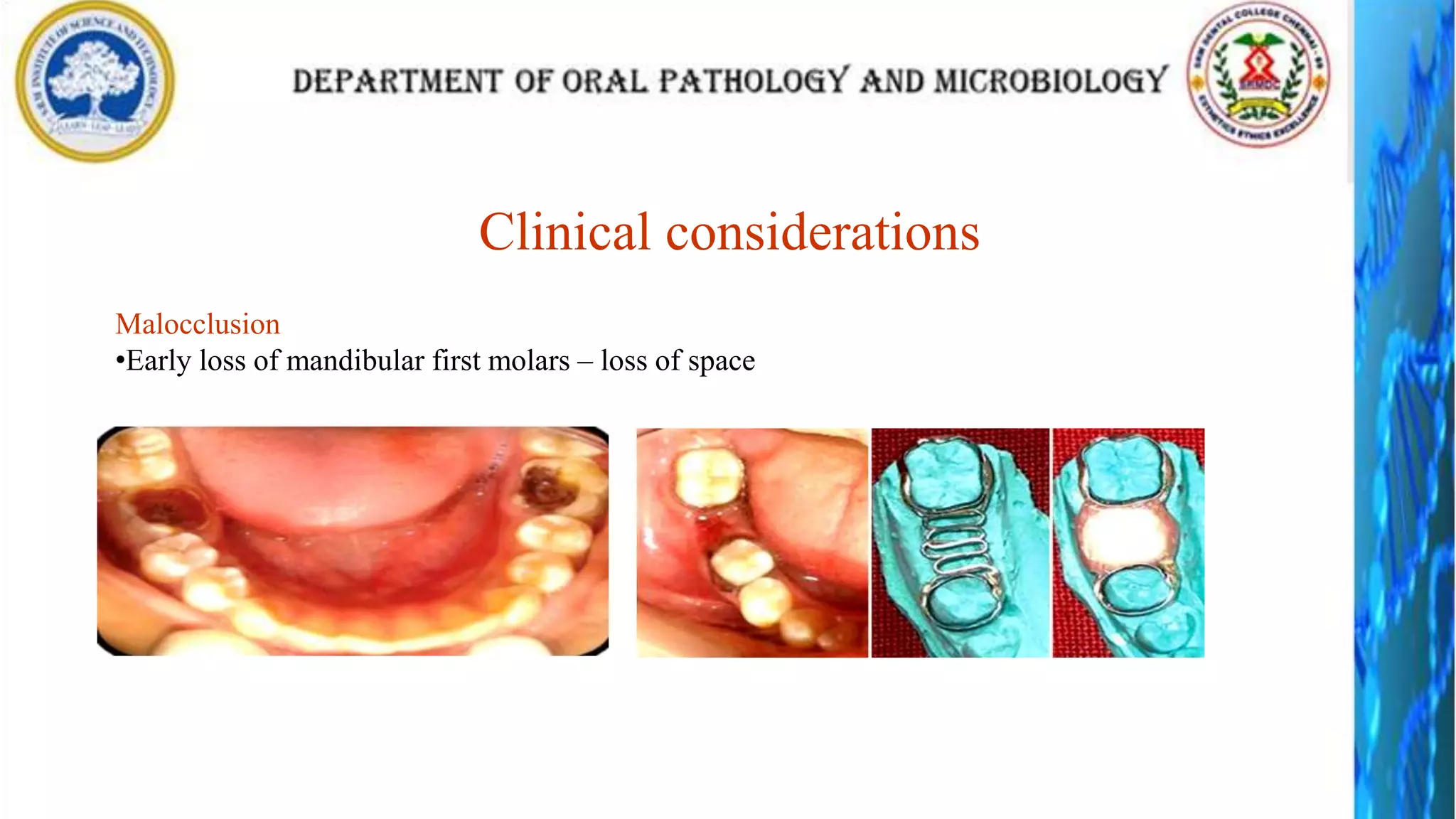
Malocclusion
•Early loss of mandibular first molars – loss of space
Clinical considerations
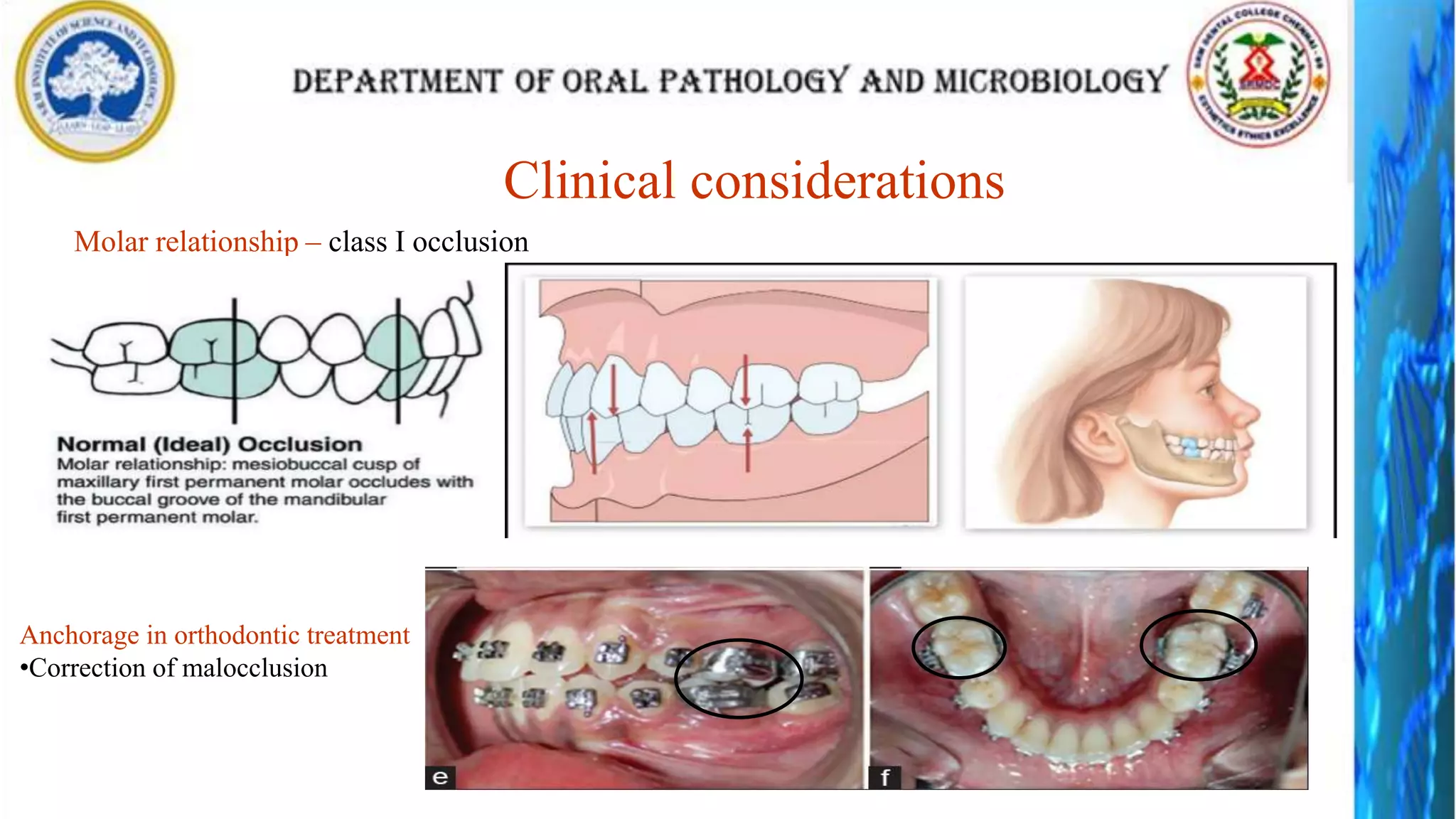
Molar relationship – class I occlusion
Anchorage in orthodontic treatment
•Correction of malocclusion
Permanent mandibular first molar

Permanent mandibular first molar

  • 1.
    dr vasanthi v Departmentof Oral Pathology & Microbiology SRM Dental College, Ramapuram, Chennai, India
  • 2.
    Introduction • First permanenttooth to erupt in the mandibular arch • Posterior to permanent mandibular second premolar • Largest & strongest in the mandibular arch • Lacks preceding primary tooth FIVE CUSPS – Mesiobuccal(MB), distobuccal(DB), distal(D), mesiolingual(ML) and distolingual(DL) MB DB D ML DL Distal canal TWO ROOTS – Mesial(M), Distal(D) (3 canals – 2 in mesial root & 1 in distal root) Mesial canals
  • 3.
    Tooth numbering system Palmer/Zsigmondysystem (Right – 6, , Left – 6 ) FDI system (Right – 46 , Left –36 ) Universal system (Right – 30, Left –19 )
  • 4.
    Chronology First evidence ofcalcification At birth Enamel completion 2.5-3 years Eruption 6-7 years Root completion 9-10 years
  • 5.
    Dimensions Cervico-occlusal length ofthe crown 7.5 mm Length of the root 14 mm Mesiodistal diameter of the crown 11 mm Mesiodistal diameter of the crown at cervix 9 mm Buccolingual diameter of the crown 10.5 mm Buccolingual diameter of the crown at cervix 9 mm Curvature of cervical line - Mesial 1 mm Curvature of cervical line - Distal 0 mm
  • 6.
    Importance of mandibularmolars • Anchorage - broad bifurcated root trunks, combined measurements of multiple roots • Sum of MD width of mandibular molars > Sum of MD width of all teeth anterior to first molar upto midline • Cervico-occlusal length of crown of molars < Cervico-occlusal length of crown of anterior teeth • MD width of crown > BL width of crown • Mastication – broader occlusal form • Functional cusps – Lingual cusps
  • 7.
    Buccal aspect OUTLINES OFTHE CROWN •Mesial – straight till contact area, then convex till cusp tip. Contact area – Junction of occlusal & middle third. •Distal – straight till contact area, then convex till cusp tip. Contact area – Junction of occlusal & middle third. •Cervical – regular with slight dip towards bifurcation •Occlusal – 3 buccal cusps (MB-widest, DB, D) & tips of 2 lingual cusps (ML, DL) are seen SHAPE OF CROWN •Trapezoidal •MD width > CO width BUCCAL SURFACE •Convex, 2 developmental grooves, buccocervical ridge •MB developmental groove (between MB, DB cusps) – till middle third of buccal surface, mesial to root bifurcation, ends in buccal pit •DB developmental groove (between DB, D cusps) - till middle third of buccal surface, at the distobuccal line angle
  • 9.
    Buccal aspect OUTLINES OFTHE ROOTS •Mesial & Distal roots- divergent •Root trunk – 3 mm •Mesial root– convex mesial and concave distal outline. Distal inclination of apical third. •Distal root – concave mesial and convex distal outline. Distal inclination of apical third. Distal inclination Distal inclination
  • 10.
    Lingual aspect OUTLINES OFTHE CROWN •Mesial – straight. Contact area – Middle third •Distal – convex from cervical line to cusp tip •Cervical – straight •Occlusal – lingual cusps (ML, DL) & part of distal (D) cusp SHAPE OF CROWN •Trapezoidal LINGUAL SURFACE •Convex, developmental groove •Lingual developmental groove - between ML, DL cusps OUTLINES OF THE ROOTS •Mesial & Distal roots – longer in lingual aspect •Root trunk – 4 mm, developmental depression from cervical line to bifurcation •Mesial root– convex mesial and concave distal outline. Distal inclination of apical third. •Distal root – straight mesial outline. Convex distal outline till middle third then concave till apical third.
  • 12.
    Mesial aspect OUTLINES OFTHE CROWN (Lingual inclination) •Buccal – convex till middle third, then concave •Lingual – straight till middle third then convex •Cervical – straight. 1 mm depth of curvature towards occlusal surface •Occlusal – MB, ML cusps. Higher mesial marginal ridge SHAPE OF CROWN •Rhomboidal CONTACT AREA •Junction of occlusal and middle third of crown OUTLINES OF THE ROOT •Mesial root – wider buccolingually than distal root •Convex buccal & lingual outline of mesial root •Developmental depression – broad, concave. From cervical line to apex
  • 14.
    Distal aspect OUTLINES OFTHE CROWN (Lingual inclination) •Buccal – slightly convex from cervical line till cusp tip •Lingual – straight till middle third then convex •Cervical – straight •Occlusal – 5 cusps (MB, DB, D, MB, ML). Shorter distal marginal ridge, distal convergence SHAPE OF CROWN •Rhomboidal CONTACT AREA •Junction of occlusal and middle third of crown OUTLINES OF THE ROOT •Distal root, part of mesial root •Convex buccal outline & straight lingual outline of distal root • Smooth distal surface, developmental depression is rare.
  • 16.
    CUSPS • 5 cusps– 4 major & 1 minor • Major cusps - MB, DB, ML, DL. Minor cusp – Distal cusp (D) • Buccal cusps – MB>DB>D •Lingual cusps - ML>DL •Lingual cusps are sharper & buccal cusps are flatter Occlusal aspect Shape of crown •Pentagonal •MD width > BL width •Mesial side > Distal side •Distal convergence •Y pattern Occlusal surface of crown •Cusps •Ridges •Fossae •Pits •Developmental grooves Outline of crown •Buccal – convex, Mesial and distal slopes of MB, DB, D cusps •Lingual – convex, Mesial and distal slopes of ML, DL cusps D MB DB ML DL
  • 17.
    RIDGES •Mesial Marginal ridge–mesial boundary •Distal Marginal ridge – distal boundary •Triangular ridge – from all 5 cusp tips to central fossae • Cuspal ridge - occlusal outline on buccal & lingual aspect Occlusal aspect FOSSAE (1 Major fossa & 2 minor fossae) • Central fossa – Major, circular depression at the centre •Mesial triangular fossa- Smaller depression distal to mesial marginal ridge •Distal triangular fossa- Smaller depression mesial to distal marginal ridge PITS - 3 pits •Central pit – narrow depression in central fossa •Mesial pit – deeper part of mesial triangular fossa •Distal pit – deeper part of distal triangular fossa DEVELOPMENTAL GROOVES •Central groove – from central pit to mesial & distal pit •Mesiobuccal groove – between MB & DB cusps, from central pit to buccal surface •Distobuccal groove – between DB & D cusps, from central pit to buccal surface •Lingual groove – between ML & DL cusps, from central pit to lingual surface
  • 19.
    •Presence of supernumeraryroots Clinical considerations Four roots Five roots
  • 20.
    Clinical considerations • Firstpermanent teeth to erupt • More prone to caries • Morphology - Deep pits, fissures and groove Buccal pit Dental caries Dental caries in buccal pit Pit & fissure caries
  • 21.
    Clinical considerations Malocclusion •Early lossof mandibular first molars – loss of space
  • 22.
    Clinical considerations Molar relationship– class I occlusion Anchorage in orthodontic treatment •Correction of malocclusion