Scalable Deep Learning in Baidu
Weide Zhang, Kyle Tsai, Jiang Wang
Baidu USDC
Background
• Spark
– Batch/Streaming processing, Spark SQL, MLLib
• Deep learning has many use cases in Baidu and showed
significant improvement in quality
– Image retrieval ranking
– Ads CTR prediction
– Machine translation
– Speech recognition
• Goal: able to use distributed deep learning in Spark
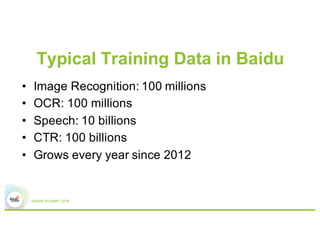
Typical Training Data in Baidu
• Image Recognition: 100 millions
• OCR: 100 millions
• Speech: 10 billions
• CTR: 100 billions
• Grows every year since 2012
Baidu Spark One
Paddle
• Parallel Asynchronous Distributed Deep Learning Library
– Support distributed parameter servers to do
synchronous/asynchronous parameter update
– Support Multi GPU / CPU training
– Support sparse model
– Easy to understand API for user to add new layers
– Support rich features for deep learning use cases,
especially for NLP
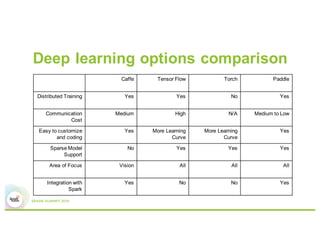
Deep learning options comparison
Caffe Tensor Flow Torch Paddle
Distributed Training Yes Yes No Yes
Communication
Cost
Medium High N/A Medium to Low
Easy to customize
and coding
Yes More Learning
Curve
More Learning
Curve
Yes
Sparse Model
Support
No Yes Yes Yes
Area of Focus Vision All All All
Integration with
Spark
Yes No No Yes
High Level Goals
• Implement Spark ML abstractions to let user train
deep learning models with minimal code change
• Leverage paddle’s native training and parameter
server mechanisms to be scheduled in spark deep
learning jobs
• Handle multi-tenancy and heterogeneity
• Parallelize hyper parameter selection
• Batch and Streaming learning
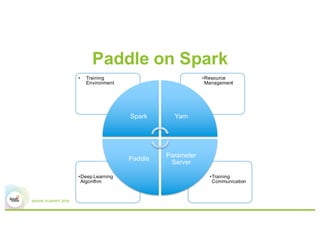
Paddle on Spark
•Training
Communication
•Deep Learning
Algorithm
•Resource
Management
• Training
Environment
Spark Yarn
Parameter
Server
Paddle
Training Data Flow
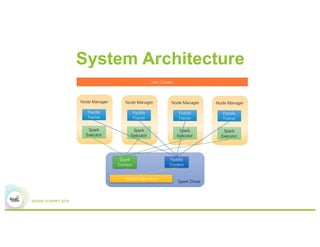
System Architecture
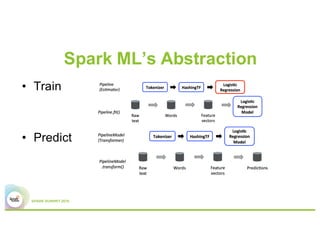
Spark ML’s Abstraction
• Train
• Predict
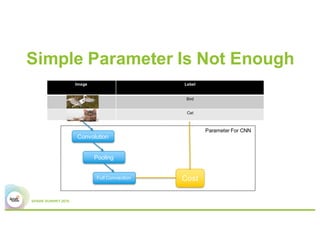
Simple Parameter Is Not Enough
Image Label
Bird
Cat
Convolution
Pooling
Full Connection Cost
Parameter For CNN
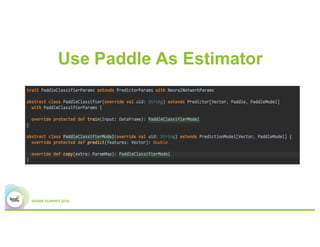
Use Paddle As Estimator
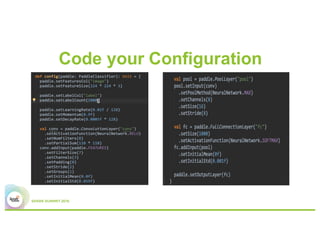
Code your Configuration
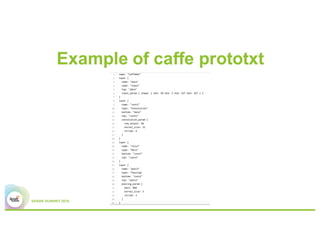
Example of caffe prototxt
Design decisions
• Spark ML Compatible API
– Compatible with Spark is more important than
implemented under Spark
• Code level configuration
– Easy and flexible
– Manual is prone to error
PADDLE Scalable Deep Learning Platform at Baidu
Sharded Parameter Server
• One parameter an one
trainer co-locate in a
machine.
• Parameters are shared,
but not replicated.
• All-to-all communication.
• Our environments
• 4 GPUs per machine.
• 4-10 machines.
• all machines in one
switch
• reliable data center.
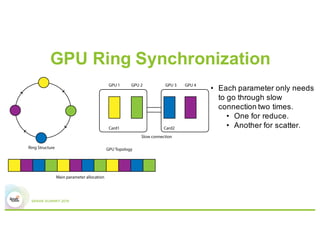
GPU Ring Synchronization
• Each parameter only needs
to go through slow
connection two times.
• One for reduce.
• Another for scatter.
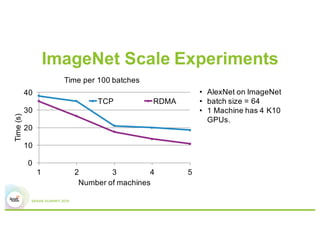
ImageNet Scale Experiments
0
10
20
30
40
1 2 3 4 5
Time(s)
Number of machines
Time per 100 batches
TCP RDMA
• AlexNet on ImageNet
• batch size = 64
• 1 Machine has 4 K10
GPUs.
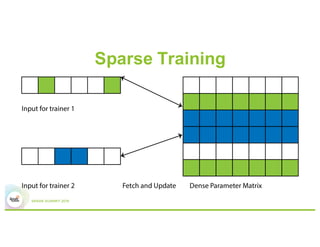
Sparse Training
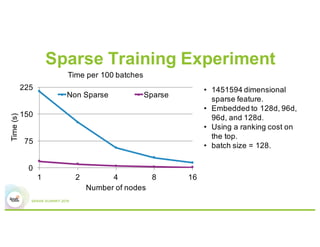
Sparse Training Experiment
0
75
150
225
1 2 4 8 16
Time(s)
Number of nodes
Time per 100 batches
Non Sparse Sparse
• 1451594 dimensional
sparse feature.
• Embedded to 128d, 96d,
96d, and 128d.
• Using a ranking cost on
the top.
• batch size = 128.
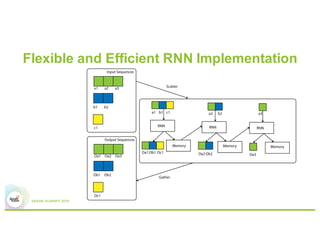
Flexible and Efficient RNN Implementation
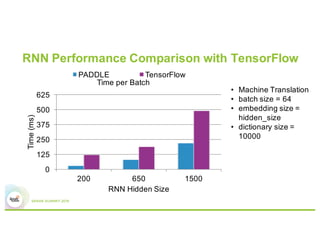
RNN Performance Comparison with TensorFlow
0
125
250
375
500
625
200 650 1500
Time(ms)
RNN Hidden Size
Time per Batch
PADDLE TensorFlow
• Machine Translation
• batch size = 64
• embedding size =
hidden_size
• dictionary size =
10000
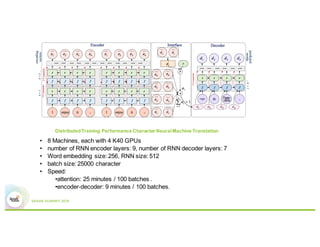
DistributedTraining Performance Character NeuralMachine Translation
• 8 Machines, each with 4 K40 GPUs
• number of RNN encoder layers: 9, number of RNN decoder layers: 7
• Word embedding size: 256, RNN size: 512
• batch size: 25000 character
• Speed:
•attention: 25 minutes / 100 batches .
•encoder-decoder: 9 minutes / 100 batches.
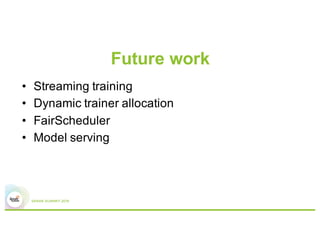
Future work
• Streaming training
• Dynamic trainer allocation
• FairScheduler
• Model serving
THANK YOU.
zhangweide/kyletsai/wangjiang03@baidu.com

Scalable Deep Learning Platform On Spark In Baidu

  • 1.
    Scalable Deep Learningin Baidu Weide Zhang, Kyle Tsai, Jiang Wang Baidu USDC
  • 2.
    Background • Spark – Batch/Streamingprocessing, Spark SQL, MLLib • Deep learning has many use cases in Baidu and showed significant improvement in quality – Image retrieval ranking – Ads CTR prediction – Machine translation – Speech recognition • Goal: able to use distributed deep learning in Spark
  • 3.
    Typical Training Datain Baidu • Image Recognition: 100 millions • OCR: 100 millions • Speech: 10 billions • CTR: 100 billions • Grows every year since 2012
  • 4.
  • 5.
    Paddle • Parallel AsynchronousDistributed Deep Learning Library – Support distributed parameter servers to do synchronous/asynchronous parameter update – Support Multi GPU / CPU training – Support sparse model – Easy to understand API for user to add new layers – Support rich features for deep learning use cases, especially for NLP
  • 6.
    Deep learning optionscomparison Caffe Tensor Flow Torch Paddle Distributed Training Yes Yes No Yes Communication Cost Medium High N/A Medium to Low Easy to customize and coding Yes More Learning Curve More Learning Curve Yes Sparse Model Support No Yes Yes Yes Area of Focus Vision All All All Integration with Spark Yes No No Yes
  • 7.
    High Level Goals •Implement Spark ML abstractions to let user train deep learning models with minimal code change • Leverage paddle’s native training and parameter server mechanisms to be scheduled in spark deep learning jobs • Handle multi-tenancy and heterogeneity • Parallelize hyper parameter selection • Batch and Streaming learning
  • 8.
    Paddle on Spark •Training Communication •DeepLearning Algorithm •Resource Management • Training Environment Spark Yarn Parameter Server Paddle
  • 9.
  • 10.
  • 11.
  • 12.
    Simple Parameter IsNot Enough Image Label Bird Cat Convolution Pooling Full Connection Cost Parameter For CNN
  • 13.
    Use Paddle AsEstimator
  • 14.
  • 15.
  • 16.
    Design decisions • SparkML Compatible API – Compatible with Spark is more important than implemented under Spark • Code level configuration – Easy and flexible – Manual is prone to error
  • 17.
    PADDLE Scalable DeepLearning Platform at Baidu
  • 18.
    Sharded Parameter Server •One parameter an one trainer co-locate in a machine. • Parameters are shared, but not replicated. • All-to-all communication. • Our environments • 4 GPUs per machine. • 4-10 machines. • all machines in one switch • reliable data center.
  • 19.
    GPU Ring Synchronization •Each parameter only needs to go through slow connection two times. • One for reduce. • Another for scatter.
  • 20.
    ImageNet Scale Experiments 0 10 20 30 40 12 3 4 5 Time(s) Number of machines Time per 100 batches TCP RDMA • AlexNet on ImageNet • batch size = 64 • 1 Machine has 4 K10 GPUs.
  • 21.
  • 22.
    Sparse Training Experiment 0 75 150 225 12 4 8 16 Time(s) Number of nodes Time per 100 batches Non Sparse Sparse • 1451594 dimensional sparse feature. • Embedded to 128d, 96d, 96d, and 128d. • Using a ranking cost on the top. • batch size = 128.
  • 23.
    Flexible and EfficientRNN Implementation
  • 24.
    RNN Performance Comparisonwith TensorFlow 0 125 250 375 500 625 200 650 1500 Time(ms) RNN Hidden Size Time per Batch PADDLE TensorFlow • Machine Translation • batch size = 64 • embedding size = hidden_size • dictionary size = 10000
  • 25.
    DistributedTraining Performance CharacterNeuralMachine Translation • 8 Machines, each with 4 K40 GPUs • number of RNN encoder layers: 9, number of RNN decoder layers: 7 • Word embedding size: 256, RNN size: 512 • batch size: 25000 character • Speed: •attention: 25 minutes / 100 batches . •encoder-decoder: 9 minutes / 100 batches.
  • 26.
    Future work • Streamingtraining • Dynamic trainer allocation • FairScheduler • Model serving
  • 27.