Re-Architecting Apache Spark for
Performance Understandability
Kay Ousterhout
Joint work with Christopher Canel, Max Wolffe,
Sylvia Ratnasamy, Scott Shenker
About Me
PhD candidate at UC Berkeley
Thesis work on performance of large-scale distributed
systems
Apache Spark PMC member
About this talk
Future architecture for systems like Spark
Implementation is API-compatible with Spark
Major change to Spark’s internals (~20K lines of code)
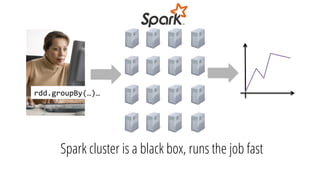
Spark cluster is a black box, runs the job fast
rdd.groupBy(…)…
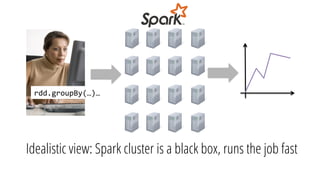
Idealistic view: Spark cluster is a black box, runs the job fast
rdd.groupBy(…)…
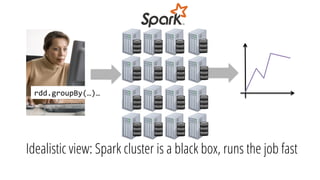
Idealistic view: Spark cluster is a black box, runs the job fast
rdd.groupBy(…)…
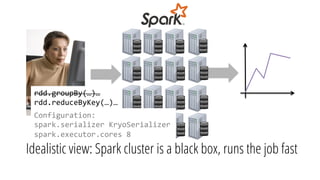
rdd.groupBy(…)…
rdd.reduceByKey(…)…	
Configuration:	
spark.serializer	KryoSerializer	
spark.executor.cores	8	
Idealistic view: Spark cluster is a black box, runs the job fast
rdd.groupBy(…)…
rdd.reduceByKey(…)…	
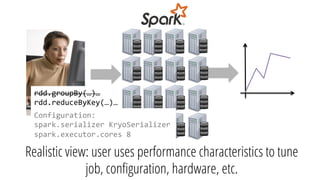
Realistic view: user uses performance characteristics to tune
job, configuration, hardware, etc.
Configuration:	
spark.serializer	KryoSerializer	
spark.executor.cores	8
rdd.groupBy(…)…
rdd.reduceByKey(…)…	
Realistic view: user uses performance characteristics to tune
job, configuration, hardware, etc.
Configuration:	
spark.serializer	KryoSerializer	
spark.executor.cores	8	
Users need to be able to reason about
performance
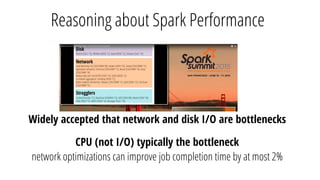
Reasoning about Spark Performance
Widely accepted that network and disk I/O are bottlenecks
CPU (not I/O) typically the bottleneck
network optimizations can improve job completion time by at most 2%
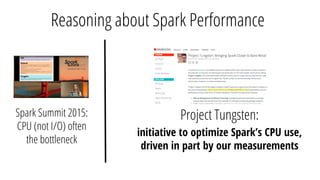
Reasoning about Spark Performance
Spark Summit 2015:
CPU (not I/O) often
the bottleneck
Project Tungsten:
initiative to optimize Spark’s CPU use,
driven in part by our measurements
Reasoning about Spark Performance
Spark Summit 2015:
CPU (not I/O) often
the bottleneck
Project Tungsten:
initiative to optimize
Spark’s CPU use
Spark 2.0:
Some evidence that I/O
is again the bottleneck
[HotCloud ’16]
Users need to understand performance to extract the best
runtimes
Reasoning about performance is currently difficult
Software and hardware are constantly evolving,
so performance is always in flux
Vision: jobs report high-level performance metrics
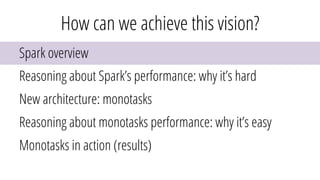
How can we achieve this vision?
Spark overview
Reasoning about Spark’s performance: why it’s hard
New architecture: monotasks
Reasoning about monotasks performance: why it’s easy
Monotasks in action (results)
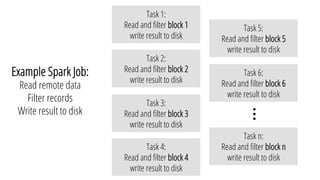
Example Spark Job:
Read remote data
Filter records
Write result to disk
Task 1:
Read and filter block 1
write result to disk
Task 2:
Read and filter block 2
write result to disk
Task 3:
Read and filter block 3
write result to disk
Task 4:
Read and filter block 4
write result to disk
Task 5:
Read and filter block 5
write result to disk
Task 6:
Read and filter block 6
write result to disk
Task n:
Read and filter block n
write result to disk
…
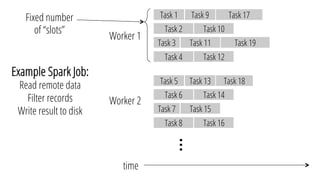
Example Spark Job:
Read remote data
Filter records
Write result to disk
time
Task 1 Task 9
Task 2
Task 3
Task 4
Task 11
Task 10
Task 12
Worker 1
Task 5 Task 13
Task 6
Task 7
Task 8
Task 15
Task 14
Task 16
Worker 2
…	
Fixed number
of “slots”
Task 17
Task 18
Task 19
Task 1 Task 9
Task 2
Task 3
Task 4
Task 11
Task 10
Task 12
Worker 1
Task 5 Task 13
Task 6
Task 7
Task 8
Task 15
Task 14
Task 16
Worker 2
…
Task 17
Task 18
Task 19
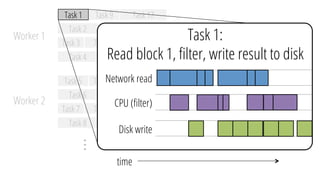
Task 1:
Read block 1, filter, write result to disk
Task 1
time
Network read
CPU (filter)
Disk write
How can we achieve this vision?
Spark overview
Reasoning about Spark’s performance: why it’s hard
New architecture: monotasks
Reasoning about monotasks performance: why it’s easy
Monotasks in action (results)
Task 18
Task 19
Task 1
Network read
CPU (filter)
Disk write
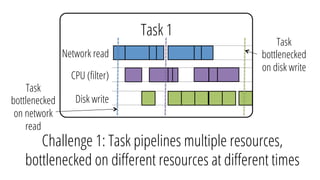
Challenge 1: Task pipelines multiple resources,
bottlenecked on different resources at different times
Task
bottlenecked
on disk write
Task
bottlenecked
on network
read
Task 1
Task 2
Task 9
Task 3
Task 4
Task 11
Task 10
Task 12
time
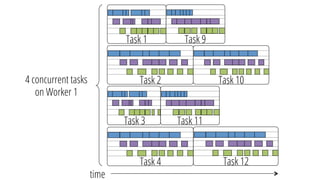
4 concurrent tasks
on Worker 1
Task 1
Task 2
Task 9
Task 3
Task 4
Task 11
Task 10
Task 12
time
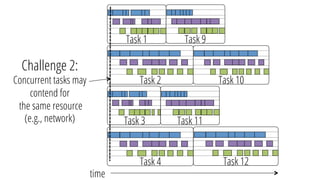
Challenge 2:
Concurrent tasks may
contend for
the same resource
(e.g., network)
Blocked time analysis: how quickly
could a job have completed if a resource
were infinitely fast? (upper bound)
Spark Summit 2015:
Result of ~1 year of adding metrics to Spark!
Task 1
Task 2
Task 9
Task 3
Task 4
Task 11
Task 10
Task 12
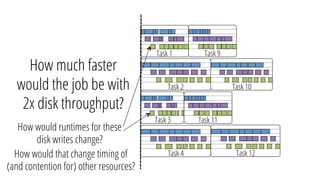
How much faster
would the job be with
2x disk throughput?
How would runtimes for these
disk writes change?
How would that change timing of
(and contention for) other resources?
Challenges to reasoning about performance
Tasks bottleneck on different resources at different times
Concurrent tasks on a machine may contend for resources
No model for performance
How can we achieve this vision?
Spark overview
Reasoning about Spark’s performance: why it’s hard
New architecture: monotasks
Reasoning about monotasks performance: why it’s easy
Monotasks in action (results)
Spark:
Tasks
bottleneck on
different
resources
Concurrent
tasks may
contend
No model for
performance
Spark:
Tasks
bottleneck on
different
resources
Concurrent
tasks may
contend
No model for
performance
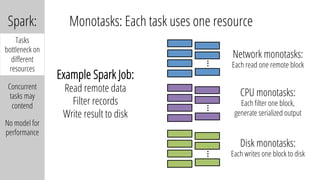
Monotasks: Each task uses one resource
Example Spark Job:
Read remote data
Filter records
Write result to disk
Network monotasks:
Each read one remote block
…	
CPU monotasks:
Each filter one block,
generate serialized output
…	
Disk monotasks:
Each writes one block to disk
…
Spark:
Tasks
bottleneck on
different
resources
Concurrent
tasks may
contend
No model for
performance
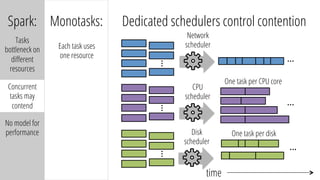
Monotasks:
Each task uses
one resource
Dedicated schedulers control contention
…	…	…	
Network
scheduler
time
CPU
scheduler
…	
…	
Disk
scheduler
…	
One task per CPU core
One task per disk
Spark:
Tasks
bottleneck on
different
resources
Concurrent
tasks may
contend
No model for
performance
Monotasks:
Each task uses
one resource
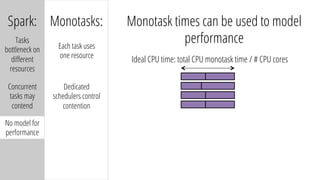
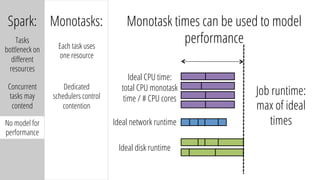
Monotask times can be used to model
performance
Dedicated
schedulers control
contention
Ideal CPU time: total CPU monotask time / # CPU cores
Spark:
Tasks
bottleneck on
different
resources
Concurrent
tasks may
contend
No model for
performance
Monotasks:
Each task uses
one resource
Monotask times can be used to model
performance
Dedicated
schedulers control
contention
Ideal CPU time:
total CPU monotask
time / # CPU cores
Ideal network runtime
Ideal disk runtime
Job runtime:
max of ideal
times
Spark:
Tasks
bottleneck on
different
resources
Concurrent
tasks may
contend
No model for
performance
Monotasks:
Each task uses
one resource
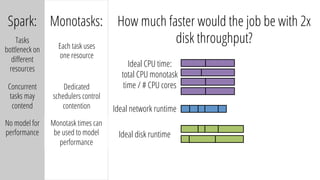
How much faster would the job be with 2x
disk throughput?
Dedicated
schedulers control
contention
Ideal CPU time:
total CPU monotask
time / # CPU cores
Ideal network runtime
Ideal disk runtime
Monotask times can
be used to model
performance
Spark:
Tasks
bottleneck on
different
resources
Concurrent
tasks may
contend
No model for
performance
Monotasks:
Each task uses
one resource
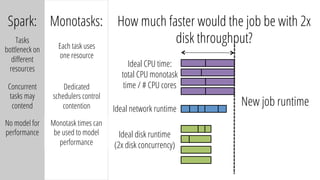
How much faster would the job be with 2x
disk throughput?
Dedicated
schedulers control
contention
Ideal CPU time:
total CPU monotask
time / # CPU cores
Ideal network runtime
Ideal disk runtime
(2x disk concurrency)
Monotask times can
be used to model
performance
New job runtime
Spark:
Tasks
bottleneck on
different
resources
Concurrent
tasks may
contend
No model for
performance
Monotasks:
Each task uses
one resource
Dedicated
schedulers control
contention
Monotask times can
be used to model
performance
Task 1
Task 2
Task 9
Task 3
Task 4
Task 11
Task 10
Task 12
…	
…	
…	
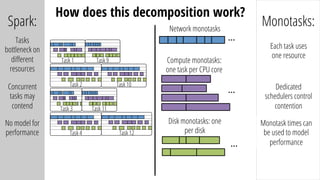
Compute monotasks:
one task per CPU core
Disk monotasks: one
per disk
Network monotasks
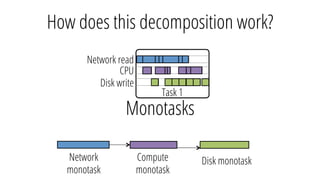
How does this decomposition work?
Task 1
Network read
CPU
Disk write
Monotasks
Network
monotask
Disk monotaskCompute
monotask
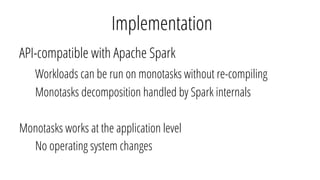
Implementation
API-compatible with Apache Spark
Workloads can be run on monotasks without re-compiling
Monotasks decomposition handled by Spark internals
Monotasks works at the application level
No operating system changes
How can we achieve this vision?
Spark overview
Reasoning about Spark’s performance: why it’s hard
New architecture: monotasks
Reasoning about monotasks performance: why it’s easy
Monotasks in action (results)
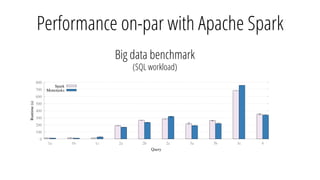
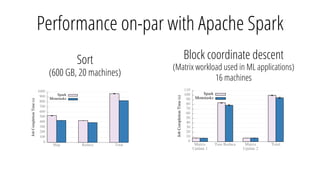
Performance on-par with Apache Spark
Big data benchmark
(SQL workload)
�
���
���
���
���
���
���
���
���
�� �� �� �� �� �� �� �� �� �
����������
�����
�����
���������
Performance on-par with Apache Spark
Sort
(600 GB, 20 machines)
Block coordinate descent
(Matrix workload used in ML applications)
16 machines
��
���
���
���
���
���
���
���
���
���
����
����
������
��������
����������� ������
��������
�����
�����������������������
�����
���������
��
����
����
����
����
����
����
����
����
����
�����
��� ������ �����
�����������������������
�����
���������
Monotasks in action
Modeling performance
Leveraging performance clarity to optimize performance
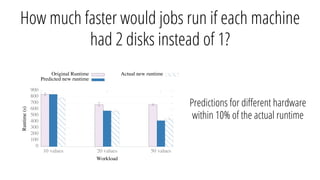
How much faster would jobs run if each machine
had 2 disks instead of 1?
��
����
����
����
����
����
����
����
����
����
��������� ��������� ���������
�����������
��������
����������������
���������������������
������������������
Predictions for different hardware
within 10% of the actual runtime
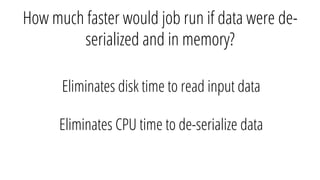
How much faster would job run if data were de-
serialized and in memory?
Eliminates disk time to read input data
Eliminates CPU time to de-serialize data
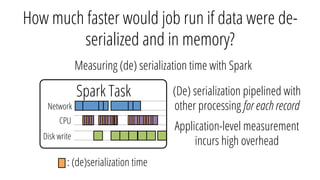
How much faster would job run if data were de-
serialized and in memory?
Task
18
Spark Task
Network
CPU
Disk write
: (de)serialization time
Measuring (de) serialization time with Spark
(De) serialization pipelined with
other processing for each record
Application-level measurement
incurs high overhead
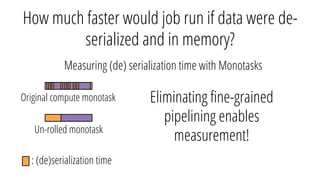
How much faster would job run if data were de-
serialized and in memory?
: (de)serialization time
Measuring (de) serialization time with Monotasks
Eliminating fine-grained
pipelining enables
measurement!
Original compute monotask
Un-rolled monotask
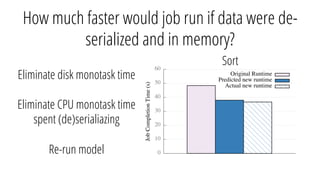
How much faster would job run if data were de-
serialized and in memory?
��
���
���
���
���
���
���
�����������������������
����������������
���������������������
������������������
Eliminate disk monotask time
Eliminate CPU monotask time
spent (de)serialiazing
Re-run model
Sort
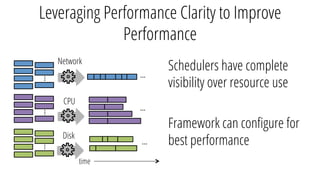
Leveraging Performance Clarity to Improve
Performance
Schedulers have complete
visibility over resource use
Framework can configure for
best performance
…	…	…	
Network
time
CPU
…	
…	
Disk
…
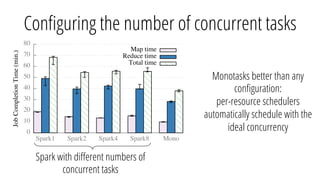
Configuring the number of concurrent tasks
		
��
���
���
���
���
���
���
���
���
������ ������ ������ ������ ����
��������������������������
��������
�����������
����������
Spark with different numbers of
concurrent tasks
Monotasks better than any
configuration:
per-resource schedulers
automatically schedule with the
ideal concurrency
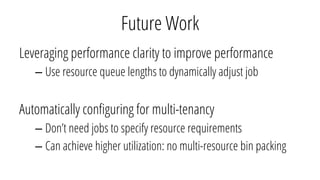
Future Work
Leveraging performance clarity to improve performance
– Use resource queue lengths to dynamically adjust job
Automatically configuring for multi-tenancy
– Don’t need jobs to specify resource requirements
– Can achieve higher utilization: no multi-resource bin packing
Monotasks:
Each task uses
one resource
Dedicated
schedulers control
contention
Monotask times can
be used to model
performance
…	
…	
…	
Compute monotasks:
one task per CPU core
Disk monotasks: one
per disk
Network monotasks
Vision:
Spark always reports
bottleneck information
Challenging with existing
architecture
Interested? Have a job whose performance
you can’t figure out? Email me:
keo@cs.berkeley.edu

Re-Architecting Spark For Performance Understandability

  • 1.
    Re-Architecting Apache Sparkfor Performance Understandability Kay Ousterhout Joint work with Christopher Canel, Max Wolffe, Sylvia Ratnasamy, Scott Shenker
  • 2.
    About Me PhD candidateat UC Berkeley Thesis work on performance of large-scale distributed systems Apache Spark PMC member
  • 3.
    About this talk Futurearchitecture for systems like Spark Implementation is API-compatible with Spark Major change to Spark’s internals (~20K lines of code)
  • 4.
    Spark cluster isa black box, runs the job fast rdd.groupBy(…)…
  • 5.
    Idealistic view: Sparkcluster is a black box, runs the job fast rdd.groupBy(…)…
  • 6.
    Idealistic view: Sparkcluster is a black box, runs the job fast rdd.groupBy(…)…
  • 7.
  • 8.
    rdd.groupBy(…)… rdd.reduceByKey(…)… Realistic view: useruses performance characteristics to tune job, configuration, hardware, etc. Configuration: spark.serializer KryoSerializer spark.executor.cores 8
  • 9.
    rdd.groupBy(…)… rdd.reduceByKey(…)… Realistic view: useruses performance characteristics to tune job, configuration, hardware, etc. Configuration: spark.serializer KryoSerializer spark.executor.cores 8 Users need to be able to reason about performance
  • 10.
    Reasoning about SparkPerformance Widely accepted that network and disk I/O are bottlenecks CPU (not I/O) typically the bottleneck network optimizations can improve job completion time by at most 2%
  • 11.
    Reasoning about SparkPerformance Spark Summit 2015: CPU (not I/O) often the bottleneck Project Tungsten: initiative to optimize Spark’s CPU use, driven in part by our measurements
  • 12.
    Reasoning about SparkPerformance Spark Summit 2015: CPU (not I/O) often the bottleneck Project Tungsten: initiative to optimize Spark’s CPU use Spark 2.0: Some evidence that I/O is again the bottleneck [HotCloud ’16]
  • 13.
    Users need tounderstand performance to extract the best runtimes Reasoning about performance is currently difficult Software and hardware are constantly evolving, so performance is always in flux
  • 14.
    Vision: jobs reporthigh-level performance metrics
  • 15.
    Vision: jobs reporthigh-level performance metrics
  • 16.
    Vision: jobs reporthigh-level performance metrics
  • 17.
    Vision: jobs reporthigh-level performance metrics
  • 18.
    How can weachieve this vision? Spark overview Reasoning about Spark’s performance: why it’s hard New architecture: monotasks Reasoning about monotasks performance: why it’s easy Monotasks in action (results)
  • 19.
    Example Spark Job: Readremote data Filter records Write result to disk Task 1: Read and filter block 1 write result to disk Task 2: Read and filter block 2 write result to disk Task 3: Read and filter block 3 write result to disk Task 4: Read and filter block 4 write result to disk Task 5: Read and filter block 5 write result to disk Task 6: Read and filter block 6 write result to disk Task n: Read and filter block n write result to disk …
  • 20.
    Example Spark Job: Readremote data Filter records Write result to disk time Task 1 Task 9 Task 2 Task 3 Task 4 Task 11 Task 10 Task 12 Worker 1 Task 5 Task 13 Task 6 Task 7 Task 8 Task 15 Task 14 Task 16 Worker 2 … Fixed number of “slots” Task 17 Task 18 Task 19
  • 21.
    Task 1 Task9 Task 2 Task 3 Task 4 Task 11 Task 10 Task 12 Worker 1 Task 5 Task 13 Task 6 Task 7 Task 8 Task 15 Task 14 Task 16 Worker 2 … Task 17 Task 18 Task 19 Task 1: Read block 1, filter, write result to disk Task 1 time Network read CPU (filter) Disk write
  • 22.
    How can weachieve this vision? Spark overview Reasoning about Spark’s performance: why it’s hard New architecture: monotasks Reasoning about monotasks performance: why it’s easy Monotasks in action (results)
  • 23.
    Task 18 Task 19 Task1 Network read CPU (filter) Disk write Challenge 1: Task pipelines multiple resources, bottlenecked on different resources at different times Task bottlenecked on disk write Task bottlenecked on network read
  • 24.
    Task 1 Task 2 Task9 Task 3 Task 4 Task 11 Task 10 Task 12 time 4 concurrent tasks on Worker 1
  • 25.
    Task 1 Task 2 Task9 Task 3 Task 4 Task 11 Task 10 Task 12 time Challenge 2: Concurrent tasks may contend for the same resource (e.g., network)
  • 26.
    Blocked time analysis:how quickly could a job have completed if a resource were infinitely fast? (upper bound) Spark Summit 2015: Result of ~1 year of adding metrics to Spark!
  • 27.
    Task 1 Task 2 Task9 Task 3 Task 4 Task 11 Task 10 Task 12 How much faster would the job be with 2x disk throughput? How would runtimes for these disk writes change? How would that change timing of (and contention for) other resources?
  • 28.
    Challenges to reasoningabout performance Tasks bottleneck on different resources at different times Concurrent tasks on a machine may contend for resources No model for performance
  • 29.
    How can weachieve this vision? Spark overview Reasoning about Spark’s performance: why it’s hard New architecture: monotasks Reasoning about monotasks performance: why it’s easy Monotasks in action (results)
  • 30.
  • 31.
    Spark: Tasks bottleneck on different resources Concurrent tasks may contend Nomodel for performance Monotasks: Each task uses one resource Example Spark Job: Read remote data Filter records Write result to disk Network monotasks: Each read one remote block … CPU monotasks: Each filter one block, generate serialized output … Disk monotasks: Each writes one block to disk …
  • 32.
    Spark: Tasks bottleneck on different resources Concurrent tasks may contend Nomodel for performance Monotasks: Each task uses one resource Dedicated schedulers control contention … … … Network scheduler time CPU scheduler … … Disk scheduler … One task per CPU core One task per disk
  • 33.
    Spark: Tasks bottleneck on different resources Concurrent tasks may contend Nomodel for performance Monotasks: Each task uses one resource Monotask times can be used to model performance Dedicated schedulers control contention Ideal CPU time: total CPU monotask time / # CPU cores
  • 34.
    Spark: Tasks bottleneck on different resources Concurrent tasks may contend Nomodel for performance Monotasks: Each task uses one resource Monotask times can be used to model performance Dedicated schedulers control contention Ideal CPU time: total CPU monotask time / # CPU cores Ideal network runtime Ideal disk runtime Job runtime: max of ideal times
  • 35.
    Spark: Tasks bottleneck on different resources Concurrent tasks may contend Nomodel for performance Monotasks: Each task uses one resource How much faster would the job be with 2x disk throughput? Dedicated schedulers control contention Ideal CPU time: total CPU monotask time / # CPU cores Ideal network runtime Ideal disk runtime Monotask times can be used to model performance
  • 36.
    Spark: Tasks bottleneck on different resources Concurrent tasks may contend Nomodel for performance Monotasks: Each task uses one resource How much faster would the job be with 2x disk throughput? Dedicated schedulers control contention Ideal CPU time: total CPU monotask time / # CPU cores Ideal network runtime Ideal disk runtime (2x disk concurrency) Monotask times can be used to model performance New job runtime
  • 37.
    Spark: Tasks bottleneck on different resources Concurrent tasks may contend Nomodel for performance Monotasks: Each task uses one resource Dedicated schedulers control contention Monotask times can be used to model performance Task 1 Task 2 Task 9 Task 3 Task 4 Task 11 Task 10 Task 12 … … … Compute monotasks: one task per CPU core Disk monotasks: one per disk Network monotasks How does this decomposition work?
  • 38.
    How does thisdecomposition work? Task 1 Network read CPU Disk write Monotasks Network monotask Disk monotaskCompute monotask
  • 39.
    Implementation API-compatible with ApacheSpark Workloads can be run on monotasks without re-compiling Monotasks decomposition handled by Spark internals Monotasks works at the application level No operating system changes
  • 40.
    How can weachieve this vision? Spark overview Reasoning about Spark’s performance: why it’s hard New architecture: monotasks Reasoning about monotasks performance: why it’s easy Monotasks in action (results)
  • 41.
    Performance on-par withApache Spark Big data benchmark (SQL workload) � ��� ��� ��� ��� ��� ��� ��� ��� �� �� �� �� �� �� �� �� �� � ���������� ����� ����� ���������
  • 42.
    Performance on-par withApache Spark Sort (600 GB, 20 machines) Block coordinate descent (Matrix workload used in ML applications) 16 machines �� ��� ��� ��� ��� ��� ��� ��� ��� ��� ���� ���� ������ �������� ����������� ������ �������� ����� ����������������������� ����� ��������� �� ���� ���� ���� ���� ���� ���� ���� ���� ���� ����� ��� ������ ����� ����������������������� ����� ���������
  • 43.
    Monotasks in action Modelingperformance Leveraging performance clarity to optimize performance
  • 44.
    How much fasterwould jobs run if each machine had 2 disks instead of 1? �� ���� ���� ���� ���� ���� ���� ���� ���� ���� ��������� ��������� ��������� ����������� �������� ���������������� ��������������������� ������������������ Predictions for different hardware within 10% of the actual runtime
  • 45.
    How much fasterwould job run if data were de- serialized and in memory? Eliminates disk time to read input data Eliminates CPU time to de-serialize data
  • 46.
    How much fasterwould job run if data were de- serialized and in memory? Task 18 Spark Task Network CPU Disk write : (de)serialization time Measuring (de) serialization time with Spark (De) serialization pipelined with other processing for each record Application-level measurement incurs high overhead
  • 47.
    How much fasterwould job run if data were de- serialized and in memory? : (de)serialization time Measuring (de) serialization time with Monotasks Eliminating fine-grained pipelining enables measurement! Original compute monotask Un-rolled monotask
  • 48.
    How much fasterwould job run if data were de- serialized and in memory? �� ��� ��� ��� ��� ��� ��� ����������������������� ���������������� ��������������������� ������������������ Eliminate disk monotask time Eliminate CPU monotask time spent (de)serialiazing Re-run model Sort
  • 49.
    Leveraging Performance Clarityto Improve Performance Schedulers have complete visibility over resource use Framework can configure for best performance … … … Network time CPU … … Disk …
  • 50.
    Configuring the numberof concurrent tasks �� ��� ��� ��� ��� ��� ��� ��� ��� ������ ������ ������ ������ ���� �������������������������� �������� ����������� ���������� Spark with different numbers of concurrent tasks Monotasks better than any configuration: per-resource schedulers automatically schedule with the ideal concurrency
  • 51.
    Future Work Leveraging performanceclarity to improve performance – Use resource queue lengths to dynamically adjust job Automatically configuring for multi-tenancy – Don’t need jobs to specify resource requirements – Can achieve higher utilization: no multi-resource bin packing
  • 52.
    Monotasks: Each task uses oneresource Dedicated schedulers control contention Monotask times can be used to model performance … … … Compute monotasks: one task per CPU core Disk monotasks: one per disk Network monotasks Vision: Spark always reports bottleneck information Challenging with existing architecture Interested? Have a job whose performance you can’t figure out? Email me: keo@cs.berkeley.edu