










AI & Deep Learning Training www.edureka.co/ai-deep-learning-with-tensorflow
Agenda
What is Keras?
Contributors for Keras
Keras Models
Implementing a Neural Network
Use-Case
Summary
Copyright © 2017, edureka and/or its affiliates. All rights reserved.
What Is Keras?
Official high-level API of TensorFlow!
Copyright © 2018, edureka and/or its affiliates. All rights reserved.
AI & Deep Learning Training www.edureka.co/ai-deep-learning-with-tensorflow
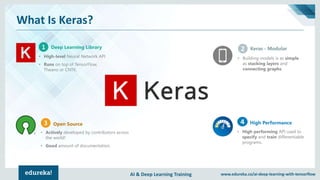
What Is Keras?
Keras - Modular
• Building models is as simple
as stacking layers and
connecting graphs.
Open Source
• Actively developed by contributors across
the world!
• Good amount of documentation
Deep Learning Library
• High-level Neural Network API
• Runs on top of TensorFlow,
Theano or CNTK.
High Performance
• High performing API used to
specify and train differentiable
programs.
AI & Deep Learning Training www.edureka.co/ai-deep-learning-with-tensorflow
Who Makes Keras?
Who are the contributors and backers?
Copyright © 2018, edureka and/or its affiliates. All rights reserved.
AI & Deep Learning Training www.edureka.co/ai-deep-learning-with-tensorflow
Who Makes Keras?
4800+ Contributors
250,000
Keras developers
> 2x
Year-on-year growth
Start-ups
Good amount of traction
AI & Deep Learning Training www.edureka.co/ai-deep-learning-with-tensorflow
Who Uses Keras?
Let’s check out the industry traction!
Copyright © 2018, edureka and/or its affiliates. All rights reserved.
AI & Deep Learning Training www.edureka.co/ai-deep-learning-with-tensorflow
Industry Traction
And more..!
AI & Deep Learning Training www.edureka.co/ai-deep-learning-with-tensorflow
What Makes Keras Special?
Highlights from one of the top Deep Learning libraries!
Copyright © 2018, edureka and/or its affiliates. All rights reserved.
AI & Deep Learning Training www.edureka.co/ai-deep-learning-with-tensorflow
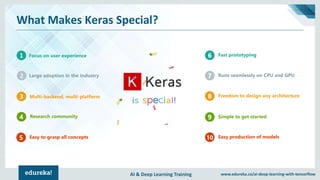
What Makes Keras Special?
Large adoption in the industry
Multi-backend, multi-platform
Focus on user experience
Research community4
Easy to grasp all concepts5
Fast prototyping6
Runs seamlessly on CPU and GPU7
Freedom to design any architecture8
Simple to get started9
Easy production of models10
AI & Deep Learning Training www.edureka.co/ai-deep-learning-with-tensorflow
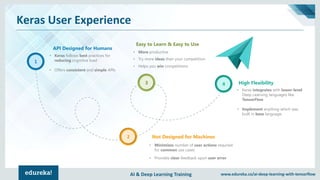
Keras User Experience
API Designed for Humans
• Keras follows best practices for
reducing cognitive load
• Offers consistent and simple APIs
Not Designed for Machines
• Minimizes number of user actions required
for common use cases
• Provides clear feedback upon user error
Easy to Learn & Easy to Use
• More productive
• Try more ideas than your competition
• Helps you win competitions
High Flexibility
• Keras integrates with lower-level
Deep Learning languages like
TensorFlow
• Implement anything which was
built in base language.
1
3
2
4
AI & Deep Learning Training www.edureka.co/ai-deep-learning-with-tensorflow
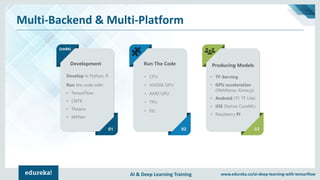
Multi-Backend & Multi-Platform
01 02 03
Development
Develop in Python, R
Run the code with:
• TensorFlow
• CNTK
• Theano
• MXNet
• CPU
• NVIDIA GPU
• AMD GPU
• TPU
• Etc..
Producing Models
• TF-Serving
• GPU acceleration
(WebKeras, Keras.js)
• Android (TF, TF Lite)
• iOS (Native CoreML)
• Raspberry Pi
{code}
Run The Code
AI & Deep Learning Training www.edureka.co/ai-deep-learning-with-tensorflow
Working Principle Of Keras
Let’s take a quick look at the basics of Keras’ backend
Copyright © 2018, edureka and/or its affiliates. All rights reserved.
AI & Deep Learning Training www.edureka.co/ai-deep-learning-with-tensorflow
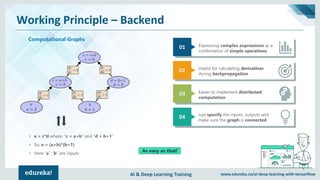
Working Principle – Backend
• e = c*d where, “c = a+b” and “d = b+1”
• So, e = (a+b)*(b+1)
• Here “a” ,“b” are inputs
01
02
03
04
Expressing complex expressions as a
combination of simple operations
Useful for calculating derivatives
during backpropagation
Easier to implement distributed
computation
Just specify the inputs, outputs and
make sure the graph is connected
Computational Graphs
As easy as that!
AI & Deep Learning Training www.edureka.co/ai-deep-learning-with-tensorflow
Keras Models
There are 2 major models that Keras offers!
Copyright © 2018, edureka and/or its affiliates. All rights reserved.
AI & Deep Learning Training www.edureka.co/ai-deep-learning-with-tensorflow
Keras Models
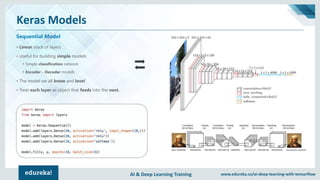
Sequential Model
• Linear stack of layers
• Useful for building simple models
• Simple classification network
• Encoder – Decoder models
• The model we all know and love!
• Treat each layer as object that feeds into the next.
AI & Deep Learning Training www.edureka.co/ai-deep-learning-with-tensorflow
Keras Models
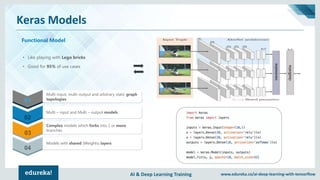
Functional Model
• Like playing with Lego bricks
• Good for 95% of use cases
Multi-input, multi-output and arbitrary static graph
topologies
Multi – input and Multi – output models
Complex models which forks into 2 or more
branches
Models with shared (Weights) layers
01
02
03
04
AI & Deep Learning Training www.edureka.co/ai-deep-learning-with-tensorflow
Keras Models
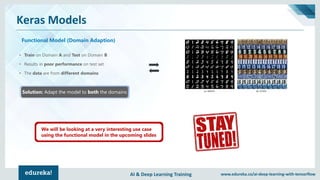
Functional Model (Domain Adaption)
• Train on Domain A and Test on Domain B
• Results in poor performance on test set
• The data are from different domains
We will be looking at a very interesting use case
using the functional model in the upcoming slides
Solution: Adapt the model to both the domains
AI & Deep Learning Training www.edureka.co/ai-deep-learning-with-tensorflow
Understanding Execution
There are 2 types of execution!
Copyright © 2018, edureka and/or its affiliates. All rights reserved.
AI & Deep Learning Training www.edureka.co/ai-deep-learning-with-tensorflow
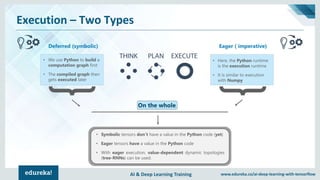
Execution – Two Types
Deferred (symbolic)
• We use Python to build a
computation graph first
• The compiled graph then
gets executed later
Eager ( imperative)
• Here, the Python runtime
is the execution runtime
• It is similar to execution
with Numpy
• Symbolic tensors don’t have a value in the Python code (yet)
• Eager tensors have a value in the Python code
• With eager execution, value-dependent dynamic topologies
(tree-RNNs) can be used.
On the whole
AI & Deep Learning Training www.edureka.co/ai-deep-learning-with-tensorflow
Implementing a Neural Network
There are 5 major steps to implement our own Neural Network with Keras!
Copyright © 2018, edureka and/or its affiliates. All rights reserved.
AI & Deep Learning Training www.edureka.co/ai-deep-learning-with-tensorflow
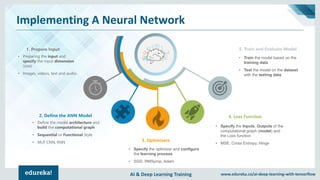
Implementing A Neural Network
1. Prepare Input
• Preparing the input and
specify the input dimension
(size)
• Images, videos, text and audio
2. Define the ANN Model
• Define the model architecture and
build the computational graph
• Sequential or Functional Style
• MLP, CNN, RNN 3. Optimizers
• Specify the optimizer and configure
the learning process
• SGD, RMSprop, Adam
5. Train and Evaluate Model
• Train the model based on the
training data
• Test the model on the dataset
with the testing data
4. Loss Function
• Specify the Inputs, Outputs of the
computational graph (model) and
the Loss function
• MSE, Cross Entropy, Hinge
AI & Deep Learning Training www.edureka.co/ai-deep-learning-with-tensorflow
Use-Case With Keras
Let’s check out an interesting Wine Classifier use-case!
Copyright © 2018, edureka and/or its affiliates. All rights reserved.
AI & Deep Learning Training www.edureka.co/ai-deep-learning-with-tensorflow
Use Case – Problem Statement
“Predicting the price of wine with the Keras Functional API and TensorFlow”
Building a wide and deep network using Keras (tf.Keras)
to predict the price of wine from its description
Predict the price of a bottle of wine
just from its description and variety?
• This problem is well suited for wide & deep learning
• It involves text input and there isn’t any correlation
between a wine’s description and its price
AI & Deep Learning Training www.edureka.co/ai-deep-learning-with-tensorflow
Use Case – Model
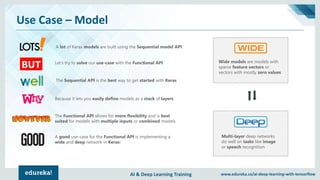
A good use-case for the Functional API is implementing a
wide and deep network in Keras!
A lot of Keras models are built using the Sequential model API
BUT Let’s try to solve our use-case with the Functional API
The Sequential API is the best way to get started with Keras
Because it lets you easily define models as a stack of layers
The Functional API allows for more flexibility and is best
suited for models with multiple inputs or combined models
Wide models are models with
sparse feature vectors or
vectors with mostly zero values
Multi-layer deep networks
do well on tasks like image
or speech recognition
AI & Deep Learning Training www.edureka.co/ai-deep-learning-with-tensorflow
Use Case – Dataset
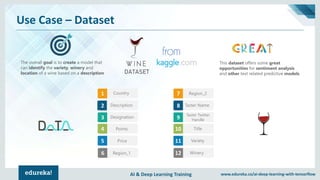
DATASET
Country1
2 Description
3 Designation
4 Points
5 Price
6 Region_1
Region_27
8 Taster Name
9
Taster Twitter
Handle
10 Title
Variety11
Winery12
The overall goal is to create a model that
can identify the variety, winery and
location of a wine based on a description
This dataset offers some great
opportunities for sentiment analysis
and other text related predictive models
AI & Deep Learning Training www.edureka.co/ai-deep-learning-with-tensorflow
Use Case – Sample
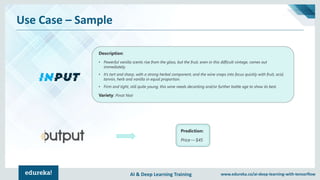
Description:
• Powerful vanilla scents rise from the glass, but the fruit, even in this difficult vintage, comes out
immediately.
• It’s tart and sharp, with a strong herbal component, and the wine snaps into focus quickly with fruit, acid,
tannin, herb and vanilla in equal proportion.
• Firm and tight, still quite young, this wine needs decanting and/or further bottle age to show its best.
Variety: Pinot Noir
Prediction:
Price — $45
AI & Deep Learning Training www.edureka.co/ai-deep-learning-with-tensorflow
Use Case – Prerequisites
AI & Deep Learning Training www.edureka.co/ai-deep-learning-with-tensorflow
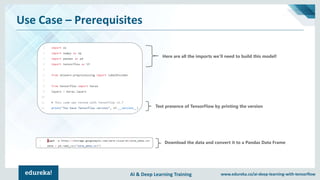
Use Case – Prerequisites
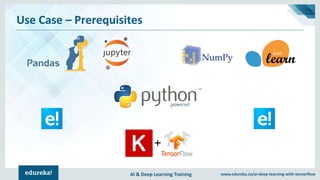
Here are all the imports we’ll need to build this model!
Test presence of TensorFlow by printing the version
Download the data and convert it to a Pandas Data Frame
AI & Deep Learning Training www.edureka.co/ai-deep-learning-with-tensorflow
Use Case – Let’s See Code!
Google Colaboratory
AI & Deep Learning Training www.edureka.co/ai-deep-learning-with-tensorflow
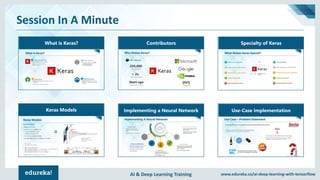
Session In A Minute
What is Keras? Contributors Specialty of Keras
Implementing a Neural Network Use-Case ImplementationKeras Models
Copyright © 2018, edureka and/or its affiliates. All rights reserved.
Keras Tutorial For Beginners | Creating Deep Learning Models Using Keras In Python | Edureka

Keras Tutorial For Beginners | Creating Deep Learning Models Using Keras In Python | Edureka

  • 1.
    AI & DeepLearning Training www.edureka.co/ai-deep-learning-with-tensorflow
  • 2.
    AI & DeepLearning Training www.edureka.co/ai-deep-learning-with-tensorflow Agenda What is Keras? Contributors for Keras Keras Models Implementing a Neural Network Use-Case Summary
  • 3.
    Copyright © 2017,edureka and/or its affiliates. All rights reserved. What Is Keras? Official high-level API of TensorFlow! Copyright © 2018, edureka and/or its affiliates. All rights reserved.
  • 4.
    AI & DeepLearning Training www.edureka.co/ai-deep-learning-with-tensorflow What Is Keras? Keras - Modular • Building models is as simple as stacking layers and connecting graphs. Open Source • Actively developed by contributors across the world! • Good amount of documentation Deep Learning Library • High-level Neural Network API • Runs on top of TensorFlow, Theano or CNTK. High Performance • High performing API used to specify and train differentiable programs.
  • 5.
    AI & DeepLearning Training www.edureka.co/ai-deep-learning-with-tensorflow Who Makes Keras? Who are the contributors and backers? Copyright © 2018, edureka and/or its affiliates. All rights reserved.
  • 6.
    AI & DeepLearning Training www.edureka.co/ai-deep-learning-with-tensorflow Who Makes Keras? 4800+ Contributors 250,000 Keras developers > 2x Year-on-year growth Start-ups Good amount of traction
  • 7.
    AI & DeepLearning Training www.edureka.co/ai-deep-learning-with-tensorflow Who Uses Keras? Let’s check out the industry traction! Copyright © 2018, edureka and/or its affiliates. All rights reserved.
  • 8.
    AI & DeepLearning Training www.edureka.co/ai-deep-learning-with-tensorflow Industry Traction And more..!
  • 9.
    AI & DeepLearning Training www.edureka.co/ai-deep-learning-with-tensorflow What Makes Keras Special? Highlights from one of the top Deep Learning libraries! Copyright © 2018, edureka and/or its affiliates. All rights reserved.
  • 10.
    AI & DeepLearning Training www.edureka.co/ai-deep-learning-with-tensorflow What Makes Keras Special? Large adoption in the industry Multi-backend, multi-platform Focus on user experience Research community4 Easy to grasp all concepts5 Fast prototyping6 Runs seamlessly on CPU and GPU7 Freedom to design any architecture8 Simple to get started9 Easy production of models10
  • 11.
    AI & DeepLearning Training www.edureka.co/ai-deep-learning-with-tensorflow Keras User Experience API Designed for Humans • Keras follows best practices for reducing cognitive load • Offers consistent and simple APIs Not Designed for Machines • Minimizes number of user actions required for common use cases • Provides clear feedback upon user error Easy to Learn & Easy to Use • More productive • Try more ideas than your competition • Helps you win competitions High Flexibility • Keras integrates with lower-level Deep Learning languages like TensorFlow • Implement anything which was built in base language. 1 3 2 4
  • 12.
    AI & DeepLearning Training www.edureka.co/ai-deep-learning-with-tensorflow Multi-Backend & Multi-Platform 01 02 03 Development Develop in Python, R Run the code with: • TensorFlow • CNTK • Theano • MXNet • CPU • NVIDIA GPU • AMD GPU • TPU • Etc.. Producing Models • TF-Serving • GPU acceleration (WebKeras, Keras.js) • Android (TF, TF Lite) • iOS (Native CoreML) • Raspberry Pi {code} Run The Code
  • 13.
    AI & DeepLearning Training www.edureka.co/ai-deep-learning-with-tensorflow Working Principle Of Keras Let’s take a quick look at the basics of Keras’ backend Copyright © 2018, edureka and/or its affiliates. All rights reserved.
  • 14.
    AI & DeepLearning Training www.edureka.co/ai-deep-learning-with-tensorflow Working Principle – Backend • e = c*d where, “c = a+b” and “d = b+1” • So, e = (a+b)*(b+1) • Here “a” ,“b” are inputs 01 02 03 04 Expressing complex expressions as a combination of simple operations Useful for calculating derivatives during backpropagation Easier to implement distributed computation Just specify the inputs, outputs and make sure the graph is connected Computational Graphs As easy as that!
  • 15.
    AI & DeepLearning Training www.edureka.co/ai-deep-learning-with-tensorflow Keras Models There are 2 major models that Keras offers! Copyright © 2018, edureka and/or its affiliates. All rights reserved.
  • 16.
    AI & DeepLearning Training www.edureka.co/ai-deep-learning-with-tensorflow Keras Models Sequential Model • Linear stack of layers • Useful for building simple models • Simple classification network • Encoder – Decoder models • The model we all know and love! • Treat each layer as object that feeds into the next.
  • 17.
    AI & DeepLearning Training www.edureka.co/ai-deep-learning-with-tensorflow Keras Models Functional Model • Like playing with Lego bricks • Good for 95% of use cases Multi-input, multi-output and arbitrary static graph topologies Multi – input and Multi – output models Complex models which forks into 2 or more branches Models with shared (Weights) layers 01 02 03 04
  • 18.
    AI & DeepLearning Training www.edureka.co/ai-deep-learning-with-tensorflow Keras Models Functional Model (Domain Adaption) • Train on Domain A and Test on Domain B • Results in poor performance on test set • The data are from different domains We will be looking at a very interesting use case using the functional model in the upcoming slides Solution: Adapt the model to both the domains
  • 19.
    AI & DeepLearning Training www.edureka.co/ai-deep-learning-with-tensorflow Understanding Execution There are 2 types of execution! Copyright © 2018, edureka and/or its affiliates. All rights reserved.
  • 20.
    AI & DeepLearning Training www.edureka.co/ai-deep-learning-with-tensorflow Execution – Two Types Deferred (symbolic) • We use Python to build a computation graph first • The compiled graph then gets executed later Eager ( imperative) • Here, the Python runtime is the execution runtime • It is similar to execution with Numpy • Symbolic tensors don’t have a value in the Python code (yet) • Eager tensors have a value in the Python code • With eager execution, value-dependent dynamic topologies (tree-RNNs) can be used. On the whole
  • 21.
    AI & DeepLearning Training www.edureka.co/ai-deep-learning-with-tensorflow Implementing a Neural Network There are 5 major steps to implement our own Neural Network with Keras! Copyright © 2018, edureka and/or its affiliates. All rights reserved.
  • 22.
    AI & DeepLearning Training www.edureka.co/ai-deep-learning-with-tensorflow Implementing A Neural Network 1. Prepare Input • Preparing the input and specify the input dimension (size) • Images, videos, text and audio 2. Define the ANN Model • Define the model architecture and build the computational graph • Sequential or Functional Style • MLP, CNN, RNN 3. Optimizers • Specify the optimizer and configure the learning process • SGD, RMSprop, Adam 5. Train and Evaluate Model • Train the model based on the training data • Test the model on the dataset with the testing data 4. Loss Function • Specify the Inputs, Outputs of the computational graph (model) and the Loss function • MSE, Cross Entropy, Hinge
  • 23.
    AI & DeepLearning Training www.edureka.co/ai-deep-learning-with-tensorflow Use-Case With Keras Let’s check out an interesting Wine Classifier use-case! Copyright © 2018, edureka and/or its affiliates. All rights reserved.
  • 24.
    AI & DeepLearning Training www.edureka.co/ai-deep-learning-with-tensorflow Use Case – Problem Statement “Predicting the price of wine with the Keras Functional API and TensorFlow” Building a wide and deep network using Keras (tf.Keras) to predict the price of wine from its description Predict the price of a bottle of wine just from its description and variety? • This problem is well suited for wide & deep learning • It involves text input and there isn’t any correlation between a wine’s description and its price
  • 25.
    AI & DeepLearning Training www.edureka.co/ai-deep-learning-with-tensorflow Use Case – Model A good use-case for the Functional API is implementing a wide and deep network in Keras! A lot of Keras models are built using the Sequential model API BUT Let’s try to solve our use-case with the Functional API The Sequential API is the best way to get started with Keras Because it lets you easily define models as a stack of layers The Functional API allows for more flexibility and is best suited for models with multiple inputs or combined models Wide models are models with sparse feature vectors or vectors with mostly zero values Multi-layer deep networks do well on tasks like image or speech recognition
  • 26.
    AI & DeepLearning Training www.edureka.co/ai-deep-learning-with-tensorflow Use Case – Dataset DATASET Country1 2 Description 3 Designation 4 Points 5 Price 6 Region_1 Region_27 8 Taster Name 9 Taster Twitter Handle 10 Title Variety11 Winery12 The overall goal is to create a model that can identify the variety, winery and location of a wine based on a description This dataset offers some great opportunities for sentiment analysis and other text related predictive models
  • 27.
    AI & DeepLearning Training www.edureka.co/ai-deep-learning-with-tensorflow Use Case – Sample Description: • Powerful vanilla scents rise from the glass, but the fruit, even in this difficult vintage, comes out immediately. • It’s tart and sharp, with a strong herbal component, and the wine snaps into focus quickly with fruit, acid, tannin, herb and vanilla in equal proportion. • Firm and tight, still quite young, this wine needs decanting and/or further bottle age to show its best. Variety: Pinot Noir Prediction: Price — $45
  • 28.
    AI & DeepLearning Training www.edureka.co/ai-deep-learning-with-tensorflow Use Case – Prerequisites
  • 29.
    AI & DeepLearning Training www.edureka.co/ai-deep-learning-with-tensorflow Use Case – Prerequisites Here are all the imports we’ll need to build this model! Test presence of TensorFlow by printing the version Download the data and convert it to a Pandas Data Frame
  • 30.
    AI & DeepLearning Training www.edureka.co/ai-deep-learning-with-tensorflow Use Case – Let’s See Code! Google Colaboratory
  • 31.
    AI & DeepLearning Training www.edureka.co/ai-deep-learning-with-tensorflow Session In A Minute What is Keras? Contributors Specialty of Keras Implementing a Neural Network Use-Case ImplementationKeras Models
  • 32.
    Copyright © 2018,edureka and/or its affiliates. All rights reserved.