Ahsan J. Awan (KTH)
Near Data Computing Architectures:
Opportunities and Challenges for
Apache Spark
#EUres10
1
2#EUres10
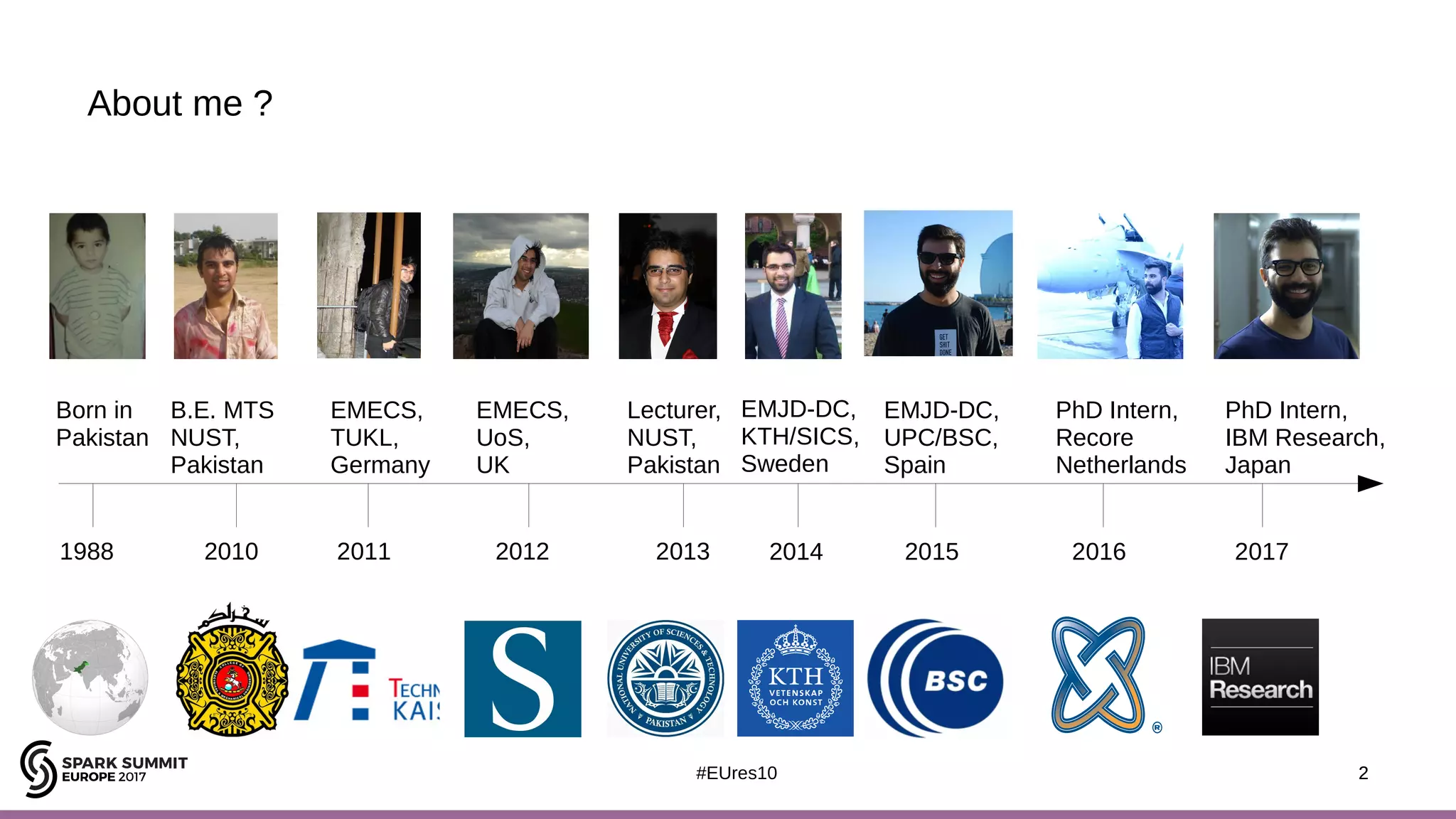
About me ?
2
1988 20112010 20132012 2014 2015 2016 2017
B.E. MTS
NUST,
Pakistan
EMECS,
TUKL,
Germany
EMECS,
UoS,
UK
Lecturer,
NUST,
Pakistan
EMJD-DC,
KTH/SICS,
Sweden
PhD Intern,
Recore
Netherlands
EMJD-DC,
UPC/BSC,
Spain
PhD Intern,
IBM Research,
Japan
Born in
Pakistan
3#EUres10
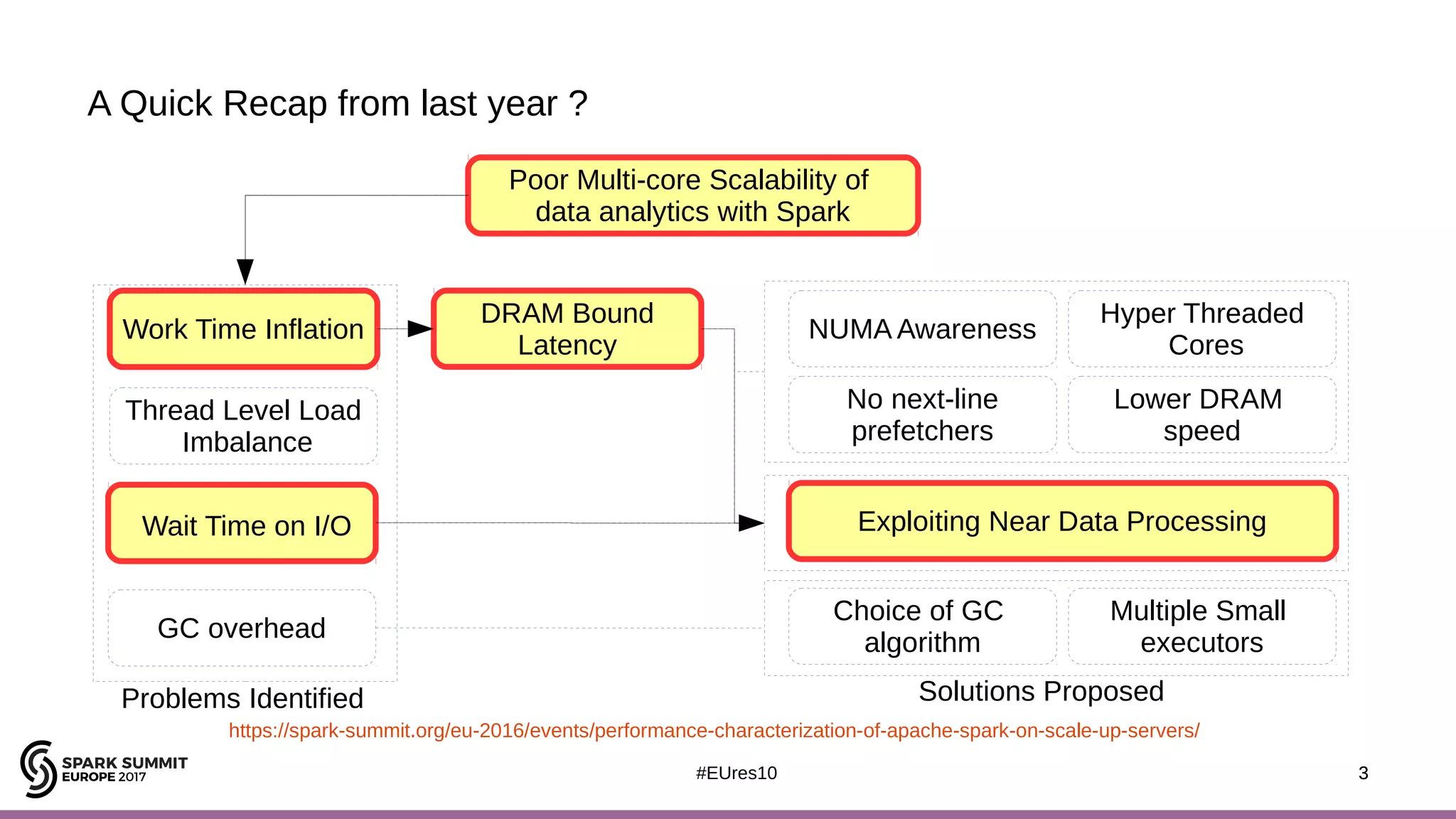
A Quick Recap from last year ?
3
Problems Identified Solutions Proposed
https://spark-summit.org/eu-2016/events/performance-characterization-of-apache-spark-on-scale-up-servers/
Work Time Inflation
Poor Multi-core Scalability of
data analytics with Spark
Thread Level Load
Imbalance
Wait Time on I/O
GC overhead
DRAM Bound
Latency
NUMA Awareness
Hyper Threaded
Cores
No next-line
prefetchers
Lower DRAM
speed
Exploiting Near Data Processing
Choice of GC
algorithm
Multiple Small
executors
4#EUres10
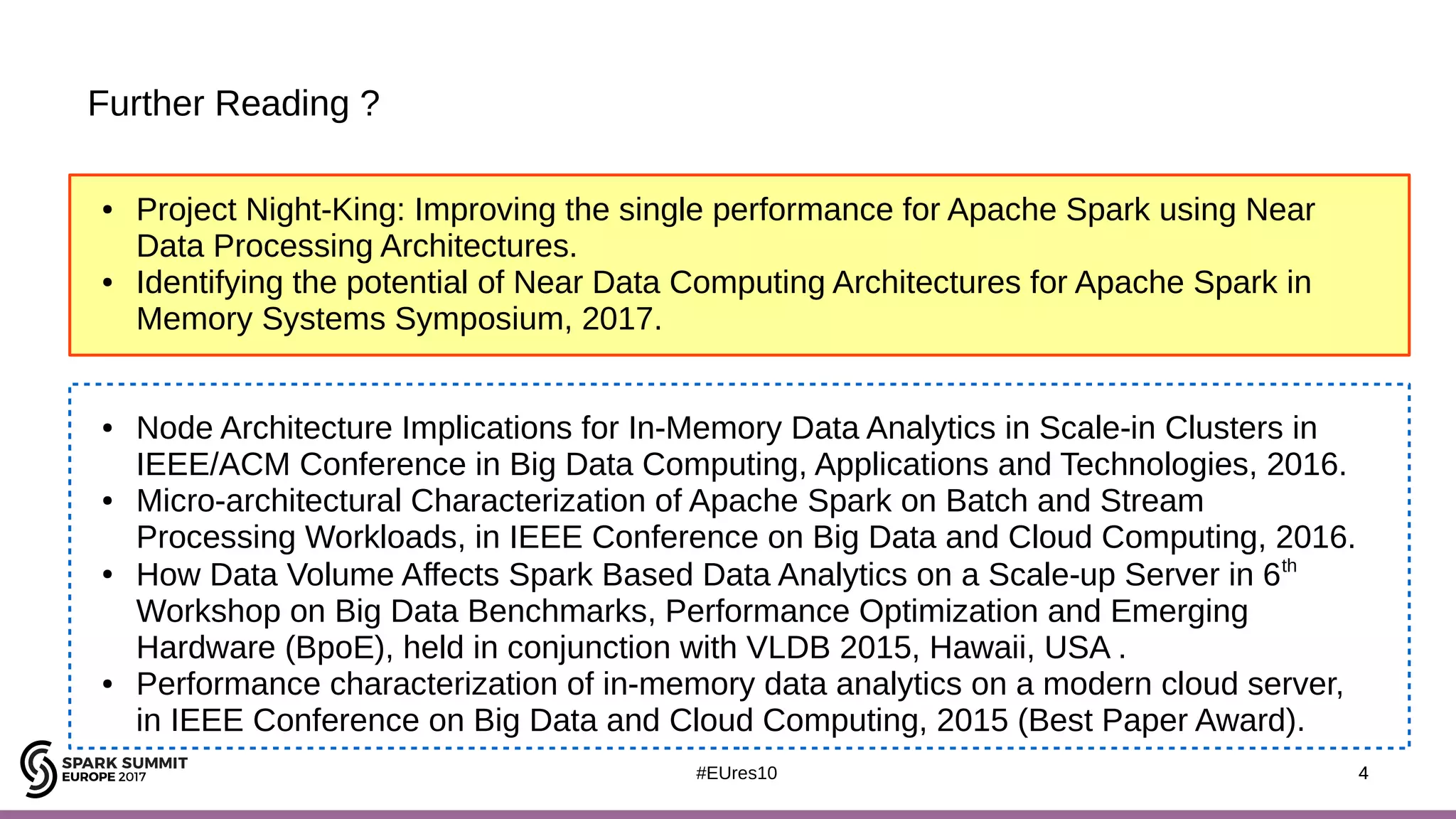
Further Reading ?
4
● Project Night-King: Improving the single performance for Apache Spark using Near
Data Processing Architectures.
● Identifying the potential of Near Data Computing Architectures for Apache Spark in
Memory Systems Symposium, 2017.
● Node Architecture Implications for In-Memory Data Analytics in Scale-in Clusters in
IEEE/ACM Conference in Big Data Computing, Applications and Technologies, 2016.
● Micro-architectural Characterization of Apache Spark on Batch and Stream
Processing Workloads, in IEEE Conference on Big Data and Cloud Computing, 2016.
●
How Data Volume Affects Spark Based Data Analytics on a Scale-up Server in 6th
Workshop on Big Data Benchmarks, Performance Optimization and Emerging
Hardware (BpoE), held in conjunction with VLDB 2015, Hawaii, USA .
● Performance characterization of in-memory data analytics on a modern cloud server,
in IEEE Conference on Big Data and Cloud Computing, 2015 (Best Paper Award).
5#EUres10
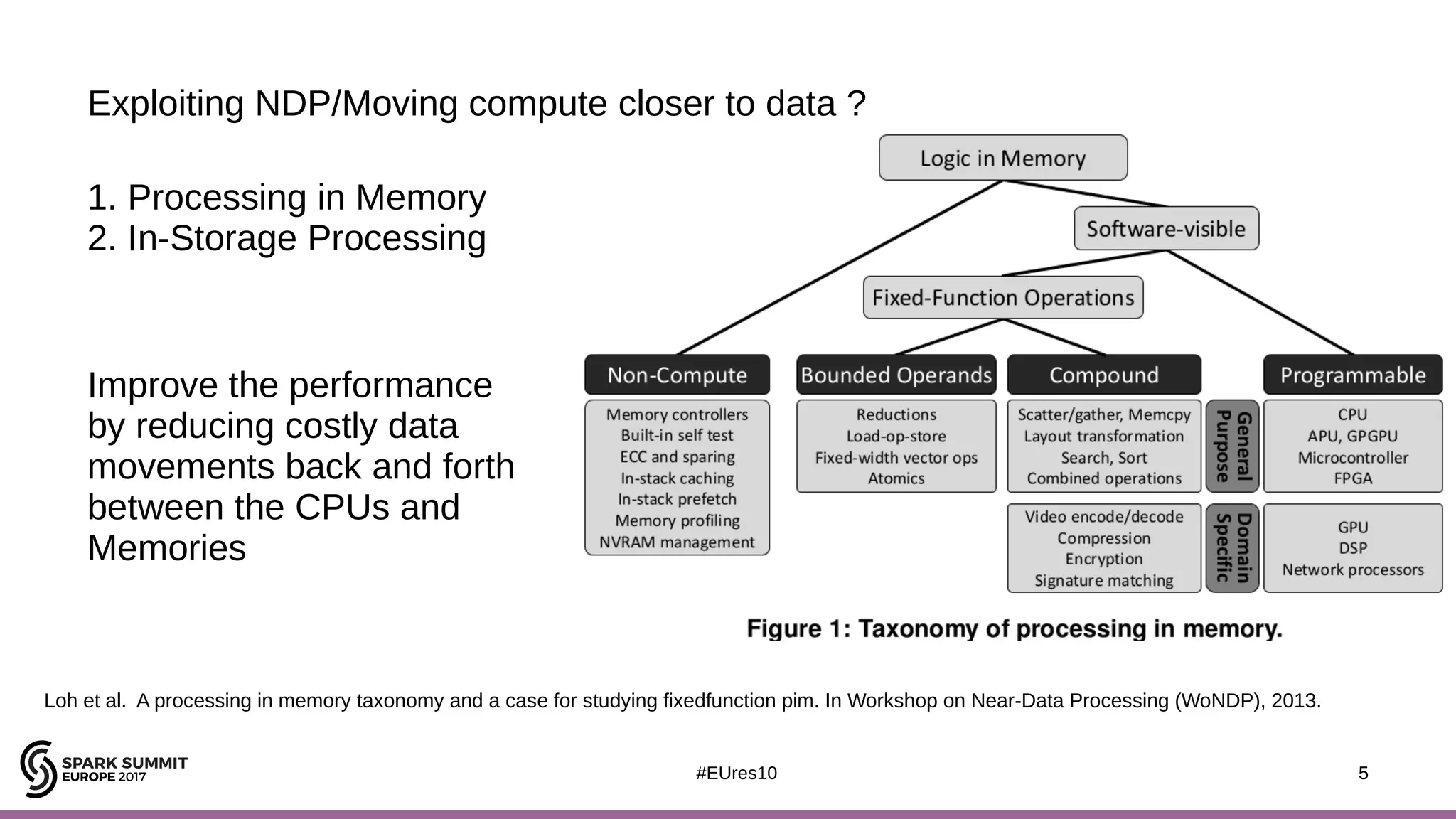
Exploiting NDP/Moving compute closer to data ?
5
Loh et al. A processing in memory taxonomy and a case for studying fixedfunction pim. In Workshop on Near-Data Processing (WoNDP), 2013.
1. Processing in Memory
2. In-Storage Processing
Improve the performance
by reducing costly data
movements back and forth
between the CPUs and
Memories
6#EUres10
Trends of Integrating NVM in the System Architecture ?
6
Chang et al. A limits study of benefits from nanostore-based future data-centric system architectures. In Computing Frontiers 2012
7#EUres10
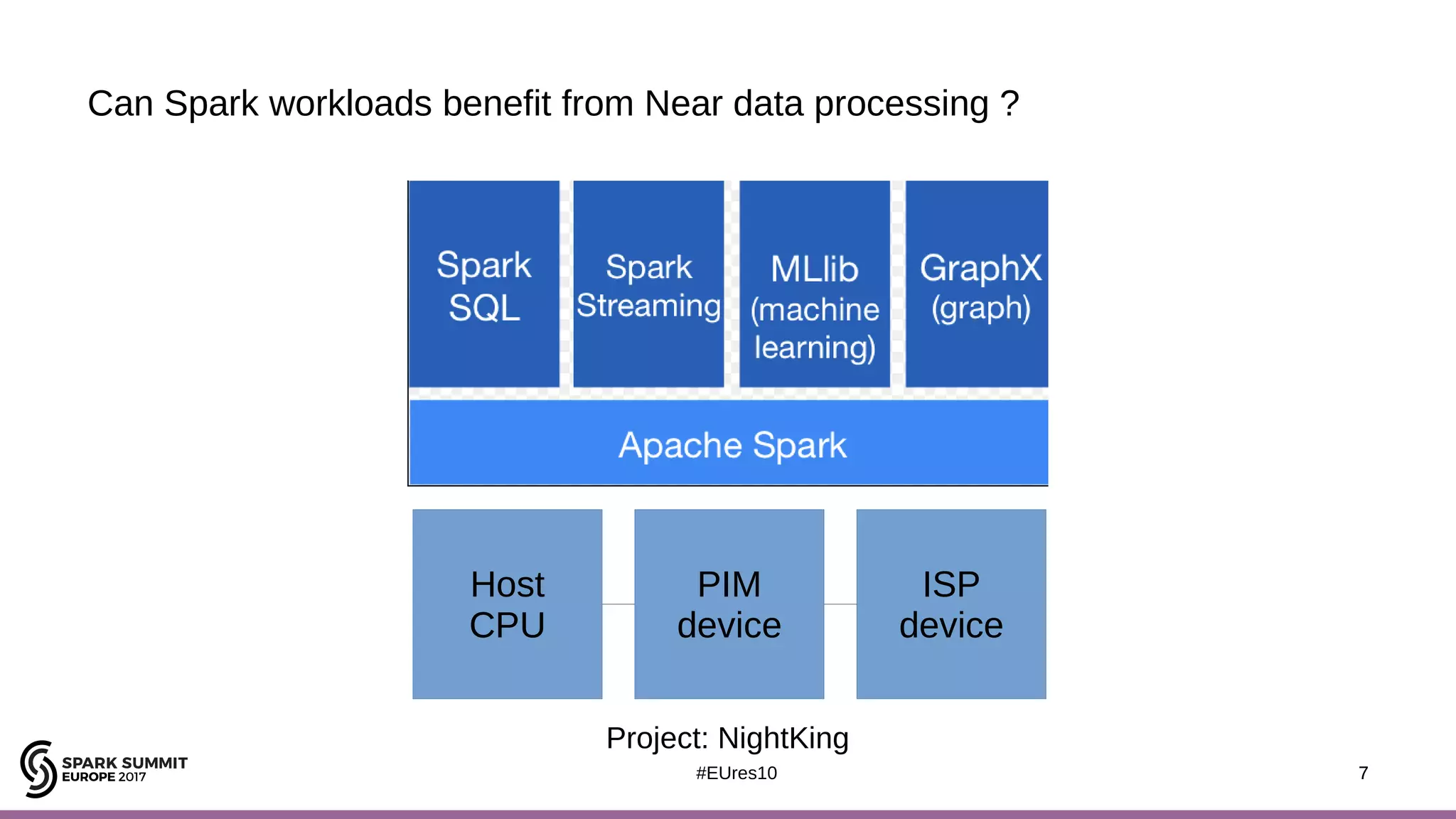
Can Spark workloads benefit from Near data processing ?
7
Host
CPU
PIM
device
ISP
device
Project: NightKing
8#EUres10
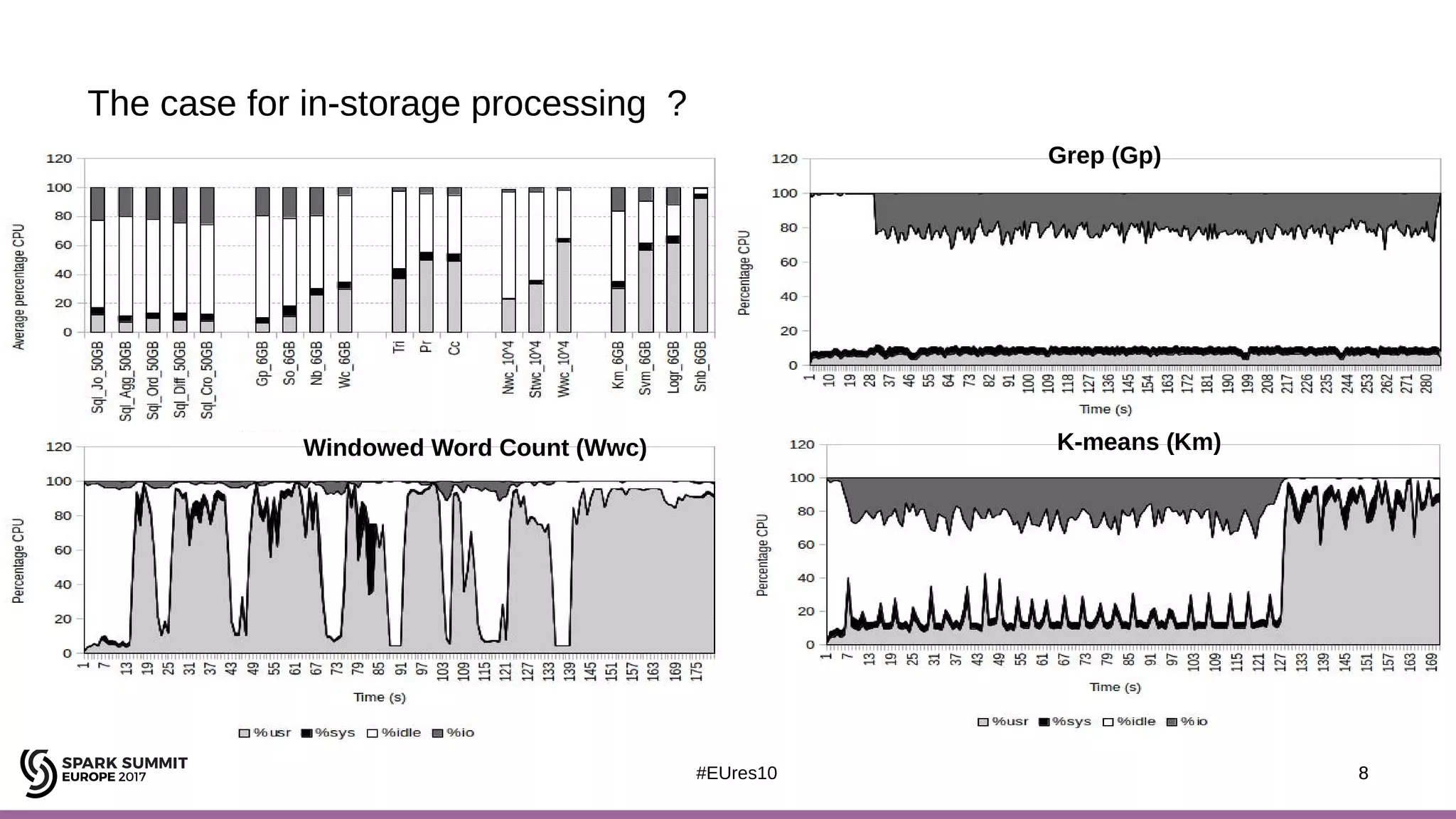
The case for in-storage processing ?
8
Grep (Gp)
K-means (Km)Windowed Word Count (Wwc)
9#EUres10
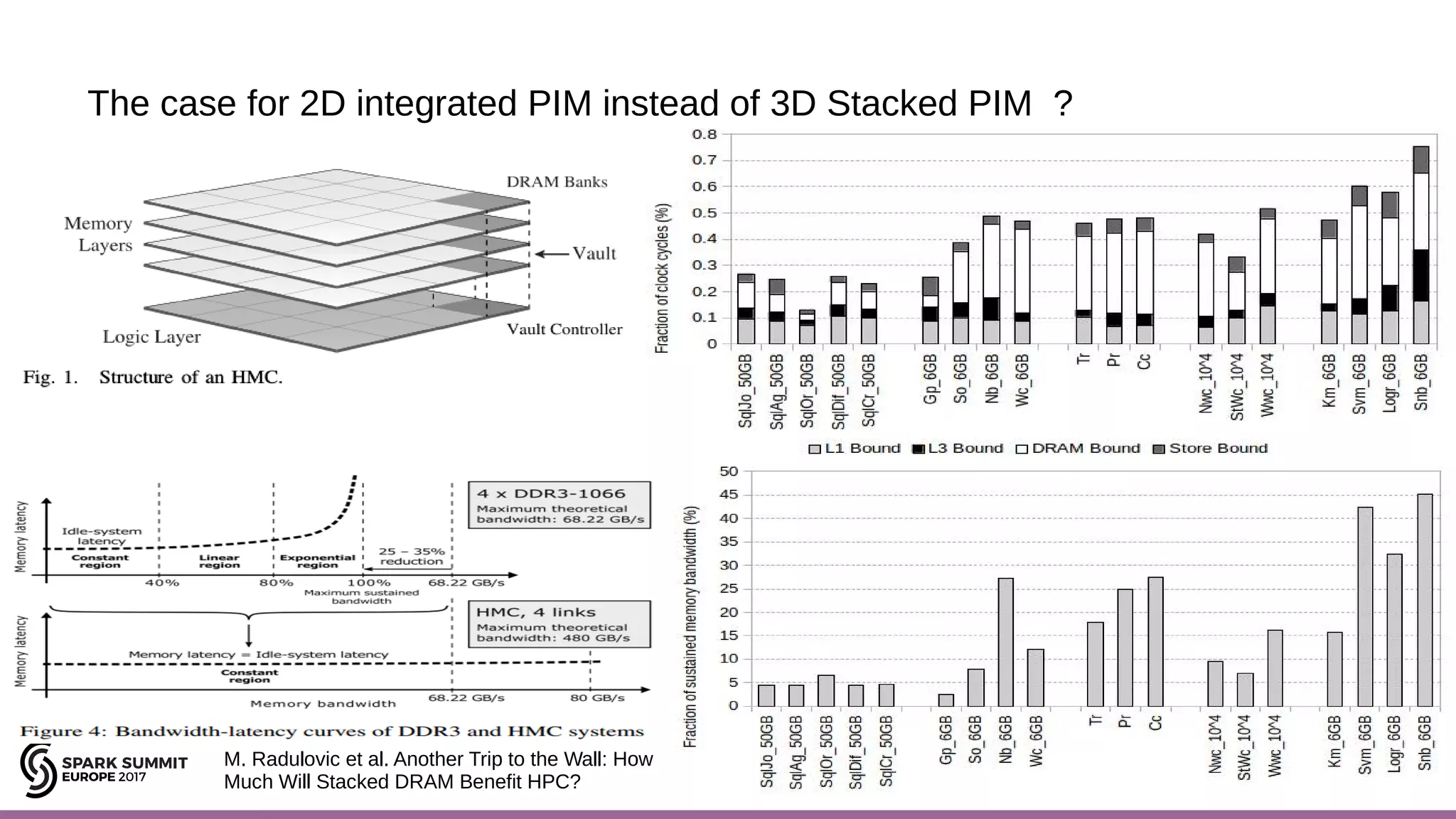
The case for 2D integrated PIM instead of 3D Stacked PIM ?
9
M. Radulovic et al. Another Trip to the Wall: How
Much Will Stacked DRAM Benefit HPC?
10#EUres10
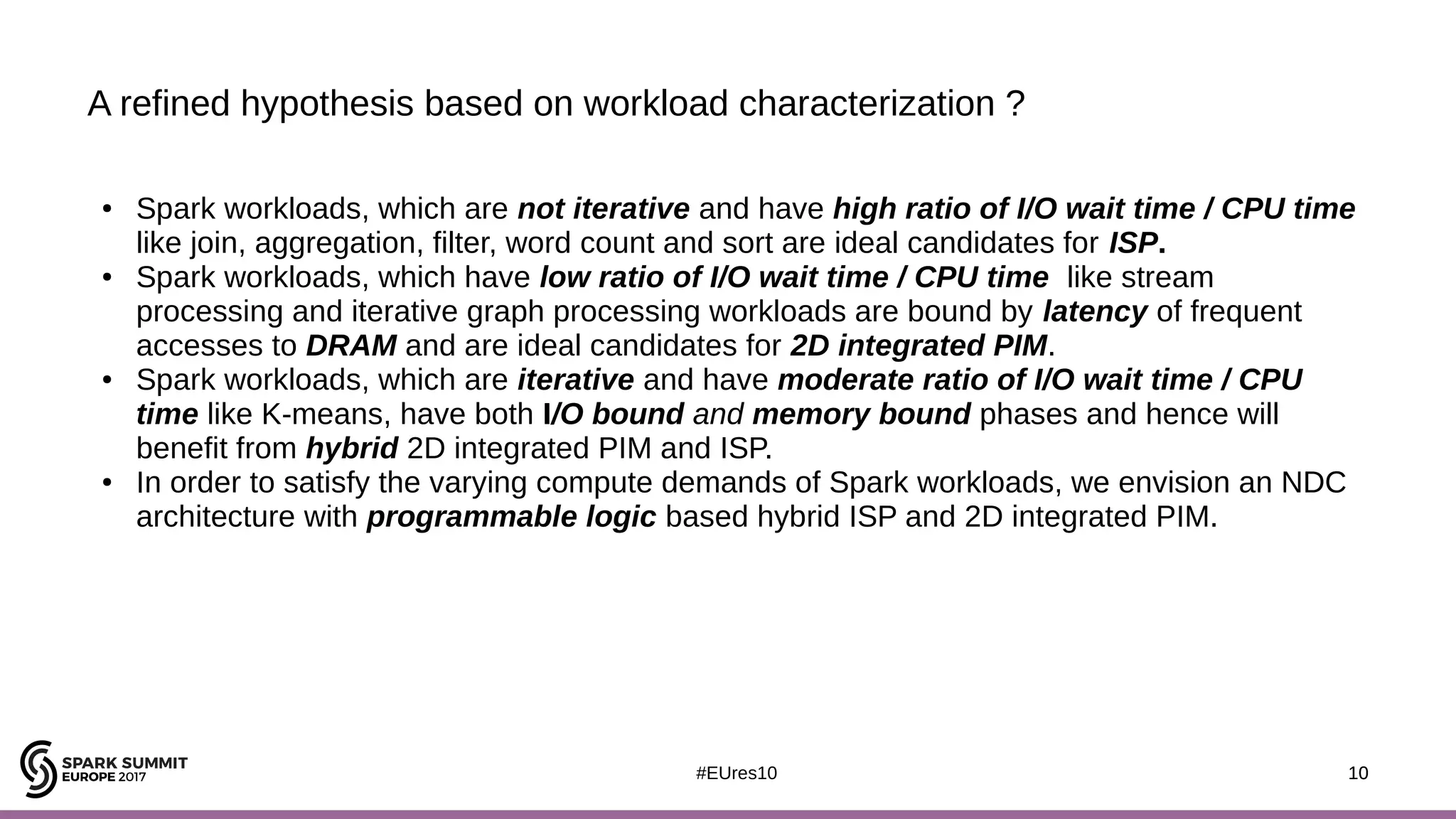
A refined hypothesis based on workload characterization ?
10
● Spark workloads, which are not iterative and have high ratio of I/O wait time / CPU time
like join, aggregation, filter, word count and sort are ideal candidates for ISP.
● Spark workloads, which have low ratio of I/O wait time / CPU time like stream
processing and iterative graph processing workloads are bound by latency of frequent
accesses to DRAM and are ideal candidates for 2D integrated PIM.
● Spark workloads, which are iterative and have moderate ratio of I/O wait time / CPU
time like K-means, have both I/O bound and memory bound phases and hence will
benefit from hybrid 2D integrated PIM and ISP.
● In order to satisfy the varying compute demands of Spark workloads, we envision an NDC
architecture with programmable logic based hybrid ISP and 2D integrated PIM.
11#EUres10
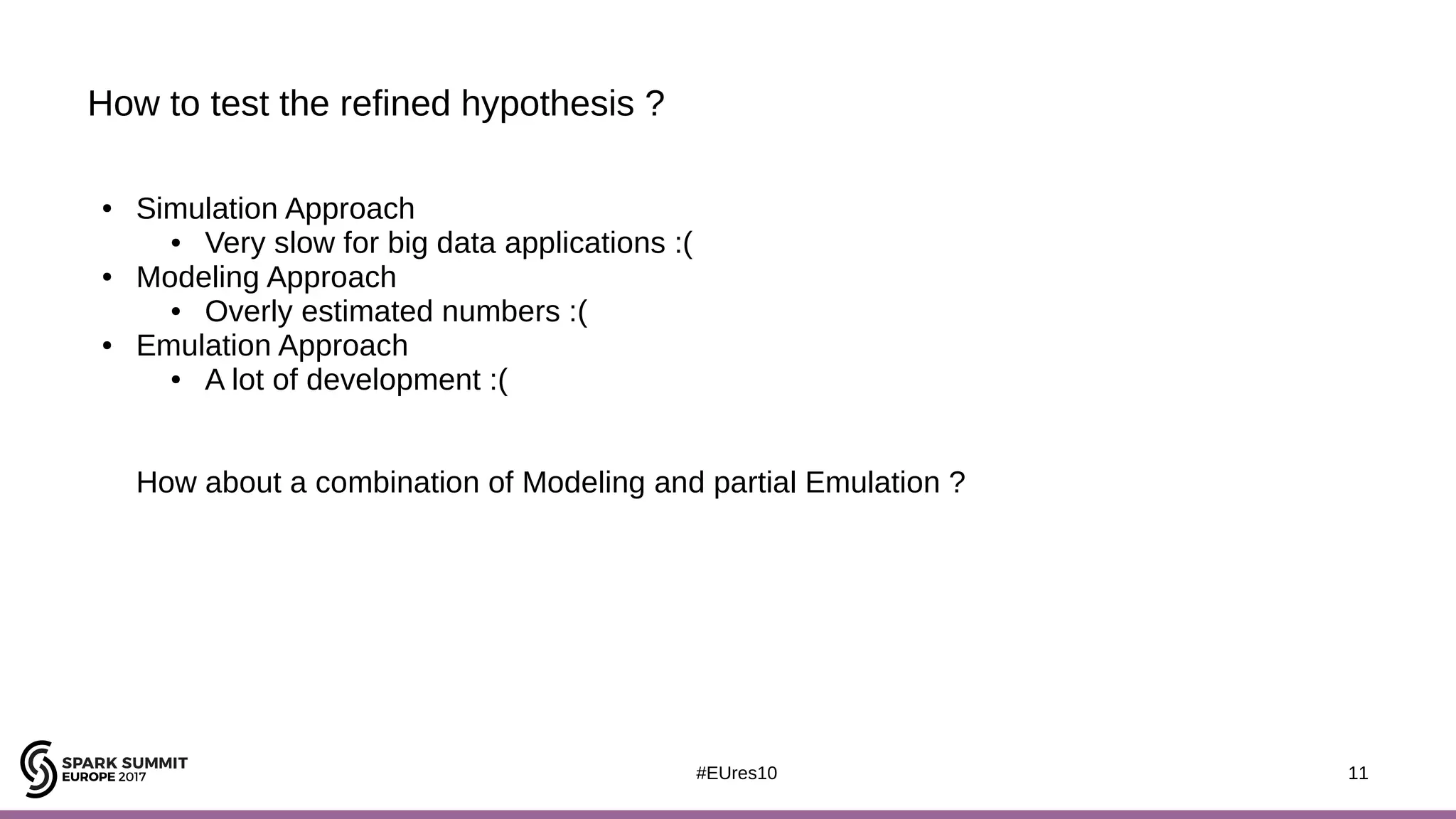
How to test the refined hypothesis ?
11
● Simulation Approach
● Very slow for big data applications :(
● Modeling Approach
● Overly estimated numbers :(
● Emulation Approach
● A lot of development :(
How about a combination of Modeling and partial Emulation ?
12#EUres10
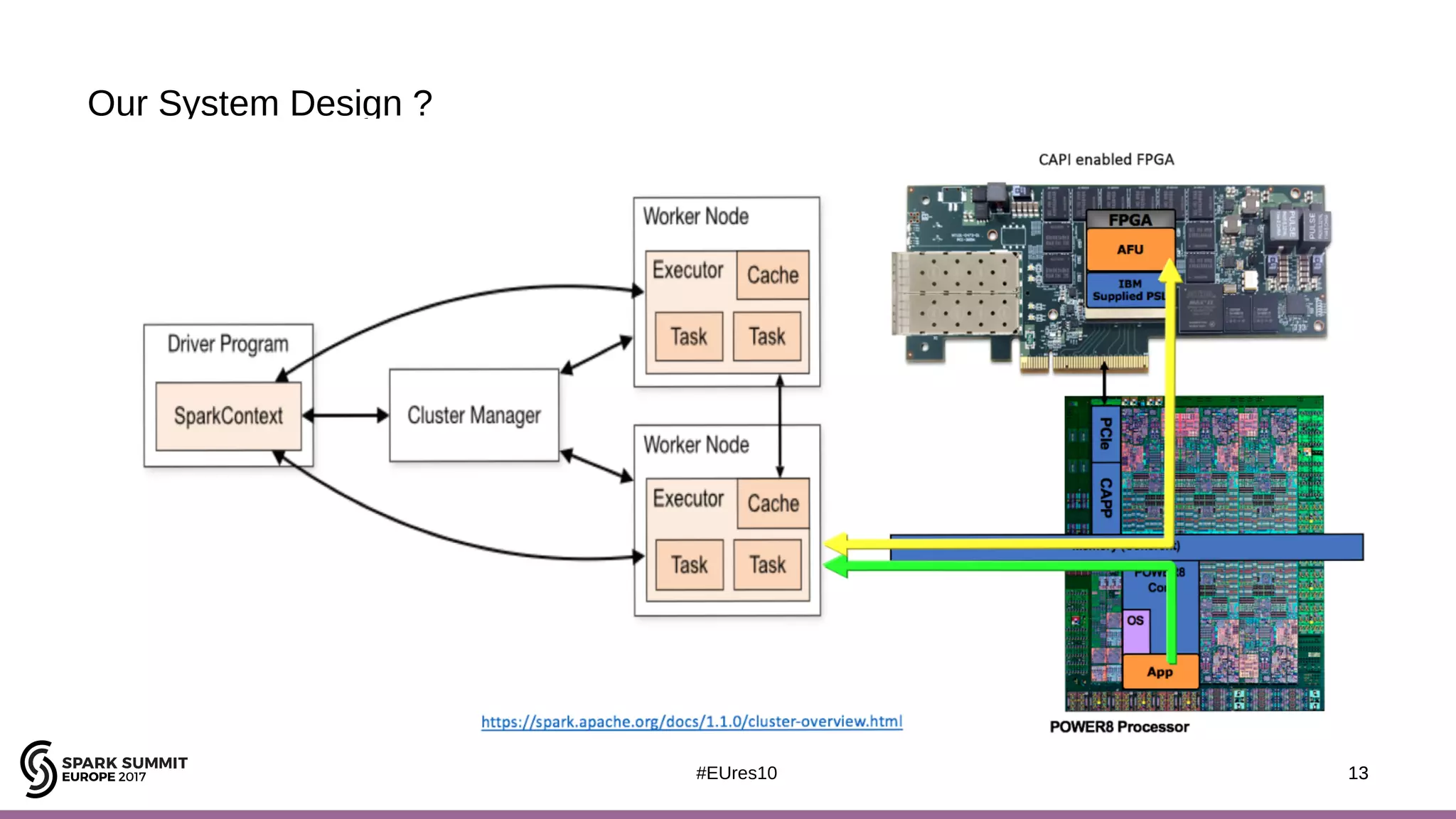
Can existing tightly coupled servers be used as emulators ?
12
13#EUres10
Our System Design ?
13
14#EUres10
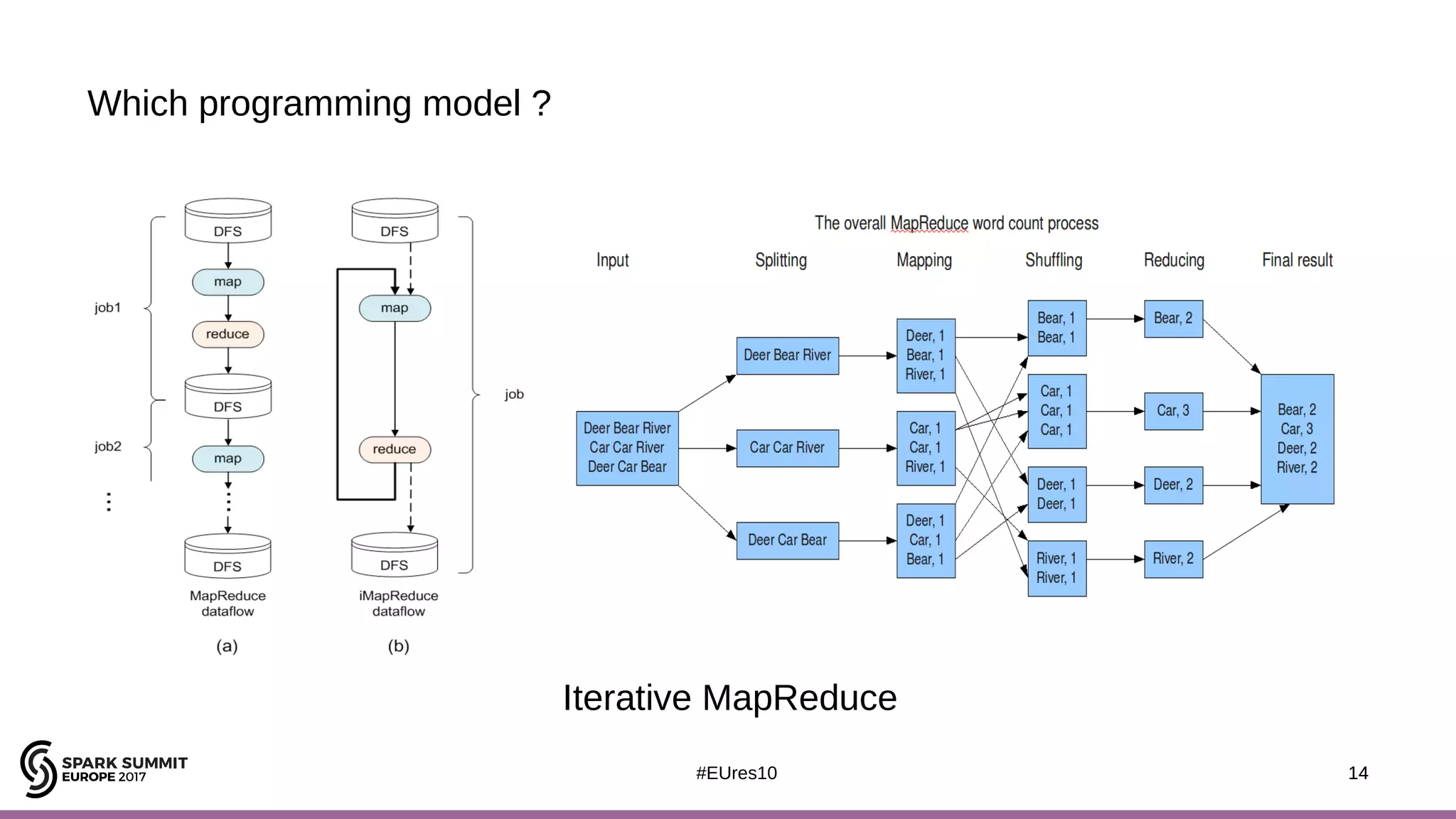
Which programming model ?
14
Iterative MapReduce
15#EUres10
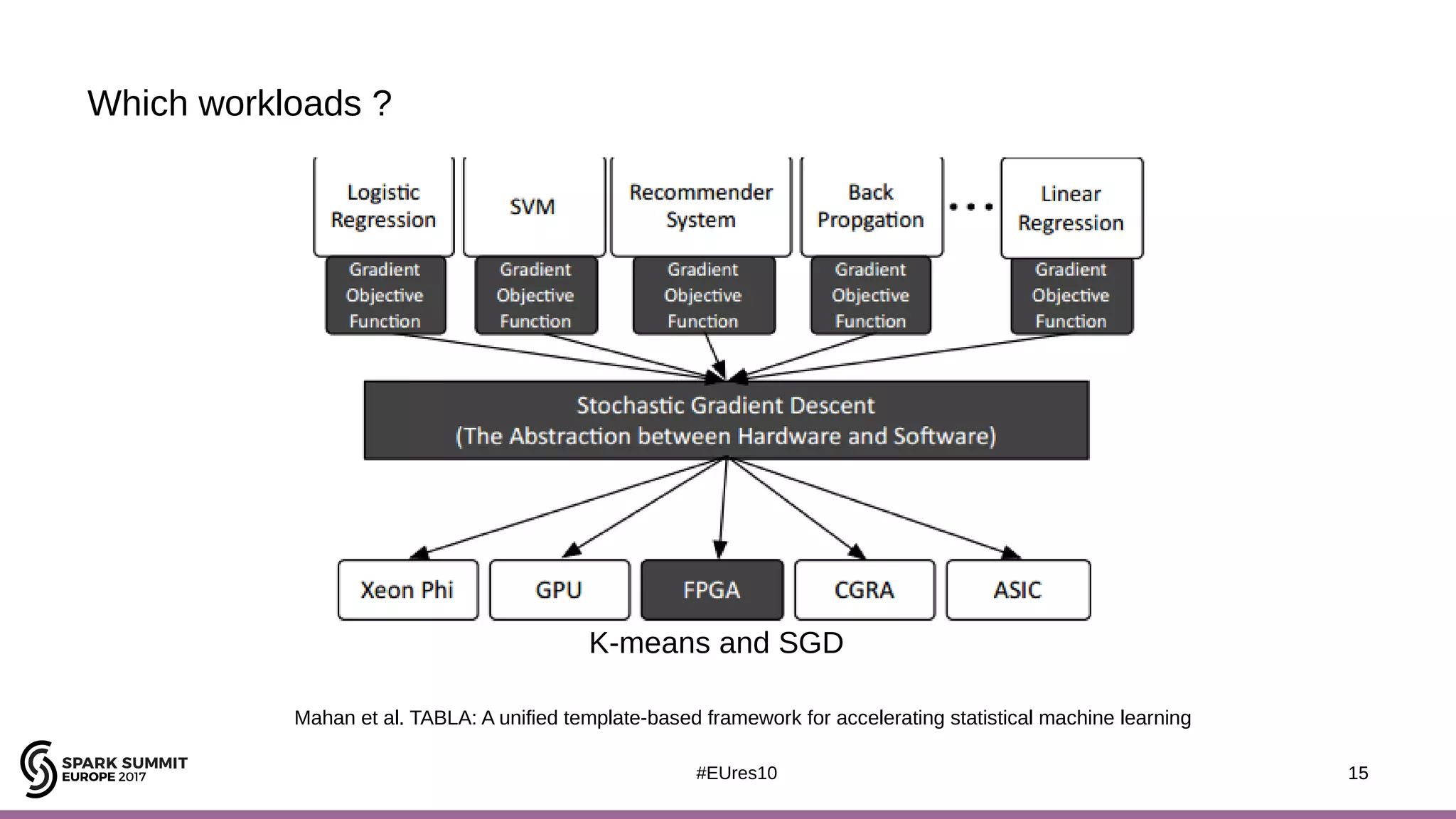
Which workloads ?
15
K-means and SGD
Mahan et al. TABLA: A unified template-based framework for accelerating statistical machine learning
16#EUres10
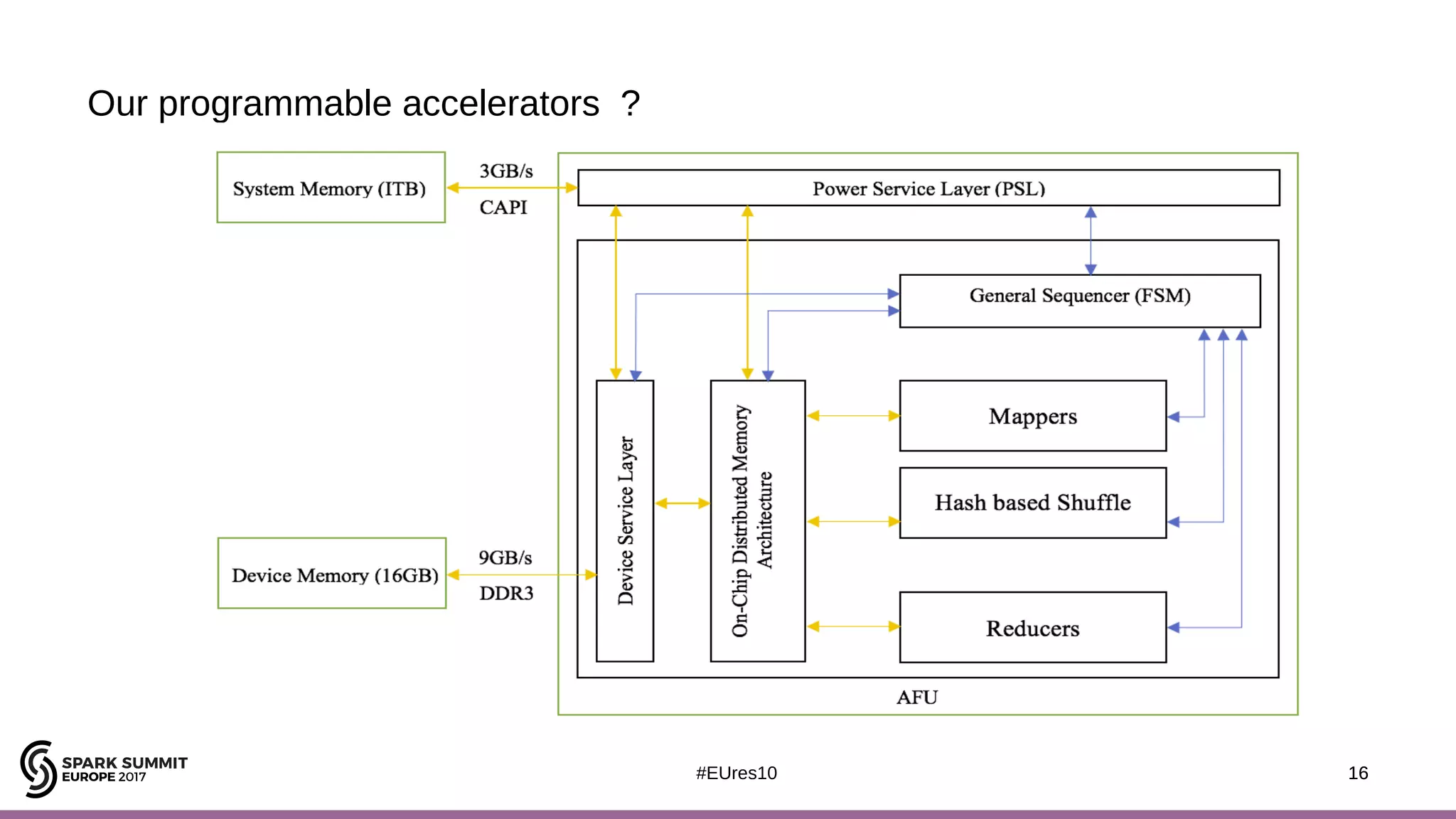
Our programmable accelerators ?
16
17#EUres10
Advantages of the design ?
17
● Template based design to support generality.
● No of mappers and reducers can be instantiated based on the FPGA
card.
● General Sequencer is a Finite State Machine whose states can be varied
to meet the diverse set of workloads
● Mappers and Reducers can be programmed in C/C++ and can be
synthesized using High Level Synthesis.
● Support hardware acceleration of Diverse set of workloads
18#EUres10
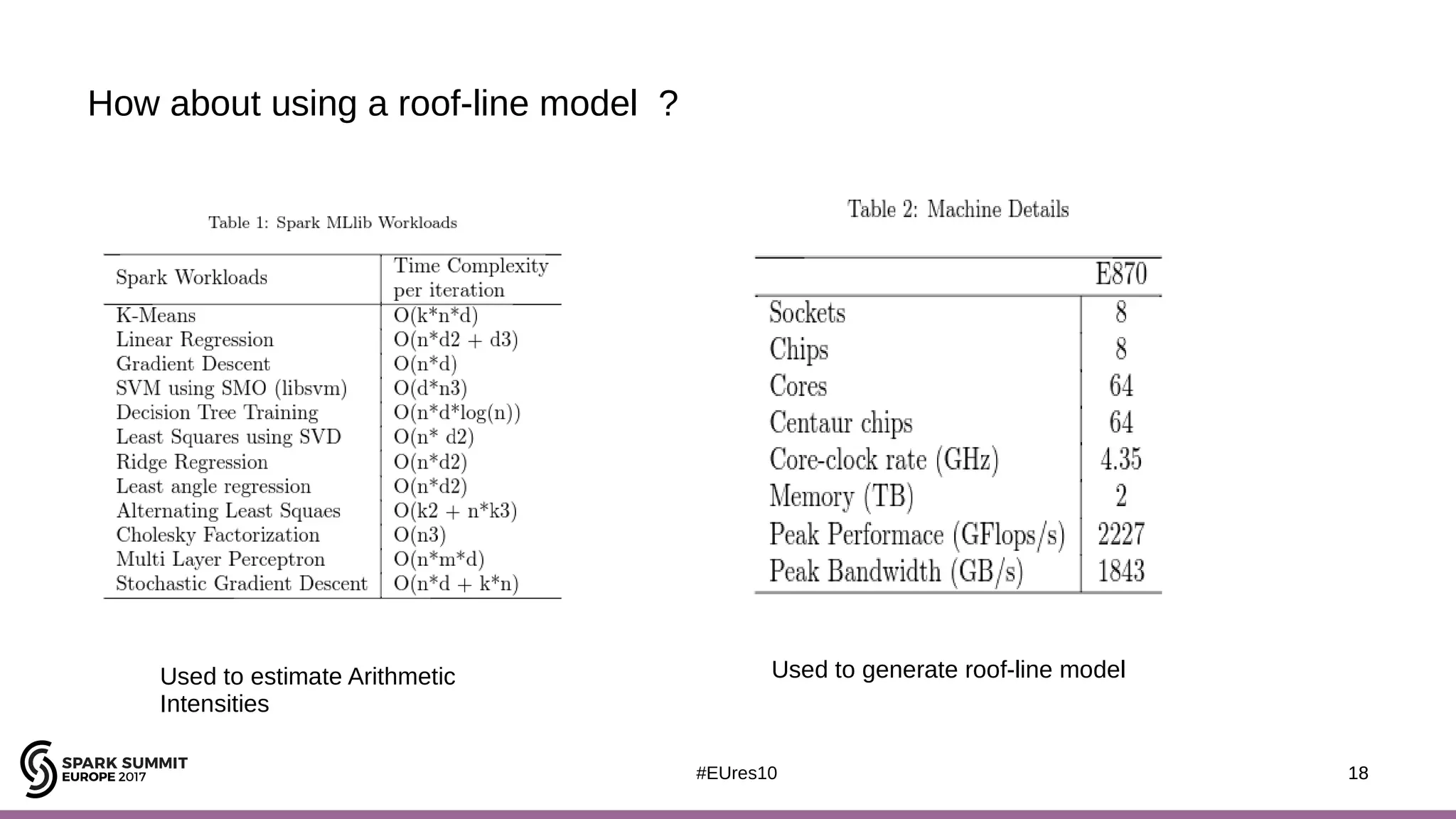
How about using a roof-line model ?
18
Used to estimate Arithmetic
Intensities
Used to generate roof-line model
19#EUres10
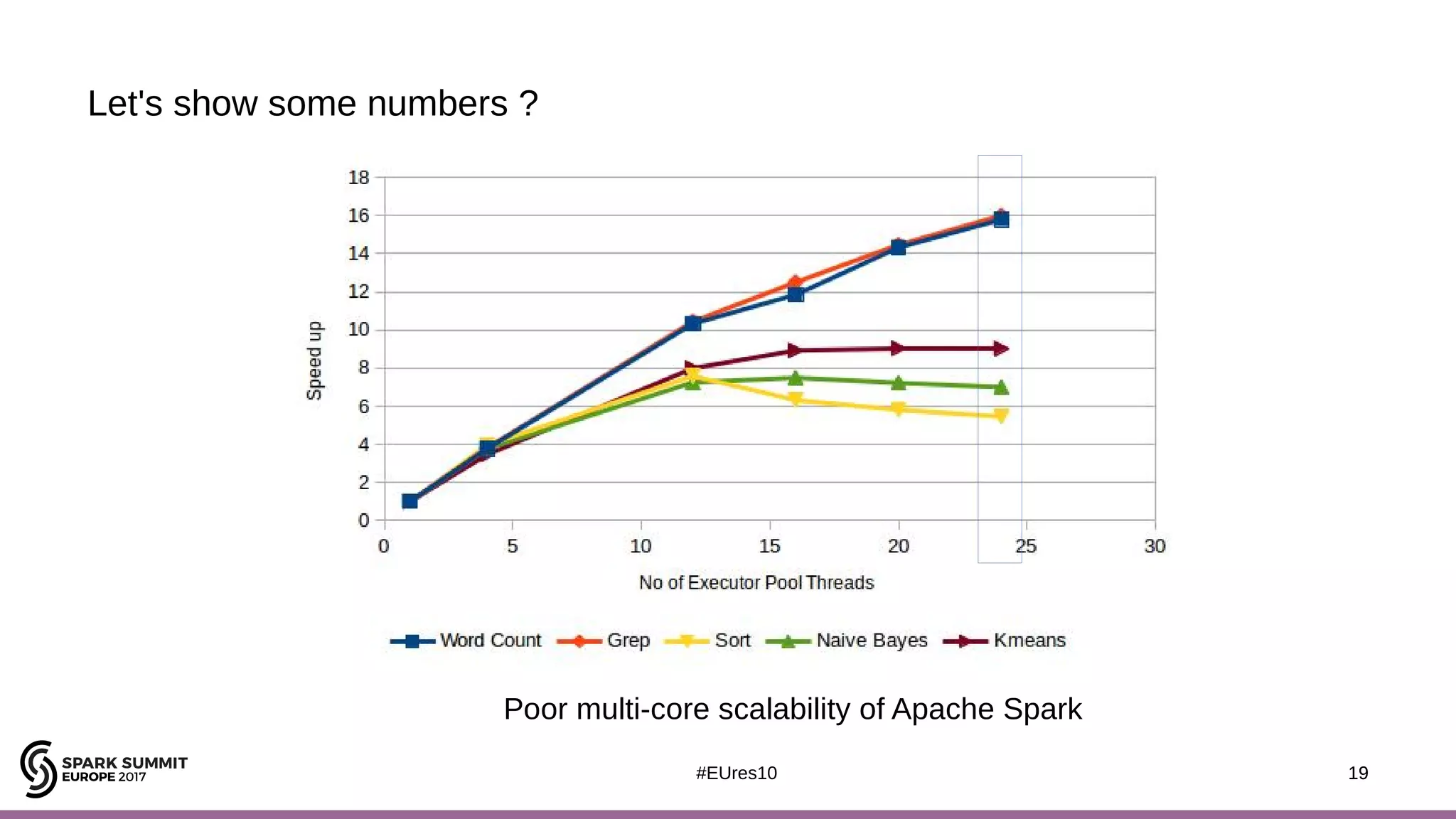
Let's show some numbers ?
19
Poor multi-core scalability of Apache Spark
20#EUres10
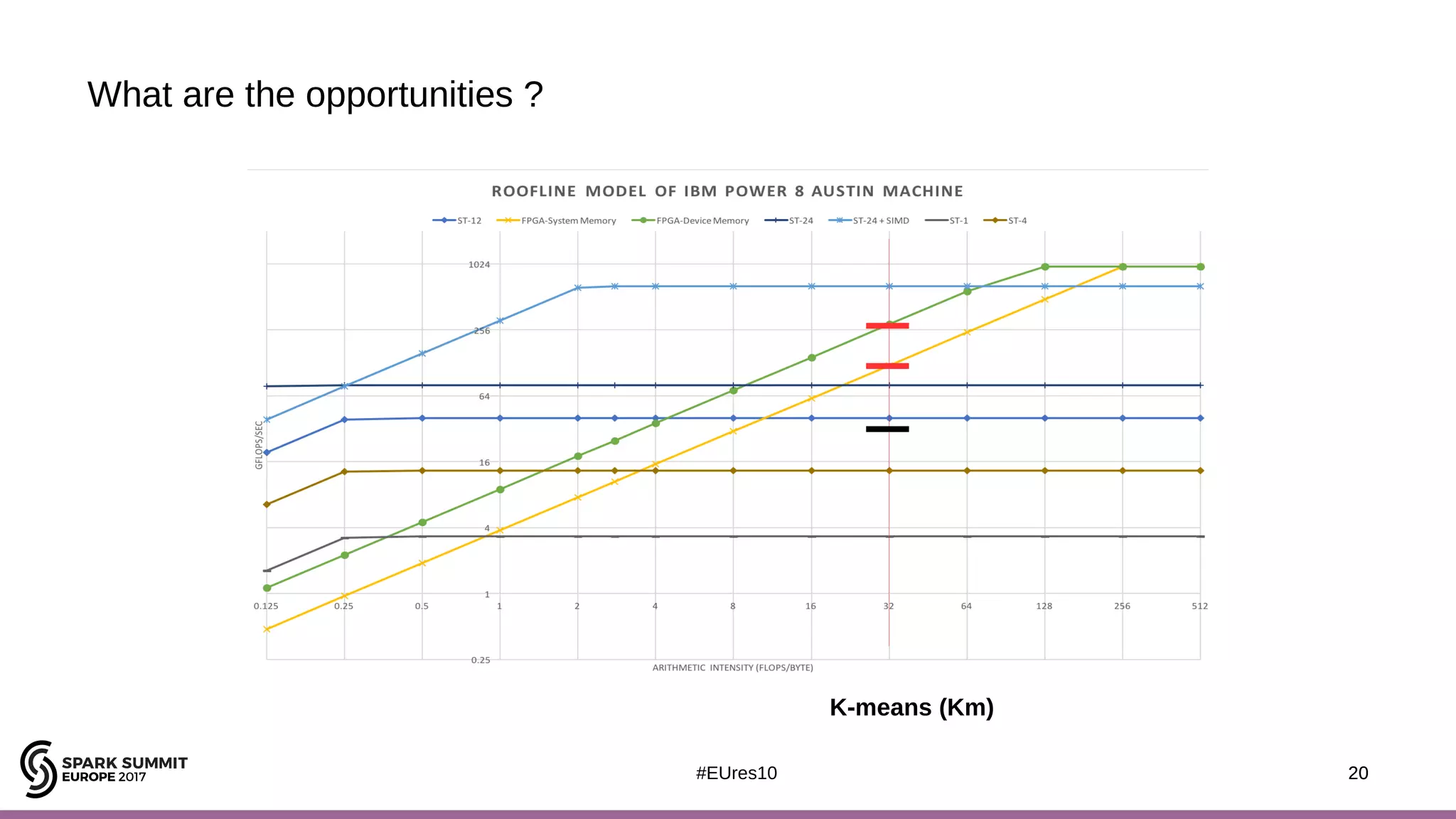
What are the opportunities ?
20
K-means (Km)
21#EUres10
What are the challenges ?
21
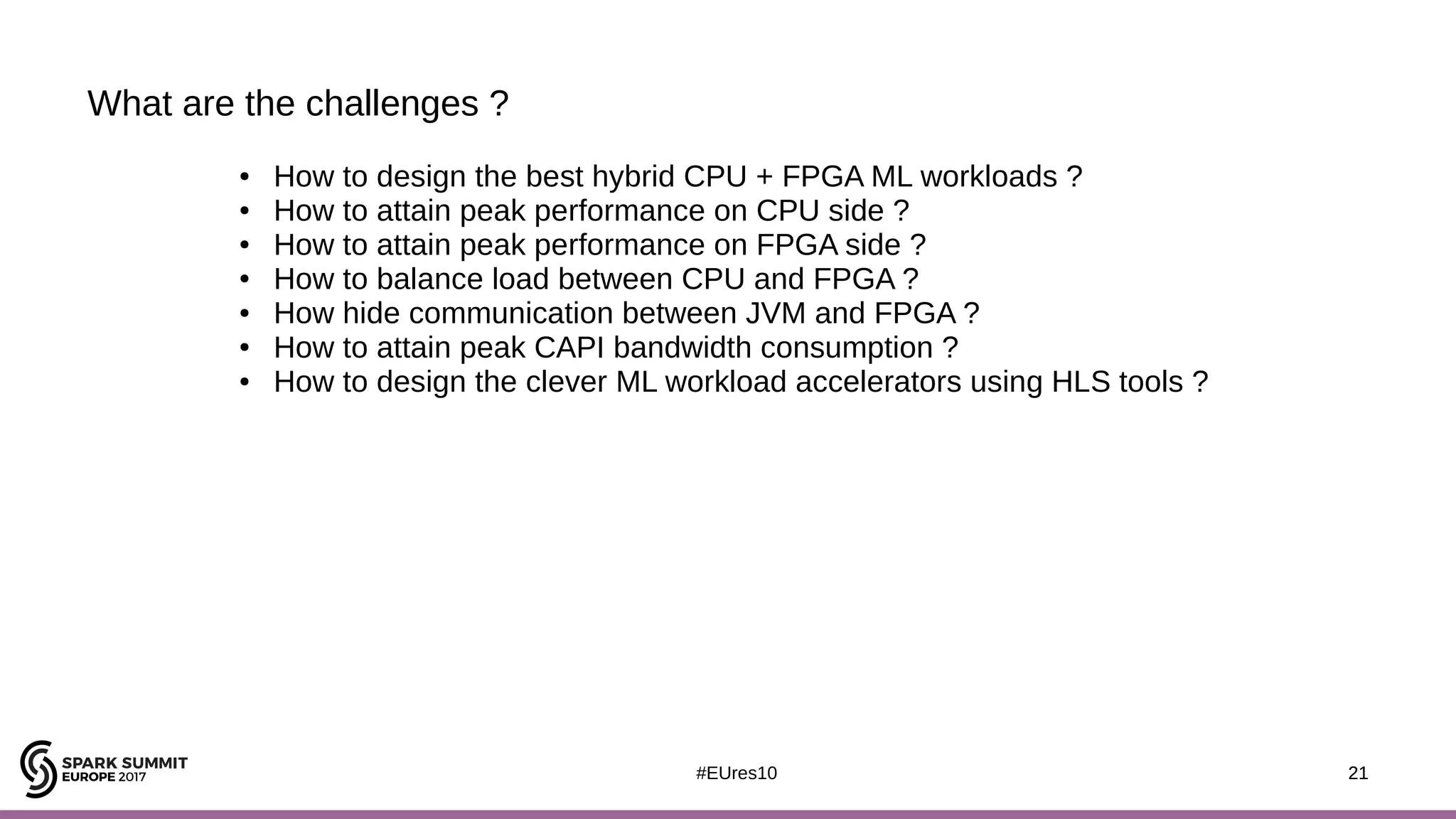
● How to design the best hybrid CPU + FPGA ML workloads ?
● How to attain peak performance on CPU side ?
● How to attain peak performance on FPGA side ?
● How to balance load between CPU and FPGA ?
● How hide communication between JVM and FPGA ?
● How to attain peak CAPI bandwidth consumption ?
● How to design the clever ML workload accelerators using HLS tools ?
22#EUres10
What High Level Synthesis (Xilinx SDSoC Tool Chain) can do ?
22
20x 10x
23#EUres10
Things to remember from this talk ?
23
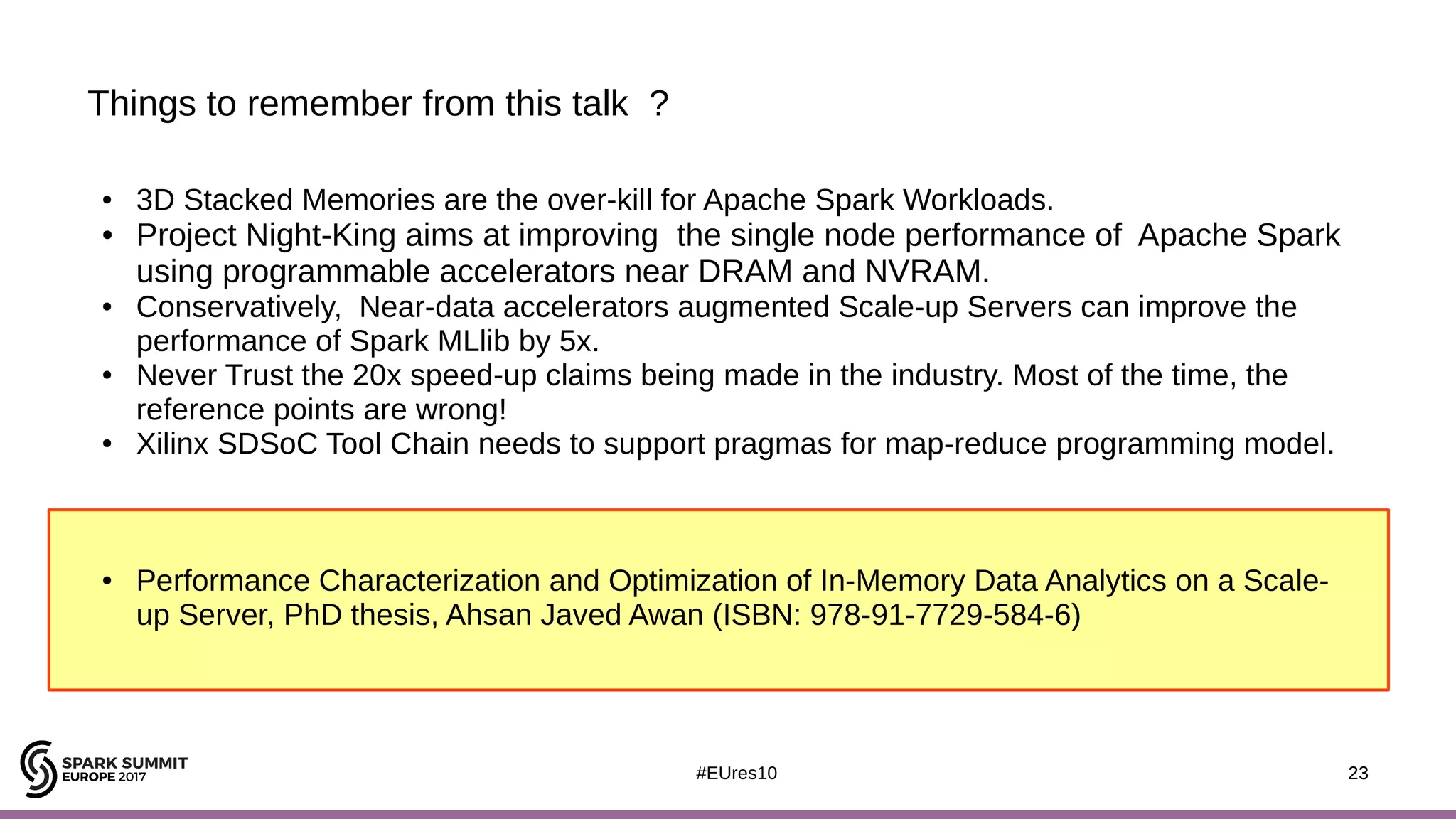
● 3D Stacked Memories are the over-kill for Apache Spark Workloads.
● Project Night-King aims at improving the single node performance of Apache Spark
using programmable accelerators near DRAM and NVRAM.
● Conservatively, Near-data accelerators augmented Scale-up Servers can improve the
performance of Spark MLlib by 5x.
● Never Trust the 20x speed-up claims being made in the industry. Most of the time, the
reference points are wrong!
● Xilinx SDSoC Tool Chain needs to support pragmas for map-reduce programming model.
● Performance Characterization and Optimization of In-Memory Data Analytics on a Scale-
up Server, PhD thesis, Ahsan Javed Awan (ISBN: 978-91-7729-584-6)
24#EUres10
That's all for now ?
24
Email: ajawan@kth.seEmail: ajawan@kth.se
Profile:Profile: www.kth.se/profile/ajawan/www.kth.se/profile/ajawan/
https://se.linkedin.com/in/ahsanjavedawanhttps://se.linkedin.com/in/ahsanjavedawan
THANK YOU

Near Data Computing Architectures: Opportunities and Challenges for Apache Spark

  • 1.
    Ahsan J. Awan(KTH) Near Data Computing Architectures: Opportunities and Challenges for Apache Spark #EUres10 1
  • 2.
    2#EUres10 About me ? 2 198820112010 20132012 2014 2015 2016 2017 B.E. MTS NUST, Pakistan EMECS, TUKL, Germany EMECS, UoS, UK Lecturer, NUST, Pakistan EMJD-DC, KTH/SICS, Sweden PhD Intern, Recore Netherlands EMJD-DC, UPC/BSC, Spain PhD Intern, IBM Research, Japan Born in Pakistan
  • 3.
    3#EUres10 A Quick Recapfrom last year ? 3 Problems Identified Solutions Proposed https://spark-summit.org/eu-2016/events/performance-characterization-of-apache-spark-on-scale-up-servers/ Work Time Inflation Poor Multi-core Scalability of data analytics with Spark Thread Level Load Imbalance Wait Time on I/O GC overhead DRAM Bound Latency NUMA Awareness Hyper Threaded Cores No next-line prefetchers Lower DRAM speed Exploiting Near Data Processing Choice of GC algorithm Multiple Small executors
  • 4.
    4#EUres10 Further Reading ? 4 ●Project Night-King: Improving the single performance for Apache Spark using Near Data Processing Architectures. ● Identifying the potential of Near Data Computing Architectures for Apache Spark in Memory Systems Symposium, 2017. ● Node Architecture Implications for In-Memory Data Analytics in Scale-in Clusters in IEEE/ACM Conference in Big Data Computing, Applications and Technologies, 2016. ● Micro-architectural Characterization of Apache Spark on Batch and Stream Processing Workloads, in IEEE Conference on Big Data and Cloud Computing, 2016. ● How Data Volume Affects Spark Based Data Analytics on a Scale-up Server in 6th Workshop on Big Data Benchmarks, Performance Optimization and Emerging Hardware (BpoE), held in conjunction with VLDB 2015, Hawaii, USA . ● Performance characterization of in-memory data analytics on a modern cloud server, in IEEE Conference on Big Data and Cloud Computing, 2015 (Best Paper Award).
  • 5.
    5#EUres10 Exploiting NDP/Moving computecloser to data ? 5 Loh et al. A processing in memory taxonomy and a case for studying fixedfunction pim. In Workshop on Near-Data Processing (WoNDP), 2013. 1. Processing in Memory 2. In-Storage Processing Improve the performance by reducing costly data movements back and forth between the CPUs and Memories
  • 6.
    6#EUres10 Trends of IntegratingNVM in the System Architecture ? 6 Chang et al. A limits study of benefits from nanostore-based future data-centric system architectures. In Computing Frontiers 2012
  • 7.
    7#EUres10 Can Spark workloadsbenefit from Near data processing ? 7 Host CPU PIM device ISP device Project: NightKing
  • 8.
    8#EUres10 The case forin-storage processing ? 8 Grep (Gp) K-means (Km)Windowed Word Count (Wwc)
  • 9.
    9#EUres10 The case for2D integrated PIM instead of 3D Stacked PIM ? 9 M. Radulovic et al. Another Trip to the Wall: How Much Will Stacked DRAM Benefit HPC?
  • 10.
    10#EUres10 A refined hypothesisbased on workload characterization ? 10 ● Spark workloads, which are not iterative and have high ratio of I/O wait time / CPU time like join, aggregation, filter, word count and sort are ideal candidates for ISP. ● Spark workloads, which have low ratio of I/O wait time / CPU time like stream processing and iterative graph processing workloads are bound by latency of frequent accesses to DRAM and are ideal candidates for 2D integrated PIM. ● Spark workloads, which are iterative and have moderate ratio of I/O wait time / CPU time like K-means, have both I/O bound and memory bound phases and hence will benefit from hybrid 2D integrated PIM and ISP. ● In order to satisfy the varying compute demands of Spark workloads, we envision an NDC architecture with programmable logic based hybrid ISP and 2D integrated PIM.
  • 11.
    11#EUres10 How to testthe refined hypothesis ? 11 ● Simulation Approach ● Very slow for big data applications :( ● Modeling Approach ● Overly estimated numbers :( ● Emulation Approach ● A lot of development :( How about a combination of Modeling and partial Emulation ?
  • 12.
    12#EUres10 Can existing tightlycoupled servers be used as emulators ? 12
  • 13.
  • 14.
    14#EUres10 Which programming model? 14 Iterative MapReduce
  • 15.
    15#EUres10 Which workloads ? 15 K-meansand SGD Mahan et al. TABLA: A unified template-based framework for accelerating statistical machine learning
  • 16.
  • 17.
    17#EUres10 Advantages of thedesign ? 17 ● Template based design to support generality. ● No of mappers and reducers can be instantiated based on the FPGA card. ● General Sequencer is a Finite State Machine whose states can be varied to meet the diverse set of workloads ● Mappers and Reducers can be programmed in C/C++ and can be synthesized using High Level Synthesis. ● Support hardware acceleration of Diverse set of workloads
  • 18.
    18#EUres10 How about usinga roof-line model ? 18 Used to estimate Arithmetic Intensities Used to generate roof-line model
  • 19.
    19#EUres10 Let's show somenumbers ? 19 Poor multi-core scalability of Apache Spark
  • 20.
    20#EUres10 What are theopportunities ? 20 K-means (Km)
  • 21.
    21#EUres10 What are thechallenges ? 21 ● How to design the best hybrid CPU + FPGA ML workloads ? ● How to attain peak performance on CPU side ? ● How to attain peak performance on FPGA side ? ● How to balance load between CPU and FPGA ? ● How hide communication between JVM and FPGA ? ● How to attain peak CAPI bandwidth consumption ? ● How to design the clever ML workload accelerators using HLS tools ?
  • 22.
    22#EUres10 What High LevelSynthesis (Xilinx SDSoC Tool Chain) can do ? 22 20x 10x
  • 23.
    23#EUres10 Things to rememberfrom this talk ? 23 ● 3D Stacked Memories are the over-kill for Apache Spark Workloads. ● Project Night-King aims at improving the single node performance of Apache Spark using programmable accelerators near DRAM and NVRAM. ● Conservatively, Near-data accelerators augmented Scale-up Servers can improve the performance of Spark MLlib by 5x. ● Never Trust the 20x speed-up claims being made in the industry. Most of the time, the reference points are wrong! ● Xilinx SDSoC Tool Chain needs to support pragmas for map-reduce programming model. ● Performance Characterization and Optimization of In-Memory Data Analytics on a Scale- up Server, PhD thesis, Ahsan Javed Awan (ISBN: 978-91-7729-584-6)
  • 24.
    24#EUres10 That's all fornow ? 24 Email: ajawan@kth.seEmail: ajawan@kth.se Profile:Profile: www.kth.se/profile/ajawan/www.kth.se/profile/ajawan/ https://se.linkedin.com/in/ahsanjavedawanhttps://se.linkedin.com/in/ahsanjavedawan THANK YOU