Shantilal Shah
Engineering College,
Bhavnagar
INSTRUMENTATION AND CONTROL
ENGINEERING
( SEMESTER 1 )
1
Sidsar Campus, P.O. Vartej, Bhavnagar-364060
Phone: 0278-2445509, 2445767
Fax: 0278-2445509
Website: http://www.ssgec.ac.in/
2
OUR GROUP
Members :
1. Jitin J Pillai
2.Dodiya Siddhraj
3.Kaneriya Yash
4.Dodiya Parth
5.Tripathi Vishal
3
4
INTRODUCTION
Optical Fibers are hair-thin,
transparent strands through
which light can be transmitted.
A group of many such optical
fibers constitute a Optical Fiber
Cable.
5
CONSTRUCTION
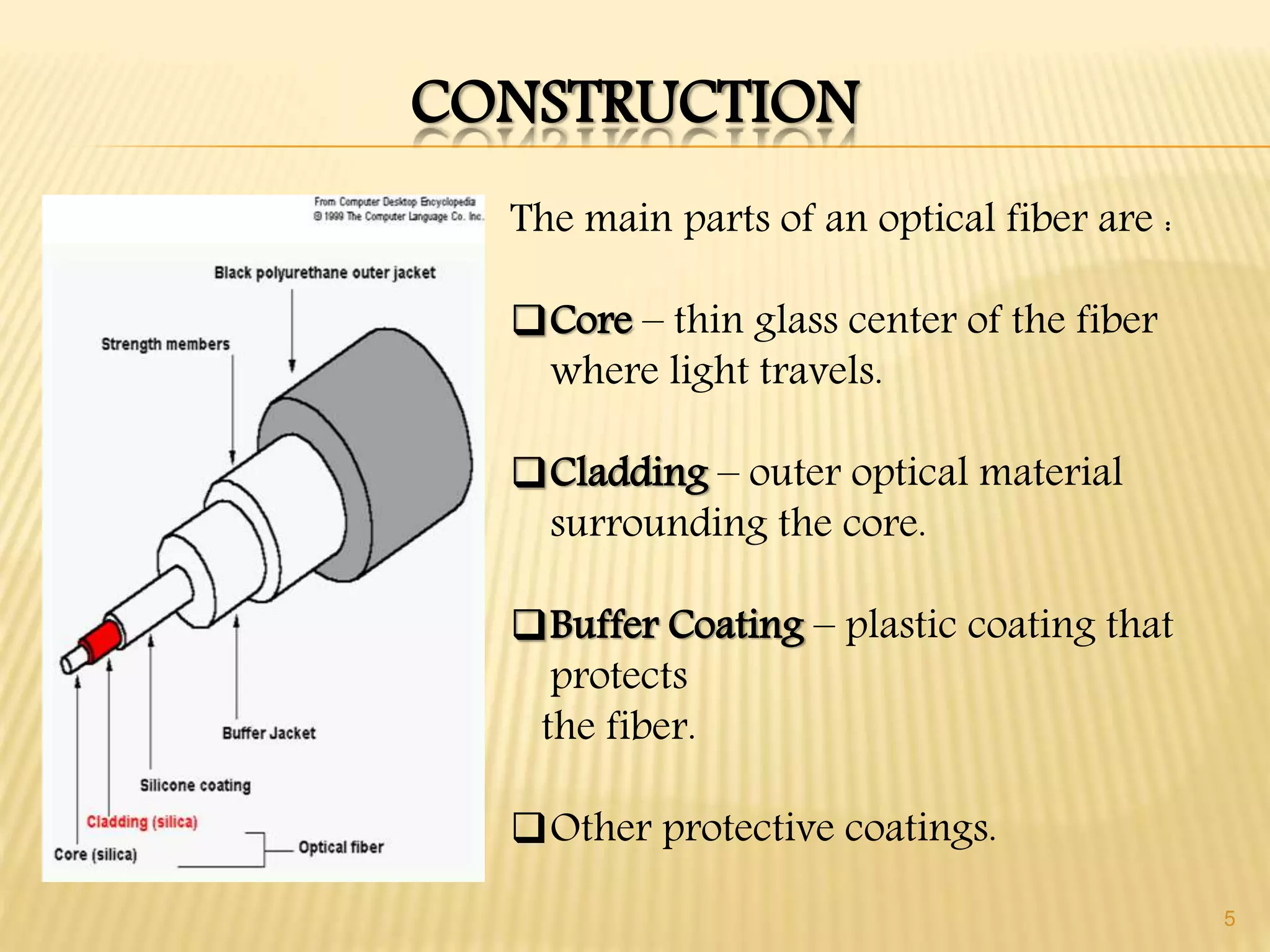
The main parts of an optical fiber are :
Core – thin glass center of the fiber
where light travels.
Cladding – outer optical material
surrounding the core.
Buffer Coating – plastic coating that
protects
the fiber.
Other protective coatings.
6
PRINCIPLE
TOTAL INTERNAL REFLECTION is the main principle behind the
working of an optical fiber.
For T.I.R., conditions are satisfied :
• Light is incident on the walls of the cable at an angle greater than
the critical angle.
• The optical-fiber core is clad (coated) by a lower density glass
layer.
7
FIBER TYPES
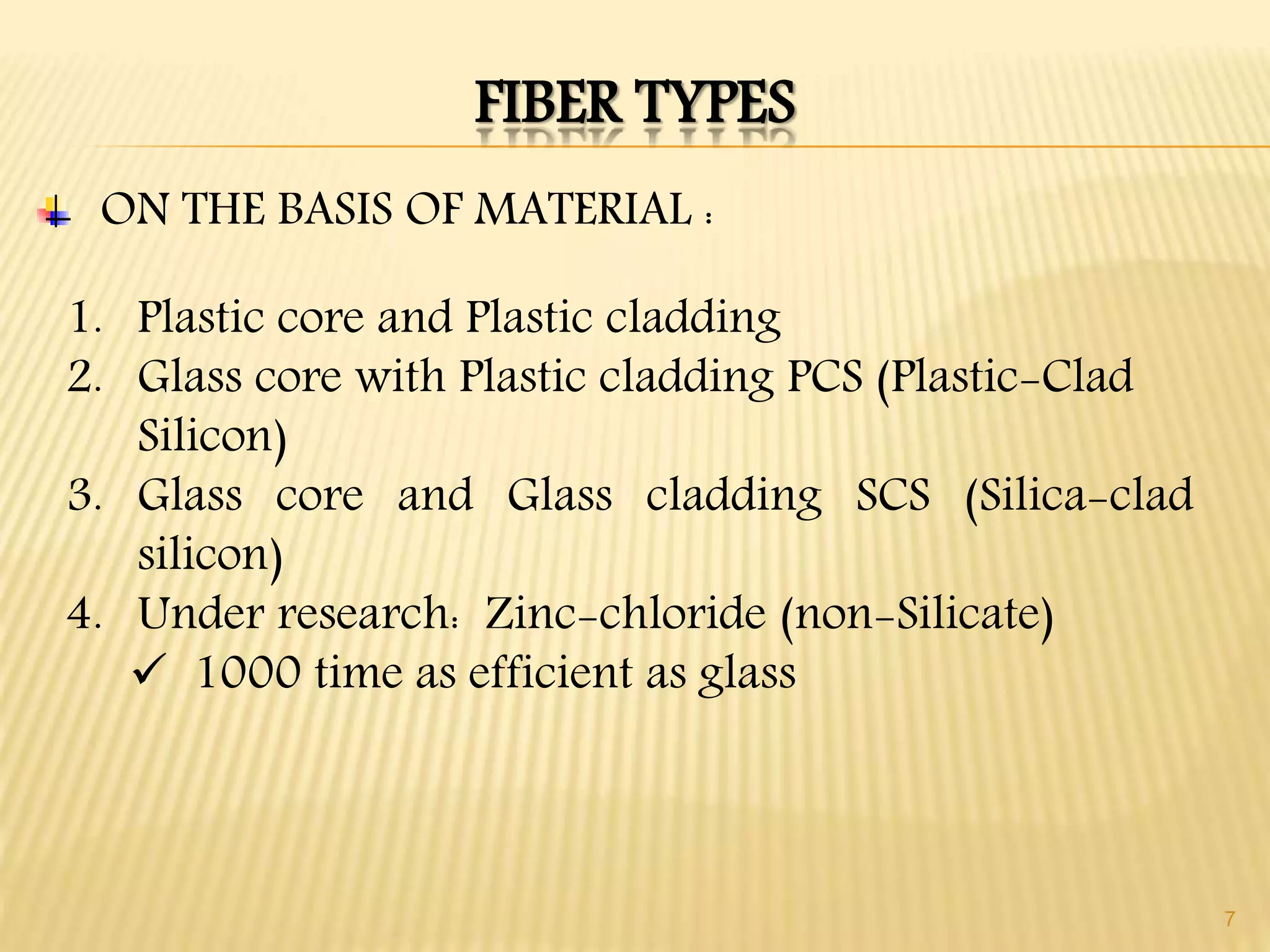
1. Plastic core and Plastic cladding
2. Glass core with Plastic cladding PCS (Plastic-Clad
Silicon)
3. Glass core and Glass cladding SCS (Silica-clad
silicon)
4. Under research: Zinc-chloride (non-Silicate)
 1000 time as efficient as glass
ON THE BASIS OF MATERIAL :
8
ON THE BASIS OF MODE OF PROPAGATION :
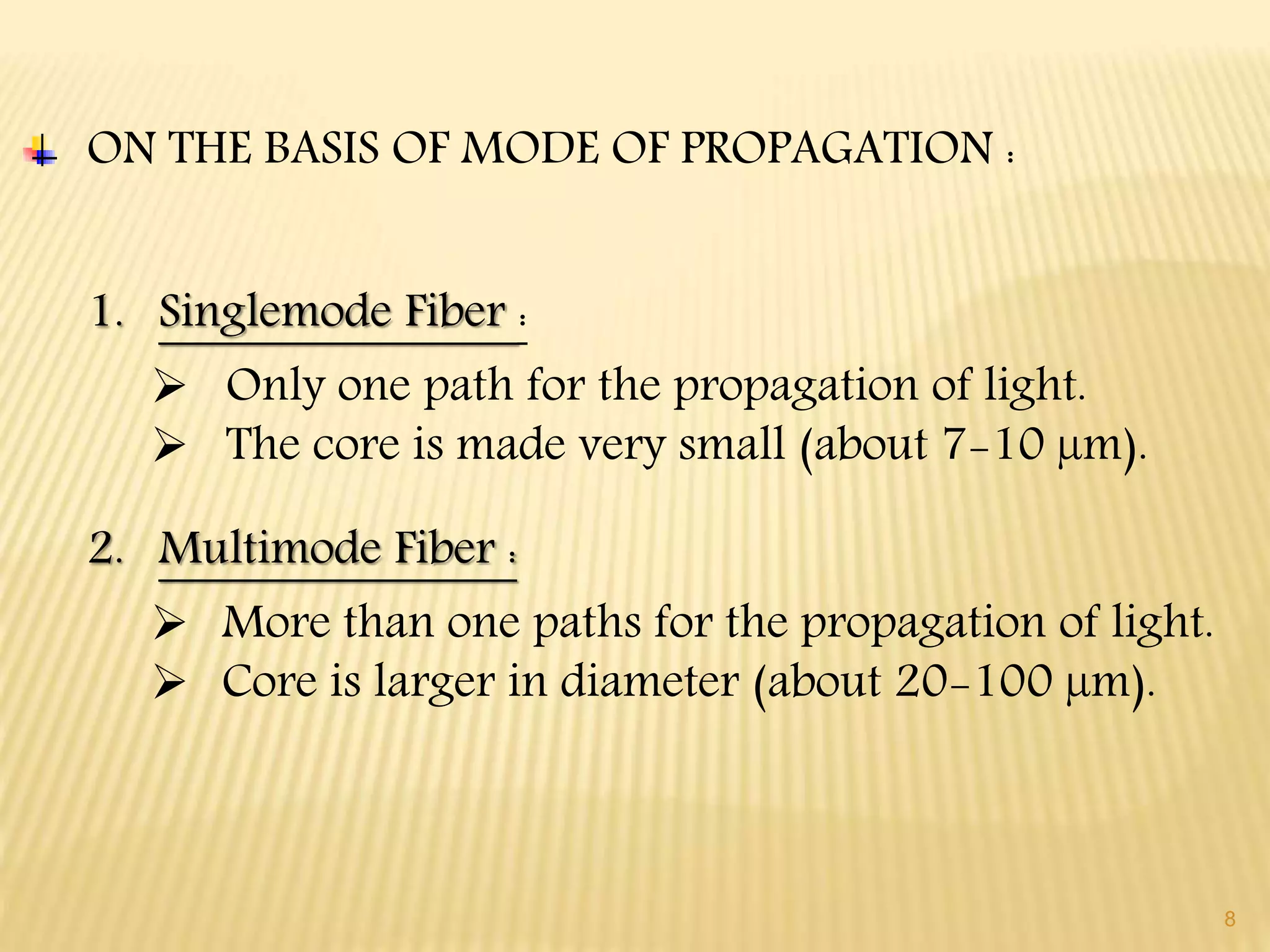
1. Singlemode Fiber :
 Only one path for the propagation of light.
 The core is made very small (about 7-10 µm).
2. Multimode Fiber :
 More than one paths for the propagation of light.
 Core is larger in diameter (about 20-100 µm).
9
ON THE BASIS OF INDEX PROFILE
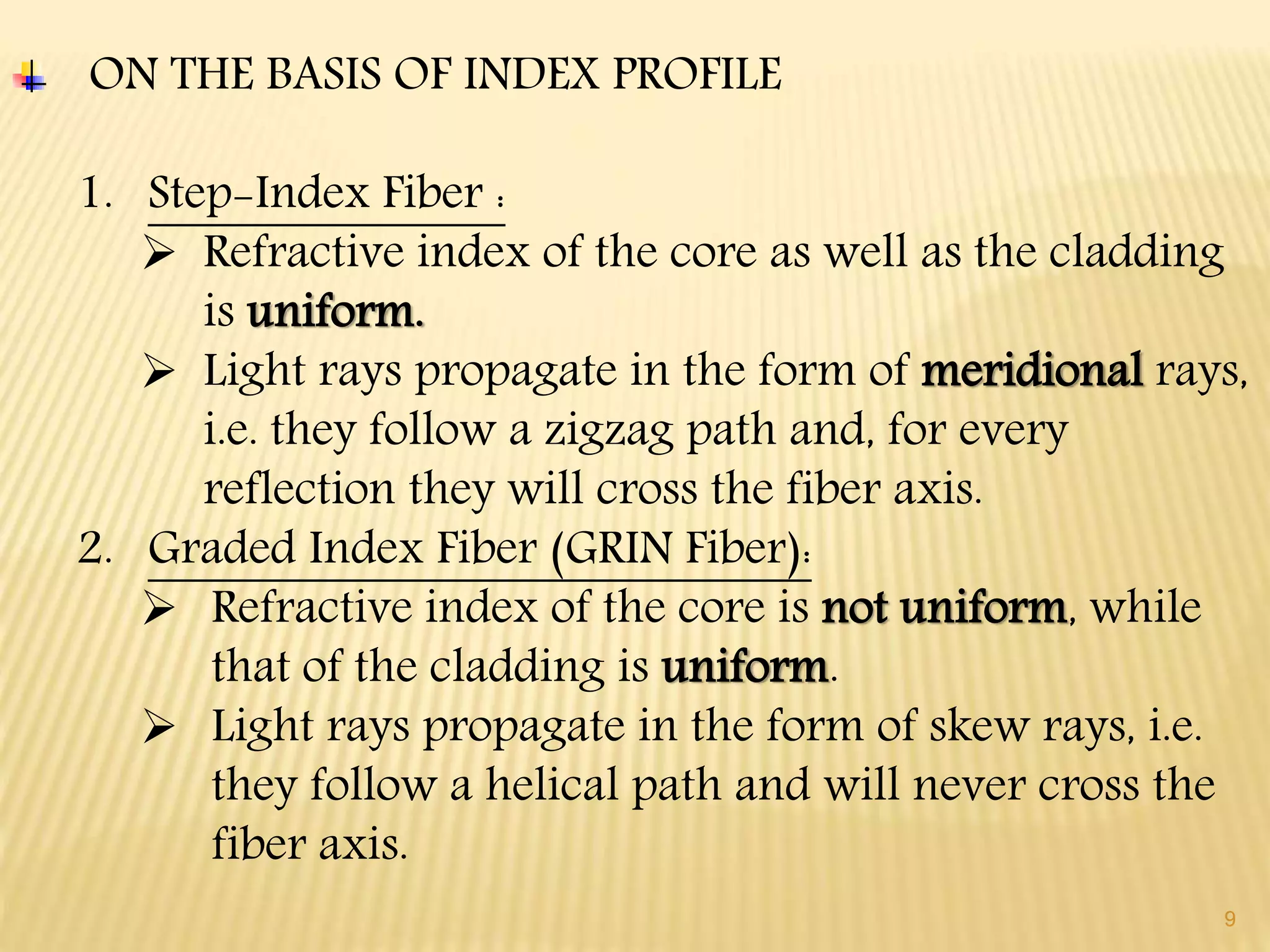
1. Step-Index Fiber :
 Refractive index of the core as well as the cladding
is uniform.
 Light rays propagate in the form of meridional rays,
i.e. they follow a zigzag path and, for every
reflection they will cross the fiber axis.
2. Graded Index Fiber (GRIN Fiber):
 Refractive index of the core is not uniform, while
that of the cladding is uniform.
 Light rays propagate in the form of skew rays, i.e.
they follow a helical path and will never cross the
fiber axis.
10
FIBER CONFIGURATIONS
I. Singlemode Step-Index Fiber (SMSI Fiber)
Single-mode step-index Fiber
n1 core
n2 cladding
no air
Light
ray
Index of
refraction
11
II. Multimode Step-Index Fiber
Multimode step-index Fiber
n2 cladding
n1 core
no air
Index of
refraction
12
III. Multimode Graded Index Fiber
Variable
n
Index profile
Multimode graded-index Fiber
Index of
refraction
13
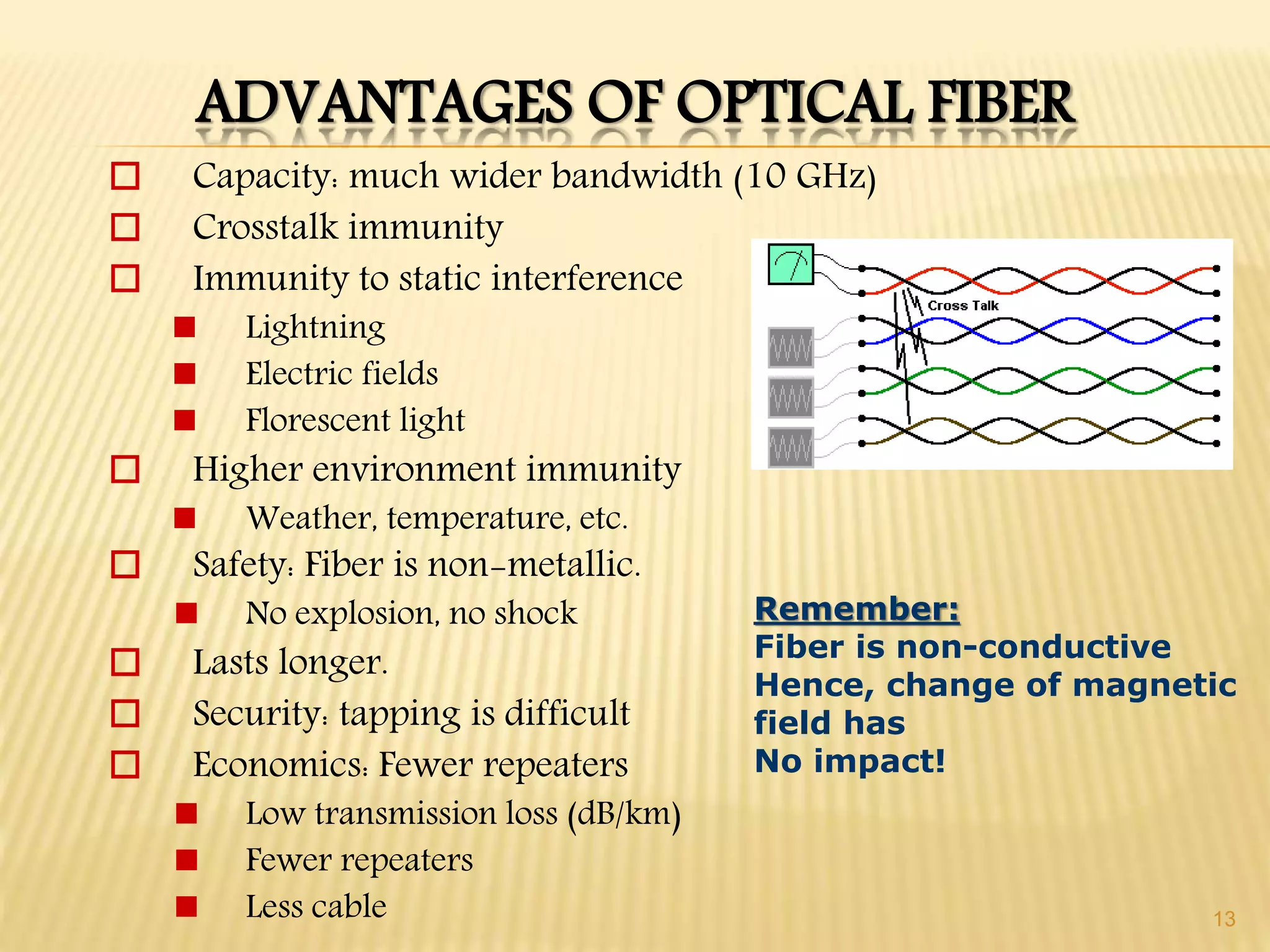
ADVANTAGES OF OPTICAL FIBER
 Capacity: much wider bandwidth (10 GHz)
 Crosstalk immunity
 Immunity to static interference
 Lightning
 Electric fields
 Florescent light
 Higher environment immunity
 Weather, temperature, etc.
 Safety: Fiber is non-metallic.
 No explosion, no shock
 Lasts longer.
 Security: tapping is difficult
 Economics: Fewer repeaters
 Low transmission loss (dB/km)
 Fewer repeaters
 Less cable
Remember:
Fiber is non-conductive
Hence, change of magnetic
field has
No impact!
14
DISADVANTAGES OF OPTICAL FIBER
 Higher initial cost in installation
 Interfacing cost
 Less strength
 Lower tensile strength
 Remote electric power
 More expensive to repair/maintain
 Tools: Specialized and sophisticated
15
APPLICATIONS
In Telecommunications to
transfer data.
In Local Area Networks to
share internet connections.
In Cable TV and CCTV.
In Optical Fiber Sensors.
In Endoscopy to view
internal body organs.
In decoration.
16
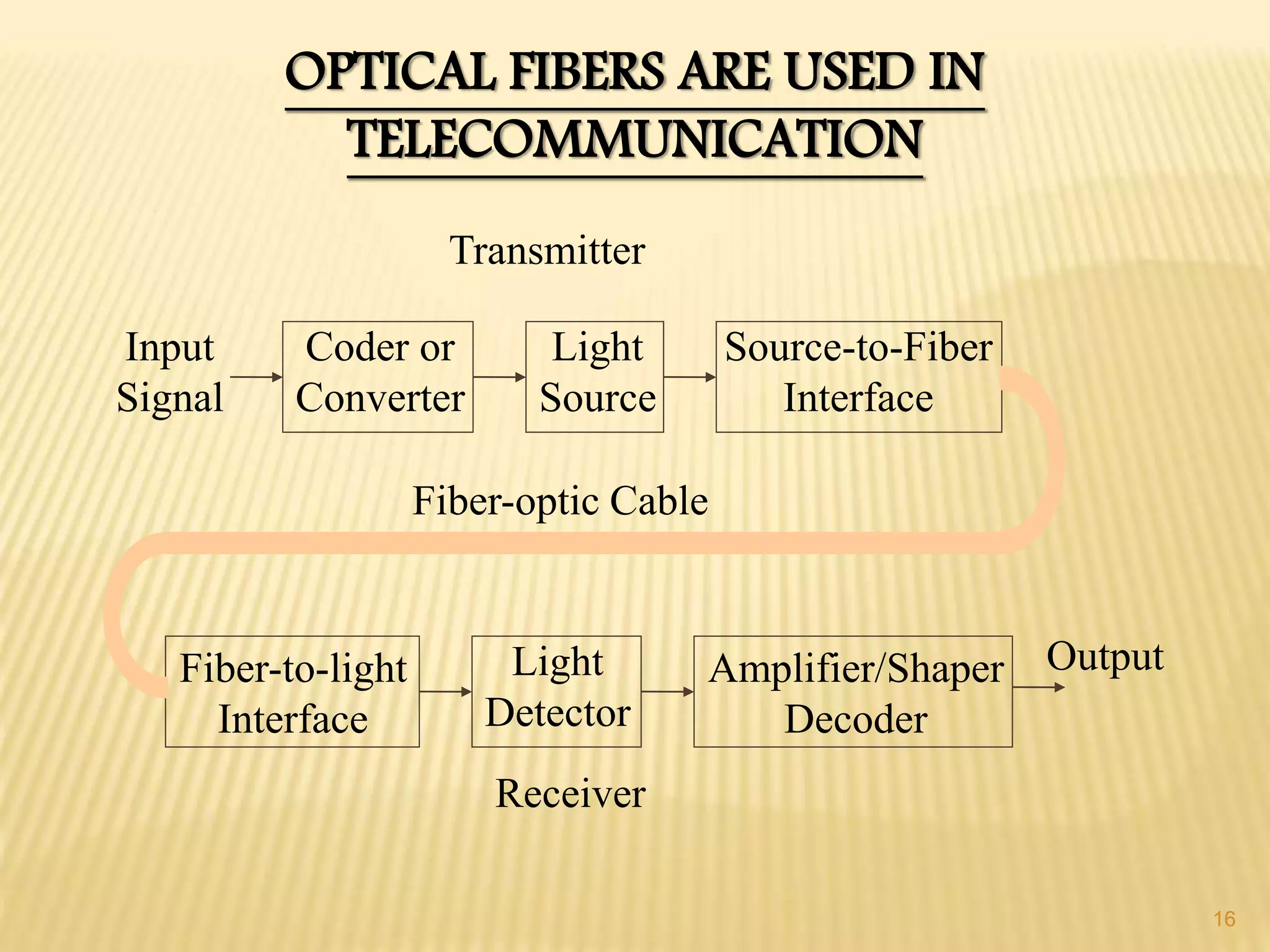
Input
Signal
Coder or
Converter
Light
Source
Source-to-Fiber
Interface
Fiber-to-light
Interface
Light
Detector
Amplifier/Shaper
Decoder
Output
Fiber-optic Cable
Receiver
OPTICAL FIBERS ARE USED IN
TELECOMMUNICATION
Transmitter
17
OPTICAL FIBERS ARE USED IN ENDOSCOPIC
SURGERY
18
THANK YOU

Fib opt

  • 1.
    Shantilal Shah Engineering College, Bhavnagar INSTRUMENTATIONAND CONTROL ENGINEERING ( SEMESTER 1 ) 1 Sidsar Campus, P.O. Vartej, Bhavnagar-364060 Phone: 0278-2445509, 2445767 Fax: 0278-2445509 Website: http://www.ssgec.ac.in/
  • 2.
    2 OUR GROUP Members : 1.Jitin J Pillai 2.Dodiya Siddhraj 3.Kaneriya Yash 4.Dodiya Parth 5.Tripathi Vishal
  • 3.
  • 4.
    4 INTRODUCTION Optical Fibers arehair-thin, transparent strands through which light can be transmitted. A group of many such optical fibers constitute a Optical Fiber Cable.
  • 5.
    5 CONSTRUCTION The main partsof an optical fiber are : Core – thin glass center of the fiber where light travels. Cladding – outer optical material surrounding the core. Buffer Coating – plastic coating that protects the fiber. Other protective coatings.
  • 6.
    6 PRINCIPLE TOTAL INTERNAL REFLECTIONis the main principle behind the working of an optical fiber. For T.I.R., conditions are satisfied : • Light is incident on the walls of the cable at an angle greater than the critical angle. • The optical-fiber core is clad (coated) by a lower density glass layer.
  • 7.
    7 FIBER TYPES 1. Plasticcore and Plastic cladding 2. Glass core with Plastic cladding PCS (Plastic-Clad Silicon) 3. Glass core and Glass cladding SCS (Silica-clad silicon) 4. Under research: Zinc-chloride (non-Silicate)  1000 time as efficient as glass ON THE BASIS OF MATERIAL :
  • 8.
    8 ON THE BASISOF MODE OF PROPAGATION : 1. Singlemode Fiber :  Only one path for the propagation of light.  The core is made very small (about 7-10 µm). 2. Multimode Fiber :  More than one paths for the propagation of light.  Core is larger in diameter (about 20-100 µm).
  • 9.
    9 ON THE BASISOF INDEX PROFILE 1. Step-Index Fiber :  Refractive index of the core as well as the cladding is uniform.  Light rays propagate in the form of meridional rays, i.e. they follow a zigzag path and, for every reflection they will cross the fiber axis. 2. Graded Index Fiber (GRIN Fiber):  Refractive index of the core is not uniform, while that of the cladding is uniform.  Light rays propagate in the form of skew rays, i.e. they follow a helical path and will never cross the fiber axis.
  • 10.
    10 FIBER CONFIGURATIONS I. SinglemodeStep-Index Fiber (SMSI Fiber) Single-mode step-index Fiber n1 core n2 cladding no air Light ray Index of refraction
  • 11.
    11 II. Multimode Step-IndexFiber Multimode step-index Fiber n2 cladding n1 core no air Index of refraction
  • 12.
    12 III. Multimode GradedIndex Fiber Variable n Index profile Multimode graded-index Fiber Index of refraction
  • 13.
    13 ADVANTAGES OF OPTICALFIBER  Capacity: much wider bandwidth (10 GHz)  Crosstalk immunity  Immunity to static interference  Lightning  Electric fields  Florescent light  Higher environment immunity  Weather, temperature, etc.  Safety: Fiber is non-metallic.  No explosion, no shock  Lasts longer.  Security: tapping is difficult  Economics: Fewer repeaters  Low transmission loss (dB/km)  Fewer repeaters  Less cable Remember: Fiber is non-conductive Hence, change of magnetic field has No impact!
  • 14.
    14 DISADVANTAGES OF OPTICALFIBER  Higher initial cost in installation  Interfacing cost  Less strength  Lower tensile strength  Remote electric power  More expensive to repair/maintain  Tools: Specialized and sophisticated
  • 15.
    15 APPLICATIONS In Telecommunications to transferdata. In Local Area Networks to share internet connections. In Cable TV and CCTV. In Optical Fiber Sensors. In Endoscopy to view internal body organs. In decoration.
  • 16.
  • 17.
    17 OPTICAL FIBERS AREUSED IN ENDOSCOPIC SURGERY
  • 18.