Active Learning Assignment
Subject :Physics (2110011)
Branch :Mechanical Engg.
Division :KG-1
Presented By: Patel Parth .V (150120119132)
Patel Parth .R (150120119133)
Patel Jaydev (150120119127)
Topic:- Types and Applications of Superconductors
Guided by :- Prof. Umang Patel
1
A Superconductor is a material that losses all its
resistance (offer zero resistance) to the flow of
electric current when it is cooled below a certain
temperature called critical temperature or
transition temperature (Tc)
Examples- Mercury(Hg), Zinc(Zn), Vanadium(V),
Tin(Sn) and Niobium(Nb).
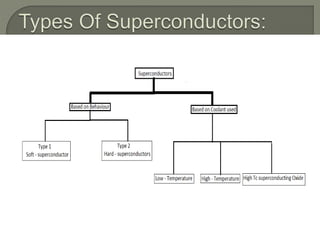
Based on behavior of superconductor in an
applied magnetic field.
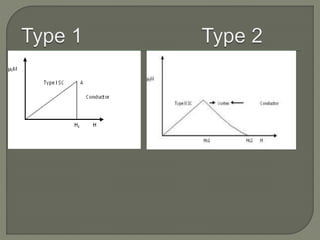
 Type 1 superconductor:-
 Type 1 superconductor exhibits complete Meissner effect.
 They are completely diamagnetic. And the values of (Hc)
[Critical magnetic field] is very low.
 They are also called soft-superconductor because of their
tendency to allow magnetic field penetration even though for
lower applied field.
 Examples- alloys and some compound superconductor exhibits
type 1 behavior.
Type 2 Superconductor :-
 Type 2 superconductor behaves differently in an increasing
field.
 They are mostly used in all engineering applications.
 They are also called hard superconductor because of relatively
large magnetic field requirement to bring them back to their
normal state.
Type 1 Type 2
Material ( Hc) in
tesla
Material (Hc) in
tesla
Ta
0.083
(Y1Ba2Cu3O7) 300
Pb
0.08
(Ba2-XBXCuO4) 150
Hg (Nb3Sn) 24.5
Based on coolant used achieve superconductivity
phenomena in material
Low-Temperature Superconductor:-
 Superconductor that requires liquid helium as coolant are called
low-temperature superconductor.
 Liquid helium temperature is 4.3k above absolute zero
temperature.
High-Temperature Superconductor:-
 Superconductors having their critical temperature above liquid
nitrogen(77k or -196c) are called high-temperature
superconductors.
 The highest transition temperature currently known is 138k, in a
thallium-doped mercuric cuprate comprises the element like Hg,
Tl, Ba, Ca, Cu and oxygen.
Sr. No Material (Tc)in k
1 (Pb2YSr2Cu3O8) 77
2 Y-Ba-Cu-O (Y1Ba2Cu3O7) 93-95
3 Tl(Bi)-Ba(Sr)-Ca-Cu-O 122-125
4 Hg-Ba-Ca-Cu-O 130-135
The high temperature superconductor have limited practical
application because they ceramics which are brittle.
 But in thin film technology these materials can find their
applications in the electronic field as high-speed computers.
1)Magnetic Levitation(Maglev)
 Magnetic levitation or maglev is the process by which
an object is suspended above another object.
 We know that a perfect diamagnetic substance
repels a magnetic field.
 Hence diamagnetic properties of superconductor
make them suitable for achieving frictionless motion
in motors and bearing.
 The levitation is achieved by two ways:
1) Electromagnetic Suspension
2) Electrodynamic Suspension
2) Josephson Effect and it’s application
 Josephson junction is formed by a layer of thin strip of
insulator between two superconductor.
 The wave nature of moving particles make the electron
to tunnel through the barrier(insulator), the electron
can tunnel from one superconductor to other.
 As a consequence of the tunneling of electron across
the insulator, there is a net current across the junction.
This is called Josephson effect.
 It is used in sensitive magnetometers called
SQUID(Superconducting Quantum Interference
Device)
 A SQUID is formed by connecting two Josephson
junction in parallel.
 It is used to detect small magnetic flux.
 This device can detect voltage as small as (10-15)V.
 Also Magnetic changes as small as (10-21) T can be
detected.
 Weak magnetic field produced by biological current
such as those in the brain can also be detected using
SQUIDs.
 SQUIDs detector are used to detect the level of iron in
liver- so that iron built-up can be treated before harm is
done to the body.
3) Some Other application of Superconductors:
 They are used to transmit electrical power to long distance.
 Superconducting generator has the benefit of small size and low
energy consumption than the conventional generators.
 Superconducting coils are used in N.M.R (nuclear magnetic
resonance) imaging equipments which are used in hospital in
scanning the whole body to diagnose medical problem.
 Very strong Magnetic fields can be generated with coils made
of superconductor.
 Superconductor can also act as relay or switching system in
computer. They can also be used as a memory or storage
element in computer.
 Very fast and accurate computer can be constructed using
superconductors and the power consumption is also very low.
 Ore separation can be done efficiently using superconducting
magnet.
Example of relay or switch:
Cryotron: It is a relay or switch made of superconductors whose
size can be made very small.
 In addition, these switches consume very less current.
 The cryotron consist of two superconducting material . And the
critical field of one coil is less than the critical filed of other coil.
 If current in one coil can be controlled by the current in other
coil.
SUPERCONDUCTORS

SUPERCONDUCTORS

  • 1.
    Active Learning Assignment Subject:Physics (2110011) Branch :Mechanical Engg. Division :KG-1 Presented By: Patel Parth .V (150120119132) Patel Parth .R (150120119133) Patel Jaydev (150120119127) Topic:- Types and Applications of Superconductors Guided by :- Prof. Umang Patel 1
  • 2.
    A Superconductor isa material that losses all its resistance (offer zero resistance) to the flow of electric current when it is cooled below a certain temperature called critical temperature or transition temperature (Tc) Examples- Mercury(Hg), Zinc(Zn), Vanadium(V), Tin(Sn) and Niobium(Nb).
  • 4.
    Based on behaviorof superconductor in an applied magnetic field.  Type 1 superconductor:-  Type 1 superconductor exhibits complete Meissner effect.  They are completely diamagnetic. And the values of (Hc) [Critical magnetic field] is very low.  They are also called soft-superconductor because of their tendency to allow magnetic field penetration even though for lower applied field.  Examples- alloys and some compound superconductor exhibits type 1 behavior.
  • 5.
    Type 2 Superconductor:-  Type 2 superconductor behaves differently in an increasing field.  They are mostly used in all engineering applications.  They are also called hard superconductor because of relatively large magnetic field requirement to bring them back to their normal state. Type 1 Type 2 Material ( Hc) in tesla Material (Hc) in tesla Ta 0.083 (Y1Ba2Cu3O7) 300 Pb 0.08 (Ba2-XBXCuO4) 150 Hg (Nb3Sn) 24.5
  • 7.
    Based on coolantused achieve superconductivity phenomena in material Low-Temperature Superconductor:-  Superconductor that requires liquid helium as coolant are called low-temperature superconductor.  Liquid helium temperature is 4.3k above absolute zero temperature. High-Temperature Superconductor:-  Superconductors having their critical temperature above liquid nitrogen(77k or -196c) are called high-temperature superconductors.  The highest transition temperature currently known is 138k, in a thallium-doped mercuric cuprate comprises the element like Hg, Tl, Ba, Ca, Cu and oxygen.
  • 8.
    Sr. No Material(Tc)in k 1 (Pb2YSr2Cu3O8) 77 2 Y-Ba-Cu-O (Y1Ba2Cu3O7) 93-95 3 Tl(Bi)-Ba(Sr)-Ca-Cu-O 122-125 4 Hg-Ba-Ca-Cu-O 130-135
  • 9.
    The high temperaturesuperconductor have limited practical application because they ceramics which are brittle.  But in thin film technology these materials can find their applications in the electronic field as high-speed computers.
  • 10.
    1)Magnetic Levitation(Maglev)  Magneticlevitation or maglev is the process by which an object is suspended above another object.  We know that a perfect diamagnetic substance repels a magnetic field.  Hence diamagnetic properties of superconductor make them suitable for achieving frictionless motion in motors and bearing.  The levitation is achieved by two ways: 1) Electromagnetic Suspension 2) Electrodynamic Suspension
  • 11.
    2) Josephson Effectand it’s application  Josephson junction is formed by a layer of thin strip of insulator between two superconductor.  The wave nature of moving particles make the electron to tunnel through the barrier(insulator), the electron can tunnel from one superconductor to other.  As a consequence of the tunneling of electron across the insulator, there is a net current across the junction. This is called Josephson effect.  It is used in sensitive magnetometers called SQUID(Superconducting Quantum Interference Device)
  • 12.
     A SQUIDis formed by connecting two Josephson junction in parallel.  It is used to detect small magnetic flux.  This device can detect voltage as small as (10-15)V.  Also Magnetic changes as small as (10-21) T can be detected.  Weak magnetic field produced by biological current such as those in the brain can also be detected using SQUIDs.  SQUIDs detector are used to detect the level of iron in liver- so that iron built-up can be treated before harm is done to the body.
  • 13.
    3) Some Otherapplication of Superconductors:  They are used to transmit electrical power to long distance.  Superconducting generator has the benefit of small size and low energy consumption than the conventional generators.  Superconducting coils are used in N.M.R (nuclear magnetic resonance) imaging equipments which are used in hospital in scanning the whole body to diagnose medical problem.  Very strong Magnetic fields can be generated with coils made of superconductor.  Superconductor can also act as relay or switching system in computer. They can also be used as a memory or storage element in computer.  Very fast and accurate computer can be constructed using superconductors and the power consumption is also very low.
  • 14.
     Ore separationcan be done efficiently using superconducting magnet. Example of relay or switch: Cryotron: It is a relay or switch made of superconductors whose size can be made very small.  In addition, these switches consume very less current.  The cryotron consist of two superconducting material . And the critical field of one coil is less than the critical filed of other coil.  If current in one coil can be controlled by the current in other coil.