FACULTY :
Prof. M.S. Khokhar
Prof. M.A. Bandi
Prof. M.M. Sharma
SHANTILAL SHAH ENGINEERING
COLLEGE, BHAVNAGAR
(INSTRUMENTATION & CONTROL
DEPARTMENT)
Roll no. Enrollment no. Name
3017 140430117019 JITIN J PILLAI
3007 140430117008 CHAUHAN ASHISH MUKESHBHAI
3010 140430117012 DODIYA PARTH KISHORBHAI
3016 140430117018 ISHAN JATINKUMAR BHATT
3002 140430117002 BAVISHI BIRJU DINESHBHAI
Group Members:
BATCH B1
OPERATIONAL
AMPLIFIERS (OP-
AMPS)
What is an Op-Amp? – The
Surface
An Operational Amplifier (Op-Amp) is an
integrated circuit that uses external voltage
to amplify the input through a very high
gain.
We recognize an Op-Amp as a mass-
produced component found in countless
electronics.
What an Op-Amp looks
like to a lay-person
What an Op-Amp looks
like to an engineer
What is an Op-Amp? – The Layout
• There are 8 pins in a common Op-
Amp, like the 741 which is used in
many instructional courses.
What is an Op-Amp? – The Inside
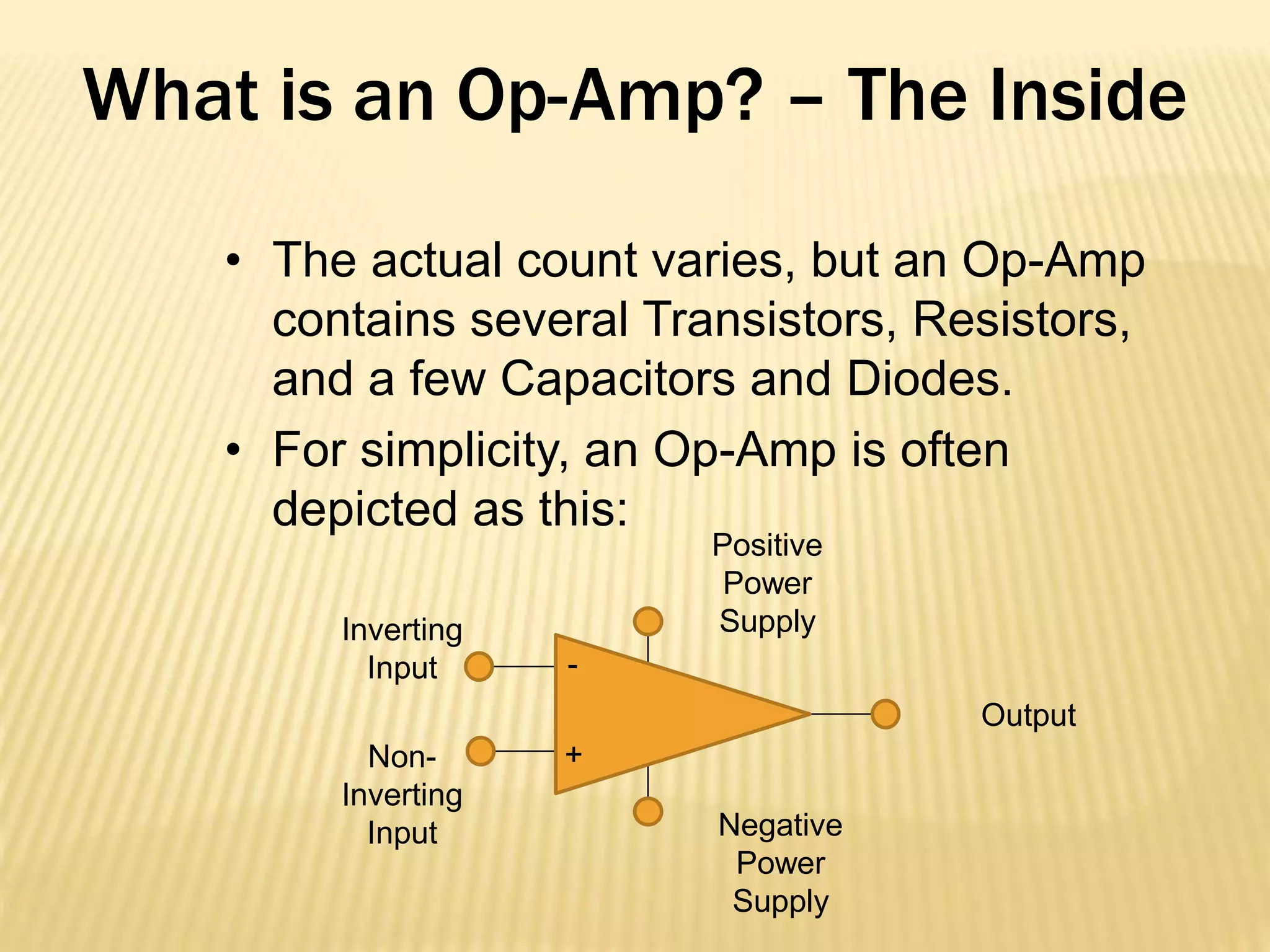
• The actual count varies, but an Op-Amp
contains several Transistors, Resistors,
and a few Capacitors and Diodes.
• For simplicity, an Op-Amp is often
depicted as this:
Non-
Inverting
Input
Inverting
Input
Positive
Power
Supply
Negative
Power
Supply
Output
-
+
History of the Op-Amp – The Dawn
• Before the Op-Amp: Harold S. Black
develops the feedback amplifier for the
Western Electric Company (1920-1930)
A
β
Input Output
Forward Gain
Feedback
History of the Op-Amp – The Dawn
• The Vacuum Tube Age
• The First Op-Amp: (1930 – 1940) Designed by Karl Swartzel for
the Bell Labs M9 gun director
• Uses 3 vacuum tubes, only one input, and ± 350 V to attain a
gain of 90 dB
• Loebe Julie then develops an Op-Amp with two inputs: Inverting
and Non-inverting
History of the Op-Amp – The Shift
• The end of Vacuum Tubes was built up during
the 1950’s-1960’s to the advent of solid-state
electronics
1. The Transistor
2. The Integrated Circuit
3. The Planar Process
History of the Op-Amp – The Shift
• 1960s: beginning of the Solid State Op-Amp
• Example: GAP/R P45 (1961 – 1971)
– Runs on ± 15 V, but costs $118 for 1 – 4
• The GAP/R PP65 (1962) makes the Op-Amp
into a circuit component as a potted module
History of the Op-Amp – The Evolution
• The solid-state decade saw a proliferation of Op-Amps
– Model 121, High Speed FET family, etc.
• Robert J. Widlar develops the μA702 Monolithic IC Op-
Amp (1963) and shortly after the μA709
• Fairchild Semiconductor vs. National Semiconductor
– National: The LM101 (1967) and then the LM101A (1968) (both
by Widlar)
– Fairchild: The “famous” μA741 (by Dave Fullager 1968) and
then the μA748 (1969)
Mathematics of the Op-Amp
• The gain of the Op-Amp itself is calculated as:
G = Vout/(V+ – V-)
• The maximum output is the power supply voltage
• When used in a circuit, the gain of the circuit (as
opposed to the op-amp component) is:
Av = Vout/Vin
Op-Amp Saturation
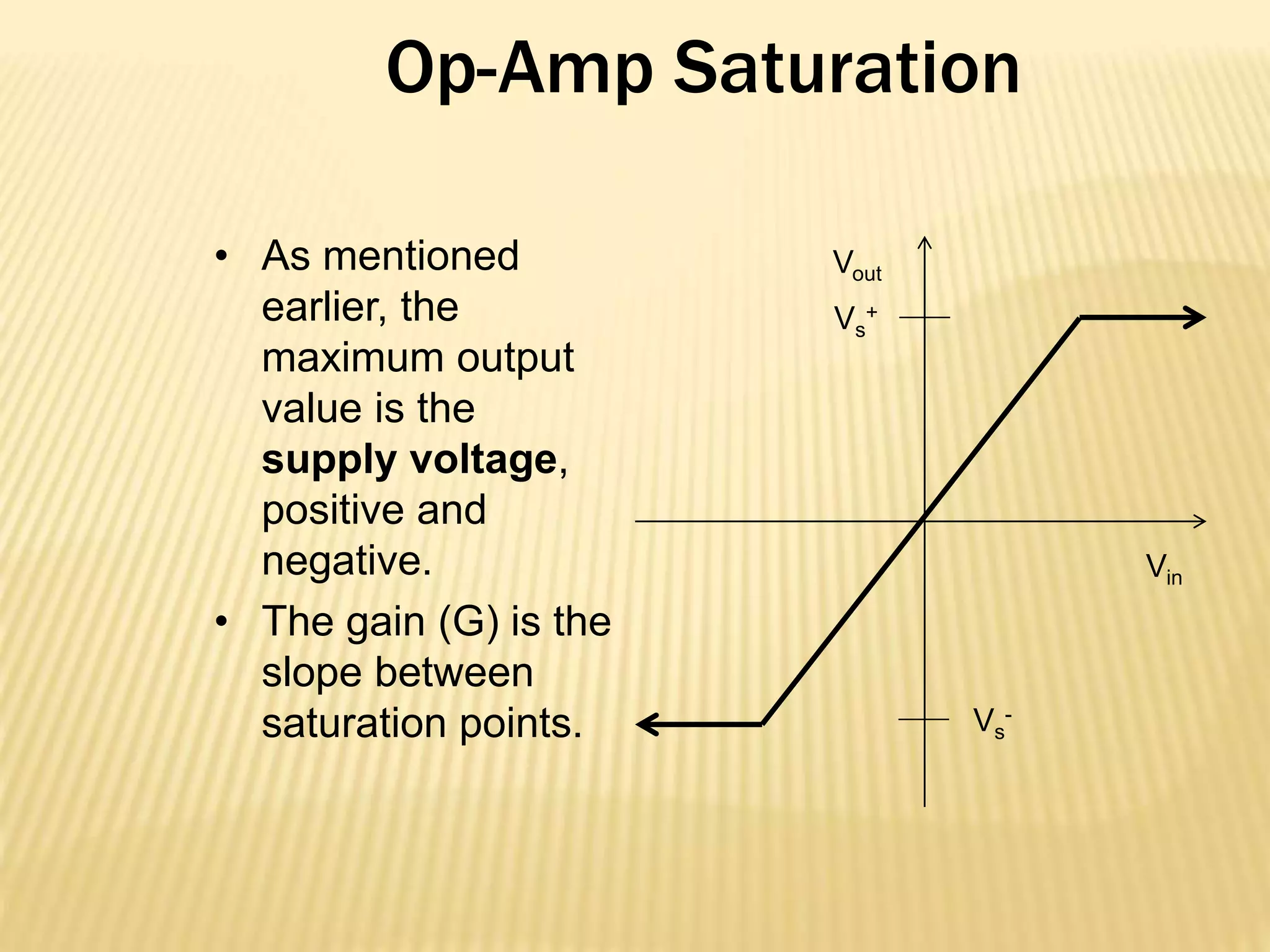
• As mentioned
earlier, the
maximum output
value is the
supply voltage,
positive and
negative.
• The gain (G) is the
slope between
saturation points.
Vout
Vin
Vs
-
Vs
+
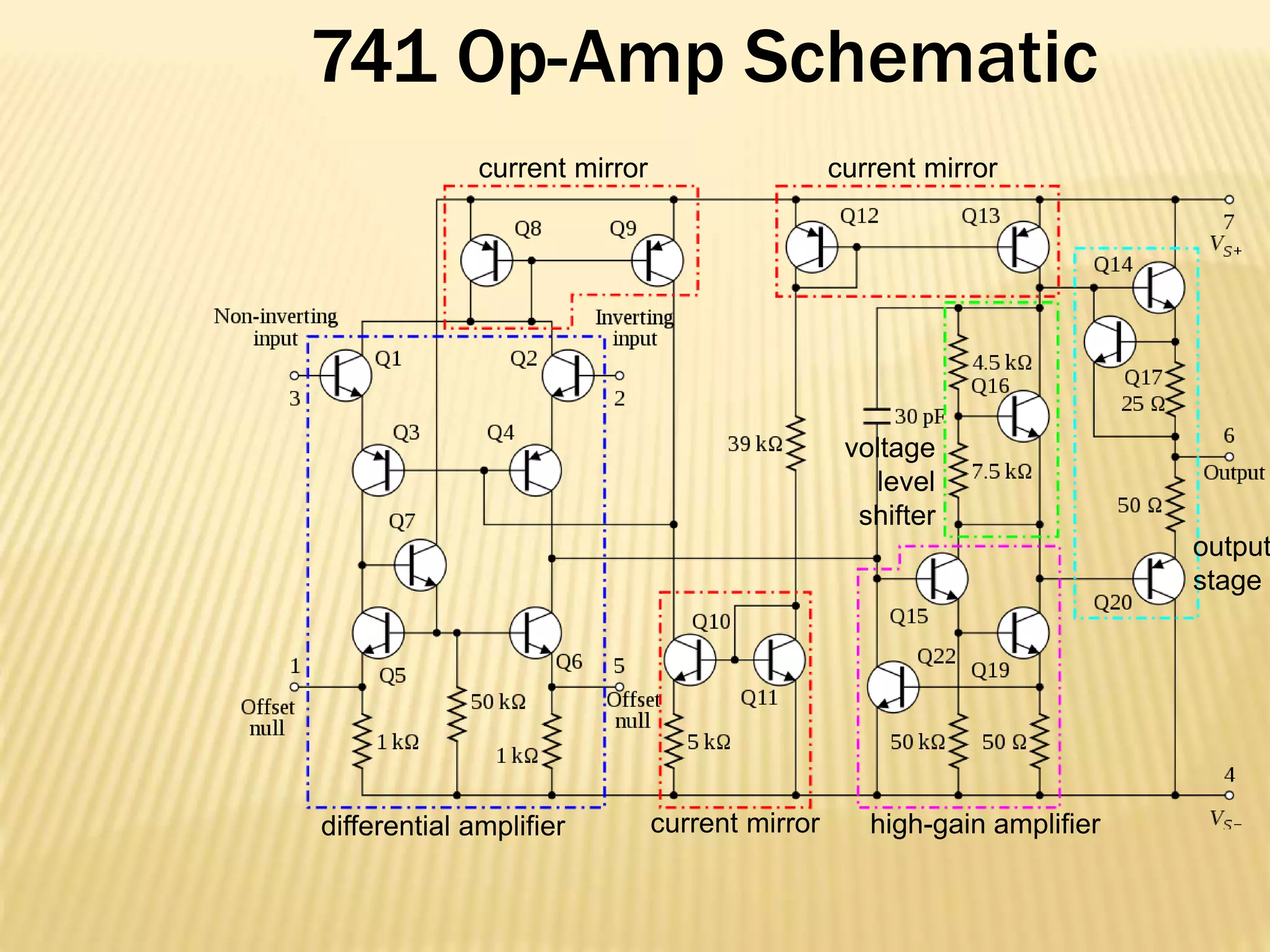
741 Op-Amp Schematic
differential amplifier high-gain amplifier
voltage
level
shifter
output
stage
current mirror
current mirror current mirror
Op-Amp Characteristics
• Open-loop gain G is typically over 9000
• But closed-loop gain is much smaller
• Rin is very large (MΩ or larger)
• Rout is small (75Ω or smaller)
• Effective output impedance in closed loop is very small
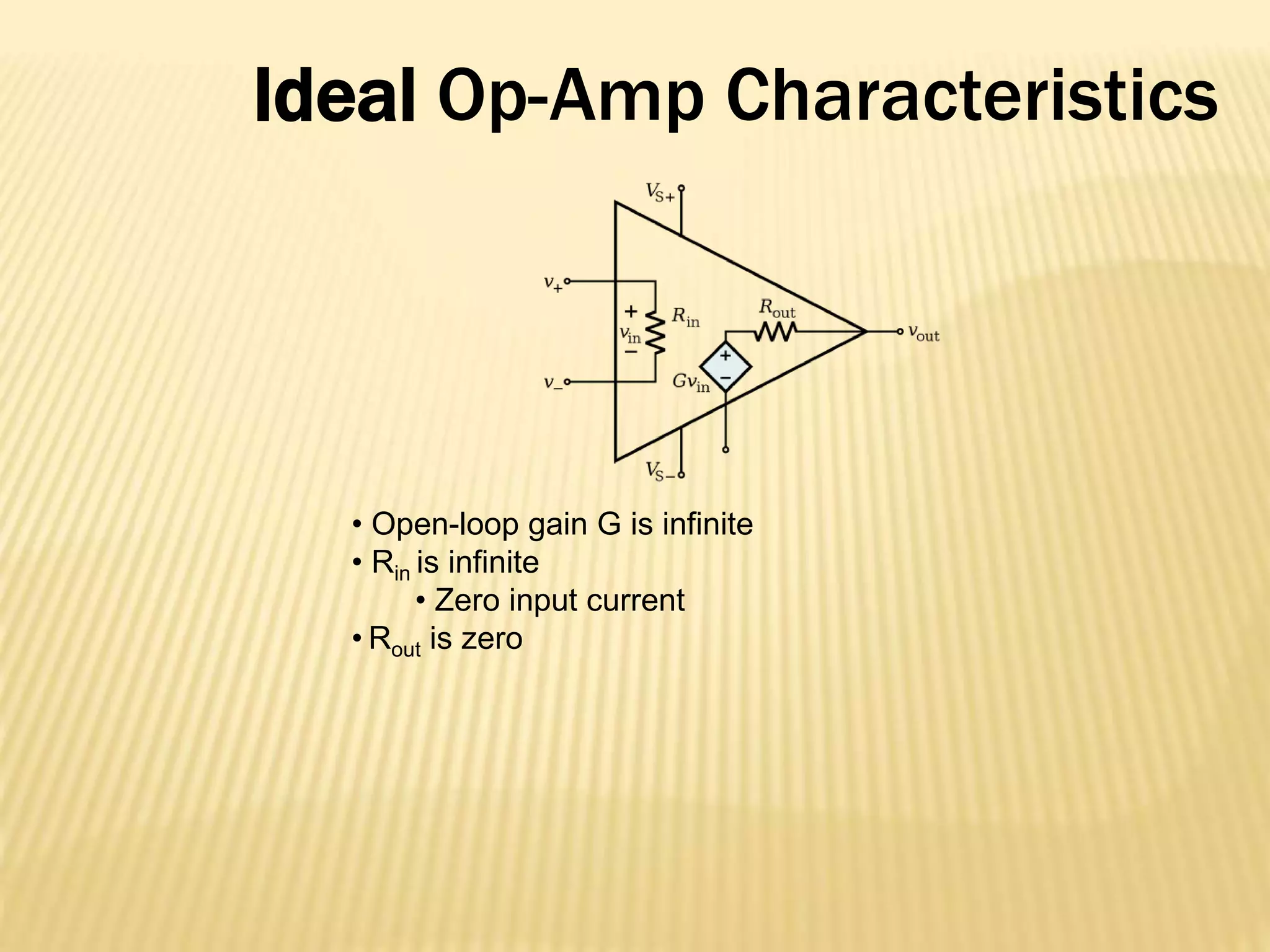
Ideal Op-Amp Characteristics
• Open-loop gain G is infinite
• Rin is infinite
• Zero input current
• Rout is zero
Ideal Op-Amp Analysis
To analyze an op-amp feedback circuit:
• Assume no current flows into either input terminal
• Assume no current flows out of the output terminal
• Constrain: V+ = V-
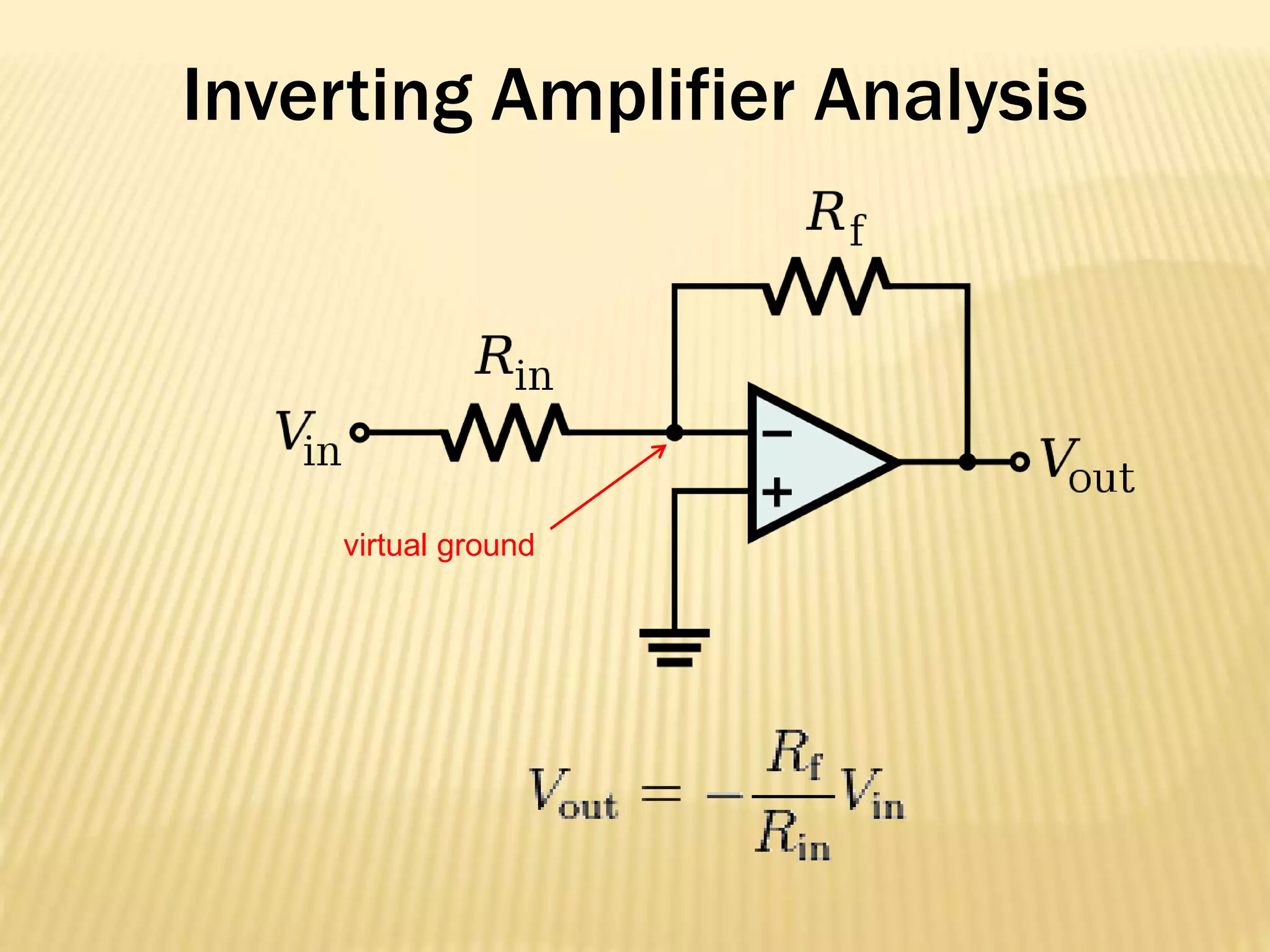
Inverting Amplifier Analysis
virtual ground
Non-Inverting Amplifier Analysis
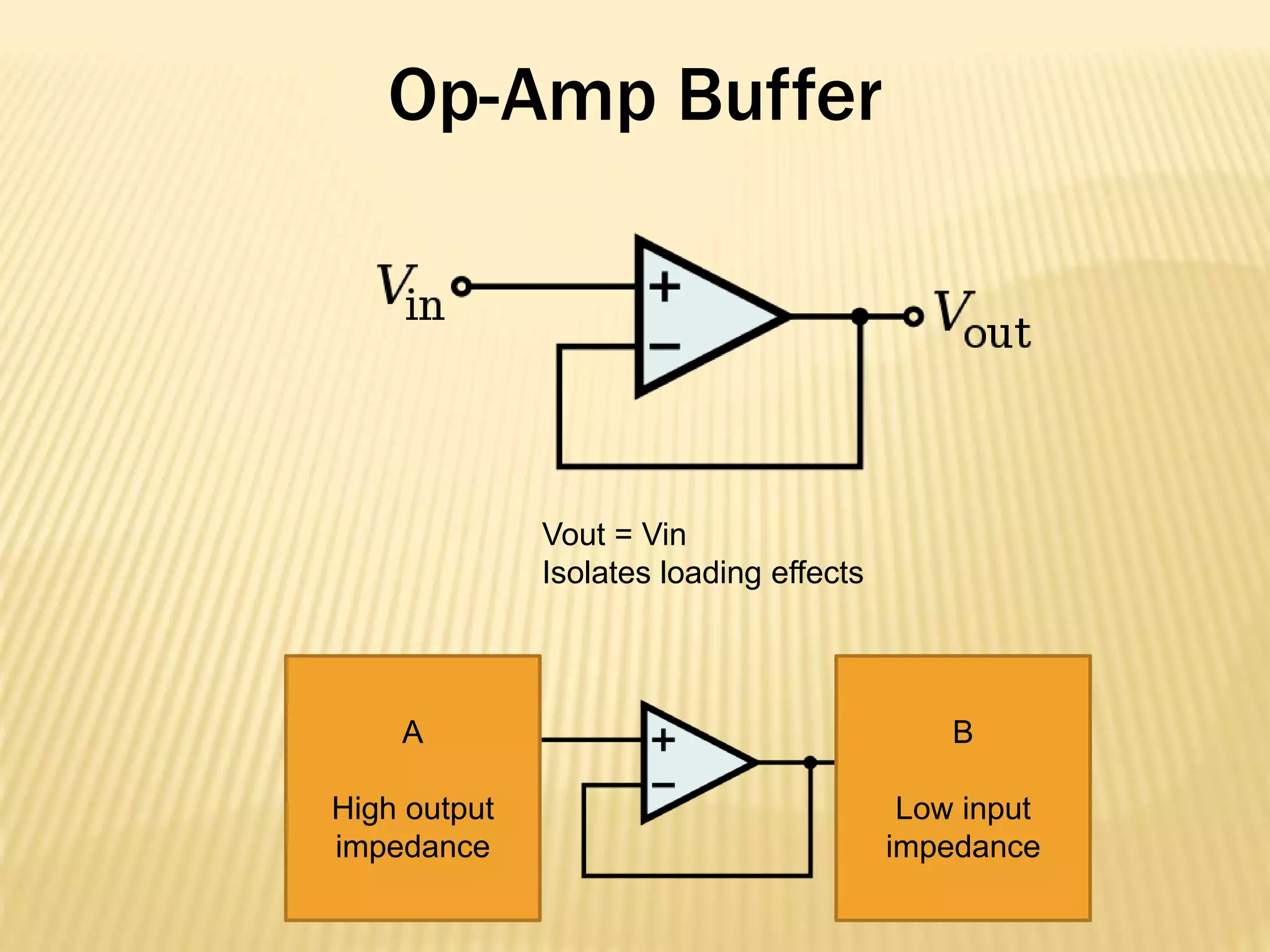
Op-Amp Buffer
Vout = Vin
Isolates loading effects
A
High output
impedance
B
Low input
impedance
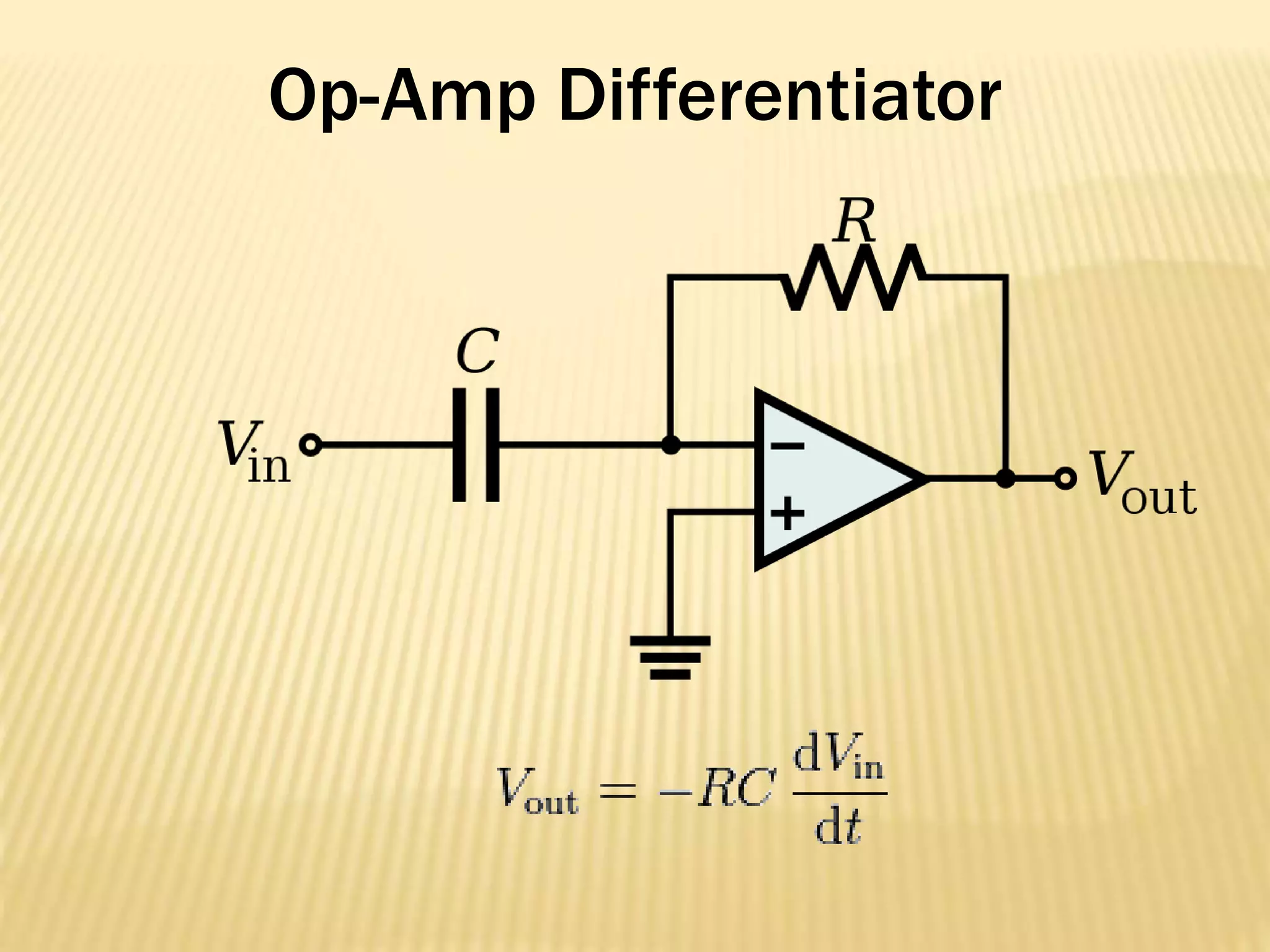
Op-Amp Differentiator
Op-Amp Integrator
Op-Amp Summing Amplifier
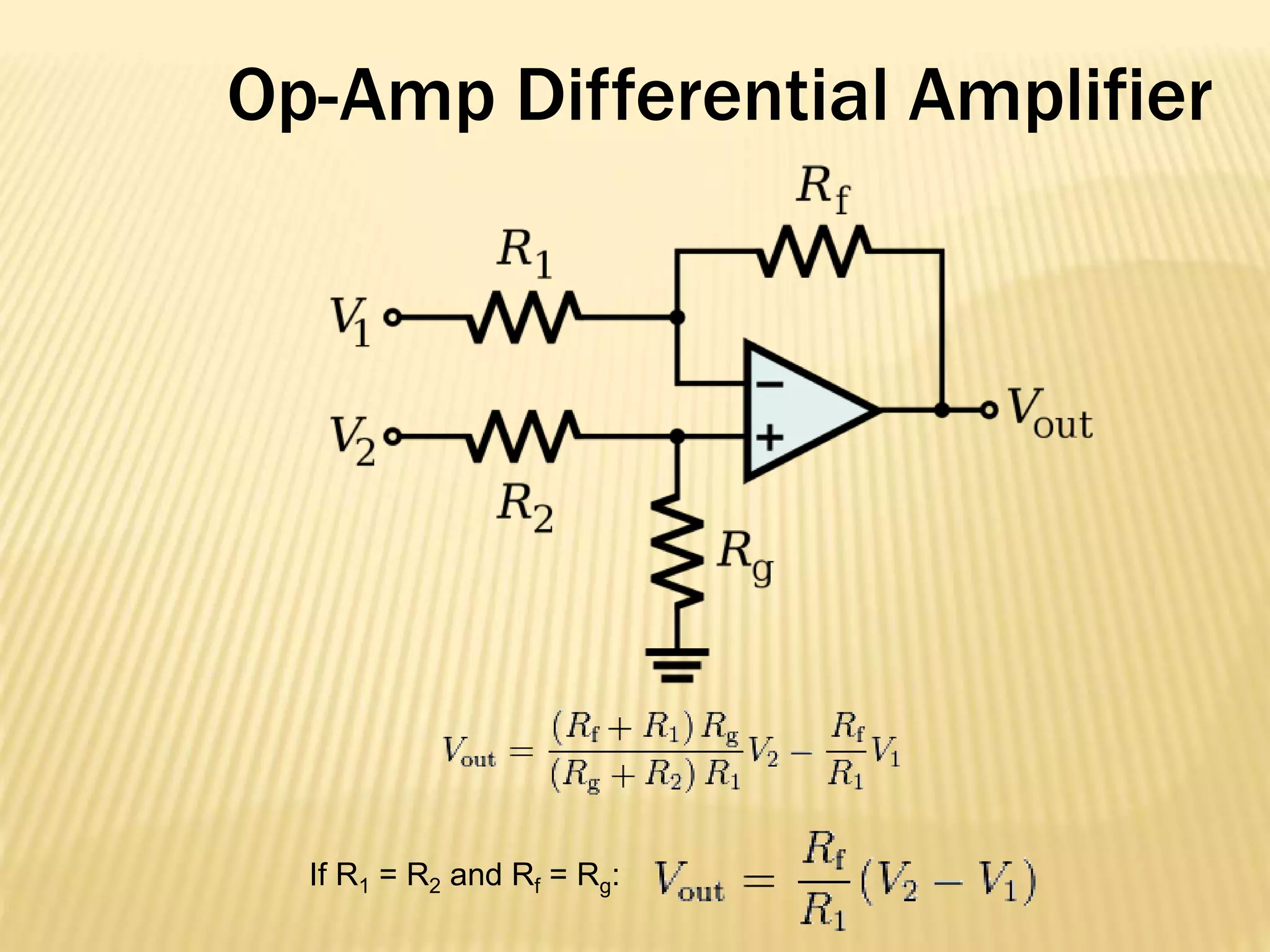
Op-Amp Differential Amplifier
If R1 = R2 and Rf = Rg:
Applications of Op-Amps
Filters
Types:
•Low pass filter
•High pass filter
•Band pass filter
•Cascading (2 or more filters connected
together) R2
+
-
+
V0
__
+ Vcc
- Vcc
-
+
R1
C
Low pass filter
Low pass filter Cutoff
frequency 
Low pass filter transfer
function
Applications of Op-Amps
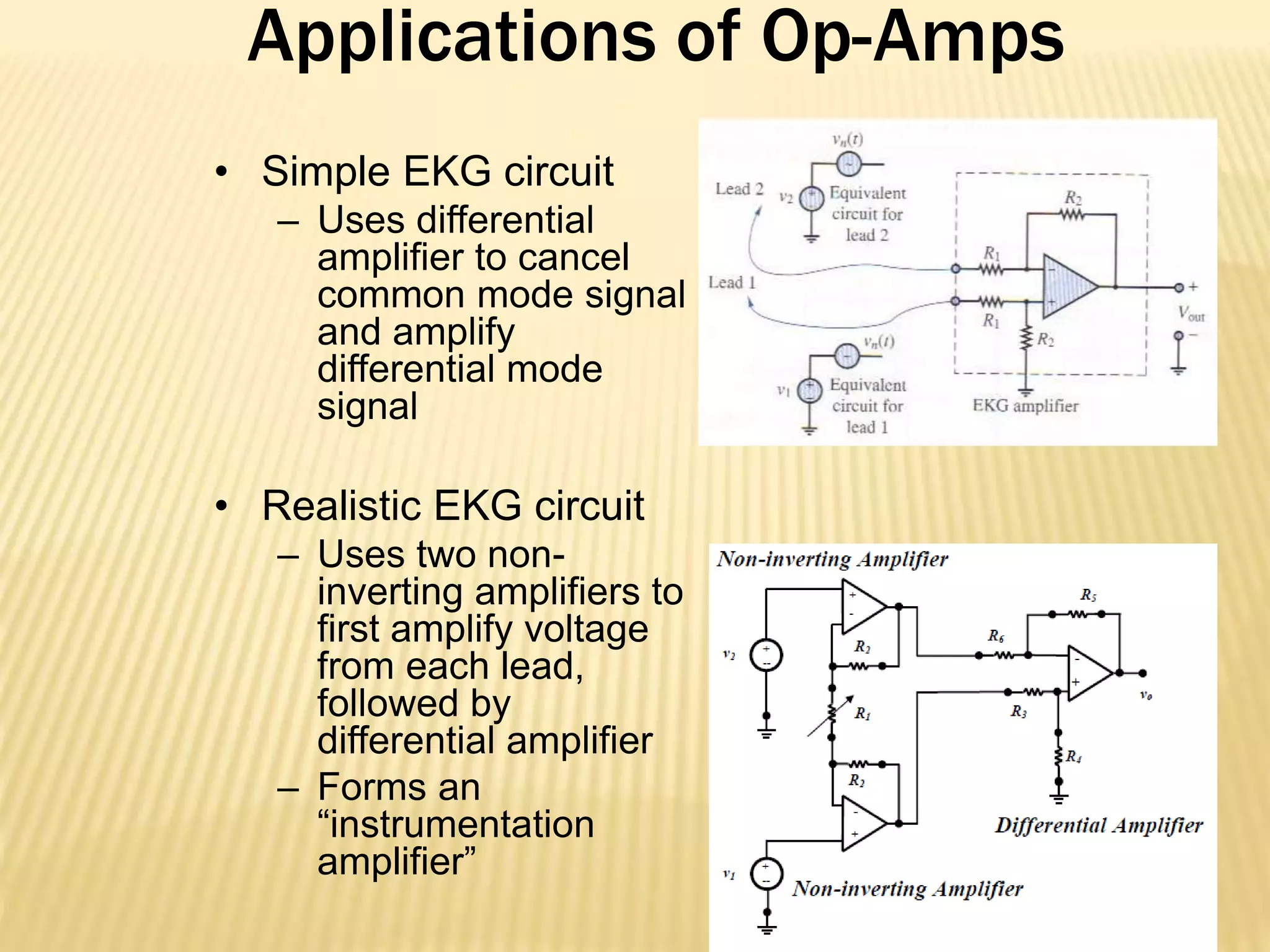
• Electrocardiogram (EKG) Amplification
– Need to measure difference in voltage from lead 1 and
lead 2
– 60 Hz interference from electrical equipment
Applications of Op-Amps
• Simple EKG circuit
– Uses differential
amplifier to cancel
common mode signal
and amplify
differential mode
signal
• Realistic EKG circuit
– Uses two non-
inverting amplifiers to
first amplify voltage
from each lead,
followed by
differential amplifier
– Forms an
“instrumentation
amplifier”
Strain Gauge
Use a Wheatstone bridge to
determine the strain of an
element by measuring the
change in resistance of a
strain gauge
(No strain) Balanced Bridge
R #1 = R #2
(Strain) Unbalanced Bridge
R #1 ≠ R #2
Strain Gauge
Half-Bridge Arrangement
Using KCL at the inverting and non-inverting
terminals of the op amp we find that  ε ~ Vo = 2ΔR(Rf /R2)
R + ΔR Rf
+
- +
V0
__
+ Vcc
- Vcc
-
+
Rf
Vref R
R - ΔR
R
Op amp used to amplify
output from strain gauge
Applications of Op-Amps
• Piezoelectric Transducer
– Used to measure force, pressure, acceleration
– Piezoelectric crystal generates an electric
charge in response to deformation
• Use Charge Amplifier
– Just an integrator op-amp circuit
•Goal is to have VSET = VOUT
•Remember that VERROR = VSET – VSENSOR
•Output Process uses VERROR from the PID controller to
adjust Vout such that it is ~VSET
P
I
D
Output
Process
Sensor
VERRORVSET
VOUT
VSENSOR
PID Controller – System Block
Diagram
Applications
PID Controller – System Circuit Diagram
Source:
http://www.ecircuitcenter.com/Circuits/op_pid/op_pid.htm
Calculates VERROR = -(VSET + VSENSOR)
Signal conditioning allows you to
introduce a time delay which could
account for things like inertia
System to control
-VSENSOR
Applications
PID Controller – PID Controller Circuit Diagram
VERR
Adjust Change
Kp RP1, RP2
Ki RI, CI
Kd RD, CD
VERR PID
Applications of Op-Amps
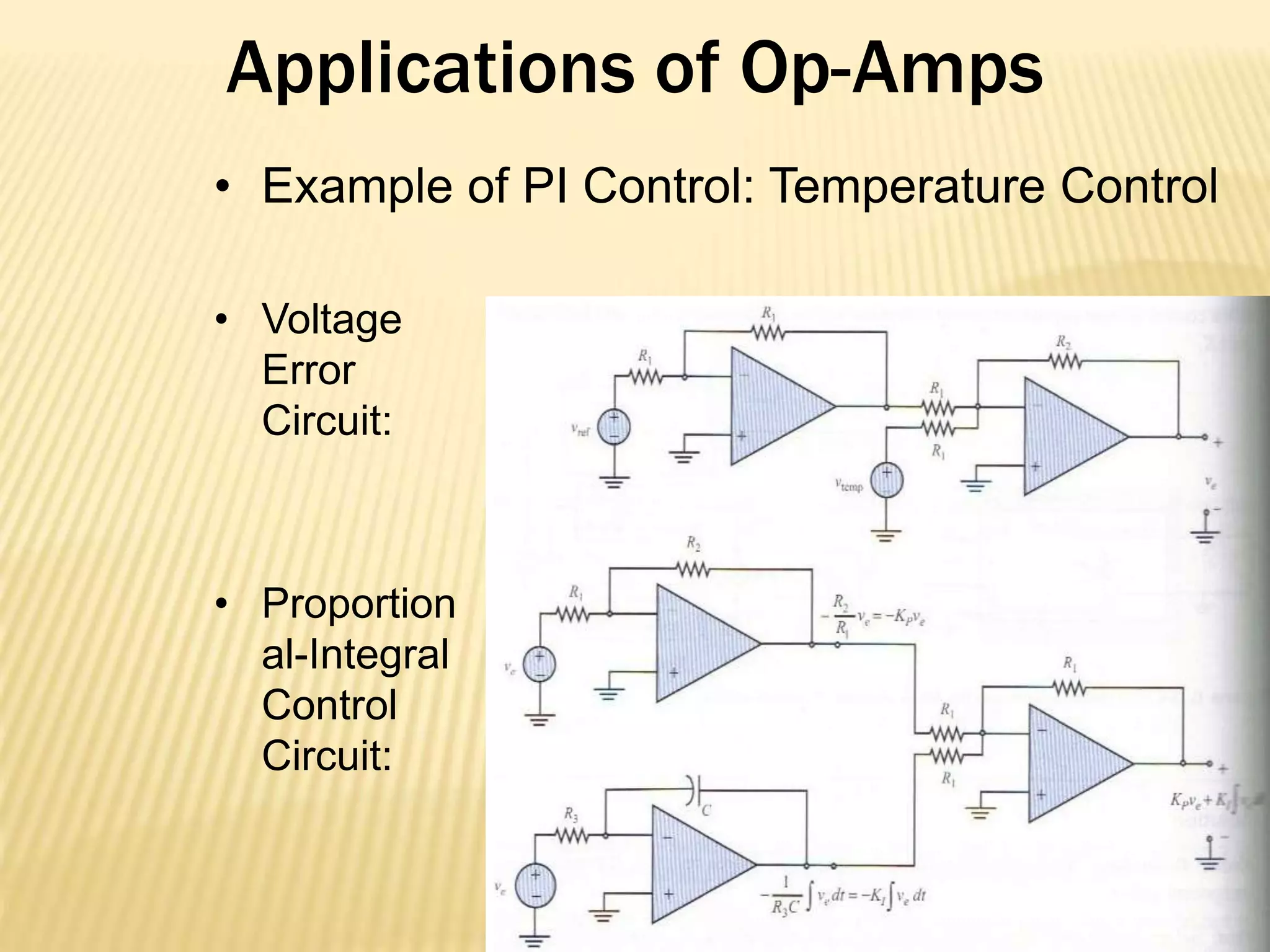
• Example of PI Control:
Temperature Control
• Thermal System we
wish to automatically
control the
temperature of:
• Block Diagram of
Control System:
Applications of Op-Amps
• Voltage
Error
Circuit:
• Proportion
al-Integral
Control
Circuit:
• Example of PI Control: Temperature Control
References
• Cetinkunt, Sabri. Mechatronics. Hoboken, NJ: John
Wiley & Sons Inc., 2007.
• Jung, Walter G. Op Amp Applications Handbook.
Analog Devices, Inc., 2005.
• “Operational Amplifier.”
http://en.wikipedia.org/wiki/Operational_amplifier.
• “Operational Amplifier Applications.”
http://en.wikipedia.org/wiki/Operational_amplifier_applica
tions.
References
• Cetinkunt, Sabri. Mechatronics. Hoboken, NJ: John
Wiley & Sons Inc., 2007.
• Jung, Walter G. Op Amp Applications Handbook.
Analog Devices, Inc., 2005.
• “Operational Amplifier.”
http://en.wikipedia.org/wiki/Operational_amplifier.
• “Operational Amplifier Applications.”
http://en.wikipedia.org/wiki/Operational_amplifier_applica
tions.
Sem2 ic b1_op_amp

Sem2 ic b1_op_amp

  • 1.
    FACULTY : Prof. M.S.Khokhar Prof. M.A. Bandi Prof. M.M. Sharma SHANTILAL SHAH ENGINEERING COLLEGE, BHAVNAGAR (INSTRUMENTATION & CONTROL DEPARTMENT)
  • 2.
    Roll no. Enrollmentno. Name 3017 140430117019 JITIN J PILLAI 3007 140430117008 CHAUHAN ASHISH MUKESHBHAI 3010 140430117012 DODIYA PARTH KISHORBHAI 3016 140430117018 ISHAN JATINKUMAR BHATT 3002 140430117002 BAVISHI BIRJU DINESHBHAI Group Members: BATCH B1
  • 3.
  • 4.
    What is anOp-Amp? – The Surface An Operational Amplifier (Op-Amp) is an integrated circuit that uses external voltage to amplify the input through a very high gain. We recognize an Op-Amp as a mass- produced component found in countless electronics. What an Op-Amp looks like to a lay-person What an Op-Amp looks like to an engineer
  • 5.
    What is anOp-Amp? – The Layout • There are 8 pins in a common Op- Amp, like the 741 which is used in many instructional courses.
  • 6.
    What is anOp-Amp? – The Inside • The actual count varies, but an Op-Amp contains several Transistors, Resistors, and a few Capacitors and Diodes. • For simplicity, an Op-Amp is often depicted as this: Non- Inverting Input Inverting Input Positive Power Supply Negative Power Supply Output - +
  • 7.
    History of theOp-Amp – The Dawn • Before the Op-Amp: Harold S. Black develops the feedback amplifier for the Western Electric Company (1920-1930) A β Input Output Forward Gain Feedback
  • 8.
    History of theOp-Amp – The Dawn • The Vacuum Tube Age • The First Op-Amp: (1930 – 1940) Designed by Karl Swartzel for the Bell Labs M9 gun director • Uses 3 vacuum tubes, only one input, and ± 350 V to attain a gain of 90 dB • Loebe Julie then develops an Op-Amp with two inputs: Inverting and Non-inverting
  • 9.
    History of theOp-Amp – The Shift • The end of Vacuum Tubes was built up during the 1950’s-1960’s to the advent of solid-state electronics 1. The Transistor 2. The Integrated Circuit 3. The Planar Process
  • 10.
    History of theOp-Amp – The Shift • 1960s: beginning of the Solid State Op-Amp • Example: GAP/R P45 (1961 – 1971) – Runs on ± 15 V, but costs $118 for 1 – 4 • The GAP/R PP65 (1962) makes the Op-Amp into a circuit component as a potted module
  • 11.
    History of theOp-Amp – The Evolution • The solid-state decade saw a proliferation of Op-Amps – Model 121, High Speed FET family, etc. • Robert J. Widlar develops the μA702 Monolithic IC Op- Amp (1963) and shortly after the μA709 • Fairchild Semiconductor vs. National Semiconductor – National: The LM101 (1967) and then the LM101A (1968) (both by Widlar) – Fairchild: The “famous” μA741 (by Dave Fullager 1968) and then the μA748 (1969)
  • 12.
    Mathematics of theOp-Amp • The gain of the Op-Amp itself is calculated as: G = Vout/(V+ – V-) • The maximum output is the power supply voltage • When used in a circuit, the gain of the circuit (as opposed to the op-amp component) is: Av = Vout/Vin
  • 13.
    Op-Amp Saturation • Asmentioned earlier, the maximum output value is the supply voltage, positive and negative. • The gain (G) is the slope between saturation points. Vout Vin Vs - Vs +
  • 14.
    741 Op-Amp Schematic differentialamplifier high-gain amplifier voltage level shifter output stage current mirror current mirror current mirror
  • 15.
    Op-Amp Characteristics • Open-loopgain G is typically over 9000 • But closed-loop gain is much smaller • Rin is very large (MΩ or larger) • Rout is small (75Ω or smaller) • Effective output impedance in closed loop is very small
  • 16.
    Ideal Op-Amp Characteristics •Open-loop gain G is infinite • Rin is infinite • Zero input current • Rout is zero
  • 17.
    Ideal Op-Amp Analysis Toanalyze an op-amp feedback circuit: • Assume no current flows into either input terminal • Assume no current flows out of the output terminal • Constrain: V+ = V-
  • 18.
  • 19.
  • 20.
    Op-Amp Buffer Vout =Vin Isolates loading effects A High output impedance B Low input impedance
  • 21.
  • 22.
  • 23.
  • 24.
  • 25.
    Applications of Op-Amps Filters Types: •Lowpass filter •High pass filter •Band pass filter •Cascading (2 or more filters connected together) R2 + - + V0 __ + Vcc - Vcc - + R1 C Low pass filter Low pass filter Cutoff frequency  Low pass filter transfer function
  • 26.
    Applications of Op-Amps •Electrocardiogram (EKG) Amplification – Need to measure difference in voltage from lead 1 and lead 2 – 60 Hz interference from electrical equipment
  • 27.
    Applications of Op-Amps •Simple EKG circuit – Uses differential amplifier to cancel common mode signal and amplify differential mode signal • Realistic EKG circuit – Uses two non- inverting amplifiers to first amplify voltage from each lead, followed by differential amplifier – Forms an “instrumentation amplifier”
  • 28.
    Strain Gauge Use aWheatstone bridge to determine the strain of an element by measuring the change in resistance of a strain gauge (No strain) Balanced Bridge R #1 = R #2 (Strain) Unbalanced Bridge R #1 ≠ R #2
  • 29.
    Strain Gauge Half-Bridge Arrangement UsingKCL at the inverting and non-inverting terminals of the op amp we find that  ε ~ Vo = 2ΔR(Rf /R2) R + ΔR Rf + - + V0 __ + Vcc - Vcc - + Rf Vref R R - ΔR R Op amp used to amplify output from strain gauge
  • 30.
    Applications of Op-Amps •Piezoelectric Transducer – Used to measure force, pressure, acceleration – Piezoelectric crystal generates an electric charge in response to deformation • Use Charge Amplifier – Just an integrator op-amp circuit
  • 31.
    •Goal is tohave VSET = VOUT •Remember that VERROR = VSET – VSENSOR •Output Process uses VERROR from the PID controller to adjust Vout such that it is ~VSET P I D Output Process Sensor VERRORVSET VOUT VSENSOR PID Controller – System Block Diagram
  • 32.
    Applications PID Controller –System Circuit Diagram Source: http://www.ecircuitcenter.com/Circuits/op_pid/op_pid.htm Calculates VERROR = -(VSET + VSENSOR) Signal conditioning allows you to introduce a time delay which could account for things like inertia System to control -VSENSOR
  • 33.
    Applications PID Controller –PID Controller Circuit Diagram VERR Adjust Change Kp RP1, RP2 Ki RI, CI Kd RD, CD VERR PID
  • 34.
    Applications of Op-Amps •Example of PI Control: Temperature Control • Thermal System we wish to automatically control the temperature of: • Block Diagram of Control System:
  • 35.
    Applications of Op-Amps •Voltage Error Circuit: • Proportion al-Integral Control Circuit: • Example of PI Control: Temperature Control
  • 36.
    References • Cetinkunt, Sabri.Mechatronics. Hoboken, NJ: John Wiley & Sons Inc., 2007. • Jung, Walter G. Op Amp Applications Handbook. Analog Devices, Inc., 2005. • “Operational Amplifier.” http://en.wikipedia.org/wiki/Operational_amplifier. • “Operational Amplifier Applications.” http://en.wikipedia.org/wiki/Operational_amplifier_applica tions.
  • 37.
    References • Cetinkunt, Sabri.Mechatronics. Hoboken, NJ: John Wiley & Sons Inc., 2007. • Jung, Walter G. Op Amp Applications Handbook. Analog Devices, Inc., 2005. • “Operational Amplifier.” http://en.wikipedia.org/wiki/Operational_amplifier. • “Operational Amplifier Applications.” http://en.wikipedia.org/wiki/Operational_amplifier_applica tions.