Definition
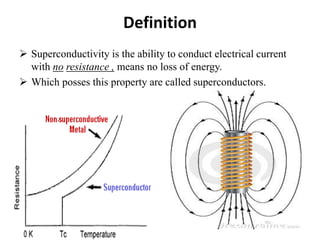
 Superconductivity is the ability to conduct electrical current
with no resistance , means no loss of energy.
 Which posses this property are called superconductors.
Discovery
• Superconductivity was first discovered in 1911 by the Dutch
physicist,Heike Kammerlingh Onnes.
• Onnes, felt that a cold wire's resistance would dissipate. This
suggested that there would be a steady decrease in electrical
resistance, allowing for better conduction of electricity.
• Onnes passed a current through a very pure mercury wire and
measured its resistance as he steadily lowered the temperature.
Much to his surprise there was no resistance at 4.15K(-2690C)
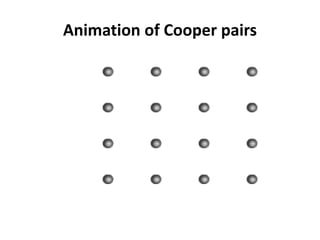
Animation of Cooper pairs
Meissner Effect
T > Tc
 Superconductors have negative susceptibility.
 If a superconductor is cooled below its critical temperature
while in a magnetic field, the magnetic field surrounds but
does not penetrate the superconductor. The magnet induces
current in the superconductor which creates a counter-
magnetic force that causes the two materials to repel.
T < Tc
h
h
h
Levitation of a magnet above a
cooled superconductor
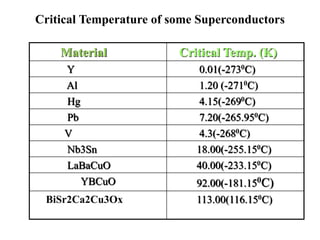
Critical Temperature of some Superconductors
Material Critical Temp. (K)
Y 0.01(-2730C)
Al 1.20 (-2710C)
Hg 4.15(-2690C)
Pb 7.20(-265.950C)
V 4.3(-2680C)
Nb3Sn 18.00(-255.150C)
LaBaCuO 40.00(-233.150C)
YBCuO 92.00(-181.150C)
BiSr2Ca2Cu3Ox 113.00(116.150C)
Disadvantages of superconductors
Today’s commercialized superconductors require
cryogenic refrigeration in order to operate, severely
restricting their market adoption because of high capital
and operating costs.
The first of these is the restricted range for operating
temperature. Since the world record for the highest critical
temperature stands at 138 K(135.150C).
there is still a long way to go before superconductors are
available to the average user at room temperature.
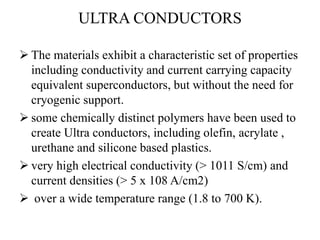
ULTRA CONDUCTORS
 The materials exhibit a characteristic set of properties
including conductivity and current carrying capacity
equivalent superconductors, but without the need for
cryogenic support.
 some chemically distinct polymers have been used to
create Ultra conductors, including olefin, acrylate ,
urethane and silicone based plastics.
 very high electrical conductivity (> 1011 S/cm) and
current densities (> 5 x 10⁸ A/cm2)
 over a wide temperature range (1.8 to 700 K).
NEW TECHNOLOGIES USING
SUPERCONDUCTORS:
Superconducting Fault Current Limiter(SFCL):
 When superconductor is cooled down to critical temperature
(about -186℃) or less, the resistance becomes zero.
 superconductor looses superconductivity and resistance occurs
rapidly (quench), when excessive current flows and exceeds
certain value (critical current). SFCL device uses this property.
SUPERCONDUCTING TRANSFORMER
 Superconducting windings are
cooled with liquid nitrogen.
 The superconducting wire can
flow 100 times more current
than copper wire of the same
unit area.
 superconducting transformer
is reduced more than 1/3 in
weight and volume, reduce
current loss more than 1/4
compared to the conventional
oil transformers.
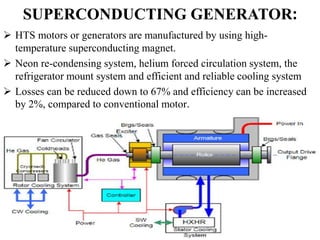
SUPERCONDUCTING GENERATOR:
 HTS motors or generators are manufactured by using high-
temperature superconducting magnet.
 Neon re-condensing system, helium forced circulation system, the
refrigerator mount system and efficient and reliable cooling system
 Losses can be reduced down to 67% and efficiency can be increased
by 2%, compared to conventional motor.
SUPERCONDUCTING CABLE
 AC superconducting cable can carry power more than five times of
power and about 1/4 or less transmission loss compared to the
conventional cable of the same size
 and DC superconducting cable can have approximately 20 times more
transmission capacity and approximately 1/40 of the transmission loss
compared to the conventional cable of the same capacity .
SUPERCONDUCTING MAGNETIC
ENERGY STORAGE SYSTEM (SEMS):
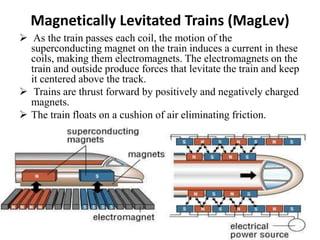
Magnetically Levitated Trains (MagLev)
 As the train passes each coil, the motion of the
superconducting magnet on the train induces a current in these
coils, making them electromagnets. The electromagnets on the
train and outside produce forces that levitate the train and keep
it centered above the track.
 Trains are thrust forward by positively and negatively charged
magnets.
 The train floats on a cushion of air eliminating friction.
Application in Medical
MRI (Magnetic Resonance Imaging) scans produce detailed images of soft tissues.
 The superconducting magnet coils produce a large and
uniform magnetic field inside the patient's body.
Technical seminar
Technical seminar
Technical seminar

Technical seminar

  • 2.
    Definition  Superconductivity isthe ability to conduct electrical current with no resistance , means no loss of energy.  Which posses this property are called superconductors.
  • 3.
    Discovery • Superconductivity wasfirst discovered in 1911 by the Dutch physicist,Heike Kammerlingh Onnes. • Onnes, felt that a cold wire's resistance would dissipate. This suggested that there would be a steady decrease in electrical resistance, allowing for better conduction of electricity. • Onnes passed a current through a very pure mercury wire and measured its resistance as he steadily lowered the temperature. Much to his surprise there was no resistance at 4.15K(-2690C)
  • 5.
  • 6.
    Meissner Effect T >Tc  Superconductors have negative susceptibility.  If a superconductor is cooled below its critical temperature while in a magnetic field, the magnetic field surrounds but does not penetrate the superconductor. The magnet induces current in the superconductor which creates a counter- magnetic force that causes the two materials to repel. T < Tc h
  • 7.
    h h Levitation of amagnet above a cooled superconductor
  • 8.
    Critical Temperature ofsome Superconductors Material Critical Temp. (K) Y 0.01(-2730C) Al 1.20 (-2710C) Hg 4.15(-2690C) Pb 7.20(-265.950C) V 4.3(-2680C) Nb3Sn 18.00(-255.150C) LaBaCuO 40.00(-233.150C) YBCuO 92.00(-181.150C) BiSr2Ca2Cu3Ox 113.00(116.150C)
  • 9.
    Disadvantages of superconductors Today’scommercialized superconductors require cryogenic refrigeration in order to operate, severely restricting their market adoption because of high capital and operating costs. The first of these is the restricted range for operating temperature. Since the world record for the highest critical temperature stands at 138 K(135.150C). there is still a long way to go before superconductors are available to the average user at room temperature.
  • 10.
    ULTRA CONDUCTORS  Thematerials exhibit a characteristic set of properties including conductivity and current carrying capacity equivalent superconductors, but without the need for cryogenic support.  some chemically distinct polymers have been used to create Ultra conductors, including olefin, acrylate , urethane and silicone based plastics.  very high electrical conductivity (> 1011 S/cm) and current densities (> 5 x 10⁸ A/cm2)  over a wide temperature range (1.8 to 700 K).
  • 11.
    NEW TECHNOLOGIES USING SUPERCONDUCTORS: SuperconductingFault Current Limiter(SFCL):  When superconductor is cooled down to critical temperature (about -186℃) or less, the resistance becomes zero.  superconductor looses superconductivity and resistance occurs rapidly (quench), when excessive current flows and exceeds certain value (critical current). SFCL device uses this property.
  • 12.
    SUPERCONDUCTING TRANSFORMER  Superconductingwindings are cooled with liquid nitrogen.  The superconducting wire can flow 100 times more current than copper wire of the same unit area.  superconducting transformer is reduced more than 1/3 in weight and volume, reduce current loss more than 1/4 compared to the conventional oil transformers.
  • 13.
    SUPERCONDUCTING GENERATOR:  HTSmotors or generators are manufactured by using high- temperature superconducting magnet.  Neon re-condensing system, helium forced circulation system, the refrigerator mount system and efficient and reliable cooling system  Losses can be reduced down to 67% and efficiency can be increased by 2%, compared to conventional motor.
  • 14.
    SUPERCONDUCTING CABLE  ACsuperconducting cable can carry power more than five times of power and about 1/4 or less transmission loss compared to the conventional cable of the same size  and DC superconducting cable can have approximately 20 times more transmission capacity and approximately 1/40 of the transmission loss compared to the conventional cable of the same capacity .
  • 15.
  • 16.
    Magnetically Levitated Trains(MagLev)  As the train passes each coil, the motion of the superconducting magnet on the train induces a current in these coils, making them electromagnets. The electromagnets on the train and outside produce forces that levitate the train and keep it centered above the track.  Trains are thrust forward by positively and negatively charged magnets.  The train floats on a cushion of air eliminating friction.
  • 17.
    Application in Medical MRI(Magnetic Resonance Imaging) scans produce detailed images of soft tissues.  The superconducting magnet coils produce a large and uniform magnetic field inside the patient's body.