S U B T I T L E H E R E
INCORPORATING RENEWABLE
ENERGY IN ELECTRICITY
GRIDS
Anuj kumar
11811726
CONTENTS
• Introduction to Electricity Systems.
• The Electricity System.
• Balancing Electricity Supply and Demand.
• Different Electricity Generation Technologies.
• Towards 100% Renewable Electricity.
Introduction to
Electricity System
An electric power system is a
network of electrical
components deployed to
supply, transfer, and use
electric power.
INTRODUCTION TO
ELECTRICITY SYSTEM
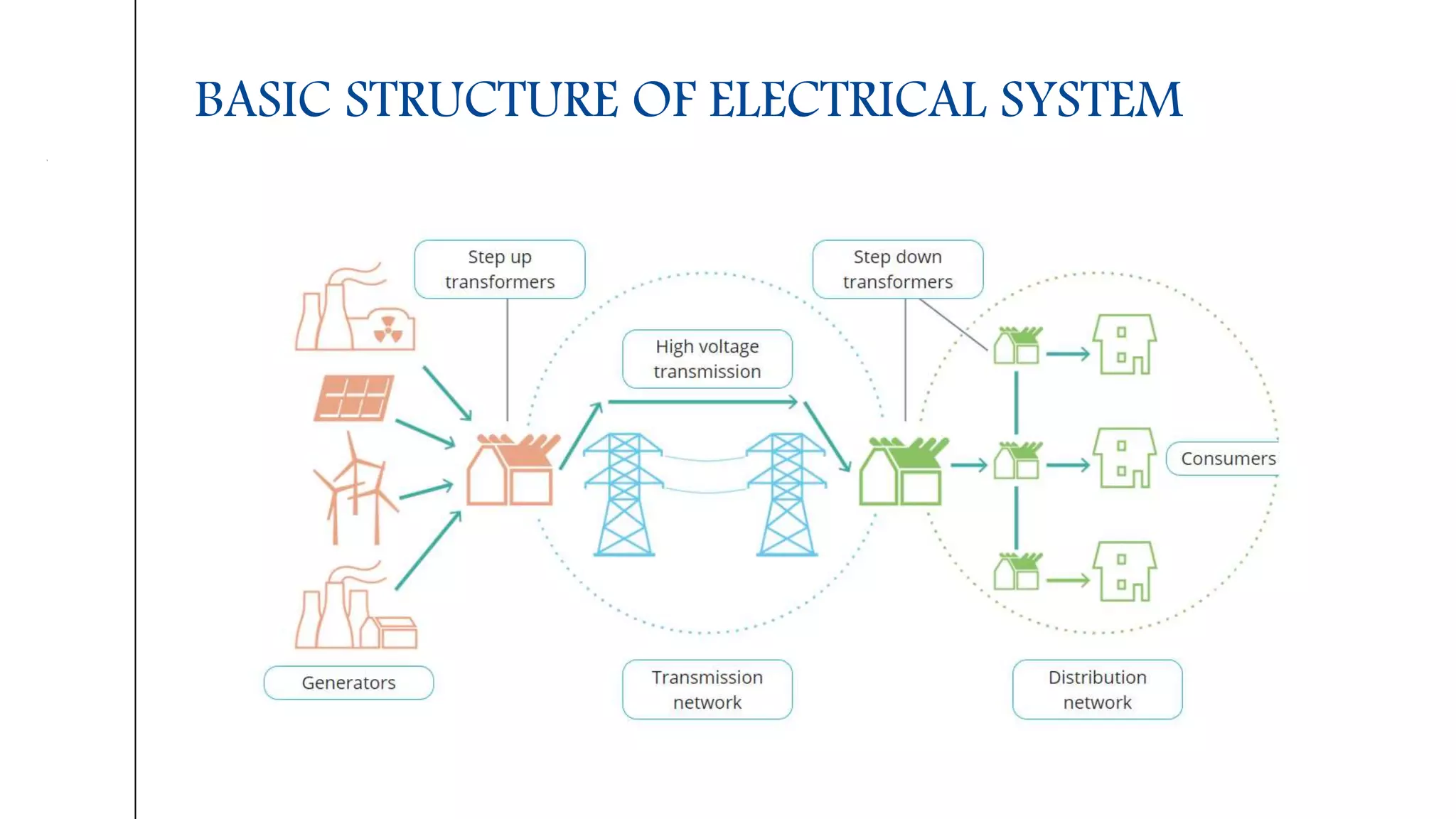
BASIC STRUCTURE OF ELECTRICAL SYSTEM
Basic structures of Electrical System
Step up transformers
These increase the voltage at which the electricity is transmitted, to many thousands of volts. This
reduces energy losses in the transmission system
Generators
A range of electricity generation technologies are used to supply electricity, from conventional fossil
fuel and nuclear to renewables like wind and solar photovoltaics. Electricity is fed into the transmission
network as Alternating Current at a specified Frequency
High voltage transmission
This can use either alternating or direct current. The latter allows very high voltage transmission with
very low losses of energy, in what are known as High Voltage Direct Current (HVDC) lines
Transmission network
This network of wires transports electricity over long distances.
Distribution network
The local network of wires that is used to deliver electricity to consumers
BALANCING ELECTRICITY SUPPLY AND DEMAND
The generation of electricity must equal the demand for electricity at all times. Unlike many commodities,
electricity cannot currently be stored economically in large quantities and for long periods. Whilst there are
methods of storage that are technically viable, at present they are relatively expensive. As a result, the
generation of electricity must equal the demand for electricity at all times. It is important that electricity supply
and demand are in balance, not only to ensure that demand is met, but also to keep the electricity system stable.
To monitor the supply-demand balance, electricity generators are metered on how much electricity they generate
within each time slot
It is ultimately the responsibility of the electricity system operator to ensure that all generation offers meet the
required demand level for the time slot.
System operators have a number of tools at their disposal to balance the system
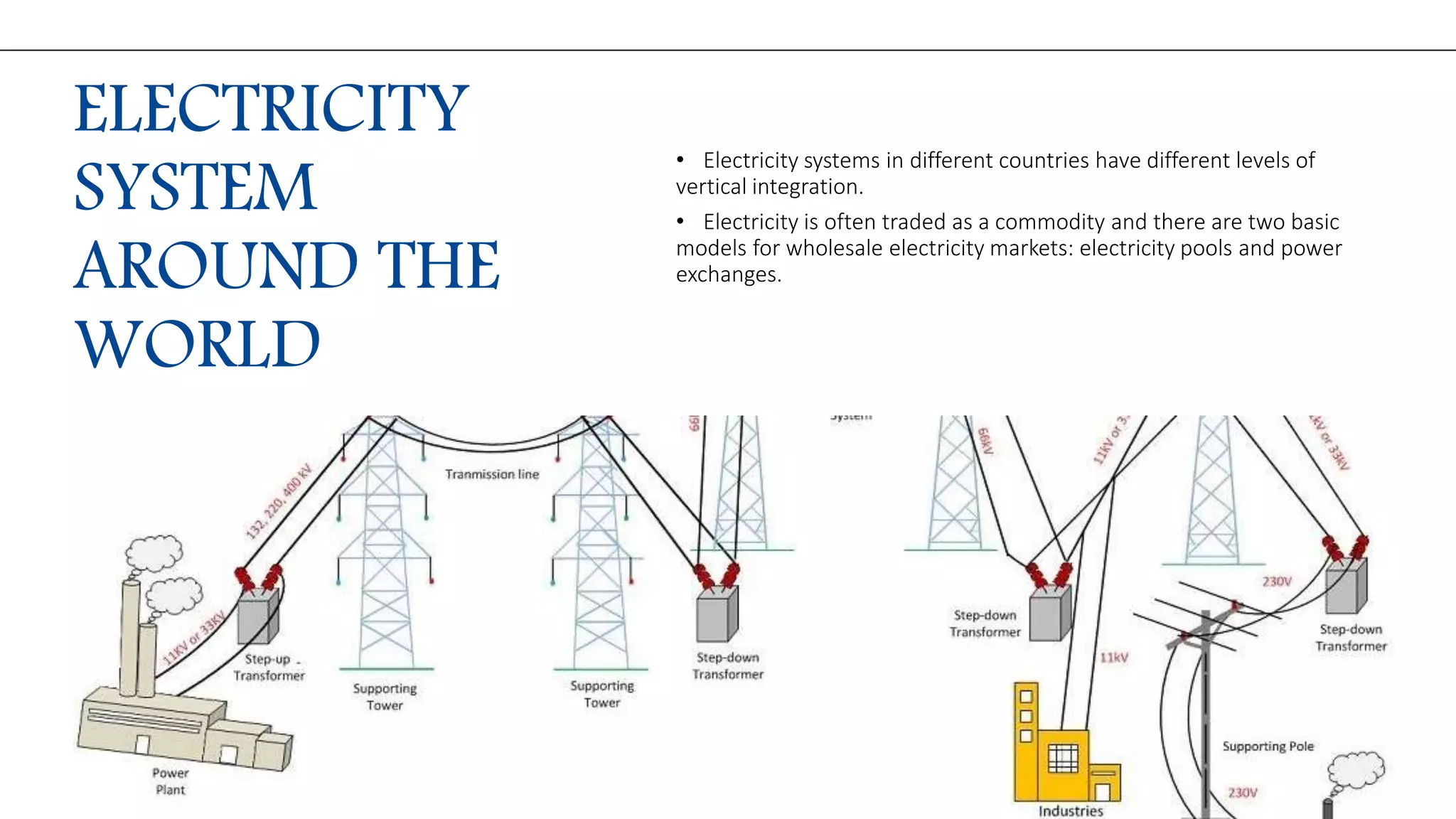
• Electricity systems in different countries have different levels of
vertical integration.
• Electricity is often traded as a commodity and there are two basic
models for wholesale electricity markets: electricity pools and power
exchanges.
ELECTRICITY
SYSTEM
AROUND THE
WORLD
DIFFERENT ELECTRICITY GENERATION
TECHNOLOGIES
•Fossil fuel plants are thermal, as are nuclear plants, since they generate electricity from heat from fuel
combustion or nuclear fission
•Renewables can be thermal (such as biomass, geothermal and concentrating solar) and non-thermal (such
as wind, hydro, solar photovoltaics, and tidal)
•Different electricity generation technologies have different operating characteristics, affecting their
predictability, flexibility and variability
COAL POWER PLANT
In coal and oil plants, chemical energy stored in the coal
and oil is released as heat when these fuels are burned
This heat is used to convert water into extremely hot
(superheated) steam in specially designed boilers. The
superheated steam is piped to a turbine, making it rotate.
The steam is then condensed back into water for re-use.
The process of generation of steam from water, and its
subsequent condensation back to water, is known as the
steam cycle. As the turbine rotates, magnets attached to
its axel rotate, inducing an alternating current in coils of
wire that surround the magnets.
NUCLEAR POWER PLANT
The heat is created from a reaction called nuclear fission.
This is the breaking up of atomic nuclei of certain elements
which are heavy and relatively unstable, most commonly
uranium, but in some cases plutonium and thorium. Fission
is caused by firing neutrons at these elements, whose nuclei
break-up (creating lighter elements) thereby releasing energy
as heat. The break-up also releases new neutrons, which
then cause further fission in what is known as a chain
reaction. This is carefully controlled using special control
rods, most commonly made of boron. The boron absorbs
some of the neutrons, and the control rods are raised and
lowered to manage the reaction rate at the desired level.
This heat is then harnessed within a conventional steam
cycle.
LEVELISED COST OF ELECTRICITY
•The levelised cost of electricity (LCOE) is a
commonly-used metric of the cost to generate
electricity using a particular generation
technology
• LCOE is an estimate of the net present value of the
unit cost of electricity (e.g. in $/MWh) over the lifetime
of the generation technology. LCOE allows for a
comparison of different generation technologies that
may operate at different scales (capacity), have
different investment and operational time horizons,
have varied capital costs, and/or require different fuel
types and associated costs.
•It does not reflect the predictability, variability and
flexibility of electricity generation.
THE IMPACT OF
RENEWABLES ON
THE MERIT ORDER
The merit order indicates that lower operating
cost plants are deployed first. Variable
renewables like wind and solar PV have very
low marginal costs of electricity generation.
TOWARDS 100%
RENEWABLE
ELECTRICITY
TOWARDS 100% RENEWABLE ELECTRICITY
•Over the past decade there have been many analyses on the potential to achieve 100% renewable
electricity systems
Justifications for such analyses include the relative maturity of renewables, their near-zero emissions, and low
environmental and political risk.
•Some analyses suggest that the cost of 100% renewable electricity systems need not be significantly
higher than conventional electricity systems
•100% renewables-based electricity may be achievable in the long-term, but we must proceed with
caution
It may be a technically achievable goal in the long-term to base electricity systems solely on renewable
generators, but transitioning to 100%, or at least very high penetration, renewables electricity systems, could
face challenges.
THANK YOU

Incorporating renewable energy in electricity grids

  • 1.
    S U BT I T L E H E R E INCORPORATING RENEWABLE ENERGY IN ELECTRICITY GRIDS Anuj kumar 11811726
  • 2.
    CONTENTS • Introduction toElectricity Systems. • The Electricity System. • Balancing Electricity Supply and Demand. • Different Electricity Generation Technologies. • Towards 100% Renewable Electricity.
  • 3.
  • 4.
    An electric powersystem is a network of electrical components deployed to supply, transfer, and use electric power. INTRODUCTION TO ELECTRICITY SYSTEM
  • 5.
    BASIC STRUCTURE OFELECTRICAL SYSTEM
  • 6.
    Basic structures ofElectrical System Step up transformers These increase the voltage at which the electricity is transmitted, to many thousands of volts. This reduces energy losses in the transmission system Generators A range of electricity generation technologies are used to supply electricity, from conventional fossil fuel and nuclear to renewables like wind and solar photovoltaics. Electricity is fed into the transmission network as Alternating Current at a specified Frequency High voltage transmission This can use either alternating or direct current. The latter allows very high voltage transmission with very low losses of energy, in what are known as High Voltage Direct Current (HVDC) lines Transmission network This network of wires transports electricity over long distances. Distribution network The local network of wires that is used to deliver electricity to consumers
  • 7.
    BALANCING ELECTRICITY SUPPLYAND DEMAND The generation of electricity must equal the demand for electricity at all times. Unlike many commodities, electricity cannot currently be stored economically in large quantities and for long periods. Whilst there are methods of storage that are technically viable, at present they are relatively expensive. As a result, the generation of electricity must equal the demand for electricity at all times. It is important that electricity supply and demand are in balance, not only to ensure that demand is met, but also to keep the electricity system stable. To monitor the supply-demand balance, electricity generators are metered on how much electricity they generate within each time slot It is ultimately the responsibility of the electricity system operator to ensure that all generation offers meet the required demand level for the time slot. System operators have a number of tools at their disposal to balance the system
  • 8.
    • Electricity systemsin different countries have different levels of vertical integration. • Electricity is often traded as a commodity and there are two basic models for wholesale electricity markets: electricity pools and power exchanges. ELECTRICITY SYSTEM AROUND THE WORLD
  • 9.
    DIFFERENT ELECTRICITY GENERATION TECHNOLOGIES •Fossilfuel plants are thermal, as are nuclear plants, since they generate electricity from heat from fuel combustion or nuclear fission •Renewables can be thermal (such as biomass, geothermal and concentrating solar) and non-thermal (such as wind, hydro, solar photovoltaics, and tidal) •Different electricity generation technologies have different operating characteristics, affecting their predictability, flexibility and variability
  • 10.
    COAL POWER PLANT Incoal and oil plants, chemical energy stored in the coal and oil is released as heat when these fuels are burned This heat is used to convert water into extremely hot (superheated) steam in specially designed boilers. The superheated steam is piped to a turbine, making it rotate. The steam is then condensed back into water for re-use. The process of generation of steam from water, and its subsequent condensation back to water, is known as the steam cycle. As the turbine rotates, magnets attached to its axel rotate, inducing an alternating current in coils of wire that surround the magnets.
  • 11.
    NUCLEAR POWER PLANT Theheat is created from a reaction called nuclear fission. This is the breaking up of atomic nuclei of certain elements which are heavy and relatively unstable, most commonly uranium, but in some cases plutonium and thorium. Fission is caused by firing neutrons at these elements, whose nuclei break-up (creating lighter elements) thereby releasing energy as heat. The break-up also releases new neutrons, which then cause further fission in what is known as a chain reaction. This is carefully controlled using special control rods, most commonly made of boron. The boron absorbs some of the neutrons, and the control rods are raised and lowered to manage the reaction rate at the desired level. This heat is then harnessed within a conventional steam cycle.
  • 12.
    LEVELISED COST OFELECTRICITY •The levelised cost of electricity (LCOE) is a commonly-used metric of the cost to generate electricity using a particular generation technology • LCOE is an estimate of the net present value of the unit cost of electricity (e.g. in $/MWh) over the lifetime of the generation technology. LCOE allows for a comparison of different generation technologies that may operate at different scales (capacity), have different investment and operational time horizons, have varied capital costs, and/or require different fuel types and associated costs. •It does not reflect the predictability, variability and flexibility of electricity generation.
  • 13.
    THE IMPACT OF RENEWABLESON THE MERIT ORDER The merit order indicates that lower operating cost plants are deployed first. Variable renewables like wind and solar PV have very low marginal costs of electricity generation.
  • 14.
  • 15.
    TOWARDS 100% RENEWABLEELECTRICITY •Over the past decade there have been many analyses on the potential to achieve 100% renewable electricity systems Justifications for such analyses include the relative maturity of renewables, their near-zero emissions, and low environmental and political risk. •Some analyses suggest that the cost of 100% renewable electricity systems need not be significantly higher than conventional electricity systems •100% renewables-based electricity may be achievable in the long-term, but we must proceed with caution It may be a technically achievable goal in the long-term to base electricity systems solely on renewable generators, but transitioning to 100%, or at least very high penetration, renewables electricity systems, could face challenges.
  • 16.