Addis Ababa Science and Technology University
Electrical and Computer Engineering Department
EHV SUBSTATION DESIGN CONSIDERATION
Prepared by: DemsewM.
JULY 2017
Module Contents
o Introduction to power system
o HVDC Fundamentals
o Substation Layout
o Substation Protection
o Earthing Design
o Lightning protection
o HV-Switching Technology
o Substation Auxiliary Equipment
Module Objective
o To create fundamental understanding of HVDC concept for
trainers.
o To show design principle of EHV-Substation
o To understand how the economical Substation Switching Scheme,
Rating of Arrester and economical size of earthing conductor and
insulator, and appropriate protection selection for EHV will be
done.
Module Category/Target Group
Prepared for EEP trainee category of:
oE4-E6
CHAPTER ONE
HVDC and AC Power System Structure
Chapter Contents:
– Power Generation System
– Power Transmission System
– Power Distribution System
– HVDC Fundamentals
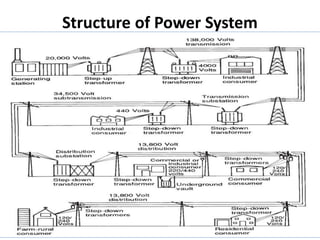
Structure of Power System
1. Electric Power Generation
• Electric generators are devices that convert energy
from a mechanical form into an electrical form.
• This process, known as electromechanical energy
conversion, involves magnetic fields that act as an
intermediate medium.
• The input to the generating machine can be derived
from a number of energy sources.
Hydro Electric Power Generation
Group Discussion
• How electric generation is possible from run-
off river and ocean wave?
Solar Power Generation
Photovoltaic energy -
solar energy converted
directly to electrical
current
Group Discussion
• How solar thermal electric generation is possible?
Bio-Electricity
• This energy
source involves
the use of high-
pressure, high-
temperature
steam fields that
exist below the
earth’s surface.
Geothermal Power Generation
Wind Power Generation
• Wind power - advantages and disadvantages
• Wind farms - potential exists in Great Plains, along seacoasts and Oceanic
area
Group Discussion
• Discuss the situation of our current power
generation from wind?
• Discuss also other source of electricity
generation?
2. Electric Power Transmission
• Electric power transmission is the bulk
transfer of electrical energy, a process in the
delivery of electricity to consumers.
• A power transmission network typically
connects power plants at remote location to
multiple substations near a populated area.
Cont’d…
• Overhead electric power transmission allows
distant energy sources (such as hydroelectric
power plants) to be connected to consumers in
population centers, and
• May allow exploitation of low-grade fuel
resources such as coal that would otherwise be
too costly to transport to generating facilities.
Cont’d…
• Today, transmission-level voltages are usually considered to be
132 kV and above (1600kV, 1100kV, 800kV, 500kV, 400kV and
230kV).
• Voltages above 230 kV are extra high voltage and require
different designs compared to equipment used at lower voltages.
• Lower voltages such as 66 kV and 33 kV are usually considered
sub-transmission voltages but are occasionally used on long
lines with light loads.
• Voltages less than 33 kV are usually used for distribution.
Cont’d…
Overhead Transmission Structures
The basic overhead transmission line structure:
o Bare conductor
oWood, Concrete, Lattice or tabular steel pole
o Insulator (Suspension , Post or Pin type)
o Ground Wire
Bare Conductor
• The most widely used conductor material for
power transmission and distribution are:
o Aluminum and,
o Copper
• Due to their:
o Electrical conductivity
o Weight, Strength and Durability
o Cost and
o Installation flexibility
Cont’d…
• Aluminum conductors reinforced with steel (known as
ACSR) are primarily used for medium and high voltage
lines and may also for overhead services to individual
customers.
• Aluminum conductors has the advantage of better weight
than copper, as well as being cheaper.
• Some copper cable is still used, especially at lower
voltages and for grounding.
Electric Pylon
• Structures for overhead lines take a variety of shapes depending
on the type of line.
• Structures may be as simple as wood poles directly set in the
earth, carrying one or more cross-arm to support conductors, or
"armless" construction with conductors supported on insulators
attached to the side of the pole.
• Tubular steel poles are typically used in urban areas.
• High-voltage lines are often carried on lattice-type steel towers.
Cont’d…
• For remote areas, wood pole or Concrete poles have been used.
• Each structure must be designed for the loads imposed on it by
the conductors (High voltage or Low voltage structure).
• Foundations for tower structures may be large and costly,
particularly if the ground conditions are poor, such as in
wetlands.
• Each structure may be considerably strengthened by the use of
guy wires to resist some of the forces due to the conductors.
Anchor pylons or strainer pylons
are employed at branch points as
branch pylons and must occur at a
maximum interval of 5 km, due to
technical limitations on conductor
length
Branch pylon
is a pylon that
is used to start
a line branch.
Tension tower for
phase transposition
Type of pylon by function
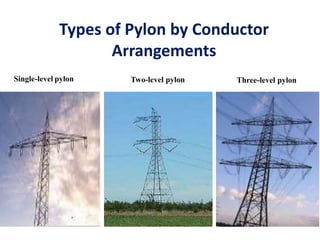
Types of Pylon by Conductor
Arrangements
Single-level pylon Two-level pylon Three-level pylon
Insulators
• Insulators must support the conductors and withstand both the
normal operating voltage and surges due to switching and lightning.
• Insulators are broadly classified as either pin-type, which support
the conductor above the structure, or suspension type, where the
conductor hangs below the structure.
• Up to about 132 kV both types are commonly used. At higher
voltages only suspension-type insulators are common for overhead
conductors.
• Insulators are usually made of ceramic or reinforced glass or
plastic.
Cont’d…
• Insulators are made of multiple
units, with the number of unit
insulator disks increasing at
higher voltages.
• The number of disks is chosen
based on line voltage, lightning
withstand requirement, and
environmental factors such as
fog, pollution, or salt spray.
Design Principle of OH Transmission Line
• Design of these lines requires:
o Minimum clearances
o High insulation level
o Economical transmission voltage level
o Optimum conductor size
o Enough mechanical strength of supporting tower.
o Optimum span length
Group Discussion
1. How you rate the transmission system in
Ethiopia?
a. The power quality issue
b. The power loss problem
c. The voltage drop issues
3. Electric Power Distribution
• In distribution systems the supply authority
collects the bulk energy at 66 kV or less from the
transmission substation.
• There are specific voltage values used in the
distribution of electrical power. These voltage
values, which are all ‘line to line’ values are
66kV, 33kV, 15kV, 11kV, 6.6kV, 3.3kV and
400/230V.
Distribution Voltage Selection
• The choice of voltage to be used on any particular section
in the distribution system will be influenced by:
– Decisions associated with voltage drops resulting from
large current loads
– Capital cost of transformers used to change voltage
levels
– Capital costs of construction of distribution lines and
associated switchgear to operate at the chosen voltage
– Environmental aspects of the system installation.
Types of Distribution Feeder
a. Radial Feeder
• Many distribution systems operate using a ‘radial
feeder’ system.
Cont’d…
• Radial feeders are the simplest and least expensive,
both to construct and for their protection system.
• This advantage however is offset by the difficulty
of maintaining supply in the event of a fault
occurring in the feeder.
• A fault would result in the loss of supply to a
number of customers until the fault is located and
cleared.
Cont’d…
b) Parallel Feeders
• A greater level of reliability at a higher cost is achieved with a
parallel feeder.
Cont’d…
c) Ring Main Feeder
• A high level of system reliability can be achieved by
using ‘ring main’ feeders.
Group Discussion
1. Discuss about the power distribution situation in
Ethiopia?
a. Types of distribution feeder?
b. How you rate the distribution reliability issue in
your area?
c. Frequently facing fault type?
d. Mechanism of location of fault and its
clearance?
e. Major cause of distribution power interruption?
Addis Ababa Science and Technology University
Electrical and Computer Engineering Department
HVDC FUNDAMENTALS
Prepared by: DemsewM.
July 2017
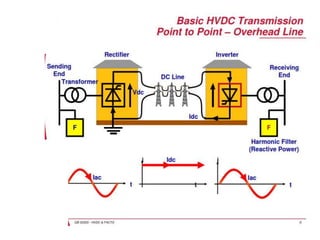
HVDC
• Introduction
• Principle of AC/DC conversion
• HVDC Link Configuration
• Economic considerations, applications of HVDC
• Advantages and disadvantages of HVDC systems.
Introduction
In the past ...
At the beginning of 20th century, DC (Direct Current) was superseded by AC
(Alternating Current) for large-scale electrification. DC power did nevertheless
survive, in applications like electric traction and drives.
Today ...
Today, bulk power systems are 3-phase AC, while utilization is either 1-phase or 3-
phase AC.
In our country ...
….is actually a single AC power system, running synchronously at 50 Hz,
spanning from N_S_E_W!
Introduction
• Power Transmission was initially carried out in the early
1880s using Direct Current (d.c.).
• So why dominated by AC-Transmission?
o With the availability of transformers
o The development of robust induction motor
o The availability of the superior synchronous
generator,
o The facilities of converting a.c. to d.c.
History of Events
1880s
Power Transmission was initially carried out using Direct Current
1930s
Efficient static AC/DC conversion (mercury arc valves) was made
possible.
1940s
High Voltage DC (HVDC) bulk power transmission was studied in
Germany.
1954
First commercial application in Sweden: submarine link between
mainland and Gotland island (100 kV-20 MW-90 km).
1970s
Today ...
Thyristors (SCRs) took over; today, HVDC operation voltages attain 600
kV, transmitted power over 3000 MW.
DC made its way back into bulk power systems!
ADVANTAGES
Advantages of dc
transmission
Technical
Advantages
Economic
Advantages
Environmental
Benefits
Technical Merits and Demerits of HVDC
Advantages of DC:
• More power can be transmitted per conductor per
circuit how?
o For the same insulation level and conductor size
the per phase power analysis give us:
Cont’d…
• Higher Capacity available for cables
o The same power transmitted P, same losses PL and
same insulation level, we can determine the reduction
of conductor cross-section Ad over Aa.
Cont’d…
• Smaller Tower Size
o Since HVDC allows small size of
insulator and conductor to
transmit power over long
distance
o And also due to lack of a time
varying magnetic flux in dc
system so conductor spacing
and clearance is not that much
high due to the above reason
smaller tower size is required
for HVDC
AC
DC
DC
Cont’d…
• No skin effect
o Under a.c. conditions, the current is not uniformly
distributed over the cross section of the conductor. The
current density is higher in the outer region (skin effect)
and result in under utilisation of the conductor cross
section.
o Skin effect under conditions of smooth d.c. is completely
absent and hence there is a uniform current in the
conductor, and the conductor metal is better utilised.
Cont’d…
• Less corona and radio interference
o Since corona loss increases with frequency (in fact
it is known to be proportional to f),
o For a given conductor diameter and applied
voltage, there is much lower corona loss and hence
more importantly less radio interference with d.c.
Cont’d…
• No Stability Problem
o There is no voltage phase angle in dc
o There is no frequency in dc
o There is no need of synchronization
o But, In a.c. links the phase angle between sending
end and receiving end should not exceed 30o at full-
load for transient stability (maximum theoretical
steady state limit is 90o).
Cont’d…
• Asynchronous interconnection possible
o With a.c. links, interconnections between power systems
must be synchronous.
o Thus different frequency systems or different voltage
systems cannot be interconnected.
o Such systems can be easily interconnected through hvdc
links.
o For different frequency interconnections both convertors
can be confined to the same station.
Problems Associated with HVDC
1. Expensive convertors (More than double of transformer station)
2. Reactive power requirement (50% of the DC link active power capacity)
3. Generation of harmonics (Need extra investment for harmonic filter)
4. Difficulty of voltage transformation
5. Difficulty of high power generation (this also the challenge of AC)
6. Absence of overload capacity (Convertors have very little overload
capacity unlike transformers)
Economic Comparison
• The hvdc system has a lower line cost per unit length as
compared to an equally reliable a.c. system due to the
lesser number of conductors and smaller tower size.
• However, the d.c. system needs two expensive convertor
stations which may cost around two to three times the
corresponding a.c. transformer stations.
• Thus hvdc transmission is not generally economical for
short distances, unless other factors dictate otherwise.
Cont’d…
• Estimates for the break even
distance of overhead lines are
around 500 km to 800km.
• This value depending on the
magnitude of power transfer
and the range of costs of lines
and equipment.
• The breakeven distances are
reducing with the progress
made in the development of
converting devices.
Cont’d…
• For cables, the break-even distance is much
smaller than for overhead lines and is of the order
of 25 km for submarine cables and 50 km for
underground cables.
• For a long cable connection, e.g. beyond 40 km,
HVDC will in most cases offer the only technical
solution because of the high charging current of
an AC cable.
Environmental Concern
• The land coverage and the associated right-of-
way for an HVDC overhead transmission line is
not as high as that of an AC line.
• This reduces the visual impact and saves plant
deforestation and impact on cultural heritages.
• It is also possible to increase the power
transmission capacity for existing rights of way.
AC/DC Conversion Fundamental
• Basically for practical Application of HVDC
transmission the following converter bridges
are used:
o12-pulse converter
o18-pulse converter and,
o24-Pulse Converter
• But those converter are fundamental blocks of
6-pulse converter
Six-pulse Converter Bridge and Their Input-Output
DC-Output Voltage of 6-Pulse Bridge
• If E is the r.m.s, line-to-line voltage, then the dc voltage output is :
𝑉𝑎𝑣𝑒 = 𝑉𝑑𝑐 =
1
𝑇 0
𝑇
2 ∗ 𝐸 sin( 𝑤𝑡)𝑑(𝑤𝑡)
𝑉𝑎𝑣𝑒 = 𝑉𝑑𝑐 =
6
2𝜋 𝜋
3
2𝜋
3
2 ∗ 𝐸 sin( 𝑤𝑡)𝑑 𝑤𝑡
𝑉𝑑𝑐 =
3 2
𝜋
𝐸 = 1.35𝐸 =
3 3 ∗ 2
𝜋
∗ 𝐸 𝑝ℎ𝑎𝑠𝑒 = 2.34𝐸 𝑝ℎ𝑎𝑠𝑒
HVDC links can be broadly classified into:
Monopolar links
Bipolar links
HVDC System Configurations
66
66
Monopolar Link
 It uses only one conductor.
 Due to single polarity, no corona effect occurs.
 For low transmission capacity,
 May have ground electrode or dedicated metallic
return path
 A bipolar links has two conductors, one positive and the other negative with
respect to earth.
 The mid-points of converters at each terminal station are earthed via electrode
lines and earth electrodes.
 The voltages between the conductors is equal to two times the voltage between
either of the conductors and earth.
 Since one conductor is at positive polarity with respect to earth and the other is
at negative polarity with respect to earth, a bipolar HVDC system is described
as say .500kV
 A bipolar system is advantageous in the sense that when one pole goes out of
operation, the system may be changed to monopolar mode with ground return.
Thus, the other pole continues to supply half the rated power through ground
return.
 Bipolar links are most commonly used in all high power HVDC systems.
Bipolar Links
Bipolar Long-Distance Transmission Schemes
• A Bipole is a combination of
two poles in such a way that a
common low voltage return
path, if available, will only
carry a small unbalance current
during normal operation.
• This configuration is used if the required transmission
capacity exceeds that of a single pole.
Cont’d…
• During maintenance or outages of one pole, it is still
possible to transmit part of the power.
• More than 50% of the transmission capacity can be
utilized, limited by the actual overload capacity of the
remaining pole.
• The advantages of a bipolar solution over a solution
with two monopoles are reduced cost due to one
common or no return path and lower losses.
Bipole with Ground Return Path
Bipole with Dedicated Metallic Return Path
• If there are restrictions even
to temporary use of
electrodes, or if the
transmission distance is
relatively short, a dedicated
LVDC metallic return
conductor can be considered
as an alternative to a ground
return path with electrodes.
CHAPTER TWO
SWITCHING SCHEME OF EHV SUBSTATION
• Types of EHV Substation
• Substation Switching Scheme Selection Criteria
• Different types of Substation Scheme
• Substation Bus Bar Selection
Purpose of Substation
The substations are very much essential to:
a) Evacuate power from generating stations.
b)Transmit to the load centers.
c) Distribute to the utilities & ultimate consumers.
d)Reactive power compensation
e)Voltage control
f) Switching
EHV Substation
• Substation having either incoming or outgoing line have
the following voltage level:
o400, 500, 800 kV
• Three types:
i) Step-up substation at generation end
ii) Transformer substation at load ends of the system
iii) Switching substations located along the lines to
parallel them.
Cont’d…
Substation Layout Selection Criteria
Factors must be considered in the selection of bus
layouts and switching arrangements:
• Safety Proper Earthing, Clearance and ROW
• Reliability performance Avoid interruption
• Economical Low cost of accessories
• Simple in design Flexible to expand with out
power interruption
Cont’d…
• The design also should consider future
expansion plan,
• flexibility of operation and maintenance 
maintenance of substation equipment with out
interrupting the power.
• low maintenance costs.
• Land cost of substation site the cost of the
land determine the type of substation layout
SUBSTATION SCHEME
 Single bus scheme
 Main and transfer bus scheme
 Double bus, single breaker scheme
 Double bus, double breaker scheme
 Ring bus scheme
 Breaker and a half scheme
Single Bus Substation Scheme
• The single-bus scheme is
not normally used for
major substations.
• Dependence on one main
bus can cause a serious
outage in the event of
breaker or bus failure
without the use of mobile
equipment.
Cont’d…
• The station must be deenergized in order to carry out bus
maintenance or add bus extensions.
• Although the protective relaying is relatively simple for
this scheme,
• the single-bus scheme is considered inflexible and subject
to complete outages of extended duration.
• Cost, area requirement and reliability is very low
A Sample Single Busbar Single Breaker System
A-Primary power line B-Secondary Power Line
1. Incoming Line 2. Ground Wire 3. Overhead line
4. Voltage Transformer 5. Disconnect switch 6. Circuit Breaker
7. Current Transformer 8. Lightening Arrester 9. Main Transformer
10. Control Building 11. Security Fence 12. Outgoing Power Line
How to improve reliability and maintenance
flexibility of the previous system…..?
• Main Bus is divided into two
sections with a Circuit Breaker
and isolators in between the
adjoining sections.
• One complete section can be
taken out for Maintenance
without disturbing the
continuity of other section.
• Even if a fault occurs on one
section of the Bus, that faulty
section alone will be isolated
while the other section
continues to be in service.
• The system becomes costly and
requires large substation area.
Group Discussion
• Is this type of switching scheme in your Area?
Main and Transfer Bus Substation Scheme
• Adds a transfer bus to the single-bus scheme.
• An extra bus-tie circuit breaker is provided to tie the main and
transfer buses together.
• When a circuit breaker is removed from service for
maintenance, the bus-tie circuit breaker is used to keep that
circuit energized.
• Due to its relative complexity, disconnect-switch operation
with the main- and transfer-bus scheme can lead to operator
error and a possible outage.
Cont’d…
• Although this scheme is
low in cost and enjoys
some popularity, it may
not provide as high a
degree of reliability and
flexibility as required.
• But as compared with
single bus-single breaker
arrangement it provides
an improved
maintenance flexibility
Double Bus-Single Breaker Switching Scheme
• This scheme
uses two main
buses, and each
circuit includes
two bus selector
disconnect
switches.
Cont’d…
• A bus-tie circuit connects to the two main buses and, when
closed, allows transfer of a feeder from one bus to the other bus
without deenergizing the feeder circuits by operating the bus
selector disconnect switches.
• The circuits may all operate from either the no. 1 or no. 2 main
bus, or half the circuits may be operated off either bus.
• In the first case, the station will be out of service for bus or
breaker failure.
• In the second case, half the circuits will be lost for bus or breaker
failure.
Cont’d…
• For this type of operation, a very selective bus
protective relaying scheme is required to prevent
complete loss of the station for a fault on either bus.
• Disconnect-switch operation becomes quite involved,
with the possibility of operator error, injury, and
possible outage.
• The double-bus, single-breaker scheme is relatively
poor in reliability and is not normally used for
important substations.
Double Bus-Double Breaker Switching Scheme
• The double bus, double breaker scheme requires two
circuit breakers for each feeder circuit.
• Normally, each circuit is connected to both buses.
• In some cases, half the circuits operate on each bus.
For these cases, a bus or breaker failure would cause
loss of only half
the circuits, which could be rapidly corrected through
switching.
Cont’d…
Cont’d…
• The use of two breakers per circuit makes this scheme
expensive;
• however, it does represent a high degree of reliability
and operation and maintenance flexibility.
• Also the site space requirement is very high and it is
difficult to implement such type of substation
switching configuration in a location where land cost
is too much expensive.
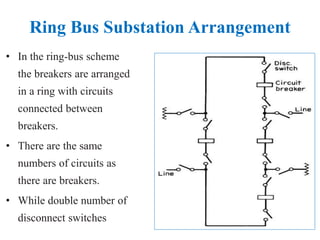
Ring Bus Substation Arrangement
• In the ring-bus scheme
the breakers are arranged
in a ring with circuits
connected between
breakers.
• There are the same
numbers of circuits as
there are breakers.
• While double number of
disconnect switches
Cont’d…
• During normal operation, all breakers are closed.
• But for a circuit fault, two breakers are tripped, and in
the event that one of the breakers fails to operate to clear
the fault, an additional circuit will be tripped by
operation of breaker-failure backup relays.
• During breaker maintenance, the ring is broken, but all
lines remain in service.
• For an extended circuit outage, the line-disconnect
switch may be opened, and the ring can be closed.
Cont’d…
• The ring-bus scheme is relatively economical in
cost, has good reliability, is flexible for maintenance,
• And is normally considered suitable for important
substations up to a limit of five circuits.
• Protective relaying and automatic reclosing are
more complex than for previously described
schemes.
Breaker and a Half Arrangement
• For more than five outgoing circuits, the ring bus is
usually converted to the breaker-and-a-half scheme.
• Sometimes called the three-switch scheme,
has three breakers in series between two main buses.
• Under normal operating conditions, all breakers are
closed, and both buses are energized.
• A circuit is tripped by opening the two associated circuit
breakers.
Cont’d….
(I-CONFIGUARATION)
•FEEDER2 •FEEDER4 •FEEDER6 •FEEDER8 •FEEDER10 •FEEDER12
•FEEDER1 •FEEDER3 •FEEDER5 •FEEDER7 •FEEDER9 •FEEDER11
•BUS-2
•BUS-1
•BAY1•BAY2•BAY3
•BAY4•BAY5•BAY6
•BAY7•BAY8•BAY9
•BAY10•BAY11•BAY12
•BAY13•BAY14•BAY15
•BAY16•BAY17•BAY18
•DIA1 •DIA2 •DIA3 •DIA4 •DIA5 •DIA6
Cont’d…
• Either bus may be taken out of service at any time
with no loss of service.
• With sources connected opposite to loads, it is
possible to operate with both buses out of service.
• Breaker maintenance can be done with no loss of
service, no relay changes, and simple operation of
the breaker disconnects.
Cont’d…
• The breaker-and-a-half arrangement is more
expensive than the other schemes, with the exception
of the double breaker, double-bus scheme,
• Protective relaying and automatic reclosing schemes
are more complex than for other schemes.
• However, the breaker-and-a half scheme is superior in
flexibility, reliability, and safety.
Comparisons of Substation Schemes
• The various schemes have been compared to
emphasize their advantages and disadvantages.
• The basis of comparison to be employed is the
economic justification of a particular degree
of reliability. {Table}
Substation Bus Selection Criteria
• Substation buses are an important part of the substation because they
carry electric currents in a confined space.
• Buses must be carefully designed to have good strength weight
ratio, low maintenance requirement, electrical conductivity and
sufficient structural strength to withstand the maximum stresses
due to:
o short-circuit currents,
o high winds, and
o ice loadings.
Cont’d…
• The design of station buses depends on a
number of elements, which include the
following:
o Current-carrying capacity
o Short-circuit stresses
o Minimum electrical clearances
Cont’d…
• The current-carrying capacity of a bus is limited by
the heating effects produced by the current.
• Buses generally are rated on the basis of the
temperature rise, which can be permitted without
danger of overheating equipment terminals, bus
connections, and joints.
• The permissible temperature rise for plain copper and
aluminum buses is usually limited to 30°C above an
ambient temperature of 40°C
Cont’d…
• Two common bus types:
o Rigid/Tabular bus- copper or alloy of aluminum
oStrain Bus ACSR
• EHV substations normally use the rigid-bus
approach and enjoy the advantage uniform
current distribution and ease of maintenance and
operation.
Cont’d…
• Tubular aluminum bus bar, is the most widely used
material in HV and EHV open-type outdoor stations.
• Aluminum has the advantage of being about one-third
the weight of copper and requires little maintenance.
• The proper use of alloys of aluminum will provide the
rigidity needed to serve as a bus material.
Standard Copper Bus Bar Size
Standard Aluminum Bus Bar Size
Minimum Electrical Clearances for Standard BIL
Outdoor AC-Bus
CHAPTER SIX
SUBSTATION LIGHTNING PROTECTION
THEORIES OF THUNDER CLOUD
“When atmosphere near the earth surface or ocean surface containing a
large amount of water vapor warms up by the heat from the sun and other
sources, it expands and ascends. When it reaches a high altitude, it is
cooled down, resulting the vapor in the atmosphere becomes water
droplets and then a cloud. When it ascends even higher, water droplets in
the cloud becomes ice grains and some of them concentrate and grow to
hailstones. At that time, these ice grains and hailstones are decomposed by
electric current. Then, ice grains are charged positively and hailstones are
charged negatively. Ice grains ascend even higher by riding updraft and
hailstones grow bigger and fall by the gravity. Charge separation continues
by the coulomb force. Before long, top of the cloud is positively charged
and the bottom negatively. A cloud accumulates electrical energy, which is
when a thundercloud emerges”.
Cont’d…
• If the space charge densities, which happen to be
present in a thundercloud, produce local field strengths
of several100 kV/m, leader discharges are formed
which initiate a lightning discharge.
• Cloud-to-cloud flashes result in charge neutralization
between positive and negative cloud charge centers and
do not directly strike objects on the ground in the
process.
Cont’d…
Downward Flash
Upward Flash
Cont’d….
• On very high, exposed
objects (e.g. wind
turbines, radio masts,
telecommunication
towers, steeples, High
voltage towers) or on
the tops of mountains,
upward flashes (earth-
to-cloud flashes) can
occur.
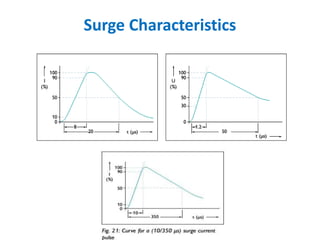
Surge voltages
• Various types of surge voltages can occur in electrical and
electronic systems.
• They differ mainly with their duration and amplitude.
• Depending on the cause, a surge voltage can last a few hundred
microseconds, hours or even days.
• The amplitude can range from a few millivolts to ten thousand volts.
• Lightning strikes are a special cause of surge voltages. Direct and
indirect strikes can result not only in high surge voltage amplitudes,
but also high and sometimes long current flows, which then have
very serious effects.
Surge Characteristics
Group Discussion
Why Lightning flash over during cold season or
rain time?
SURGE ARRESTER
• An arrester can be considered a replication of an HRC fuse.
What a fuse is to a fault current, arrester is to a voltage surge,
both limit, their severity.
• This is a device that limits the high TVs generated during a
system disturbance by diverting the excessive part of it to the
ground and reducing the amplitude of the transient voltage
wave across the equipment to a permissible safe value less
than the impulse withstand level of the equipment.
Cont’d…
• The arrester providing a conducting path of
relatively low surge impedance between the line and
the ground to the arriving surge.
• The discharge current to the ground through the
surge impedance limits the residual voltage across
the arrester hence the equipment and the system
connected to it.
• During normal service this impedance is high
enough to provide a near-open circuit.
Cont’d…
• Arresters or diverters are generally of the following types
and the choice between them will depend upon the power
frequency system voltage, and characteristics of the
voltage surges, i.e.
(i) Gapped or conventional type, and
(ii) Gapless or metal oxide type.
Gapped Surge Arresters
• These are generally of the following types:
I. Expulsion Arrester
II. Spark Gap Arrester
III. Valve or non Linear Resistor Arrester
Expulsion Arrester
• These interrupt the flow of current by an expulsion action and
limit the amplitude of the surge voltages to the required level.
• They have low residual safe or discharge voltages (Vres).
• The arrester gap is housed in a gas-ejecting chamber that
expels gases during spark-over.
• The arc across the gap is reduced and blown-off by the force
of the gases thus produced.
Cont’d…
Cont’d…
• The enclosure is so designed that after blowing off the arc it
forcefully expels the gases into the atmosphere.
• The discharge of gases affects the surroundings, particularly
nearby equipment.
• The gas ejecting enclosure deteriorates with every operation and,
therefore, has only a limited operating life.
• Moreover, these types of arresters are for low system voltage
and of specific ratings and an excessive surge than the rated may
result in its failure.
Spark Gap Arrester
• These have a pair of conducting rods with an
adjustable gap, depending upon the spark over-
voltage of the arrester.
• Precise protection is not possible, as the spark-over-
voltage varies with polarity, steepness and the shape
of the wave protection becomes uncertain.
• These arresters are also now obsolete for the same
reasons as the previous one.
Valve or non Linear Resistor Arrester
• A non-linear SiC resistor-type gapped surge arrester may generally
consist of three non-linear resistors (NR) in series with the three spark
gap assemblies.
Cont’d…
• The resistance has an extremely low value on surge voltages and
a very high one during normal operations to cause a near-open
circuit. It is now easier to interrupt the flow currents.
• Across the spark gaps, known as current limiting gaps, are
provided high-value resistors (HR) backed up with HRC fuses.
• The non-linear resistors have a very flat V-I curve, i.e. they
maintain a near-constant voltage at different discharge currents.
• The flatness of the curve provides a small residual voltage and a
low current.
Cont’d…
Cont’d…
• When the switching or lightning surge voltage exceeds the
breakdown voltage of the spark gap, a spark-over takes place and
permits the current to flow through the NR.
• Due to the nonlinear nature of the resistor, the voltage across the
line is limited to approximately the discharge commencing voltage
(Vres), which is below the 3–5 p.u. level for a line.
• It may be noted that the use of resistor across the spark gap
stabilizes the breakdown of the spark gap by distributing the surge
voltage between the gap and the non-linear resistor.
Gapless Surge Arresters
• The high resistive component of the previous system
results high power loss which generates heat is the
limitation.
• The alternative was found in ZnO.
• ZnO is a semiconductor device and is a ceramic resistor
material constituting ZnO and oxides of other metals,
such as bismuth, cobalt, antimony and manganese.
Cont’d…
• These ingredients in different proportions are mixed in
powdered form, ZnO being the main ingredient.
• It is then pressed to form into discs and fired at high
temperatures to result in a dense polycrystalline
ceramic.
• Surge arresters made of these elements have no
conventional spark gap and possess excellent energy
absorption capability.
Cont’d…
• Under rated system conditions, its feature of
high non-linearity raises its impedance
substantially and diminishes the discharge
current to a trickle.
• Under rated conditions, it conducts in mA
while during transient conditions it offers a
very low impedance to the impending surges
and thus rises the discharge current and the
discharge voltage.
• However, it conducts only that discharge
current which is essential to limit the
amplitude of the prospective surge to the
required protective level of the arrester.
Cont’d
ZnO Arrester for various Rating
Group Discussion
Discuss the arrester type and operation in your
area?
Electrical Characteristics of a ZnO Surge Arrester
• ZnO blocks have extremely non-linear, current-voltage
characteristics, typically represented by:
• K, represents its geometrical configuration, cross-sectional area
and length, and is a measure of its current-carrying capacity.
• ∞ is a measure of non-linearity between V and I, and depends upon
the composition of the oxides used. Typical values are:
 In SiC it is 2 to 6
 In ZnO – it can be varied from 20 to 50.
𝐼 = 𝐾 · 𝑉∞
Cont’d…
• By altering ∞ and K, the arrester can be designed for any
conducting voltage (Vres) and nominal current discharge (In).
• Vres and In define the basic parameters of a surge arrester.
Maximum continuous operating voltage
(MCOV), Vc
• This is the maximum power frequency operating r.m.s. voltage that
can be applied continuously (≥ 2 hours) across the arrester
terminals without a discharge (point 1 on the curve).
• It continuously draws an extremely low leakage current, IZnO,
capacitive in nature, due to ground capacitance.
• Where Vm is 5% above the system line-line nominal voltage.
𝑽 𝒄 =
𝑽 𝒎
𝟑
(Phase to phase)
Rated Voltage, Vr
• This is the maximum permissible r.m.s. voltage for
which the arrester is designed (point 2 on the curve).
• The arrester can withstand this voltage without a
discharge for minimum 10s under continuously rated
conditions (when the arrester has reached its thermal
stability),
• Indirectly indicating an in-built TOV (transient over
voltage) capability of 10s.
Cont’d…
• Now it also draws a current resistive in nature, in the
range of a few mA.
• The lower this current, lower will be the loss and the heat
generated during an over-voltage and hence better energy
absorption capability.
Discharge or Residual Voltage, Vres
• It is the voltage that appears across the arrester
during the passage of discharge current – that
flows through the arrester due to a surge.
• Vres is the conducting voltage of an arrester during an
over-voltage or transient condition and defines its
protective level.
Temporary Over-Voltage (TOV)
• It is determined by its low current region (d) that is
usually less than 1 A and for prospective transient
voltages it is determined by its high current region (e)
(2.5–20 kA, 8/20𝜇s current impulse).
• It is beyond the knee point and relatively long duration
voltage transient.
• Major sources are short cct fault and load rejection
Transient voltages (Vt)
• Depending upon the magnitude of Vt the
operating point may shift to near point 4 or
beyond and conduct a current 2.5–20 kA and
more. It is point 4 on the curve.
• The maximum surge voltage exist at this point
and the arrester should effectively clear the surge.
Energy Capability (J)
• Energy capability of an arrester defines its capability to
absorb the surge energy of an impending surge, usually
the long duration switching surge without any thermal
damage or heat generation.
• Energy capability values are provided as standard by the
manufacturers in their data sheets.
• For a series of consecutive discharge the ZnO discs must
attain thermal equilibrium.
Basic insulation level (BIL)
• BIL is the basic insulation level of equipment. When the system
TOVs or voltage surges exceed this level, the equipment may fails.
• In the latest international and national standards it is defined as
follows:
a. For systems 1 kV < Vm < 245 kV.
i. Rated lightning impulse withstand level (LIWL)
ii. Rated short time power frequency dielectric strength.
b. For systems Vm > 300 kV to 765 kV;
i. Rated lightning impulse withstand level (LIWL)
ii. Rated short time power frequency dielectric strength.
iii.Rated switching impulses withstand level (SIWL).
Protective Margins
• On the BIL discussed above a suitable protective margin is considered
to provide sufficient safety to the protected equipment against
unforeseen contingencies. ANSI/IEEEC62.22 has recommended
certain values to account for these and they are given in Table 5.1.
𝐏𝐫𝐨𝐭𝐞𝐜𝐭𝐢𝐯𝐞 𝐌𝐚𝐫𝐠𝐢𝐧 =
𝐁𝐈𝐋 𝐨𝐟 𝐭𝐡𝐞 𝑬𝒒𝒖𝒊𝒑𝒎𝒆𝒏𝒕
𝐈𝐦𝐩𝐮𝐥𝐬𝐞 𝐏𝐫𝐨𝐭𝐞𝐜𝐭𝐢𝐨𝐧 𝐋𝐞𝐯𝐞𝐥 𝐨𝐟 𝐭𝐡𝐞 𝐀𝐫𝐫𝐞𝐬𝐭𝐞𝐫 (𝑽 𝒓𝒆𝒔)
Selection of a ZnO Surge Arrester
• Service conditions:
• Mechanical soundness:
• Maximum continuous operating voltage (MCOV) Vc
(rms):
• The BIL of the equipment being protected
• The arrester’s nominal discharge current (In):
• For each kind of TOV and its duration, a
corresponding factor (K) is obtained and with this is
determined the required rating, Vr of the arrester.
• The most crucial TOV may be selected as the rating
of the arrester.
• If it is not a standard rating as in the manufacturer’s
catalogue one may select the next higher rating
available.
Vc= K · Vr
Cont’d….
Example:
Determine the rating of a surge arrester to protect a solid ground fault stay for 3 second and
load rejection of 1 second simultaneously for a 400 kV system.
400kV Arrester Rating at Different TOV
Protective Distance of the Arrester
• If the arrester and the equipment to be
protected at different location:
Vs = Vres + 2.S.T 𝑻 =
𝒍 ∗ 𝟏𝟎−𝟑
𝟎. 𝟑
𝝁𝒔 𝒍 = 𝟏𝟓𝟎
𝑽 𝒔 − 𝑽 𝒓𝒆𝒔
𝑺
(𝒎)
o Vs= actual surge voltage at the instant of strike in the equipment
o S = steepness of the incoming wave in kV/𝜇s
o T = travelling time of the surge to reach the equipment from the arrester
terminals.
o L= line length between arrester andequipment
Example
• For the arrester of the previous example, Vm = 420 kV, Vr = 336 kV and Vres = 844
kV for a lightning surge protective margin at 20 kA discharge current, from the
manufacturer.
• If we consider the lightning surge with a steepness of 2000 kV/𝜇s, then for a
total distance of, say, 8 m from the arrester to the equipment please determine the
actual surge voltage at the equipment and BIL of the equipment If we maintain a
protective margin of 20%.
𝑉𝑠 = 844𝑘𝑉 + 2 ∗ 2000 ∗
8
0.3
∗ 10−3 𝑘𝑉 = 951𝑘𝑉
• Then the minimum BIL that the equipment under protection must have
= 1.20 *951kV = 1141.2 kV
Ehv substation

Ehv substation

  • 1.
    Addis Ababa Scienceand Technology University Electrical and Computer Engineering Department EHV SUBSTATION DESIGN CONSIDERATION Prepared by: DemsewM. JULY 2017
  • 2.
    Module Contents o Introductionto power system o HVDC Fundamentals o Substation Layout o Substation Protection o Earthing Design o Lightning protection o HV-Switching Technology o Substation Auxiliary Equipment
  • 3.
    Module Objective o Tocreate fundamental understanding of HVDC concept for trainers. o To show design principle of EHV-Substation o To understand how the economical Substation Switching Scheme, Rating of Arrester and economical size of earthing conductor and insulator, and appropriate protection selection for EHV will be done.
  • 4.
    Module Category/Target Group Preparedfor EEP trainee category of: oE4-E6
  • 5.
    CHAPTER ONE HVDC andAC Power System Structure Chapter Contents: – Power Generation System – Power Transmission System – Power Distribution System – HVDC Fundamentals
  • 6.
  • 7.
    1. Electric PowerGeneration • Electric generators are devices that convert energy from a mechanical form into an electrical form. • This process, known as electromechanical energy conversion, involves magnetic fields that act as an intermediate medium. • The input to the generating machine can be derived from a number of energy sources.
  • 8.
  • 9.
    Group Discussion • Howelectric generation is possible from run- off river and ocean wave?
  • 10.
    Solar Power Generation Photovoltaicenergy - solar energy converted directly to electrical current
  • 11.
    Group Discussion • Howsolar thermal electric generation is possible?
  • 12.
  • 13.
    • This energy sourceinvolves the use of high- pressure, high- temperature steam fields that exist below the earth’s surface. Geothermal Power Generation
  • 14.
    Wind Power Generation •Wind power - advantages and disadvantages • Wind farms - potential exists in Great Plains, along seacoasts and Oceanic area
  • 15.
    Group Discussion • Discussthe situation of our current power generation from wind? • Discuss also other source of electricity generation?
  • 16.
    2. Electric PowerTransmission • Electric power transmission is the bulk transfer of electrical energy, a process in the delivery of electricity to consumers. • A power transmission network typically connects power plants at remote location to multiple substations near a populated area.
  • 17.
    Cont’d… • Overhead electricpower transmission allows distant energy sources (such as hydroelectric power plants) to be connected to consumers in population centers, and • May allow exploitation of low-grade fuel resources such as coal that would otherwise be too costly to transport to generating facilities.
  • 18.
    Cont’d… • Today, transmission-levelvoltages are usually considered to be 132 kV and above (1600kV, 1100kV, 800kV, 500kV, 400kV and 230kV). • Voltages above 230 kV are extra high voltage and require different designs compared to equipment used at lower voltages. • Lower voltages such as 66 kV and 33 kV are usually considered sub-transmission voltages but are occasionally used on long lines with light loads. • Voltages less than 33 kV are usually used for distribution.
  • 19.
  • 20.
    Overhead Transmission Structures Thebasic overhead transmission line structure: o Bare conductor oWood, Concrete, Lattice or tabular steel pole o Insulator (Suspension , Post or Pin type) o Ground Wire
  • 21.
    Bare Conductor • Themost widely used conductor material for power transmission and distribution are: o Aluminum and, o Copper • Due to their: o Electrical conductivity o Weight, Strength and Durability o Cost and o Installation flexibility
  • 22.
    Cont’d… • Aluminum conductorsreinforced with steel (known as ACSR) are primarily used for medium and high voltage lines and may also for overhead services to individual customers. • Aluminum conductors has the advantage of better weight than copper, as well as being cheaper. • Some copper cable is still used, especially at lower voltages and for grounding.
  • 23.
    Electric Pylon • Structuresfor overhead lines take a variety of shapes depending on the type of line. • Structures may be as simple as wood poles directly set in the earth, carrying one or more cross-arm to support conductors, or "armless" construction with conductors supported on insulators attached to the side of the pole. • Tubular steel poles are typically used in urban areas. • High-voltage lines are often carried on lattice-type steel towers.
  • 24.
    Cont’d… • For remoteareas, wood pole or Concrete poles have been used. • Each structure must be designed for the loads imposed on it by the conductors (High voltage or Low voltage structure). • Foundations for tower structures may be large and costly, particularly if the ground conditions are poor, such as in wetlands. • Each structure may be considerably strengthened by the use of guy wires to resist some of the forces due to the conductors.
  • 25.
    Anchor pylons orstrainer pylons are employed at branch points as branch pylons and must occur at a maximum interval of 5 km, due to technical limitations on conductor length Branch pylon is a pylon that is used to start a line branch. Tension tower for phase transposition Type of pylon by function
  • 26.
    Types of Pylonby Conductor Arrangements Single-level pylon Two-level pylon Three-level pylon
  • 27.
    Insulators • Insulators mustsupport the conductors and withstand both the normal operating voltage and surges due to switching and lightning. • Insulators are broadly classified as either pin-type, which support the conductor above the structure, or suspension type, where the conductor hangs below the structure. • Up to about 132 kV both types are commonly used. At higher voltages only suspension-type insulators are common for overhead conductors. • Insulators are usually made of ceramic or reinforced glass or plastic.
  • 28.
    Cont’d… • Insulators aremade of multiple units, with the number of unit insulator disks increasing at higher voltages. • The number of disks is chosen based on line voltage, lightning withstand requirement, and environmental factors such as fog, pollution, or salt spray.
  • 29.
    Design Principle ofOH Transmission Line • Design of these lines requires: o Minimum clearances o High insulation level o Economical transmission voltage level o Optimum conductor size o Enough mechanical strength of supporting tower. o Optimum span length
  • 30.
    Group Discussion 1. Howyou rate the transmission system in Ethiopia? a. The power quality issue b. The power loss problem c. The voltage drop issues
  • 31.
    3. Electric PowerDistribution • In distribution systems the supply authority collects the bulk energy at 66 kV or less from the transmission substation. • There are specific voltage values used in the distribution of electrical power. These voltage values, which are all ‘line to line’ values are 66kV, 33kV, 15kV, 11kV, 6.6kV, 3.3kV and 400/230V.
  • 32.
    Distribution Voltage Selection •The choice of voltage to be used on any particular section in the distribution system will be influenced by: – Decisions associated with voltage drops resulting from large current loads – Capital cost of transformers used to change voltage levels – Capital costs of construction of distribution lines and associated switchgear to operate at the chosen voltage – Environmental aspects of the system installation.
  • 33.
    Types of DistributionFeeder a. Radial Feeder • Many distribution systems operate using a ‘radial feeder’ system.
  • 34.
    Cont’d… • Radial feedersare the simplest and least expensive, both to construct and for their protection system. • This advantage however is offset by the difficulty of maintaining supply in the event of a fault occurring in the feeder. • A fault would result in the loss of supply to a number of customers until the fault is located and cleared.
  • 35.
    Cont’d… b) Parallel Feeders •A greater level of reliability at a higher cost is achieved with a parallel feeder.
  • 36.
    Cont’d… c) Ring MainFeeder • A high level of system reliability can be achieved by using ‘ring main’ feeders.
  • 37.
    Group Discussion 1. Discussabout the power distribution situation in Ethiopia? a. Types of distribution feeder? b. How you rate the distribution reliability issue in your area? c. Frequently facing fault type? d. Mechanism of location of fault and its clearance? e. Major cause of distribution power interruption?
  • 38.
    Addis Ababa Scienceand Technology University Electrical and Computer Engineering Department HVDC FUNDAMENTALS Prepared by: DemsewM. July 2017
  • 39.
    HVDC • Introduction • Principleof AC/DC conversion • HVDC Link Configuration • Economic considerations, applications of HVDC • Advantages and disadvantages of HVDC systems.
  • 40.
    Introduction In the past... At the beginning of 20th century, DC (Direct Current) was superseded by AC (Alternating Current) for large-scale electrification. DC power did nevertheless survive, in applications like electric traction and drives. Today ... Today, bulk power systems are 3-phase AC, while utilization is either 1-phase or 3- phase AC. In our country ... ….is actually a single AC power system, running synchronously at 50 Hz, spanning from N_S_E_W!
  • 41.
    Introduction • Power Transmissionwas initially carried out in the early 1880s using Direct Current (d.c.). • So why dominated by AC-Transmission? o With the availability of transformers o The development of robust induction motor o The availability of the superior synchronous generator, o The facilities of converting a.c. to d.c.
  • 42.
    History of Events 1880s PowerTransmission was initially carried out using Direct Current 1930s Efficient static AC/DC conversion (mercury arc valves) was made possible. 1940s High Voltage DC (HVDC) bulk power transmission was studied in Germany. 1954 First commercial application in Sweden: submarine link between mainland and Gotland island (100 kV-20 MW-90 km). 1970s Today ... Thyristors (SCRs) took over; today, HVDC operation voltages attain 600 kV, transmitted power over 3000 MW. DC made its way back into bulk power systems!
  • 46.
  • 47.
    Technical Merits andDemerits of HVDC Advantages of DC: • More power can be transmitted per conductor per circuit how? o For the same insulation level and conductor size the per phase power analysis give us:
  • 48.
    Cont’d… • Higher Capacityavailable for cables o The same power transmitted P, same losses PL and same insulation level, we can determine the reduction of conductor cross-section Ad over Aa.
  • 49.
    Cont’d… • Smaller TowerSize o Since HVDC allows small size of insulator and conductor to transmit power over long distance o And also due to lack of a time varying magnetic flux in dc system so conductor spacing and clearance is not that much high due to the above reason smaller tower size is required for HVDC
  • 50.
  • 51.
  • 52.
  • 53.
    Cont’d… • No skineffect o Under a.c. conditions, the current is not uniformly distributed over the cross section of the conductor. The current density is higher in the outer region (skin effect) and result in under utilisation of the conductor cross section. o Skin effect under conditions of smooth d.c. is completely absent and hence there is a uniform current in the conductor, and the conductor metal is better utilised.
  • 54.
    Cont’d… • Less coronaand radio interference o Since corona loss increases with frequency (in fact it is known to be proportional to f), o For a given conductor diameter and applied voltage, there is much lower corona loss and hence more importantly less radio interference with d.c.
  • 55.
    Cont’d… • No StabilityProblem o There is no voltage phase angle in dc o There is no frequency in dc o There is no need of synchronization o But, In a.c. links the phase angle between sending end and receiving end should not exceed 30o at full- load for transient stability (maximum theoretical steady state limit is 90o).
  • 56.
    Cont’d… • Asynchronous interconnectionpossible o With a.c. links, interconnections between power systems must be synchronous. o Thus different frequency systems or different voltage systems cannot be interconnected. o Such systems can be easily interconnected through hvdc links. o For different frequency interconnections both convertors can be confined to the same station.
  • 57.
    Problems Associated withHVDC 1. Expensive convertors (More than double of transformer station) 2. Reactive power requirement (50% of the DC link active power capacity) 3. Generation of harmonics (Need extra investment for harmonic filter) 4. Difficulty of voltage transformation 5. Difficulty of high power generation (this also the challenge of AC) 6. Absence of overload capacity (Convertors have very little overload capacity unlike transformers)
  • 58.
    Economic Comparison • Thehvdc system has a lower line cost per unit length as compared to an equally reliable a.c. system due to the lesser number of conductors and smaller tower size. • However, the d.c. system needs two expensive convertor stations which may cost around two to three times the corresponding a.c. transformer stations. • Thus hvdc transmission is not generally economical for short distances, unless other factors dictate otherwise.
  • 59.
    Cont’d… • Estimates forthe break even distance of overhead lines are around 500 km to 800km. • This value depending on the magnitude of power transfer and the range of costs of lines and equipment. • The breakeven distances are reducing with the progress made in the development of converting devices.
  • 60.
    Cont’d… • For cables,the break-even distance is much smaller than for overhead lines and is of the order of 25 km for submarine cables and 50 km for underground cables. • For a long cable connection, e.g. beyond 40 km, HVDC will in most cases offer the only technical solution because of the high charging current of an AC cable.
  • 62.
    Environmental Concern • Theland coverage and the associated right-of- way for an HVDC overhead transmission line is not as high as that of an AC line. • This reduces the visual impact and saves plant deforestation and impact on cultural heritages. • It is also possible to increase the power transmission capacity for existing rights of way.
  • 63.
    AC/DC Conversion Fundamental •Basically for practical Application of HVDC transmission the following converter bridges are used: o12-pulse converter o18-pulse converter and, o24-Pulse Converter • But those converter are fundamental blocks of 6-pulse converter
  • 64.
    Six-pulse Converter Bridgeand Their Input-Output
  • 65.
    DC-Output Voltage of6-Pulse Bridge • If E is the r.m.s, line-to-line voltage, then the dc voltage output is : 𝑉𝑎𝑣𝑒 = 𝑉𝑑𝑐 = 1 𝑇 0 𝑇 2 ∗ 𝐸 sin( 𝑤𝑡)𝑑(𝑤𝑡) 𝑉𝑎𝑣𝑒 = 𝑉𝑑𝑐 = 6 2𝜋 𝜋 3 2𝜋 3 2 ∗ 𝐸 sin( 𝑤𝑡)𝑑 𝑤𝑡 𝑉𝑑𝑐 = 3 2 𝜋 𝐸 = 1.35𝐸 = 3 3 ∗ 2 𝜋 ∗ 𝐸 𝑝ℎ𝑎𝑠𝑒 = 2.34𝐸 𝑝ℎ𝑎𝑠𝑒
  • 66.
    HVDC links canbe broadly classified into: Monopolar links Bipolar links HVDC System Configurations 66 66
  • 67.
    Monopolar Link  Ituses only one conductor.  Due to single polarity, no corona effect occurs.  For low transmission capacity,  May have ground electrode or dedicated metallic return path
  • 68.
     A bipolarlinks has two conductors, one positive and the other negative with respect to earth.  The mid-points of converters at each terminal station are earthed via electrode lines and earth electrodes.  The voltages between the conductors is equal to two times the voltage between either of the conductors and earth.  Since one conductor is at positive polarity with respect to earth and the other is at negative polarity with respect to earth, a bipolar HVDC system is described as say .500kV  A bipolar system is advantageous in the sense that when one pole goes out of operation, the system may be changed to monopolar mode with ground return. Thus, the other pole continues to supply half the rated power through ground return.  Bipolar links are most commonly used in all high power HVDC systems. Bipolar Links
  • 69.
    Bipolar Long-Distance TransmissionSchemes • A Bipole is a combination of two poles in such a way that a common low voltage return path, if available, will only carry a small unbalance current during normal operation. • This configuration is used if the required transmission capacity exceeds that of a single pole.
  • 70.
    Cont’d… • During maintenanceor outages of one pole, it is still possible to transmit part of the power. • More than 50% of the transmission capacity can be utilized, limited by the actual overload capacity of the remaining pole. • The advantages of a bipolar solution over a solution with two monopoles are reduced cost due to one common or no return path and lower losses.
  • 71.
    Bipole with GroundReturn Path
  • 72.
    Bipole with DedicatedMetallic Return Path • If there are restrictions even to temporary use of electrodes, or if the transmission distance is relatively short, a dedicated LVDC metallic return conductor can be considered as an alternative to a ground return path with electrodes.
  • 73.
    CHAPTER TWO SWITCHING SCHEMEOF EHV SUBSTATION • Types of EHV Substation • Substation Switching Scheme Selection Criteria • Different types of Substation Scheme • Substation Bus Bar Selection
  • 74.
    Purpose of Substation Thesubstations are very much essential to: a) Evacuate power from generating stations. b)Transmit to the load centers. c) Distribute to the utilities & ultimate consumers. d)Reactive power compensation e)Voltage control f) Switching
  • 75.
    EHV Substation • Substationhaving either incoming or outgoing line have the following voltage level: o400, 500, 800 kV • Three types: i) Step-up substation at generation end ii) Transformer substation at load ends of the system iii) Switching substations located along the lines to parallel them.
  • 76.
  • 77.
    Substation Layout SelectionCriteria Factors must be considered in the selection of bus layouts and switching arrangements: • Safety Proper Earthing, Clearance and ROW • Reliability performance Avoid interruption • Economical Low cost of accessories • Simple in design Flexible to expand with out power interruption
  • 78.
    Cont’d… • The designalso should consider future expansion plan, • flexibility of operation and maintenance  maintenance of substation equipment with out interrupting the power. • low maintenance costs. • Land cost of substation site the cost of the land determine the type of substation layout
  • 79.
    SUBSTATION SCHEME  Singlebus scheme  Main and transfer bus scheme  Double bus, single breaker scheme  Double bus, double breaker scheme  Ring bus scheme  Breaker and a half scheme
  • 80.
    Single Bus SubstationScheme • The single-bus scheme is not normally used for major substations. • Dependence on one main bus can cause a serious outage in the event of breaker or bus failure without the use of mobile equipment.
  • 81.
    Cont’d… • The stationmust be deenergized in order to carry out bus maintenance or add bus extensions. • Although the protective relaying is relatively simple for this scheme, • the single-bus scheme is considered inflexible and subject to complete outages of extended duration. • Cost, area requirement and reliability is very low
  • 82.
    A Sample SingleBusbar Single Breaker System A-Primary power line B-Secondary Power Line 1. Incoming Line 2. Ground Wire 3. Overhead line 4. Voltage Transformer 5. Disconnect switch 6. Circuit Breaker 7. Current Transformer 8. Lightening Arrester 9. Main Transformer 10. Control Building 11. Security Fence 12. Outgoing Power Line
  • 83.
    How to improvereliability and maintenance flexibility of the previous system…..? • Main Bus is divided into two sections with a Circuit Breaker and isolators in between the adjoining sections. • One complete section can be taken out for Maintenance without disturbing the continuity of other section. • Even if a fault occurs on one section of the Bus, that faulty section alone will be isolated while the other section continues to be in service. • The system becomes costly and requires large substation area.
  • 84.
    Group Discussion • Isthis type of switching scheme in your Area?
  • 85.
    Main and TransferBus Substation Scheme • Adds a transfer bus to the single-bus scheme. • An extra bus-tie circuit breaker is provided to tie the main and transfer buses together. • When a circuit breaker is removed from service for maintenance, the bus-tie circuit breaker is used to keep that circuit energized. • Due to its relative complexity, disconnect-switch operation with the main- and transfer-bus scheme can lead to operator error and a possible outage.
  • 86.
    Cont’d… • Although thisscheme is low in cost and enjoys some popularity, it may not provide as high a degree of reliability and flexibility as required. • But as compared with single bus-single breaker arrangement it provides an improved maintenance flexibility
  • 87.
    Double Bus-Single BreakerSwitching Scheme • This scheme uses two main buses, and each circuit includes two bus selector disconnect switches.
  • 88.
    Cont’d… • A bus-tiecircuit connects to the two main buses and, when closed, allows transfer of a feeder from one bus to the other bus without deenergizing the feeder circuits by operating the bus selector disconnect switches. • The circuits may all operate from either the no. 1 or no. 2 main bus, or half the circuits may be operated off either bus. • In the first case, the station will be out of service for bus or breaker failure. • In the second case, half the circuits will be lost for bus or breaker failure.
  • 89.
    Cont’d… • For thistype of operation, a very selective bus protective relaying scheme is required to prevent complete loss of the station for a fault on either bus. • Disconnect-switch operation becomes quite involved, with the possibility of operator error, injury, and possible outage. • The double-bus, single-breaker scheme is relatively poor in reliability and is not normally used for important substations.
  • 90.
    Double Bus-Double BreakerSwitching Scheme • The double bus, double breaker scheme requires two circuit breakers for each feeder circuit. • Normally, each circuit is connected to both buses. • In some cases, half the circuits operate on each bus. For these cases, a bus or breaker failure would cause loss of only half the circuits, which could be rapidly corrected through switching.
  • 91.
  • 92.
    Cont’d… • The useof two breakers per circuit makes this scheme expensive; • however, it does represent a high degree of reliability and operation and maintenance flexibility. • Also the site space requirement is very high and it is difficult to implement such type of substation switching configuration in a location where land cost is too much expensive.
  • 93.
    Ring Bus SubstationArrangement • In the ring-bus scheme the breakers are arranged in a ring with circuits connected between breakers. • There are the same numbers of circuits as there are breakers. • While double number of disconnect switches
  • 94.
    Cont’d… • During normaloperation, all breakers are closed. • But for a circuit fault, two breakers are tripped, and in the event that one of the breakers fails to operate to clear the fault, an additional circuit will be tripped by operation of breaker-failure backup relays. • During breaker maintenance, the ring is broken, but all lines remain in service. • For an extended circuit outage, the line-disconnect switch may be opened, and the ring can be closed.
  • 95.
    Cont’d… • The ring-busscheme is relatively economical in cost, has good reliability, is flexible for maintenance, • And is normally considered suitable for important substations up to a limit of five circuits. • Protective relaying and automatic reclosing are more complex than for previously described schemes.
  • 96.
    Breaker and aHalf Arrangement • For more than five outgoing circuits, the ring bus is usually converted to the breaker-and-a-half scheme. • Sometimes called the three-switch scheme, has three breakers in series between two main buses. • Under normal operating conditions, all breakers are closed, and both buses are energized. • A circuit is tripped by opening the two associated circuit breakers.
  • 97.
    Cont’d…. (I-CONFIGUARATION) •FEEDER2 •FEEDER4 •FEEDER6•FEEDER8 •FEEDER10 •FEEDER12 •FEEDER1 •FEEDER3 •FEEDER5 •FEEDER7 •FEEDER9 •FEEDER11 •BUS-2 •BUS-1 •BAY1•BAY2•BAY3 •BAY4•BAY5•BAY6 •BAY7•BAY8•BAY9 •BAY10•BAY11•BAY12 •BAY13•BAY14•BAY15 •BAY16•BAY17•BAY18 •DIA1 •DIA2 •DIA3 •DIA4 •DIA5 •DIA6
  • 98.
    Cont’d… • Either busmay be taken out of service at any time with no loss of service. • With sources connected opposite to loads, it is possible to operate with both buses out of service. • Breaker maintenance can be done with no loss of service, no relay changes, and simple operation of the breaker disconnects.
  • 99.
    Cont’d… • The breaker-and-a-halfarrangement is more expensive than the other schemes, with the exception of the double breaker, double-bus scheme, • Protective relaying and automatic reclosing schemes are more complex than for other schemes. • However, the breaker-and-a half scheme is superior in flexibility, reliability, and safety.
  • 100.
    Comparisons of SubstationSchemes • The various schemes have been compared to emphasize their advantages and disadvantages. • The basis of comparison to be employed is the economic justification of a particular degree of reliability. {Table}
  • 101.
    Substation Bus SelectionCriteria • Substation buses are an important part of the substation because they carry electric currents in a confined space. • Buses must be carefully designed to have good strength weight ratio, low maintenance requirement, electrical conductivity and sufficient structural strength to withstand the maximum stresses due to: o short-circuit currents, o high winds, and o ice loadings.
  • 102.
    Cont’d… • The designof station buses depends on a number of elements, which include the following: o Current-carrying capacity o Short-circuit stresses o Minimum electrical clearances
  • 103.
    Cont’d… • The current-carryingcapacity of a bus is limited by the heating effects produced by the current. • Buses generally are rated on the basis of the temperature rise, which can be permitted without danger of overheating equipment terminals, bus connections, and joints. • The permissible temperature rise for plain copper and aluminum buses is usually limited to 30°C above an ambient temperature of 40°C
  • 104.
    Cont’d… • Two commonbus types: o Rigid/Tabular bus- copper or alloy of aluminum oStrain Bus ACSR • EHV substations normally use the rigid-bus approach and enjoy the advantage uniform current distribution and ease of maintenance and operation.
  • 105.
    Cont’d… • Tubular aluminumbus bar, is the most widely used material in HV and EHV open-type outdoor stations. • Aluminum has the advantage of being about one-third the weight of copper and requires little maintenance. • The proper use of alloys of aluminum will provide the rigidity needed to serve as a bus material.
  • 106.
  • 107.
  • 108.
    Minimum Electrical Clearancesfor Standard BIL Outdoor AC-Bus
  • 110.
  • 111.
    THEORIES OF THUNDERCLOUD “When atmosphere near the earth surface or ocean surface containing a large amount of water vapor warms up by the heat from the sun and other sources, it expands and ascends. When it reaches a high altitude, it is cooled down, resulting the vapor in the atmosphere becomes water droplets and then a cloud. When it ascends even higher, water droplets in the cloud becomes ice grains and some of them concentrate and grow to hailstones. At that time, these ice grains and hailstones are decomposed by electric current. Then, ice grains are charged positively and hailstones are charged negatively. Ice grains ascend even higher by riding updraft and hailstones grow bigger and fall by the gravity. Charge separation continues by the coulomb force. Before long, top of the cloud is positively charged and the bottom negatively. A cloud accumulates electrical energy, which is when a thundercloud emerges”.
  • 112.
    Cont’d… • If thespace charge densities, which happen to be present in a thundercloud, produce local field strengths of several100 kV/m, leader discharges are formed which initiate a lightning discharge. • Cloud-to-cloud flashes result in charge neutralization between positive and negative cloud charge centers and do not directly strike objects on the ground in the process.
  • 113.
  • 114.
  • 115.
  • 116.
    Cont’d…. • On veryhigh, exposed objects (e.g. wind turbines, radio masts, telecommunication towers, steeples, High voltage towers) or on the tops of mountains, upward flashes (earth- to-cloud flashes) can occur.
  • 117.
    Surge voltages • Varioustypes of surge voltages can occur in electrical and electronic systems. • They differ mainly with their duration and amplitude. • Depending on the cause, a surge voltage can last a few hundred microseconds, hours or even days. • The amplitude can range from a few millivolts to ten thousand volts. • Lightning strikes are a special cause of surge voltages. Direct and indirect strikes can result not only in high surge voltage amplitudes, but also high and sometimes long current flows, which then have very serious effects.
  • 118.
  • 119.
    Group Discussion Why Lightningflash over during cold season or rain time?
  • 120.
    SURGE ARRESTER • Anarrester can be considered a replication of an HRC fuse. What a fuse is to a fault current, arrester is to a voltage surge, both limit, their severity. • This is a device that limits the high TVs generated during a system disturbance by diverting the excessive part of it to the ground and reducing the amplitude of the transient voltage wave across the equipment to a permissible safe value less than the impulse withstand level of the equipment.
  • 121.
    Cont’d… • The arresterproviding a conducting path of relatively low surge impedance between the line and the ground to the arriving surge. • The discharge current to the ground through the surge impedance limits the residual voltage across the arrester hence the equipment and the system connected to it. • During normal service this impedance is high enough to provide a near-open circuit.
  • 122.
    Cont’d… • Arresters ordiverters are generally of the following types and the choice between them will depend upon the power frequency system voltage, and characteristics of the voltage surges, i.e. (i) Gapped or conventional type, and (ii) Gapless or metal oxide type.
  • 123.
    Gapped Surge Arresters •These are generally of the following types: I. Expulsion Arrester II. Spark Gap Arrester III. Valve or non Linear Resistor Arrester
  • 124.
    Expulsion Arrester • Theseinterrupt the flow of current by an expulsion action and limit the amplitude of the surge voltages to the required level. • They have low residual safe or discharge voltages (Vres). • The arrester gap is housed in a gas-ejecting chamber that expels gases during spark-over. • The arc across the gap is reduced and blown-off by the force of the gases thus produced.
  • 125.
  • 126.
    Cont’d… • The enclosureis so designed that after blowing off the arc it forcefully expels the gases into the atmosphere. • The discharge of gases affects the surroundings, particularly nearby equipment. • The gas ejecting enclosure deteriorates with every operation and, therefore, has only a limited operating life. • Moreover, these types of arresters are for low system voltage and of specific ratings and an excessive surge than the rated may result in its failure.
  • 127.
    Spark Gap Arrester •These have a pair of conducting rods with an adjustable gap, depending upon the spark over- voltage of the arrester. • Precise protection is not possible, as the spark-over- voltage varies with polarity, steepness and the shape of the wave protection becomes uncertain. • These arresters are also now obsolete for the same reasons as the previous one.
  • 128.
    Valve or nonLinear Resistor Arrester • A non-linear SiC resistor-type gapped surge arrester may generally consist of three non-linear resistors (NR) in series with the three spark gap assemblies.
  • 129.
    Cont’d… • The resistancehas an extremely low value on surge voltages and a very high one during normal operations to cause a near-open circuit. It is now easier to interrupt the flow currents. • Across the spark gaps, known as current limiting gaps, are provided high-value resistors (HR) backed up with HRC fuses. • The non-linear resistors have a very flat V-I curve, i.e. they maintain a near-constant voltage at different discharge currents. • The flatness of the curve provides a small residual voltage and a low current.
  • 130.
  • 131.
    Cont’d… • When theswitching or lightning surge voltage exceeds the breakdown voltage of the spark gap, a spark-over takes place and permits the current to flow through the NR. • Due to the nonlinear nature of the resistor, the voltage across the line is limited to approximately the discharge commencing voltage (Vres), which is below the 3–5 p.u. level for a line. • It may be noted that the use of resistor across the spark gap stabilizes the breakdown of the spark gap by distributing the surge voltage between the gap and the non-linear resistor.
  • 132.
    Gapless Surge Arresters •The high resistive component of the previous system results high power loss which generates heat is the limitation. • The alternative was found in ZnO. • ZnO is a semiconductor device and is a ceramic resistor material constituting ZnO and oxides of other metals, such as bismuth, cobalt, antimony and manganese.
  • 133.
    Cont’d… • These ingredientsin different proportions are mixed in powdered form, ZnO being the main ingredient. • It is then pressed to form into discs and fired at high temperatures to result in a dense polycrystalline ceramic. • Surge arresters made of these elements have no conventional spark gap and possess excellent energy absorption capability.
  • 134.
    Cont’d… • Under ratedsystem conditions, its feature of high non-linearity raises its impedance substantially and diminishes the discharge current to a trickle. • Under rated conditions, it conducts in mA while during transient conditions it offers a very low impedance to the impending surges and thus rises the discharge current and the discharge voltage. • However, it conducts only that discharge current which is essential to limit the amplitude of the prospective surge to the required protective level of the arrester.
  • 135.
  • 136.
    ZnO Arrester forvarious Rating
  • 137.
    Group Discussion Discuss thearrester type and operation in your area?
  • 138.
    Electrical Characteristics ofa ZnO Surge Arrester • ZnO blocks have extremely non-linear, current-voltage characteristics, typically represented by: • K, represents its geometrical configuration, cross-sectional area and length, and is a measure of its current-carrying capacity. • ∞ is a measure of non-linearity between V and I, and depends upon the composition of the oxides used. Typical values are:  In SiC it is 2 to 6  In ZnO – it can be varied from 20 to 50. 𝐼 = 𝐾 · 𝑉∞
  • 139.
    Cont’d… • By altering∞ and K, the arrester can be designed for any conducting voltage (Vres) and nominal current discharge (In). • Vres and In define the basic parameters of a surge arrester.
  • 140.
    Maximum continuous operatingvoltage (MCOV), Vc • This is the maximum power frequency operating r.m.s. voltage that can be applied continuously (≥ 2 hours) across the arrester terminals without a discharge (point 1 on the curve). • It continuously draws an extremely low leakage current, IZnO, capacitive in nature, due to ground capacitance. • Where Vm is 5% above the system line-line nominal voltage. 𝑽 𝒄 = 𝑽 𝒎 𝟑 (Phase to phase)
  • 141.
    Rated Voltage, Vr •This is the maximum permissible r.m.s. voltage for which the arrester is designed (point 2 on the curve). • The arrester can withstand this voltage without a discharge for minimum 10s under continuously rated conditions (when the arrester has reached its thermal stability), • Indirectly indicating an in-built TOV (transient over voltage) capability of 10s.
  • 142.
    Cont’d… • Now italso draws a current resistive in nature, in the range of a few mA. • The lower this current, lower will be the loss and the heat generated during an over-voltage and hence better energy absorption capability.
  • 143.
    Discharge or ResidualVoltage, Vres • It is the voltage that appears across the arrester during the passage of discharge current – that flows through the arrester due to a surge. • Vres is the conducting voltage of an arrester during an over-voltage or transient condition and defines its protective level.
  • 144.
    Temporary Over-Voltage (TOV) •It is determined by its low current region (d) that is usually less than 1 A and for prospective transient voltages it is determined by its high current region (e) (2.5–20 kA, 8/20𝜇s current impulse). • It is beyond the knee point and relatively long duration voltage transient. • Major sources are short cct fault and load rejection
  • 145.
    Transient voltages (Vt) •Depending upon the magnitude of Vt the operating point may shift to near point 4 or beyond and conduct a current 2.5–20 kA and more. It is point 4 on the curve. • The maximum surge voltage exist at this point and the arrester should effectively clear the surge.
  • 146.
    Energy Capability (J) •Energy capability of an arrester defines its capability to absorb the surge energy of an impending surge, usually the long duration switching surge without any thermal damage or heat generation. • Energy capability values are provided as standard by the manufacturers in their data sheets. • For a series of consecutive discharge the ZnO discs must attain thermal equilibrium.
  • 147.
    Basic insulation level(BIL) • BIL is the basic insulation level of equipment. When the system TOVs or voltage surges exceed this level, the equipment may fails. • In the latest international and national standards it is defined as follows: a. For systems 1 kV < Vm < 245 kV. i. Rated lightning impulse withstand level (LIWL) ii. Rated short time power frequency dielectric strength. b. For systems Vm > 300 kV to 765 kV; i. Rated lightning impulse withstand level (LIWL) ii. Rated short time power frequency dielectric strength. iii.Rated switching impulses withstand level (SIWL).
  • 148.
    Protective Margins • Onthe BIL discussed above a suitable protective margin is considered to provide sufficient safety to the protected equipment against unforeseen contingencies. ANSI/IEEEC62.22 has recommended certain values to account for these and they are given in Table 5.1. 𝐏𝐫𝐨𝐭𝐞𝐜𝐭𝐢𝐯𝐞 𝐌𝐚𝐫𝐠𝐢𝐧 = 𝐁𝐈𝐋 𝐨𝐟 𝐭𝐡𝐞 𝑬𝒒𝒖𝒊𝒑𝒎𝒆𝒏𝒕 𝐈𝐦𝐩𝐮𝐥𝐬𝐞 𝐏𝐫𝐨𝐭𝐞𝐜𝐭𝐢𝐨𝐧 𝐋𝐞𝐯𝐞𝐥 𝐨𝐟 𝐭𝐡𝐞 𝐀𝐫𝐫𝐞𝐬𝐭𝐞𝐫 (𝑽 𝒓𝒆𝒔)
  • 149.
    Selection of aZnO Surge Arrester • Service conditions: • Mechanical soundness: • Maximum continuous operating voltage (MCOV) Vc (rms): • The BIL of the equipment being protected • The arrester’s nominal discharge current (In):
  • 150.
    • For eachkind of TOV and its duration, a corresponding factor (K) is obtained and with this is determined the required rating, Vr of the arrester. • The most crucial TOV may be selected as the rating of the arrester. • If it is not a standard rating as in the manufacturer’s catalogue one may select the next higher rating available. Vc= K · Vr
  • 151.
    Cont’d…. Example: Determine the ratingof a surge arrester to protect a solid ground fault stay for 3 second and load rejection of 1 second simultaneously for a 400 kV system.
  • 152.
    400kV Arrester Ratingat Different TOV
  • 153.
    Protective Distance ofthe Arrester • If the arrester and the equipment to be protected at different location: Vs = Vres + 2.S.T 𝑻 = 𝒍 ∗ 𝟏𝟎−𝟑 𝟎. 𝟑 𝝁𝒔 𝒍 = 𝟏𝟓𝟎 𝑽 𝒔 − 𝑽 𝒓𝒆𝒔 𝑺 (𝒎) o Vs= actual surge voltage at the instant of strike in the equipment o S = steepness of the incoming wave in kV/𝜇s o T = travelling time of the surge to reach the equipment from the arrester terminals. o L= line length between arrester andequipment
  • 154.
    Example • For thearrester of the previous example, Vm = 420 kV, Vr = 336 kV and Vres = 844 kV for a lightning surge protective margin at 20 kA discharge current, from the manufacturer. • If we consider the lightning surge with a steepness of 2000 kV/𝜇s, then for a total distance of, say, 8 m from the arrester to the equipment please determine the actual surge voltage at the equipment and BIL of the equipment If we maintain a protective margin of 20%. 𝑉𝑠 = 844𝑘𝑉 + 2 ∗ 2000 ∗ 8 0.3 ∗ 10−3 𝑘𝑉 = 951𝑘𝑉 • Then the minimum BIL that the equipment under protection must have = 1.20 *951kV = 1141.2 kV