Next Generation Sequencing
Sanger Dideoxy Method (1st Generational)
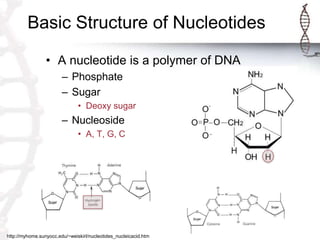
Basic Structure of Nucleotides
• A nucleotide is a polymer of DNA
– Phosphate
– Sugar
• Deoxy sugar
– Nucleoside
• A, T, G, C
http://myhome.sunyocc.edu/~weiskirl/nucleotides_nucleicacid.htm
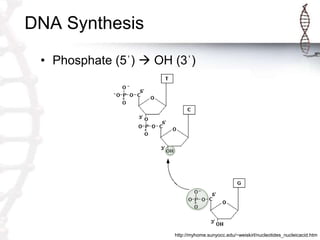
DNA Synthesis
• Phosphate (5ˈ)  OH (3ˈ)
http://myhome.sunyocc.edu/~weiskirl/nucleotides_nucleicacid.htm
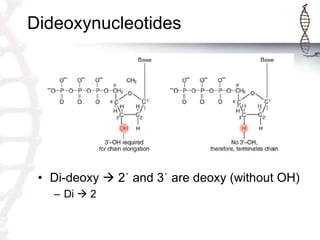
Dideoxynucleotides
• Di-deoxy  2ˈ and 3ˈ are deoxy (without OH)
– Di  2
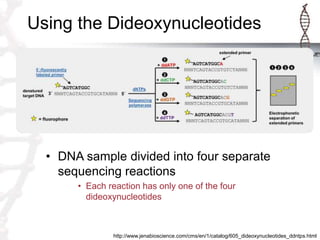
Using the Dideoxynucleotides
• DNA sample divided into four separate
sequencing reactions
• Each reaction has only one of the four
dideoxynucleotides
http://www.jenabioscience.com/cms/en/1/catalog/605_dideoxynucleotides_ddntps.html
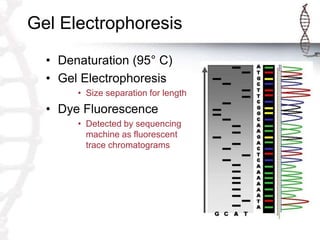
Gel Electrophoresis
• Denaturation (95° C)
• Gel Electrophoresis
• Size separation for length
• Dye Fluorescence
• Detected by sequencing
machine as fluorescent
trace chromatograms
Work Cited
• Ambry Genetics. Making Sense of NextGent Sequencing. Kelly Gonzalez, MS,
CGC, and Senior Manager of Clinical Genomics. Available at
http://www.ambrygen.com/sites/default/files/pdfs/NERRG_4-10-
12_Making_Sense_of_NetGen_Sequencing_KG(3).pdf. Access verified May
21, 2014.
• Omixon. Allen Van Deynze, 2010; Solanaceae Coordinated Agricultural Project.
Next Generation Sequencing. Available at http://www.omixon.com/the-basics-
of-next-generation-sequencing/. Access verified May 21, 2014.
• Chapter 2 Notes: Organic Chemistry.
http://mayhewbiology.com/Biology%20notes/carbo%20notes.htm Access
verified July 30, 2014.
• OCC Biology. Nucleic acids contain genetic information and enable synthesis of
proteins. Nucleotides are used to make Nucleic Acids.
http://myhome.sunyocc.edu/~weiskirl/nucleotides_nucleicacid.htm Access
verified July 30, 2014.
• Sanger sequencing. (2014, July 27). In Wikipedia, The Free Encyclopedia.
Retrieved 19:34, July 30, 2014, from
http://en.wikipedia.org/w/index.php?title=Sanger_sequencing&oldid=618681657
Access verified July 30, 2014.
Recommended Videos
Sanger method of DNA sequencing, 3D
animation with narration
http://www.dnalc.org/view/15479-Sanger-
method-of-DNA-sequencing-3D-
animation-with-narration.html
Dideoxy DNA Sequencing
https://www.youtube.com/watch?v=bEFL
Bf5WEtc
Next Generation Sequencing
454-Pyrosequencing

Sanger Dideoxy Method

  • 1.
    Next Generation Sequencing SangerDideoxy Method (1st Generational)
  • 2.
    Basic Structure ofNucleotides • A nucleotide is a polymer of DNA – Phosphate – Sugar • Deoxy sugar – Nucleoside • A, T, G, C http://myhome.sunyocc.edu/~weiskirl/nucleotides_nucleicacid.htm
  • 3.
    DNA Synthesis • Phosphate(5ˈ)  OH (3ˈ) http://myhome.sunyocc.edu/~weiskirl/nucleotides_nucleicacid.htm
  • 4.
    Dideoxynucleotides • Di-deoxy 2ˈ and 3ˈ are deoxy (without OH) – Di  2
  • 5.
    Using the Dideoxynucleotides •DNA sample divided into four separate sequencing reactions • Each reaction has only one of the four dideoxynucleotides http://www.jenabioscience.com/cms/en/1/catalog/605_dideoxynucleotides_ddntps.html
  • 6.
    Gel Electrophoresis • Denaturation(95° C) • Gel Electrophoresis • Size separation for length • Dye Fluorescence • Detected by sequencing machine as fluorescent trace chromatograms
  • 7.
    Work Cited • AmbryGenetics. Making Sense of NextGent Sequencing. Kelly Gonzalez, MS, CGC, and Senior Manager of Clinical Genomics. Available at http://www.ambrygen.com/sites/default/files/pdfs/NERRG_4-10- 12_Making_Sense_of_NetGen_Sequencing_KG(3).pdf. Access verified May 21, 2014. • Omixon. Allen Van Deynze, 2010; Solanaceae Coordinated Agricultural Project. Next Generation Sequencing. Available at http://www.omixon.com/the-basics- of-next-generation-sequencing/. Access verified May 21, 2014. • Chapter 2 Notes: Organic Chemistry. http://mayhewbiology.com/Biology%20notes/carbo%20notes.htm Access verified July 30, 2014. • OCC Biology. Nucleic acids contain genetic information and enable synthesis of proteins. Nucleotides are used to make Nucleic Acids. http://myhome.sunyocc.edu/~weiskirl/nucleotides_nucleicacid.htm Access verified July 30, 2014. • Sanger sequencing. (2014, July 27). In Wikipedia, The Free Encyclopedia. Retrieved 19:34, July 30, 2014, from http://en.wikipedia.org/w/index.php?title=Sanger_sequencing&oldid=618681657 Access verified July 30, 2014.
  • 8.
    Recommended Videos Sanger methodof DNA sequencing, 3D animation with narration http://www.dnalc.org/view/15479-Sanger- method-of-DNA-sequencing-3D- animation-with-narration.html Dideoxy DNA Sequencing https://www.youtube.com/watch?v=bEFL Bf5WEtc
  • 9.

Editor's Notes

  • #2 This video is an overview on what the Sanger method is and how it works.
  • #3 In order to understand the Sanger dideoxy method of sequencing a basic understanding of the DNA molecule and its synthesis is needed. The DNA molecule is made up of polymers called nucleotides. These nucleotide are made up of 3 basic sections. The backbone of the DNA molecule is composed of the 5 ring deoxyribose sugar and the phosphate on the 5 prime end of the sugar. The reason the sugar is called deoxy is because a ribose sugar usually has two OH groups on the 2nd and 3rd prime end of the sugar but instead there is not OH group on the 2nd end in the DNA sugar. The third part of the nucleotide is the nucleoside base of adenine, thymine, guanine, or cytosine which make the molecule double stranded by the hydrogen bonds between adenine and thymine and cytosine and guanine.
  • #4 The Polymerase enzyme adds nucleotides to the DNA chain by connecting the phosphate on the 5 prime end of the new nucleotide’s sugar to the OH on the 3 prime end of the previous nucleotide’s sugar. This reaction releases a water molecule and the polymerase enzyme will continue on to add another nucleotide to the DNA strand.
  • #5 In the Sanger method modified nucleotide are used. These nucleotides are called di-deoxy because not only is the 2 prime end of the ribose sugar without an OH group, but the 3 prime end is also without the OH group. Since the 3 prime OH group is required to elongate the DNA chain by adding the phosphate end of the next nucleotide to it, without it the DNA chain will end there.
  • #6 The DNA sample is divided into four separate sequencing reactions, containing all four of the standard deoxynucleotides (ddATP, ddGTP, ddCTP and ddTTP) and the DNA polymerase. To each reaction is added only one of the four dideoxynucleotides (ddATP, ddGTP, ddCTP, or ddTTP), while three other nucleotides are ordinary ones. After many cycles of copying, all the possible chain-termination molecules are produced: the reaction has stopped at every base. Putting it in a more sensible order, four separate reactions are needed in this process to test all four ddNTPs.
  • #7 Following rounds of template DNA extension from the bound primer, the resulting DNA fragments are heat denatured and separated by size using gel electrophoresis. What this does is tell us the length of the strand since the smaller molecules of DNA travel faster through the gel than the large strands. Therefore, DNA sequencers carry out capillary electrophoresis for size separation, detection and recording of dye fluorescence, and data output as fluorescent peak trace chromatograms. This way the nucleotide at a given part of the sequence can be determined using the fluorescence given at a given length of the sequence in the gel. With this method it is very time consuming and labor extensive. It is also only able to out put short sequences one at a time, therefore faster multi-parallel sequencing has since been developed and named Next Generational sequencing. These new methods are discussed in the next videos.
  • #8 This is the Work Cited for this video.
  • #9 Here are some recommended videos to watch in order to better understand how the Sanger Dideoxy method works. Sanger method of DNA sequencing, 3D animation with narration http://www.dnalc.org/view/15479-Sanger-method-of-DNA-sequencing-3D-animation-with-narration.html Dideoxy DNA Sequencing https://www.youtube.com/watch?v=bEFLBf5WEtc
  • #10 The next video is on the Next Generational Sequencing method 454 Pyrosequencing.