Next Generation Sequencing
454-Pyrosequencing
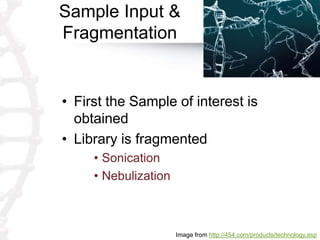
Sample Input &
Fragmentation
• First the Sample of interest is
obtained
• Library is fragmented
• Sonication
• Nebulization
Image from http://454.com/products/technology.asp
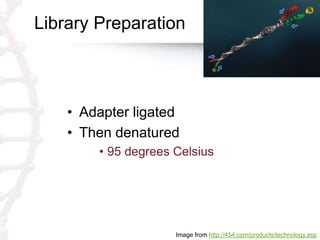
Library Preparation
• Adapter ligated
• Then denatured
• 95 degrees Celsius
Image from http://454.com/products/technology.asp
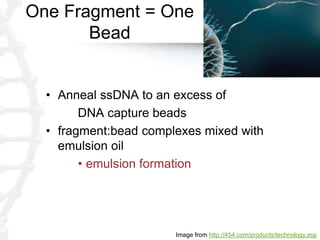
One Fragment = One
Bead
• Anneal ssDNA to an excess of
DNA capture beads
• fragment:bead complexes mixed with
emulsion oil
• emulsion formation
Image from http://454.com/products/technology.asp
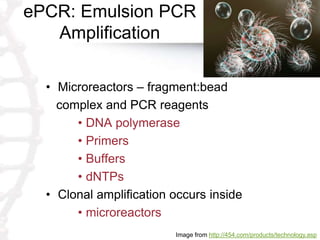
ePCR: Emulsion PCR
Amplification
• Microreactors – fragment:bead
complex and PCR reagents
• DNA polymerase
• Primers
• Buffers
• dNTPs
• Clonal amplification occurs inside
• microreactors
Image from http://454.com/products/technology.asp
Sequencing: One
Bead = One Read
• micelles broken and enriched for DNA-
positive beads.
• Loaded into a picotiter plate
• Enzyme beads loaded
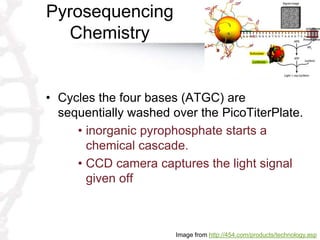
Pyrosequencing
Chemistry
• Cycles the four bases (ATGC) are
sequentially washed over the PicoTiterPlate.
• inorganic pyrophosphate starts a
chemical cascade.
• CCD camera captures the light signal
given off
Image from http://454.com/products/technology.asp
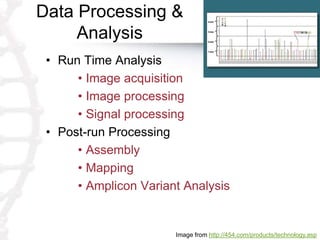
Data Processing &
Analysis
• Run Time Analysis
• Image acquisition
• Image processing
• Signal processing
• Post-run Processing
• Assembly
• Mapping
• Amplicon Variant Analysis
Image from http://454.com/products/technology.asp
Work Cited
• Ambry Genetics. Making Sense of NextGent Sequencing. Kelly Gonzalez, MS,
CGC, and Senior Manager of Clinical Genomics. Available at
http://www.ambrygen.com/sites/default/files/pdfs/NERRG_4-10-
12_Making_Sense_of_NetGen_Sequencing_KG(3).pdf. Access verified May
21, 2014.
• Omixon. Allen Van Deynze, 2010; Solanaceae Coordinated Agricultural Project.
Next Generation Sequencing. Available at http://www.omixon.com/the-basics-
of-next-generation-sequencing/. Access verified May 21, 2014.
• 454 Sequencing. The Technology: System Workflow.
http://454.com/products/technology.asp. Access verified July 30, 2014.
• PYROSEQUENCING: Genome Sequencing Utilizing Light-Emitting Luciferase
and PCR-Reaction-Mixture-in-Oil Emulsion. Mr. Meir Shachar and Dr. Edwin
Ginés-Candelaria. Available at
https://www.google.com/url?sa=t&rct=j&q=&esrc=s&source=web&cd=2&cad=rja&ua
ct=8&ved=0CEEQFjAB&url=http%3A%2F%2Fwcis.mdc.edu%2Fegines%2FBSC294
3L_THE%2520BIOSCIENCE%2520INTERNSHIP%2FNEXT_GENERATION%2520
SEQUENCING%2FPUBLICATIONS%2F454%2FPOWER%2520POINT%2FPYROS
EQUENCING.ppt&ei=mO3gU7e3MY-
3yATKvILoAw&usg=AFQjCNFUTJOwRiQVfr4QOpRwtEoW7E4Gow&sig2=5E5kc
HvdziwacvOOtvRxow. Access verified Aug 5, 2014.
Next Generation Sequencing
Illumina Sequencing

Pyrosequencing 454

  • 1.
  • 2.
    Sample Input & Fragmentation •First the Sample of interest is obtained • Library is fragmented • Sonication • Nebulization Image from http://454.com/products/technology.asp
  • 3.
    Library Preparation • Adapterligated • Then denatured • 95 degrees Celsius Image from http://454.com/products/technology.asp
  • 4.
    One Fragment =One Bead • Anneal ssDNA to an excess of DNA capture beads • fragment:bead complexes mixed with emulsion oil • emulsion formation Image from http://454.com/products/technology.asp
  • 5.
    ePCR: Emulsion PCR Amplification •Microreactors – fragment:bead complex and PCR reagents • DNA polymerase • Primers • Buffers • dNTPs • Clonal amplification occurs inside • microreactors Image from http://454.com/products/technology.asp
  • 6.
    Sequencing: One Bead =One Read • micelles broken and enriched for DNA- positive beads. • Loaded into a picotiter plate • Enzyme beads loaded
  • 7.
    Pyrosequencing Chemistry • Cycles thefour bases (ATGC) are sequentially washed over the PicoTiterPlate. • inorganic pyrophosphate starts a chemical cascade. • CCD camera captures the light signal given off Image from http://454.com/products/technology.asp
  • 8.
    Data Processing & Analysis •Run Time Analysis • Image acquisition • Image processing • Signal processing • Post-run Processing • Assembly • Mapping • Amplicon Variant Analysis Image from http://454.com/products/technology.asp
  • 9.
    Work Cited • AmbryGenetics. Making Sense of NextGent Sequencing. Kelly Gonzalez, MS, CGC, and Senior Manager of Clinical Genomics. Available at http://www.ambrygen.com/sites/default/files/pdfs/NERRG_4-10- 12_Making_Sense_of_NetGen_Sequencing_KG(3).pdf. Access verified May 21, 2014. • Omixon. Allen Van Deynze, 2010; Solanaceae Coordinated Agricultural Project. Next Generation Sequencing. Available at http://www.omixon.com/the-basics- of-next-generation-sequencing/. Access verified May 21, 2014. • 454 Sequencing. The Technology: System Workflow. http://454.com/products/technology.asp. Access verified July 30, 2014. • PYROSEQUENCING: Genome Sequencing Utilizing Light-Emitting Luciferase and PCR-Reaction-Mixture-in-Oil Emulsion. Mr. Meir Shachar and Dr. Edwin Ginés-Candelaria. Available at https://www.google.com/url?sa=t&rct=j&q=&esrc=s&source=web&cd=2&cad=rja&ua ct=8&ved=0CEEQFjAB&url=http%3A%2F%2Fwcis.mdc.edu%2Fegines%2FBSC294 3L_THE%2520BIOSCIENCE%2520INTERNSHIP%2FNEXT_GENERATION%2520 SEQUENCING%2FPUBLICATIONS%2F454%2FPOWER%2520POINT%2FPYROS EQUENCING.ppt&ei=mO3gU7e3MY- 3yATKvILoAw&usg=AFQjCNFUTJOwRiQVfr4QOpRwtEoW7E4Gow&sig2=5E5kc HvdziwacvOOtvRxow. Access verified Aug 5, 2014.
  • 10.

Editor's Notes

  • #2 This video covers an overview on 454-Pyrosequencing, a type of Next Generational Sequencing.
  • #3 In order to prepare the library for emulsion PCR it must first be fragmented into smaller pieces of about 300-800bps, which can then be sequenced. The process of cutting up a large strand of DNA, sequencing it, and then putting it back together is referred to as shotgun sequencing. There are various ways to fragment DNA. One common method used is sonication which shears DNA by exposing it to periods of high sound energy. Another common method is nebulization which shears DNA by forcing it through a small hole in a nebulizer unit. This results in the formation of a mist that is collected. The fragment size is determined by the pressure of the gas used to push the DNA through the nebulizer. Difference between this method and the various others is that there is no cloning step. Allows for sequencing in a highly parallel manner. Sequence is amplified on little beads in emulsion PCR. By adding single nucleotides one at a time the Machine can detect the light reaction coming off the specific base, and are able to get a sequence from this.
  • #4 After the DNA is fragments the ends are then ligated with adapters. Then the DNA is sheared into smaller pieces it is then denatured into single strands by heating it to 95 degrees Celsius. Ligating Rapid Library Adaptors to the fragments are needed for subsequent purification, quantitation, amplification, and sequencing steps. For amplicon libraries, create PCR products by amplifying with specific fusion primer containing 454 Sequencing adaptor sequences.
  • #5 Aided by the adaptors, the sequences are then captured on their own unique bead. These beads are then mixed in emulsion oil in order to form fine dispersion of minute droplets and separate each of the fragment:bead complexes. This allows for amplification of each sequence simultaneously without contamination. Each bead carries a unique single-stranded library fragment. Emulsify beads with amplification reagents in a water-in-oil mixture to trap individual beads in amplification microreactors.
  • #6 Next the sequences are then amplified by emulsion PCR in parallel to create millions of clonally copies of each library fragment on each bead. Break the emulsion while the amplified fragments remain bound to their specific beads. Microreactors are the fragment:bead complexes and the PCR reagents in the emulsion micelles, or droplets. Each of these microreactors are ready to start amplifying the sequence. Primers are used as a starting point for DNA synthesis. DNA polymerase, the enzyme used in the body to copy DNA, is then used to add nucleotides, or the dNTPs, from these primers. Buffers set the pH level at an optimal level for enzymatic activity and keep it at that relative level. micelles produce one million copies of each DNA fragment on the surface of each bead.
  • #7 Load the beads onto the PicoTiterPlate device, where the surface design allows for only one bead per well. The PTP Device is then loaded in instrument for sequencing. Individual nucleotides are flowed in sequence across the wells. Each incorporation of a nucleotide complementary to the template strand results in a chemiluminescent light signal recorded by the camera.
  • #8 Pyrosequencing reaction of 454 Sequencing Systems. Millions of copies of a single clonal fragment are contained on each DNA Capture Bead. Sequencing is accomplished by synthesizing the complementary strands of the bead attached templates. In a number of cycles the four bases (ATGC) are sequentially washed over the PicoTiterPlate. The incorporation of a new base is associated with the release of inorganic pyrophosphate starting a chemical cascade. This results in the generation of a light signal which is captured by a CCD camera. The sequencing machine will record the order of the nucleotides and provide a file with the results.
  • #9 454 Sequencing Data Analysis software uses the signal intensity of each incorporation event at each well position to determine the sequence of all reads in parallel. Analyze the results in depth with powerful and user-friendly bioinformatics software for de novo assembly, mapping and amplicon variant detection. The intensity of the light emitted by luciferase is proportional to the number of nucleotides incorporated. Therefore, if the intensity of a single read is 3 times the intensity of a previous read, there are 3 times the amount of incorporated nucleotides in the second read. There are 2 Types of Analysis: Run Time Analysis which uses Image acquisition of the raw image, Image processing by mapping of raw image to corresponding wells, and Signal processing of the individual well signals incorporated into a flowgram And the second is Post-run Processing (separate computer) which assemble the sequence by overlapping multiple reads to create larger reads and thus assembling a consensus read, maps the reads onto the consensus obtained from the assembly to “re-sequence” the genome, and compares the sample reads to referenced known sequences for identification. .
  • #10 This is the Work Cited for this video.
  • #11 The next video will be covering another type of Next Generational Sequencing called Illuminal Sequencing.