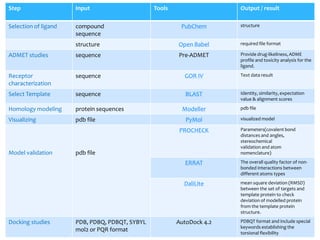
Step Input ToolsOutput / result
Selection of ligand compound
sequence
PubChem structure
structure Open Babel required file format
ADMET studies sequence Pre-ADMET Provide drug-likeliness, ADME
profile and toxicity analysis for the
ligand.
Receptor
characterization
sequence GOR IV Text data result
Select Template sequence BLAST Identity, similarity, expectation
value & alignment scores
Homology modeling protein sequences Modeller pdb file
Visualizing pdb file PyMol visualized model
Model validation pdb file
PROCHECK Parameters(covalent bond
distances and angles,
stereochemical
validation and atom
nomenclature)
ERRAT The overall quality factor of non-
bonded interactions between
different atoms types
DaliLite mean square deviation (RMSD)
between the set of targets and
template protein to check
deviation of modelled protein
from the template protein
structure.
Docking studies PDB, PDBQ, PDBQT, SYBYL
mol2 or PQR format
AutoDock 4.2 PDBQT format and include special
keywords establishing the
torsional flexibility
4.
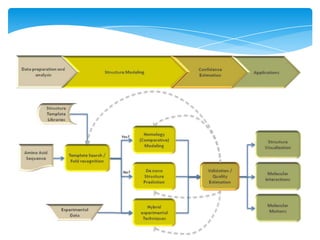
Data Preparation andAnalysis
The world wide Protein Data Bank: The single archive of experimental
marcomolecular structural data. [RCSB PDB] (USA); [PDBe] (Europe); [PDBj]
(Japan)
CATH: A manually curated hierarchical domain classification of protein structures
in the Protein Data Bank.
UniProt: Protein Knowledgebase. A comprehensive, high-quality and freely
accessible database of protein sequence and functional information.
RefSeq: NCBI Reference Sequence. A collection of curated, non-redundant
genomic DNA, transcript (RNA), and protein sequences produced by NCBI.
SBKB: Structural Biology Knowledgebase. A portal to protein structures,
sequences, functions and methods.
5.
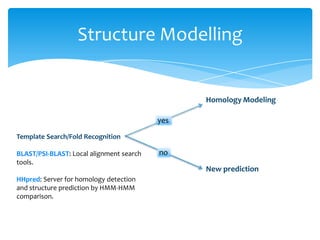
Structure Modelling
Template Search/FoldRecognition
BLAST/PSI-BLAST: Local alignment search
tools.
HHpred: Server for homology detection
and structure prediction by HMM-HMM
comparison.
Homology Modeling
New prediction
yes
no
6.
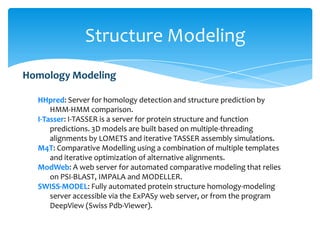
HHpred: Server forhomology detection and structure prediction by
HMM-HMM comparison.
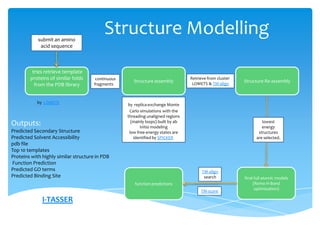
I-Tasser: I-TASSER is a server for protein structure and function
predictions. 3D models are built based on multiple-threading
alignments by LOMETS and iterative TASSER assembly simulations.
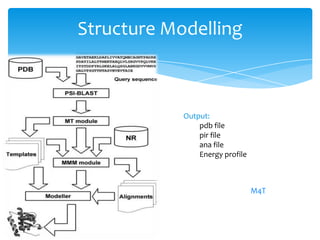
M4T: Comparative Modelling using a combination of multiple templates
and iterative optimization of alternative alignments.
ModWeb: A web server for automated comparative modeling that relies
on PSI-BLAST, IMPALA and MODELLER.
SWISS-MODEL: Fully automated protein structure homology-modeling
server accessible via the ExPASy web server, or from the program
DeepView (Swiss Pdb-Viewer).
Homology Modeling
Structure Modeling
7.
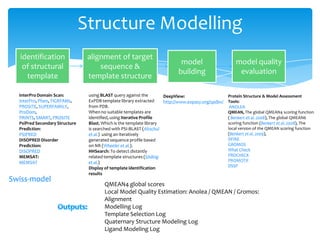
Swiss-model
identification
of structural
template
alignment oftarget
sequence &
template structure
model
building
model quality
evaluation
InterPro Domain Scan:
InterPro, Pfam, TIGRFAMs,
PROSITE, SUPERFAMILY,
ProDom,
PRINTS, SMART, PROSITE
PsiPred Secondary Structure
Prediction:
PSIPRED
DISOPRED Disorder
Prediction:
DISOPRED
MEMSAT:
MEMSAT
using BLAST query against the
ExPDB template library extracted
from PDB.
When no suitable templates are
identified, using Iterative Profile
Blast. Which is the template library
is searched with PSI-BLAST (Altschul
et al.) using an iteratively
generated sequence profile based
on NR (Wheeler et al.).
HHSearch: To detect distantly
related template structures (Söding
et al.)
Display of template identification
results
DeepView:
http://www.expasy.org/spdbv/
Protein Structure & Model Assessment
Tools:
ANOLEA
QMEAN, The global QMEAN4 scoring function
( Benkert et al. 2008), The global QMEAN6
scoring function (Benkert et al. 2008), The
local version of the QMEAN scoring function
(Benkert et al. 2009),
DFIRE
GROMOS
What Check
PROCHECK
PROMOTIF
DSSP
QMEAN4 global scores
Local Model Quality Estimation: Anolea / QMEAN / Gromos:
Alignment
Modelling Log
Template Selection Log
Quaternary Structure Modeling Log
Ligand Modeling Log
Structure Modelling
8.
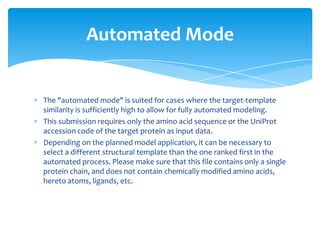
The "automated mode"is suited for cases where the target-template
similarity is sufficiently high to allow for fully automated modeling.
This submission requires only the amino acid sequence or the UniProt
accession code of the target protein as input data.
Depending on the planned model application, it can be necessary to
select a different structural template than the one ranked first in the
automated process. Please make sure that this file contains only a single
protein chain, and does not contain chemically modified amino acids,
hereto atoms, ligands, etc.
Automated Mode
9.
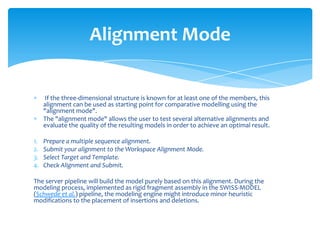
If the three-dimensionalstructure is known for at least one of the members, this
alignment can be used as starting point for comparative modelling using the
"alignment mode".
The "alignment mode" allows the user to test several alternative alignments and
evaluate the quality of the resulting models in order to achieve an optimal result.
1. Prepare a multiple sequence alignment.
2. Submit your alignment to the Workspace Alignment Mode.
3. Select Target and Template.
4. Check Alignment and Submit.
The server pipeline will build the model purely based on this alignment. During the
modeling process, implemented as rigid fragment assembly in the SWISS-MODEL
(Schwede et al.) pipeline, the modeling engine might introduce minor heuristic
modifications to the placement of insertions and deletions.
Alignment Mode
10.
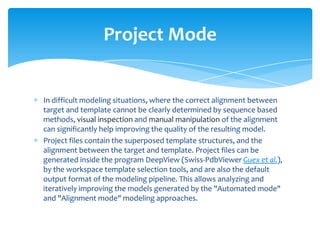
In difficult modelingsituations, where the correct alignment between
target and template cannot be clearly determined by sequence based
methods, visual inspection and manual manipulation of the alignment
can significantly help improving the quality of the resulting model.
Project files contain the superposed template structures, and the
alignment between the target and template. Project files can be
generated inside the program DeepView (Swiss-PdbViewer Guex et al.),
by the workspace template selection tools, and are also the default
output format of the modeling pipeline. This allows analyzing and
iteratively improving the models generated by the "Automated mode"
and "Alignment mode" modeling approaches.
Project Mode
I-TASSER
tries retrieve template
proteinsof similar folds
from the PDB library
by LOMETS
Structure assemblycontinuous
fragments
by replica-exchange Monte
Carlo simulations with the
threading unaligned regions
(mainly loops) built by ab
initio modeling
low free-energy states are
identified by SPICKER
Structure Re-assembly
Retrieve from cluster
LOMETS & TM-align
lowest
energy
structures
are selected.
final full-atomic models
(Remo H-Bond
optimization)
function predictions
TM-align
search
TM-score
Outputs:
Predicted Secondary Structure
Predicted Solvent Accessibility
pdb file
Top 10 templates
Proteins with highly similar structure in PDB
Function Prediction
Predicted GO terms
Predicted Binding Site
Structure Modellingsubmit an amino
acid sequence
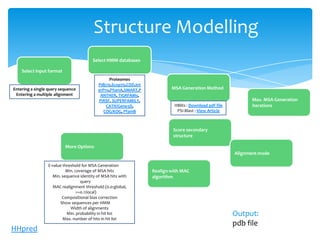
13.
HHpred
Select input format
MSAGeneration Method
More Options
Max. MSA Generation
iterations
Score secondary
structure
Realign with MAC
algorithm
Alignment mode
Select HMM databases
Entering a single query sequence
Entering a multiple alignment
Proteomes
Pdb70,Scop70,CDD,Int
erPro,PfamA,SMART,P
ANTHER, TIGRFAMs,
PIRSF, SUPERFAMILY,
CATH/Gene3D,
COG/KOG, PfamB
HBlits : Download pdf file
PSI-Blast : View Article
E-value threshold for MSA Generation
Min. coverage of MSA hits
Min. sequence identity of MSA hits with
query
MAC realignment threshold (0.0:global,
>=0.1:local)
Compositional bias correction
Show sequences per HMM
Width of alignments
Min. probability in hit list
Max. number of hits in hit list
Output:
pdb file
Structure Modelling
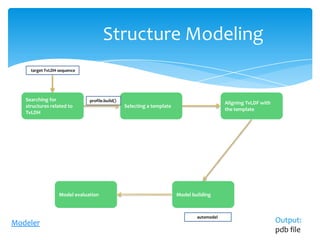
14.
Modeler
Searching for
structures relatedto
TvLDH
Selecting a template
Model evaluation Model building
Aligning TvLDF with
the template
target TvLDH sequence
profile.build()
automodel
Output:
pdb file
Structure Modeling
15.
New prediction
When nosuitable template structure can be identified, de
novo (a.k.a. ab initio) structure prediction methods can be
used to generate three-dimensional protein models without
relying on a homologus template structure:
Robetta: Full-chain protein structure prediction server based
on the Rosetta method.
Rosetta: De novo protein structure prediction software.
Structure Modeling
16.
Hybrid techniques
The goalof hybrid techniques is to contribute to a comprehensive
structural characterization of biomolecules ranging in size and
complexity from small peptides to large macromolecular
assemblies. Detailed structural characterization of assemblies is
generally impossible by any single existing experimental or
computational method. This barrier can be overcome by hybrid
approaches that integrate data from diverse biochemical and
biophysical experiments:
CS-ROSETTA: System for chemical shifts based protein structure
prediction using ROSETTA.
IMP: software for a comprehensive structural characterization of
biomolecules.
Structure Modelling
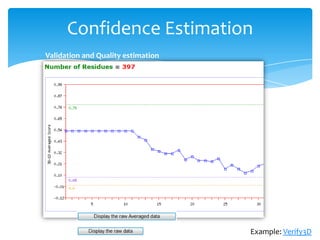
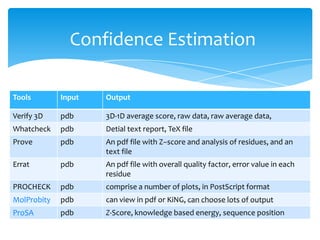
Tools Input Output
Verify3D pdb 3D-1D average score, raw data, raw average data,
Whatcheck pdb Detial text report, TeX file
Prove pdb An pdf file with Z–score and analysis of residues, and an
text file
Errat pdb An pdf file with overall quality factor, error value in each
residue
PROCHECK pdb comprise a number of plots, in PostScript format
MolProbity pdb can view in pdf or KiNG, can choose lots of output
ProSA pdb Z-Score, knowledge based energy, sequence position
Confidence Estimation
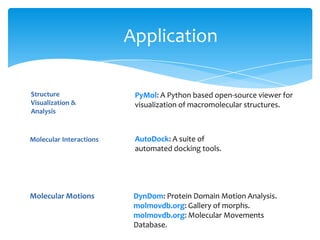
19.
Application
Structure
Visualization &
Analysis
PyMol: APython based open-source viewer for
visualization of macromolecular structures.
AutoDock: A suite of
automated docking tools.
Molecular Interactions
Molecular Motions DynDom: Protein Domain Motion Analysis.
molmovdb.org: Gallery of morphs.
molmovdb.org: Molecular Movements
Database.
![Data Preparation and Analysis
The world wide Protein Data Bank: The single archive of experimental
marcomolecular structural data. [RCSB PDB] (USA); [PDBe] (Europe); [PDBj]
(Japan)
CATH: A manually curated hierarchical domain classification of protein structures
in the Protein Data Bank.
UniProt: Protein Knowledgebase. A comprehensive, high-quality and freely
accessible database of protein sequence and functional information.
RefSeq: NCBI Reference Sequence. A collection of curated, non-redundant
genomic DNA, transcript (RNA), and protein sequences produced by NCBI.
SBKB: Structural Biology Knowledgebase. A portal to protein structures,
sequences, functions and methods.](https://image.slidesharecdn.com/sessioniig2overview-metabolicnetworkmodelingmcc-130626195635-phpapp02/85/Session-ii-g2-overview-metabolic-network-modeling-mcc-4-320.jpg)