Download to read offline
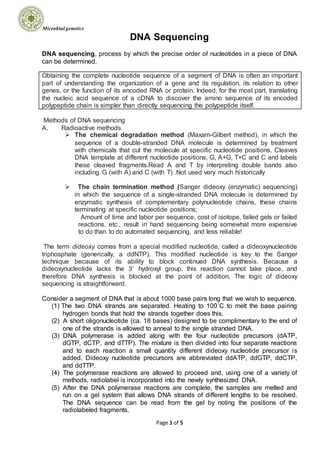

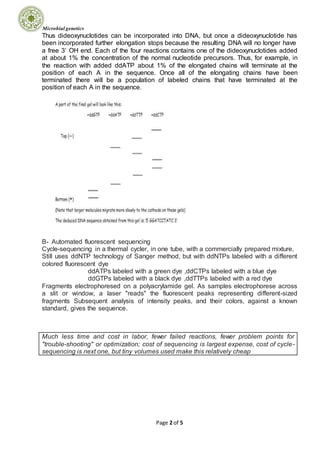
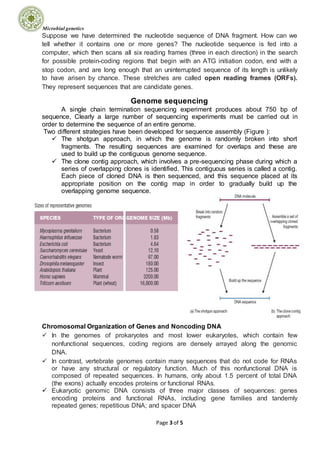

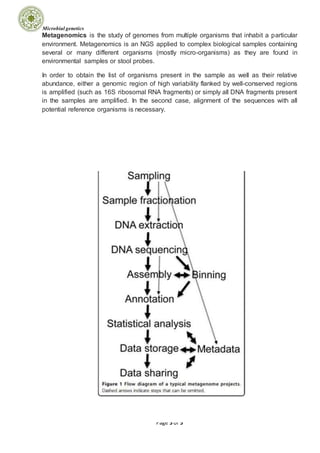

There are two main methods of DNA sequencing: the chain termination method (Sanger sequencing) and fluorescent sequencing. Sanger sequencing uses dideoxynucleotides that terminate DNA synthesis, producing fragments of different lengths that can be resolved on a gel. Fluorescent sequencing labels each dideoxynucleotide with a different colored dye, then uses software to analyze electrophoresed fragments by color and size. Next-generation sequencing allows high-throughput parallel sequencing of multiple DNA segments. It can be used for whole genome sequencing, targeted exome sequencing, or custom panels. Metagenomics applies next-generation sequencing to study the genomes of multiple organisms within an environmental sample.


![ONFH[AVN HIP] -TRIPLE REGIME -A NOVAL SURGICAL CONCEPT .pptx](https://cdn.slidesharecdn.com/ss_thumbnails/onfhavnhip2026koaconcalicutdrgokuldevdrmashraf-260210064517-213ec005-thumbnail.jpg?width=640&height=640&fit=bounds)


![PERI-PROSTHETIC FRACTURE NAIL-PLATE CONSTRUCT [NPC].pptx](https://cdn.slidesharecdn.com/ss_thumbnails/drarunkumardrmohamedashrafperiprostheticfrasturenail-plateconstructnpc-260209164459-7e9d15a1-thumbnail.jpg?width=640&height=640&fit=bounds)


