
Topic : Gene Transfer Methods In Animals
FROM : M.HUZAIFA NOTES
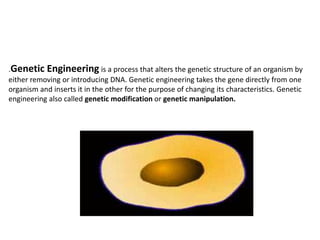
.Genetic Engineering is a process that alters the genetic structure of an organism by
either removing or introducing DNA. Genetic engineering takes the gene directly from one
organism and inserts it in the other for the purpose of changing its characteristics. Genetic
engineering also called genetic modification or genetic manipulation.
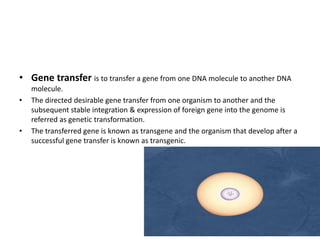
• Gene transfer is to transfer a gene from one DNA molecule to another DNA
molecule.
• The directed desirable gene transfer from one organism to another and the
subsequent stable integration & expression of foreign gene into the genome is
referred as genetic transformation.
• The transferred gene is known as transgene and the organism that develop after a
successful gene transfer is known as transgenic.
Methods Of Gene Transfer
• DNA Transfer by Natural Methods :
• 1. Conjugation
• 2. Bacterial Transformation
• 3. Retroviral Transduction
• DNA TRANSFER BY ARTIFICIAL METHOD :
• 1. Microinjection (Physical Method )
• 2. Biolistics Transformation (Physical Method)
• 3. DNA transfer by calcium phosphate method (Chemical Method)
• 4. Liposome mediated transfer (Chemical Method)
• 5. Electroporation (Electrical Method).
NATURAL METHODS OF GENE TRANSFER
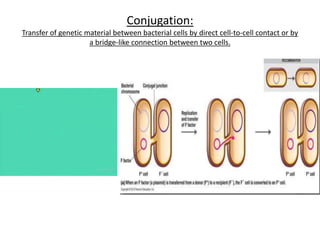
Conjugation:
Transfer of genetic material between bacterial cells by direct cell-to-cell contact or by
a bridge-like connection between two cells.
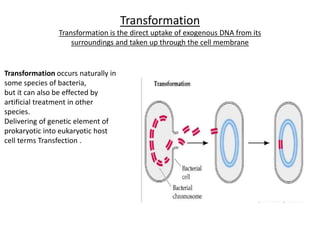
Transformation
Transformation is the direct uptake of exogenous DNA from its
surroundings and taken up through the cell membrane
Transformation occurs naturally in
some species of bacteria,
but it can also be effected by
artificial treatment in other
species.
Delivering of genetic element of
prokaryotic into eukaryotic host
cell terms Transfection .
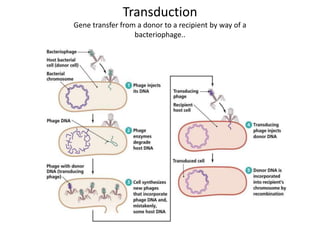
Transduction
Gene transfer from a donor to a recipient by way of a
bacteriophage..
Artificial (Vectorless)Gene Transfer
Microinjection (Physical Method)
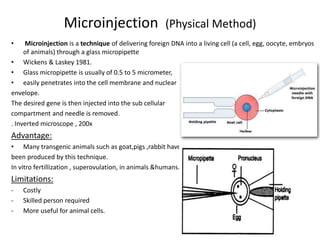
• Microinjection is a technique of delivering foreign DNA into a living cell (a cell, egg, oocyte, embryos
of animals) through a glass micropipette
• Wickens & Laskey 1981.
• Glass micropipette is usually of 0.5 to 5 micrometer,
• easily penetrates into the cell membrane and nuclear
envelope.
The desired gene is then injected into the sub cellular
compartment and needle is removed.
. Inverted microscope , 200x
Advantage:
• Many transgenic animals such as goat,pigs ,rabbit have
been produced by this technique.
In vitro fertillization , superovulation, in animals &humans.
Limitations:
- Costly
- Skilled person required
- More useful for animal cells.
Biolistics or Microprojectiles
(Physical Method)
Developed By Stanford&coworkers of cornell uni (USA) 1987
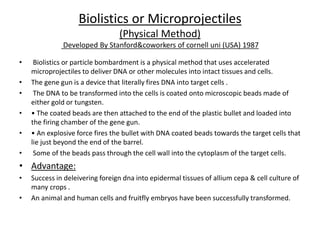
• Biolistics or particle bombardment is a physical method that uses accelerated
microprojectiles to deliver DNA or other molecules into intact tissues and cells.
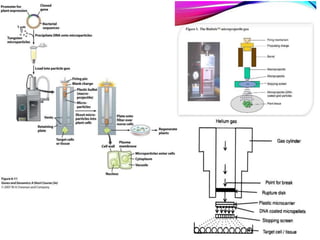
• The gene gun is a device that literally fires DNA into target cells .
• The DNA to be transformed into the cells is coated onto microscopic beads made of
either gold or tungsten.
• • The coated beads are then attached to the end of the plastic bullet and loaded into
the firing chamber of the gene gun.
• • An explosive force fires the bullet with DNA coated beads towards the target cells that
lie just beyond the end of the barrel.
• Some of the beads pass through the cell wall into the cytoplasm of the target cells.
• Advantage:
• Success in deleivering foreign dna into epidermal tissues of allium cepa & cell culture of
many crops .
• An animal and human cells and fruitfly embryos have been successfully transformed.
Liposome mediated gene transfer
(Chemical Method)
Discovered by Dr.Alec D.Bangham(1960)
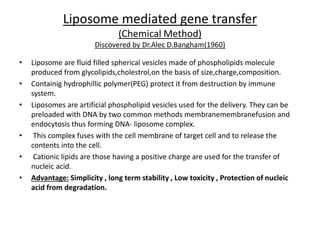
• Liposome are fluid filled spherical vesicles made of phospholipids molecule
produced from glycolipids,cholestrol,on the basis of size,charge,composition.
• Containig hydrophillic polymer(PEG) protect it from destruction by immune
system.
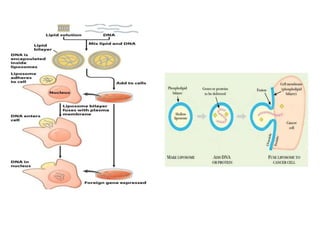
• Liposomes are artificial phospholipid vesicles used for the delivery. They can be
preloaded with DNA by two common methods membranemembranefusion and
endocytosis thus forming DNA- liposome complex.
• This complex fuses with the cell membrane of target cell and to release the
contents into the cell.
• Cationic lipids are those having a positive charge are used for the transfer of
nucleic acid.
• Advantage: Simplicity , long term stability , Low toxicity , Protection of nucleic
acid from degradation.
Calcium phosphate mediated DNA transfer
(Chemical Method)
Develop by graham,vander ebb&wigler
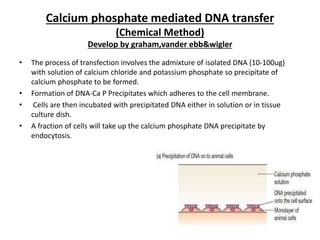
• The process of transfection involves the admixture of isolated DNA (10-100ug)
with solution of calcium chloride and potassium phosphate so precipitate of
calcium phosphate to be formed.
• Formation of DNA-Ca P Precipitates which adheres to the cell membrane.
• Cells are then incubated with precipitated DNA either in solution or in tissue
culture dish.
• A fraction of cells will take up the calcium phosphate DNA precipitate by
endocytosis.
Limitations:
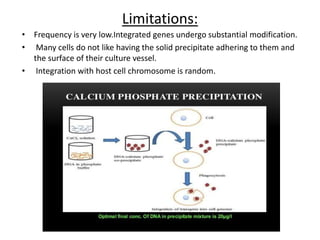
• Frequency is very low.Integrated genes undergo substantial modification.
• Many cells do not like having the solid precipitate adhering to them and
the surface of their culture vessel.
• Integration with host cell chromosome is random.
Electroporation
(Electrical Method)
Discovered in 1970-80 by zimmerman,neuman&crowley
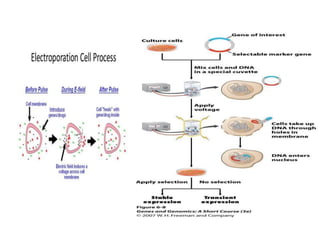
• Electroporation uses electrical pulse(about 350 V) to produce transient pores in
the plasma membrane thereby allowing DNA into the cells..These pores are known
as electropores.
• The cells are placed in a solution containing DNA and subjected to electrical pulse
to cause holes in the membrane.
• The foreign DNA fragments enter through holes into the cytoplasm and then to
nucleus.
• Advantages:
1 .Method is fast.
2 . Less costly.
3. Applied for a number of cell types.
4. Simultaneously a large number of cell can be treated.
5. High percentage of stable transformants can be produced.
Applications
• Vaccine Development.
• Production of transgenic animals.
• Treatment of cancer, AIDS.
• Gene Therapy.
• Genetically Modified Organisms (GMO).
• Screening:
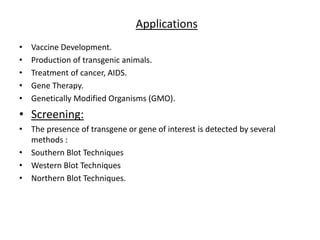
• The presence of transgene or gene of interest is detected by several
methods :
• Southern Blot Techniques
• Western Blot Techniques
• Northern Blot Techniques.
THANKYOU


GENE TRANSFER METHODS IN ANIMALS

  • 1.
    Topic : GeneTransfer Methods In Animals FROM : M.HUZAIFA NOTES
  • 2.
    .Genetic Engineering isa process that alters the genetic structure of an organism by either removing or introducing DNA. Genetic engineering takes the gene directly from one organism and inserts it in the other for the purpose of changing its characteristics. Genetic engineering also called genetic modification or genetic manipulation.
  • 3.
    • Gene transferis to transfer a gene from one DNA molecule to another DNA molecule. • The directed desirable gene transfer from one organism to another and the subsequent stable integration & expression of foreign gene into the genome is referred as genetic transformation. • The transferred gene is known as transgene and the organism that develop after a successful gene transfer is known as transgenic.
  • 4.
    Methods Of GeneTransfer • DNA Transfer by Natural Methods : • 1. Conjugation • 2. Bacterial Transformation • 3. Retroviral Transduction • DNA TRANSFER BY ARTIFICIAL METHOD : • 1. Microinjection (Physical Method ) • 2. Biolistics Transformation (Physical Method) • 3. DNA transfer by calcium phosphate method (Chemical Method) • 4. Liposome mediated transfer (Chemical Method) • 5. Electroporation (Electrical Method).
  • 5.
    NATURAL METHODS OFGENE TRANSFER
  • 6.
    Conjugation: Transfer of geneticmaterial between bacterial cells by direct cell-to-cell contact or by a bridge-like connection between two cells.
  • 7.
    Transformation Transformation is thedirect uptake of exogenous DNA from its surroundings and taken up through the cell membrane Transformation occurs naturally in some species of bacteria, but it can also be effected by artificial treatment in other species. Delivering of genetic element of prokaryotic into eukaryotic host cell terms Transfection .
  • 8.
    Transduction Gene transfer froma donor to a recipient by way of a bacteriophage..
  • 9.
  • 10.
    Microinjection (Physical Method) •Microinjection is a technique of delivering foreign DNA into a living cell (a cell, egg, oocyte, embryos of animals) through a glass micropipette • Wickens & Laskey 1981. • Glass micropipette is usually of 0.5 to 5 micrometer, • easily penetrates into the cell membrane and nuclear envelope. The desired gene is then injected into the sub cellular compartment and needle is removed. . Inverted microscope , 200x Advantage: • Many transgenic animals such as goat,pigs ,rabbit have been produced by this technique. In vitro fertillization , superovulation, in animals &humans. Limitations: - Costly - Skilled person required - More useful for animal cells.
  • 11.
    Biolistics or Microprojectiles (PhysicalMethod) Developed By Stanford&coworkers of cornell uni (USA) 1987 • Biolistics or particle bombardment is a physical method that uses accelerated microprojectiles to deliver DNA or other molecules into intact tissues and cells. • The gene gun is a device that literally fires DNA into target cells . • The DNA to be transformed into the cells is coated onto microscopic beads made of either gold or tungsten. • • The coated beads are then attached to the end of the plastic bullet and loaded into the firing chamber of the gene gun. • • An explosive force fires the bullet with DNA coated beads towards the target cells that lie just beyond the end of the barrel. • Some of the beads pass through the cell wall into the cytoplasm of the target cells. • Advantage: • Success in deleivering foreign dna into epidermal tissues of allium cepa & cell culture of many crops . • An animal and human cells and fruitfly embryos have been successfully transformed.
  • 13.
    Liposome mediated genetransfer (Chemical Method) Discovered by Dr.Alec D.Bangham(1960) • Liposome are fluid filled spherical vesicles made of phospholipids molecule produced from glycolipids,cholestrol,on the basis of size,charge,composition. • Containig hydrophillic polymer(PEG) protect it from destruction by immune system. • Liposomes are artificial phospholipid vesicles used for the delivery. They can be preloaded with DNA by two common methods membranemembranefusion and endocytosis thus forming DNA- liposome complex. • This complex fuses with the cell membrane of target cell and to release the contents into the cell. • Cationic lipids are those having a positive charge are used for the transfer of nucleic acid. • Advantage: Simplicity , long term stability , Low toxicity , Protection of nucleic acid from degradation.
  • 15.
    Calcium phosphate mediatedDNA transfer (Chemical Method) Develop by graham,vander ebb&wigler • The process of transfection involves the admixture of isolated DNA (10-100ug) with solution of calcium chloride and potassium phosphate so precipitate of calcium phosphate to be formed. • Formation of DNA-Ca P Precipitates which adheres to the cell membrane. • Cells are then incubated with precipitated DNA either in solution or in tissue culture dish. • A fraction of cells will take up the calcium phosphate DNA precipitate by endocytosis.
  • 16.
    Limitations: • Frequency isvery low.Integrated genes undergo substantial modification. • Many cells do not like having the solid precipitate adhering to them and the surface of their culture vessel. • Integration with host cell chromosome is random.
  • 17.
    Electroporation (Electrical Method) Discovered in1970-80 by zimmerman,neuman&crowley • Electroporation uses electrical pulse(about 350 V) to produce transient pores in the plasma membrane thereby allowing DNA into the cells..These pores are known as electropores. • The cells are placed in a solution containing DNA and subjected to electrical pulse to cause holes in the membrane. • The foreign DNA fragments enter through holes into the cytoplasm and then to nucleus. • Advantages: 1 .Method is fast. 2 . Less costly. 3. Applied for a number of cell types. 4. Simultaneously a large number of cell can be treated. 5. High percentage of stable transformants can be produced.
  • 19.
    Applications • Vaccine Development. •Production of transgenic animals. • Treatment of cancer, AIDS. • Gene Therapy. • Genetically Modified Organisms (GMO). • Screening: • The presence of transgene or gene of interest is detected by several methods : • Southern Blot Techniques • Western Blot Techniques • Northern Blot Techniques.
  • 20.

Editor's Notes