SSaammpplliinngg aanndd SSaammppllee 
SSiizzee DDeetteerrmmiinnaattiioonn
TTeerrmmss 
 SSaammppllee 
 PPooppuullaattiioonn 
 PPooppuullaattiioonn eelleemmeenntt 
 CCeennssuuss
WWhhyy uussee aa ssaammppllee?? 
 CCoosstt 
 SSppeeeedd 
 AAccccuurraaccyy 
 DDeessttrruuccttiioonn ooff tteesstt uunniittss
SStteeppss 
 DDeeffiinniittiioonn ooff ttaarrggeett ppooppuullaattiioonn 
 SSeelleeccttiioonn ooff aa ssaammpplliinngg ffrraammee ((lliisstt)) 
 PPrroobbaabbiilliittyy oorr NNoonnpprroobbaabbiilliittyy ssaammpplliinngg 
 SSaammpplliinngg UUnniitt 
 EErrrroorr 
–– RRaannddoomm ssaammpplliinngg eerrrroorr ((cchhaannccee 
fflluuccttuuaattiioonnss)) 
– NNoonnssaammpplliinngg eerrrroorr ((ddeessiiggnn eerrrroorrss))
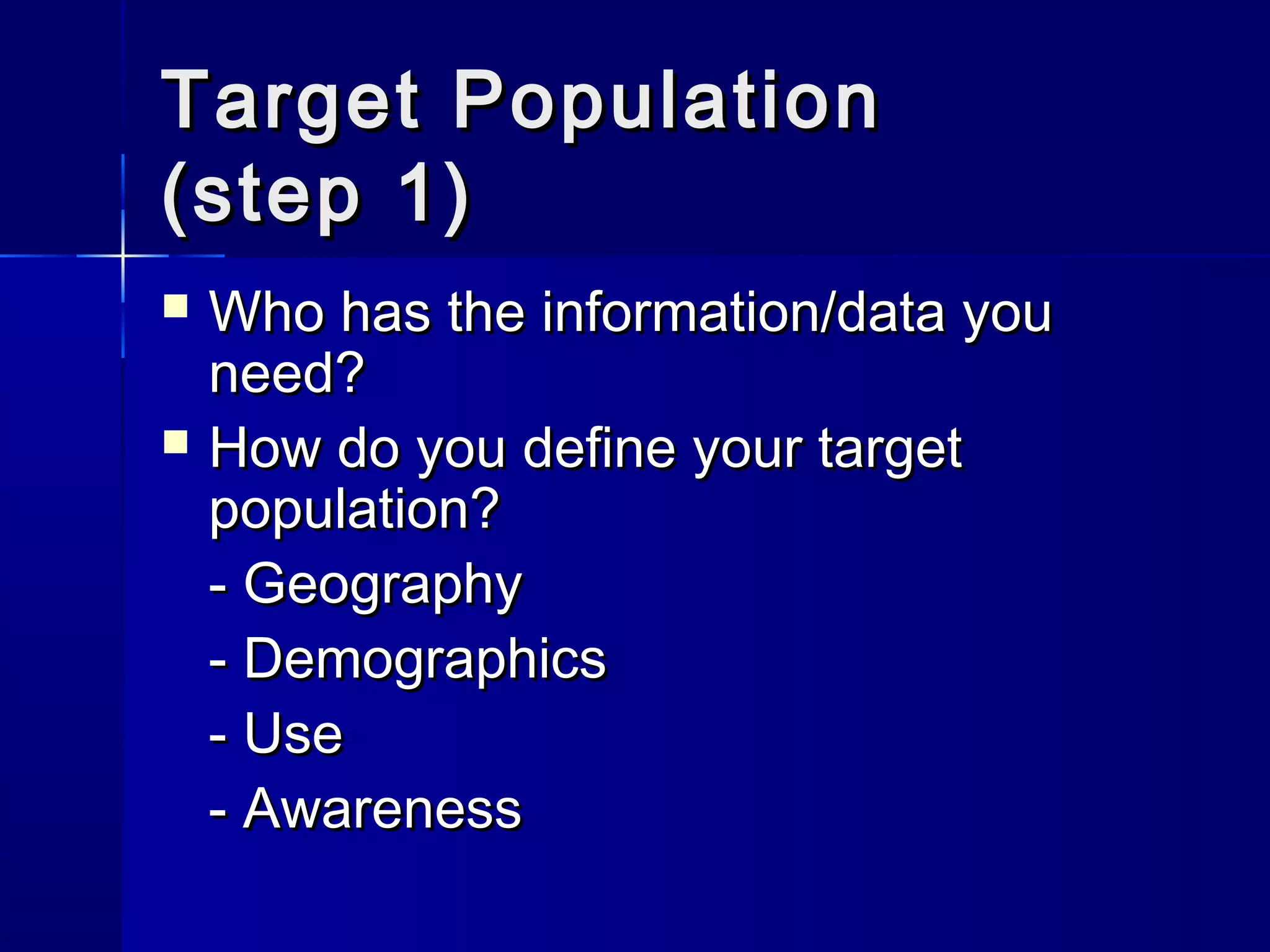
TTaarrggeett PPooppuullaattiioonn 
((sstteepp 11)) 
 WWhhoo hhaass tthhee iinnffoorrmmaattiioonn//ddaattaa yyoouu 
nneeeedd?? 
 HHooww ddoo yyoouu ddeeffiinnee yyoouurr ttaarrggeett 
ppooppuullaattiioonn?? 
-- GGeeooggrraapphhyy 
-- DDeemmooggrraapphhiiccss 
-- UUssee 
-- AAwwaarreenneessss
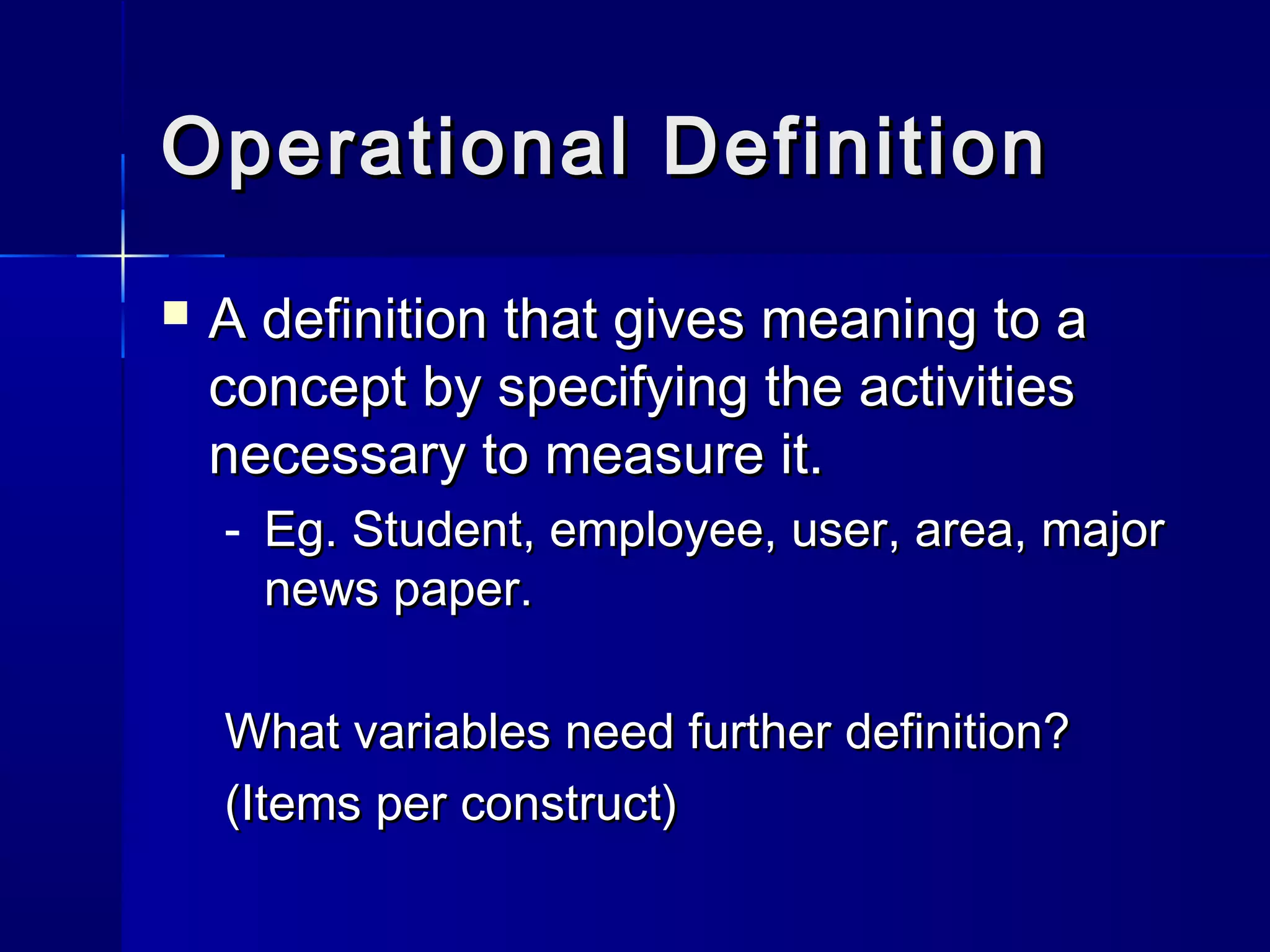
Operational DDeeffiinniittiioonn 
 AA ddeeffiinniittiioonn tthhaatt ggiivveess mmeeaanniinngg ttoo aa 
ccoonncceepptt bbyy ssppeecciiffyyiinngg tthhee aaccttiivviittiieess 
nneecceessssaarryy ttoo mmeeaassuurree iitt.. 
- EEgg.. SSttuuddeenntt,, eemmppllooyyeeee,, uusseerr,, aarreeaa,, mmaajjoorr 
nneewwss ppaappeerr.. 
WWhhaatt vvaarriiaabblleess nneeeedd ffuurrtthheerr ddeeffiinniittiioonn?? 
((IItteemmss ppeerr ccoonnssttrruucctt))
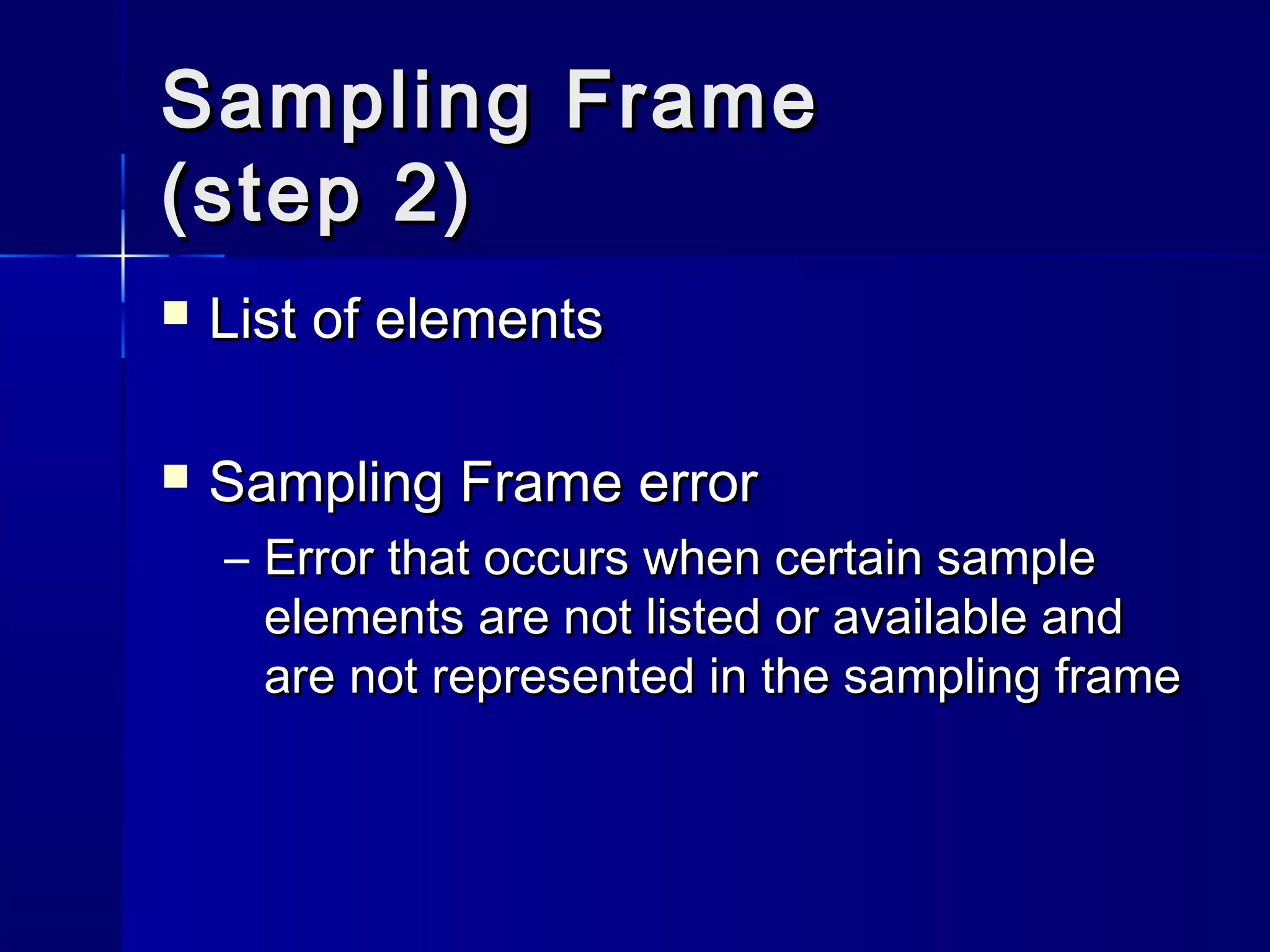
SSaammpplliinngg FFrraammee 
((sstteepp 2)) 
 LLiisstt ooff eelleemmeennttss 
 SSaammpplliinngg FFrraammee eerrrroorr 
– EErrrroorr tthhaatt ooccccuurrss wwhheenn cceerrttaaiinn ssaammppllee 
eelleemmeennttss aarree nnoott lliisstteedd oorr aavvaaiillaabbllee aanndd 
aarree nnoott rreepprreesseenntteedd iinn tthhee ssaammpplliinngg ffrraammee
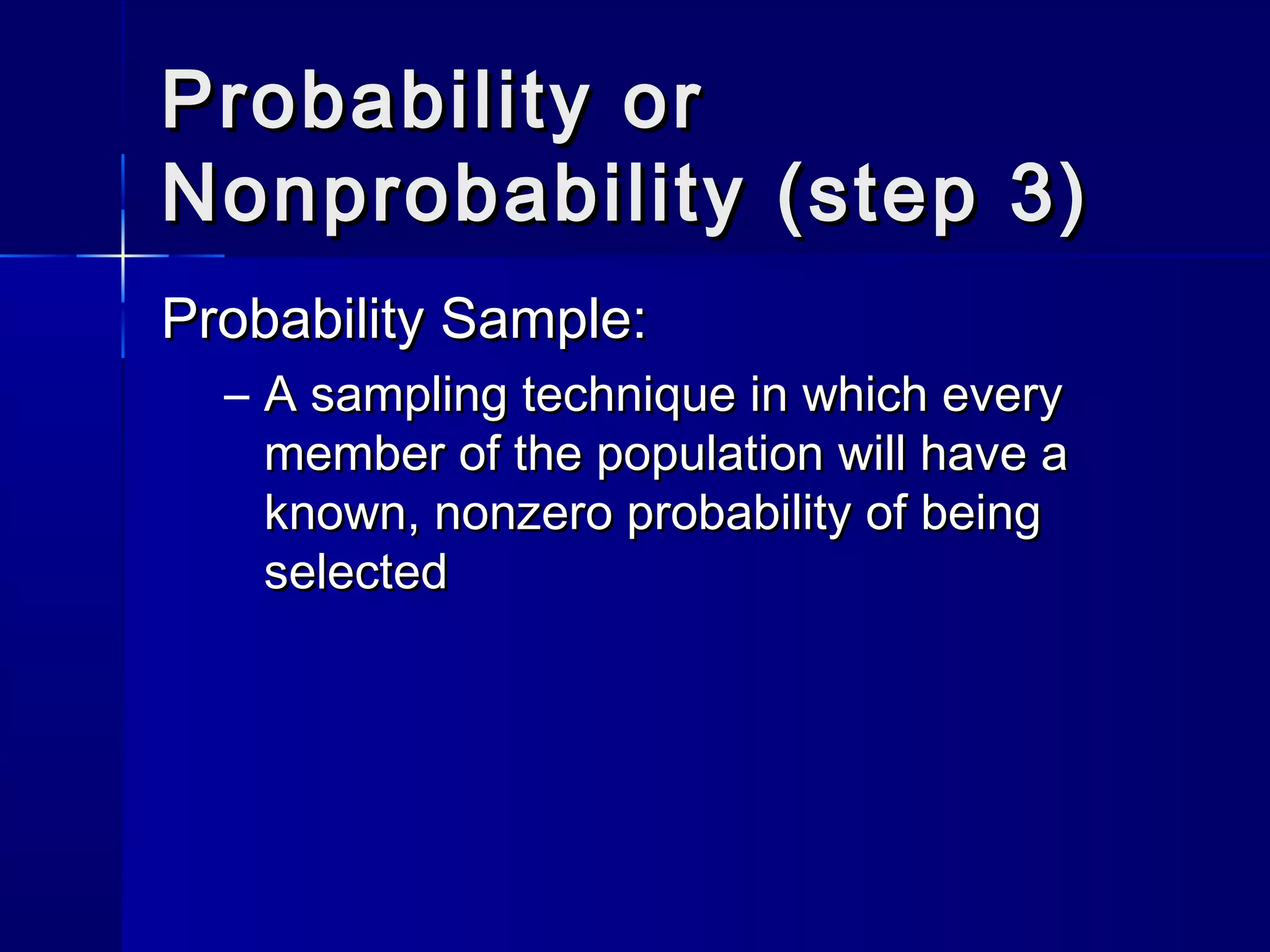
PPrroobbaabbiilliittyy oorr 
NNoonnpprroobbaabbiilliittyy ((sstteepp 33)) 
PPrroobbaabbiilliittyy SSaammppllee:: 
– AA ssaammpplliinngg tteecchhnniiqquuee iinn wwhhiicchh eevveerryy 
mmeemmbbeerr ooff tthhee ppooppuullaattiioonn wwiillll hhaavvee aa 
kknnoowwnn,, nnoonnzzeerroo pprroobbaabbiilliittyy ooff bbeeiinngg 
sseelleecctteedd
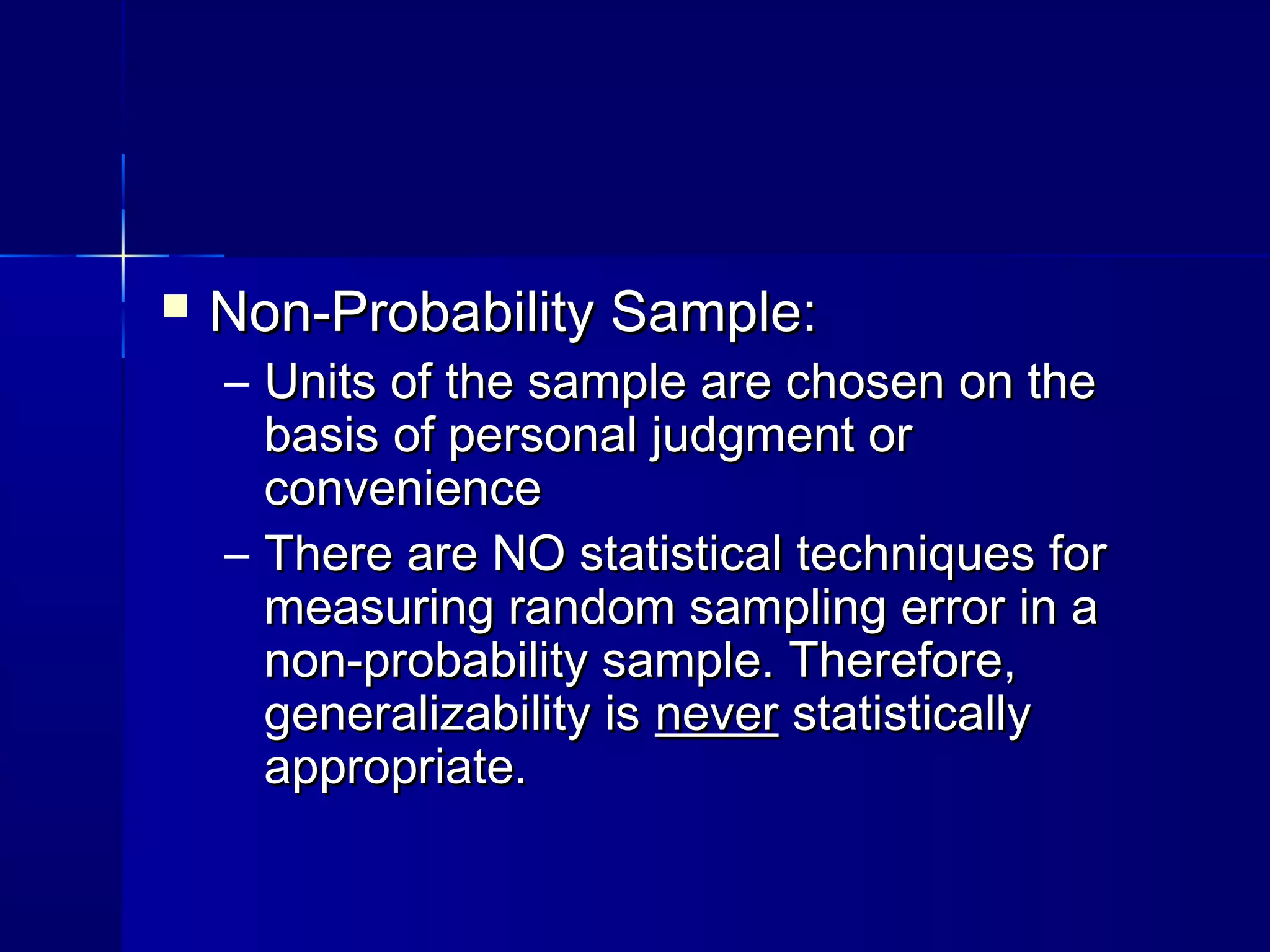
 NNoonn--PPrroobbaabbiilliittyy SSaammppllee:: 
– UUnniittss ooff tthhee ssaammppllee aarree cchhoosseenn oonn tthhee 
bbaassiiss ooff ppeerrssoonnaall jjuuddggmmeenntt oorr 
ccoonnvveenniieennccee 
– TThheerree aarree NNOO ssttaattiissttiiccaall tteecchhnniiqquueess ffoorr 
mmeeaassuurriinngg rraannddoomm ssaammpplliinngg eerrrroorr iinn aa 
nnoonn--pprroobbaabbiilliittyy ssaammppllee.. TThheerreeffoorree,, 
ggeenneerraalliizzaabbiilliittyy iiss nneevveerr ssttaattiissttiiccaallllyy 
aapppprroopprriiaattee..
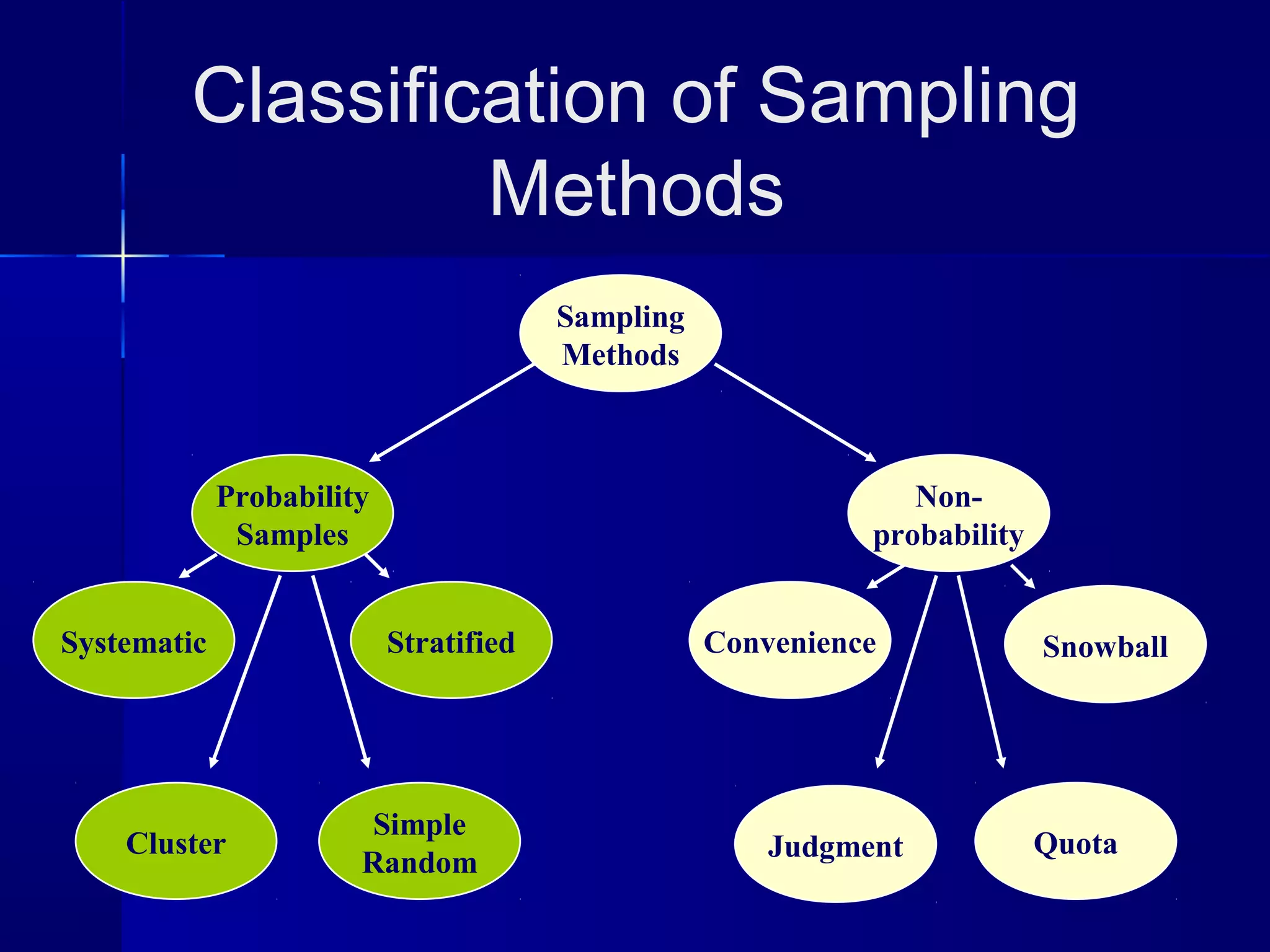
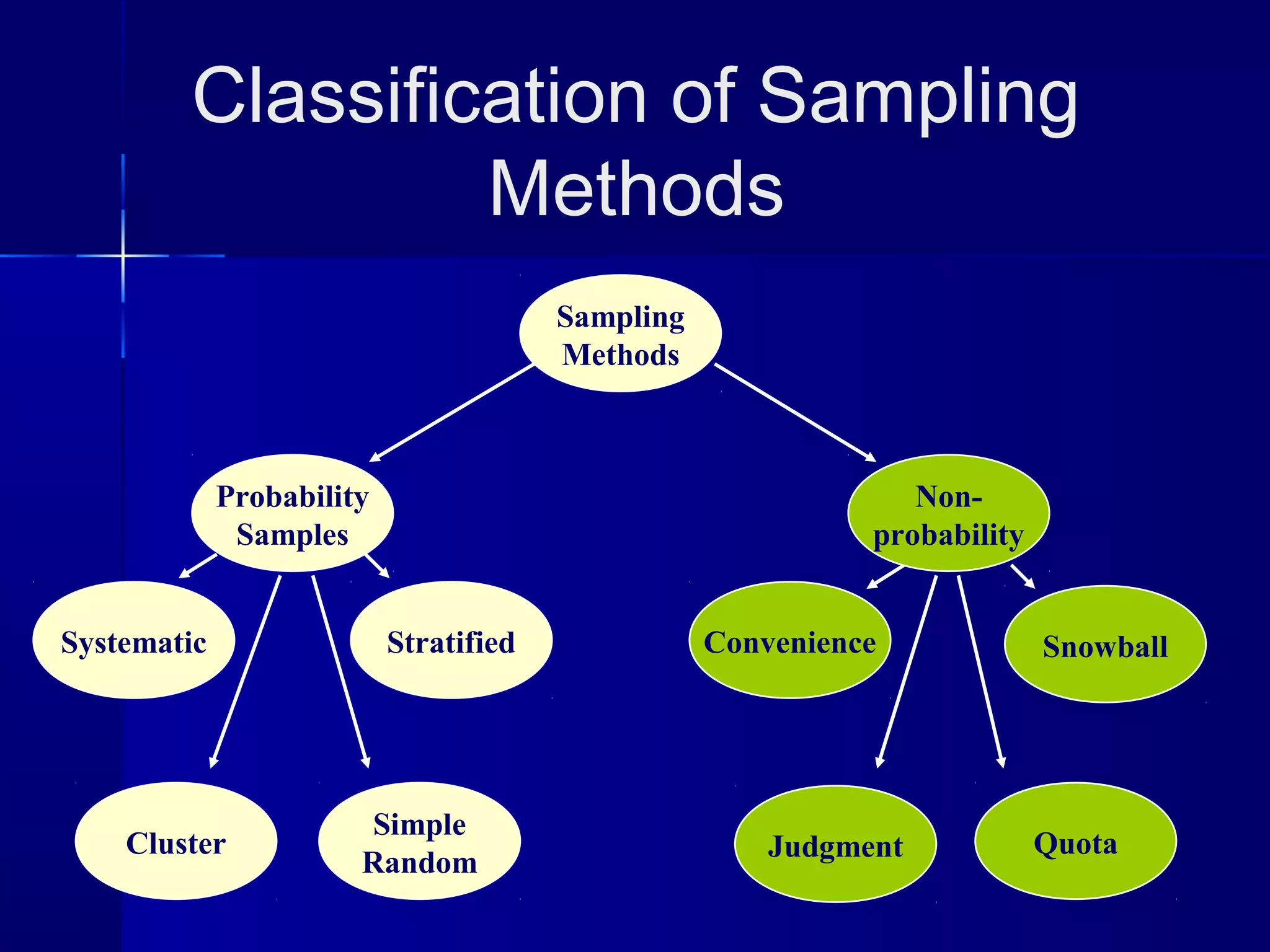
Classification of Sampling 
Methods 
Sampling 
Methods 
Probability 
Samples 
Systematic Stratified 
Simple 
Cluster Random 
Non-probability 
Convenience Snowball 
Judgment Quota
Probability Sampling 
Methods 
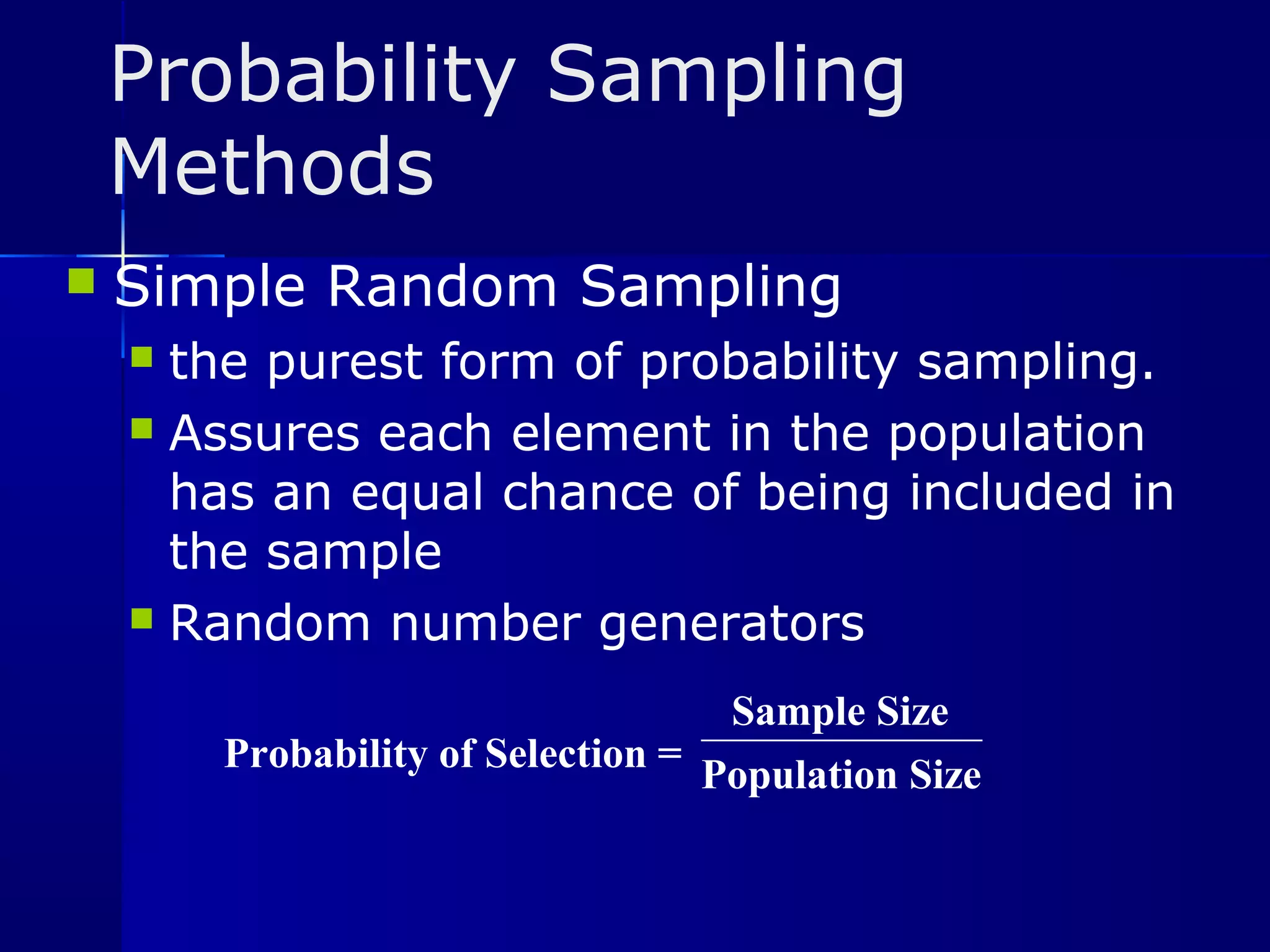
 Simple Random Sampling 
 the purest form of probability sampling. 
 Assures each element in the population 
has an equal chance of being included in 
the sample 
 Random number generators 
Probability of Selection = 
Sample Size 
Population Size
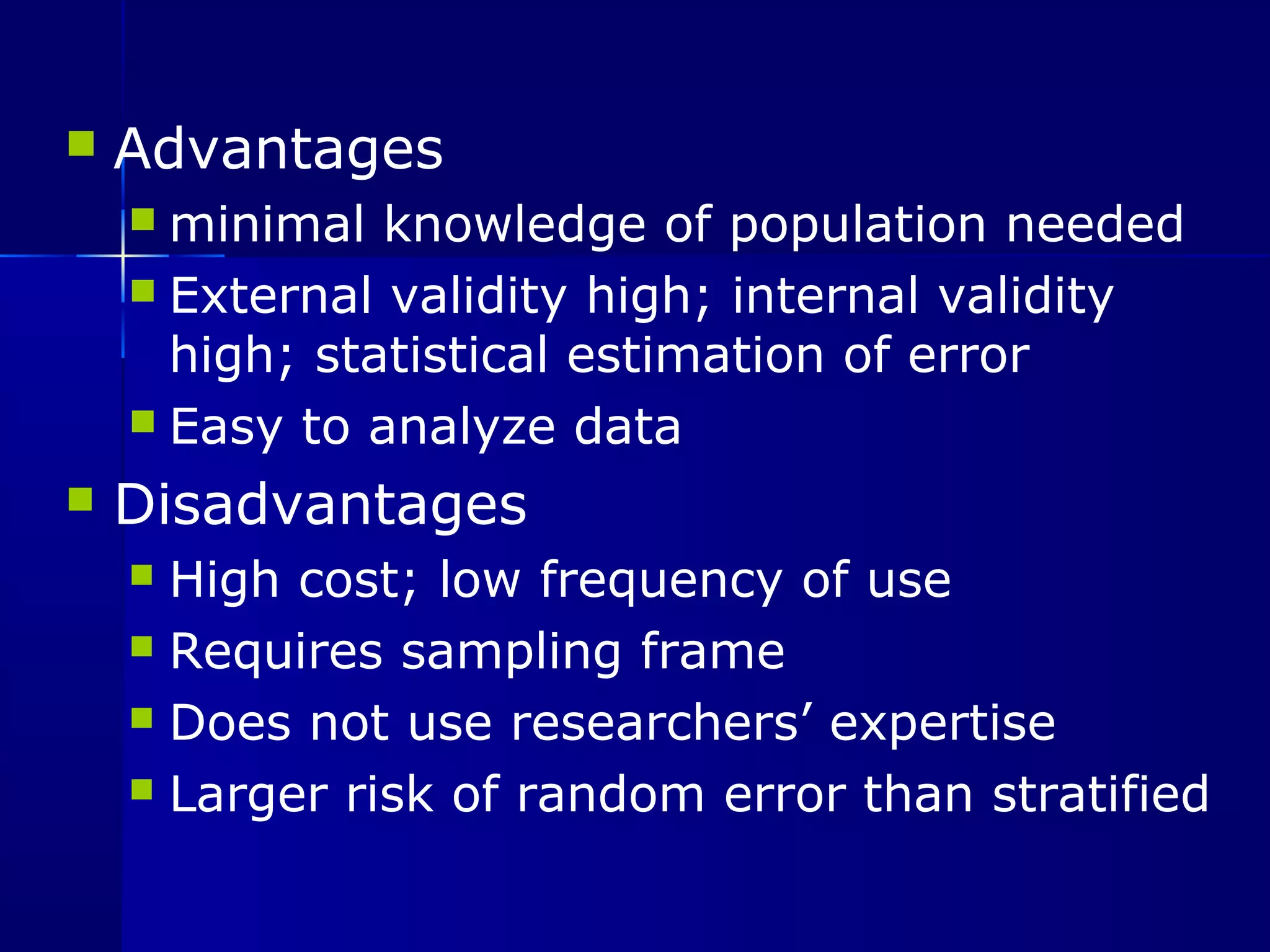
 Advantages 
minimal knowledge of population needed 
 External validity high; internal validity 
high; statistical estimation of error 
 Easy to analyze data 
 Disadvantages 
 High cost; low frequency of use 
 Requires sampling frame 
 Does not use researchers’ expertise 
 Larger risk of random error than stratified
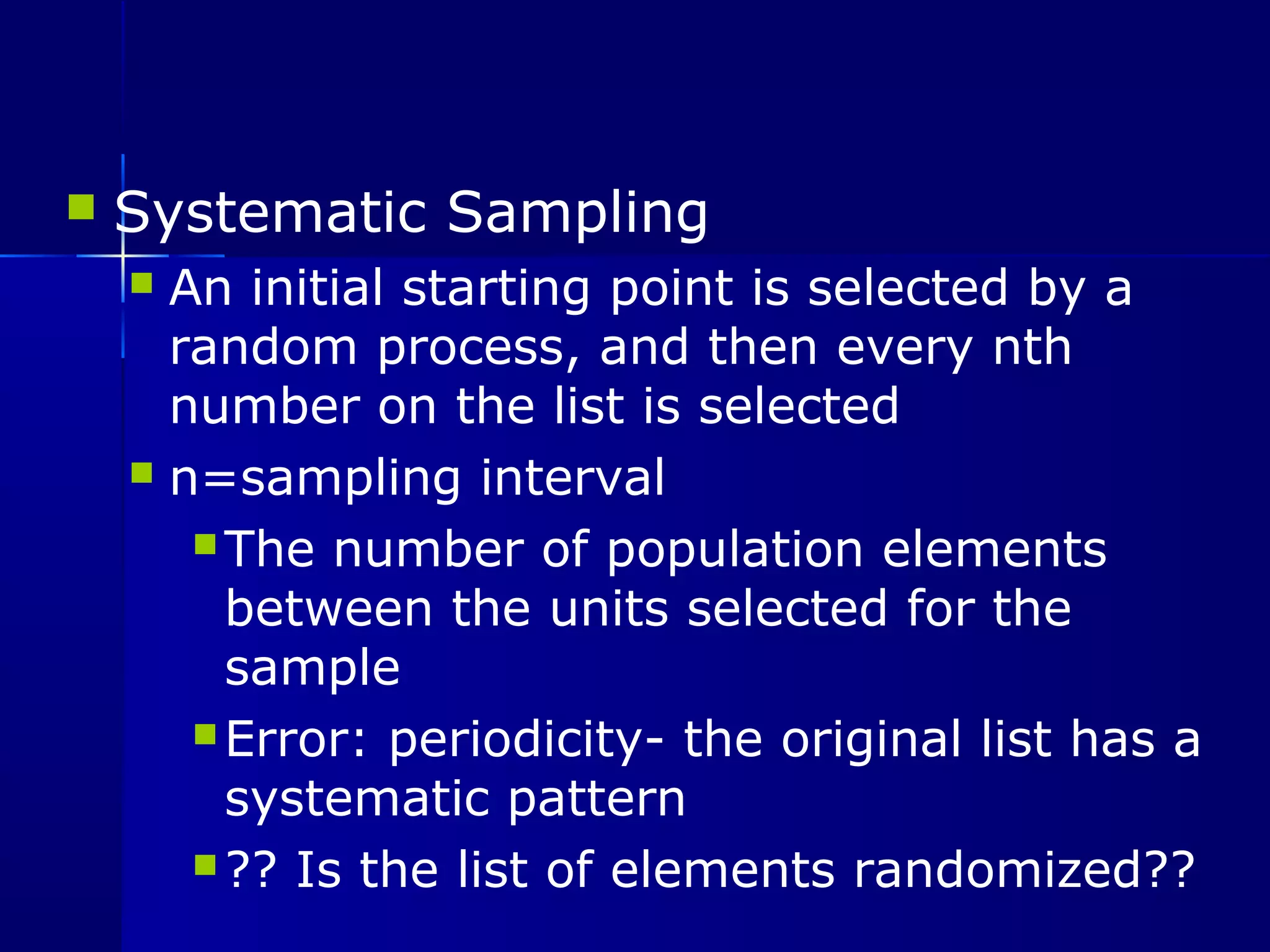
 Systematic Sampling 
 An initial starting point is selected by a 
random process, and then every nth 
number on the list is selected 
 n=sampling interval 
The number of population elements 
between the units selected for the 
sample 
Error: periodicity- the original list has a 
systematic pattern 
?? Is the list of elements randomized??
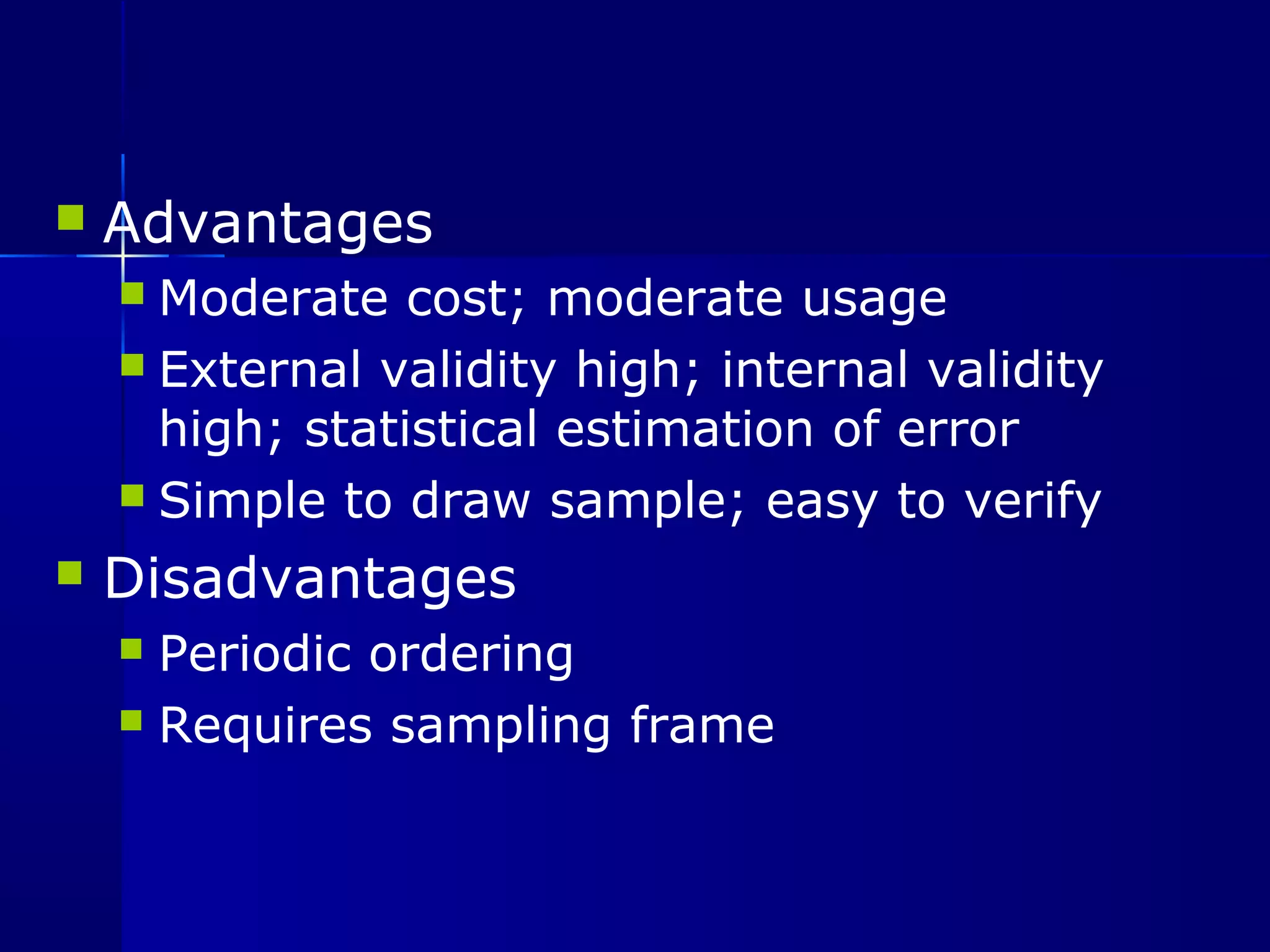
 Advantages 
 Moderate cost; moderate usage 
 External validity high; internal validity 
high; statistical estimation of error 
 Simple to draw sample; easy to verify 
 Disadvantages 
 Periodic ordering 
 Requires sampling frame
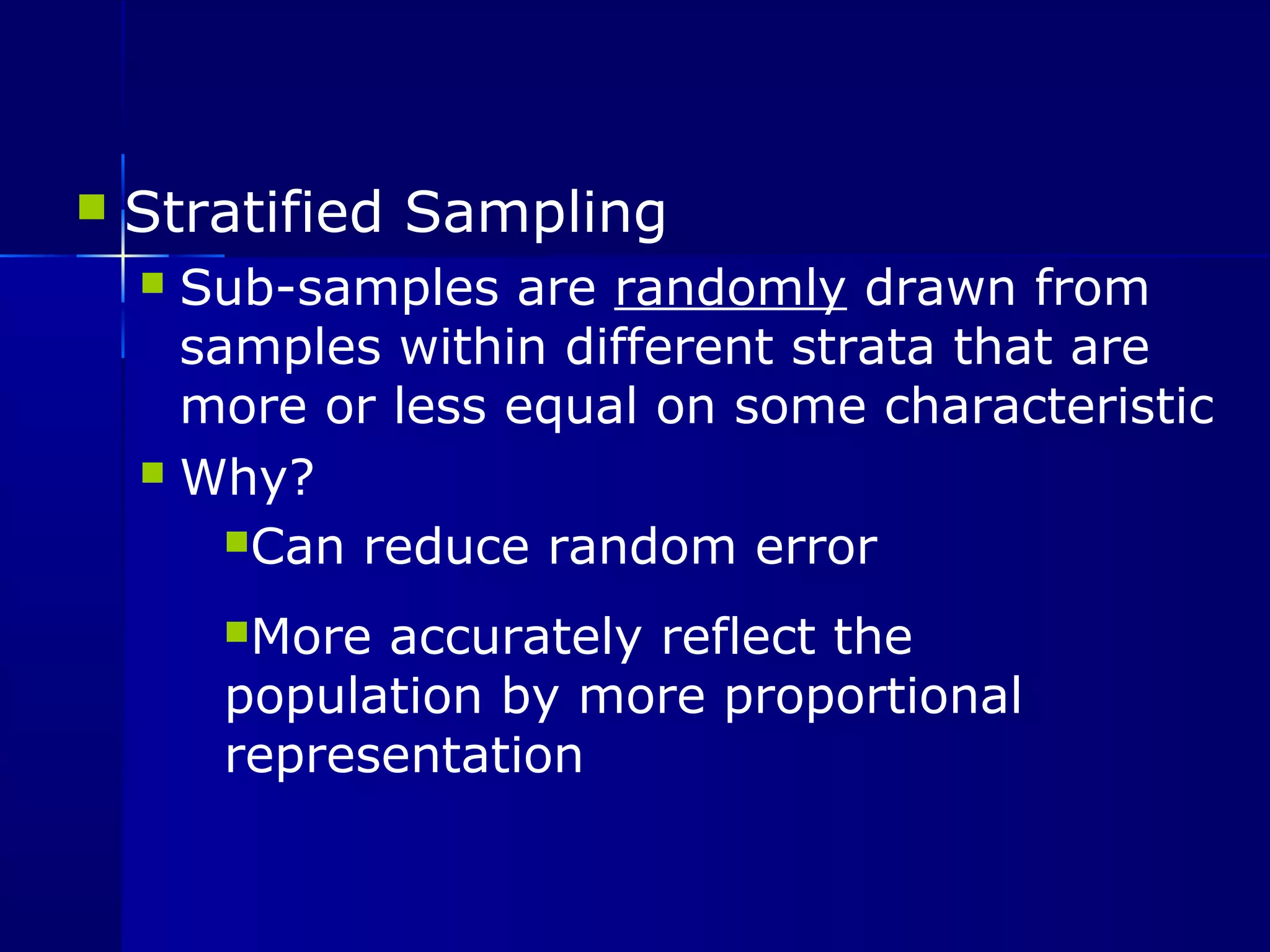
 Stratified Sampling 
 Sub-samples are randomly drawn from 
samples within different strata that are 
more or less equal on some characteristic 
 Why? 
Can reduce random error 
More accurately reflect the 
population by more proportional 
representation
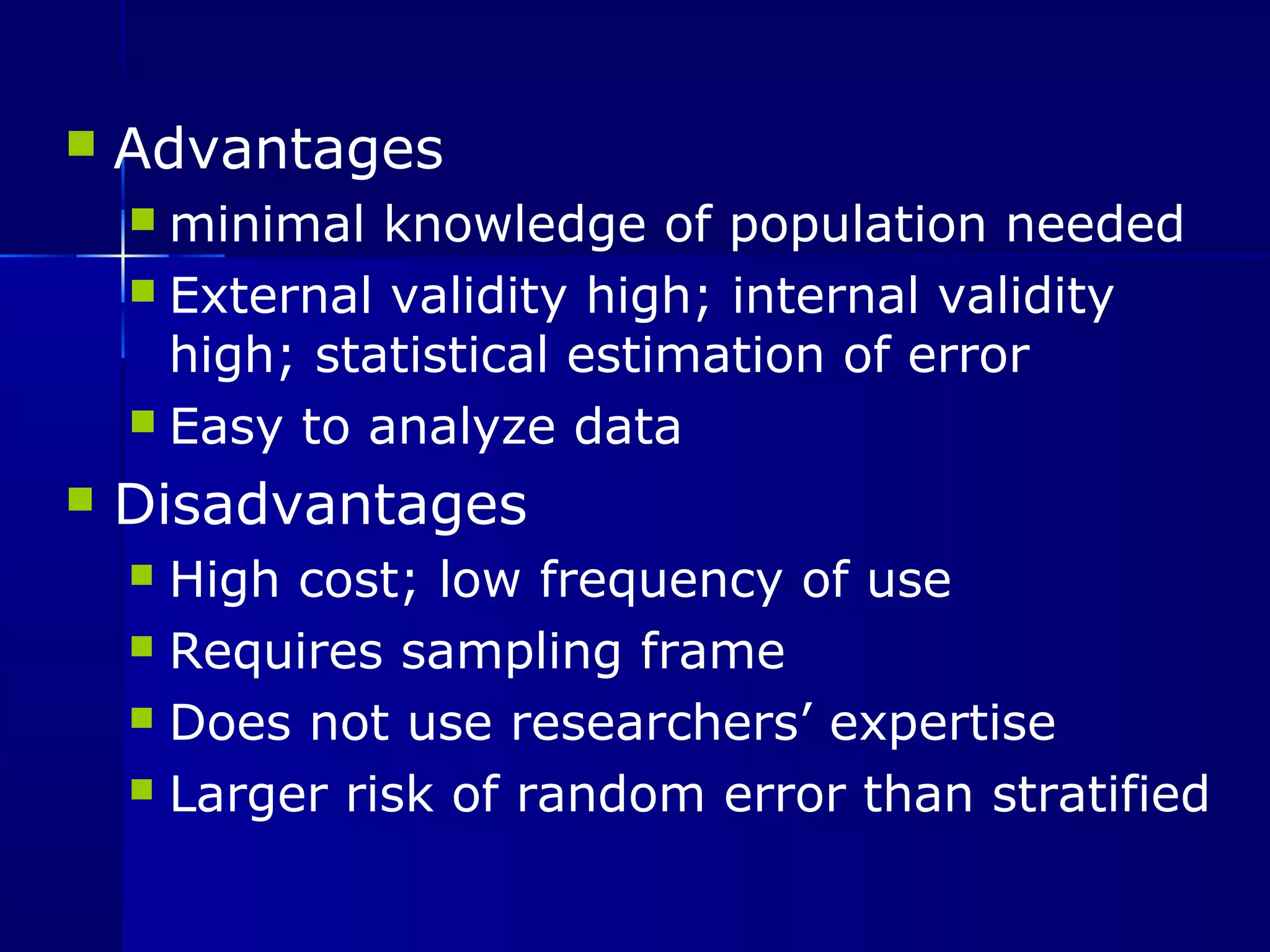
 Advantages 
minimal knowledge of population needed 
 External validity high; internal validity 
high; statistical estimation of error 
 Easy to analyze data 
 Disadvantages 
 High cost; low frequency of use 
 Requires sampling frame 
 Does not use researchers’ expertise 
 Larger risk of random error than stratified
 Systematic Sampling 
 An initial starting point is selected by a 
random process, and then every nth 
number on the list is selected 
 n=sampling interval 
The number of population elements 
between the units selected for the 
sample 
Error: periodicity- the original list has a 
systematic pattern 
?? Is the list of elements randomized??
 Advantages 
 Moderate cost; moderate usage 
 External validity high; internal validity 
high; statistical estimation of error 
 Simple to draw sample; easy to verify 
 Disadvantages 
 Periodic ordering 
 Requires sampling frame
 Stratified Sampling 
 Sub-samples are randomly drawn from 
samples within different strata that are 
more or less equal on some characteristic 
 Why? 
Can reduce random error 
More accurately reflect the 
population by more proportional 
representation
 How? 
1.Identify variable(s) as an efficient 
basis for stratification. Must be known 
to be related to dependent variable. 
Usually a categorical variable 
2.Complete list of population elements 
must be obtained 
3.Use randomization to take a simple 
random sample from each stratum
 Types of Stratified Samples 
Proportional Stratified Sample: 
 The number of sampling units drawn 
from each stratum is in proportion to 
the relative population size of that 
stratum 
Disproportional Stratified Sample: 
 The number of sampling units drawn 
from each stratum is allocated 
according to analytical considerations 
e.g. as variability increases sample 
size of stratum should increase
 Types of Stratified Samples… 
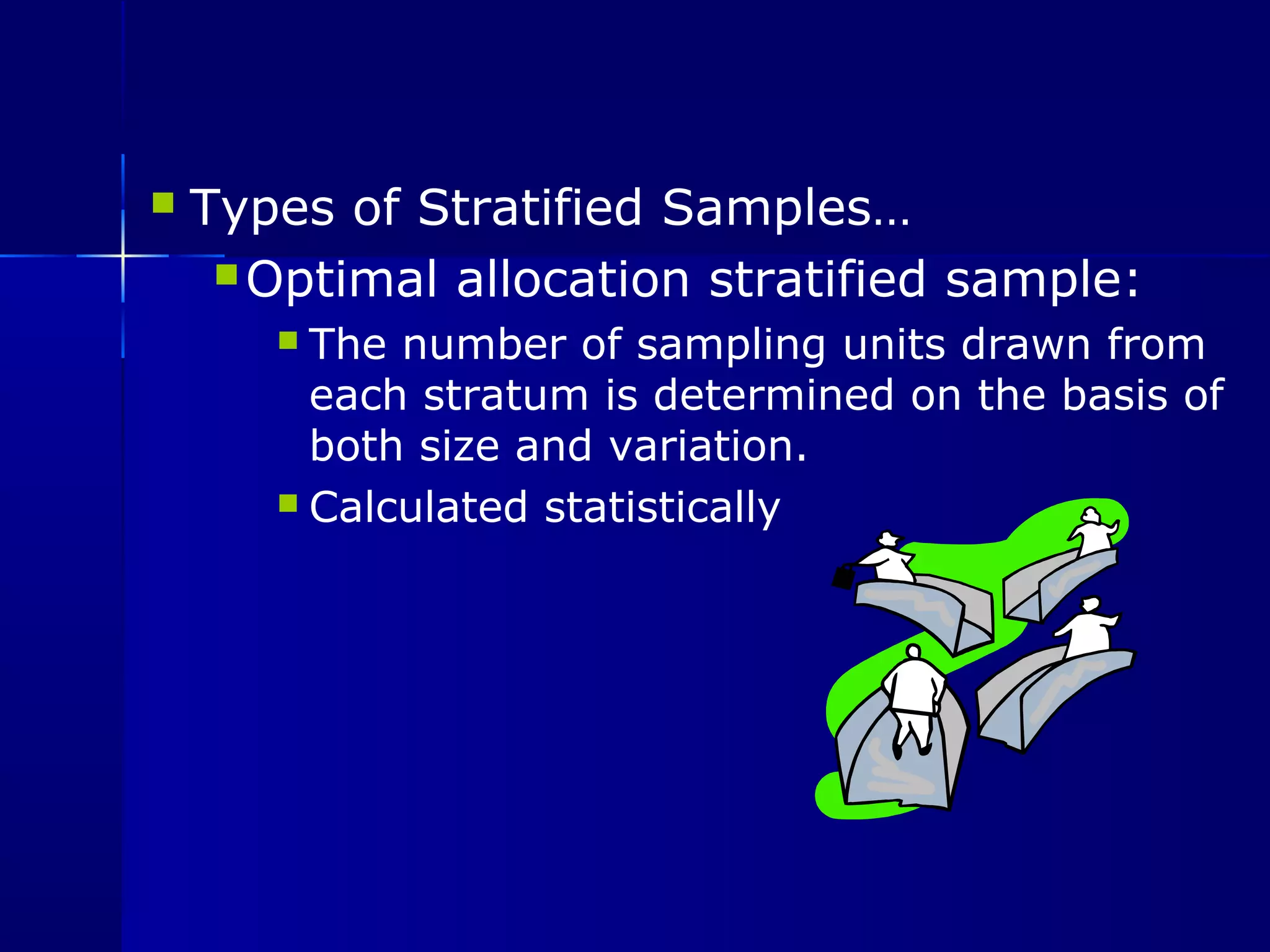
Optimal allocation stratified sample: 
 The number of sampling units drawn from 
each stratum is determined on the basis of 
both size and variation. 
 Calculated statistically
 Advantages 
 Assures representation of all groups in 
sample population needed 
 Characteristics of each stratum can be 
estimated and comparisons made 
 Reduces variability from systematic 
 Disadvantages 
 Requires accurate information on 
proportions of each stratum 
 Stratified lists costly to prepare
 Cluster Sampling 
 The primary sampling unit is not the 
individual element, but a large cluster of 
elements. Either the cluster is randomly 
selected or the elements within are 
randomly selected 
 Why? Frequently used when no list of 
population available or because of cost 
Ask: is the cluster as heterogeneous as 
the population? Can we assume it is 
representative?
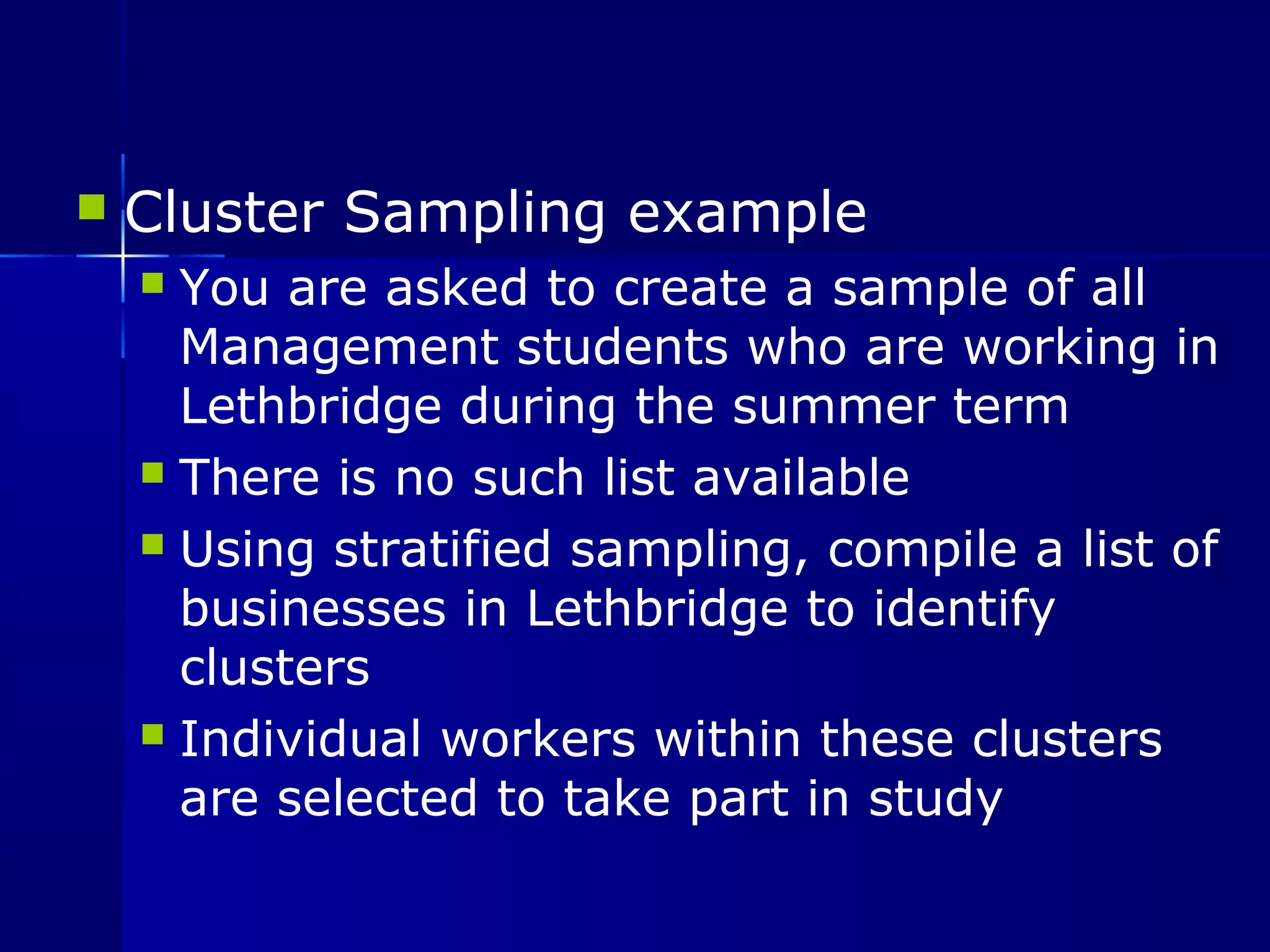
 Cluster Sampling example 
 You are asked to create a sample of all 
Management students who are working in 
Lethbridge during the summer term 
 There is no such list available 
 Using stratified sampling, compile a list of 
businesses in Lethbridge to identify 
clusters 
 Individual workers within these clusters 
are selected to take part in study
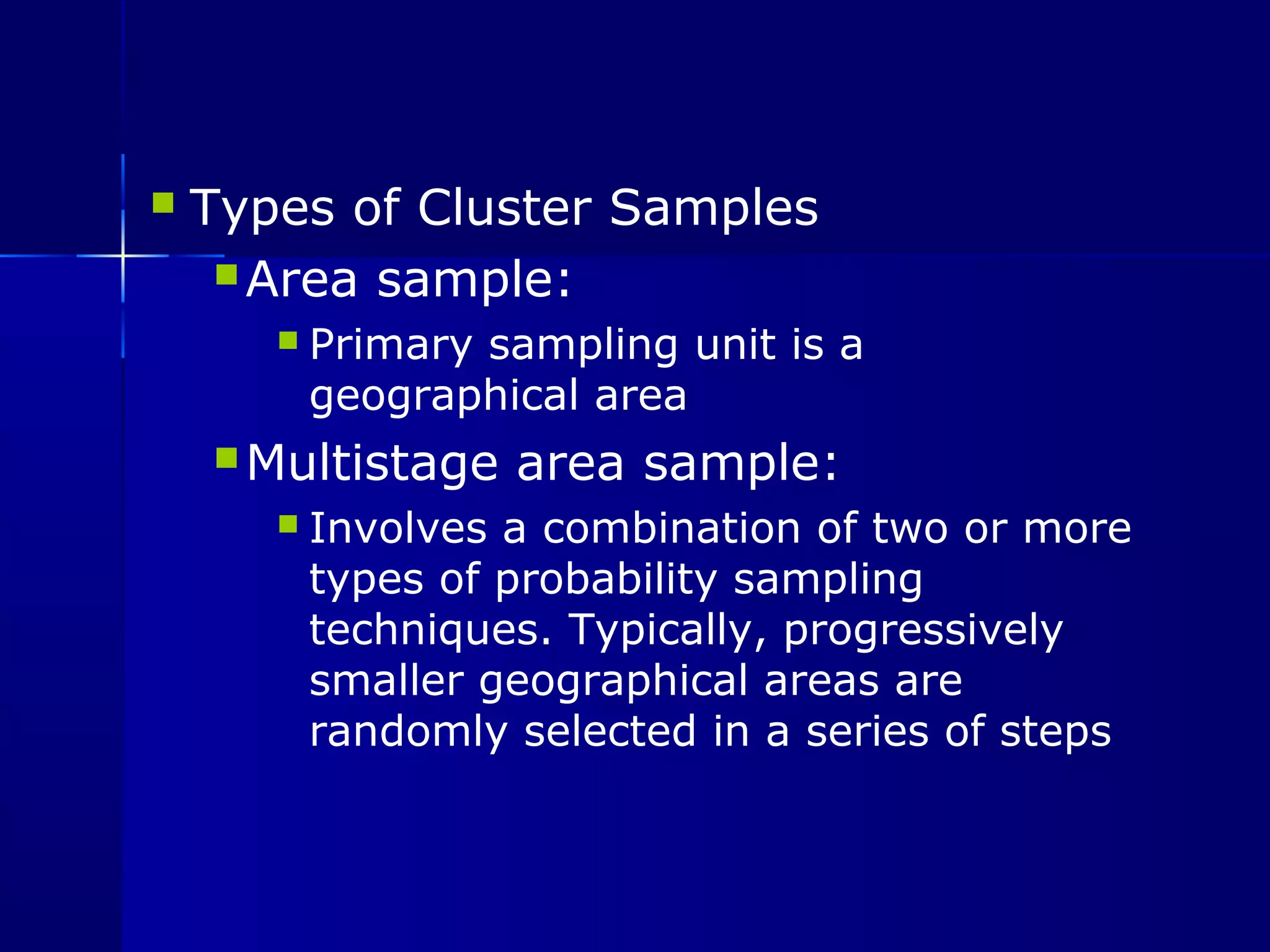
 Types of Cluster Samples 
Area sample: 
 Primary sampling unit is a 
geographical area 
Multistage area sample: 
 Involves a combination of two or more 
types of probability sampling 
techniques. Typically, progressively 
smaller geographical areas are 
randomly selected in a series of steps
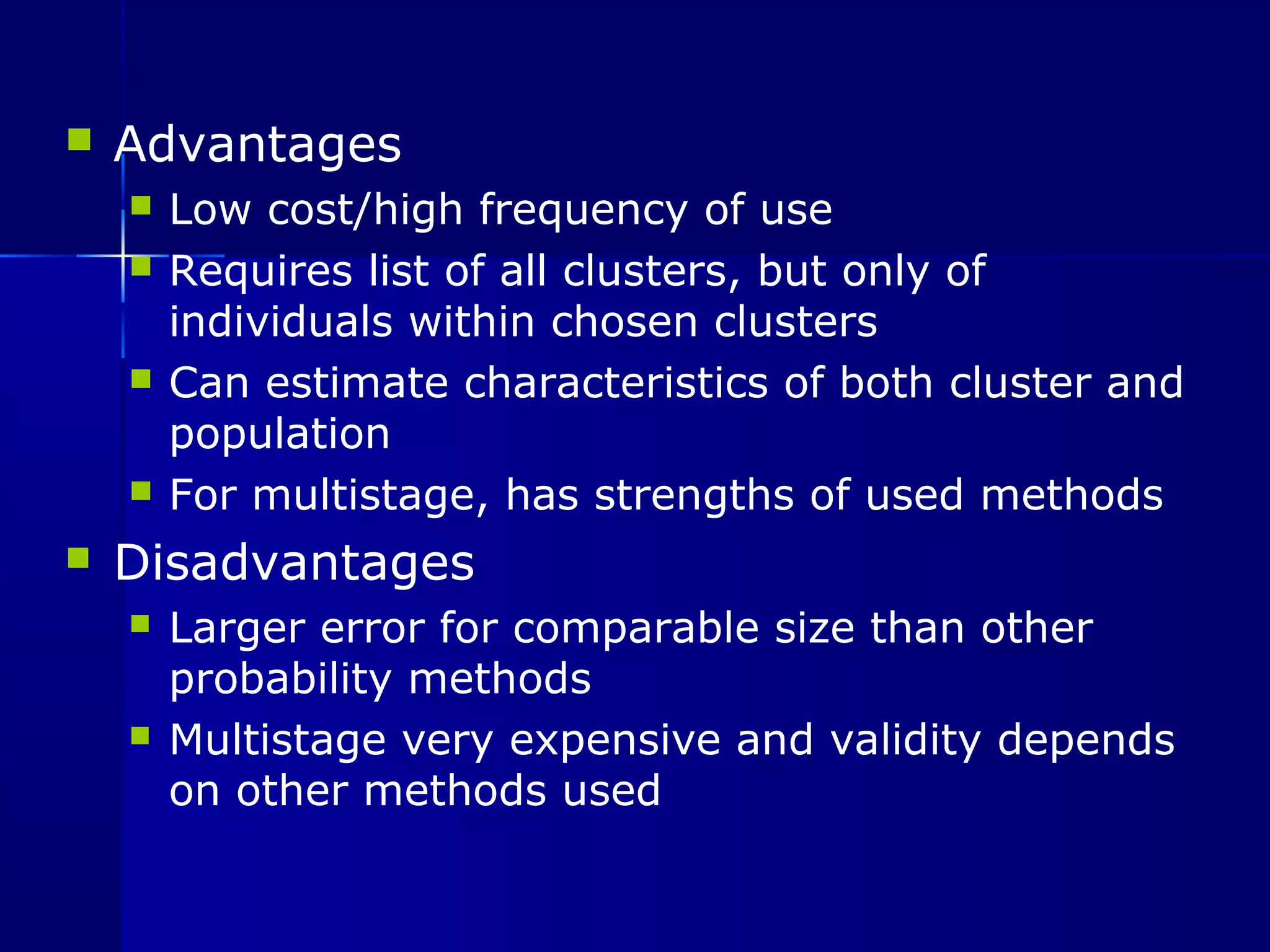
 Advantages 
 Low cost/high frequency of use 
 Requires list of all clusters, but only of 
individuals within chosen clusters 
 Can estimate characteristics of both cluster and 
population 
 For multistage, has strengths of used methods 
 Disadvantages 
 Larger error for comparable size than other 
probability methods 
 Multistage very expensive and validity depends 
on other methods used
Classification of Sampling 
Methods 
Sampling 
Methods 
Probability 
Samples 
Systematic Stratified 
Simple 
Cluster Random 
Non-probability 
Convenience Snowball 
Judgment Quota
Non-Probability Sampling 
Methods 
 Convenience Sample 
 The sampling procedure used to obtain 
those units or people most conveniently 
available 
 Why: speed and cost 
 External validity? 
 Internal validity 
 Is it ever justified?
 Advantages 
 Very low cost 
 Extensively used/understood 
 No need for list of population elements 
 Disadvantages 
 Variability and bias cannot be measured 
or controlled 
 Projecting data beyond sample not 
justified.
 Judgment or Purposive Sample 
 The sampling procedure in which an 
experienced research selects the sample 
based on some appropriate characteristic 
of sample members… to serve a purpose
 Advantages 
 Moderate cost 
 Commonly used/understood 
 Sample will meet a specific objective 
 Disadvantages 
 Bias! 
 Projecting data beyond sample not 
justified.
 Quota Sample 
 The sampling procedure that ensure that 
a certain characteristic of a population 
sample will be represented to the exact 
extent that the investigator desires
 Advantages 
moderate cost 
 Very extensively used/understood 
 No need for list of population elements 
 Introduces some elements of 
stratification 
 Disadvantages 
 Variability and bias cannot be measured 
or controlled (classification of subjects0 
 Projecting data beyond sample not 
justified.
 Snowball sampling 
 The sampling procedure in which the 
initial respondents are chosen by 
probability or non-probability methods, 
and then additional respondents are 
obtained by information provided by the 
initial respondents
 Advantages 
 low cost 
 Useful in specific circumstances 
 Useful for locating rare populations 
 Disadvantages 
 Bias because sampling units not 
independent 
 Projecting data beyond sample not 
justified.
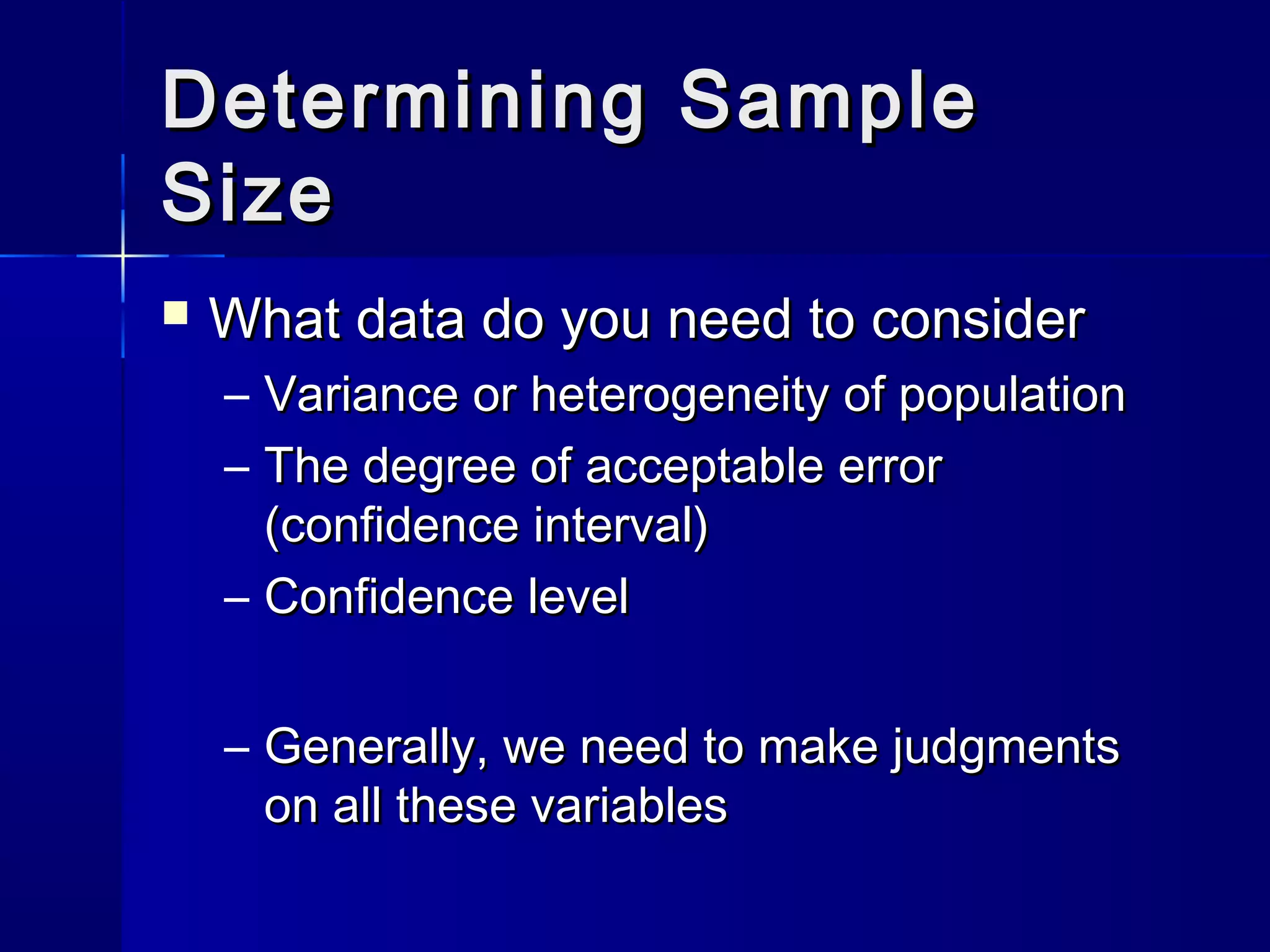
DDeetteerrmmiinniinngg SSaammppllee 
SSiizzee 
 WWhhaatt ddaattaa ddoo yyoouu nneeeedd ttoo ccoonnssiiddeerr 
– VVaarriiaannccee oorr hheetteerrooggeenneeiittyy ooff ppooppuullaattiioonn 
– TThhee ddeeggrreeee ooff aacccceeppttaabbllee eerrrroorr 
((ccoonnffiiddeennccee iinntteerrvvaall)) 
– CCoonnffiiddeennccee lleevveell 
– GGeenneerraallllyy,, wwee nneeeedd ttoo mmaakkee jjuuddggmmeennttss 
oonn aallll tthheessee vvaarriiaabblleess
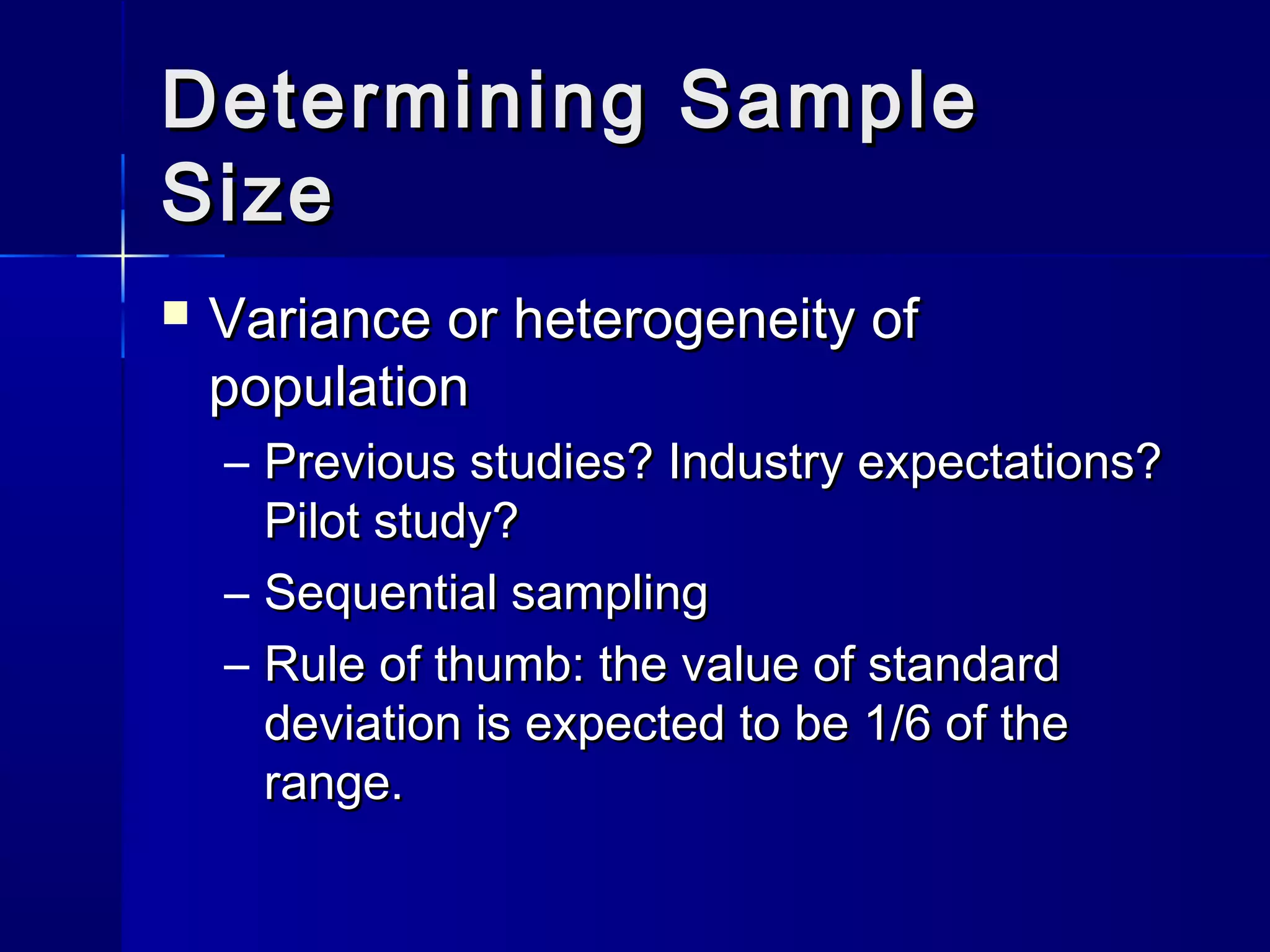
DDeetteerrmmiinniinngg SSaammppllee 
SSiizzee 
 VVaarriiaannccee oorr hheetteerrooggeenneeiittyy ooff 
ppooppuullaattiioonn 
– PPrreevviioouuss ssttuuddiieess?? IInndduussttrryy eexxppeeccttaattiioonnss?? 
PPiilloott ssttuuddyy?? 
– SSeeqquueennttiiaall ssaammpplliinngg 
– RRuullee ooff tthhuummbb:: tthhee vvaalluuee ooff ssttaannddaarrdd 
ddeevviiaattiioonn iiss eexxppeecctteedd ttoo bbee 11//66 ooff tthhee 
rraannggee..
DDeetteerrmmiinniinngg SSaammppllee 
SSiizzee 
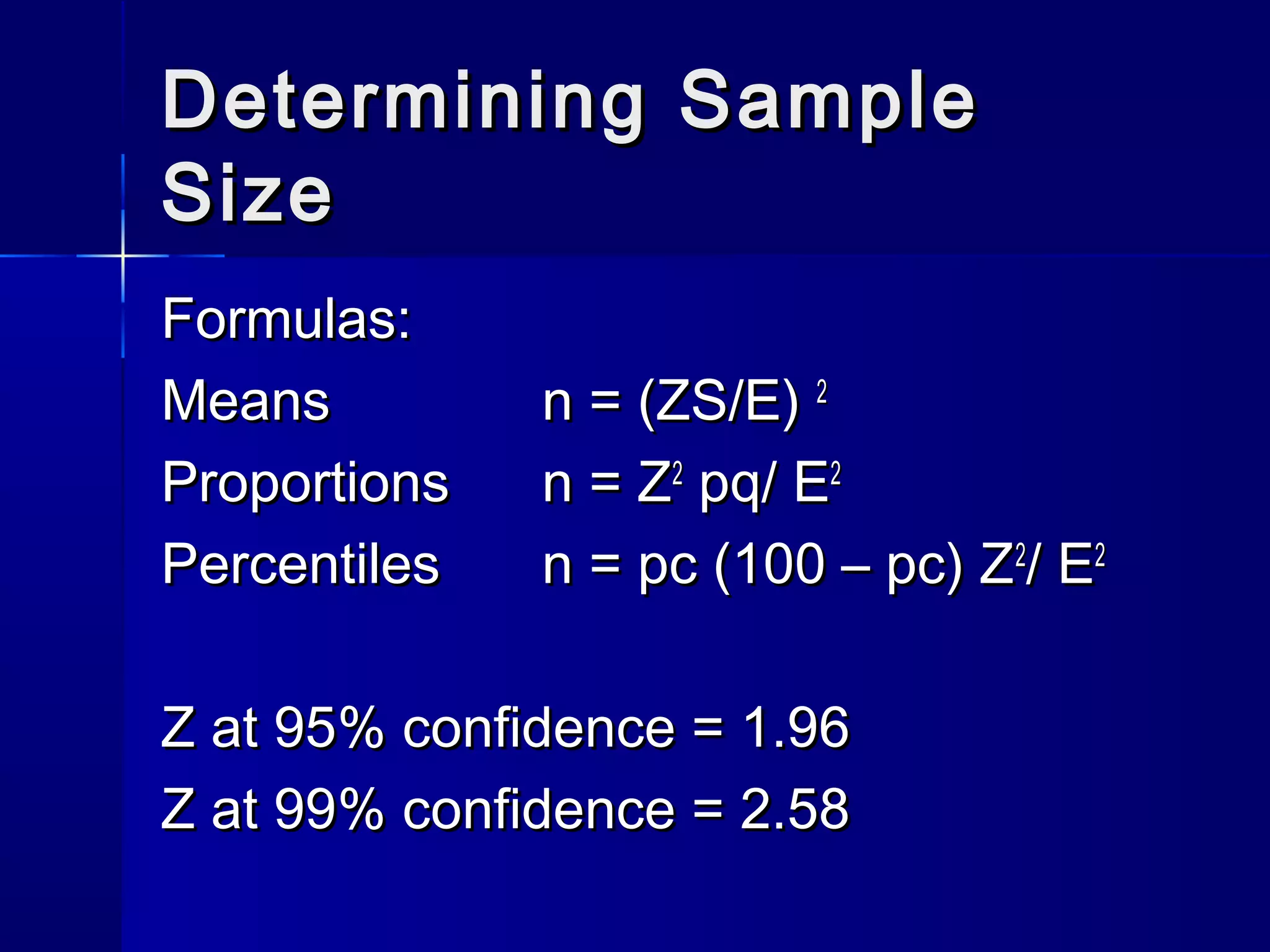
FFoorrmmuullaass:: 
MMeeaannss nn == ((ZZSS//EE)) 22 
PPrrooppoorrttiioonnss nn == ZZ22 ppqq// EE22 
PPeerrcceennttiilleess nn == ppcc ((110000 –– ppcc)) ZZ22// EE22 
ZZ aatt 9955%% ccoonnffiiddeennccee == 11..9966 
ZZ aatt 9999%% ccoonnffiiddeennccee == 22..5588
SSaammppllee SSiizzee ((MMeeaann)) 
EExxeerrcciissee 11 
 WWee aarree aabboouutt ttoo ggoo oonn aa rreeccrruuiittmmeenntt ddrriivvee ttoo hhiirree 
ssoommee aauuddiittoorrss aatt tthhee eennttrryy lleevveell.. WWee nneeeedd ttoo 
ddeecciiddee oonn aa ccoommppeettiittiivvee ssaallaarryy ooffffeerr ffoorr tthheessee nneeww 
aauuddiittoorrss.. FFrroomm ttaallkkiinngg ttoo ssoommee HHRR pprrooffeessssiioonnaallss,, 
II’’vvee mmaaddee aa rroouugghh eessttiimmaattee tthhaatt mmoosstt nneeww hhiirreess aarree 
ggeettttiinngg ssttaarrttiinngg ssaallaarriieess iinn tthhee $$3388--4422,,000000 rraannggee 
aanndd tthhee aavveerraaggee ((mmeeaann)) iiss aarroouunndd $$3399,,000000.. TThhee 
ssttaannddaarrdd ddeevviiaattiioonn sseeeemmss ttoo bbee aarroouunndd $$33000000.. 
 II wwaanntt ttoo bbee 9955%% ccoonnffiiddeenntt aabboouutt tthhee aavveerraaggee 
ssaallaarryy aanndd II’’mm wwiilllliinngg ttoo ttoolleerraattee aann eessttiimmaattee tthhaatt iiss 
wwiitthhiinn $$550000 ((pplluuss oorr mmiinnuuss)) ooff tthhee ttrruuee eessttiimmaattee.. IIff 
wwee’’rree ooffff,, wwee ccaann aallwwaayyss aaddjjuusstt ssaallaarriieess aatt tthhee eenndd 
ooff tthhee pprroobbaattiioonn ppeerriioodd.. 
 WWhhaatt ssaammppllee ssiizzee sshhoouulldd wwee uussee??
SSaammppllee SSiizzee 
((PPrrooppoorrttiioonn)) 
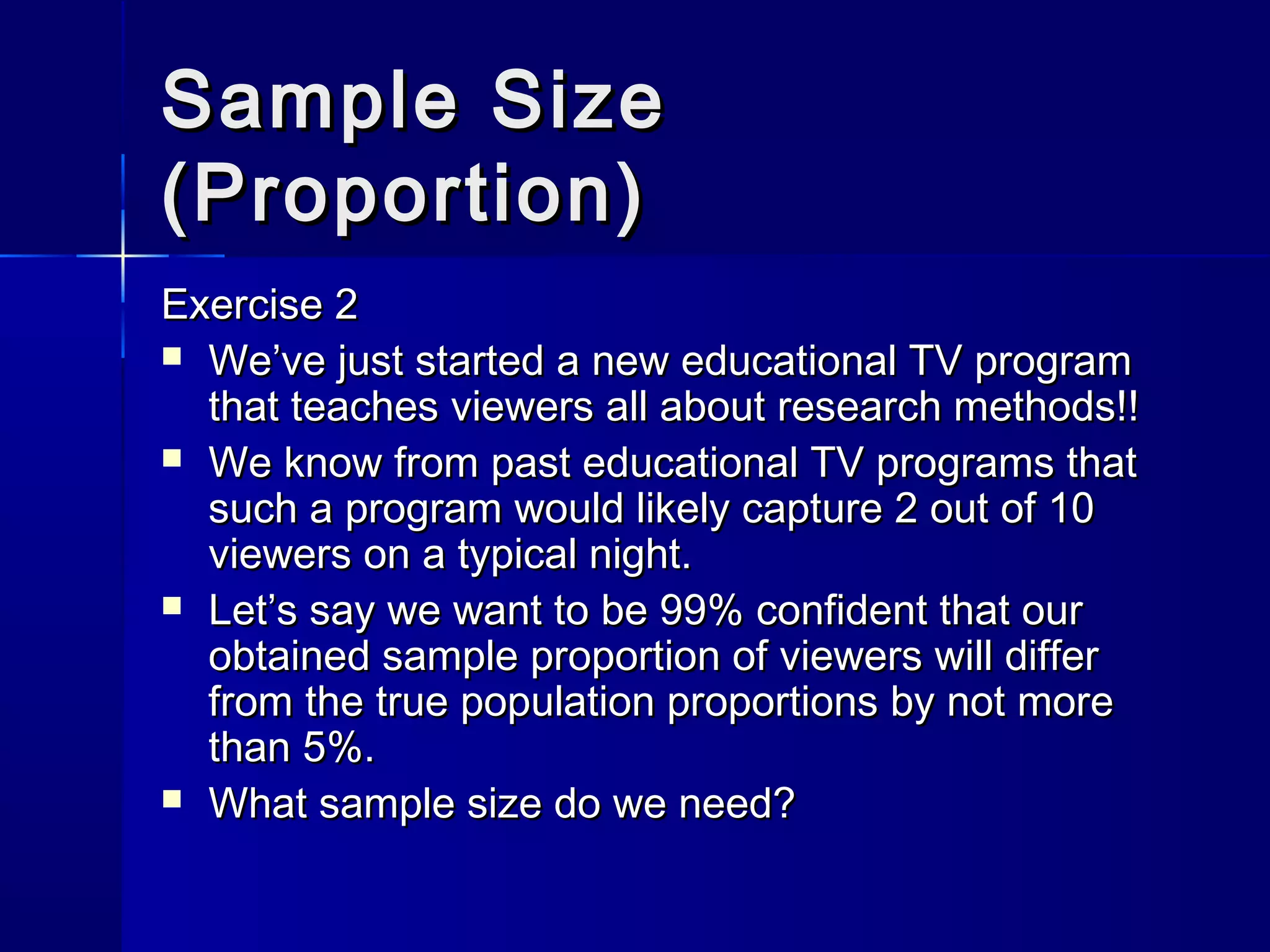
EExxeerrcciissee 22 
 WWee’’vvee jjuusstt ssttaarrtteedd aa nneeww eedduuccaattiioonnaall TTVV pprrooggrraamm 
tthhaatt tteeaacchheess vviieewweerrss aallll aabboouutt rreesseeaarrcchh mmeetthhooddss!!!! 
 WWee kknnooww ffrroomm ppaasstt eedduuccaattiioonnaall TTVV pprrooggrraammss tthhaatt 
ssuucchh aa pprrooggrraamm wwoouulldd lliikkeellyy ccaappttuurree 22 oouutt ooff 1100 
vviieewweerrss oonn aa ttyyppiiccaall nniigghhtt.. 
 LLeett’’ss ssaayy wwee wwaanntt ttoo bbee 9999%% ccoonnffiiddeenntt tthhaatt oouurr 
oobbttaaiinneedd ssaammppllee pprrooppoorrttiioonn ooff vviieewweerrss wwiillll ddiiffffeerr 
ffrroomm tthhee ttrruuee ppooppuullaattiioonn pprrooppoorrttiioonnss bbyy nnoott mmoorree 
tthhaann 55%%.. 
 WWhhaatt ssaammppllee ssiizzee ddoo wwee nneeeedd??
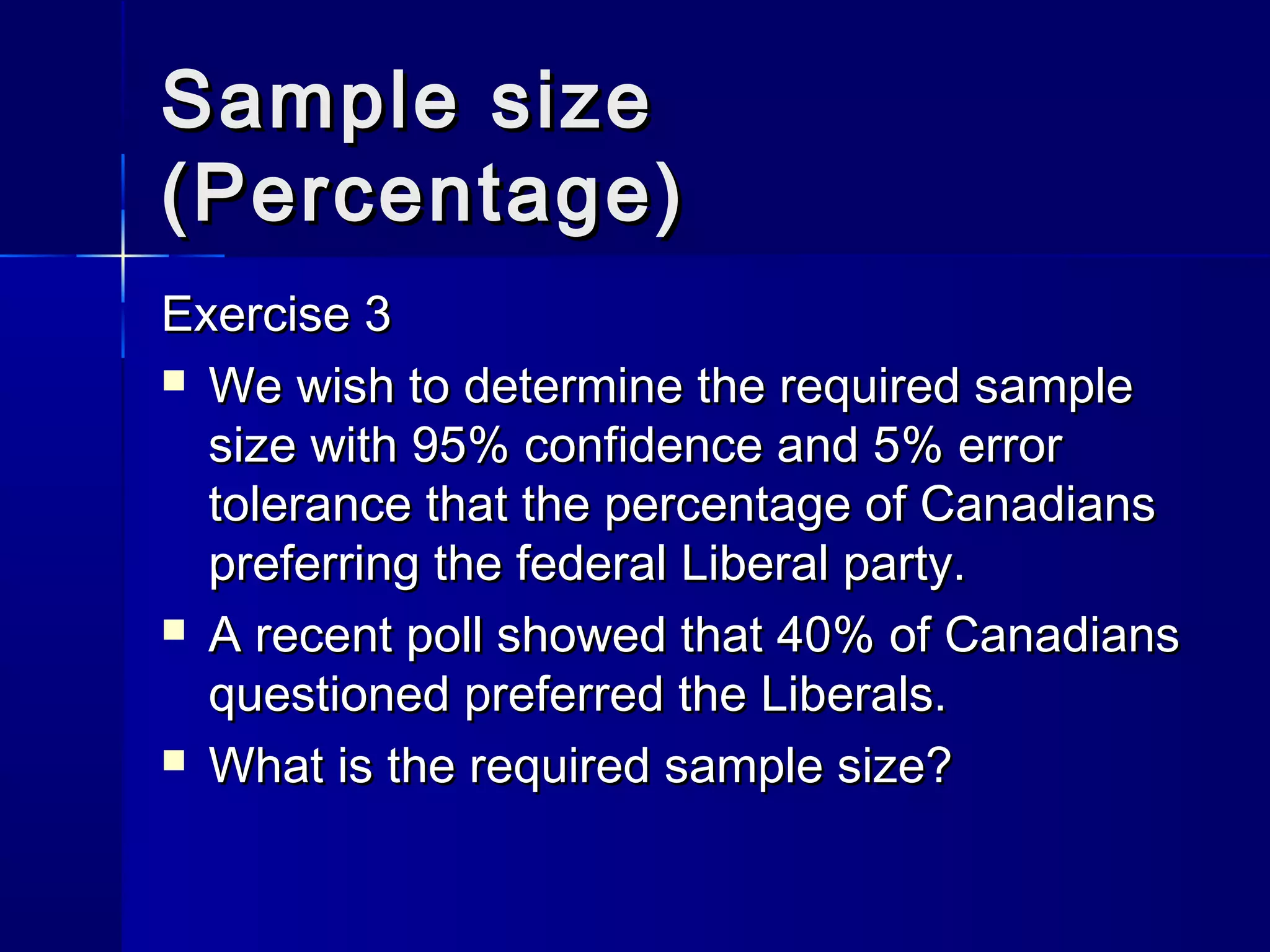
SSaammppllee ssiizzee 
((PPeerrcceennttaaggee)) 
EExxeerrcciissee 33 
 WWee wwiisshh ttoo ddeetteerrmmiinnee tthhee rreeqquuiirreedd ssaammppllee 
ssiizzee wwiitthh 9955%% ccoonnffiiddeennccee aanndd 55%% eerrrroorr 
ttoolleerraannccee tthhaatt tthhee ppeerrcceennttaaggee ooff CCaannaaddiiaannss 
pprreeffeerrrriinngg tthhee ffeeddeerraall LLiibbeerraall ppaarrttyy.. 
 AA rreecceenntt ppoollll sshhoowweedd tthhaatt 4400%% ooff CCaannaaddiiaannss 
qquueessttiioonneedd pprreeffeerrrreedd tthhee LLiibbeerraallss.. 
 WWhhaatt iiss tthhee rreeqquuiirreedd ssaammppllee ssiizzee??

Sampling and sample size determination

  • 1.
    SSaammpplliinngg aanndd SSaammppllee SSiizzee DDeetteerrmmiinnaattiioonn
  • 2.
    TTeerrmmss  SSaammppllee  PPooppuullaattiioonn  PPooppuullaattiioonn eelleemmeenntt  CCeennssuuss
  • 3.
    WWhhyy uussee aassaammppllee??  CCoosstt  SSppeeeedd  AAccccuurraaccyy  DDeessttrruuccttiioonn ooff tteesstt uunniittss
  • 4.
    SStteeppss  DDeeffiinniittiioonnooff ttaarrggeett ppooppuullaattiioonn  SSeelleeccttiioonn ooff aa ssaammpplliinngg ffrraammee ((lliisstt))  PPrroobbaabbiilliittyy oorr NNoonnpprroobbaabbiilliittyy ssaammpplliinngg  SSaammpplliinngg UUnniitt  EErrrroorr –– RRaannddoomm ssaammpplliinngg eerrrroorr ((cchhaannccee fflluuccttuuaattiioonnss)) – NNoonnssaammpplliinngg eerrrroorr ((ddeessiiggnn eerrrroorrss))
  • 5.
    TTaarrggeett PPooppuullaattiioonn ((sstteepp11))  WWhhoo hhaass tthhee iinnffoorrmmaattiioonn//ddaattaa yyoouu nneeeedd??  HHooww ddoo yyoouu ddeeffiinnee yyoouurr ttaarrggeett ppooppuullaattiioonn?? -- GGeeooggrraapphhyy -- DDeemmooggrraapphhiiccss -- UUssee -- AAwwaarreenneessss
  • 6.
    Operational DDeeffiinniittiioonn AA ddeeffiinniittiioonn tthhaatt ggiivveess mmeeaanniinngg ttoo aa ccoonncceepptt bbyy ssppeecciiffyyiinngg tthhee aaccttiivviittiieess nneecceessssaarryy ttoo mmeeaassuurree iitt.. - EEgg.. SSttuuddeenntt,, eemmppllooyyeeee,, uusseerr,, aarreeaa,, mmaajjoorr nneewwss ppaappeerr.. WWhhaatt vvaarriiaabblleess nneeeedd ffuurrtthheerr ddeeffiinniittiioonn?? ((IItteemmss ppeerr ccoonnssttrruucctt))
  • 7.
    SSaammpplliinngg FFrraammee ((sstteepp2))  LLiisstt ooff eelleemmeennttss  SSaammpplliinngg FFrraammee eerrrroorr – EErrrroorr tthhaatt ooccccuurrss wwhheenn cceerrttaaiinn ssaammppllee eelleemmeennttss aarree nnoott lliisstteedd oorr aavvaaiillaabbllee aanndd aarree nnoott rreepprreesseenntteedd iinn tthhee ssaammpplliinngg ffrraammee
  • 8.
    PPrroobbaabbiilliittyy oorr NNoonnpprroobbaabbiilliittyy((sstteepp 33)) PPrroobbaabbiilliittyy SSaammppllee:: – AA ssaammpplliinngg tteecchhnniiqquuee iinn wwhhiicchh eevveerryy mmeemmbbeerr ooff tthhee ppooppuullaattiioonn wwiillll hhaavvee aa kknnoowwnn,, nnoonnzzeerroo pprroobbaabbiilliittyy ooff bbeeiinngg sseelleecctteedd
  • 9.
     NNoonn--PPrroobbaabbiilliittyy SSaammppllee:: – UUnniittss ooff tthhee ssaammppllee aarree cchhoosseenn oonn tthhee bbaassiiss ooff ppeerrssoonnaall jjuuddggmmeenntt oorr ccoonnvveenniieennccee – TThheerree aarree NNOO ssttaattiissttiiccaall tteecchhnniiqquueess ffoorr mmeeaassuurriinngg rraannddoomm ssaammpplliinngg eerrrroorr iinn aa nnoonn--pprroobbaabbiilliittyy ssaammppllee.. TThheerreeffoorree,, ggeenneerraalliizzaabbiilliittyy iiss nneevveerr ssttaattiissttiiccaallllyy aapppprroopprriiaattee..
  • 10.
    Classification of Sampling Methods Sampling Methods Probability Samples Systematic Stratified Simple Cluster Random Non-probability Convenience Snowball Judgment Quota
  • 11.
    Probability Sampling Methods  Simple Random Sampling  the purest form of probability sampling.  Assures each element in the population has an equal chance of being included in the sample  Random number generators Probability of Selection = Sample Size Population Size
  • 12.
     Advantages minimalknowledge of population needed  External validity high; internal validity high; statistical estimation of error  Easy to analyze data  Disadvantages  High cost; low frequency of use  Requires sampling frame  Does not use researchers’ expertise  Larger risk of random error than stratified
  • 13.
     Systematic Sampling  An initial starting point is selected by a random process, and then every nth number on the list is selected  n=sampling interval The number of population elements between the units selected for the sample Error: periodicity- the original list has a systematic pattern ?? Is the list of elements randomized??
  • 14.
     Advantages Moderate cost; moderate usage  External validity high; internal validity high; statistical estimation of error  Simple to draw sample; easy to verify  Disadvantages  Periodic ordering  Requires sampling frame
  • 15.
     Stratified Sampling  Sub-samples are randomly drawn from samples within different strata that are more or less equal on some characteristic  Why? Can reduce random error More accurately reflect the population by more proportional representation
  • 16.
     Advantages minimalknowledge of population needed  External validity high; internal validity high; statistical estimation of error  Easy to analyze data  Disadvantages  High cost; low frequency of use  Requires sampling frame  Does not use researchers’ expertise  Larger risk of random error than stratified
  • 17.
     Systematic Sampling  An initial starting point is selected by a random process, and then every nth number on the list is selected  n=sampling interval The number of population elements between the units selected for the sample Error: periodicity- the original list has a systematic pattern ?? Is the list of elements randomized??
  • 18.
     Advantages Moderate cost; moderate usage  External validity high; internal validity high; statistical estimation of error  Simple to draw sample; easy to verify  Disadvantages  Periodic ordering  Requires sampling frame
  • 19.
     Stratified Sampling  Sub-samples are randomly drawn from samples within different strata that are more or less equal on some characteristic  Why? Can reduce random error More accurately reflect the population by more proportional representation
  • 20.
     How? 1.Identifyvariable(s) as an efficient basis for stratification. Must be known to be related to dependent variable. Usually a categorical variable 2.Complete list of population elements must be obtained 3.Use randomization to take a simple random sample from each stratum
  • 21.
     Types ofStratified Samples Proportional Stratified Sample:  The number of sampling units drawn from each stratum is in proportion to the relative population size of that stratum Disproportional Stratified Sample:  The number of sampling units drawn from each stratum is allocated according to analytical considerations e.g. as variability increases sample size of stratum should increase
  • 22.
     Types ofStratified Samples… Optimal allocation stratified sample:  The number of sampling units drawn from each stratum is determined on the basis of both size and variation.  Calculated statistically
  • 23.
     Advantages Assures representation of all groups in sample population needed  Characteristics of each stratum can be estimated and comparisons made  Reduces variability from systematic  Disadvantages  Requires accurate information on proportions of each stratum  Stratified lists costly to prepare
  • 24.
     Cluster Sampling  The primary sampling unit is not the individual element, but a large cluster of elements. Either the cluster is randomly selected or the elements within are randomly selected  Why? Frequently used when no list of population available or because of cost Ask: is the cluster as heterogeneous as the population? Can we assume it is representative?
  • 25.
     Cluster Samplingexample  You are asked to create a sample of all Management students who are working in Lethbridge during the summer term  There is no such list available  Using stratified sampling, compile a list of businesses in Lethbridge to identify clusters  Individual workers within these clusters are selected to take part in study
  • 26.
     Types ofCluster Samples Area sample:  Primary sampling unit is a geographical area Multistage area sample:  Involves a combination of two or more types of probability sampling techniques. Typically, progressively smaller geographical areas are randomly selected in a series of steps
  • 27.
     Advantages Low cost/high frequency of use  Requires list of all clusters, but only of individuals within chosen clusters  Can estimate characteristics of both cluster and population  For multistage, has strengths of used methods  Disadvantages  Larger error for comparable size than other probability methods  Multistage very expensive and validity depends on other methods used
  • 28.
    Classification of Sampling Methods Sampling Methods Probability Samples Systematic Stratified Simple Cluster Random Non-probability Convenience Snowball Judgment Quota
  • 29.
    Non-Probability Sampling Methods  Convenience Sample  The sampling procedure used to obtain those units or people most conveniently available  Why: speed and cost  External validity?  Internal validity  Is it ever justified?
  • 30.
     Advantages Very low cost  Extensively used/understood  No need for list of population elements  Disadvantages  Variability and bias cannot be measured or controlled  Projecting data beyond sample not justified.
  • 31.
     Judgment orPurposive Sample  The sampling procedure in which an experienced research selects the sample based on some appropriate characteristic of sample members… to serve a purpose
  • 32.
     Advantages Moderate cost  Commonly used/understood  Sample will meet a specific objective  Disadvantages  Bias!  Projecting data beyond sample not justified.
  • 33.
     Quota Sample  The sampling procedure that ensure that a certain characteristic of a population sample will be represented to the exact extent that the investigator desires
  • 34.
     Advantages moderatecost  Very extensively used/understood  No need for list of population elements  Introduces some elements of stratification  Disadvantages  Variability and bias cannot be measured or controlled (classification of subjects0  Projecting data beyond sample not justified.
  • 35.
     Snowball sampling  The sampling procedure in which the initial respondents are chosen by probability or non-probability methods, and then additional respondents are obtained by information provided by the initial respondents
  • 36.
     Advantages low cost  Useful in specific circumstances  Useful for locating rare populations  Disadvantages  Bias because sampling units not independent  Projecting data beyond sample not justified.
  • 37.
    DDeetteerrmmiinniinngg SSaammppllee SSiizzee  WWhhaatt ddaattaa ddoo yyoouu nneeeedd ttoo ccoonnssiiddeerr – VVaarriiaannccee oorr hheetteerrooggeenneeiittyy ooff ppooppuullaattiioonn – TThhee ddeeggrreeee ooff aacccceeppttaabbllee eerrrroorr ((ccoonnffiiddeennccee iinntteerrvvaall)) – CCoonnffiiddeennccee lleevveell – GGeenneerraallllyy,, wwee nneeeedd ttoo mmaakkee jjuuddggmmeennttss oonn aallll tthheessee vvaarriiaabblleess
  • 38.
    DDeetteerrmmiinniinngg SSaammppllee SSiizzee  VVaarriiaannccee oorr hheetteerrooggeenneeiittyy ooff ppooppuullaattiioonn – PPrreevviioouuss ssttuuddiieess?? IInndduussttrryy eexxppeeccttaattiioonnss?? PPiilloott ssttuuddyy?? – SSeeqquueennttiiaall ssaammpplliinngg – RRuullee ooff tthhuummbb:: tthhee vvaalluuee ooff ssttaannddaarrdd ddeevviiaattiioonn iiss eexxppeecctteedd ttoo bbee 11//66 ooff tthhee rraannggee..
  • 39.
    DDeetteerrmmiinniinngg SSaammppllee SSiizzee FFoorrmmuullaass:: MMeeaannss nn == ((ZZSS//EE)) 22 PPrrooppoorrttiioonnss nn == ZZ22 ppqq// EE22 PPeerrcceennttiilleess nn == ppcc ((110000 –– ppcc)) ZZ22// EE22 ZZ aatt 9955%% ccoonnffiiddeennccee == 11..9966 ZZ aatt 9999%% ccoonnffiiddeennccee == 22..5588
  • 40.
    SSaammppllee SSiizzee ((MMeeaann)) EExxeerrcciissee 11  WWee aarree aabboouutt ttoo ggoo oonn aa rreeccrruuiittmmeenntt ddrriivvee ttoo hhiirree ssoommee aauuddiittoorrss aatt tthhee eennttrryy lleevveell.. WWee nneeeedd ttoo ddeecciiddee oonn aa ccoommppeettiittiivvee ssaallaarryy ooffffeerr ffoorr tthheessee nneeww aauuddiittoorrss.. FFrroomm ttaallkkiinngg ttoo ssoommee HHRR pprrooffeessssiioonnaallss,, II’’vvee mmaaddee aa rroouugghh eessttiimmaattee tthhaatt mmoosstt nneeww hhiirreess aarree ggeettttiinngg ssttaarrttiinngg ssaallaarriieess iinn tthhee $$3388--4422,,000000 rraannggee aanndd tthhee aavveerraaggee ((mmeeaann)) iiss aarroouunndd $$3399,,000000.. TThhee ssttaannddaarrdd ddeevviiaattiioonn sseeeemmss ttoo bbee aarroouunndd $$33000000..  II wwaanntt ttoo bbee 9955%% ccoonnffiiddeenntt aabboouutt tthhee aavveerraaggee ssaallaarryy aanndd II’’mm wwiilllliinngg ttoo ttoolleerraattee aann eessttiimmaattee tthhaatt iiss wwiitthhiinn $$550000 ((pplluuss oorr mmiinnuuss)) ooff tthhee ttrruuee eessttiimmaattee.. IIff wwee’’rree ooffff,, wwee ccaann aallwwaayyss aaddjjuusstt ssaallaarriieess aatt tthhee eenndd ooff tthhee pprroobbaattiioonn ppeerriioodd..  WWhhaatt ssaammppllee ssiizzee sshhoouulldd wwee uussee??
  • 41.
    SSaammppllee SSiizzee ((PPrrooppoorrttiioonn)) EExxeerrcciissee 22  WWee’’vvee jjuusstt ssttaarrtteedd aa nneeww eedduuccaattiioonnaall TTVV pprrooggrraamm tthhaatt tteeaacchheess vviieewweerrss aallll aabboouutt rreesseeaarrcchh mmeetthhooddss!!!!  WWee kknnooww ffrroomm ppaasstt eedduuccaattiioonnaall TTVV pprrooggrraammss tthhaatt ssuucchh aa pprrooggrraamm wwoouulldd lliikkeellyy ccaappttuurree 22 oouutt ooff 1100 vviieewweerrss oonn aa ttyyppiiccaall nniigghhtt..  LLeett’’ss ssaayy wwee wwaanntt ttoo bbee 9999%% ccoonnffiiddeenntt tthhaatt oouurr oobbttaaiinneedd ssaammppllee pprrooppoorrttiioonn ooff vviieewweerrss wwiillll ddiiffffeerr ffrroomm tthhee ttrruuee ppooppuullaattiioonn pprrooppoorrttiioonnss bbyy nnoott mmoorree tthhaann 55%%..  WWhhaatt ssaammppllee ssiizzee ddoo wwee nneeeedd??
  • 42.
    SSaammppllee ssiizzee ((PPeerrcceennttaaggee)) EExxeerrcciissee 33  WWee wwiisshh ttoo ddeetteerrmmiinnee tthhee rreeqquuiirreedd ssaammppllee ssiizzee wwiitthh 9955%% ccoonnffiiddeennccee aanndd 55%% eerrrroorr ttoolleerraannccee tthhaatt tthhee ppeerrcceennttaaggee ooff CCaannaaddiiaannss pprreeffeerrrriinngg tthhee ffeeddeerraall LLiibbeerraall ppaarrttyy..  AA rreecceenntt ppoollll sshhoowweedd tthhaatt 4400%% ooff CCaannaaddiiaannss qquueessttiioonneedd pprreeffeerrrreedd tthhee LLiibbeerraallss..  WWhhaatt iiss tthhee rreeqquuiirreedd ssaammppllee ssiizzee??

Editor's Notes

  • #4 Homogeneous populations – small samples are highly representative
  • #40 Let n = sample size S = standard deviation Z = confidence level (ex. 95% confidence = 1.96), E = range of possible random error (how much error you are willing to accept) p = estimated proportion of successes q = 1 – p, or estimated proportion of failures pc = percentage