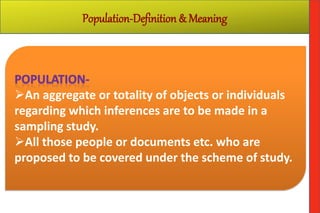
An aggregate or totality of objects or individuals
regarding which inferences are to be made in a
sampling study.
All those people or documents etc. who are
proposed to be covered under the scheme of study.
Population-Definition & Meaning
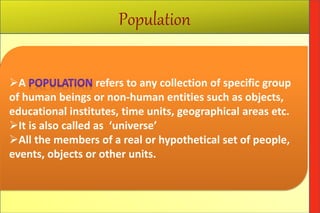
A refers to any collection of specific group
of human beings or non-human entities such as objects,
educational institutes, time units, geographical areas etc.
It is also called as ‘universe’
All the members of a real or hypothetical set of people,
events, objects or other units.
Population
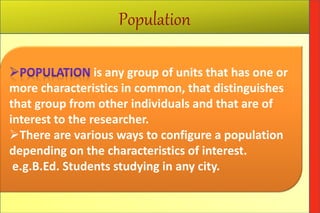
is any group of units that has one or
more characteristics in common, that distinguishes
that group from other individuals and that are of
interest to the researcher.
There are various ways to configure a population
depending on the characteristics of interest.
e.g.B.Ed. Students studying in any city.
Population
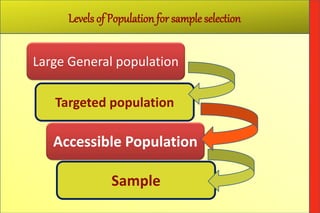
Levels of Population for sample selection
Large General population
Targeted population
Accessible Population
Sample
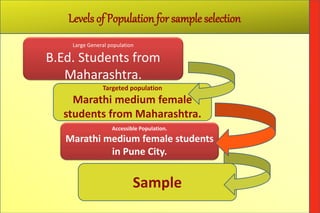
Levels of Population for sample selection
Large General population
B.Ed. Students from
Maharashtra.
Targeted population
Marathi medium female
students from Maharashtra.
Accessible Population.
Marathi medium female students
in Pune City.
Sample
.
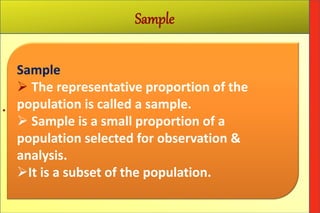
Sample
 The representative proportion of the
population is called a sample.
 Sample is a small proportion of a
population selected for observation &
analysis.
It is a subset of the population.
Sample
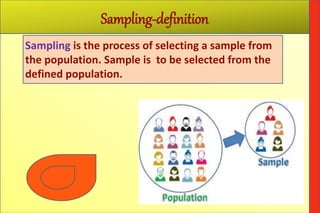
Sampling-definition
Sampling is the process of selecting a sample from
the population. Sample is to be selected from the
defined population.
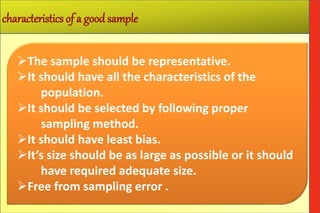
The sample should be representative.
It should have all the characteristics of the
population.
It should be selected by following proper
sampling method.
It should have least bias.
It’s size should be as large as possible or it should
have required adequate size.
Free from sampling error .
characteristics of a good sample
The complete population should be represented in the
selected group.
To avoid wastage of time & money.
To make a deep study.
To make the proper administration of the
research.
To achieve proper rapport with the respondents.
To make it possible to analyze the data thoroughly.
Useful in the scarcity of resources.
If a comprehensive study is needed.
Importance of sampling
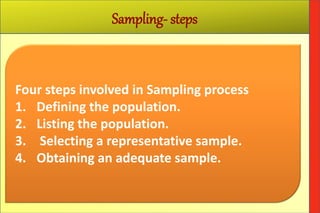
Four steps involved in Sampling process
1. Defining the population.
2. Listing the population.
3. Selecting a representative sample.
4. Obtaining an adequate sample.
Sampling- steps
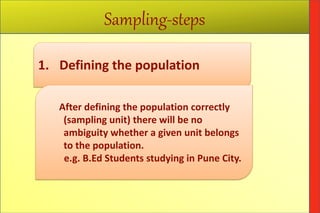
Sampling-steps
1. Defining the population
After defining the population correctly
(sampling unit) there will be no
ambiguity whether a given unit belongs
to the population.
e.g. B.Ed Students studying in Pune City.
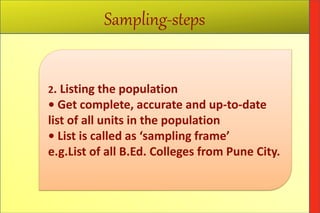
Sampling-steps
2. Listing the population
• Get complete, accurate and up-to-date
list of all units in the population
• List is called as ‘sampling frame’
e.g.List of all B.Ed. Colleges from Pune City.
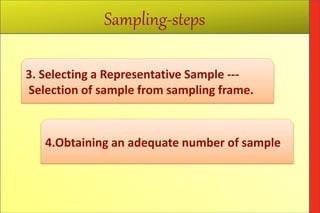
Sampling-steps
3. Selecting a Representative Sample ---
Selection of sample from sampling frame.
4.Obtaining an adequate number of sample.
Methods of sampling
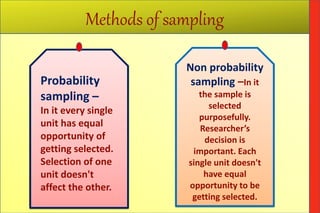
Probability
sampling –
In it every single
unit has equal
opportunity of
getting selected.
Selection of one
unit doesn't
affect the other.
Non probability
sampling –In it
the sample is
selected
purposefully.
Researcher’s
decision is
important. Each
single unit doesn't
have equal
opportunity to be
getting selected.
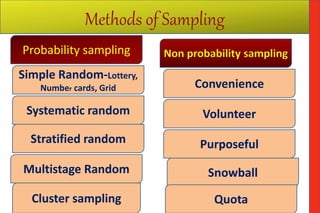
Methods of Sampling
Probability sampling Non probability sampling
Simple Random-Lottery,
Number cards, Grid
Systematic random
Stratified random
Multistage Random
Cluster sampling
Convenience
Purposeful
Snowball
Volunteer
Quota
Sample Size
n = N*X / (X + N – 1), where, X = Zα/2
2 *p*(1-p) /
MOE2, and Zα/2 is the critical value of the Normal
distribution at α/2 (e.g. for a confidence level of
95%, α is 0.05 and the critical value is 1.96), MOE
is the margin of error, p is the sample proportion,
and N is the population
references
Best, J. W. & Kahn, J. V. (2010).Research in Education
(Tenth Edition). New Delhi: PHI Learning.
https://select-statistics.co.uk/calculators/sample-size-
Population & Sampling by Dr. Neha Deo

Population & Sampling by Dr. Neha Deo

  • 2.
    An aggregate ortotality of objects or individuals regarding which inferences are to be made in a sampling study. All those people or documents etc. who are proposed to be covered under the scheme of study. Population-Definition & Meaning
  • 3.
    A refers toany collection of specific group of human beings or non-human entities such as objects, educational institutes, time units, geographical areas etc. It is also called as ‘universe’ All the members of a real or hypothetical set of people, events, objects or other units. Population
  • 4.
    is any groupof units that has one or more characteristics in common, that distinguishes that group from other individuals and that are of interest to the researcher. There are various ways to configure a population depending on the characteristics of interest. e.g.B.Ed. Students studying in any city. Population
  • 5.
    Levels of Populationfor sample selection Large General population Targeted population Accessible Population Sample
  • 6.
    Levels of Populationfor sample selection Large General population B.Ed. Students from Maharashtra. Targeted population Marathi medium female students from Maharashtra. Accessible Population. Marathi medium female students in Pune City. Sample
  • 7.
    . Sample  The representativeproportion of the population is called a sample.  Sample is a small proportion of a population selected for observation & analysis. It is a subset of the population. Sample
  • 8.
    Sampling-definition Sampling is theprocess of selecting a sample from the population. Sample is to be selected from the defined population.
  • 9.
    The sample shouldbe representative. It should have all the characteristics of the population. It should be selected by following proper sampling method. It should have least bias. It’s size should be as large as possible or it should have required adequate size. Free from sampling error . characteristics of a good sample
  • 10.
    The complete populationshould be represented in the selected group. To avoid wastage of time & money. To make a deep study. To make the proper administration of the research. To achieve proper rapport with the respondents. To make it possible to analyze the data thoroughly. Useful in the scarcity of resources. If a comprehensive study is needed. Importance of sampling
  • 11.
    Four steps involvedin Sampling process 1. Defining the population. 2. Listing the population. 3. Selecting a representative sample. 4. Obtaining an adequate sample. Sampling- steps
  • 12.
    Sampling-steps 1. Defining thepopulation After defining the population correctly (sampling unit) there will be no ambiguity whether a given unit belongs to the population. e.g. B.Ed Students studying in Pune City.
  • 13.
    Sampling-steps 2. Listing thepopulation • Get complete, accurate and up-to-date list of all units in the population • List is called as ‘sampling frame’ e.g.List of all B.Ed. Colleges from Pune City.
  • 14.
    Sampling-steps 3. Selecting aRepresentative Sample --- Selection of sample from sampling frame. 4.Obtaining an adequate number of sample.
  • 15.
    Methods of sampling Probability sampling– In it every single unit has equal opportunity of getting selected. Selection of one unit doesn't affect the other. Non probability sampling –In it the sample is selected purposefully. Researcher’s decision is important. Each single unit doesn't have equal opportunity to be getting selected.
  • 16.
    Methods of Sampling Probabilitysampling Non probability sampling Simple Random-Lottery, Number cards, Grid Systematic random Stratified random Multistage Random Cluster sampling Convenience Purposeful Snowball Volunteer Quota
  • 17.
    Sample Size n =N*X / (X + N – 1), where, X = Zα/2 2 *p*(1-p) / MOE2, and Zα/2 is the critical value of the Normal distribution at α/2 (e.g. for a confidence level of 95%, α is 0.05 and the critical value is 1.96), MOE is the margin of error, p is the sample proportion, and N is the population
  • 18.
    references Best, J. W.& Kahn, J. V. (2010).Research in Education (Tenth Edition). New Delhi: PHI Learning. https://select-statistics.co.uk/calculators/sample-size-