DETERMINING THE 
SAMPLE SIZE 
RICHARD Z. ZONIO 
Student
Sample 
It is the small group you 
observe and a population is the 
larger group about which your 
generalization is made
Population 
It is the group to which a 
researcher would like the 
results to be generalizable
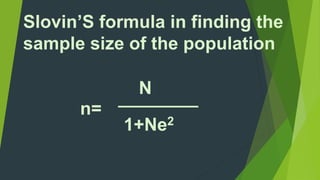
Slovin’S formula in finding the 
sample size of the population 
N 
________ 
n= 
1+Ne2
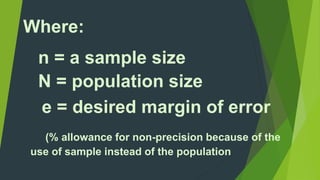
Where: 
n = a sample size 
N = population size 
e = desired margin of error 
(% allowance for non-precision because of the 
use of sample instead of the population
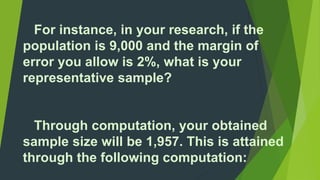
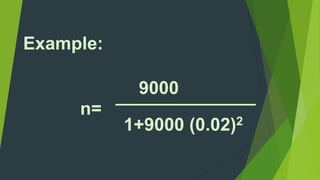
For instance, in your research, if the 
population is 9,000 and the margin of 
error you allow is 2%, what is your 
representative sample? 
Through computation, your obtained 
sample size will be 1,957. This is attained 
through the following computation:
9000 
Example: 
______________ 
n= 
1+9000 (0.02)2
___9_0_0_0________ 
n= 
1+9000 (0.0004)
___9_0_0_0____ 
n= 
1+ 3.6
___9_0_0_0____ 
n= 
4.6
n = 1,957
Always remember that the 
assumption of a normal distribution of 
the population should be considered. 
When the normal approximation of your 
population is small or poor, this sample 
size formula does not apply.
SAMPLE STUDY
DETERMINANTS OF YTHE PERFORMANCE OF 
GRADE SIX PUPILS IN THE NATIONAL 
ACHIEVEMENT TEST
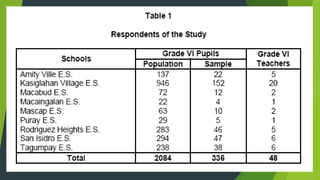
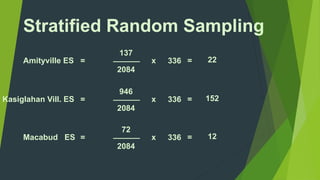
Stratified Random Sampling 
Amityville ES = 
137 
______ 
2084 
x 336 = 22 
Kasiglahan Vill. ES = 
946 
______ 
2084 
x 336 = 152 
Macabud ES = 
72 
______ 
2084 
x 336 = 12
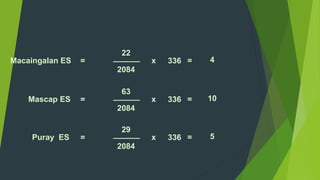
Macaingalan ES = 
22 
______ 
2084 
x 336 = 4 
Mascap ES = 
63 
______ 
2084 
x 336 = 10 
Puray ES = 
29 
______ 
2084 
x 336 = 5
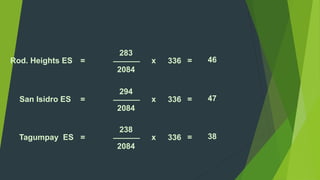
Rod. Heights ES = 
283 
______ 
2084 
x 336 = 46 
San Isidro ES = 
294 
______ 
2084 
x 336 = 47 
Tagumpay ES = 
238 
______ 
2084 
x 336 = 38
THANK YOU

Determining the Sample Size

  • 1.
    DETERMINING THE SAMPLESIZE RICHARD Z. ZONIO Student
  • 2.
    Sample It isthe small group you observe and a population is the larger group about which your generalization is made
  • 3.
    Population It isthe group to which a researcher would like the results to be generalizable
  • 4.
    Slovin’S formula infinding the sample size of the population N ________ n= 1+Ne2
  • 5.
    Where: n =a sample size N = population size e = desired margin of error (% allowance for non-precision because of the use of sample instead of the population
  • 6.
    For instance, inyour research, if the population is 9,000 and the margin of error you allow is 2%, what is your representative sample? Through computation, your obtained sample size will be 1,957. This is attained through the following computation:
  • 7.
    9000 Example: ______________ n= 1+9000 (0.02)2
  • 8.
  • 9.
  • 10.
  • 11.
  • 12.
    Always remember thatthe assumption of a normal distribution of the population should be considered. When the normal approximation of your population is small or poor, this sample size formula does not apply.
  • 13.
  • 14.
    DETERMINANTS OF YTHEPERFORMANCE OF GRADE SIX PUPILS IN THE NATIONAL ACHIEVEMENT TEST
  • 18.
    Stratified Random Sampling Amityville ES = 137 ______ 2084 x 336 = 22 Kasiglahan Vill. ES = 946 ______ 2084 x 336 = 152 Macabud ES = 72 ______ 2084 x 336 = 12
  • 19.
    Macaingalan ES = 22 ______ 2084 x 336 = 4 Mascap ES = 63 ______ 2084 x 336 = 10 Puray ES = 29 ______ 2084 x 336 = 5
  • 20.
    Rod. Heights ES= 283 ______ 2084 x 336 = 46 San Isidro ES = 294 ______ 2084 x 336 = 47 Tagumpay ES = 238 ______ 2084 x 336 = 38
  • 24.