TOPIC : SAMPLING
Presented by :
Amna Javed
(Overview)
a) What is Population ?
b) What is Sample ?
c) Sampling Techniques
 What is Probability sampling ?
 What is Non-probability sampling ?
a) Advantages & Disadvantages sampling
b) Difference b/w Probability &
Non-Probability
c) Characteristics of sampling
What is a Population?
DEFINITION:
The group to which you want to generalize your findings.
IN OTHER WORDS:
The larger group you are representing with your sample.
OR
The larger group to which your results will apply.
What is a Sample?
DEFINITION
A subset of the population being studied from
which data is actually collected.
A good sample accurately represents all kinds of
elements/members in proportion to their presence in
the population.
Sampling Techniques
“Sampling techniques are the processes by which
the subset of the population from which you will
collect data are chosen”.
There are TWO general types of sampling techniques:
1. PROBABILITY SAMPLING
2. NON-PROBABILITY SAMPLING
Probability Sampling
DEFINITION
The process of selecting a sample from a population
using (statistical) probability theory.
IN PROBABILITY SAMPLING
 Each element/member of the population have an equal
chance of being included in the sample, and
 The researcher CAN estimate the error caused by
collecting data from all elements/members of the
population.
Types of Probability Sampling
1) Simple Random Sampling
2) Stratified Random Sampling
3) Cluster Sampling
4) Systematic Random Sampling
5) Multistage sampling
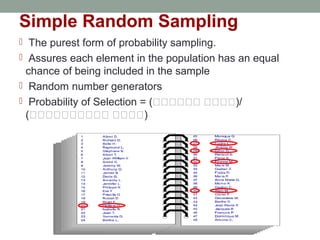
Simple Random Sampling
 The purest form of probability sampling.
 Assures each element in the population has an equal
chance of being included in the sample
 Random number generators
 Probability of Selection = (𝑆𝑆𝑆𝑆𝑆𝑆 𝑆𝑆𝑆𝑆)/
(𝑆𝑆𝑆𝑆𝑆𝑆𝑆𝑆𝑆𝑆 𝑆𝑆𝑆𝑆)
Stratified Random Sampling
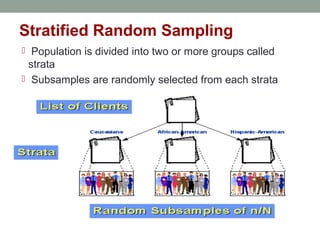
 Population is divided into two or more groups called
strata
 Subsamples are randomly selected from each strata
Cluster Sampling
 The population is divided into subgroups (clusters) like
families.
 A simple random sample is taken from each cluster
Systematic Random Sampling
 Each element has an equal probability of selection, but
combinations of elements have different probabilities.
 Population size N, desired sample size n,
 sampling interval k=N/n.
Multistage sampling
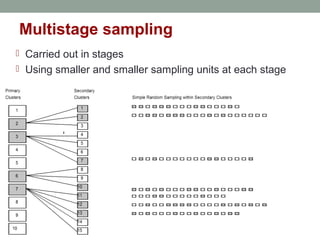
 Carried out in stages
 Using smaller and smaller sampling units at each stage
Non-Probability Sampling
DEFINITION
The process of selecting a sample from a population
without using (statistical) probability theory.
IN NON-PROBABILITY SAMPLING
• Each element/member of the population DOES NOT
have an equal chance of being included in the
sample, and
• The researcher CANNOT estimate the error caused
by not collecting data from all elements/members of
the population.
Types of Non-Probability Sampling
1. Convenience Sampling
2. Quota Sampling
3. Purposive (Judgmental) Sampling
4. Snowball Sampling
Convenient Sampling
DEFINITION;
• Selecting easily accessible participants with no
randomization.
For example;
In our example of the 10,000 university students, if we
were only interested in achieving a sample size of say
100 students. we may simply stand at one of the main
entrances to campus, where it would be easy to invite the
many students that pass by to take part in the research.
So, it is very easy (Convenient) to select.
Selection of Participants
TYPE OF
SAMPLING
SELECTION
STRATEGY
PURPOSE
Convenience Select cases
based on their
availability for
the study.
Saves time,
money and
effort; but at
the expense of
information and
credibility.
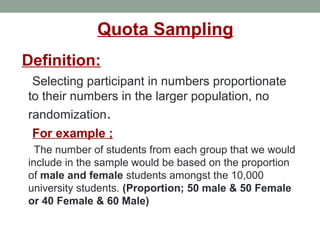
Quota Sampling
Definition:
Selecting participant in numbers proportionate
to their numbers in the larger population, no
randomization.
For example ;
The number of students from each group that we would
include in the sample would be based on the proportion
of male and female students amongst the 10,000
university students. (Proportion; 50 male & 50 Female
or 40 Female & 60 Male)
Selection of Participants
TYPE OF
SAMPLING
SELECTION
STRATEGY
PURPOSE
Quota; Select a sample
that yields the
same proportions
as the population
proportions on
easily identified
variables.
Taking a set
number of cases
from each
subgroup to raise
analytic
confidence and
representativeness
.
Purposive (Judgmental)
Sampling
Definition:
Purposive sampling, also known
as judgmental, selective or subjective
sampling, reflects a group of sampling
techniques that rely on the judgment of the
researcher; when it comes to selecting the units
that are to be studied.
For Example Specific People, Specific
cases/organizations, Specific events, Specific
pieces of data)
Selection of Participants
TYPE OF
SAMPLING
SELECTION
STRATEGY
PURPOSE
Purposive All cases that
meet some
criteria.
Useful for
quality
assurance.
Snowball Sampling
DEFINITION
Selecting participants by finding one or two
participants and then asking them to refer you to
others.
For example; Meeting a homeless person,
interviewing that person, and then asking him/her
to introduce you to other homeless people you
might interview.
Selection of Participants
TYPE OF
SAMPLING
SELECTION
STRATEGY
PURPOSE
Snowball or chain
referral
Group members
identify additional
members to be
included in the
sample.
Identifies cases of
interest to people
who know people,
who know what
cases are
information-rich.
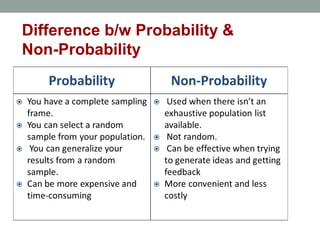
Difference b/w Probability &
Non-Probability
Advantages of Sampling
 Very accurate.
 Economical in nature.
 Very reliable.
 High suitability ratio towards the different surveys.
 Takes less time.
 In cases, when the universe is very large, then the
sampling method is the only practical method for
collecting the data.
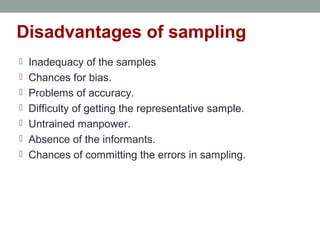
Disadvantages of sampling
 Inadequacy of the samples
 Chances for bias.
 Problems of accuracy.
 Difficulty of getting the representative sample.
 Untrained manpower.
 Absence of the informants.
 Chances of committing the errors in sampling.
Characteristics of the Sampling
 Much cheaper.
 Saves time.
 Much reliable.
 Very suitable for carrying out different surveys.
 Scientific in nature.
Difference Between sampling
and population
 The collection of all elements possessing common
characteristics that comprise universe is known as the
population. A subgroup of the members of population
chosen for participation in the study is called sample.
 The population consists of each and every element of
the entire group. On the other hand, only a handful of
items of the population is included in a sample.
 The characteristic of population based on all units is
called parameter while the measure of sample
observation is called statistic.
Questions ??
Thankyou
In a world where you can be anything, Be
Kind

Sampling

  • 1.
  • 2.
    (Overview) a) What isPopulation ? b) What is Sample ? c) Sampling Techniques  What is Probability sampling ?  What is Non-probability sampling ? a) Advantages & Disadvantages sampling b) Difference b/w Probability & Non-Probability c) Characteristics of sampling
  • 3.
    What is aPopulation? DEFINITION: The group to which you want to generalize your findings. IN OTHER WORDS: The larger group you are representing with your sample. OR The larger group to which your results will apply.
  • 4.
    What is aSample? DEFINITION A subset of the population being studied from which data is actually collected. A good sample accurately represents all kinds of elements/members in proportion to their presence in the population.
  • 5.
    Sampling Techniques “Sampling techniquesare the processes by which the subset of the population from which you will collect data are chosen”. There are TWO general types of sampling techniques: 1. PROBABILITY SAMPLING 2. NON-PROBABILITY SAMPLING
  • 6.
    Probability Sampling DEFINITION The processof selecting a sample from a population using (statistical) probability theory. IN PROBABILITY SAMPLING  Each element/member of the population have an equal chance of being included in the sample, and  The researcher CAN estimate the error caused by collecting data from all elements/members of the population.
  • 7.
    Types of ProbabilitySampling 1) Simple Random Sampling 2) Stratified Random Sampling 3) Cluster Sampling 4) Systematic Random Sampling 5) Multistage sampling
  • 8.
    Simple Random Sampling The purest form of probability sampling.  Assures each element in the population has an equal chance of being included in the sample  Random number generators  Probability of Selection = (𝑆𝑆𝑆𝑆𝑆𝑆 𝑆𝑆𝑆𝑆)/ (𝑆𝑆𝑆𝑆𝑆𝑆𝑆𝑆𝑆𝑆 𝑆𝑆𝑆𝑆)
  • 9.
    Stratified Random Sampling Population is divided into two or more groups called strata  Subsamples are randomly selected from each strata
  • 10.
    Cluster Sampling  Thepopulation is divided into subgroups (clusters) like families.  A simple random sample is taken from each cluster
  • 11.
    Systematic Random Sampling Each element has an equal probability of selection, but combinations of elements have different probabilities.  Population size N, desired sample size n,  sampling interval k=N/n.
  • 12.
    Multistage sampling  Carriedout in stages  Using smaller and smaller sampling units at each stage
  • 13.
    Non-Probability Sampling DEFINITION The processof selecting a sample from a population without using (statistical) probability theory. IN NON-PROBABILITY SAMPLING • Each element/member of the population DOES NOT have an equal chance of being included in the sample, and • The researcher CANNOT estimate the error caused by not collecting data from all elements/members of the population.
  • 14.
    Types of Non-ProbabilitySampling 1. Convenience Sampling 2. Quota Sampling 3. Purposive (Judgmental) Sampling 4. Snowball Sampling
  • 15.
    Convenient Sampling DEFINITION; • Selectingeasily accessible participants with no randomization. For example; In our example of the 10,000 university students, if we were only interested in achieving a sample size of say 100 students. we may simply stand at one of the main entrances to campus, where it would be easy to invite the many students that pass by to take part in the research. So, it is very easy (Convenient) to select.
  • 16.
    Selection of Participants TYPEOF SAMPLING SELECTION STRATEGY PURPOSE Convenience Select cases based on their availability for the study. Saves time, money and effort; but at the expense of information and credibility.
  • 17.
    Quota Sampling Definition: Selecting participantin numbers proportionate to their numbers in the larger population, no randomization. For example ; The number of students from each group that we would include in the sample would be based on the proportion of male and female students amongst the 10,000 university students. (Proportion; 50 male & 50 Female or 40 Female & 60 Male)
  • 18.
    Selection of Participants TYPEOF SAMPLING SELECTION STRATEGY PURPOSE Quota; Select a sample that yields the same proportions as the population proportions on easily identified variables. Taking a set number of cases from each subgroup to raise analytic confidence and representativeness .
  • 19.
    Purposive (Judgmental) Sampling Definition: Purposive sampling,also known as judgmental, selective or subjective sampling, reflects a group of sampling techniques that rely on the judgment of the researcher; when it comes to selecting the units that are to be studied. For Example Specific People, Specific cases/organizations, Specific events, Specific pieces of data)
  • 20.
    Selection of Participants TYPEOF SAMPLING SELECTION STRATEGY PURPOSE Purposive All cases that meet some criteria. Useful for quality assurance.
  • 21.
    Snowball Sampling DEFINITION Selecting participantsby finding one or two participants and then asking them to refer you to others. For example; Meeting a homeless person, interviewing that person, and then asking him/her to introduce you to other homeless people you might interview.
  • 22.
    Selection of Participants TYPEOF SAMPLING SELECTION STRATEGY PURPOSE Snowball or chain referral Group members identify additional members to be included in the sample. Identifies cases of interest to people who know people, who know what cases are information-rich.
  • 23.
    Difference b/w Probability& Non-Probability
  • 24.
    Advantages of Sampling Very accurate.  Economical in nature.  Very reliable.  High suitability ratio towards the different surveys.  Takes less time.  In cases, when the universe is very large, then the sampling method is the only practical method for collecting the data.
  • 25.
    Disadvantages of sampling Inadequacy of the samples  Chances for bias.  Problems of accuracy.  Difficulty of getting the representative sample.  Untrained manpower.  Absence of the informants.  Chances of committing the errors in sampling.
  • 26.
    Characteristics of theSampling  Much cheaper.  Saves time.  Much reliable.  Very suitable for carrying out different surveys.  Scientific in nature.
  • 27.
    Difference Between sampling andpopulation  The collection of all elements possessing common characteristics that comprise universe is known as the population. A subgroup of the members of population chosen for participation in the study is called sample.  The population consists of each and every element of the entire group. On the other hand, only a handful of items of the population is included in a sample.  The characteristic of population based on all units is called parameter while the measure of sample observation is called statistic.
  • 28.
  • 29.
    Thankyou In a worldwhere you can be anything, Be Kind