SAMPLE
•It is aUnit that selected from population
•Representers of the population
•Purpose to draw the inference
5.
Very difficult tostudy each and every unit
of the population when population unit
are heterogeneous
WHY SAMPLE ?
Time Constraints
Finance
6.
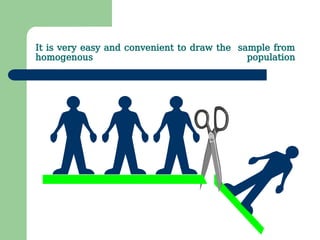
It is veryeasy and convenient to draw the sample from
homogenous population
7.
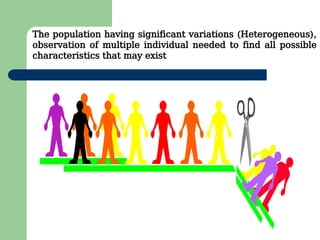
The population havingsignificant variations (Heterogeneous),
observation of multiple individual needed to find all possible
characteristics that may exist
8.
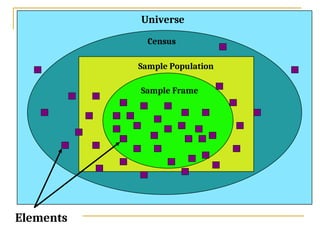
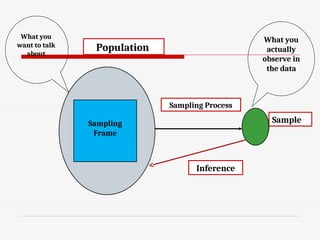
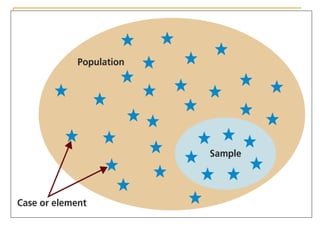
Population
The entire groupof people of interest from whom the researcher
needs to obtain information
Element (sampling unit)
One unit from a population
Sampling
The selection of a subset of the population through various
sampling techniques
Sampling Frame
Listing of population from which a sample is chosen.
The sampling frame for any probability sample is a
complete list of all the cases in the population from
which your sample will be drown
9.
Parameter
The variable ofinterest
Statistic
The information obtained from the sample about
the parameter
10.
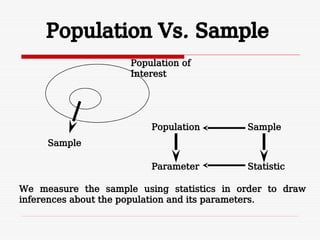
Population Vs. Sample
Populationof
Interest
Sample
Population Sample
Parameter Statistic
We measure the sample using statistics in order to draw
inferences about the population and its parameters.
Process by whichthe sample are taken from population
to obtain the information
Sampling is the process of selecting observations (a
sample) to provide an adequate description and
inferences of the population
SAMPLING
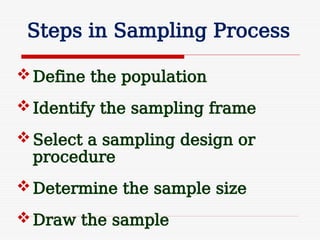
Steps in SamplingProcess
Define the population
Identify the sampling frame
Select a sampling design or
procedure
Determine the sample size
Draw the sample
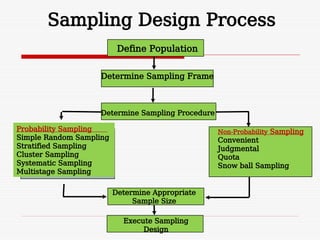
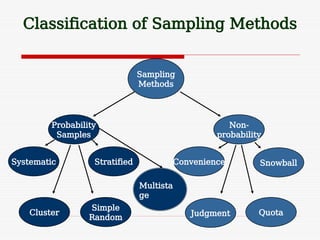
Classification of SamplingMethods
Sampling
Methods
Probability
Samples
Simple
Random
Cluster
Systematic Stratified
Non-
probability
Quota
Judgment
Convenience Snowball
Multista
ge
19.
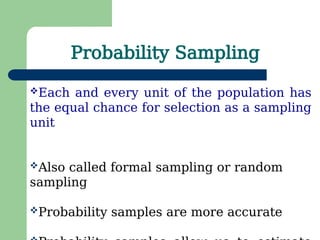
Probability Sampling
Each andevery unit of the population has
the equal chance for selection as a sampling
unit
Also called formal sampling or random
sampling
Probability samples are more accurate
20.
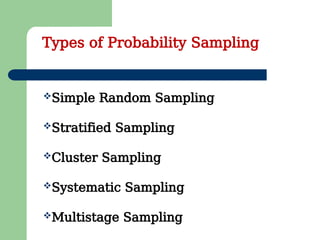
Types of ProbabilitySampling
Simple Random Sampling
Stratified Sampling
Cluster Sampling
Systematic Sampling
Multistage Sampling
21.
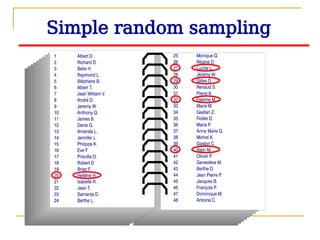
Simple Random Sampling
The purest form of probability sampling
Assures each element in the population
has an equal chance of being included
in the sample
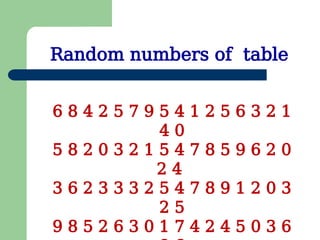
Random number generators
Advantages of SRS
Minimal knowledge of population
needed
External validity high; internal
validity high; statistical estimation of
error
Easy to analyze data
28.
Disadvantage
High cost;low frequency of use
Requires sampling frame
Does not use researchers’ expertise
Larger risk of random error than
stratified
29.
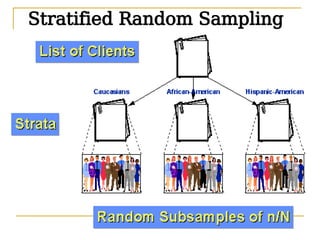
Stratified Random Sampling
Populationis divided into two or more
groups called strata, according to some
criterion, such as geographic location,
grade level, age, or income, and
subsamples are randomly selected from
each strata.
Elements within each strata are
homogeneous, but are heterogeneous
across strata
Types of StratifiedRandom Sampling
Proportionate Stratified Random
Sampling
Equal proportion of sample unit are selected
from each strata
Disproportionate Stratified Random
Sampling
Also called as equal allocation technique and
32.
Advantage
Assures representationof all groups
in sample population needed
Characteristics of each stratum can be
estimated and comparisons made
Reduces variability from systematic
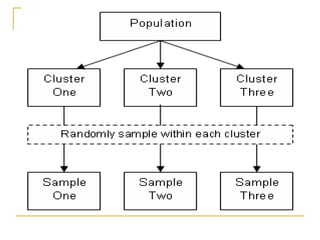
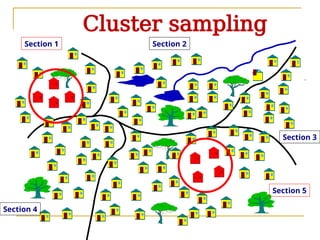
The population isdivided into subgroups
(clusters) like families. A simple random sample
is taken of the subgroups and then all members
of the cluster selected are surveyed.
Cluster Sampling
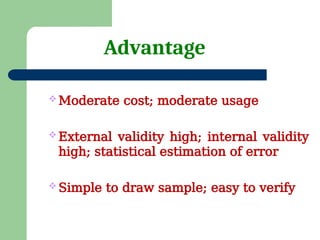
Advantage
Low cost/highfrequency of use
Requires list of all clusters, but only of individuals within
chosen clusters
Can estimate characteristics of both cluster and
population
For multistage, has strengths of used methods
Researchers lack a good sampling frame for a dispersed
population
38.
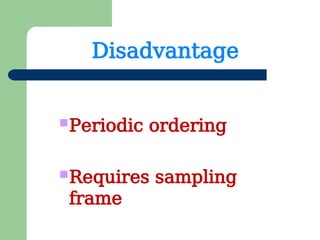
Disadvantage
The cost toreach an element to sample is very
high
Usually less expensive than SRS but not as
accurate
Each stage in cluster sampling introduces
sampling error—the more stages there are, the
more error there tends to be
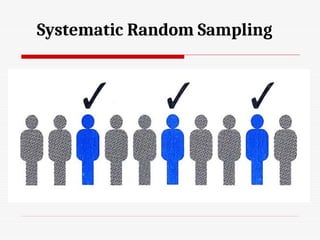
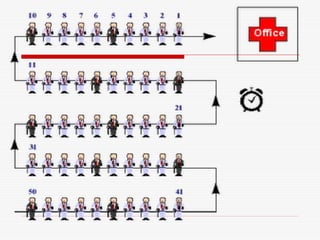
39.
Systematic Random Sampling
Orderall units in the sampling frame based
on some variable and then every nth number
on the list is selected
Gaps between elements are equal and
Constant There is periodicity.
N= Sampling Interval
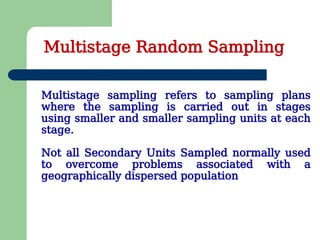
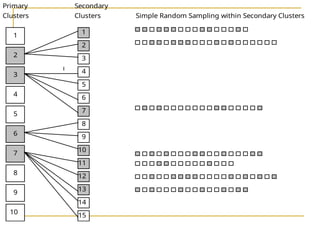
Multistage sampling refersto sampling plans
where the sampling is carried out in stages
using smaller and smaller sampling units at each
stage.
Not all Secondary Units Sampled normally used
to overcome problems associated with a
geographically dispersed population
Multistage Random Sampling
Multistage Random Sampling
Selectall schools; then sample within
schools
Sample schools; then measure all
students
Sample schools; then sample students
47.
The probability ofeach case being selected from
the total population is not known
Units of the sample are chosen on the basis of
personal judgment or convenience
There are NO statistical techniques for
measuring random sampling error in a non-
probability sample. Therefore, generalizability is
never statistically appropriate.
Non Probability Sampling
48.
Non Probability Sampling
Involves non random methods in selection of
sample
All have not equal chance of being selected
Selection depend upon situation
Considerably less expensive
Convenient
Sample chosen in many ways
Purposive Sampling
Also calledjudgment Sampling
The sampling procedure in which an experienced
research selects the sample based on some
appropriate characteristic of sample
members… to serve a purpose
When taking sample reject, people who do not
fit for a particular profile
Start with a purpose in mind
51.
Sample are chosenwell based on the
some criteria
There is a assurance of Quality
response
Meet the specific objective
Advantage
Quota Sampling
The populationis divided into cells on the basis
of relevant control characteristics.
A quota of sample units is established for each
cell
A convenience sample is drawn for each cell
until the quota is met
It is entirely non random and it is normally used
for interview surveys
54.
Advantage
Used whenresearch budget limited
Very extensively used/understood
No need for list of population elements
Introduces some elements of stratification
Demerit
Variability and bias cannot be measured
or controlled
Time Consuming
Projecting data beyond sample not
justified
55.
Snowball Sampling
The researchstarts with a key person and
introduce the next one to become a chain
Make contact with one or two cases in the
population
Ask these cases to identify further cases.
Stop when either no new cases are given or the
sample is as large as manageable
56.
Advantage
Demerit
low cost
Useful in specific circumstances
Useful for locating rare populations
Bias because sampling units not independent
Projecting data beyond sample not justified
57.
Self selection Sampling
Itoccurs when you allow each case usually
individuals, to identify their desire to take part
in the research you therefore
Publicize your need for cases, either by
advertising through appropriate media or by
asking them to take part
Collect data from those who respond
Called as Accidental/ Incidental
Sampling
Selecting haphazardly those cases that
are easiest to obtain
Sample most available are chosen
It is done at the “convenience” of the
researcher
Convenience Sampling
61.
Merit
Very lowcost
Extensively used/understood
No need for list of population elements
Demerit
Variability and bias cannot be measured
or controlled
Projecting data beyond sample not
justified
62.
Sampling Error
Sampling errorrefers to differences
between the sample and the population
that exist only because of the observations
that happened to be selected for the
sample
Increasing the sample size will reduce this
type of error
Sample Errors
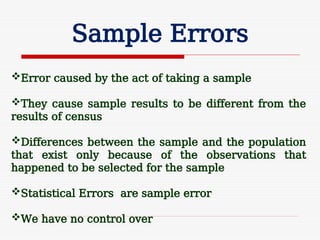
Error causedby the act of taking a sample
They cause sample results to be different from the
results of census
Differences between the sample and the population
that exist only because of the observations that
happened to be selected for the sample
Statistical Errors are sample error
We have no control over
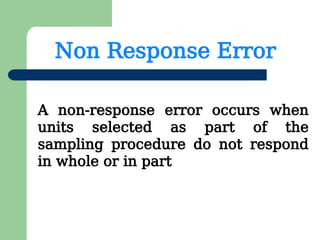
Non Response Error
Anon-response error occurs when
units selected as part of the
sampling procedure do not respond
in whole or in part
68.
Response Errors
Respondent error(e.g., lying, forgetting, etc.)
Interviewer bias
Recording errors
Poorly designed questionnaires
Measurement error
A response or data error is any systematic bias
that occurs during data collection, analysis or
interpretation
69.
Respondent error
respondentgives an incorrect answer, e.g. due to prestige
or competence implications, or due to sensitivity or social
undesirability of question
respondent misunderstands the requirements
lack of motivation to give an accurate answer
“lazy” respondent gives an “average” answer
question requires memory/recall
proxy respondents are used, i.e. taking answers from
someone other than the respondent
70.
Interviewer bias
Differentinterviewers administer a survey in different
ways
Differences occur in reactions of respondents to
different interviewers, e.g. to interviewers of their own
sex or own ethnic group
Inadequate training of interviewers
Inadequate attention to the selection of interviewers
There is too high a workload for the interviewer
71.
Measurement Error
Thequestion is unclear, ambiguous or difficult to
answer
The list of possible answers suggested in the recording
instrument is incomplete
Requested information assumes a framework
unfamiliar to the respondent
The definitions used by the survey are different from
those used by the respondent (e.g. how many part-
time employees do you have? See next slide for an
example)
72.
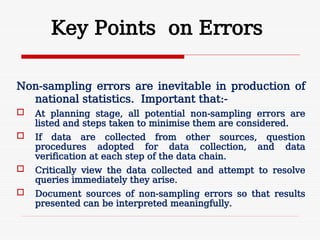
Key Points onErrors
Non-sampling errors are inevitable in production of
national statistics. Important that:-
At planning stage, all potential non-sampling errors are
listed and steps taken to minimise them are considered.
If data are collected from other sources, question
procedures adopted for data collection, and data
verification at each step of the data chain.
Critically view the data collected and attempt to resolve
queries immediately they arise.
Document sources of non-sampling errors so that results
presented can be interpreted meaningfully.







![SAMPLING_POWERPOINT[1] h.pptx on popoulation](https://cdn.slidesharecdn.com/ss_thumbnails/samplingpowerpoint1h-250414080939-ebb0ef87-thumbnail.jpg?width=640&height=640&fit=bounds)


