
Sampling
Overview
• Technical terminology
• What & why of sampling
• Develop an understanding about different sampling
methods
• Distinguish between probability & non probability
sampling
• Discuss the relative advantages & disadvantages of each
sampling methods
Technical Terminology
• An element is an object on which a measurement is
taken.
• A population is a collection of elements about which
we wish to make an inference.
• Sampling units are nonoverlapping collections of
elements from the population that cover the entire
population.
Technical Terms
• A sampling frame is a list of sampling units.
• A sample is a collection of sampling units drawn from
a sampling frame.
• Parameter: numerical characteristic of a population
• Statistic: numerical characteristic of a sample
SAMPLING
• A sample is “a smaller (but hopefully representative)
collection of units from a population used to determine
truths about that population” (Field, 2005)
• Why sample?
▫ Resources (time, money) and workload
▫ Gives results with known accuracy that can be
calculated mathematically
• The sampling frame is the list from which the potential
respondents are drawn
▫ Registrar’s office
▫ Class rosters
▫ Must assess sampling frame errors
SAMPLING……
• What is your population of interest?
– To whom do you want to generalize your
results?
 All doctors
 School children
 Indians
 Women aged 15-45 years
 Other
• Can you sample the entire population?
SAMPLING…….
• 3 factors that influence sample representative-ness
– Sampling procedure
– Sample size
– Participation (response)
• When might you sample the entire population?
– When your population is very small
– When you have extensive resources
– When you don’t expect a very high response
7
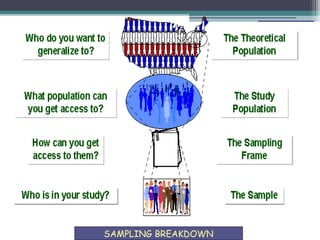
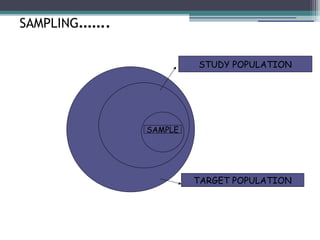
SAMPLING BREAKDOWN
SAMPLING…….
TARGET POPULATION
STUDY POPULATION
SAMPLE
Process
• The sampling process comprises several stages:
▫ Defining the population of concern
▫ Specifying a sampling frame, a set of items or
events possible to measure
▫ Specifying a sampling method for selecting
items or events from the frame
▫ Determining the sample size
▫ Implementing the sampling plan
▫ Sampling and data collecting
▫ Reviewing the sampling process
Types of Samples
• Probability (Random) Samples
▫ Simple random sample
▫ Systematic random sample
▫ Stratified random sample
▫ Cluster sample
• Non-Probability Samples
▫ Convenience sample
▫ Purposive sample
▫ Snowball
▫ Quota
PROBABILITY SAMPLING
• A probability sampling scheme is one in which every
unit in the population has a chance (greater than
zero) of being selected in the sample, and this
probability can be accurately determined.
NON PROBABILITY SAMPLING
• Any sampling method where some
elements of population have no chance of
selection (these are sometimes referred
to as 'out of coverage'/'undercovered'),
or where the probability of selection
can't be accurately determined.
Probability sampling
1. SIMPLE RANDOM SAMPLING
• Applicable when population is small, homogeneous
& readily available
• All subsets of the frame are given an equal
probability. Each element of the frame thus has
an equal probability of selection.
• It provides for greatest number of possible
samples. This is done by assigning a number to
each unit in the sampling frame.
• A table of random number or lottery system is
used to determine which units are to be
selected.
Advantages & disadvantages
• Estimates are easy to calculate.
• Simple random sampling is always an EPS design,
but not all EPS designs are simple random sampling.
• Disadvantages
• If sampling frame large, this method
impracticable.
• Minority subgroups of interest in population may
not be present in sample in sufficient numbers for
study.
2. STRATIFIED SAMPLING
• population is divided into a number of distinct categories, the
frame can be organized into separate "strata." Each stratum is
then sampled as an independent sub-population, out of which
individual elements can be randomly selected.
• Every unit in a stratum has same chance of being selected.
• Using same sampling fraction for all strata ensures proportionate
representation in the sample.
• Adequate representation of minority subgroups of interest can
be ensured by stratification & varying sampling fraction between
strata as required.
Contd…
• Finally, since each stratum is treated as an
independent population, different sampling
approaches can be applied to different strata.
• Drawbacks to using stratified sampling.
• First, sampling frame of entire population has to be
prepared separately for each stratum
• Second, when examining multiple criteria,
stratifying variables may be related to some, but
not to others, further complicating the design, and
potentially reducing the utility of the strata.
• Finally, in some cases (such as designs with a large
number of strata, or those with a specified
minimum sample size per group), stratified sampling
can potentially require a larger sample than would
other methods
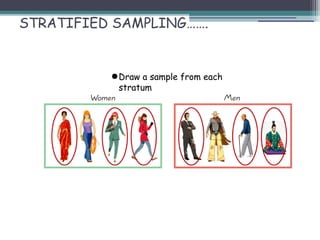
STRATIFIED SAMPLING…….
●Draw a sample from each
stratum
3. SYSTEMATIC SAMPLING
• Systematic sampling relies on arranging the target
population according to some ordering scheme and
then selecting elements at regular intervals through
that ordered list
• Systematic sampling involves a random start and then
proceeds with the selection of every kth element from
then onwards. In this case, k=(population size/sample
size)
• It is important that the starting point is not
automatically the first in the list, but is instead
randomly chosen from within the first to the kth
element in the list.
SYSTEMATIC SAMPLING……
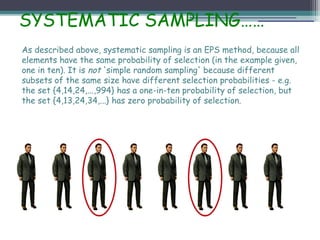
As described above, systematic sampling is an EPS method, because all
elements have the same probability of selection (in the example given,
one in ten). It is not 'simple random sampling' because different
subsets of the same size have different selection probabilities - e.g.
the set {4,14,24,...,994} has a one-in-ten probability of selection, but
the set {4,13,24,34,...} has zero probability of selection.
Advantages & disadvantages
• ADVANTAGES:
• Sample easy to select
• Suitable sampling frame can be identified easily
• Sample evenly spread over entire reference
population
• DISADVANTAGES:
• Sample may be biased if hidden periodicity in
population coincides with that of selection.
• Difficult to assess precision of estimate from one
survey.
4.CLUSTER SAMPLING
• Cluster sampling is an example of 'two-stage
sampling' .
• First stage a sample of areas is chosen;
• Second stage a sample of respondents within those
areas is selected.
• Population divided into clusters of homogeneous
units, usually based on geographical contiguity.
• Sampling units are groups rather than individuals.
• A sample of such clusters is then selected.
• All units from the selected clusters are studied.
Advantages & disadvantages
Advantages :
• Cuts down on the cost of preparing a sampling frame.
• This can reduce travel and other administrative costs.
Disadvantages:
sampling error is higher for a simple random sample of same
size.
• Often used to evaluate vaccination coverage in EPI
Difference Between Strata and Clusters
• Although strata and clusters are both non-overlapping
subsets of the population, they differ in several ways
• All strata are represented in the sample; but only a
subset of clusters are in the sample.
• With stratified sampling, the best survey results occur
when elements within strata are internally
homogeneous. However, with cluster sampling, the best
results occur when elements within clusters are
internally heterogeneous
Non-probability sampling
1. CONVENIENCE SAMPLING
• Sometimes known as grab or opportunity sampling or accidental or haphazard
sampling
• A type of nonprobability sampling which involves the sample being drawn from that part
of the population that is readily available and convenient
• For example, if the interviewer was to conduct a survey at a shopping center early in the
morning on a given day, the people that he/she could interview would be limited to those
given there at that given time, which would not represent the views of other members of
society in such an area, if the survey was to be conducted at different times of day and
several times per week.
• This type of sampling is most useful for pilot testing
• In social science research, snowball sampling is a similar technique, where existing
study subjects are used to recruit more subjects into the sample.
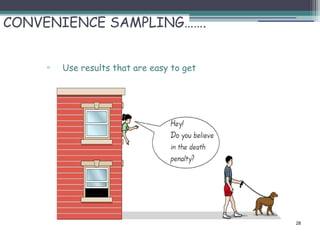
CONVENIENCE SAMPLING…….
▫ Use results that are easy to get
28
2.Judgmental sampling or Purposive
sampling
• - The researcher chooses the sample based on
who they think would be appropriate for the
study. This is used primarily when there is a
limited number of people that have expertise
in the area being researched
3. QUOTA SAMPLING
• The population is first segmented into mutually exclusive sub-
groups, just as in stratified sampling.
• Then judgment used to select subjects or units from each
segment based on a specified proportion.
• For example, an interviewer may be told to sample 200 females
and 300 males between the age of 45 and 60.
• It is this second step which makes the technique one of non-
probability sampling.
• In quota sampling the selection of the sample is non-random.
• For example interviewers might be tempted to interview those
who look most helpful. The problem is that these samples may
be biased because not everyone gets a chance of selection. This
random element is its greatest weakness and quota versus
probability has been a matter of controversy for many years
Contd… Quota Sampling
• Quota sampling is the nonprobability equivalent of
stratified sampling.
▫ First identify the stratums and their proportions as
they are represented in the population
▫ Then convenience or judgment sampling is used to
select the required number of subjects from each
stratum.
4.Snowball Sampling
• Snowball sampling is a special nonprobability method
used when the desired sample characteristic is rare.
• It may be extremely difficult or cost prohibitive to locate
respondents in these situations.
• This technique relies on referrals from initial subjects to
generate additional subjects.
• It lowers search costs; however, it introduces bias because
the technique itself reduces the likelihood that the sample
will represent a good cross section from the population.
Errors/biases of sampling
1. Errors of SAMPLING/ non-observation
ERROR
• The deviation between an estimate from an ideal
sample and the true population value is the
sampling error.
• Almost always, the sampling frame does not
match up perfectly with the target population,
leading to errors of coverage.
NON-RESPONSE
• Nonresponse is probably the most serious of these errors.
▫ Arises in three ways:
▫ Inability of the person responding to come up with the
answer
▫ Refusal to answer
▫ Inability to contact the sampled elements
2.Errors of observation
• These errors can be classified as due to the
interviewer, respondent, instrument, or method
of data collection.
Interviewers
• Interviewers have a direct and dramatic effect on the
way a person responds to a question.
▫ Most people tend to side with the view apparently favored by
the interviewer, especially if they are neutral.
▫ Friendly interviewers are more successful.
▫ In general, interviewers of the same gender, racial, and ethnic
groups as those being interviewed are slightly more successful.
Respondents
• Respondents differ greatly in motivation to answer correctly
and in ability to do so.
• Obtaining an honest response to sensitive questions is difficult.
• Basic errors
▫ Recall bias: simply does not remember
▫ Prestige bias: exaggerates to ‘look’ better
▫ Intentional deception: lying
▫ Incorrect measurement: does not understand the units or definition
What sampling method u recommend?
• Determining proportion of undernourished fiveyear oldsin a
village.
• Investigating nutritional statusof preschool children.
• Selecting maternity recordsfor thestudy of previousabortionsor
duration of postnatal stay.
• In estimation of immunization coveragein aprovince, dataon
seven children aged 12-23 monthsin 30 clustersareused to
determineproportion of fully immunized children in theprovince.
• Givereasonswhy cluster sampling isused in thissurvey.
Stage One: Decide whether you need a sample, or
whether it is possible to have the whole
population.
Stage Two: Identify the population, its important
features (the sampling frame) and its size.
Stage Three: Identify the kind of sampling strategy
you require (e.g. which variant of probability, non-
probability, or mixed methods sample you require).
Stage Four: Ensure that access to the sample is
guaranteed. If not, be prepared to modify the
sampling strategy.
PLANNING A SAMPLING STRATEGY
Stage Five: For probability sampling, identify the
confidence level and confidence intervals that you
require. For non-probability sampling, identify the
people whom you require in the sample.
Stage Six: Calculate the numbers required in the
sample, allowing for non-response, incomplete or
spoiled responses, attrition and sample mortality.
Stage Seven: Decide how to gain and manage access
and contact.
Stage Eight: Be prepared to weight (adjust) the
data, once collected.
PLANNING A SAMPLING STRATEGY
Questions…
At your table explain how you would conduct:
• A simple random sample of teachers in our class
• A stratified random sample of teachers in our
class
• A systematic sample of teachers in our class
Questions…
To conduct a survey of long-distance calling patterns, a researcher opens a
telephone book to a random page, closes his eyes, puts his finger down on the
page, and then reads off the next 50 names. Which of the following are true
statements?
I. The survey design incorporates chance
II. The procedure results in a simple random sample
III. The procedure could easily result in selection bias
a) I and II
b) I and III
c) II and III
d) I, II and III
e) None of the above gives the complete set of true responses
Practice
A large elementary school has 15
classrooms, with 24 children in each
classroom. A sample of 30 children is
chosen by the following procedure:
Each of the 15 teachers selects 2 children
from his or her classroom to be in the
sample by numbering the children from 1
to 24, using a random digit table to select
two different random numbers between 01
and 24. The 2 children with those numbers
are in the sample.
Did this procedure give a simple random
sample of 30 children from the elementary
school?
a) No, because the teachers
were not selected randomly
b) No, because not all possible
groups of 30 children had the
same chance of being chosen
c) No, because not all children
had the same chance of being
chosen
d) Yes, because each child had
the same chance of being
chosen
e) Yes, because the numbers
were assigned randomly to the
children
Guess the ST?
• In dealing with a stressful event, 440 participants reported how frequently they used a
variety of different coping strategies, rated their separate impacts on problems and
the associated emotions, and reported their effects on subsequent health and well-
being. Coping strategies did not generally impact problems or emotions differently.
Use of planning led to increased self-efficacy, which along with positive
reinterpretation, predicted growth. Emotional venting and behavioral disengagement
predicted diminishment, which along with mental disengagement and self-injury,
predicted illness. Social support buffered against diminishment. Use of acceptance
coping and seeking advice from others had both positive and negative effects on well-
being
How to do sampling?

How to do sampling?

  • 1.
  • 2.
    Overview • Technical terminology •What & why of sampling • Develop an understanding about different sampling methods • Distinguish between probability & non probability sampling • Discuss the relative advantages & disadvantages of each sampling methods
  • 3.
    Technical Terminology • Anelement is an object on which a measurement is taken. • A population is a collection of elements about which we wish to make an inference. • Sampling units are nonoverlapping collections of elements from the population that cover the entire population.
  • 4.
    Technical Terms • Asampling frame is a list of sampling units. • A sample is a collection of sampling units drawn from a sampling frame. • Parameter: numerical characteristic of a population • Statistic: numerical characteristic of a sample
  • 5.
    SAMPLING • A sampleis “a smaller (but hopefully representative) collection of units from a population used to determine truths about that population” (Field, 2005) • Why sample? ▫ Resources (time, money) and workload ▫ Gives results with known accuracy that can be calculated mathematically • The sampling frame is the list from which the potential respondents are drawn ▫ Registrar’s office ▫ Class rosters ▫ Must assess sampling frame errors
  • 6.
    SAMPLING…… • What isyour population of interest? – To whom do you want to generalize your results?  All doctors  School children  Indians  Women aged 15-45 years  Other • Can you sample the entire population?
  • 7.
    SAMPLING……. • 3 factorsthat influence sample representative-ness – Sampling procedure – Sample size – Participation (response) • When might you sample the entire population? – When your population is very small – When you have extensive resources – When you don’t expect a very high response 7
  • 8.
  • 9.
  • 10.
    Process • The samplingprocess comprises several stages: ▫ Defining the population of concern ▫ Specifying a sampling frame, a set of items or events possible to measure ▫ Specifying a sampling method for selecting items or events from the frame ▫ Determining the sample size ▫ Implementing the sampling plan ▫ Sampling and data collecting ▫ Reviewing the sampling process
  • 11.
    Types of Samples •Probability (Random) Samples ▫ Simple random sample ▫ Systematic random sample ▫ Stratified random sample ▫ Cluster sample • Non-Probability Samples ▫ Convenience sample ▫ Purposive sample ▫ Snowball ▫ Quota
  • 12.
    PROBABILITY SAMPLING • Aprobability sampling scheme is one in which every unit in the population has a chance (greater than zero) of being selected in the sample, and this probability can be accurately determined.
  • 13.
    NON PROBABILITY SAMPLING •Any sampling method where some elements of population have no chance of selection (these are sometimes referred to as 'out of coverage'/'undercovered'), or where the probability of selection can't be accurately determined.
  • 14.
  • 15.
    1. SIMPLE RANDOMSAMPLING • Applicable when population is small, homogeneous & readily available • All subsets of the frame are given an equal probability. Each element of the frame thus has an equal probability of selection. • It provides for greatest number of possible samples. This is done by assigning a number to each unit in the sampling frame. • A table of random number or lottery system is used to determine which units are to be selected.
  • 16.
    Advantages & disadvantages •Estimates are easy to calculate. • Simple random sampling is always an EPS design, but not all EPS designs are simple random sampling. • Disadvantages • If sampling frame large, this method impracticable. • Minority subgroups of interest in population may not be present in sample in sufficient numbers for study.
  • 17.
    2. STRATIFIED SAMPLING •population is divided into a number of distinct categories, the frame can be organized into separate "strata." Each stratum is then sampled as an independent sub-population, out of which individual elements can be randomly selected. • Every unit in a stratum has same chance of being selected. • Using same sampling fraction for all strata ensures proportionate representation in the sample. • Adequate representation of minority subgroups of interest can be ensured by stratification & varying sampling fraction between strata as required.
  • 18.
    Contd… • Finally, sinceeach stratum is treated as an independent population, different sampling approaches can be applied to different strata. • Drawbacks to using stratified sampling. • First, sampling frame of entire population has to be prepared separately for each stratum • Second, when examining multiple criteria, stratifying variables may be related to some, but not to others, further complicating the design, and potentially reducing the utility of the strata. • Finally, in some cases (such as designs with a large number of strata, or those with a specified minimum sample size per group), stratified sampling can potentially require a larger sample than would other methods
  • 19.
    STRATIFIED SAMPLING……. ●Draw asample from each stratum
  • 20.
    3. SYSTEMATIC SAMPLING •Systematic sampling relies on arranging the target population according to some ordering scheme and then selecting elements at regular intervals through that ordered list • Systematic sampling involves a random start and then proceeds with the selection of every kth element from then onwards. In this case, k=(population size/sample size) • It is important that the starting point is not automatically the first in the list, but is instead randomly chosen from within the first to the kth element in the list.
  • 21.
    SYSTEMATIC SAMPLING…… As describedabove, systematic sampling is an EPS method, because all elements have the same probability of selection (in the example given, one in ten). It is not 'simple random sampling' because different subsets of the same size have different selection probabilities - e.g. the set {4,14,24,...,994} has a one-in-ten probability of selection, but the set {4,13,24,34,...} has zero probability of selection.
  • 22.
    Advantages & disadvantages •ADVANTAGES: • Sample easy to select • Suitable sampling frame can be identified easily • Sample evenly spread over entire reference population • DISADVANTAGES: • Sample may be biased if hidden periodicity in population coincides with that of selection. • Difficult to assess precision of estimate from one survey.
  • 23.
    4.CLUSTER SAMPLING • Clustersampling is an example of 'two-stage sampling' . • First stage a sample of areas is chosen; • Second stage a sample of respondents within those areas is selected. • Population divided into clusters of homogeneous units, usually based on geographical contiguity. • Sampling units are groups rather than individuals. • A sample of such clusters is then selected. • All units from the selected clusters are studied.
  • 24.
    Advantages & disadvantages Advantages: • Cuts down on the cost of preparing a sampling frame. • This can reduce travel and other administrative costs. Disadvantages: sampling error is higher for a simple random sample of same size. • Often used to evaluate vaccination coverage in EPI
  • 25.
    Difference Between Strataand Clusters • Although strata and clusters are both non-overlapping subsets of the population, they differ in several ways • All strata are represented in the sample; but only a subset of clusters are in the sample. • With stratified sampling, the best survey results occur when elements within strata are internally homogeneous. However, with cluster sampling, the best results occur when elements within clusters are internally heterogeneous
  • 26.
  • 27.
    1. CONVENIENCE SAMPLING •Sometimes known as grab or opportunity sampling or accidental or haphazard sampling • A type of nonprobability sampling which involves the sample being drawn from that part of the population that is readily available and convenient • For example, if the interviewer was to conduct a survey at a shopping center early in the morning on a given day, the people that he/she could interview would be limited to those given there at that given time, which would not represent the views of other members of society in such an area, if the survey was to be conducted at different times of day and several times per week. • This type of sampling is most useful for pilot testing • In social science research, snowball sampling is a similar technique, where existing study subjects are used to recruit more subjects into the sample.
  • 28.
    CONVENIENCE SAMPLING……. ▫ Useresults that are easy to get 28
  • 29.
    2.Judgmental sampling orPurposive sampling • - The researcher chooses the sample based on who they think would be appropriate for the study. This is used primarily when there is a limited number of people that have expertise in the area being researched
  • 30.
    3. QUOTA SAMPLING •The population is first segmented into mutually exclusive sub- groups, just as in stratified sampling. • Then judgment used to select subjects or units from each segment based on a specified proportion. • For example, an interviewer may be told to sample 200 females and 300 males between the age of 45 and 60. • It is this second step which makes the technique one of non- probability sampling. • In quota sampling the selection of the sample is non-random. • For example interviewers might be tempted to interview those who look most helpful. The problem is that these samples may be biased because not everyone gets a chance of selection. This random element is its greatest weakness and quota versus probability has been a matter of controversy for many years
  • 31.
    Contd… Quota Sampling •Quota sampling is the nonprobability equivalent of stratified sampling. ▫ First identify the stratums and their proportions as they are represented in the population ▫ Then convenience or judgment sampling is used to select the required number of subjects from each stratum.
  • 32.
    4.Snowball Sampling • Snowballsampling is a special nonprobability method used when the desired sample characteristic is rare. • It may be extremely difficult or cost prohibitive to locate respondents in these situations. • This technique relies on referrals from initial subjects to generate additional subjects. • It lowers search costs; however, it introduces bias because the technique itself reduces the likelihood that the sample will represent a good cross section from the population.
  • 33.
  • 34.
    1. Errors ofSAMPLING/ non-observation ERROR • The deviation between an estimate from an ideal sample and the true population value is the sampling error. • Almost always, the sampling frame does not match up perfectly with the target population, leading to errors of coverage.
  • 35.
    NON-RESPONSE • Nonresponse isprobably the most serious of these errors. ▫ Arises in three ways: ▫ Inability of the person responding to come up with the answer ▫ Refusal to answer ▫ Inability to contact the sampled elements
  • 36.
    2.Errors of observation •These errors can be classified as due to the interviewer, respondent, instrument, or method of data collection.
  • 37.
    Interviewers • Interviewers havea direct and dramatic effect on the way a person responds to a question. ▫ Most people tend to side with the view apparently favored by the interviewer, especially if they are neutral. ▫ Friendly interviewers are more successful. ▫ In general, interviewers of the same gender, racial, and ethnic groups as those being interviewed are slightly more successful.
  • 38.
    Respondents • Respondents differgreatly in motivation to answer correctly and in ability to do so. • Obtaining an honest response to sensitive questions is difficult. • Basic errors ▫ Recall bias: simply does not remember ▫ Prestige bias: exaggerates to ‘look’ better ▫ Intentional deception: lying ▫ Incorrect measurement: does not understand the units or definition
  • 39.
    What sampling methodu recommend? • Determining proportion of undernourished fiveyear oldsin a village. • Investigating nutritional statusof preschool children. • Selecting maternity recordsfor thestudy of previousabortionsor duration of postnatal stay. • In estimation of immunization coveragein aprovince, dataon seven children aged 12-23 monthsin 30 clustersareused to determineproportion of fully immunized children in theprovince. • Givereasonswhy cluster sampling isused in thissurvey.
  • 40.
    Stage One: Decidewhether you need a sample, or whether it is possible to have the whole population. Stage Two: Identify the population, its important features (the sampling frame) and its size. Stage Three: Identify the kind of sampling strategy you require (e.g. which variant of probability, non- probability, or mixed methods sample you require). Stage Four: Ensure that access to the sample is guaranteed. If not, be prepared to modify the sampling strategy. PLANNING A SAMPLING STRATEGY
  • 41.
    Stage Five: Forprobability sampling, identify the confidence level and confidence intervals that you require. For non-probability sampling, identify the people whom you require in the sample. Stage Six: Calculate the numbers required in the sample, allowing for non-response, incomplete or spoiled responses, attrition and sample mortality. Stage Seven: Decide how to gain and manage access and contact. Stage Eight: Be prepared to weight (adjust) the data, once collected. PLANNING A SAMPLING STRATEGY
  • 42.
    Questions… At your tableexplain how you would conduct: • A simple random sample of teachers in our class • A stratified random sample of teachers in our class • A systematic sample of teachers in our class
  • 43.
    Questions… To conduct asurvey of long-distance calling patterns, a researcher opens a telephone book to a random page, closes his eyes, puts his finger down on the page, and then reads off the next 50 names. Which of the following are true statements? I. The survey design incorporates chance II. The procedure results in a simple random sample III. The procedure could easily result in selection bias a) I and II b) I and III c) II and III d) I, II and III e) None of the above gives the complete set of true responses
  • 44.
    Practice A large elementaryschool has 15 classrooms, with 24 children in each classroom. A sample of 30 children is chosen by the following procedure: Each of the 15 teachers selects 2 children from his or her classroom to be in the sample by numbering the children from 1 to 24, using a random digit table to select two different random numbers between 01 and 24. The 2 children with those numbers are in the sample. Did this procedure give a simple random sample of 30 children from the elementary school? a) No, because the teachers were not selected randomly b) No, because not all possible groups of 30 children had the same chance of being chosen c) No, because not all children had the same chance of being chosen d) Yes, because each child had the same chance of being chosen e) Yes, because the numbers were assigned randomly to the children
  • 45.
    Guess the ST? •In dealing with a stressful event, 440 participants reported how frequently they used a variety of different coping strategies, rated their separate impacts on problems and the associated emotions, and reported their effects on subsequent health and well- being. Coping strategies did not generally impact problems or emotions differently. Use of planning led to increased self-efficacy, which along with positive reinterpretation, predicted growth. Emotional venting and behavioral disengagement predicted diminishment, which along with mental disengagement and self-injury, predicted illness. Social support buffered against diminishment. Use of acceptance coping and seeking advice from others had both positive and negative effects on well- being

Editor's Notes

  • #6 <number> Sampling frame errors: university versus personal email addresses; changing class rosters; are all students in your population of interest represented?
  • #7 <number> How do we determine our population of interest? Administrators can tell us We notice anecdotally or through qualitative research that a particular subgroup of students is experiencing higher risk We decide to do everyone and go from there 3 factors that influence sample representativeness Sampling procedure Sample size Participation (response) When might you sample the entire population? When your population is very small When you have extensive resources When you don’t expect a very high response
  • #9 <number> Picture of sampling breakdown
  • #12 <number> Two general approaches to sampling are used in social science research. With probability sampling, all elements (e.g., persons, households) in the population have some opportunity of being included in the sample, and the mathematical probability that any one of them will be selected can be calculated. With nonprobability sampling, in contrast, population elements are selected on the basis of their availability (e.g., because they volunteered) or because of the researcher's personal judgment that they are representative. The consequence is that an unknown portion of the population is excluded (e.g., those who did not volunteer). One of the most common types of nonprobability sample is called a convenience sample – not because such samples are necessarily easy to recruit, but because the researcher uses whatever individuals are available rather than selecting from the entire population. Because some members of the population have no chance of being sampled, the extent to which a convenience sample – regardless of its size – actually represents the entire population cannot be known
  • #29 <number>