Tahir Mahmood
Lecturer
Department of Statistics
Outlines:
 Explain the role of sampling in the research process
 Distinguish between probability and non probability
sampling
 Understand the factors to consider when determining
sample size
 Understand the steps in developing a sampling plan
What is Sampling?
 Sampling is the procedure a researcher uses
to gather people, places, or things to study.
 Samples are always subsets or small parts of
the total number that could be studied.
 Sampling is the process of selecting a small
number of elements from a larger defined
target group of elements such that the
information gathered from the small group
will allow judgments to be made about the
larger groups
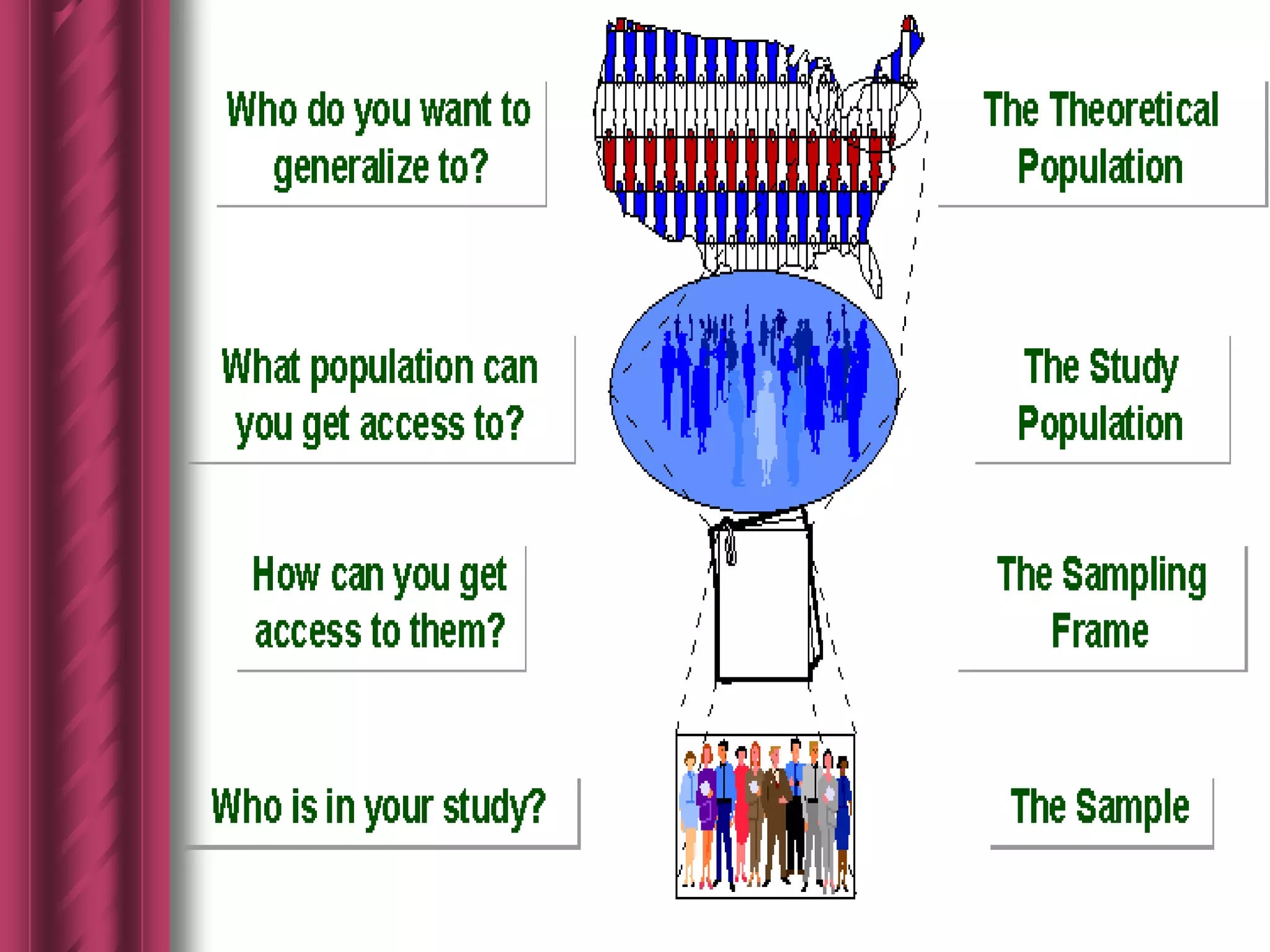
What is your population of interest?
To whom do you want to generalize your
results?
All doctors
School children
Indians
Women aged 15-45 years
Other
Can you sample the entire population?
Why sampling?
Get information about large populations
 Less costs
 Less field time
 More accuracy i.e. Can Do A Better Job of
Data Collection
 When it’s impossible to study the whole
population
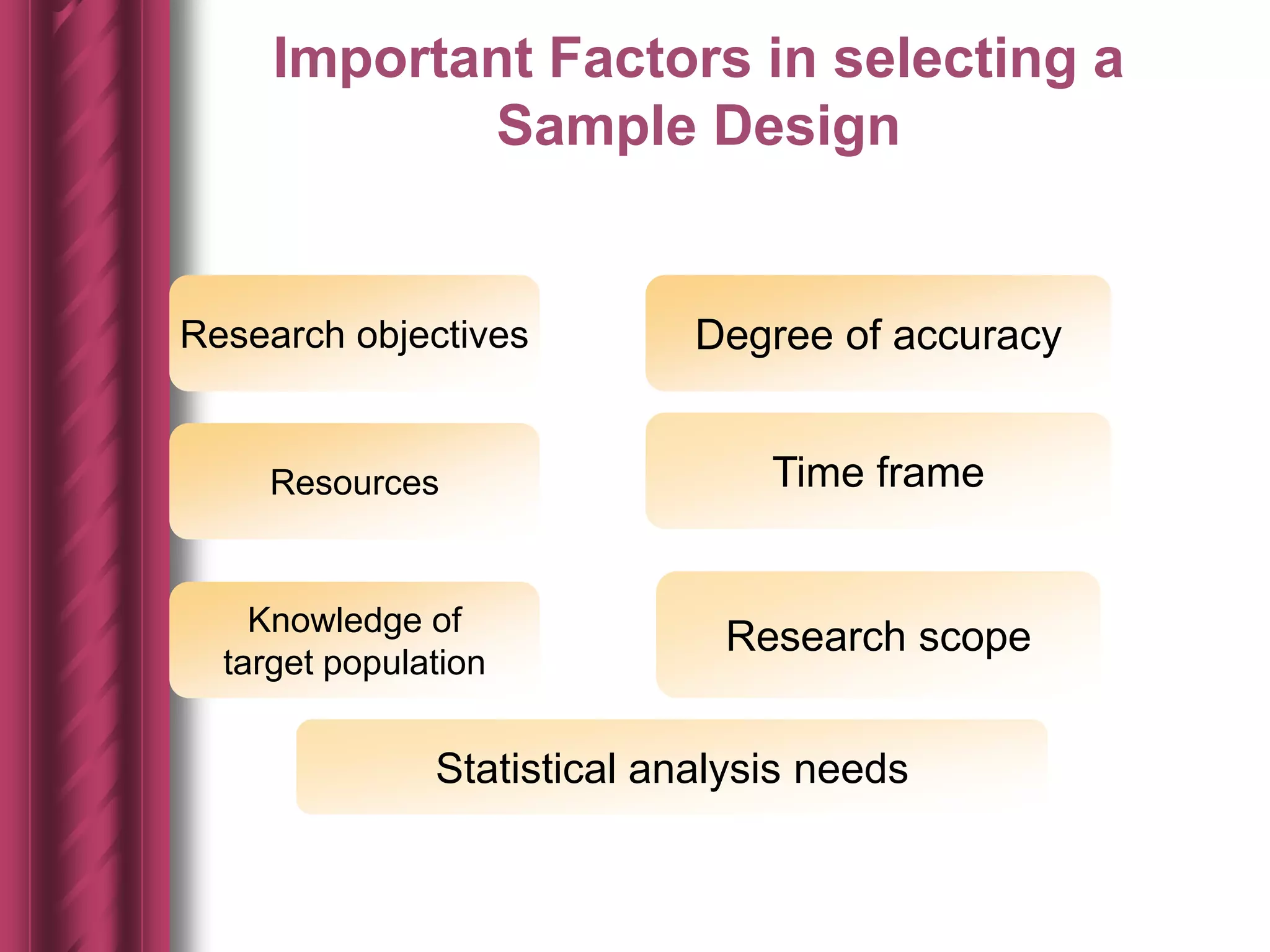
Important Factors in selecting a
Sample Design
Research objectives Degree of accuracy
Time frame
Research scope
Statistical analysis needs
Resources
Knowledge of
target population
Common Methods:
– Budget/time available
– Executive decision
– Statistical methods
– Historical data/guidelines
Common Methods for Determining
Sample Size
 How many completed questionnaires do we need
to have a representative sample?
 Generally the larger the better, but that takes
more time and money.
 Answer depends on:
– How different or dispersed the population is.
– Desired level of confidence.
– Desired degree of accuracy.
Determining Sample Size
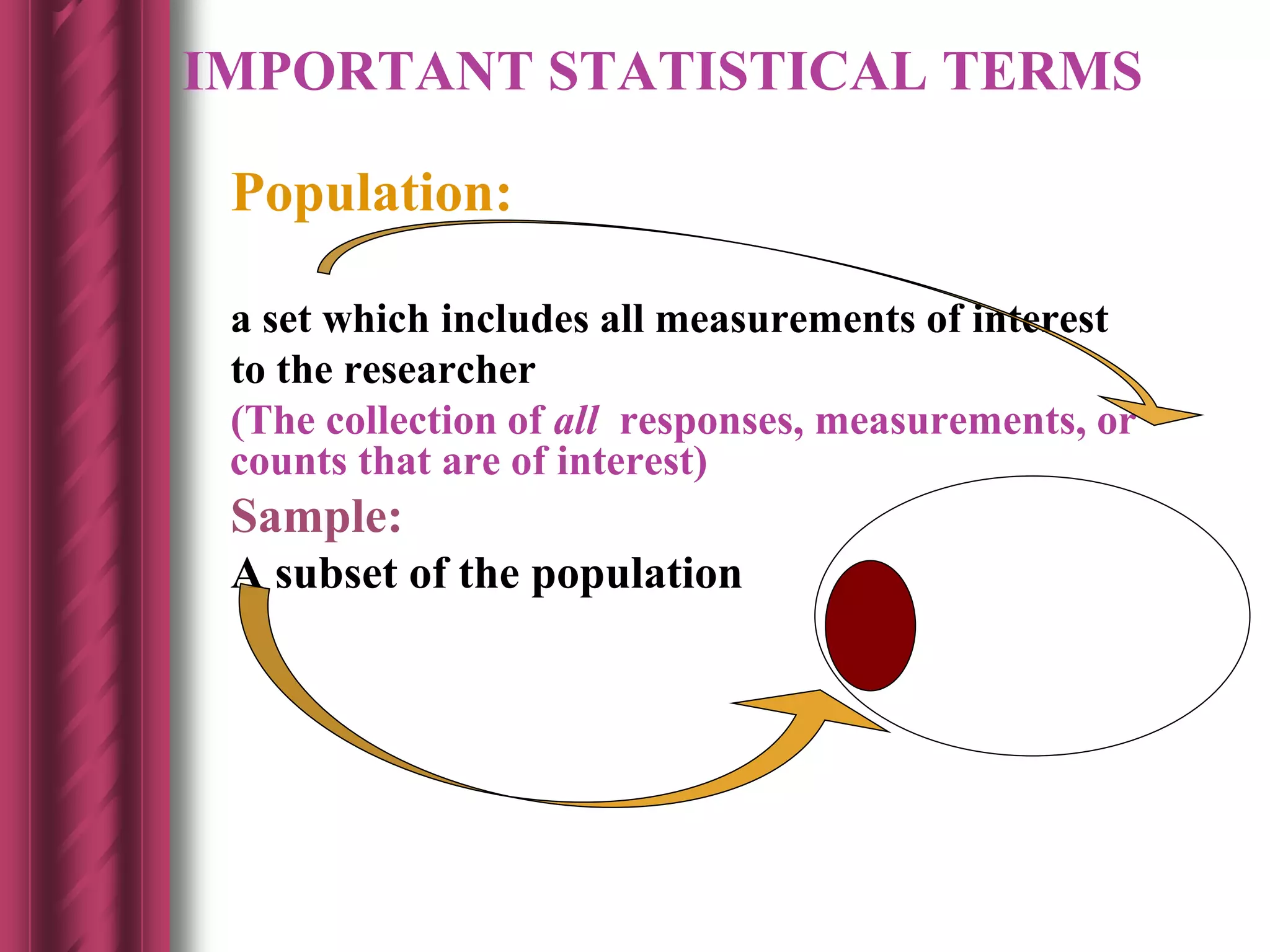
IMPORTANT STATISTICAL TERMS
Population:
a set which includes all measurements of interest
to the researcher
(The collection of all responses, measurements, or
counts that are of interest)
Sample:
A subset of the population
Sampling Frame
 A list of population elements (people, companies,
houses, cities, etc.) from which units to be sampled can
be selected.
 Difficult to get an accurate list.
 Sample frame error occurs when certain elements of
the population are accidentally omitted or not
included on the list.
 See Survey Sampling like HIES PDHS, PSLM, MICS
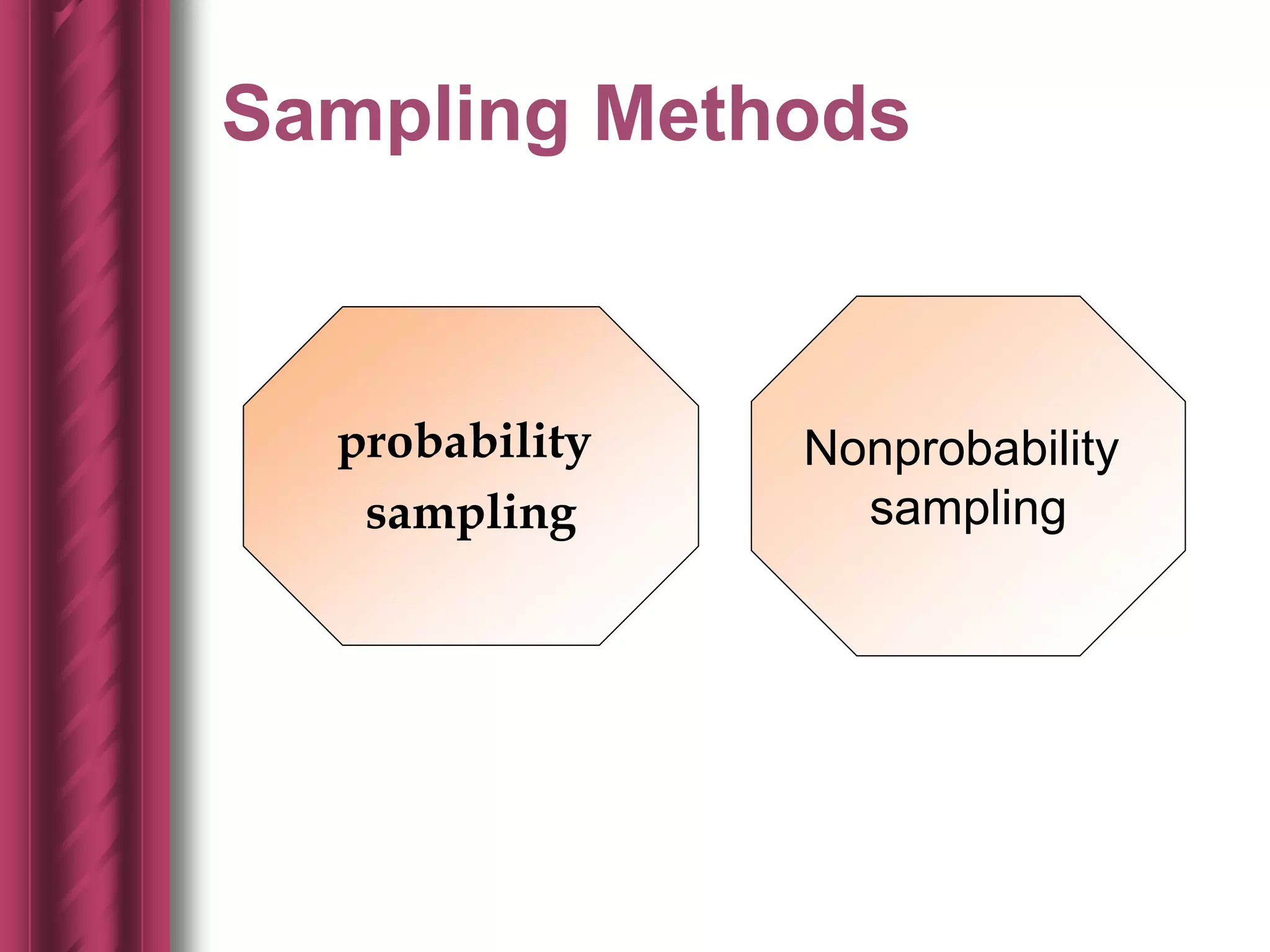
Sampling Methods
probability
sampling
Nonprobability
sampling
Probability Sampling
 A probability sampling scheme is one in
which every unit in the population has a
chance (greater than zero) of being selected in
the sample, and this probability can be
accurately determined.
Non-Probability Sampling
 Non probability sampling is any sampling
method where some elements of the population
have no chance of selection (these are sometimes
referred to as 'out of coverage‘ / 'under
covered'), or where the probability of selection
can't be accurately determined.
 It involves the selection of elements based on
assumptions regarding the population of
interest, which forms the criteria for selection.
Types of Sampling Methods
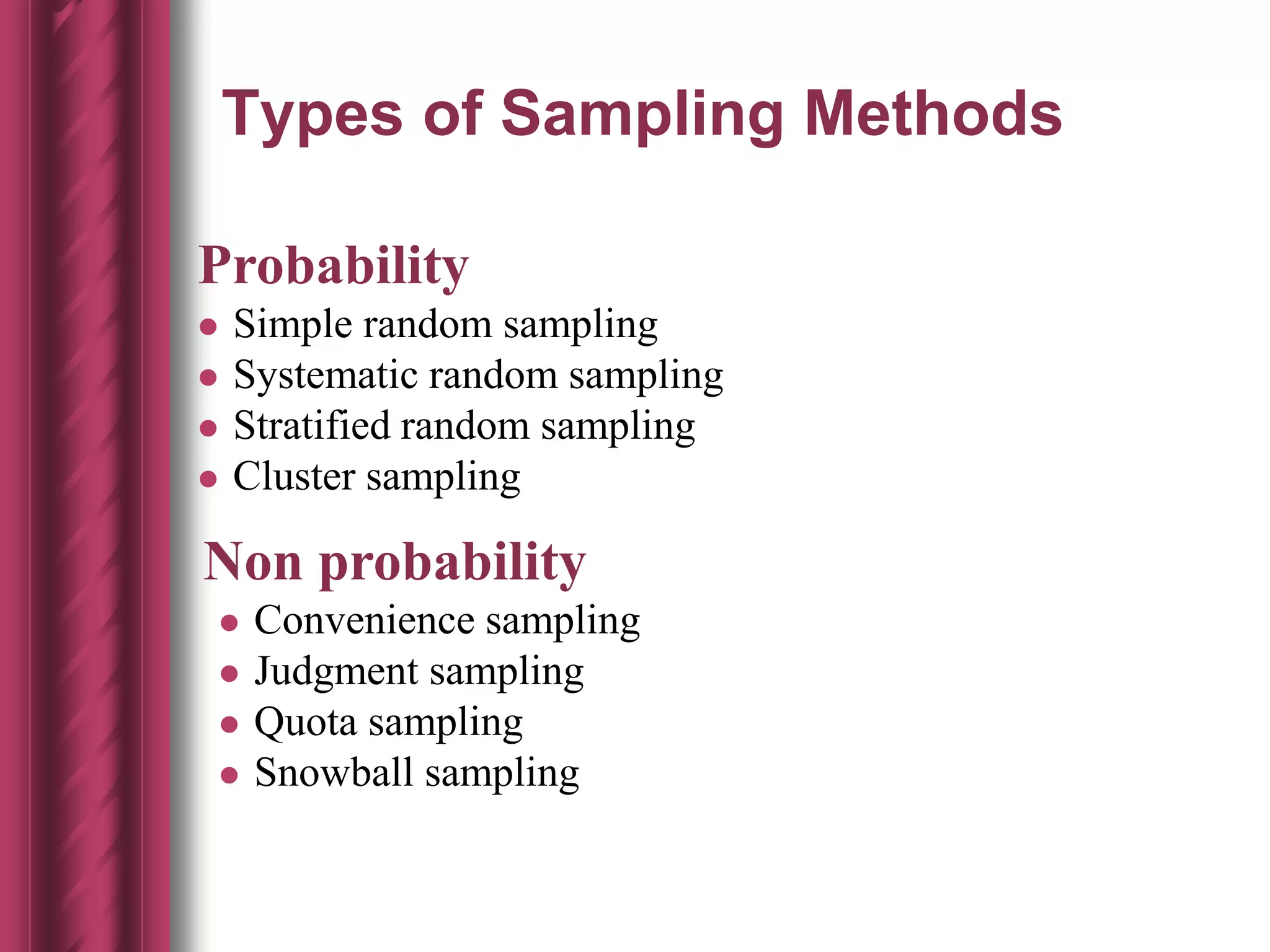
Probability
 Simple random sampling
 Systematic random sampling
 Stratified random sampling
 Cluster sampling
Non probability
 Convenience sampling
 Judgment sampling
 Quota sampling
 Snowball sampling
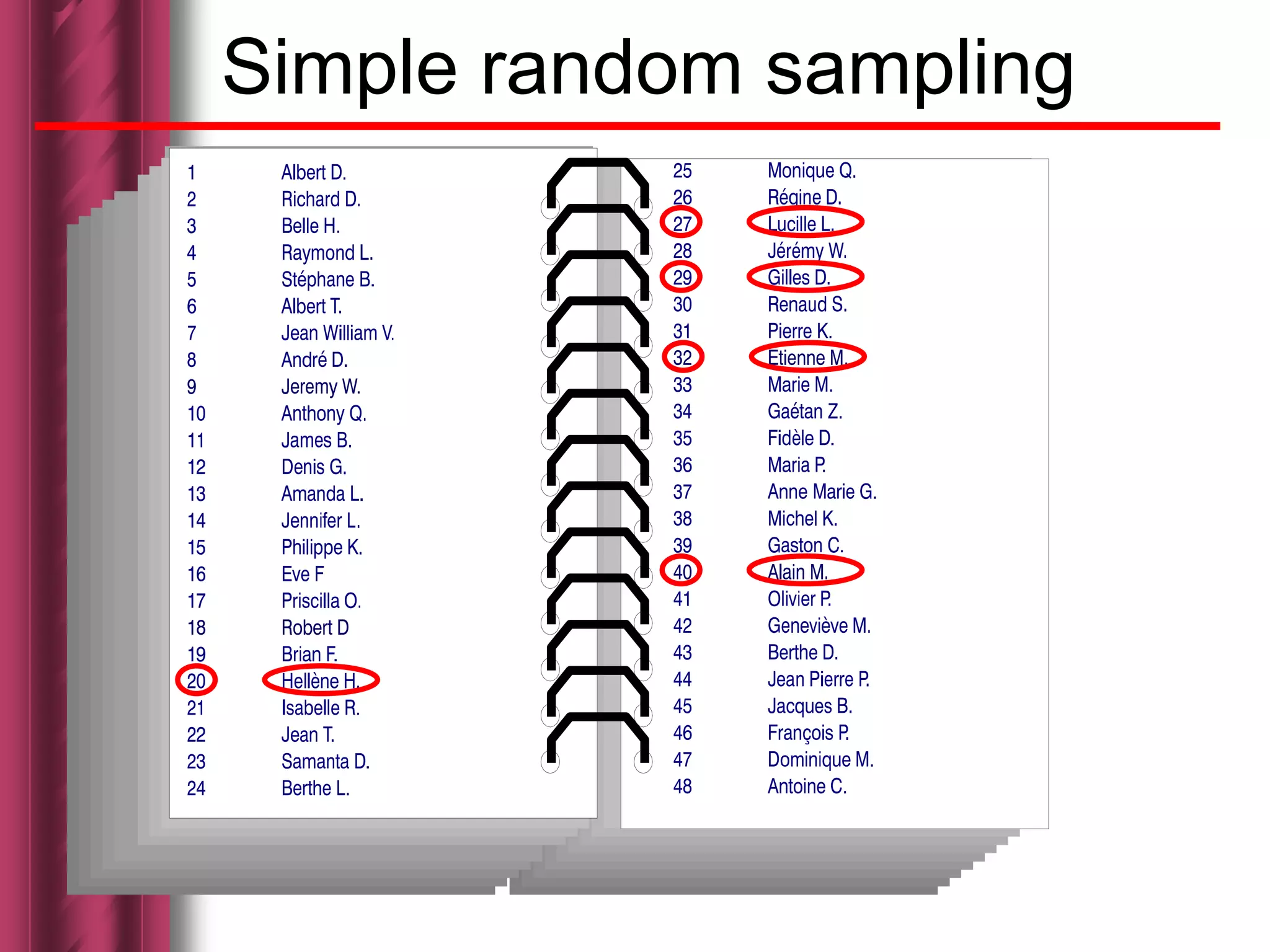
Simple Random Sampling
Simple random sampling is a method of
probability sampling in which every unit has
an equal non zero chance of being selected
Simple random sampling
Systematic Random Sampling
Systematic random sampling is a
method of probability sampling in
which the defined target population is
ordered and the sample is selected
according to position using a skip
interval
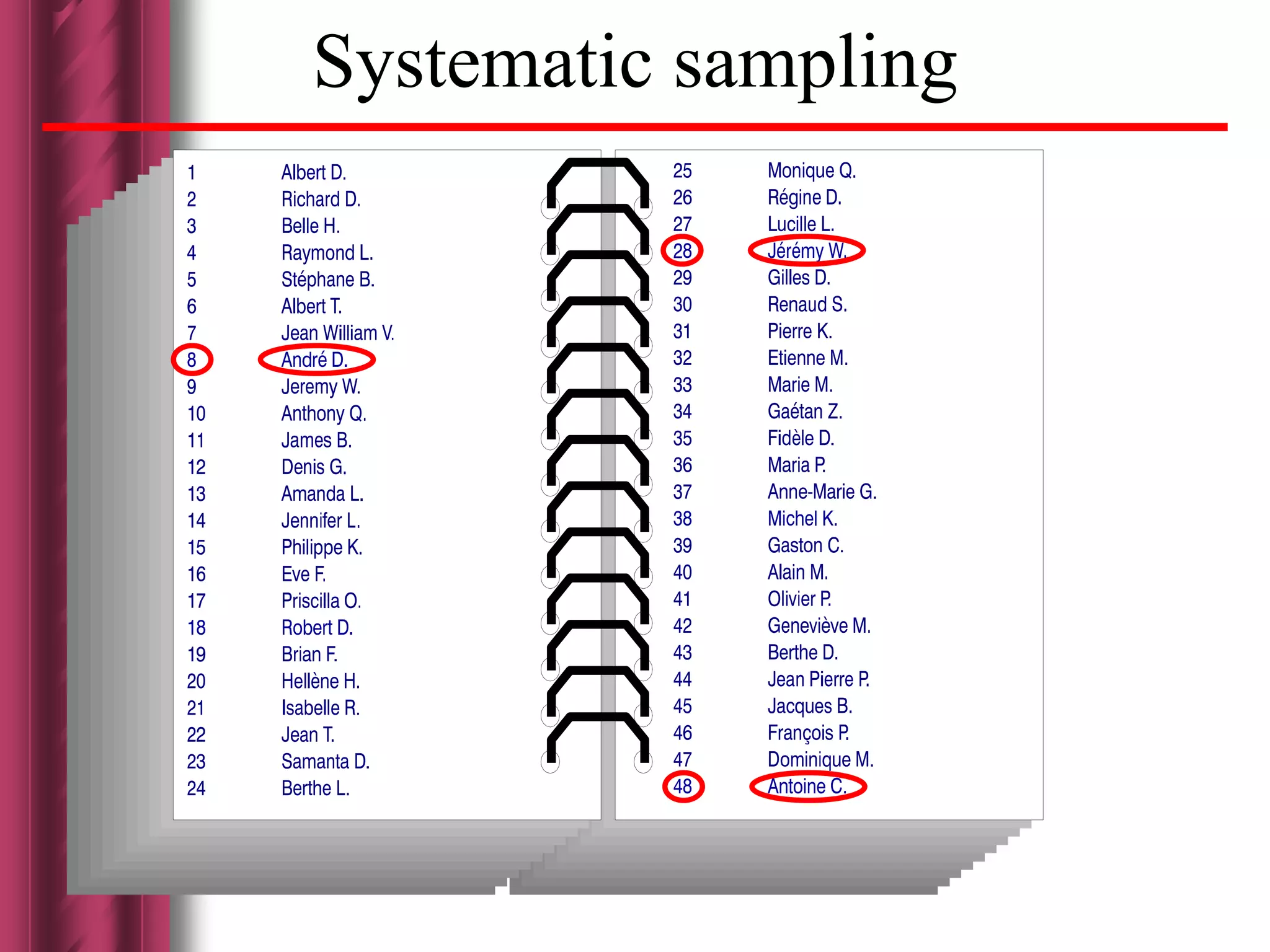
Steps in Drawing a Systematic Random
Sample
 1: Obtain a list of units that contains an acceptable frame of
the target population
 2: Determine the number of units in the list and the desired
sample size
 3: Compute the skip interval
 4: Determine a random start point
 5: Beginning at the start point, select the units by choosing
each unit that corresponds to the skip interval
Systematic sampling
Stratified Random Sampling
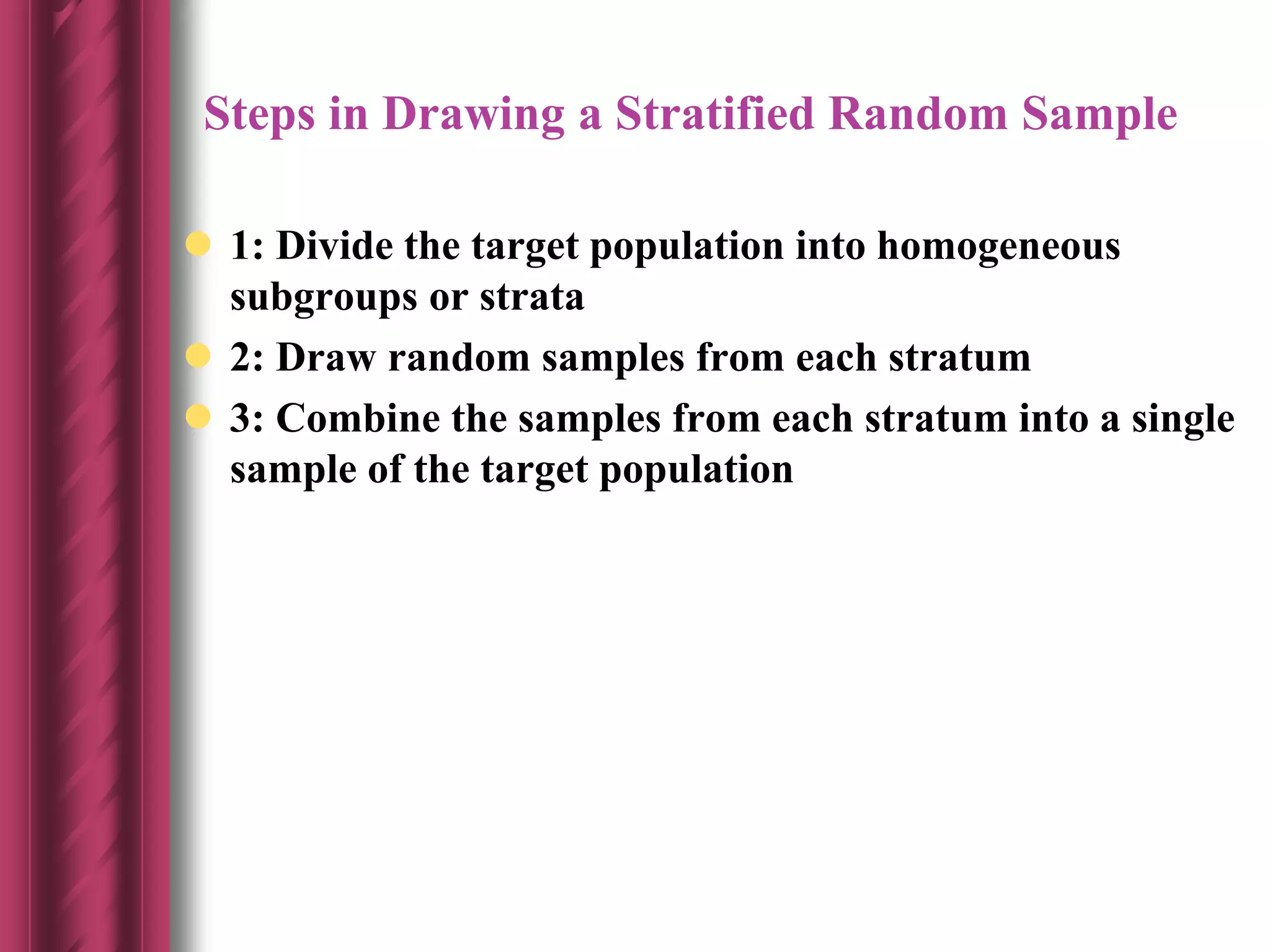
Stratified random sampling is a method of probability
sampling in which the population is divided into
different subgroups and samples are selected from each.
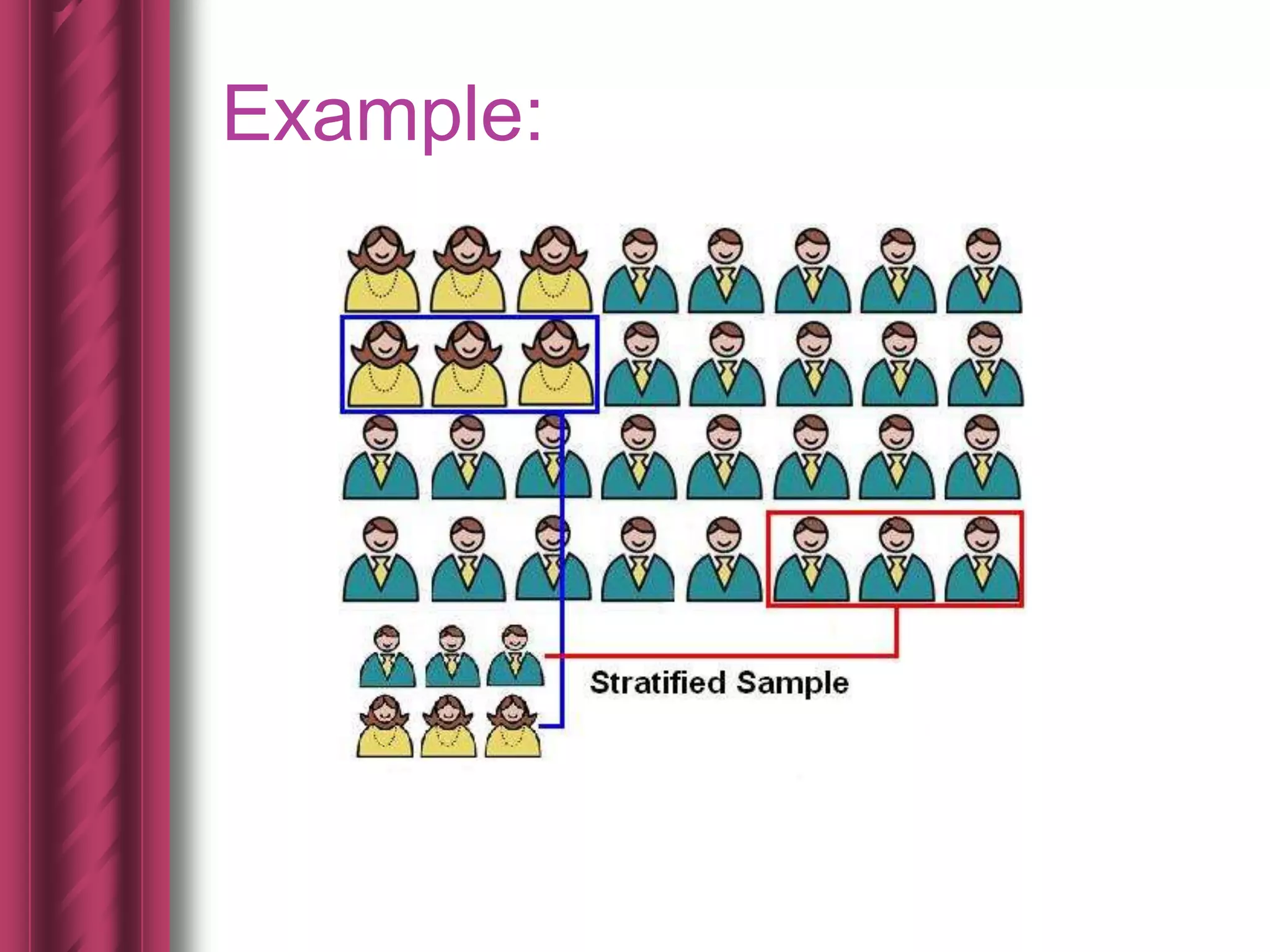
Steps in Drawing a Stratified Random Sample
 1: Divide the target population into homogeneous
subgroups or strata
 2: Draw random samples from each stratum
 3: Combine the samples from each stratum into a single
sample of the target population
Example:
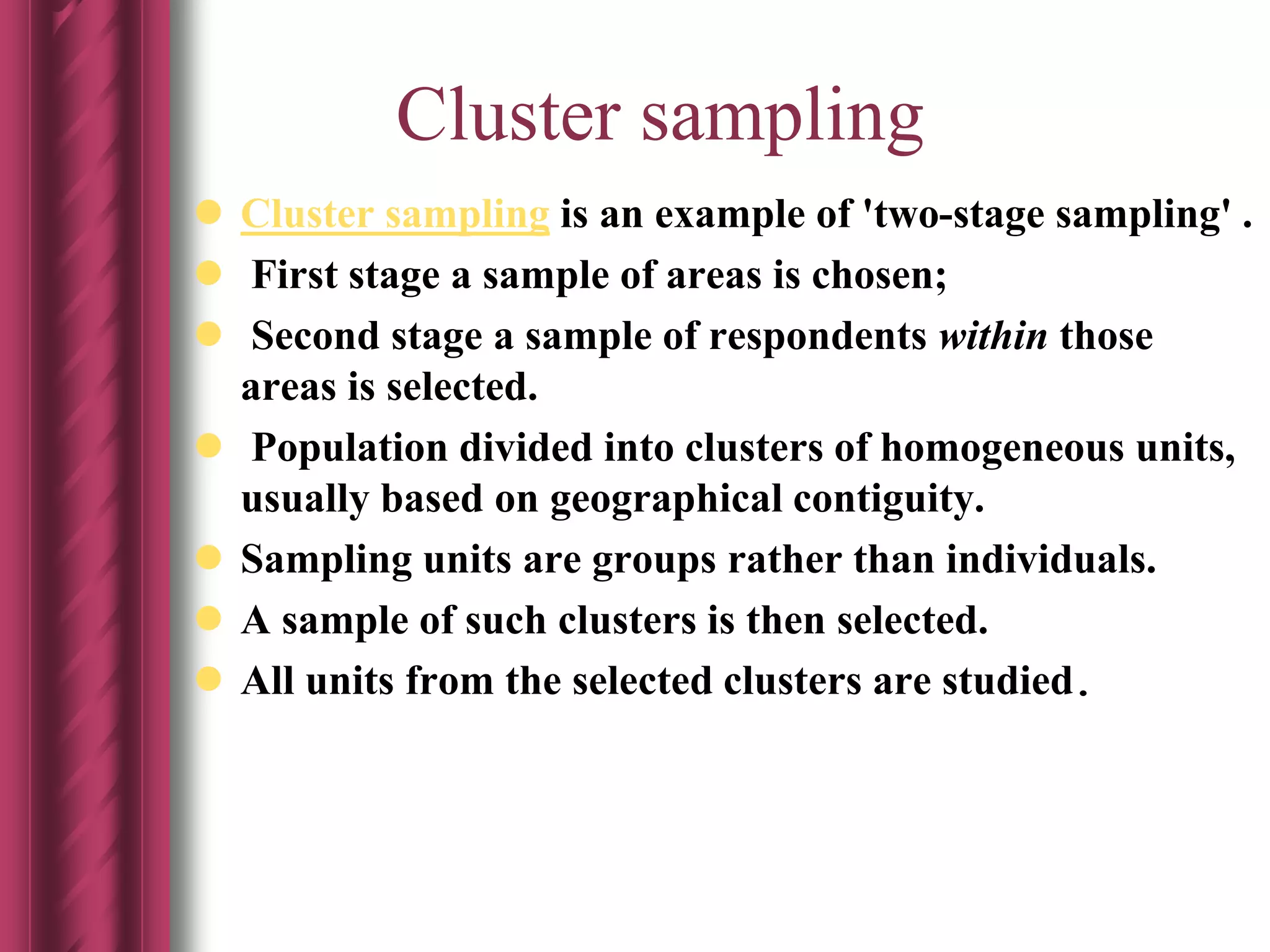
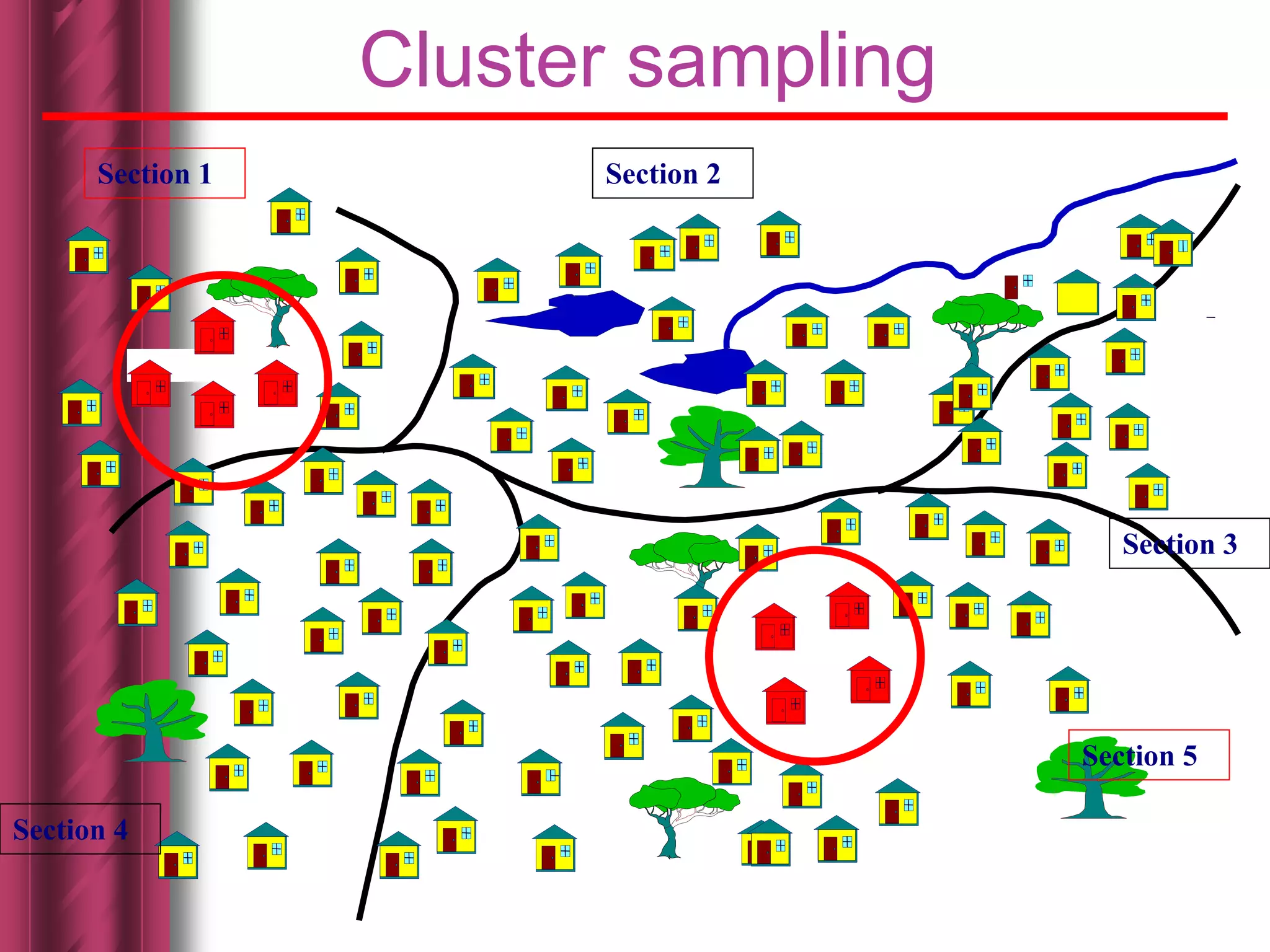
Cluster sampling
 Cluster sampling is an example of 'two-stage sampling' .
 First stage a sample of areas is chosen;
 Second stage a sample of respondents within those
areas is selected.
 Population divided into clusters of homogeneous units,
usually based on geographical contiguity.
 Sampling units are groups rather than individuals.
 A sample of such clusters is then selected.
 All units from the selected clusters are studied.
Cluster sampling
Section 4
Section 5
Section 3
Section 2Section 1
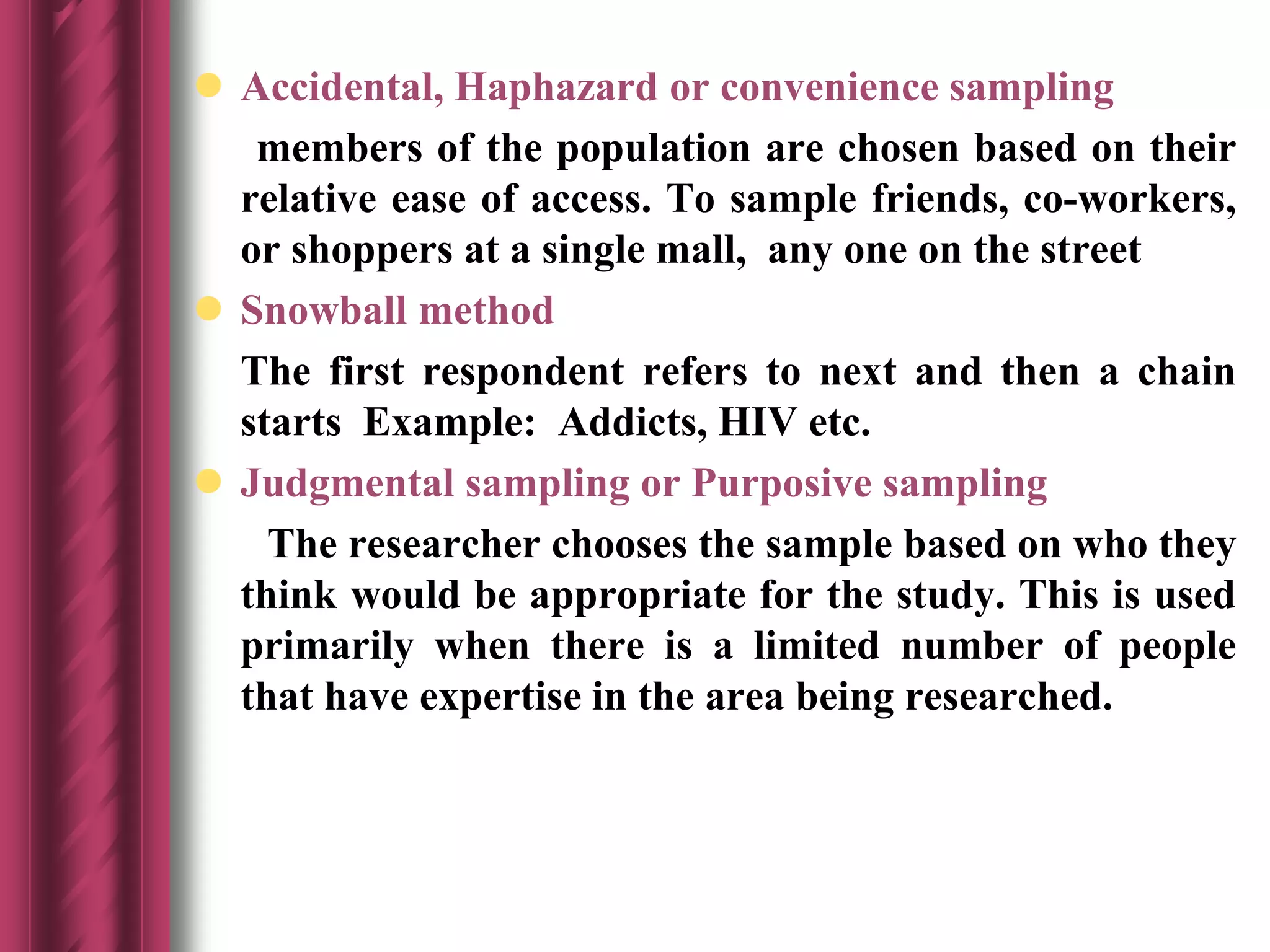
 Accidental, Haphazard or convenience sampling
members of the population are chosen based on their
relative ease of access. To sample friends, co-workers,
or shoppers at a single mall, any one on the street
 Snowball method
The first respondent refers to next and then a chain
starts Example: Addicts, HIV etc.
 Judgmental sampling or Purposive sampling
The researcher chooses the sample based on who they
think would be appropriate for the study. This is used
primarily when there is a limited number of people
that have expertise in the area being researched.
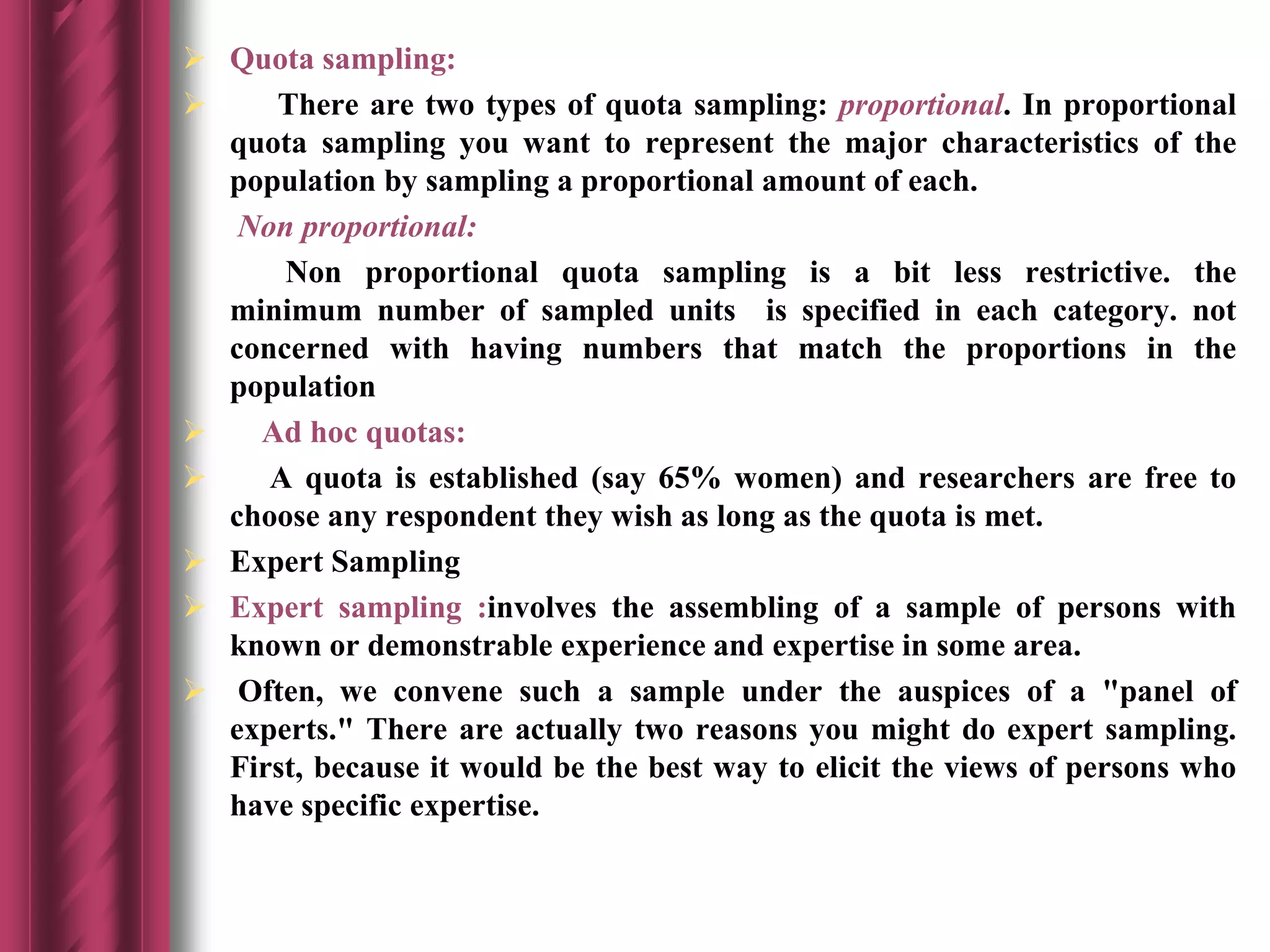
 Quota sampling:
 There are two types of quota sampling: proportional. In proportional
quota sampling you want to represent the major characteristics of the
population by sampling a proportional amount of each.
Non proportional:
Non proportional quota sampling is a bit less restrictive. the
minimum number of sampled units is specified in each category. not
concerned with having numbers that match the proportions in the
population
 Ad hoc quotas:
 A quota is established (say 65% women) and researchers are free to
choose any respondent they wish as long as the quota is met.
 Expert Sampling
 Expert sampling :involves the assembling of a sample of persons with
known or demonstrable experience and expertise in some area.
 Often, we convene such a sample under the auspices of a "panel of
experts." There are actually two reasons you might do expert sampling.
First, because it would be the best way to elicit the views of persons who
have specific expertise.
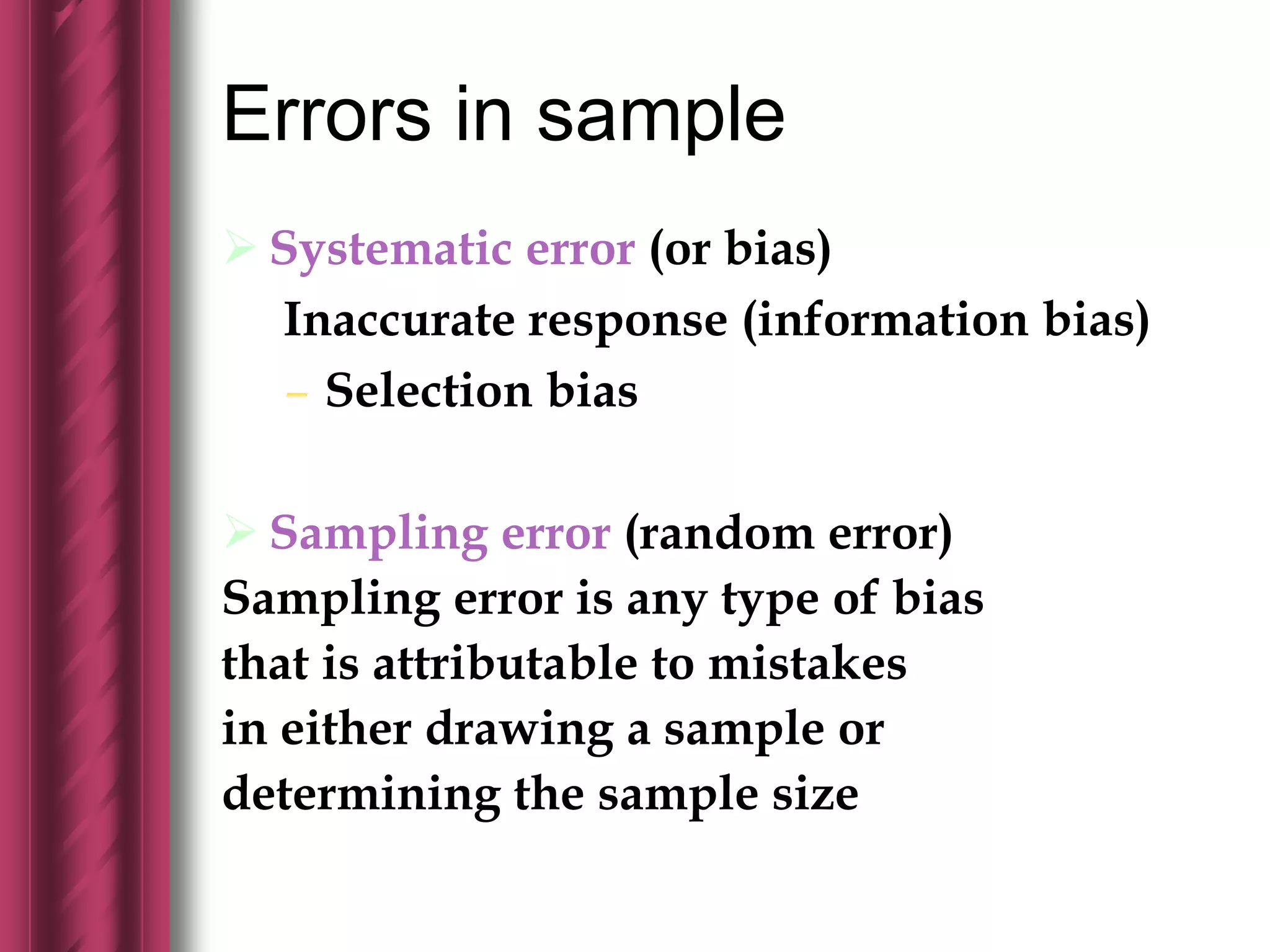
Errors in sample
 Systematic error (or bias)
Inaccurate response (information bias)
– Selection bias
 Sampling error (random error)
Sampling error is any type of bias
that is attributable to mistakes
in either drawing a sample or
determining the sample size
Type-I Error
The probability of finding a difference
with our sample compared to
population, and there really isn’t one….
Known as the α (or “type 1 error”)
Usually set at 5% (or 0.05)
Type-II Error
The probability of not finding a
difference that actually exists between
our sample compared to the
population…
Known as the β (or “type 2 error”)
Power is (1- β) and is usually 80%
Factors Affecting Sample Size for
Probability Designs
 Variability of the population characteristic under
investigation
 Level of confidence desired in the estimate
 Degree of precision desired in estimating the
population characteristic
Comparison b/w Probability and
Nonprobability Sampling
 The difference between nonprobability and probability
sampling is that nonprobability sampling does not
involve random selection and probability sampling
does.
 Nonprobability sampling techniques cannot be used to
infer from the sample to the general population.
 Any generalizations obtained from a nonprobability
sample must be filtered through one's knowledge of
the topic being studied.
 Performing nonprobability sampling is considerably
less expensive than doing probability sampling, but the
results are of limited value.
 When estimating a population mean
n = (Z2
B,CL)(σ2/e2)
 n estimates of a population proportion are of
concern
n = (Z2
B,CL)([P x Q]/e2)
Probability Sampling and Sample Sizes
Probability Sampling Advantages
Less prone to bias
Allows estimation of magnitude of
sampling error, from which you can
determine the statistical significance
of changes/differences in indicators
Probability Sampling Disadvantages
Requires that you have a list of all
sample elements
 More time-consuming
More costly
 No advantage when small numbers
of elements are to be chosen
Non Probability Sampling Advantages
More flexible
Less costly
 Less time-consuming
 Judgmentally representative
samples may be preferred when
small numbers of elements are to be
chosen.
Non Probability Sampling
Disadvantages
Greater risk of bias
May not be possible to generalize
to program target population
 Subjectivity can make it difficult to
measure changes in indicators
overtime
 No way to assess precision or
reliability of data
Sampling techniques
Sampling techniques

Sampling techniques

  • 1.
  • 2.
    Outlines:  Explain therole of sampling in the research process  Distinguish between probability and non probability sampling  Understand the factors to consider when determining sample size  Understand the steps in developing a sampling plan
  • 3.
    What is Sampling? Sampling is the procedure a researcher uses to gather people, places, or things to study.  Samples are always subsets or small parts of the total number that could be studied.  Sampling is the process of selecting a small number of elements from a larger defined target group of elements such that the information gathered from the small group will allow judgments to be made about the larger groups
  • 4.
    What is yourpopulation of interest? To whom do you want to generalize your results? All doctors School children Indians Women aged 15-45 years Other Can you sample the entire population?
  • 6.
    Why sampling? Get informationabout large populations  Less costs  Less field time  More accuracy i.e. Can Do A Better Job of Data Collection  When it’s impossible to study the whole population
  • 7.
    Important Factors inselecting a Sample Design Research objectives Degree of accuracy Time frame Research scope Statistical analysis needs Resources Knowledge of target population
  • 8.
    Common Methods: – Budget/timeavailable – Executive decision – Statistical methods – Historical data/guidelines Common Methods for Determining Sample Size
  • 9.
     How manycompleted questionnaires do we need to have a representative sample?  Generally the larger the better, but that takes more time and money.  Answer depends on: – How different or dispersed the population is. – Desired level of confidence. – Desired degree of accuracy. Determining Sample Size
  • 10.
    IMPORTANT STATISTICAL TERMS Population: aset which includes all measurements of interest to the researcher (The collection of all responses, measurements, or counts that are of interest) Sample: A subset of the population
  • 11.
    Sampling Frame  Alist of population elements (people, companies, houses, cities, etc.) from which units to be sampled can be selected.  Difficult to get an accurate list.  Sample frame error occurs when certain elements of the population are accidentally omitted or not included on the list.  See Survey Sampling like HIES PDHS, PSLM, MICS
  • 12.
  • 13.
    Probability Sampling  Aprobability sampling scheme is one in which every unit in the population has a chance (greater than zero) of being selected in the sample, and this probability can be accurately determined.
  • 14.
    Non-Probability Sampling  Nonprobability sampling is any sampling method where some elements of the population have no chance of selection (these are sometimes referred to as 'out of coverage‘ / 'under covered'), or where the probability of selection can't be accurately determined.  It involves the selection of elements based on assumptions regarding the population of interest, which forms the criteria for selection.
  • 15.
    Types of SamplingMethods Probability  Simple random sampling  Systematic random sampling  Stratified random sampling  Cluster sampling Non probability  Convenience sampling  Judgment sampling  Quota sampling  Snowball sampling
  • 16.
    Simple Random Sampling Simplerandom sampling is a method of probability sampling in which every unit has an equal non zero chance of being selected
  • 17.
  • 18.
    Systematic Random Sampling Systematicrandom sampling is a method of probability sampling in which the defined target population is ordered and the sample is selected according to position using a skip interval
  • 19.
    Steps in Drawinga Systematic Random Sample  1: Obtain a list of units that contains an acceptable frame of the target population  2: Determine the number of units in the list and the desired sample size  3: Compute the skip interval  4: Determine a random start point  5: Beginning at the start point, select the units by choosing each unit that corresponds to the skip interval
  • 20.
  • 21.
    Stratified Random Sampling Stratifiedrandom sampling is a method of probability sampling in which the population is divided into different subgroups and samples are selected from each.
  • 22.
    Steps in Drawinga Stratified Random Sample  1: Divide the target population into homogeneous subgroups or strata  2: Draw random samples from each stratum  3: Combine the samples from each stratum into a single sample of the target population
  • 23.
  • 24.
    Cluster sampling  Clustersampling is an example of 'two-stage sampling' .  First stage a sample of areas is chosen;  Second stage a sample of respondents within those areas is selected.  Population divided into clusters of homogeneous units, usually based on geographical contiguity.  Sampling units are groups rather than individuals.  A sample of such clusters is then selected.  All units from the selected clusters are studied.
  • 25.
    Cluster sampling Section 4 Section5 Section 3 Section 2Section 1
  • 26.
     Accidental, Haphazardor convenience sampling members of the population are chosen based on their relative ease of access. To sample friends, co-workers, or shoppers at a single mall, any one on the street  Snowball method The first respondent refers to next and then a chain starts Example: Addicts, HIV etc.  Judgmental sampling or Purposive sampling The researcher chooses the sample based on who they think would be appropriate for the study. This is used primarily when there is a limited number of people that have expertise in the area being researched.
  • 27.
     Quota sampling: There are two types of quota sampling: proportional. In proportional quota sampling you want to represent the major characteristics of the population by sampling a proportional amount of each. Non proportional: Non proportional quota sampling is a bit less restrictive. the minimum number of sampled units is specified in each category. not concerned with having numbers that match the proportions in the population  Ad hoc quotas:  A quota is established (say 65% women) and researchers are free to choose any respondent they wish as long as the quota is met.  Expert Sampling  Expert sampling :involves the assembling of a sample of persons with known or demonstrable experience and expertise in some area.  Often, we convene such a sample under the auspices of a "panel of experts." There are actually two reasons you might do expert sampling. First, because it would be the best way to elicit the views of persons who have specific expertise.
  • 28.
    Errors in sample Systematic error (or bias) Inaccurate response (information bias) – Selection bias  Sampling error (random error) Sampling error is any type of bias that is attributable to mistakes in either drawing a sample or determining the sample size
  • 29.
    Type-I Error The probabilityof finding a difference with our sample compared to population, and there really isn’t one…. Known as the α (or “type 1 error”) Usually set at 5% (or 0.05)
  • 30.
    Type-II Error The probabilityof not finding a difference that actually exists between our sample compared to the population… Known as the β (or “type 2 error”) Power is (1- β) and is usually 80%
  • 31.
    Factors Affecting SampleSize for Probability Designs  Variability of the population characteristic under investigation  Level of confidence desired in the estimate  Degree of precision desired in estimating the population characteristic
  • 32.
    Comparison b/w Probabilityand Nonprobability Sampling  The difference between nonprobability and probability sampling is that nonprobability sampling does not involve random selection and probability sampling does.  Nonprobability sampling techniques cannot be used to infer from the sample to the general population.  Any generalizations obtained from a nonprobability sample must be filtered through one's knowledge of the topic being studied.  Performing nonprobability sampling is considerably less expensive than doing probability sampling, but the results are of limited value.
  • 33.
     When estimatinga population mean n = (Z2 B,CL)(σ2/e2)  n estimates of a population proportion are of concern n = (Z2 B,CL)([P x Q]/e2) Probability Sampling and Sample Sizes
  • 34.
    Probability Sampling Advantages Lessprone to bias Allows estimation of magnitude of sampling error, from which you can determine the statistical significance of changes/differences in indicators
  • 35.
    Probability Sampling Disadvantages Requiresthat you have a list of all sample elements  More time-consuming More costly  No advantage when small numbers of elements are to be chosen
  • 36.
    Non Probability SamplingAdvantages More flexible Less costly  Less time-consuming  Judgmentally representative samples may be preferred when small numbers of elements are to be chosen.
  • 37.
    Non Probability Sampling Disadvantages Greaterrisk of bias May not be possible to generalize to program target population  Subjectivity can make it difficult to measure changes in indicators overtime  No way to assess precision or reliability of data