GUIDED BY:
Dr. M. R. PATEL
Principale & HOD in
pharmaceutics

PRESENTEDE BY:

SAHILHUSEN I . JETHARA
M. PHARM – I (2013-14)
ROLL NO. - 02

DEPARTMENT OF PHARMACEUTICS
SHRI B. M. SHAH COLLEGE OF PHARMACEUTICAL EDUCATION
2/21/2014
1
AND REASERCH, MODASA-2013 SHRI B.M.C.P.E.R, MODASA
CONTENTS
ď‚— UTILITY SERVICES
ď‚— SERVICE FACILITIES
ď‚— HVAC

INRODUCTION
ROLE IN PHARMACEUTICAL INDUSTRY
LEVEL OF PROTECTION
COMPONENTS
FILTER CLASSES
AIR FLOW PATTERNS
VALIDATION AND QUALIFICATION
ď‚— PERSONNEL FACILITIES
2/21/2014

SHRI B.M.C.P.E.R, MODASA

2
UTILITY SERVICES
1.
2.
3.
4.
5.
6.
7.

8.

2/21/2014

HVAC
PLUMBING
DRAINAGE SYSTEM
GAS SYSTEM
SANITATION
WATER FOR PHARMACEUTICAL USE
FIRE PROTECTION SYSTEM
Services used by a factory include compressed gases, water,
vacuum, electricity and room air conditioning
SHRI B.M.C.P.E.R, MODASA

3
1.HVAC: (The Heating, Ventilating, and Air conditioning)
2.PLUMBING:
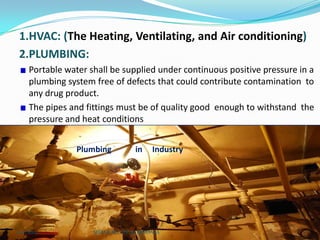
Portable water shall be supplied under continuous positive pressure in a
plumbing system free of defects that could contribute contamination to
any drug product.
The pipes and fittings must be of quality good enough to withstand the
pressure and heat conditions
Plumbing

2/21/2014

in

Industry

SHRI B.M.C.P.E.R, MODASA

4
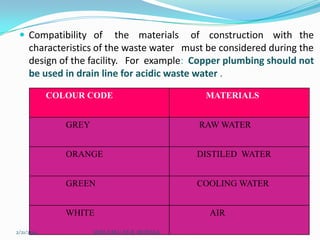
ď‚— Compatibility of

the materials of construction with the
characteristics of the waste water must be considered during the
design of the facility. For example: Copper plumbing should not
be used in drain line for acidic waste water .
COLOUR CODE

MATERIALS

GREY

RAW WATER

ORANGE

DISTILED WATER

GREEN

COOLING WATER

WHITE
2/21/2014

SHRI B.M.C.P.E.R, MODASA

AIR
5
ď‚—
ď‚—
ď‚—
ď‚—
ď‚—

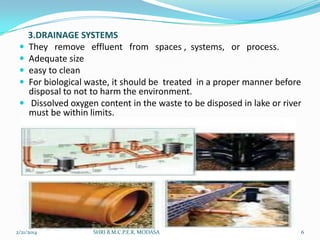
3.DRAINAGE SYSTEMS
They remove effluent from spaces , systems, or process.
Adequate size
easy to clean
For biological waste, it should be treated in a proper manner before
disposal to not to harm the environment.
Dissolved oxygen content in the waste to be disposed in lake or river
must be within limits.

2/21/2014

SHRI B.M.C.P.E.R, MODASA

6
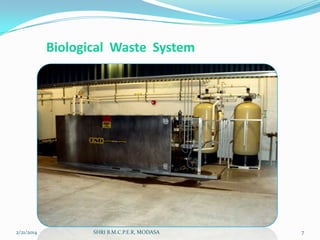
Biological Waste System

2/21/2014

SHRI B.M.C.P.E.R, MODASA

7
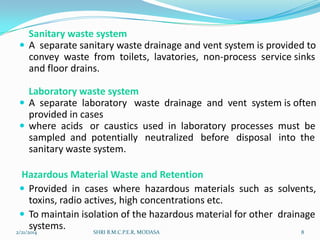
Sanitary waste system
ď‚— A separate sanitary waste drainage and vent system is provided to
convey waste from toilets, lavatories, non-process service sinks
and floor drains.
Laboratory waste system
ď‚— A separate laboratory waste drainage and vent system is often
provided in cases
ď‚— where acids or caustics used in laboratory processes must be
sampled and potentially neutralized before disposal into the
sanitary waste system.
Hazardous Material Waste and Retention
ď‚— Provided in cases where hazardous materials such as solvents,
toxins, radio actives, high concentrations etc.
ď‚— To maintain isolation of the hazardous material for other drainage
systems.
2/21/2014
SHRI B.M.C.P.E.R, MODASA
8
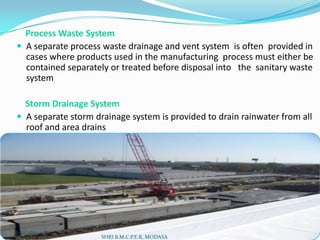
Process Waste System
ď‚— A separate process waste drainage and vent system is often provided in
cases where products used in the manufacturing process must either be
contained separately or treated before disposal into the sanitary waste
system
Storm Drainage System
ď‚— A separate storm drainage system is provided to drain rainwater from all
roof and area drains

2/21/2014

SHRI B.M.C.P.E.R, MODASA

9
4.GAS SYSTEMS
ď‚— All gases used in manufacturing and processing operations, including the
sterilization process
Compressed Air
 In general compressed air should be supplied by an “oil- free” type
compressor and
ď‚— must be free of oil and oil vapour unless vented directly to a noncontrolled environment area.
ď‚— It should also be dehumidified to prevent condensation of water vapour.
Breathing Air
ď‚— Breathing air is generally provided for use to personnel working in
hazardous environment.
ď‚— Provided centrally through a breathing air distribution system or at the
local level with “backpack” type breathing air units worn by each person.
2/21/2014

SHRI B.M.C.P.E.R, MODASA

10
Nitrogen
ď‚— Used for the purging of electrical equipment in volatile or explosive
environments
vacuum
ď‚— Vacuum is utilized in the encapsulation and tablet compression
areas.
Vacuum Cleaning
ď‚— For dry particulate and powder pickup

2/21/2014

SHRI B.M.C.P.E.R, MODASA

11
5. SANITATION IN THE MANUFACTURING PREMISES

ď‚—
ď‚—
ď‚—
ď‚—
ď‚—

Objectives
Removal of dirt and other waste material;
Minimize the risk of cross contamination between different products in the
same area;
Reduce the number of micro-organisms in work area;
Control pests so that these do not affect the quality of materials to be used
in the manufacture of drugs.
Cleaning procedure to be followed, including equipment and materials to
be used for cleaning.

CLEANING AGENTS AND DISINFECTANTS:
ď‚— Cleaning agents help to remove extraneous materials from surfaces.
ď‚— Disinfectants destroy pathogenic and other micro organisms and are used
to reduce microbial count in manufacturing area.
12
2/21/2014

SHRI B.M.C.P.E.R, MODASA
6.WATER FOR PHARMACEUTICAL USE
ď‚— Water is most widely used material in pharmaceutical manufacturing.
A greater volume of water is used in cleaning and rinsing processes than
in formulation in most facilities. Regardless of the water volume used in
actual drug formulation all pharmaceutical water is subject to cGMPs
even when the water does not remain in the finished product.
WATER QUALITY REQUIREMENTS
ď‚— The types of water defined in the pharmacopoeial monographs such as

Purified Water and Water for Injection (WFI) are known as compendial
waters.
ď‚— Other quality waters used in manufacturing, not defined by USP or other
recognized compendia are known as non-compendial waters.
2/21/2014

SHRI B.M.C.P.E.R, MODASA

13
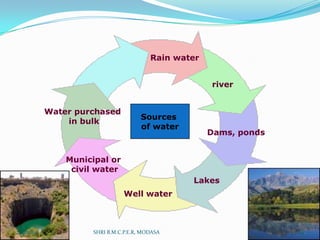
Rain water

river
Water purchased
in bulk

Sources
of water

Dams, ponds

Municipal or
civil water
Lakes

Well water

2/21/2014

SHRI B.M.C.P.E.R, MODASA

14
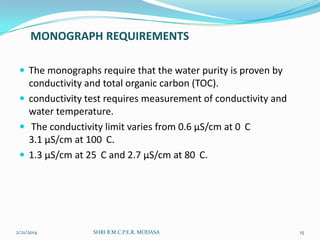
MONOGRAPH REQUIREMENTS
ď‚— The monographs require that the water purity is proven by

conductivity and total organic carbon (TOC).
ď‚— conductivity test requires measurement of conductivity and
water temperature.
 The conductivity limit varies from 0.6 µS/cm at 0 C
3.1 µS/cm at 100 C.
 1.3 µS/cm at 25 C and 2.7 µS/cm at 80 C.

2/21/2014

SHRI B.M.C.P.E.R, MODASA

15
7.FIRE PROTECTION SYSTEMS
ď‚— Pharmaceutical manufacturing facilities are with

typically
provided with automatic fire suppression and protection system
throghout.

ď‚— The provision of specific suppresion and protection throughout

the facility might be the
requirement.

2/21/2014

SHRI B.M.C.P.E.R, MODASA

consequence of a strict code

16
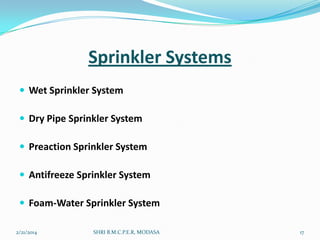
Sprinkler Systems
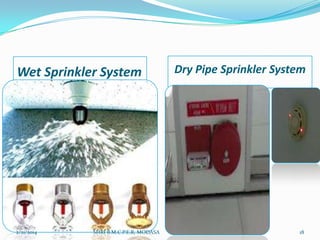
ď‚— Wet Sprinkler System
ď‚— Dry Pipe Sprinkler System
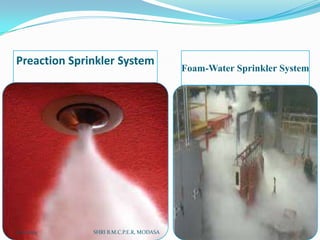
ď‚— Preaction Sprinkler System
ď‚— Antifreeze Sprinkler System
ď‚— Foam-Water Sprinkler System
2/21/2014

SHRI B.M.C.P.E.R, MODASA

17
Wet Sprinkler System

2/21/2014

SHRI B.M.C.P.E.R, MODASA

Dry Pipe Sprinkler System

18
Preaction Sprinkler System

2/21/2014

SHRI B.M.C.P.E.R, MODASA

Foam-Water Sprinkler System

19
SERVICE FACILITIES
ď‚—

Medical Services

ď‚—

Canteen Facilities

ď‚—

Washing and Toilet Facilities

ď‚—

Protective Clothing facilities

ď‚—

Change Rooms Facilities

ď‚—

Educational Programmes and Training facilities

ď‚—

Safety Programmes will be covered in the personal facilities.
2/21/2014

SHRI B.M.C.P.E.R, MODASA

20
HVAC
ď‚— The Heating, Ventilating, and Air conditioning -HVAC the technology

of indoor environmental comfort.
ď‚— HVAC system based on the principles of thermodynamic, fluid
mechanics and heat transfer.
HVAC system performs four basic functions:
1.Control airborne particles, dust and micro-organisms
2. Maintain room pressure.
3. Maintain space moisture.
4. Maintain space temperature.
2/21/2014

SHRI B.M.C.P.E.R, MODASA

21
1. Heating
ď‚— There are different types of standard heating systems.
Central heating
ď‚— It is used in cold climates to heat private houses and public
buildings.
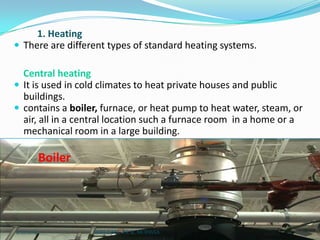
ď‚— contains a boiler, furnace, or heat pump to heat water, steam, or
air, all in a central location such a furnace room in a home or a
mechanical room in a large building.

Boiler

2/21/2014

SHRI B.M.C.P.E.R, MODASA

22
ď‚— also contains either ductwork, for forced air systems, or piping to

distribute a heated fluid .

2. Ventilation
ď‚— It is the process of "changing" or replacing air in any space to control

temperature or remove moisture, odors, smoke, heat, dust and airborne
particle.
ď‚— Ventilation includes both the exchange of air to the outside as well as
circulation of air within the building.
ď‚— Methods for ventilating a building may be divided into
mechanical/forced and natural types.

Mechanical Ventilation
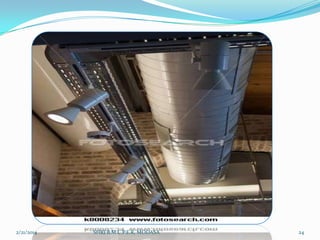
Mechanical ventilation is the use of mechanical air handling systems—
commonly referred to as heating, ventilation, and air conditioning
(HVAC) systems—toB.M.C.P.E.R, MODASA
2/21/2014
SHRI ventilate buildings.
23
2/21/2014

SHRI B.M.C.P.E.R, MODASA

24
Natural Ventilation
ď‚— Natural ventilation is the use of differences in air pressure that exist
between the inside of a building relative to the outside of it.
ď‚— These air pressure differences are created by natural forces such as wind
and temperature.
ď‚— Air moves into and out of naturally ventilated buildings through
windows, doors, vents and other openings incorporated into the
building design.

2/21/2014

SHRI B.M.C.P.E.R, MODASA

25
3. Air conditioning
ď‚— Air conditioning and refrigeration are provided through the

removal of heat.
ď‚— Heat can be removed through the process of radiation,
convection and cooling through a process called the
refrigeration cycle.
ď‚— The system uses mediums such as water, air, ice, and
chemicals referred to as refrigerants.

2/21/2014

SHRI B.M.C.P.E.R, MODASA

26
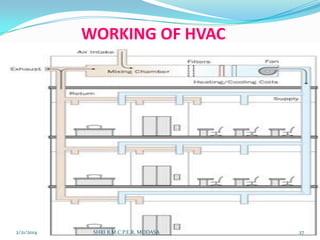
WORKING OF HVAC

2/21/2014

SHRI B.M.C.P.E.R, MODASA

27
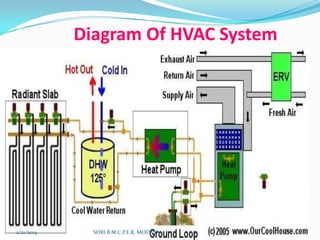
Diagram Of HVAC System

2/21/2014

SHRI B.M.C.P.E.R, MODASA

28
System Design Criteria
ď‚—
ď‚—
ď‚—
ď‚—
ď‚—
ď‚—
ď‚—
ď‚—
ď‚—

Temperature and Moisture
Air Cleanliness
Pressurization
Building Intake and Exhaust
Heating Systems
Humidification Systems
Dehumidification Systems
Supply Air Handling Systems
Prime movers

2/21/2014

SHRI B.M.C.P.E.R, MODASA

29
Temperature and Moisture
ď‚— Space and process temperature and moisture conditions are
generally determined by the product or process performed.
Air Cleanliness
ď‚— The level of acceptable airborne contamination within the
space must be identified ,for product quality or employee
safety.
ď‚—
ď‚—
ď‚—
ď‚—
ď‚—

Environmental cleanliness is determined by several factors:The quality of air introduced into the space
The quantity of air introduced into the space
The effectiveness of air distribution through the space
The effectiveness of the removal of the air contaminant

2/21/2014

SHRI B.M.C.P.E.R, MODASA

30
Air flow sheets
ď‚— The airflow sheets should be developed on full size drawings and should

show air quantities supplied, returned, and exhausted from each space.
ď‚— They also must show air transferred into and out of spaces.
ď‚— The airflow sheet is a useful tool for transfer of information to the owner
or user, for agency reviews, for transmission of information to HVAC
designers, and for other engineering disciplines.

Air Flow Pattern
ď‚— The air distribution has to be appropriate with the class of clean

room. Air turbulance in the space can cause particulates which have
settle onto the floor and work surfaces to become re-entrained in
the air.
ď‚— Air turbulance is greatly influenced by the configuration of air supply
and return grilles, people traffic and process equipment layout.
2/21/2014

SHRI B.M.C.P.E.R, MODASA

31
Pressurization
ď‚— Space relative pressurization will be determined primarily by requirements

of the product.
ď‚— Where product contamination control is required, the space relative
pressurization must be designed to assure that the movement of exfiltred
air is from the clean to the less clean areas.

Building Intake and Exhaust
ď‚— Careful attention must be paid to the incoming system air quality.
ď‚— An industrial area may have a more corrosive or there are chemical in air

quality.
ď‚— These issues must be carefully considered when selecting filtration
systems so as to minimize the possibility of product contamination.
ď‚— Careful consideration must be made as to the impacts of building exhaust
and relief systems, loading docks and other incidences of vehicle exhaust
and electrical generator exhaust
2/21/2014

SHRI B.M.C.P.E.R, MODASA

32
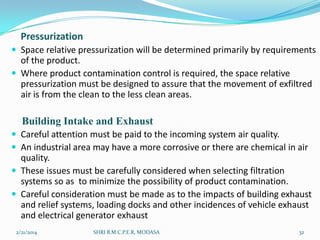
Heating Systems
ď‚— Using steam or hot water as the heat source.
ď‚— Heating can also be provided by electric means that is easily controlled.
Cooling System
ď‚— chilled water, condenser water, /anti-freeze solution or other heat exchange
fluid may be utilized.
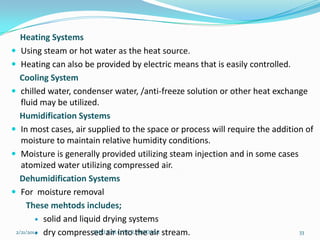
Humidification Systems
ď‚— In most cases, air supplied to the space or process will require the addition of
moisture to maintain relative humidity conditions.
ď‚— Moisture is generally provided utilizing steam injection and in some cases
atomized water utilizing compressed air.
Dehumidification Systems
ď‚— For moisture removal
These mehtods includes;
ď‚— solid and liquid drying systems
2/21/2014 dry compressed air into the air stream.
SHRI B.M.C.P.E.R, MODASA
33
ď‚—
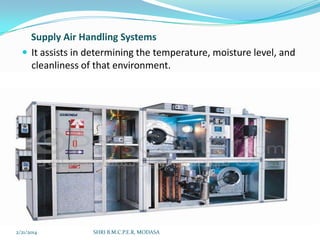
Supply Air Handling Systems
ď‚— It assists in determining the temperature, moisture level, and
cleanliness of that environment.

2/21/2014

SHRI B.M.C.P.E.R, MODASA

34
Different Components of HVAC and their Function
1. FLOW RATE CONTROLLER
ď‚— Automated adjustment of volume of air.
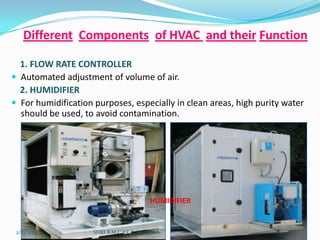
2. HUMIDIFIER
ď‚— For humidification purposes, especially in clean areas, high purity water
should be used, to avoid contamination.

HUMIDIFIER

2/21/2014

SHRI B.M.C.P.E.R, MODASA

35
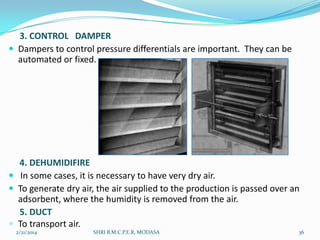
3. CONTROL DAMPER
ď‚— Dampers to control pressure differentials are important. They can be
automated or fixed.

4. DEHUMIDIFIRE
ď‚— In some cases, it is necessary to have very dry air.
ď‚— To generate dry air, the air supplied to the production is passed over an
adsorbent, where the humidity is removed from the air.
5. DUCT
ď‚— To transport air.
2/21/2014

SHRI B.M.C.P.E.R, MODASA

36
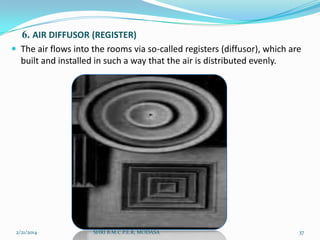
6. AIR DIFFUSOR (REGISTER)
ď‚— The air flows into the rooms via so-called registers (diffusor), which are

built and installed in such a way that the air is distributed evenly.

2/21/2014

SHRI B.M.C.P.E.R, MODASA

37
7. FILTERS
ď‚— To eliminate particles of predetermined dimensions and/or micro-

organisms.
Types of Filters Used in HVAC
ď‚— Primary Panel filters
ď‚— Secondary filters
ď‚— HEPA or tertiary filters

FILTER CLASSES
ULPA- Ultra-Low Penetration Air filter
HEPA- High Efficiency Particulate Air filter
ď‚— Leak tests (integrity tests), showing leakage of air through the filter itself
or through its frame, therefore, have to be performed. Integrity tests
are usually only carried out on the Aerosol filters.
2/21/2014

SHRI B.M.C.P.E.R, MODASA

38
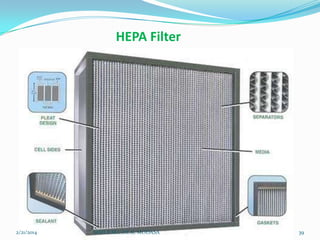
HEPA Filter

2/21/2014

SHRI B.M.C.P.E.R, MODASA

39
FILTER POSITION
The filtered air entering a production room can be coming from:
ď‚— An air-handling unit, equipped with pre-filtration and the main
(HEPA) filter, but at some distance from that room (AHU mounted
final filter)
ď‚— for injectables and sterile forms, it is recommended that they be
placed in terminal position.

2/21/2014

SHRI B.M.C.P.E.R, MODASA

40
DIFFERENT AIR TYPES TO BE CONSIDERED WITHIN THE
AIR HANDLING SYSTEM
FRESH AIR
ď‚— If the plant is of the re-circulation type, it is necessary to replace
some of the re-circulating air with fresh air, which is then called
make-up air.
SUPPLY AIR
There are two ways to supply air to a room or a piece of equipment
ď‚— Turbulent air flow
ď‚— Uni-directional flow, often called laminar flow

2/21/2014

SHRI B.M.C.P.E.R, MODASA

41
Role of HVAC in Pharmaceutical Industry
ď‚— PRODUCT PROTECTION
ď‚— PERSONNEL PROTECTION
ď‚— PROTECTION OF THE ENVIRONMENT

2/21/2014

SHRI B.M.C.P.E.R, MODASA

42
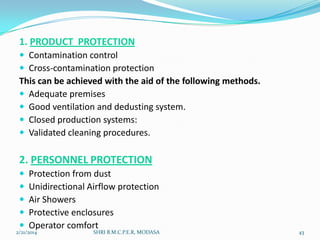
1. PRODUCT PROTECTION
ď‚— Contamination control
ď‚— Cross-contamination protection

This can be achieved with the aid of the following methods.
ď‚— Adequate premises
ď‚— Good ventilation and dedusting system.
ď‚— Closed production systems:
ď‚— Validated cleaning procedures.

2. PERSONNEL PROTECTION
ď‚—
ď‚—
ď‚—
ď‚—
ď‚—

Protection from dust
Unidirectional Airflow protection
Air Showers
Protective enclosures
Operator comfort

2/21/2014

SHRI B.M.C.P.E.R, MODASA

43
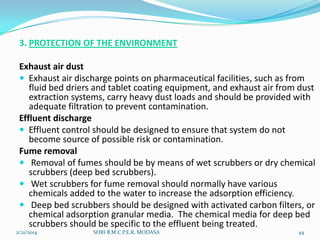
3. PROTECTION OF THE ENVIRONMENT
Exhaust air dust
ď‚— Exhaust air discharge points on pharmaceutical facilities, such as from
fluid bed driers and tablet coating equipment, and exhaust air from dust
extraction systems, carry heavy dust loads and should be provided with
adequate filtration to prevent contamination.
Effluent discharge
ď‚— Effluent control should be designed to ensure that system do not
become source of possible risk or contamination.
Fume removal
ď‚— Removal of fumes should be by means of wet scrubbers or dry chemical
scrubbers (deep bed scrubbers).
ď‚— Wet scrubbers for fume removal should normally have various
chemicals added to the water to increase the adsorption efficiency.
ď‚— Deep bed scrubbers should be designed with activated carbon filters, or
chemical adsorption granular media. The chemical media for deep bed
scrubbers should be specific to the effluent being treated.
2/21/2014

SHRI B.M.C.P.E.R, MODASA

44
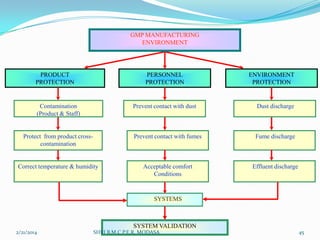
GMP MANUFACTURING
ENVIRONMENT

PRODUCT
PROTECTION

PERSONNEL
PROTECTION

Contamination
(Product & Staff)

ENVIRONMENT
PROTECTION

Prevent contact with dust

Dust discharge

Protect from product crosscontamination

Prevent contact with fumes

Fume discharge

Correct temperature & humidity

Acceptable comfort
Conditions

Effluent discharge

SYSTEMS

SYSTEM VALIDATION
2/21/2014

SHRI B.M.C.P.E.R, MODASA

45
VALIDATION AND QUALIFICATION
List of Parameters to be qualified
ď‚— room temperature (if there is an impact on product quality)
ď‚— room humidity (if there is an impact on product qualit
ď‚— return air or exhaust air quantities
ď‚— room air change rates
ď‚— room pressures
ď‚— room air flow patterns
ď‚— HEPA filter penetration tests
ď‚— room particle counts
ď‚— microbiological air and surface counts
2/21/2014

SHRI B.M.C.P.E.R, MODASA

46
PERSONNEL FACILITIES
ď‚— EATING AND DRINKING FACILITIES
ď‚— LAVATORIES & LOCKERS
ď‚— CLOTHING
ď‚— FIRST AID FACILITIES
ď‚— GOWNING ROOMS
ď‚— SAFETY PROGRAMS
ď‚— TRAINING FACILITES
2/21/2014

SHRI B.M.C.P.E.R, MODASA

47
1. EATING AND DRINKING FACILITIES

ď‚— Eating & drinking permitted only in separate eating facilities.
ď‚— Permanent facilities for breaks & people bringing lunches required.
ď‚— Manufacturer should provide facility of canteen; it should be away from

operating areas.

2. LAVATORIES & LOCKERS

ď‚—
ď‚—
ď‚—
ď‚—

Adequate in number for the number of personnel employed.
Conveniently located to all areas.
Complete cleaning with cleansing & disinfectant agents daily.
Lavatory & locker areas separated from all sterile spaces by an air lock.

3. CLOTHING

ď‚— Workers in special clean areas wearing only lint- & dust-free garments
ď‚§
ď‚—
ď‚—
ď‚—
ď‚—
ď‚—
ď‚—
ď‚—

to prevent shedding.
Where necessary the following articles are provided by the company:Hats & head covers for clean areas.
Aprons
Safety shoes
Gloves, disposable in clean areas
Safety glasses
Masks
Protective goggles

2/21/2014

SHRI B.M.C.P.E.R, MODASA

48
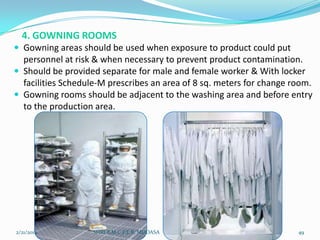
4. GOWNING ROOMS
ď‚— Gowning areas should be used when exposure to product could put

personnel at risk & when necessary to prevent product contamination.
ď‚— Should be provided separate for male and female worker & With locker
facilities Schedule-M prescribes an area of 8 sq. meters for change room.
ď‚— Gowning rooms should be adjacent to the washing area and before entry
to the production area.

2/21/2014

SHRI B.M.C.P.E.R, MODASA

49
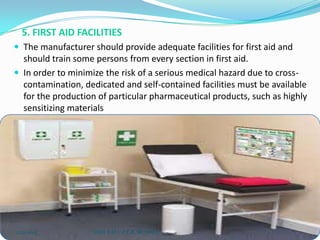
5. FIRST AID FACILITIES
ď‚— The manufacturer should provide adequate facilities for first aid and

should train some persons from every section in first aid.
ď‚— In order to minimize the risk of a serious medical hazard due to crosscontamination, dedicated and self-contained facilities must be available
for the production of particular pharmaceutical products, such as highly
sensitizing materials

2/21/2014

SHRI B.M.C.P.E.R, MODASA

50
6. RESTROOM FACILITIES
ď‚— Restroom facilities should be physically separated from lab & processing

areas by a room, corridor or other intermediate space.

7. SAFETY PROGRAMS
ď‚— Plant safety programs play an important role, since hazardous conditions
ď‚—
ď‚—
ď‚—
ď‚—
ď‚—
ď‚—

diminish employee moral and performance.
Posters displayed prominently & changed often.
Safety equipment available free of cost to employee.
Safety showers and eye baths in hazardous areas.
Lectures, movies
Safety bulletin boards listing recent plant accidents & methods of
prevention.
Safety inspection teams from several departments to audit work areas
periodically

2/21/2014

SHRI B.M.C.P.E.R, MODASA

51
8. TRAINING FACILITES
ď‚— Management must provide training in accordance with written program

for all personnel whose duties taken them into manufacturing area or
into control lab & for other Personnel working in areas where
contamination is a hazard those should be given specific training.
ď‚— Consultant & contract staff should be qualified for services they provide.
evidence of these should be included in training required.

2/21/2014

SHRI B.M.C.P.E.R, MODASA

52
QUESTIONS
ď‚—
ď‚—
ď‚—
ď‚—
ď‚—

Give role of HVAC in pharmaceutical industry.
Draw a diagram of HVAC.
Give name of different components, their functions.
Give different type of air.
Write a note on different types of filters, position of filters & filter
classes with reference to HVAC?
ď‚— Write a note on system design criteria for HVAC?
ď‚— PERSONNEL FACILITIES
ď‚— What are the personnel facilities required in a pharmaceutical
industry as per GMP?

2/21/2014

SHRI B.M.C.P.E.R, MODASA

53
REFERENCES
ď‚— GOOD DESIGN PRACTICES FOR GMP PHARMACEUTICAL FACILITIES

ď‚—
ď‚—
ď‚—
ď‚—
ď‚—
ď‚—
ď‚—
ď‚—

BY:- ANDREW. A.SIGNORE & TERRY JACOBS
VOL-146, PAGE NOS:- 50,90-104,345
GOOD MANUFACTURING PRACTICES FOR PHARMACEUTICALS
BY; - JAMES SWARBRICK VOL-2, PAGE NOS:- 20,21,22,23,36,37
www.wikipedia.com
www.p2pays.org
www.foreigntradeexchange.com
www.industrialleaders.org
Encyclopedia, vol. -7, page - 229
Encyclopaedia of pharmaceutical technology vol-16 water for
pharmaceutical use 293-306
USP 25 Official Monograph pg. No. 1809-1810
2/21/2014

SHRI B.M.C.P.E.R, MODASA

54
Ph. No. :- +918460378336
Address:- 44, Assiyana Society;
Dugarvada Road,
Taluko & City : Modasa
State: Gujarat
Country: India
Email: sahil.pharm4@gmail.com

BEST OF LUCK TO ALL . . . . . . . . . .
2/21/2014

SHRI B.M.C.P.E.R, MODASA

55
Sahilhusen utility service

Sahilhusen utility service

  • 1.
    GUIDED BY: Dr. M.R. PATEL Principale & HOD in pharmaceutics PRESENTEDE BY: SAHILHUSEN I . JETHARA M. PHARM – I (2013-14) ROLL NO. - 02 DEPARTMENT OF PHARMACEUTICS SHRI B. M. SHAH COLLEGE OF PHARMACEUTICAL EDUCATION 2/21/2014 1 AND REASERCH, MODASA-2013 SHRI B.M.C.P.E.R, MODASA
  • 2.
    CONTENTS ď‚— UTILITY SERVICES ď‚—SERVICE FACILITIES ď‚— HVAC INRODUCTION ROLE IN PHARMACEUTICAL INDUSTRY LEVEL OF PROTECTION COMPONENTS FILTER CLASSES AIR FLOW PATTERNS VALIDATION AND QUALIFICATION ď‚— PERSONNEL FACILITIES 2/21/2014 SHRI B.M.C.P.E.R, MODASA 2
  • 3.
    UTILITY SERVICES 1. 2. 3. 4. 5. 6. 7. 8. 2/21/2014 HVAC PLUMBING DRAINAGE SYSTEM GASSYSTEM SANITATION WATER FOR PHARMACEUTICAL USE FIRE PROTECTION SYSTEM Services used by a factory include compressed gases, water, vacuum, electricity and room air conditioning SHRI B.M.C.P.E.R, MODASA 3
  • 4.
    1.HVAC: (The Heating,Ventilating, and Air conditioning) 2.PLUMBING: Portable water shall be supplied under continuous positive pressure in a plumbing system free of defects that could contribute contamination to any drug product. The pipes and fittings must be of quality good enough to withstand the pressure and heat conditions Plumbing 2/21/2014 in Industry SHRI B.M.C.P.E.R, MODASA 4
  • 5.
    ď‚— Compatibility of thematerials of construction with the characteristics of the waste water must be considered during the design of the facility. For example: Copper plumbing should not be used in drain line for acidic waste water . COLOUR CODE MATERIALS GREY RAW WATER ORANGE DISTILED WATER GREEN COOLING WATER WHITE 2/21/2014 SHRI B.M.C.P.E.R, MODASA AIR 5
  • 6.
    ď‚— ď‚— ď‚— ď‚— ď‚— 3.DRAINAGE SYSTEMS They removeeffluent from spaces , systems, or process. Adequate size easy to clean For biological waste, it should be treated in a proper manner before disposal to not to harm the environment. Dissolved oxygen content in the waste to be disposed in lake or river must be within limits. 2/21/2014 SHRI B.M.C.P.E.R, MODASA 6
  • 7.
  • 8.
    Sanitary waste system ď‚—A separate sanitary waste drainage and vent system is provided to convey waste from toilets, lavatories, non-process service sinks and floor drains. Laboratory waste system ď‚— A separate laboratory waste drainage and vent system is often provided in cases ď‚— where acids or caustics used in laboratory processes must be sampled and potentially neutralized before disposal into the sanitary waste system. Hazardous Material Waste and Retention ď‚— Provided in cases where hazardous materials such as solvents, toxins, radio actives, high concentrations etc. ď‚— To maintain isolation of the hazardous material for other drainage systems. 2/21/2014 SHRI B.M.C.P.E.R, MODASA 8
  • 9.
    Process Waste System ď‚—A separate process waste drainage and vent system is often provided in cases where products used in the manufacturing process must either be contained separately or treated before disposal into the sanitary waste system Storm Drainage System ď‚— A separate storm drainage system is provided to drain rainwater from all roof and area drains 2/21/2014 SHRI B.M.C.P.E.R, MODASA 9
  • 10.
    4.GAS SYSTEMS  Allgases used in manufacturing and processing operations, including the sterilization process Compressed Air  In general compressed air should be supplied by an “oil- free” type compressor and  must be free of oil and oil vapour unless vented directly to a noncontrolled environment area.  It should also be dehumidified to prevent condensation of water vapour. Breathing Air  Breathing air is generally provided for use to personnel working in hazardous environment.  Provided centrally through a breathing air distribution system or at the local level with “backpack” type breathing air units worn by each person. 2/21/2014 SHRI B.M.C.P.E.R, MODASA 10
  • 11.
    Nitrogen ď‚— Used forthe purging of electrical equipment in volatile or explosive environments vacuum ď‚— Vacuum is utilized in the encapsulation and tablet compression areas. Vacuum Cleaning ď‚— For dry particulate and powder pickup 2/21/2014 SHRI B.M.C.P.E.R, MODASA 11
  • 12.
    5. SANITATION INTHE MANUFACTURING PREMISES ď‚— ď‚— ď‚— ď‚— ď‚— Objectives Removal of dirt and other waste material; Minimize the risk of cross contamination between different products in the same area; Reduce the number of micro-organisms in work area; Control pests so that these do not affect the quality of materials to be used in the manufacture of drugs. Cleaning procedure to be followed, including equipment and materials to be used for cleaning. CLEANING AGENTS AND DISINFECTANTS: ď‚— Cleaning agents help to remove extraneous materials from surfaces. ď‚— Disinfectants destroy pathogenic and other micro organisms and are used to reduce microbial count in manufacturing area. 12 2/21/2014 SHRI B.M.C.P.E.R, MODASA
  • 13.
    6.WATER FOR PHARMACEUTICALUSE ď‚— Water is most widely used material in pharmaceutical manufacturing. A greater volume of water is used in cleaning and rinsing processes than in formulation in most facilities. Regardless of the water volume used in actual drug formulation all pharmaceutical water is subject to cGMPs even when the water does not remain in the finished product. WATER QUALITY REQUIREMENTS ď‚— The types of water defined in the pharmacopoeial monographs such as Purified Water and Water for Injection (WFI) are known as compendial waters. ď‚— Other quality waters used in manufacturing, not defined by USP or other recognized compendia are known as non-compendial waters. 2/21/2014 SHRI B.M.C.P.E.R, MODASA 13
  • 14.
    Rain water river Water purchased inbulk Sources of water Dams, ponds Municipal or civil water Lakes Well water 2/21/2014 SHRI B.M.C.P.E.R, MODASA 14
  • 15.
    MONOGRAPH REQUIREMENTS  Themonographs require that the water purity is proven by conductivity and total organic carbon (TOC).  conductivity test requires measurement of conductivity and water temperature.  The conductivity limit varies from 0.6 µS/cm at 0 C 3.1 µS/cm at 100 C.  1.3 µS/cm at 25 C and 2.7 µS/cm at 80 C. 2/21/2014 SHRI B.M.C.P.E.R, MODASA 15
  • 16.
    7.FIRE PROTECTION SYSTEMS ď‚—Pharmaceutical manufacturing facilities are with typically provided with automatic fire suppression and protection system throghout. ď‚— The provision of specific suppresion and protection throughout the facility might be the requirement. 2/21/2014 SHRI B.M.C.P.E.R, MODASA consequence of a strict code 16
  • 17.
    Sprinkler Systems ď‚— WetSprinkler System ď‚— Dry Pipe Sprinkler System ď‚— Preaction Sprinkler System ď‚— Antifreeze Sprinkler System ď‚— Foam-Water Sprinkler System 2/21/2014 SHRI B.M.C.P.E.R, MODASA 17
  • 18.
    Wet Sprinkler System 2/21/2014 SHRIB.M.C.P.E.R, MODASA Dry Pipe Sprinkler System 18
  • 19.
    Preaction Sprinkler System 2/21/2014 SHRIB.M.C.P.E.R, MODASA Foam-Water Sprinkler System 19
  • 20.
    SERVICE FACILITIES ď‚— Medical Services ď‚— CanteenFacilities ď‚— Washing and Toilet Facilities ď‚— Protective Clothing facilities ď‚— Change Rooms Facilities ď‚— Educational Programmes and Training facilities ď‚— Safety Programmes will be covered in the personal facilities. 2/21/2014 SHRI B.M.C.P.E.R, MODASA 20
  • 21.
    HVAC ď‚— The Heating,Ventilating, and Air conditioning -HVAC the technology of indoor environmental comfort. ď‚— HVAC system based on the principles of thermodynamic, fluid mechanics and heat transfer. HVAC system performs four basic functions: 1.Control airborne particles, dust and micro-organisms 2. Maintain room pressure. 3. Maintain space moisture. 4. Maintain space temperature. 2/21/2014 SHRI B.M.C.P.E.R, MODASA 21
  • 22.
    1. Heating ď‚— Thereare different types of standard heating systems. Central heating ď‚— It is used in cold climates to heat private houses and public buildings. ď‚— contains a boiler, furnace, or heat pump to heat water, steam, or air, all in a central location such a furnace room in a home or a mechanical room in a large building. Boiler 2/21/2014 SHRI B.M.C.P.E.R, MODASA 22
  • 23.
     also containseither ductwork, for forced air systems, or piping to distribute a heated fluid . 2. Ventilation  It is the process of "changing" or replacing air in any space to control temperature or remove moisture, odors, smoke, heat, dust and airborne particle.  Ventilation includes both the exchange of air to the outside as well as circulation of air within the building.  Methods for ventilating a building may be divided into mechanical/forced and natural types. Mechanical Ventilation Mechanical ventilation is the use of mechanical air handling systems— commonly referred to as heating, ventilation, and air conditioning (HVAC) systems—toB.M.C.P.E.R, MODASA 2/21/2014 SHRI ventilate buildings. 23
  • 24.
  • 25.
    Natural Ventilation ď‚— Naturalventilation is the use of differences in air pressure that exist between the inside of a building relative to the outside of it. ď‚— These air pressure differences are created by natural forces such as wind and temperature. ď‚— Air moves into and out of naturally ventilated buildings through windows, doors, vents and other openings incorporated into the building design. 2/21/2014 SHRI B.M.C.P.E.R, MODASA 25
  • 26.
    3. Air conditioning ď‚—Air conditioning and refrigeration are provided through the removal of heat. ď‚— Heat can be removed through the process of radiation, convection and cooling through a process called the refrigeration cycle. ď‚— The system uses mediums such as water, air, ice, and chemicals referred to as refrigerants. 2/21/2014 SHRI B.M.C.P.E.R, MODASA 26
  • 27.
    WORKING OF HVAC 2/21/2014 SHRIB.M.C.P.E.R, MODASA 27
  • 28.
    Diagram Of HVACSystem 2/21/2014 SHRI B.M.C.P.E.R, MODASA 28
  • 29.
    System Design Criteria ď‚— ď‚— ď‚— ď‚— ď‚— ď‚— ď‚— ď‚— ď‚— Temperatureand Moisture Air Cleanliness Pressurization Building Intake and Exhaust Heating Systems Humidification Systems Dehumidification Systems Supply Air Handling Systems Prime movers 2/21/2014 SHRI B.M.C.P.E.R, MODASA 29
  • 30.
    Temperature and Moisture ď‚—Space and process temperature and moisture conditions are generally determined by the product or process performed. Air Cleanliness ď‚— The level of acceptable airborne contamination within the space must be identified ,for product quality or employee safety. ď‚— ď‚— ď‚— ď‚— ď‚— Environmental cleanliness is determined by several factors:The quality of air introduced into the space The quantity of air introduced into the space The effectiveness of air distribution through the space The effectiveness of the removal of the air contaminant 2/21/2014 SHRI B.M.C.P.E.R, MODASA 30
  • 31.
    Air flow sheets ď‚—The airflow sheets should be developed on full size drawings and should show air quantities supplied, returned, and exhausted from each space. ď‚— They also must show air transferred into and out of spaces. ď‚— The airflow sheet is a useful tool for transfer of information to the owner or user, for agency reviews, for transmission of information to HVAC designers, and for other engineering disciplines. Air Flow Pattern ď‚— The air distribution has to be appropriate with the class of clean room. Air turbulance in the space can cause particulates which have settle onto the floor and work surfaces to become re-entrained in the air. ď‚— Air turbulance is greatly influenced by the configuration of air supply and return grilles, people traffic and process equipment layout. 2/21/2014 SHRI B.M.C.P.E.R, MODASA 31
  • 32.
    Pressurization ď‚— Space relativepressurization will be determined primarily by requirements of the product. ď‚— Where product contamination control is required, the space relative pressurization must be designed to assure that the movement of exfiltred air is from the clean to the less clean areas. Building Intake and Exhaust ď‚— Careful attention must be paid to the incoming system air quality. ď‚— An industrial area may have a more corrosive or there are chemical in air quality. ď‚— These issues must be carefully considered when selecting filtration systems so as to minimize the possibility of product contamination. ď‚— Careful consideration must be made as to the impacts of building exhaust and relief systems, loading docks and other incidences of vehicle exhaust and electrical generator exhaust 2/21/2014 SHRI B.M.C.P.E.R, MODASA 32
  • 33.
    Heating Systems ď‚— Usingsteam or hot water as the heat source. ď‚— Heating can also be provided by electric means that is easily controlled. Cooling System ď‚— chilled water, condenser water, /anti-freeze solution or other heat exchange fluid may be utilized. Humidification Systems ď‚— In most cases, air supplied to the space or process will require the addition of moisture to maintain relative humidity conditions. ď‚— Moisture is generally provided utilizing steam injection and in some cases atomized water utilizing compressed air. Dehumidification Systems ď‚— For moisture removal These mehtods includes; ď‚— solid and liquid drying systems 2/21/2014 dry compressed air into the air stream. SHRI B.M.C.P.E.R, MODASA 33 ď‚—
  • 34.
    Supply Air HandlingSystems ď‚— It assists in determining the temperature, moisture level, and cleanliness of that environment. 2/21/2014 SHRI B.M.C.P.E.R, MODASA 34
  • 35.
    Different Components ofHVAC and their Function 1. FLOW RATE CONTROLLER ď‚— Automated adjustment of volume of air. 2. HUMIDIFIER ď‚— For humidification purposes, especially in clean areas, high purity water should be used, to avoid contamination. HUMIDIFIER 2/21/2014 SHRI B.M.C.P.E.R, MODASA 35
  • 36.
    3. CONTROL DAMPER ď‚—Dampers to control pressure differentials are important. They can be automated or fixed. 4. DEHUMIDIFIRE ď‚— In some cases, it is necessary to have very dry air. ď‚— To generate dry air, the air supplied to the production is passed over an adsorbent, where the humidity is removed from the air. 5. DUCT ď‚— To transport air. 2/21/2014 SHRI B.M.C.P.E.R, MODASA 36
  • 37.
    6. AIR DIFFUSOR(REGISTER) ď‚— The air flows into the rooms via so-called registers (diffusor), which are built and installed in such a way that the air is distributed evenly. 2/21/2014 SHRI B.M.C.P.E.R, MODASA 37
  • 38.
    7. FILTERS ď‚— Toeliminate particles of predetermined dimensions and/or micro- organisms. Types of Filters Used in HVAC ď‚— Primary Panel filters ď‚— Secondary filters ď‚— HEPA or tertiary filters FILTER CLASSES ULPA- Ultra-Low Penetration Air filter HEPA- High Efficiency Particulate Air filter ď‚— Leak tests (integrity tests), showing leakage of air through the filter itself or through its frame, therefore, have to be performed. Integrity tests are usually only carried out on the Aerosol filters. 2/21/2014 SHRI B.M.C.P.E.R, MODASA 38
  • 39.
  • 40.
    FILTER POSITION The filteredair entering a production room can be coming from: ď‚— An air-handling unit, equipped with pre-filtration and the main (HEPA) filter, but at some distance from that room (AHU mounted final filter) ď‚— for injectables and sterile forms, it is recommended that they be placed in terminal position. 2/21/2014 SHRI B.M.C.P.E.R, MODASA 40
  • 41.
    DIFFERENT AIR TYPESTO BE CONSIDERED WITHIN THE AIR HANDLING SYSTEM FRESH AIR ď‚— If the plant is of the re-circulation type, it is necessary to replace some of the re-circulating air with fresh air, which is then called make-up air. SUPPLY AIR There are two ways to supply air to a room or a piece of equipment ď‚— Turbulent air flow ď‚— Uni-directional flow, often called laminar flow 2/21/2014 SHRI B.M.C.P.E.R, MODASA 41
  • 42.
    Role of HVACin Pharmaceutical Industry ď‚— PRODUCT PROTECTION ď‚— PERSONNEL PROTECTION ď‚— PROTECTION OF THE ENVIRONMENT 2/21/2014 SHRI B.M.C.P.E.R, MODASA 42
  • 43.
    1. PRODUCT PROTECTION ď‚—Contamination control ď‚— Cross-contamination protection This can be achieved with the aid of the following methods. ď‚— Adequate premises ď‚— Good ventilation and dedusting system. ď‚— Closed production systems: ď‚— Validated cleaning procedures. 2. PERSONNEL PROTECTION ď‚— ď‚— ď‚— ď‚— ď‚— Protection from dust Unidirectional Airflow protection Air Showers Protective enclosures Operator comfort 2/21/2014 SHRI B.M.C.P.E.R, MODASA 43
  • 44.
    3. PROTECTION OFTHE ENVIRONMENT Exhaust air dust ď‚— Exhaust air discharge points on pharmaceutical facilities, such as from fluid bed driers and tablet coating equipment, and exhaust air from dust extraction systems, carry heavy dust loads and should be provided with adequate filtration to prevent contamination. Effluent discharge ď‚— Effluent control should be designed to ensure that system do not become source of possible risk or contamination. Fume removal ď‚— Removal of fumes should be by means of wet scrubbers or dry chemical scrubbers (deep bed scrubbers). ď‚— Wet scrubbers for fume removal should normally have various chemicals added to the water to increase the adsorption efficiency. ď‚— Deep bed scrubbers should be designed with activated carbon filters, or chemical adsorption granular media. The chemical media for deep bed scrubbers should be specific to the effluent being treated. 2/21/2014 SHRI B.M.C.P.E.R, MODASA 44
  • 45.
    GMP MANUFACTURING ENVIRONMENT PRODUCT PROTECTION PERSONNEL PROTECTION Contamination (Product &Staff) ENVIRONMENT PROTECTION Prevent contact with dust Dust discharge Protect from product crosscontamination Prevent contact with fumes Fume discharge Correct temperature & humidity Acceptable comfort Conditions Effluent discharge SYSTEMS SYSTEM VALIDATION 2/21/2014 SHRI B.M.C.P.E.R, MODASA 45
  • 46.
    VALIDATION AND QUALIFICATION Listof Parameters to be qualified ď‚— room temperature (if there is an impact on product quality) ď‚— room humidity (if there is an impact on product qualit ď‚— return air or exhaust air quantities ď‚— room air change rates ď‚— room pressures ď‚— room air flow patterns ď‚— HEPA filter penetration tests ď‚— room particle counts ď‚— microbiological air and surface counts 2/21/2014 SHRI B.M.C.P.E.R, MODASA 46
  • 47.
    PERSONNEL FACILITIES ď‚— EATINGAND DRINKING FACILITIES ď‚— LAVATORIES & LOCKERS ď‚— CLOTHING ď‚— FIRST AID FACILITIES ď‚— GOWNING ROOMS ď‚— SAFETY PROGRAMS ď‚— TRAINING FACILITES 2/21/2014 SHRI B.M.C.P.E.R, MODASA 47
  • 48.
    1. EATING ANDDRINKING FACILITIES ď‚— Eating & drinking permitted only in separate eating facilities. ď‚— Permanent facilities for breaks & people bringing lunches required. ď‚— Manufacturer should provide facility of canteen; it should be away from operating areas. 2. LAVATORIES & LOCKERS ď‚— ď‚— ď‚— ď‚— Adequate in number for the number of personnel employed. Conveniently located to all areas. Complete cleaning with cleansing & disinfectant agents daily. Lavatory & locker areas separated from all sterile spaces by an air lock. 3. CLOTHING ď‚— Workers in special clean areas wearing only lint- & dust-free garments ď‚§ ď‚— ď‚— ď‚— ď‚— ď‚— ď‚— ď‚— to prevent shedding. Where necessary the following articles are provided by the company:Hats & head covers for clean areas. Aprons Safety shoes Gloves, disposable in clean areas Safety glasses Masks Protective goggles 2/21/2014 SHRI B.M.C.P.E.R, MODASA 48
  • 49.
    4. GOWNING ROOMS ď‚—Gowning areas should be used when exposure to product could put personnel at risk & when necessary to prevent product contamination. ď‚— Should be provided separate for male and female worker & With locker facilities Schedule-M prescribes an area of 8 sq. meters for change room. ď‚— Gowning rooms should be adjacent to the washing area and before entry to the production area. 2/21/2014 SHRI B.M.C.P.E.R, MODASA 49
  • 50.
    5. FIRST AIDFACILITIES ď‚— The manufacturer should provide adequate facilities for first aid and should train some persons from every section in first aid. ď‚— In order to minimize the risk of a serious medical hazard due to crosscontamination, dedicated and self-contained facilities must be available for the production of particular pharmaceutical products, such as highly sensitizing materials 2/21/2014 SHRI B.M.C.P.E.R, MODASA 50
  • 51.
    6. RESTROOM FACILITIES ď‚—Restroom facilities should be physically separated from lab & processing areas by a room, corridor or other intermediate space. 7. SAFETY PROGRAMS ď‚— Plant safety programs play an important role, since hazardous conditions ď‚— ď‚— ď‚— ď‚— ď‚— ď‚— diminish employee moral and performance. Posters displayed prominently & changed often. Safety equipment available free of cost to employee. Safety showers and eye baths in hazardous areas. Lectures, movies Safety bulletin boards listing recent plant accidents & methods of prevention. Safety inspection teams from several departments to audit work areas periodically 2/21/2014 SHRI B.M.C.P.E.R, MODASA 51
  • 52.
    8. TRAINING FACILITES ď‚—Management must provide training in accordance with written program for all personnel whose duties taken them into manufacturing area or into control lab & for other Personnel working in areas where contamination is a hazard those should be given specific training. ď‚— Consultant & contract staff should be qualified for services they provide. evidence of these should be included in training required. 2/21/2014 SHRI B.M.C.P.E.R, MODASA 52
  • 53.
    QUESTIONS ď‚— ď‚— ď‚— ď‚— ď‚— Give role ofHVAC in pharmaceutical industry. Draw a diagram of HVAC. Give name of different components, their functions. Give different type of air. Write a note on different types of filters, position of filters & filter classes with reference to HVAC? ď‚— Write a note on system design criteria for HVAC? ď‚— PERSONNEL FACILITIES ď‚— What are the personnel facilities required in a pharmaceutical industry as per GMP? 2/21/2014 SHRI B.M.C.P.E.R, MODASA 53
  • 54.
    REFERENCES ď‚— GOOD DESIGNPRACTICES FOR GMP PHARMACEUTICAL FACILITIES ď‚— ď‚— ď‚— ď‚— ď‚— ď‚— ď‚— ď‚— BY:- ANDREW. A.SIGNORE & TERRY JACOBS VOL-146, PAGE NOS:- 50,90-104,345 GOOD MANUFACTURING PRACTICES FOR PHARMACEUTICALS BY; - JAMES SWARBRICK VOL-2, PAGE NOS:- 20,21,22,23,36,37 www.wikipedia.com www.p2pays.org www.foreigntradeexchange.com www.industrialleaders.org Encyclopedia, vol. -7, page - 229 Encyclopaedia of pharmaceutical technology vol-16 water for pharmaceutical use 293-306 USP 25 Official Monograph pg. No. 1809-1810 2/21/2014 SHRI B.M.C.P.E.R, MODASA 54
  • 55.
    Ph. No. :-+918460378336 Address:- 44, Assiyana Society; Dugarvada Road, Taluko & City : Modasa State: Gujarat Country: India Email: sahil.pharm4@gmail.com BEST OF LUCK TO ALL . . . . . . . . . . 2/21/2014 SHRI B.M.C.P.E.R, MODASA 55