Fundamentals of pharmaceutical
HVAC systems
Group No : 01
PRESENTED BY:
RANA AHMED (PHA-14001)
MAHFUJUL HASAN (PHA-14002)
SHAHIDA YEASMIN (PHA-14005)
SHAMIMA AKTER SUMI (PHA-14007)
RUMA AKTER (PHA-14008)
A.H.M.ADNAN KHAN (PHA-14033)
 Contents
 Introduction
 History
 Components of HVAC system
 System design
 HVAC requirements
 Basic HVAC system
 Ventilation
 System selection guidelines
 Air conditioning
 What can HVAC system do and what do not ?
 INTRODUCTION
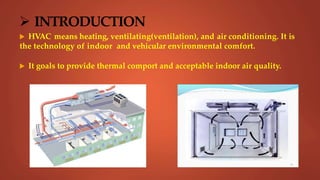
 HVAC means heating, ventilating(ventilation), and air conditioning. It is
the technology of indoor and vehicular environmental comfort.
 It goals to provide thermal comport and acceptable indoor air quality.
 History
 1000s-1400s: Egyptians used man powered fans and the Indians
used rope fans.
 1500s-1600s: In France, ventilating machines were used in the
mines. These machines contains series of fans.
 1700s-1800s: Many countries used stove to built of bricks and
centrifugal fan used.
 1900s: This era saw a sudden steps in the inventions and
evalution of the hvac system.
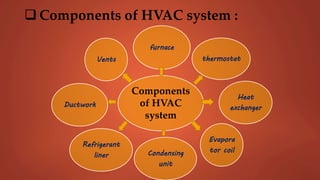
 Components of HVAC system :
Components
of HVAC
system
furnace
thermostat
Heat
exchanger
Evapora
tor coilCondensing
unit
Refrigerant
liner
Ductwork
Vents
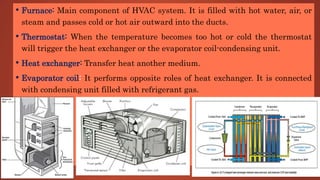
• Furnace: Main component of HVAC system. It is filled with hot water, air, or
steam and passes cold or hot air outward into the ducts.
• Thermostat: When the temperature becomes too hot or cold the thermostat
will trigger the heat exchanger or the evaporator coil-condensing unit.
• Heat exchanger: Transfer heat another medium.
• Evaporator coil: It performs opposite roles of heat exchanger. It is connected
with condensing unit filled with refrigerant gas.
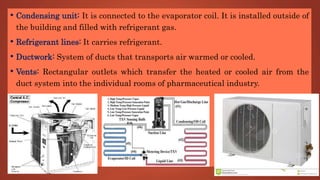
• Condensing unit: It is connected to the evaporator coil. It is installed outside of
the building and filled with refrigerant gas.
• Refrigerant lines: It carries refrigerant.
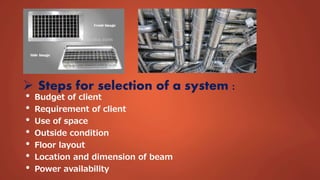
• Ductwork: System of ducts that transports air warmed or cooled.
• Vents: Rectangular outlets which transfer the heated or cooled air from the
duct system into the individual rooms of pharmaceutical industry.
 Steps for selection of a system :
• Budget of client
• Requirement of client
• Use of space
• Outside condition
• Floor layout
• Location and dimension of beam
• Power availability
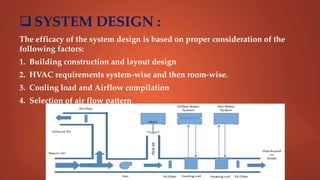
 SYSTEM DESIGN :
The efficacy of the system design is based on proper consideration of the
following factors:
1. Building construction and layout design
2. HVAC requirements system-wise and then room-wise.
3. Cooling load and Airflow compilation
4. Selection of air flow pattern
CONTINUE….
5. Pressurization of rooms
6. Air handling system
7. Duct system design and construction
8. Selection, location and mounting of filtration system
9. DE fumigation requirement
10. Testing and validation
11. Documentation
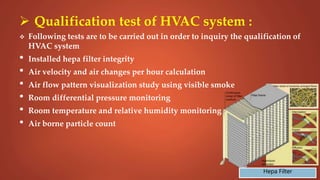
 Qualification test of HVAC system :
 Following tests are to be carried out in order to inquiry the qualification of
HVAC system
• Installed hepa filter integrity
• Air velocity and air changes per hour calculation
• Air flow pattern visualization study using visible smoke
• Room differential pressure monitoring
• Room temperature and relative humidity monitoring
• Air borne particle count
Hepa Filter
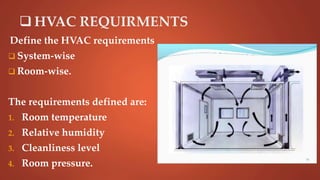
 HVAC REQUIRMENTS
Define the HVAC requirements
 System-wise
 Room-wise.
The requirements defined are:
1. Room temperature
2. Relative humidity
3. Cleanliness level
4. Room pressure.
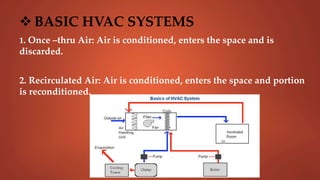
 BASIC HVAC SYSTEMS
1. Once –thru Air: Air is conditioned, enters the space and is
discarded.
2. Recirculated Air: Air is conditioned, enters the space and portion
is reconditioned.
 Once –thru Air Advantages
Advantages:
 Fresh air
 Can handle hazardous materials
 Exhaust duct is usually easy
Disadvantages:
 Expensive to operate
 Filter loading very high
 Potential need for dust collection
 Applications
 Labs with hoods, potential hazards
 Bulk Pharmaceutical Chemical
 Oral Solid Dosage (OSD) plants where potent
products/materials exposed
 Where high potential of product
 Some bio API facilities with exposed potent
materials
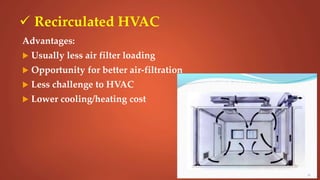
 Recirculated HVAC
Advantages:
 Usually less air filter loading
 Opportunity for better air-filtration
 Less challenge to HVAC
 Lower cooling/heating cost
 Disadvantages
 Return air handling may be complicated
 Chance of cross contamination
Applications
1. Classified spaces such as sterile manufacture
2. Finished oral solid dosage(OSD)
3. Final bulk APIs, usually with dedicated air handler for each
room
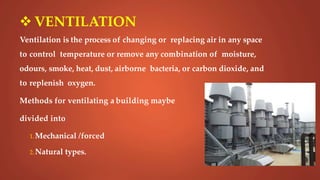
 VENTILATION
Ventilation is the process of changing or replacing air in any space
to control temperature or remove any combination of moisture,
odours, smoke, heat, dust, airborne bacteria, or carbon dioxide, and
to replenish oxygen.
Methods for ventilating a building maybe
divided into
1.Mechanical /forced
2.Natural types.
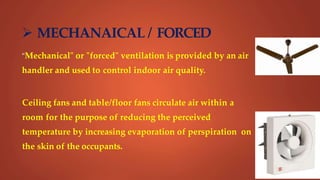
 MECHANAICAL / FORCED
"Mechanical" or "forced" ventilation is provided by an air
handler and used to control indoor air quality.
Ceiling fans and table/floor fans circulate air within a
room for the purpose of reducing the perceived
temperature by increasing evaporation of perspiration on
the skin of the occupants.
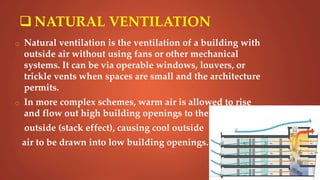
 NATURAL VENTILATION
o Natural ventilation is the ventilation of a building with
outside air without using fans or other mechanical
systems. It can be via operable windows, louvers, or
trickle vents when spaces are small and the architecture
permits.
o In more complex schemes, warm air is allowed to rise
and flow out high building openings to the
outside (stack effect), causing cool outside
air to be drawn into low building openings.
 SYSTEM SELECTION GUIDELINES:
 Financial factors
 Initial cost
 Operating costs
 Maintenance and repair cost
 Equipment replacement or upgrading cost
 Equipment failure cost
 Return on investment (ROI)
 Energy costs
 Building conditions
 New or existing building or space
 Location
 Orientation & Architecture
 Climate and shading
CONTINUE
 Climate and shading
 Configuration & Construction
 Building conditions
 New or existing building or space
 Location
 Factors affecting HVAC system :
• Use of space
• Inside room design condition
• Filtration level required
• Ambient condition
• Glass area exposed to sun
• Occupancy
• Lighting load
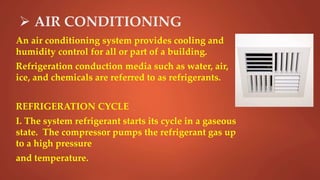
 AIR CONDITIONING
An air conditioning system provides cooling and
humidity control for all or part of a building.
Refrigeration conduction media such as water, air,
ice, and chemicals are referred to as refrigerants.
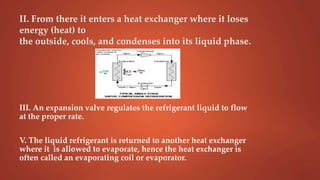
REFRIGERATION CYCLE
I. The system refrigerant starts its cycle in a gaseous
state. The compressor pumps the refrigerant gas up
to a high pressure
and temperature.
II. From there it enters a heat exchanger where it loses
energy (heat) to
the outside, cools, and condenses into its liquid phase.
III. An expansion valve regulates the refrigerant liquid to flow
at the proper rate.
V. The liquid refrigerant is returned to another heat exchanger
where it is allowed to evaporate, hence the heat exchanger is
often called an evaporating coil or evaporator.
What can HVAC do?
1. Control airborne particles, dust and micro-organisms
2. Maintain room pressure
3. Maintain space moisture
4. Maintain space temperature
5. Natural Ventilation Monitoring
6. Mechanical or Forced Ventilation Monitoring
7. Room Air Distribution
8. Increased Building Safety
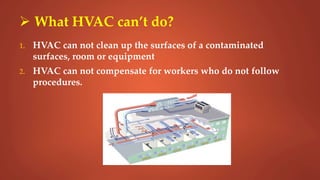
 What HVAC can’t do?
1. HVAC can not clean up the surfaces of a contaminated
surfaces, room or equipment
2. HVAC can not compensate for workers who do not follow
procedures.
Pharmaceutical hvac system by adnan et.al

Pharmaceutical hvac system by adnan et.al

  • 1.
  • 2.
    Group No :01 PRESENTED BY: RANA AHMED (PHA-14001) MAHFUJUL HASAN (PHA-14002) SHAHIDA YEASMIN (PHA-14005) SHAMIMA AKTER SUMI (PHA-14007) RUMA AKTER (PHA-14008) A.H.M.ADNAN KHAN (PHA-14033)
  • 3.
     Contents  Introduction History  Components of HVAC system  System design  HVAC requirements  Basic HVAC system  Ventilation  System selection guidelines  Air conditioning  What can HVAC system do and what do not ?
  • 4.
     INTRODUCTION  HVACmeans heating, ventilating(ventilation), and air conditioning. It is the technology of indoor and vehicular environmental comfort.  It goals to provide thermal comport and acceptable indoor air quality.
  • 5.
     History  1000s-1400s:Egyptians used man powered fans and the Indians used rope fans.  1500s-1600s: In France, ventilating machines were used in the mines. These machines contains series of fans.  1700s-1800s: Many countries used stove to built of bricks and centrifugal fan used.  1900s: This era saw a sudden steps in the inventions and evalution of the hvac system.
  • 6.
     Components ofHVAC system : Components of HVAC system furnace thermostat Heat exchanger Evapora tor coilCondensing unit Refrigerant liner Ductwork Vents
  • 7.
    • Furnace: Maincomponent of HVAC system. It is filled with hot water, air, or steam and passes cold or hot air outward into the ducts. • Thermostat: When the temperature becomes too hot or cold the thermostat will trigger the heat exchanger or the evaporator coil-condensing unit. • Heat exchanger: Transfer heat another medium. • Evaporator coil: It performs opposite roles of heat exchanger. It is connected with condensing unit filled with refrigerant gas.
  • 8.
    • Condensing unit:It is connected to the evaporator coil. It is installed outside of the building and filled with refrigerant gas. • Refrigerant lines: It carries refrigerant. • Ductwork: System of ducts that transports air warmed or cooled. • Vents: Rectangular outlets which transfer the heated or cooled air from the duct system into the individual rooms of pharmaceutical industry.
  • 9.
     Steps forselection of a system : • Budget of client • Requirement of client • Use of space • Outside condition • Floor layout • Location and dimension of beam • Power availability
  • 10.
     SYSTEM DESIGN: The efficacy of the system design is based on proper consideration of the following factors: 1. Building construction and layout design 2. HVAC requirements system-wise and then room-wise. 3. Cooling load and Airflow compilation 4. Selection of air flow pattern
  • 11.
    CONTINUE…. 5. Pressurization ofrooms 6. Air handling system 7. Duct system design and construction 8. Selection, location and mounting of filtration system 9. DE fumigation requirement 10. Testing and validation 11. Documentation
  • 12.
     Qualification testof HVAC system :  Following tests are to be carried out in order to inquiry the qualification of HVAC system • Installed hepa filter integrity • Air velocity and air changes per hour calculation • Air flow pattern visualization study using visible smoke • Room differential pressure monitoring • Room temperature and relative humidity monitoring • Air borne particle count Hepa Filter
  • 13.
     HVAC REQUIRMENTS Definethe HVAC requirements  System-wise  Room-wise. The requirements defined are: 1. Room temperature 2. Relative humidity 3. Cleanliness level 4. Room pressure.
  • 14.
     BASIC HVACSYSTEMS 1. Once –thru Air: Air is conditioned, enters the space and is discarded. 2. Recirculated Air: Air is conditioned, enters the space and portion is reconditioned.
  • 15.
     Once –thruAir Advantages Advantages:  Fresh air  Can handle hazardous materials  Exhaust duct is usually easy Disadvantages:  Expensive to operate  Filter loading very high  Potential need for dust collection
  • 16.
     Applications  Labswith hoods, potential hazards  Bulk Pharmaceutical Chemical  Oral Solid Dosage (OSD) plants where potent products/materials exposed  Where high potential of product  Some bio API facilities with exposed potent materials
  • 17.
     Recirculated HVAC Advantages: Usually less air filter loading  Opportunity for better air-filtration  Less challenge to HVAC  Lower cooling/heating cost
  • 18.
     Disadvantages  Returnair handling may be complicated  Chance of cross contamination Applications 1. Classified spaces such as sterile manufacture 2. Finished oral solid dosage(OSD) 3. Final bulk APIs, usually with dedicated air handler for each room
  • 19.
     VENTILATION Ventilation isthe process of changing or replacing air in any space to control temperature or remove any combination of moisture, odours, smoke, heat, dust, airborne bacteria, or carbon dioxide, and to replenish oxygen. Methods for ventilating a building maybe divided into 1.Mechanical /forced 2.Natural types.
  • 20.
     MECHANAICAL /FORCED "Mechanical" or "forced" ventilation is provided by an air handler and used to control indoor air quality. Ceiling fans and table/floor fans circulate air within a room for the purpose of reducing the perceived temperature by increasing evaporation of perspiration on the skin of the occupants.
  • 21.
     NATURAL VENTILATION oNatural ventilation is the ventilation of a building with outside air without using fans or other mechanical systems. It can be via operable windows, louvers, or trickle vents when spaces are small and the architecture permits. o In more complex schemes, warm air is allowed to rise and flow out high building openings to the outside (stack effect), causing cool outside air to be drawn into low building openings.
  • 22.
     SYSTEM SELECTIONGUIDELINES:  Financial factors  Initial cost  Operating costs  Maintenance and repair cost  Equipment replacement or upgrading cost  Equipment failure cost  Return on investment (ROI)  Energy costs  Building conditions  New or existing building or space  Location  Orientation & Architecture  Climate and shading
  • 23.
    CONTINUE  Climate andshading  Configuration & Construction  Building conditions  New or existing building or space  Location  Factors affecting HVAC system : • Use of space • Inside room design condition • Filtration level required • Ambient condition • Glass area exposed to sun • Occupancy • Lighting load
  • 24.
     AIR CONDITIONING Anair conditioning system provides cooling and humidity control for all or part of a building. Refrigeration conduction media such as water, air, ice, and chemicals are referred to as refrigerants. REFRIGERATION CYCLE I. The system refrigerant starts its cycle in a gaseous state. The compressor pumps the refrigerant gas up to a high pressure and temperature.
  • 25.
    II. From thereit enters a heat exchanger where it loses energy (heat) to the outside, cools, and condenses into its liquid phase. III. An expansion valve regulates the refrigerant liquid to flow at the proper rate. V. The liquid refrigerant is returned to another heat exchanger where it is allowed to evaporate, hence the heat exchanger is often called an evaporating coil or evaporator.
  • 26.
    What can HVACdo? 1. Control airborne particles, dust and micro-organisms 2. Maintain room pressure 3. Maintain space moisture 4. Maintain space temperature 5. Natural Ventilation Monitoring 6. Mechanical or Forced Ventilation Monitoring 7. Room Air Distribution 8. Increased Building Safety
  • 27.
     What HVACcan’t do? 1. HVAC can not clean up the surfaces of a contaminated surfaces, room or equipment 2. HVAC can not compensate for workers who do not follow procedures.