AIR CIRCULATION MAINTENANCE
INDUSTRY FOR STERILE AND NON
STERILE AREA
Presented by : Ashvin Bhoge
M-pharmacy first year(PQA)
Dr. D.Y Patil college of pharmacy,akurdi,pune.
Contents :
 INTRODUCTION
 OBJECTIVES
 APPLICATIONS
 HVAC SYSTEM
 FILTERS
 CONCLUSION
 REFERENCES
INTRODUCTION:
 Air circulation system plays a major role in the quality of
pharmaceutical product manufacturing( all types).(3)
 It is the technology of indoor and manufacturing space
environmental control and or comfort.
 The uncontrolled environment can lead to product degradation,
loss of product, and , product contamination/cross contamination.
Objective :
 To understand the need for air handling system in the
pharmaceutical industry(3)
 The technical requirements for air handling system
 Different types of air handling system
 Qualification and validation of HVAC system
 Monitoring and maintenance
APPLICATIONS :
 Product protection:
protect from contamination , cross contamination, prevent
contamination by operatives, correct conditions of humidity and
temperature.
 Personnel protection:
prevent contact with dust, prevent contact with fumes, good
comfort condition
 Environment protection:
No dust discharge, no fumes discharge, no effluent discharge
 Preservation of materials and equipment
Handling, holding and storage
HVAC SYSTEM :
 Can be simply said to be a utility system used to provide air
ventilation, heating, cooling and air conditioning services to a building
or a pharmaceutical space for drug manufacturing.(1,2,3)
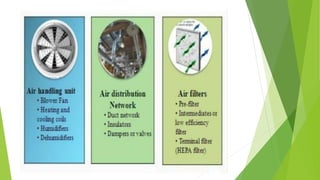
 COMPONENT OF HVAC :
 Ducting ( for delivery of controlled air)
 Fan component
 Vibration isolator (flex joint)
 Heating and /or cooling coil
 HEPA Filters
 Damper ( fixed adjustment of volume of air)
 Dehumidifiers
 Flow rate controller
 Humidity, Temperature, Pressure sensors, alarms and audit log
system
 Dust extractors
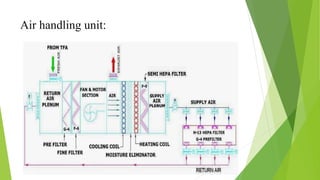
Air handling unit:
Clean room concept :
There are two basic concepts of clean air delivery for
pharmaceutical production(1,5)
 Full Fresh air or Make up air
 Recirculation or Return air
All to provide the need conditioned clean air for intended clean
room required for manufacturing areas.
What is clean area/ room/space?
 A closed room supplied with filtered ( purified air ) in which the
particulate and microbial contamination load is below specified
level. And is used in such a way to minimise introduction,
generation and retention of contaminants.
Clean room classification
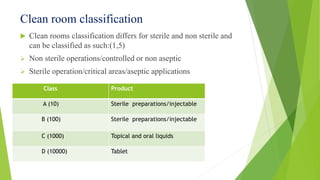
 Clean rooms classification differs for sterile and non sterile and
can be classified as such:(1,5)
 Non sterile operations/controlled or non aseptic
 Sterile operation/critical areas/aseptic applications
Class Product
A (10) Sterile preparations/injectable
B (100) Sterile preparations/injectable
C (1000) Topical and oral liquids
D (10000) Tablet
FRESH AIR ( 100%)/ONCE THROUGH
SYSTEM
 Applicable to factory dealing with toxic products.(3)
 Low risk of cross contamination
 Offers abundant oxygen rich fresh air for dilution of contaminants
 Air leakage between the supply and exhaust air should be
prevented, supply air pressure should be higher that the exhaust
air pressure .
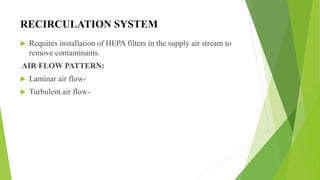
RECIRCULATION SYSTEM
 Requires installation of HEPA filters in the supply air stream to
remove contaminants.
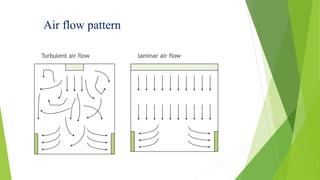
AIR FLOW PATTERN:
 Laminar air flow-
 Turbulent air flow-
Air flow pattern
Turbulent air flow laminar air flow
Air filters
POSITIONING OF FILTERS
 The required cleanliness or purity of air can be achieved with
effective cleaning of the external air or recirculated air through
correctly designed and installed filters to meet the specification
Types of air filters :
 Ultra Low Particulate Air filter( ULPA)
 High Efficiency particulate air filter( HEPA)
 Packed towers
 Membrane filter cartridges
 Hydrophobic filters
HEPA FILTERS
 HEPA is an acronym for “High Efficiency Particulate Air”
 This type of air filter can remove at least 99.97% of dust, pollen,
mold, bacteria and any airborne particles with a size of 0.3
micrometres (μm).
HEPA FILTERS
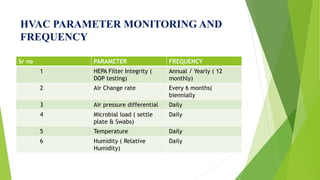
HVAC PARAMETER MONITORING AND
FREQUENCY
Sr no PARAMETER FREQUENCY
1 HEPA Filter Integrity (
DOP testing)
Annual / Yearly ( 12
monthly)
2 Air Change rate Every 6 months(
biennially
3 Air pressure differential Daily
4 Microbial load ( settle
plate & Swabs)
Daily
5 Temperature Daily
6 Humidity ( Relative
Humidity)
Daily
Conclusion
 The pharmaceutical production must effectively control the
contamination from people, raw materials, finished products as
well as accommodating-services, process plant and equipment.
The requirements that are available involved in the overall design
and a complex construction process.(5)
REFERENCES :
1.HVAC Design for Pharmaceutical Products, A. Bhatia
2. HVAC Basics; Vishal Katyar
3. AIR HANDLING SYSTEM IN PHARMACEUTICAL
MANUFACTURING by R.A.BINITIE.
4.Maintanance of sterile area /authorstream .
5. Mikhail Kitain CLEANROOMS IN PHARMACEUTICAL
PRODUCTION.
6.HEPA air polution control technology .
THANK YOU

Air circulation

  • 1.
    AIR CIRCULATION MAINTENANCE INDUSTRYFOR STERILE AND NON STERILE AREA Presented by : Ashvin Bhoge M-pharmacy first year(PQA) Dr. D.Y Patil college of pharmacy,akurdi,pune.
  • 2.
    Contents :  INTRODUCTION OBJECTIVES  APPLICATIONS  HVAC SYSTEM  FILTERS  CONCLUSION  REFERENCES
  • 3.
    INTRODUCTION:  Air circulationsystem plays a major role in the quality of pharmaceutical product manufacturing( all types).(3)  It is the technology of indoor and manufacturing space environmental control and or comfort.  The uncontrolled environment can lead to product degradation, loss of product, and , product contamination/cross contamination.
  • 4.
    Objective :  Tounderstand the need for air handling system in the pharmaceutical industry(3)  The technical requirements for air handling system  Different types of air handling system  Qualification and validation of HVAC system  Monitoring and maintenance
  • 5.
    APPLICATIONS :  Productprotection: protect from contamination , cross contamination, prevent contamination by operatives, correct conditions of humidity and temperature.  Personnel protection: prevent contact with dust, prevent contact with fumes, good comfort condition  Environment protection: No dust discharge, no fumes discharge, no effluent discharge  Preservation of materials and equipment Handling, holding and storage
  • 6.
    HVAC SYSTEM : Can be simply said to be a utility system used to provide air ventilation, heating, cooling and air conditioning services to a building or a pharmaceutical space for drug manufacturing.(1,2,3)  COMPONENT OF HVAC :  Ducting ( for delivery of controlled air)  Fan component  Vibration isolator (flex joint)  Heating and /or cooling coil  HEPA Filters  Damper ( fixed adjustment of volume of air)  Dehumidifiers  Flow rate controller  Humidity, Temperature, Pressure sensors, alarms and audit log system  Dust extractors
  • 8.
  • 10.
    Clean room concept: There are two basic concepts of clean air delivery for pharmaceutical production(1,5)  Full Fresh air or Make up air  Recirculation or Return air All to provide the need conditioned clean air for intended clean room required for manufacturing areas. What is clean area/ room/space?  A closed room supplied with filtered ( purified air ) in which the particulate and microbial contamination load is below specified level. And is used in such a way to minimise introduction, generation and retention of contaminants.
  • 11.
    Clean room classification Clean rooms classification differs for sterile and non sterile and can be classified as such:(1,5)  Non sterile operations/controlled or non aseptic  Sterile operation/critical areas/aseptic applications Class Product A (10) Sterile preparations/injectable B (100) Sterile preparations/injectable C (1000) Topical and oral liquids D (10000) Tablet
  • 12.
    FRESH AIR (100%)/ONCE THROUGH SYSTEM  Applicable to factory dealing with toxic products.(3)  Low risk of cross contamination  Offers abundant oxygen rich fresh air for dilution of contaminants  Air leakage between the supply and exhaust air should be prevented, supply air pressure should be higher that the exhaust air pressure .
  • 13.
    RECIRCULATION SYSTEM  Requiresinstallation of HEPA filters in the supply air stream to remove contaminants. AIR FLOW PATTERN:  Laminar air flow-  Turbulent air flow-
  • 14.
    Air flow pattern Turbulentair flow laminar air flow
  • 15.
    Air filters POSITIONING OFFILTERS  The required cleanliness or purity of air can be achieved with effective cleaning of the external air or recirculated air through correctly designed and installed filters to meet the specification Types of air filters :  Ultra Low Particulate Air filter( ULPA)  High Efficiency particulate air filter( HEPA)  Packed towers  Membrane filter cartridges  Hydrophobic filters
  • 16.
    HEPA FILTERS  HEPAis an acronym for “High Efficiency Particulate Air”  This type of air filter can remove at least 99.97% of dust, pollen, mold, bacteria and any airborne particles with a size of 0.3 micrometres (μm).
  • 17.
  • 18.
    HVAC PARAMETER MONITORINGAND FREQUENCY Sr no PARAMETER FREQUENCY 1 HEPA Filter Integrity ( DOP testing) Annual / Yearly ( 12 monthly) 2 Air Change rate Every 6 months( biennially 3 Air pressure differential Daily 4 Microbial load ( settle plate & Swabs) Daily 5 Temperature Daily 6 Humidity ( Relative Humidity) Daily
  • 19.
    Conclusion  The pharmaceuticalproduction must effectively control the contamination from people, raw materials, finished products as well as accommodating-services, process plant and equipment. The requirements that are available involved in the overall design and a complex construction process.(5)
  • 20.
    REFERENCES : 1.HVAC Designfor Pharmaceutical Products, A. Bhatia 2. HVAC Basics; Vishal Katyar 3. AIR HANDLING SYSTEM IN PHARMACEUTICAL MANUFACTURING by R.A.BINITIE. 4.Maintanance of sterile area /authorstream . 5. Mikhail Kitain CLEANROOMS IN PHARMACEUTICAL PRODUCTION. 6.HEPA air polution control technology .
  • 21.