By Abhishek Sharma


      Submitted To: RVM Finishing School & Consultancy
 Indian Pharmaceutical Evolution


 Pharmaceutical Market(CDSCO)


 Major Players


 SWOT Analysis


 GDP Relation


 Future
                  Submitted To: RVM Finishing School &
                                          COnsultancy
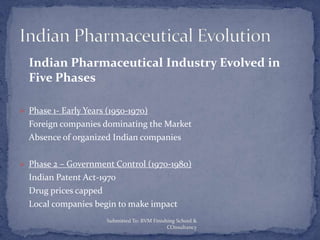
Indian Pharmaceutical Industry Evolved in
  Five Phases

 Phase 1- Early Years (1950-1970)
  Foreign companies dominating the Market
  Absence of organized Indian companies

 Phase 2 – Government Control (1970-1980)
  Indian Patent Act-1970
  Drug prices capped
  Local companies begin to make impact
                       Submitted To: RVM Finishing School &
                                               COnsultancy
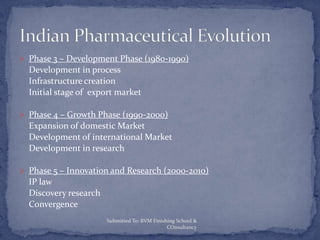
 Phase 3 – Development Phase (1980-1990)
  Development in process
  Infrastructure creation
  Initial stage of export market

 Phase 4 – Growth Phase (1990-2000)
  Expansion of domestic Market
  Development of international Market
  Development in research

 Phase 5 – Innovation and Research (2000-2010)
  IP law
  Discovery research
  Convergence
                       Submitted To: RVM Finishing School &
                                               COnsultancy
Submitted To: RVM Finishing School &
                        COnsultancy
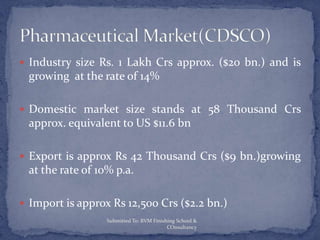
 Industry size Rs. 1 Lakh Crs approx. ($20 bn.) and is
 growing at the rate of 14%

 Domestic market size stands at 58 Thousand Crs
 approx. equivalent to US $11.6 bn

 Export is approx Rs 42 Thousand Crs ($9 bn.)growing
 at the rate of 10% p.a.

 Import is approx Rs 12,500 Crs ($2.2 bn.)
                  Submitted To: RVM Finishing School &
                                          COnsultancy
 India is 3rd largest in terms of volume 13th in terms of
  value

 Export of Biotech products and Biopharmaceuticals
  US $1.36 bn.

 India is 800 WHO-GMP certified and 172 US FDA
  Approvals along with 153 EDQM certified facilities

 India has the largest number of manufacturing
  facilities outside US
                   Submitted To: RVM Finishing School &
                                           COnsultancy
 Drugs from India exported to more than 200 countries


 Vaccines from India are exported to more than 151
 countries


                 Submitted To: RVM Finishing School &
                                         COnsultancy
 Sun Pharma
  Sun Pharma has market Capitalization around
  Rs 73,018.88 Cr.
 Cipla
  Cipla has market capitalization of around Rs 33,280 Cr.
 Dr Reddys Labs
  Dr. Reddys Lab has market capitalization of around
  Rs 31,106.79 Cr.
 Lupin
  Lupin has market capitalization of Rs 26,196 Cr.

                 Submitted To: RVM Finishing School &
                                         COnsultancy
 Strengths
   Cost effective
   Strong Manufacturing Base
   Ability of high quality skilled workforce
   Excellent marketing and distribution network
   Diverse ecosystem
 Weakness
   Less investment is research and development
   Lack of coordination between industry and academic
   Negligible expenditure on healthcare in the country
   Manufacturing of fake and low quality medicines

                 Submitted To: RVM Finishing School &
                                         COnsultancy
 Opportunities
   Increased export potential
   Marketing tie ups with multinational companies to sell
    their products in domestic market
   Immense scope to position India as a centre for
    international clinical trials
   Key player in global pharmaceutical R&D
   Export of generic drugs to developed market


                  Submitted To: RVM Finishing School &
                                          COnsultancy
 Threats
   Product patent regime is a major threat to domestic
    industry unless the industry takes up R&D initiative
    aggressively
   Drug price control order puts undue pressure on
    product prices, affecting the profitability of
    pharmaceutical companies.
   The new MRP based excise duty regime threatens the
    business of smaller pharmaceutical companies


                  Submitted To: RVM Finishing School &
                                          COnsultancy
 Pharma industry generally grows at about 1.5-1.6 times
  the Gross Domestic Product
 Globally, India ranks third in terms of manufacturing
  Pharma products by volume
 According to a study by FICCI-Ernst & Young India will
  open a probable US$ 8 billion market for MNCs selling
  expensive drugs by 2015
 The study also says that the domestic Pharma market
  is likely to reach US$ 20 billion by 2015


                 Submitted To: RVM Finishing School &
                                         COnsultancy
 The Minister of Commerce estimates that US$ 6.31
  billion will be invested in the domestic pharmaceutical
  sector
 Public spending on healthcare is likely to raise from 7
  per cent of GDP in 2007 to 13 per cent of GDP by 2015
 Dr Reddy's Laboratories has tied up with
  GlaxoSmithKline to develop and market generics and
  formulations in upcoming markets overseas.
 Due to the low cost of R&D, the Indian pharmaceutical
  off-shoring industry is designated to turn out to be a
  US$ 2.5 billion opportunity by 2012

                 Submitted To: RVM Finishing School &
                                         COnsultancy
Thank You

 Submitted To: RVM Finishing School &
                         COnsultancy

Pharma industry

  • 1.
    By Abhishek Sharma Submitted To: RVM Finishing School & Consultancy
  • 2.
     Indian PharmaceuticalEvolution  Pharmaceutical Market(CDSCO)  Major Players  SWOT Analysis  GDP Relation  Future Submitted To: RVM Finishing School & COnsultancy
  • 3.
    Indian Pharmaceutical IndustryEvolved in Five Phases  Phase 1- Early Years (1950-1970) Foreign companies dominating the Market Absence of organized Indian companies  Phase 2 – Government Control (1970-1980) Indian Patent Act-1970 Drug prices capped Local companies begin to make impact Submitted To: RVM Finishing School & COnsultancy
  • 4.
     Phase 3– Development Phase (1980-1990) Development in process Infrastructure creation Initial stage of export market  Phase 4 – Growth Phase (1990-2000) Expansion of domestic Market Development of international Market Development in research  Phase 5 – Innovation and Research (2000-2010) IP law Discovery research Convergence Submitted To: RVM Finishing School & COnsultancy
  • 5.
    Submitted To: RVMFinishing School & COnsultancy
  • 6.
     Industry sizeRs. 1 Lakh Crs approx. ($20 bn.) and is growing at the rate of 14%  Domestic market size stands at 58 Thousand Crs approx. equivalent to US $11.6 bn  Export is approx Rs 42 Thousand Crs ($9 bn.)growing at the rate of 10% p.a.  Import is approx Rs 12,500 Crs ($2.2 bn.) Submitted To: RVM Finishing School & COnsultancy
  • 7.
     India is3rd largest in terms of volume 13th in terms of value  Export of Biotech products and Biopharmaceuticals US $1.36 bn.  India is 800 WHO-GMP certified and 172 US FDA Approvals along with 153 EDQM certified facilities  India has the largest number of manufacturing facilities outside US Submitted To: RVM Finishing School & COnsultancy
  • 8.
     Drugs fromIndia exported to more than 200 countries  Vaccines from India are exported to more than 151 countries Submitted To: RVM Finishing School & COnsultancy
  • 9.
     Sun Pharma Sun Pharma has market Capitalization around Rs 73,018.88 Cr.  Cipla Cipla has market capitalization of around Rs 33,280 Cr.  Dr Reddys Labs Dr. Reddys Lab has market capitalization of around Rs 31,106.79 Cr.  Lupin Lupin has market capitalization of Rs 26,196 Cr. Submitted To: RVM Finishing School & COnsultancy
  • 10.
     Strengths  Cost effective  Strong Manufacturing Base  Ability of high quality skilled workforce  Excellent marketing and distribution network  Diverse ecosystem  Weakness  Less investment is research and development  Lack of coordination between industry and academic  Negligible expenditure on healthcare in the country  Manufacturing of fake and low quality medicines Submitted To: RVM Finishing School & COnsultancy
  • 11.
     Opportunities  Increased export potential  Marketing tie ups with multinational companies to sell their products in domestic market  Immense scope to position India as a centre for international clinical trials  Key player in global pharmaceutical R&D  Export of generic drugs to developed market Submitted To: RVM Finishing School & COnsultancy
  • 12.
     Threats  Product patent regime is a major threat to domestic industry unless the industry takes up R&D initiative aggressively  Drug price control order puts undue pressure on product prices, affecting the profitability of pharmaceutical companies.  The new MRP based excise duty regime threatens the business of smaller pharmaceutical companies Submitted To: RVM Finishing School & COnsultancy
  • 13.
     Pharma industrygenerally grows at about 1.5-1.6 times the Gross Domestic Product  Globally, India ranks third in terms of manufacturing Pharma products by volume  According to a study by FICCI-Ernst & Young India will open a probable US$ 8 billion market for MNCs selling expensive drugs by 2015  The study also says that the domestic Pharma market is likely to reach US$ 20 billion by 2015 Submitted To: RVM Finishing School & COnsultancy
  • 14.
     The Ministerof Commerce estimates that US$ 6.31 billion will be invested in the domestic pharmaceutical sector  Public spending on healthcare is likely to raise from 7 per cent of GDP in 2007 to 13 per cent of GDP by 2015  Dr Reddy's Laboratories has tied up with GlaxoSmithKline to develop and market generics and formulations in upcoming markets overseas.  Due to the low cost of R&D, the Indian pharmaceutical off-shoring industry is designated to turn out to be a US$ 2.5 billion opportunity by 2012 Submitted To: RVM Finishing School & COnsultancy
  • 15.
    Thank You SubmittedTo: RVM Finishing School & COnsultancy