









www.drugragulations.org 1
Presentation prepared by Drug Regulations – a not for
profit organization. Visit www.drugregulations.org for
the latest in Pharmaceuticals.
This presentation is compiled from freely available
resource like the website of WHO, specifically the
WHO Draft Guidance on HVAC.
“Drug Regulations” is a non profit organization
which provides free online resource to the
Pharmaceutical Professional.
Visit http://www.drugregulations.org for latest
information from the world of Pharmaceuticals.
11/13/2015 2
Drug Regulations : Online
Resource for Latest Information
3
 Heating, ventilation and air-conditioning (HVAC) play an
important role in ensuring the manufacture of quality
pharmaceutical products.
 A well-designed HVAC system will also provide comfortable
conditions for operators.
 WHO guidelines mainly focus on recommendations for systems
for solid dosage forms.
 The guidelines also refer to other systems or components which
are not relevant to solid dosage form plants.
 This may assist in providing a comparison between the
requirements for solid dosage-form plants and other systems.
http://www.drugregulations.org
4
 HVAC system design influences architectural layouts
◦ Airlock positions, doorways and lobbies.
 The architectural components have an effect on
◦ Room pressure, differential cascades and cross- contamination
control.
 The prevention of contamination and cross-
contamination is an essential design consideration
 The design of HVAC system should be considered at
the concept design stage.
http://www.drugregulations.org
5
 Temperature, relative humidity and ventilation should be
appropriate
 Above should not adversely affect the quality of
pharmaceutical products during their manufacture and
storage, or the accurate functioning of equipment.
 This WHO guidance focuses on the design, installation,
qualification and maintenance of the HVAC systems.
http://www.drugregulations.org
6
 These guidelines are intended to complement those
provided in Good manufacturing practices for
pharmaceutical Products.
 The additional standards are supplementary to the general
requirements set out in the parent guide.
http://www.drugregulations.org
7
 GMP requirements for HVAC systems for the manufacture
of solid dosage forms.
 Most of the system design principles also apply to facilities
for
◦ Other dosage forms
◦ Other classes of products
◦ Biological products,
◦ Herbal medicines,
◦ Complimentary medicines
◦ Finishing process steps for APIs
http://www.drugregulations.org
8
 Requirements for sterile products and
hazardous products covered in
separate Guidelines
◦ WHO Technical Report Series, No. 957, Annex 3,
Technical Report Series, No. 961 Annex 6
◦ Working document WHO/BS/2015.2253, intended
to replace Technical Report Series, No. 822, Annex
1, 1992
http://www.drugregulations.org
9
 A basic guide for use by pharmaceutical manufacturers and
GMP inspectors.
 They are not intended to be prescriptive in specifying
requirements and design parameters.
 There are many parameters affecting a clean area condition
 Therefore difficult to lay down the specific requirements
for one particular parameter in isolation.
 User requirements may vary from one manufacturer to the
next.
http://www.drugregulations.org
10
 Design parameters and user requirements should,
therefore, be set realistically for each project.
◦ Cost-effective design
◦ Comply with all regulatory standards
 Ensure that product quality and safety are not
compromised.
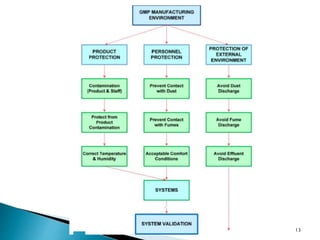
 The three primary aspects to be considered are Protection
of
◦ Product
◦ Personnel
◦ Environment
http://www.drugregulations.org
11
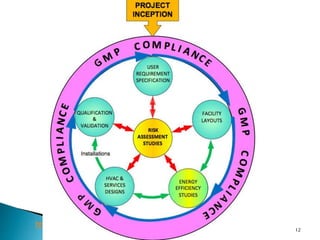
 Consider the products to be manufactured when establishing
system design parameters.
 Multiple product facility will have stringent design parameters
◦ cross-contamination control, compared with a single product facility.
 Risk assessment studies should be an integral part of the
facility design and implementation
 Implement R A from the URS stage right through to validation
 Validation protocols and criteria should be justified by links to
a written risk assessment.
http://www.drugregulations.org
12
http://www.drugregulations.org
13
14
 Close relationship between architectural design
and HVAC design
 Both have an impact on the functionality of each
other
 HVAC system design influences architectural
layouts
◦ Airlock positions
◦ Doorways
◦ Lobbies
http://www.drugregulations.org
15
 The architectural layouts have an effect on room pressure
differential cascades and cross-contamination control.
 The prevention of contamination and cross-contamination
is an essential design consideration of the HVAC system.
 The design of the HVAC system should be considered at
the concept design stage
 Architectural layout must ensure that
◦ Material flow is in a logical sequence
◦ Excluding material flow reversals where possible.
http://www.drugregulations.org
16
 Efficient operation of the air-handling system and
cleanliness levels attained are reliant on the correct
building layout and building finishes,
 Consider items given in Subsequent slides
http://www.drugregulations.org
17
 Adequate airlocks, change rooms and passages should be
provided to protect passage between different cleanliness
conditions.
◦ Personnel airlocks (PAL) and/or material airlocks (MAL),
 These should have supply and extract air systems as
appropriate.
 Areas such as airlocks, change rooms and passages,
should be designed so that the required pressure cascades
can be achieved.
http://www.drugregulations.org
18
 Detailed diagrams depicting pressure cascades, air flow
directions and flow routes for personnel and materials should
be prepared and maintained.
 Where possible, personnel and materials should not move
from a higher cleanliness zone to a lower cleanliness zone and
back to a higher cleanliness zone.
 If moving from a lower cleanliness zone to a higher cleanliness
zone, changing /decontamination procedures should be
followed
 The final stage of the changing room should be the same GMP
classification grade as the area into which it leads.
http://www.drugregulations.org
19
 Changing rooms should be of a sufficient size to allow for
ease of changing.
 Changing rooms should be equipped with mirrors so that
personnel can confirm the correct fit of garments before
leaving the changing room.
 Appropriate hand wash and sanitizing facilities should be
provided.
 Hand-wash basins should be provided with elbow taps or
sensor operated taps.
http://www.drugregulations.org
20
 Door gaps around the door perimeter have a marked impact on the
pressure differential across the doorway.
 The fit of the doors should ensure that the correct leakages are allowed
for.
 Likewise the maintenance of doors is a critical factor in room pressure
control
 A poorly fitting door can severely compromise a room pressure
differential
 Where the opening and closing of airlock doors could lead to cross-
Contamination, these airlock doors should not be opened simultaneously.
 An interlocking system and a visual and/or audible warning system
should be operated to prevent the opening of more than one door at a
time.
http://www.drugregulations.org
21
 Doors should be carefully designed to avoid un-cleanable
recesses;
 Sliding doors may be undesirable for this reason.
 Swing doors should open to the high-pressure side and be
provided with self-closers.
 Exceptions are permitted based on egress and site environmental,
fire, health and safety containment requirements.
http://www.drugregulations.org
22
 The choice of building finishes and materials also has an impact
on air conditioning performance and air cleanliness.
 Materials should be selected that will provide a well-sealed
building to facilitate room pressure control.
 Materials and paint finishes should also be non-dust and particle
liberating as this impacts on room cleanliness.
 Finishes should be easy to clean and non-absorbent.
 To reduce the accumulation of dust and to facilitate cleaning,
◦ There should be no un-cleanable recesses and
◦ A minimum of projecting ledges, shelves, cupboards and equipment.
http://www.drugregulations.org
23
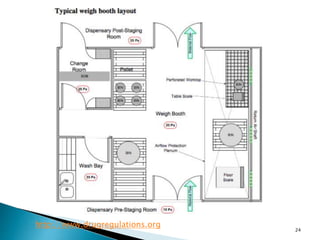
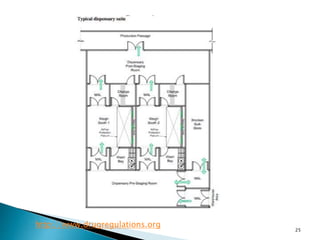
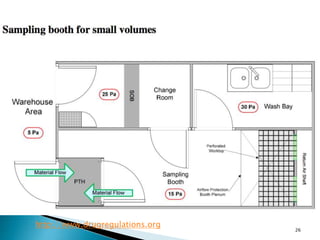
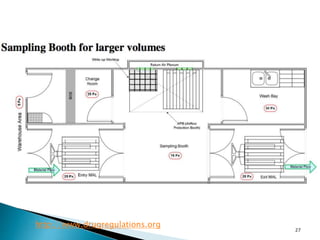
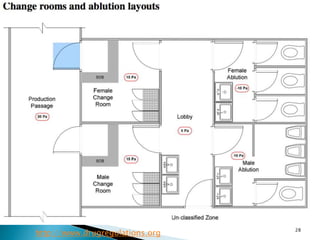
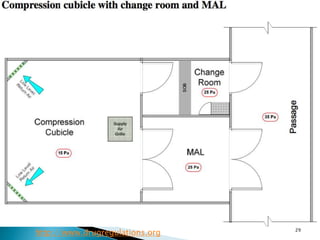
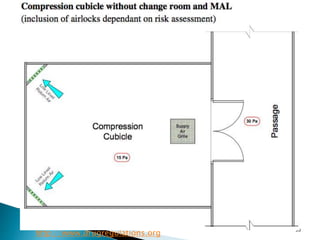
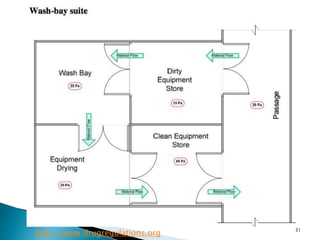
 Diagrams in subsequent slides illustrate some typical room and
suite layouts with their associated room pressures.
 These are purely examples and other factors may dictate different
room arrangements and room pressures.
http://www.drugregulations.org
24
http://www.drugregulations.org
25
http://www.drugregulations.org
26
http://www.drugregulations.org
27
http://www.drugregulations.org
28
http://www.drugregulations.org
29
http://www.drugregulations.org
30
http://www.drugregulations.org
31
http://www.drugregulations.org
32
 The required degree of air cleanliness in most OSD
manufacturing facilities
◦ Can normally be achieved without the use of high-efficiency particulate
air (HEPA) filters
◦ Provided the air is not recirculated or in the case of a single-product
facility.
 Many open product zones of OSD form facilities are
capable of meeting ISO 14644-1 Class 8 or Grade D, “at-
rest” condition,
◦ Measured against particle sizes of 0.5 μm and 5 μm,
◦ Cleanliness may not necessarily be classified as such by manufacturers.
http://www.drugregulations.org
33
 A risk assessment should be carried out to
determine
◦ The cleanroom conditions required and
◦ The extent of validation required.
 There are two basic concepts of air delivery to
pharmaceutical production facilities:
◦ A recirculation system, and
◦ A full fresh air system (100% outside air supply).
http://www.drugregulations.org
34
 For recirculation systems the amount of fresh air
should not be determined arbitrarily on a percentage
basis, but, for example, by the following criteria:
◦ Sufficient fresh air to compensate for leakage from the
facility and loss through exhaust air systems;
◦ Sufficient fresh air to comply with national building
regulations (depending on occupant density, between 1 and
2.5 ACPH will often satisfy occupancy requirements);
◦ Sufficient fresh air for odor control;
◦ Sufficient fresh air to provide the required building
pressurization
http://www.drugregulations.org
35
 Automated monitoring systems
◦ Capable of indicating any out-of-specification (OOS)
condition without delay by means of an alarm or similar
system.
 Sophisticated computer- based data monitoring
systems
◦ Can aide with planning of preventive maintenance and
can also provide trend logging.
http://www.drugregulations.org
36
 This type of system is commonly referred to
as
◦ A building management system (BMS),
◦ Building automation system (BAS) or
◦ System control and data acquisition (SCADA)
system.
 If these systems are used for critical
decision-making, they should be validated.
http://www.drugregulations.org
37
 If the BMS is not validated in full (or in part for
these critical parameters),
◦ an independent validated environmental monitoring
system (EMS) should be provided, specifically for
recording and alarming critical parameters.
 Critical parameters could include for example
◦ Room temperature in production areas
◦ Humidity
◦ Differential pressures
◦ Fan failure alarms, etc.
http://www.drugregulations.org
38
 Failure of a supply air fan, return air fan, exhaust air
fan or dust extract system fan can cause a system
imbalance
 This results in a pressure cascade malfunction with a
resultant airflow reversal.
 A fan interlock failure matrix should be set up,
◦ If a fan serving a high pressure zone fails, then any fans serving
surrounding lower pressure areas should automatically stop,
 This should prevent an airflow reversal and possible cross-contamination.
http://www.drugregulations.org
39
 This fan stop-start matrix should apply to the
switching on and switching off of systems to
ensure that there is no flow reversal causing
cross-contamination.
 Appropriate alarm systems should be in place to
alert personnel if a critical fan fails
 All critical alarms should be easily identifiable
and visible and/or audible to relevant personnel.
http://www.drugregulations.org
40
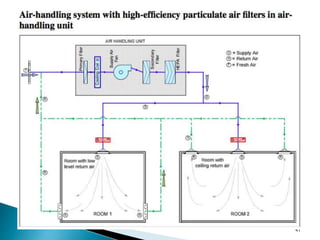
 The positioning of supply and extract grilles should be
such as to provide effective room flushing.
 Low-level return or exhaust air grilles are usually
preferred.
 However, where this is not possible, a higher air change
rate may be needed to achieve a specified clean area
condition, e.g. where ceiling return air grilles are used.
 There may be alternative locations for return air.
 For example, referring to Figure in next slides , Room 1
(low-level return air) and Room 2 (ceiling return air)..
http://www.drugregulations.org
41
http://www.drugregulations.org
42
 The airflow schematics of the two systems (last &
subsequent slides) indicate air-handling units with return
air or recirculated air, having a percentage of fresh air
added.
 Depending on product characteristics and dust loading it is
sometimes preferable to fit filters on return air outlets or in
return air ducting.
http://www.drugregulations.org
43
http://www.drugregulations.org
44
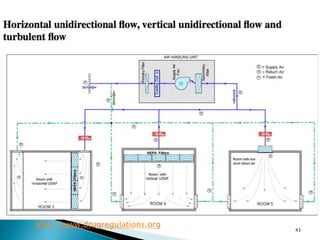
 Last figure is a schematic diagram of an air-handling system
serving rooms with horizontal unidirectional flow, vertical
unidirectional flow and turbulent flow, for rooms 3, 4 and 5,
respectively.
 In this case the HEPA filters are terminally mounted at the
rooms, and not in the AHU.
 Terminally mounted HEPA filters can assist with preventing
cross- contamination from room to room in the event of a fan
failure condition.
 The decision whether to install terminal HEPA filters should be
based on a risk-assessment study.
http://www.drugregulations.org
45
 There should be no risk of contamination or cross-
contamination(including by fumes and volatiles) due to recirculation
of air.
 Depending on the airborne contaminants in the return-air system it
may be acceptable to use recirculated air, provided that HEPA filters
are installed in the supply air stream (or return air stream) to remove
contaminants and thus prevent cross-contamination.
 The HEPA filters for this application should have an EN 1822
classification of H13.
 HEPA filters may not be required where the air-handling system is
serving a single product facility and there is evidence that cross-
contamination would not be possible.
http://www.drugregulations.org
46
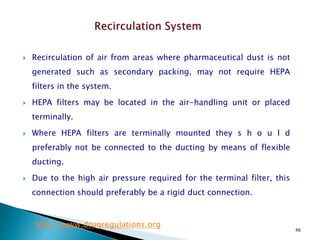
 Recirculation of air from areas where pharmaceutical dust is not
generated such as secondary packing, may not require HEPA
filters in the system.
 HEPA filters may be located in the air-handling unit or placed
terminally.
 Where HEPA filters are terminally mounted they s h o u l d
preferably not be connected to the ducting by means of flexible
ducting.
 Due to the high air pressure required for the terminal filter, this
connection should preferably be a rigid duct connection.
http://www.drugregulations.org
47
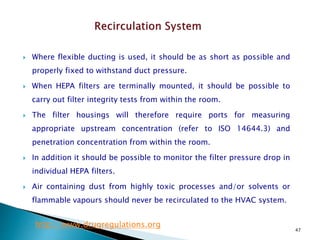
 Where flexible ducting is used, it should be as short as possible and
properly fixed to withstand duct pressure.
 When HEPA filters are terminally mounted, it should be possible to
carry out filter integrity tests from within the room.
 The filter housings will therefore require ports for measuring
appropriate upstream concentration (refer to ISO 14644.3) and
penetration concentration from within the room.
 In addition it should be possible to monitor the filter pressure drop in
individual HEPA filters.
 Air containing dust from highly toxic processes and/or solvents or
flammable vapours should never be recirculated to the HVAC system.
http://www.drugregulations.org
48
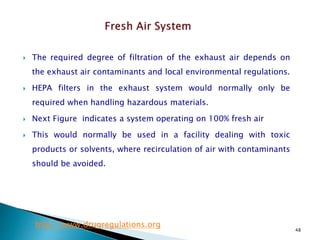
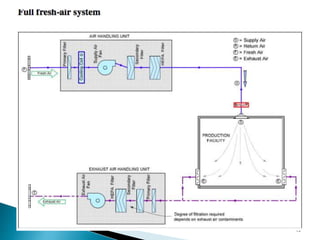
 The required degree of filtration of the exhaust air depends on
the exhaust air contaminants and local environmental regulations.
 HEPA filters in the exhaust system would normally only be
required when handling hazardous materials.
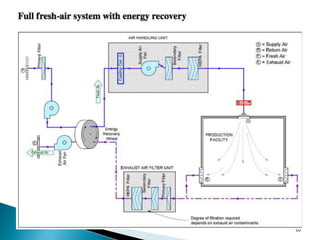
 Next Figure indicates a system operating on 100% fresh air
 This would normally be used in a facility dealing with toxic
products or solvents, where recirculation of air with contaminants
should be avoided.
http://www.drugregulations.org
49
http://www.drugregulations.org
50
http://www.drugregulations.org
51
 Energy-recovery wheels if used in multiproduct facilities should have
been subjected to a risk assessment to determine if there is any risk
of cross-contamination.
 When such wheels are used they should not become a source of
possible contamination .
◦ Alternatives to the energy-recovery wheels, such as crossover plate heat exchangers
and water-coil heat exchangers, may be used in multiproduct facilities.
 The potential for air leakage between the supply air and exhaust air
as it passes through the wheel should be prevented.
 The relative pressures between supply and exhaust air systems
should be such that the exhaust air system operates at a lower
pressure than the supply system.
http://www.drugregulations.org
52
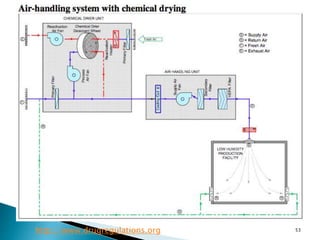
 A schematic diagram of the airflow for a typical system
serving a low relative humidity suite is represented in next
Figure.
 Air can be dried with a chemical drier
 e.g. a rotating desiccant wheel which is continuously
regenerated by means of passing hot air through one
segment of the wheel.
 Alternative methods of drying air are also available.
http://www.drugregulations.org
53http://www.drugregulations.org
54
 The figure illustrates the chemical drier handling part of the fresh
air/return air mixture on a bypass flow.
 The location of the chemical drier should be considered in the design
phase.
 The practice of locating the complete chemical drier unit in the
production cubicle is not recommended as this could be a source of
contamination or cross-contamination.
 Examples of appropriate locations for the drying wheel could include:
◦ Full flow of fresh/return air;
◦ Partial handling of fresh/return air (bypass airflow);
◦ Return air only;
◦ Fresh air only; or
◦ Pre-cooled air with any of the above alternatives.
http://www.drugregulations.org
55
 Possible additional components that may be required in air
handling should be considered depending on the climatic
conditions and locations.
 These may include items such as:
◦ Frost coils on fresh air inlets in very cold climates to preheat the air;
◦ Reheaters for humidity control
◦ Automatic air volume control devices
◦ Sound attenuators
◦ Snow eliminators to prevent snow entering air inlets and blocking airflow
◦ Dust eliminators on air inlets in arid and dusty locations ‒ moisture eliminators in
humid areas with high rainfall
◦ Fresh air precooling coils for very hot or humid climates.
http://www.drugregulations.org
56
 Areas where following are exposed to
the environment should be defined as
“clean areas”, “clean zones”, “controlled
areas” or “cleanrooms”.
◦ Starting materials and products
◦ Utensils
◦ Primary packing materials
◦ Equipment .
http://www.drugregulations.org
57
 The achievement of a particular clean area
condition depends on a number of criteria
 These should be addressed at the design and
qualification stages.
 A suitable balance between the different criteria
will be required in order to create an efficient
clean area.
http://www.drugregulations.org
58
 Some of the basic criteria to be considered which affects room
cleanliness should include:
◦ Building finishes and structure• dust control and containment
◦ Air filtration
◦ Air change rate or flushing rate
◦ Room pressure
◦ Location of air terminals and directional airflow
◦ Temperature
◦ Relative humidity
◦ Material flow
◦ Personnel flow
◦ Gowning procedures
◦ Equipment movement
◦ Process being carried out (open or closed system)
◦ Outside air conditions
◦ Occupancy
◦ Type of product
◦ Cleaning standard operating procedures (SOPs).
http://www.drugregulations.org
59
 Air filtration and air change rates should be set to ensure
that the defined clean area condition is attained.
 The air change rates should be determined by taking into
account
◦ The various critical parameters
◦ Using a risk based approach
◦ With due consideration of capital and running costs and energy usage.
 Primarily the air change rate should be set to a level that
will achieve the required clean area condition.
http://www.drugregulations.org
60
 Air change rates are normally determined by the following
considerations
◦ (could normally vary between 6 and 20 air changes per hour):
 Area condition required:
◦ Whether a specific room cleanliness condition is in fact required and
whether the room condition is rated for an “at rest” condition or an
“operational” condition
◦ (air change rate should be selected on need rather than tradition)
http://www.drugregulations.org
61
 The product characteristics
◦ (e.g. odours, hygroscopicity, etc.); the quality and filtration of the supply air
 Particulates generated by the manufacturing process;
 Particulates generated by the operators
 Configuration of the room and air supply and extract
locations;
 Sufficient air to achieve containment effect and to clean up the
area;
 Sufficient air to cope with the room heat load
 Sufficient air to balance extract rates;
 Sufficient air to maintain the required room pressure.
http://www.drugregulations.org
62
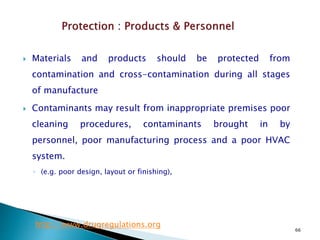
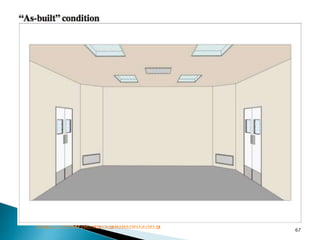
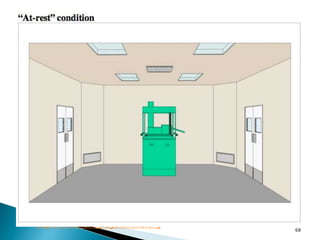
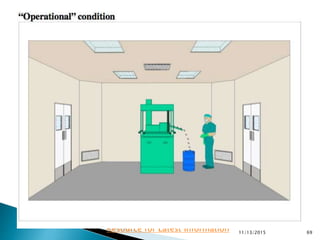
 If a cleanroom classification is specified, the manufacturer
should state whether this is achieved under “as-built” , “at-
rest” or “operational” conditions.
 Room classification tests in the “as-built” condition should
be carried out on the bare room, in the absence of any
equipment or personnel.
 Room classification tests in the “at-rest” condition should
be carried out with the equipment operating where
relevant, but without any operators.
http://www.drugregulations.org
63
 Because of the amounts of dust usually generated in a solid
dosage facility, the clean area classifications would be rated
for the “at-rest” condition.
 Room classification tests in the “operational” condition are
normally carried out during the normal production process
with equipment operating, and the normal number of
personnel present in the room.
 When qualifying for the operational condition details of the
process operating, number and positions of staff should be
stipulated for each room, to enable future qualifications to
duplicate the same conditions.
http://www.drugregulations.org
64
 Room clean-up or recovery tests are performed to
determine whether the installation is capable of returning
to a specified cleanliness level within a finite time, after
being exposed briefly to a source of airborne particulate
challenge.
 Room “clean-up” or “recovery” tests should demonstrate a
change in particle concentration by a factor of 100 within
the prescribed time (as per ISO 14644-3 clause B.12)
http://www.drugregulations.org
65
 The guidance time period for clean-up or recovery is about
15 to 20 minutes.
 In some instances it is not possible to increase the
concentration by a factor of 100 (such as for an ISO 14644
Class 8 condition) as the high particle concentration can
damage the particle counter.
 In this instance the particle decay method can be used as
per ISO 14644-3 clause B.12.3.2
http://www.drugregulations.org
66
 Materials and products should be protected from
contamination and cross-contamination during all stages
of manufacture
 Contaminants may result from inappropriate premises poor
cleaning procedures, contaminants brought in by
personnel, poor manufacturing process and a poor HVAC
system.
◦ (e.g. poor design, layout or finishing),
http://www.drugregulations.org
67
http://www.drugregulations.org
68
http://www.drugregulations.org
11/13/2015 69
Drug Regulations : Online
Resource for Latest Information
70
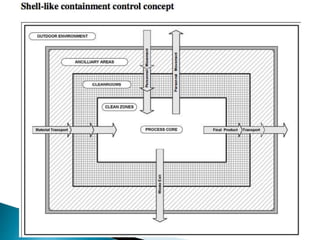
 Airborne contaminants should be controlled through
effective ventilation and filtration.
 External contaminants should be removed by effective
filtration of the supply air
 See next Figure for an example of a shell-like building
layout to enhance containment and protection from
external contaminants.
http://www.drugregulations.org
71
http://www.drugregulations.org
72
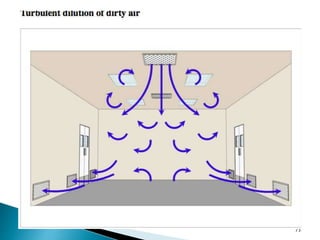
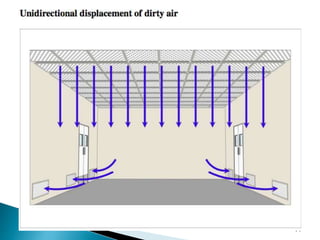
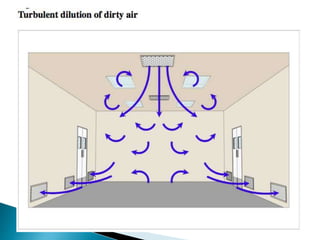
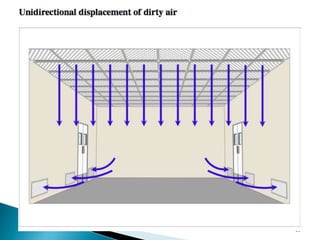
 Internal contaminants should be controlled by dilution and
flushing of contaminants in the room, or by displacement
airflow
 See Figures next two slides for examples of methods for
the flushing of airborne contaminants.
http://www.drugregulations.org
73
http://www.drugregulations.org
74
http://www.drugregulations.org
75
 Airborne particulates and the degree of filtration should be
considered critical parameters with reference to the level of
product protection required.
 Personnel should not be a source of contamination.
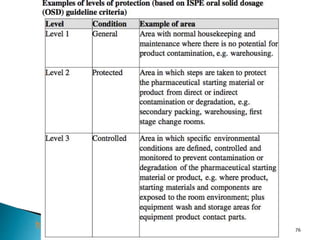
 The level of protection and air cleanliness for different
areas should be determined according to
◦ The product being manufactured
◦ The process being used
◦ The product’s susceptibility to degradation ( Next Slide).
http://www.drugregulations.org
76
http://www.drugregulations.org
77
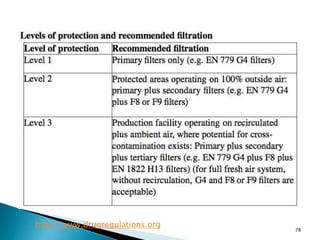
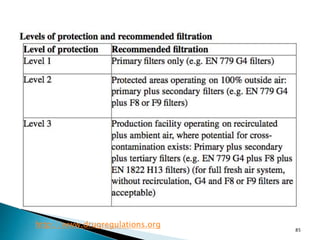
 The degree to which air is filtered plays an important role
in the
◦ Prevention of contamination and
◦ Control of cross-contamination.
 The type of filters required for different applications
depends on the quality of the ambient air and the return air
(where applicable) and also on the air change rates.
 Table in next slide gives the recommended filtration levels
for different levels of protection in a pharmaceutical
facility.
http://www.drugregulations.org
78
http://www.drugregulations.org
79
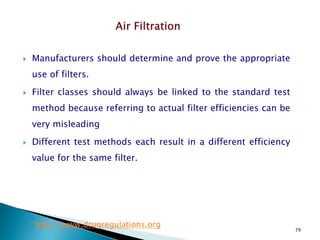
 Manufacturers should determine and prove the appropriate
use of filters.
 Filter classes should always be linked to the standard test
method because referring to actual filter efficiencies can be
very misleading
 Different test methods each result in a different efficiency
value for the same filter.
http://www.drugregulations.org
80
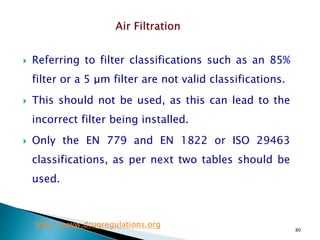
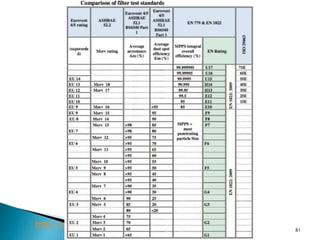
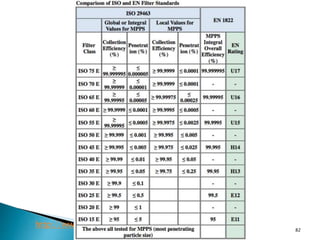
 Referring to filter classifications such as an 85%
filter or a 5 μm filter are not valid classifications.
 This should not be used, as this can lead to the
incorrect filter being installed.
 Only the EN 779 and EN 1822 or ISO 29463
classifications, as per next two tables should be
used.
http://www.drugregulations.org
81
http://www.drugregulations.org
82
http://www.drugregulations.org
83
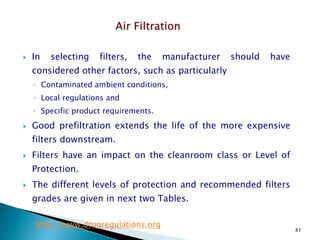
 In selecting filters, the manufacturer should have
considered other factors, such as particularly
◦ Contaminated ambient conditions,
◦ Local regulations and
◦ Specific product requirements.
 Good prefiltration extends the life of the more expensive
filters downstream.
 Filters have an impact on the cleanroom class or Level of
Protection.
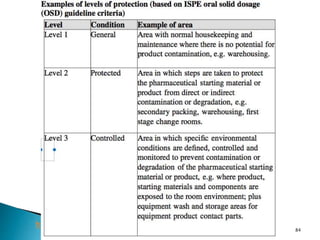
 The different levels of protection and recommended filters
grades are given in next two Tables.
http://www.drugregulations.org
84
http://www.drugregulations.org
85
http://www.drugregulations.org
86
 Materials for components of an HVAC system should be
selected with care so that they do not become a source of
contamination.
 Any component with the potential for liberating particulate
or microbial contamination into the airstream should be
located upstream of the final filters.
 Where possible ventilation dampers, filters and other
services should be designed and positioned so that they
are accessible from outside the manufacturing areas
(service voids or service corridors) for maintenance
purposes.
http://www.drugregulations.org
87
 Directional airflow within production or primary packing
areas should assist in preventing contamination.
 Airflows should be planned in conjunction with operator
locations,
 This will minimize contamination of the product by the
operator and also to protect the operator from dust
inhalation.
 Different airflow patterns are indicated in Next two slides.
http://www.drugregulations.org
88
http://www.drugregulations.org
89
http://www.drugregulations.org
90
 HVAC air distribution components should be designed,
installed and located to prevent contaminants generated
within the room from being spread.
 Supply air diffusers should be selected with care taking
consideration of,
◦ e.g. room requirements and positions of equipment and operators in
the room.
 Supply air diffusers of the high induction type should not
be used in clean areas where dust is liberated.
◦ (e.g. those typically used for office-type air-conditioning)
http://www.drugregulations.org
91
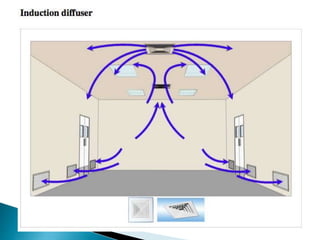
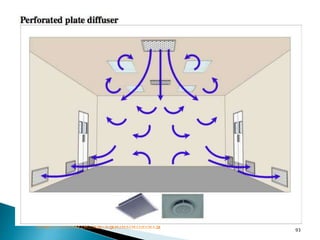
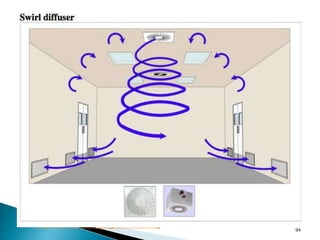
 Air diffusers should be of the non-induction type
 They should introduce air with the least amount of induction
so as to maximize the flushing effect.
 In rooms where the process results in high dust liberation;
◦ Perforated plates or low induction swirl diffusers with low level extract or
return should be used to contain the dust at the lower level of the room
 In cases where dust liberation is low, ceiling return air grilles
may be acceptable.
 See next three slides for illustrations of the three types of
diffusers.
http://www.drugregulations.org
92
http://www.drugregulations.org
93
http://www.drugregulations.org
94
http://www.drugregulations.org
95
 Induction and certain swirl diffusers induce room air vertically
up to the diffuser to mix with the supply air.
 These diffusers create good dilution of contaminants in the
room
 They may be used in rooms where there is low dust liberation.
 However, if used in rooms where excessive dust is generated,
the distribution of dust in the room could be hazardous for
the operators in the room.
 This is because dust is drawn up into the supply air stream
and then spread throughout the room.
http://www.drugregulations.org
96
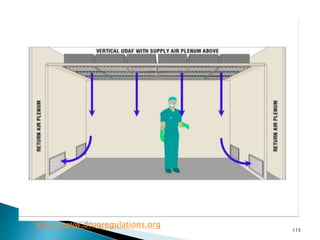
 Unidirectional airflow (UDAF) should be used for weighing
booths or sampling booths.
 They provide operator and product protection
 They should also have a slight air in-flow from the room to
enhance containment.
 Dust containment at the weigh booth should be
demonstrated by smoke airflow pattern tests, or other
appropriate tests.
 UDAF can also be used to provide protection of other dusty
processes.
http://www.drugregulations.org
97
 Sampling of materials such as starting materials, primary
packaging materials and products, should be carried out in
the same environmental conditions that are required for
the further processing of the product.
 In a weighing booth situation, the aim of the UDAF is to
provide dust containment and operator protection.
http://www.drugregulations.org
98
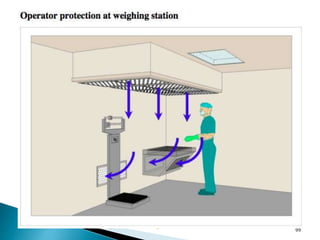
 Example: In next slide the dust generated at the weighing
station is immediately extracted through the perforated
worktop,
 This protects the operator from dust inhalation,
 At the same time product is protected from contamination
by the operator by means of the vertical unidirectional
airflow stream.
http://www.drugregulations.org
99
http://www.drugregulations.org
100
 The unidirectional flow velocity should be such that it does
not disrupt the sensitivity of balances in weighing areas.
 Where necessary the velocity may be reduced to prevent
inaccuracies during weighing.
 However sufficient airflow should be maintained to provide
containment.
 Conventional unidirectional airflow systems, where a Grade
A condition is required, have a guidance airflow velocity of
0.36 to 0.54 m/s.
http://www.drugregulations.org
101
 However, in a weigh booth or sampling booth a lower
velocity can be used as a Grade A condition is not required.
 It is often necessary to reduce velocities to a lower level in
order not to influence balance readings.
 The airflow velocity and directional flow should still ensure
product containment.
 For this type of application it is sometimes better to refer
to the unit as an airflow protection booth (APB) rather than
a UDAF,
 This avoids confusion, with a Grade A requirement.
http://www.drugregulations.org
102
 Containment for weighing and sampling operations
◦ There should be a slight inflow of air into the UDAF
protected zone from the surrounding room
◦ This prevents dust escaping.
 Thus the amount of air extracted from below the
UDAF/APB should exceed the amount of air supplied.
◦ Unless the hazardous or sterile nature of the product dictates
otherwise.
http://www.drugregulations.org
103
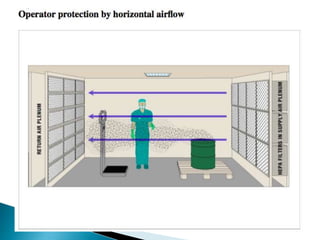
 The position in which the operator stands relative
to the source of dust liberation and airflow
should be determined
 This ensure that the operator is not in the path of
an airflow that could lead to contamination of the
product (Next slide).
http://www.drugregulations.org
104
http://www.drugregulations.org
105
 Once the system has been designed and qualified
with a specific layout for operators and
processes, this should be maintained in
accordance with an SOP.
 There should be no obstructions in the path of a
unidirectional flow air stream that may cause the
operator to be exposed to dust.
http://www.drugregulations.org
106
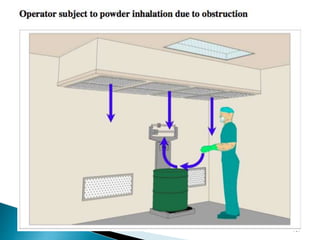
 Next slide illustrates the incorrect use of a
weighing scale which has a solid back.
 The back of the weighing scale should not block
the return air path
 This obstructs the airflow
 Causes air to rise vertically carrying dust
 This results in a hazardous situation for the
operator.
http://www.drugregulations.org
107
http://www.drugregulations.org
108
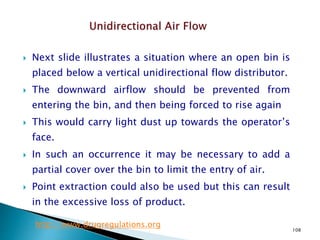
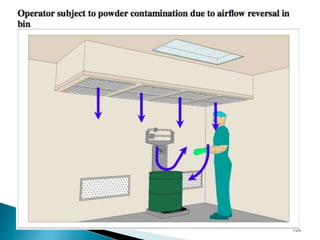
 Next slide illustrates a situation where an open bin is
placed below a vertical unidirectional flow distributor.
 The downward airflow should be prevented from
entering the bin, and then being forced to rise again
 This would carry light dust up towards the operator’s
face.
 In such an occurrence it may be necessary to add a
partial cover over the bin to limit the entry of air.
 Point extraction could also be used but this can result
in the excessive loss of product.
http://www.drugregulations.org
109
http://www.drugregulations.org
110
http://www.drugregulations.org
111
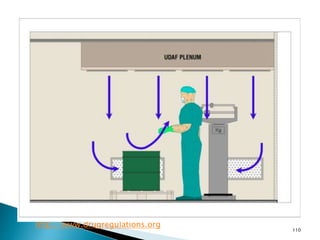
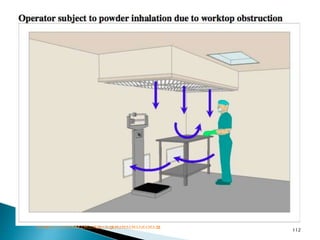
 Next slide shows that a solid worktop can
sometimes cause deflection of the vertical
unidirectional airflow resulting in a flow reversal.
 A possible solution would be to have a 100 mm
gap between the back of the table and the wall,
with the air being extracted here.
http://www.drugregulations.org
112
http://www.drugregulations.org
113
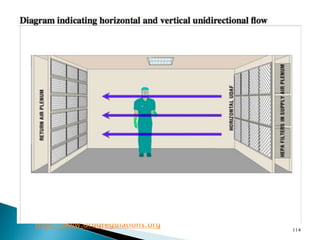
 The manufacturer should select either
vertical or horizontal unidirectional
airflow Next slide
 An appropriate airflow pattern to provide
the best protection for the particular
application.
http://www.drugregulations.org
114
http://www.drugregulations.org
115
http://www.drugregulations.org
116
 Return or exhaust air grilles in rooms or at weigh
or sampling booths should preferably be of the
perforated grille types.
 They are easy to clean.
 Return/exhaust air filters can either be installed
at the room terminal or in the air-handling unit.
 Maintenance and cleaning of filters and ducts
should be addressed to ensure constant airflow.
http://www.drugregulations.org
117
 Air infiltration of unfiltered air into a pharmaceutical plant
should not be a source of contamination.
 Manufacturing facilities should normally be maintained at a
positive pressure relative to the outside
 This limits the ingress of contaminants.
 Where facilities are to be maintained at negative pressures
relative to the ambient pressure, special precautions
should be taken.
 Refer to the WHO guidelines for hazardous products, for
further guidance on negative pressure facilities.
http://www.drugregulations.org
118
 The location of the negative pressure facility should
be carefully considered with reference to the areas
surrounding it
 Attention should be given to ensuring that the
building structure is well sealed.
 Negative pressure zones should be encapsulated by
surrounding areas with clean air supplies.
 This will ensure that only clean air can infiltrate into
the controlled zone.
http://www.drugregulations.org
119
 Where different products are manufactured at the same
time measures should be taken to ensure that dust cannot
move from one cubicle to another.
◦ In different areas or cubicles,
◦ In a multiproduct OSD manufacturing site,
 Correct directional air movement and a pressure cascade
system can assist in preventing cross-contamination.
 The pressure cascade should be such that the direction of
airflow is from the clean corridor into the cubicles
 This results in dust containment.
http://www.drugregulations.org
120
 For cubicles where dust is liberated,
◦ The corridor should be maintained at a higher pressure than the cubicles
and
◦ The cubicles at a higher pressure than atmospheric pressure.
 Containment can normally be achieved
◦ By application of the displacement concept (low pressure differential, high
airflow), or
◦ The pressure differential concept (high pressure differential, low airflow), or
◦ The physical barrier concept.
 The pressure cascade regime and the direction of airflow
should be appropriate to the product and processing method
used.
http://www.drugregulations.org
121
 Highly potent products should be manufactured under a
pressure cascade regime
◦ That is negative relative to atmospheric pressure.
 The pressure cascade for each facility should be individually
assessed
◦ According to the product handled and
◦ Level of protection required.
 Building structure should be given special attention to
accommodate the pressure cascade design.
 Ceilings and walls, close fitting doors and sealed light fittings
should be in place, to limit ingress or egress of air.
http://www.drugregulations.org
122
 This method of containment is not the preferred method,
as the measurement and monitoring of airflow velocities in
doorways is difficult.
 This concept is commonly found in production processes
where large amounts of dust are generated.
 Under this concept the air should be supplied
◦ To the corridor,
◦ Flow through the doorway, and
◦ Be extracted from the back of the cubicle.
http://www.drugregulations.org
123
 Normally the cubicle door should be closed
 The air should enter the cubicle through a door grille
 The concept can be applied to an opening without a door.
 With the door open the pressure differential will effectively
be zero.
 The velocity should be high enough to prevent turbulence
within the doorway resulting in dust escaping.
http://www.drugregulations.org
124
 This displacement airflow should be calculated as the
product of the door area and the velocity through the
doorway
 This generally results in fairly large air quantities.
 This method of containment may still exist on older
facilities
 It is not the preferred method, as the measurement and
monitoring of doorway velocities is difficult.
 Maintaining the correct room pressure and the correct
room air change rate is often not achieved.
http://www.drugregulations.org
125
 The pressure differential concept may normally be used in
zones where little or no dust is being generated.
 It may be used alone or in combination with other
containment control techniques and concepts,
◦ such as a double door airlock.
 The high-pressure differential between the clean and less
clean zones should be generated by leakage through the
gaps of the closed doors to the cubicle.
http://www.drugregulations.org
126
 The pressure differential should be of sufficient magnitude
 This ensures containment and prevention of flow reversal
 However the differential should not be so high as to create
turbulence problems.
 In considering room pressure differentials, transient
variations, such as machine extract systems, should be taken
into consideration.
 A pressure differential of 15 Pa is often used for achieving
containment between two adjacent zones,
 Pressure differentials of between 5 Pa and 20 Pa may be
acceptable.
http://www.drugregulations.org
127
 Where the design pressure differential is too low and
tolerances are at opposite extremities, a flow reversal can
take place.
 For example, where a control tolerance of ± 3 Pa is
specified, the implications of adjacent rooms being
operated at the upper and lower tolerances should be
evaluated.
 It is important to select pressures and tolerances such that
a flow reversal is unlikely to occur.
http://www.drugregulations.org
128
 The pressure differential between adjacent
rooms could be considered a critical
parameter, depending on the outcome of risk
analysis.
 The limits for the pressure differential
between adjacent areas should be such that
there is no risk of overlap in the acceptable
operating range
http://www.drugregulations.org
129
 e.g. 5 Pa to 15 Pa in one room and 15 Pa to 30 Pa in an
adjacent room, resulting in the failure of the pressure
cascade, where the first room is at the maximu pressure
limit and the second room is at its minimum pressure limit.
 Low pressure differentials may be acceptable when airlocks
(pressure sinks or pressure bubbles) are used to segregate
areas.
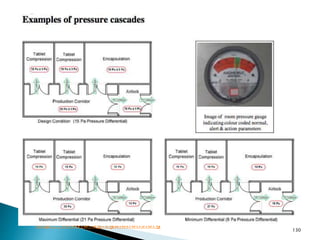
 The effect of room pressure tolerances are illustrated in
Next slide
http://www.drugregulations.org
130
http://www.drugregulations.org
131
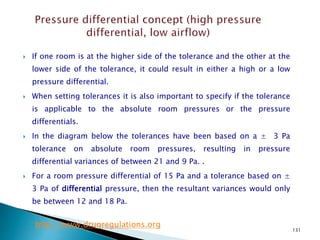
 If one room is at the higher side of the tolerance and the other at the
lower side of the tolerance, it could result in either a high or a low
pressure differential.
 When setting tolerances it is also important to specify if the tolerance
is applicable to the absolute room pressures or the pressure
differentials.
 In the diagram below the tolerances have been based on a ± 3 Pa
tolerance on absolute room pressures, resulting in pressure
differential variances of between 21 and 9 Pa. .
 For a room pressure differential of 15 Pa and a tolerance based on ±
3 Pa of differential pressure, then the resultant variances would only
be between 12 and 18 Pa.
http://www.drugregulations.org
132
 The pressure control and monitoring devices used should be
calibrated and qualified.
 Compliance with specifications should be regularly verified and
the results recorded.
 Pressure control devices should be linked to an alarm system set
according to the levels determined by a risk analysis.
 Manual control systems should be set up during commissioning,
with set point marked
 This should not change unless other system conditions change.
http://www.drugregulations.org
133
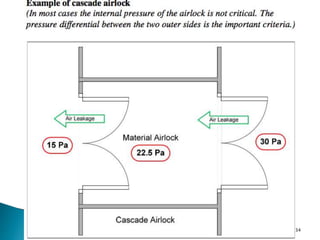
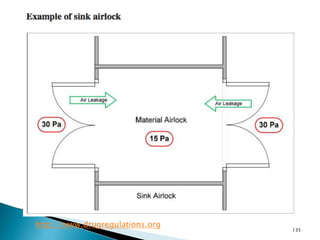
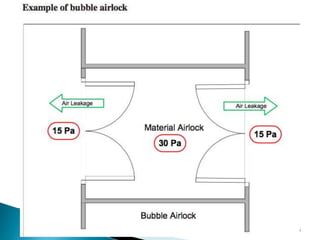
 Airlocks can be important components in setting up and
maintaining pressure cascade systems
 They also to limit cross-contamination.
 Airlocks with different pressure cascade regimes include the
cascade airlock, sink airlock and bubble airlock (Next three
slides):
◦ Cascade airlock: higher pressure on one side of the airlock and lower pressure on
the other;
◦ Sink airlock: lower pressure inside the airlock and higher pressure on both outer
sides;
◦ Bubble airlock: higher pressure inside the airlock and lower pressure on both
outer sides.
http://www.drugregulations.org
134
http://www.drugregulations.org
135
http://www.drugregulations.org
136
http://www.drugregulations.org
137
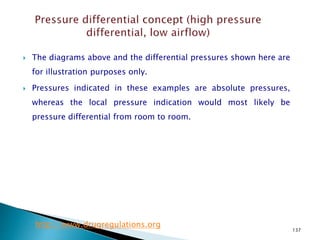
 The diagrams above and the differential pressures shown here are
for illustration purposes only.
 Pressures indicated in these examples are absolute pressures,
whereas the local pressure indication would most likely be
pressure differential from room to room.
http://www.drugregulations.org
138
 Doors should open to the high pressure side, so that room
pressure assists in holding the door closed
 Doors should be provided with self- closers.
 Should the doors open to the low pressure side, the door closer
springs should be sufficient to hold the door closed and prevent
the pressure differential from pushing the door open.
 There should be a method to indicate if both doors to airlocks are
open at the same time
 Alternatively these should be interlocked.
 The determination of which doors should be interlocked should
be the subject of a risk assessment study.
http://www.drugregulations.org
139
 Central dust extraction systems should be interlocked with the
appropriate air-handling systems,
 This ensures that they operate simultaneously.
 Room pressure differential between adjacent cubicles, which are
linked by common dust extraction ducting, should be avoided.
 Air should not flow through the dust extraction ducting or return
air ducting from the room with the higher pressure to the room
with the lower pressure
◦ This would normally occur only if extract or return systems were inoperative
http://www.drugregulations.org
140
 Systems should be designed to prevent dust flowing back in the
opposite direction in the event of component failure or airflow
failure.
 Adequate room pressure differential indication should be
provided
 This ensures that each critical room pressure can be traced back
to ambient pressure in order to determine the room actual
absolute pressure,
 A pressure gauge installed to indicate the pressure differential
from a central corridor to the outside.
http://www.drugregulations.org
141
 Room pressure indication gauges should have a range and
graduation scale which enables the reading to an appropriate
accuracy.
 Normal operating range, alert and action limits should be defined
and displayed at the point of indication.
 A colour coding of these limits on the gauge may be helpful.
 Room pressure indication may be either analogue or digital,
 May be represented as either pressure differentials or absolute
pressures.
 Whichever system is used any out-of-specification condition
should be easily identifiable.
http://www.drugregulations.org
142
 Material pass-through-hatches (PTH) or pass boxes (PB) can also
be used for separating two different zones.
 PTHs fall into two categories, namely a dynamic PTH or a passive
PTH.
 Dynamic PTHs have an air supply to or extraction from them, and
can then be used as bubble, sink or cascade PTHs.
 Room pressure differential tolerances should always be set with a
maximum and minimum tolerance.
 Setting tolerances as NMT or NLT can easily lead to an OOS
condition.
http://www.drugregulations.org
143
 Where appropriate, an impervious barrier to
prevent cross- contamination between two
zones, such as closed systems, pumped or
vacuum transfer of materials, should be used.
http://www.drugregulations.org
144
 Where appropriate, temperature and relative humidity
should be controlled, monitored and recorded,
 Where relevant, ensure compliance with requirements
pertinent to the materials and products
 Provide a comfortable environment for the operator
where necessary.
 Maximum and minimum room temperatures and
relative humidity should be appropriate.
 Alert and action limits on temperatures and
humidities should be set, as appropriate.
http://www.drugregulations.org
145
 The operating band, or tolerance, between the acceptable
minimum and maximum temperatures should not be made
too close.
 Tight control tolerances may be difficult to achieve and can
also add unnecessary installation and running costs.
 Cubicles, or suites, in which products requiring low relative
humidity are processed, should have well-sealed walls and
ceilings
 They should also be separated from adjacent areas with
higher relative humidity by means of suitable airlocks.
http://www.drugregulations.org
146
 Precautions should be taken to prevent moisture migration
that increases the load on the HVAC system.
 Humidity control should be achieved by removing moisture
from the air, or adding moisture to the air, as relevant.
 Dehumidification (moisture removal) may be achieved by
means of either refrigerated dehumidifiers or chemical
dehumidifiers.
 Appropriate cooling media for dehumidification such as
low temperature chilled water/glycol mixture or refrigerant
should be used.
http://www.drugregulations.org
147
 Humidifiers should be avoided if possible as they may
become a source of contamination (e.g. microbiological
growth).
 Where humidification is required, this should be achieved
by appropriate means such as the injection of steam into
the air stream.
 A product-contamination assessment should be done to
determine whether pure or clean steam is required for the
purposes of humidification.
http://www.drugregulations.org
148
 Where steam humidifiers are used, chemicals such as
corrosion inhibitors or chelating agents, which could have a
detrimental effect o the product, should not be added to the
boiler system.
 Only appropriate additives should be added to the boiler
system.
 Humidification systems should be well drained.
 No condensate should accumulate in air-handling systems.
 Other humidification appliances such as evaporative systems,
atomizers and water mist sprays, should not be used because
of the potential risk of microbial contamination.
http://www.drugregulations.org
149
 Duct material in the vicinity of the humidifier should not
add contaminants to air that will not be removed by
filtration further downstream.
 Air filters should not be installed immediately downstream
of humidifiers, as moisture on the filters could lead to
bacterial growth.
 Cold surfaces should be insulated to prevent condensation
within the clean area or on air-handling components.
http://www.drugregulations.org
150
 When specifying relative humidity, the associated
temperature should also be specified.
 Chemical driers using silica gel or lithium
chloride are acceptable, provided that they do
not become sources of contamination.
http://www.drugregulations.org
151
 Wherever possible, dust or vapour contamination should be
removed at source.
 Point-of-use extraction, i.e. as close as possible to the point
where the dust is generated, should be employed.
 Spot ventilation or capture hoods may be used as appropriate.
 The HVAC system should not serve as the primary mechanism
of dust control.
 Point-of-use extraction should be either in the form of a
fixed, high-velocity extraction point or an articulated arm
with movable hood or a fixed extraction hood.
http://www.drugregulations.org
152
 Dust extraction ducting should be designed with sufficient
transfer velocity to ensure that dust is carried away, and
does not settle in the ducting.
 Periodic checks should be performed to ensure that there
is no build-up of the dust in the ducting.
 The required transfer velocity should be determined:
 It is dependent on the density of the dust (the denser the
dust, the higher the transfer velocity should be, e.g. 15–20
m/s).
http://www.drugregulations.org
153
 Airflow direction should be carefully chosen, to ensure that
the operator does not contaminate the product,
 Also so that the operator is not put at risk by the product.
 Point extraction alone is usually not sufficient to capture all
of the contaminants,
 General directional airflow should be used to assist in
removing dust and vapours from the room.
http://www.drugregulations.org
154
 Typically, in a room operating with turbulent airflow, the
air should be introduced from ceiling diffusers,
◦ They should be located at the door entry side of the room and
◦ The air should be extracted from the rear of the room at low level to
help give a flushing effect in the room.
 Correct flushing of the rooms may be verified by airflow
visualization smoke tests.
 When dealing with particularly harmful products, additional
steps, such as handling the products in glove boxes or
using barrier isolator technology, should be used.
http://www.drugregulations.org
155
 It should be noted that protection of the environment is
not addressed in this guideline
 Discharges into the atmosphere should be compliant with
relevant local and national environmental legislation and
standards.
 Dust, vapours and fumes could be possible sources of
contamination;
 Therefore, care should be taken when deciding on the
location of the inlet and exhaust points relative to one
other.
http://www.drugregulations.org
156
 Exhaust air discharge points on pharmaceutical
equipment and facilities carry heavy dust loads.
◦ Such as from fluid bed driers and tablet-coating
equipment, and
◦ Exhaust air from dust extraction systems,
 They should be provided with adequate filtration
to prevent contamination of the ambient air.
http://www.drugregulations.org
157
 Where the powders are not highly potent,
◦ Final filters on a dust exhaust system should be fine dust
filters with a filter classification of F9 according to EN 779
filter standards.
 Where reverse-pulse dust collectors are used for
removing dust from dust extraction systems,
◦ They should usually be equipped with cartridge filters
containing a compressed air lance, and
◦ Be capable of continuous operation without interrupting the
airflow.
http://www.drugregulations.org
158
 Alternative types of dust collectors should be
used in such a manner that there is no risk of
cross-contamination.
◦ such as those operating with a mechanical shaker,
requiring that the fan be switched off when the
mechanical shaker is activated.
 There should be no disruption of airflow during a
production run as the loss of airflow could
disrupt the pressure cascade.
http://www.drugregulations.org
159
 Mechanical-shaker dust collectors should not be used
for applications where continuous airflow is required,
 This is in order to avoid unacceptable fluctuations in
room pressures.
 Except in the case where room pressures are
automatically controlled.
 When wet scrubbers are used, the dust-slurry should
be removed by a suitable means,
◦ e.g. a drainage system or waste removal contractor.
http://www.drugregulations.org
160
 The quality of the exhaust air should be
determined to see whether the filtration
efficiency is adequate with all types of dust
collectors and wet scrubbers.
 Where necessary, additional filtration may be
provided downstream of the dust collector.
http://www.drugregulations.org
161
 Vapour should be extracted at the point of generation.
 When planning the system for the extraction of residual vapours,
the density of the vapour should be taken into account.
 If the vapour is lighter than air, the extract grilles should be at a
high level, or possibly at both high and low levels.
 The systems for fume, dust and effluent control should be
designed, installed and operated in such a manner that they do
not become possible sources of contamination or cross-
contamination,
◦ e.g. an exhaust-air discharge point located close to the HVAC system
fresh air inlet.
http://www.drugregulations.org
162
 Fumes should be removed by means of wet scrubbers or
dry chemical scrubbers (deep-bed scrubbers).
 Wet scrubbers for fume removal normally require the
addition of various chemicals to the water to increase the
adsorption efficiency.
 Deep-bed scrubbers should be designed with activated
carbon filters or granular chemical adsorption media.
http://www.drugregulations.org
163
 The chemical media for deep-bed scrubbers
should be specific to the effluent being treated.
 The type and quantity of the vapours to be
removed should be known.
 This will enable the appropriate filter media, as
well as the volume of media required to be
determined.
http://www.drugregulations.org
164
 The heating, ventilation and air-conditioning (HVAC) system plays an
important role in the protection of the product, the personnel and the
environment.
 For all HVAC installation components, subsystems or parameters, critical
parameters and non-critical parameters should be determined.
 Some of the parameters of a typical HVAC system that should be qualified
include:
◦ Room temperature and humidity;
◦ Supply air and return air quantities;
◦ Room pressure, air change rate, flow patterns, particle count and clean-up rates;
◦ Unidirectional flow velocities
◦ HEPA filter penetration tests; and critical alarms,
http://www.drugregulations.org
165
 Commissioning should involve following to
ensure that the system meets all the
requirements, as specified in the user
requirement specification, and capacities as
specified by the designer or developer.
◦ Setting up
◦ Balancing
◦ Adjustment and
◦ Testing of the entire HVAC system.
http://www.drugregulations.org
166
 The commissioning plan should start at the early stages of a
project so that it can be integrated with qualification and
verification procedures.
 Acceptable tolerances for all system parameters should be
specified and agreed by the user prior to commencing the
physical installation.
 These tolerances should be specified in the User Requirement
Specifications
 Acceptance criteria should be set for all system parameters.
 The measured data should fall within the acceptance criteria.
http://www.drugregulations.org
167
 System installation records should provide documented
evidence of all measured capacities of the system.
 The installation records should include items such as the
design and measured figures for airflows, water flows,
system pressures electrical amperages, etc.
 These should be contained in the operating and
maintenance manuals (O & M manuals).
 The installation records of the system should provide
documented evidence of all measured capacities of the
system.
http://www.drugregulations.org
168
 Typical information that should be contained in the O&M manuals is
the following: System description;
◦ Operating instructions,
◦ Trouble shooting;
◦ Commissioning data schedules;
◦ Maintenance instructions;
◦ List of equipment suppliers;
◦ Spare parts lists;
◦ Equipment capacity and data schedules;
◦ Supplier’ s literature;
◦ Control system operation;
◦ Electrical drawings;
◦ As-built drawings;
◦ Maintenance records.
http://www.drugregulations.org
169
 O & M manuals, schematic drawings, protocols and reports should be
maintained as reference documents for any future changes and
upgrades to the system.
 As-built drawings should be available and should be kept up to date
with all the latest system changes.
 Any changes from the original approved system should be covered by
change control documentation and risk assessment studies where
deemed necessary.
 Training should be provided to personnel after installation of the
system, and should include how to perform operation and
maintenance.
 Commissioning should be a precursor to system qualification and
validation.
http://www.drugregulations.org
170
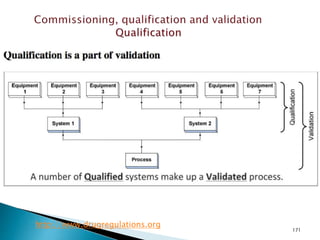
 Manufacturers should qualify HVAC systems using a risk-based
approach.
 The basic concepts of qualification of HVAC systems are set out
in Next slide
http://www.drugregulations.org
171
http://www.drugregulations.org
172
 The qualification of the HVAC system should be described in a
validation master plan (VMP), or a subsection of the VMP.
 The validation master plan should define the nature and extent of
testing and the test procedures and protocols to be followed.
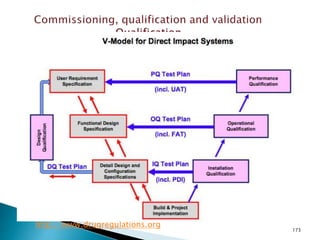
 Stages of the qualification of the HVAC system should include
◦ Design qualification (DQ),
◦ Installation qualification (IQ),
◦ Operational qualification (OQ) and
◦ Performance qualification (PQ)
 The relationship between the development stage of a project and
the qualification/validation stage is given in the V-Diagram in
next slide.
http://www.drugregulations.org
173
http://www.drugregulations.org
174
 Critical and non-critical parameters for all HVAC
installation components, subsystems and controls should
be determined by means of a risk analysis.
 Any parameter that may affect the quality of the
pharmaceutical product should be considered a critical
parameter.
 All critical parameters should be included in the
qualification process.
http://www.drugregulations.org
175
 A realistic approach to differentiating between
critical and noncritical parameters, systems or
components is required, to avoid making the
validation process unnecessarily complex.
http://www.drugregulations.org
176
 The humidity of the room where the product is exposed
should be considered a critical parameter when a
humidity-sensitive product is being manufactured.
 The humidity sensors and the humidity monitoring system
should, therefore, be qualified.
 Components or equipment such as the heat transfer
system, chemical drier or steam humidifier, which is
producing the humidity-controlled air, is further removed
from the product and may not require operational
qualification.
http://www.drugregulations.org
177
 A room cleanliness classification is a critical parameter and,
therefore, the room air-change rates and high-efficiency
particulate air (HEPA) filters should be considered critical
parameters and components, and therefore require
qualification.
 Items such as the fan generating the airflow and the primary
and secondary filters are considered non-critical components,
and may not require operational qualification.
 Non-critical systems and components should be subject to
verification by good engineering practice (GEP) and may not
necessarily require full qualification.
http://www.drugregulations.org
178
 A change control procedure should be followed when
changes are planned to the HVAC system, its components
and controls, that may affect critical parameters.
 The design condition, normal operating ranges, operating
range and alert and action limits should be defined and be
realistic.
 Alert limits should be based on system capability.
 All parameters should fall within the design condition
range during system operational qualification.
http://www.drugregulations.org
179
 Conditions may go out of the design condition range during
normal operating procedures but they should remain within
the operating range.
 Out-of-limit results (e.g. alert or action limit deviations)
should be recorded and form part of the batch manufacturing
records, and their impact should be investigated.
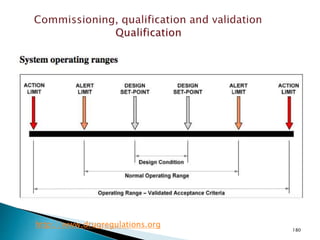
 The relationships between design conditions, operating range
and qualified acceptance criteria are given in next slide.
 There should be SOPs to determine action to be taken when
alert and action limits are reached.
http://www.drugregulations.org
180
http://www.drugregulations.org
181
 A narrow range of relative humidities coupled with a wide
range of temperatures is unacceptable as changes in
temperature will automatically give rise to variations in the
relative humidity.
 Some of the typical HVAC system parameters, based on a risk
assessment, that should be qualified for a pharmaceutical
facility may include:
◦ Temperature
◦ Relative humidity
◦ Supply air quantities for all diffusers
◦ Return air or exhaust air quantities
http://www.drugregulations.org
182
◦ Room air-change rates
◦ Room pressures (pressure differentials)
◦ Room airflow patterns
◦ Unidirectional flow velocities
◦ Containment system velocities
◦ HEPA filter penetration tests
◦ Room particle counts
◦ Room clean-up or recovery rates
◦ Microbiological air and surface counts where appropriate
◦ Operation of de-dusting
◦ Warning/alarm systems where applicable.
http://www.drugregulations.org
183
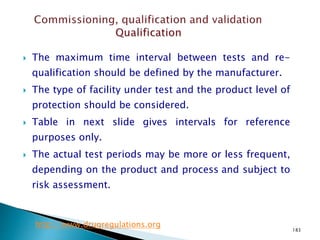
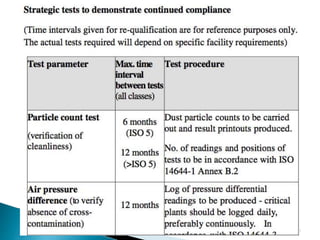
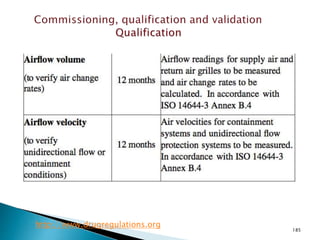
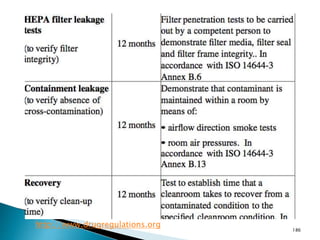
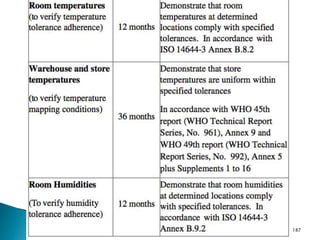
 The maximum time interval between tests and re-
qualification should be defined by the manufacturer.
 The type of facility under test and the product level of
protection should be considered.
 Table in next slide gives intervals for reference
purposes only.
 The actual test periods may be more or less frequent,
depending on the product and process and subject to
risk assessment.
http://www.drugregulations.org
184
http://www.drugregulations.org
185
http://www.drugregulations.org
186
http://www.drugregulations.org
187
http://www.drugregulations.org
188
 Requalification should also be done when any change,
which could affect system performance, takes place.
 Room clean-up or recovery tests are performed to
determine whether the installation is capable of returning
to a specified cleanliness level within a finite time, after
being exposed briefly to a source of airborne particulate
challenge.
 Room clean-up or recovery tests should demonstrate a
change in particle concentration by a factor of 100 within
the prescribed time (as per ISO 14644-3 clause B.12).
http://www.drugregulations.org
189
 The guidance time period for clean-up or recovery is about 15 to 20
minutes.
 In some instances it is not possible to increase the concentration by a
factor of 100 (such as for an ISO 14644 Class 8 condition) as the high
particle concentration can damage the particle counter.
 In this instance the particle decay method can be used as per ISO
14644-3 clause B.12.3.2.
 If energy-saving procedures such as reducing the airflow during non-
production hours are used, precautionary measures should be in
place to ensure that the systems are not operated outside the defined
relevant environmental conditions.
http://www.drugregulations.org
190
 These precautionary measures should be based
on a risk assessment to ensure that there is no
negative impact on the quality of the product.
 Qualification tests should be carried out to
demonstrate that there are
◦ No flow reversals,
◦ Loss of room pressurisation cascade,
◦ Temperature, humidity excursions, etc.
http://www.drugregulations.org
191
 Additional documents that should be
included in the qualification manuals
should include
◦ System airflow schematics,
◦ Room pressure cascade drawings,
◦ Zone concept drawings,
◦ Air-handling system allocation drawings,
◦ Particle count mapping drawings, etc.
http://www.drugregulations.org
192
 Tests should be carried as described in ISO
14644-3.
 However below are some supplementary notes
and aspects that provide additional guidance.
http://www.drugregulations.org
193
 The ISO 14644 method - "B.4.3.3 Supply airflow rate
calculated from filter face velocity" - should not be used to
measure the airflow at diffuser outlets.
 The diffuser air directional blades or swirl outlets result in
highly inaccurate measurements.
 The cone and anemometer method is more accurate.
 Other methods can be used such as volume flow regulators
with built in orifice and pressure differential ports, whereby
airflow can be read off a graph from the corresponding
pressure differentials.
http://www.drugregulations.org
194
 Particle count test results should be calculated using the
UCL (upper confidence level) formulas as described in ISO
14644-3, if there are up to nine locations.
 The practice of using the average value of all particle count
readings as the pass criteria is not acceptable.
 Ensure that the test certificate states the condition under
which the test was taken i.e. “as built”, “at-rest” or
“operational”.
 The operational condition should be clearly defined for
each room.
http://www.drugregulations.org
195
 For example: number of staff, staff locations, manner of
equipment operating,
 ISO 14644-1 clause B.4.3.42 states that when only one
test location is determined by formula, “take a minimum of
three single sample volumes (B.4.2) at that location.”
 A more representative result would be obtained by taking a
single sample at each of three different locations in that
room.
 The actual locations should be based on a risk assessment.
http://www.drugregulations.org
196
 In addition to determining the number of the sampling
locations based on the area of the clean room, a risk
assessment should determine if additional sample
locations are warranted.
 Consider aspects such as personnel and/or production
activities and air flow dead spots.
http://www.drugregulations.org
197
 Where a UDAF is located within a room the UDAF and its
background environment should be considered separately
in terms of sampling location calculations,
 They should be individually certified.
 The mapping drawing indicating test location should be
included with the test certificate,
 The same mapping locations should be used for future
tests for comparative purposes.
http://www.drugregulations.org
198
 Filter media, frame and seal should be tested for each filter
and results for media, frame and seal penetration reflected
separately on the test certificates.
 When HEPA filters are terminally mounted at the room, it
should be possible to carry out filter integrity tests from
within the room.
 The filter housings will therefore require ports for
measuring appropriate upstream concentration and
penetration concentration from within the room.
http://www.drugregulations.org
199
 In addition it should be possible to measure the filter
pressure drop in individual HEPA filters, also preferably
from within the room.
 These pressure drops should be recorded on the filter test
certificate as an indication of the filter life.
 The practice of measuring the appropriate upstream
concentration from the ceiling void or at the air handling
plant- room, and then measuring the filter penetration
concentration in the room is unacceptable.
http://www.drugregulations.org
200
 The time lag between measuring the upstream
concentration and the penetration concentration could
mean that by the time the room penetration is measured,
the upstream concentration is no longer the required
concentration.
 The test procedure should not compromise the quality of
the product.
http://www.drugregulations.org
201
 Maintenance records, maintenance procedures and
Operating & Maintenance Manuals should be sufficient to
indicate that the company has control over the HVAC
systems.
 There should be a planned preventive maintenance
programme, procedures and records for the HVAC system.
 Records should be kept for a sufficient length of time
should they be required for any product defect analysis.
http://www.drugregulations.org
202
 O&M manuals, schematic drawings, protocols and reports
should be maintained as reference documents for any future
changes and upgrades to the system.
 These documents should be kept up to date, containing any
system revisions made.
 The O&M manuals should typically contain the following
information:
◦ System description
◦ Operating instructions
◦ Trouble shooting
◦ Commissioning data
http://www.drugregulations.org
203
◦ Maintenance instructions,
◦ List of equipment suppliers,
◦ Spare parts list,
◦ Equipment data/capacity schedules,
◦ Supplier’s literature,
◦ Control system description,
◦ Electrical drawings and
◦ As-built drawings.
http://www.drugregulations.org
204
 Maintenance personnel should receive appropriate training, and training
records should be kept.
 HEPA filters should be changed either by a specialist or a trained person,
and then followed by installed filter leakage testing.
 Any maintenance activity should be assessed critically to determine any
impact on product quality including possible contamination.
 Maintenance activities should normally be scheduled to take place outside
production hours
 Any system stoppage should be assessed with a view to the possible need
for requalification of an area as a result of an interruption of the service.
http://www.drugregulations.org
This presentation is compiled from freely available
resource like the website of WHO, specifically the
WHO Draft Guidance on HVAC.
“Drug Regulations” is a non profit organization
which provides free online resource to the
Pharmaceutical Professional.
Visit http://www.drugregulations.org for latest
information from the world of Pharmaceuticals.
11/13/2015
20
5
Drug Regulations : Online
Resource for Latest Information

WHO Guidance on HVAC Systems for Non Sterile Pharmaceuticals

  • 1.
    www.drugragulations.org 1 Presentation preparedby Drug Regulations – a not for profit organization. Visit www.drugregulations.org for the latest in Pharmaceuticals.
  • 2.
    This presentation iscompiled from freely available resource like the website of WHO, specifically the WHO Draft Guidance on HVAC. “Drug Regulations” is a non profit organization which provides free online resource to the Pharmaceutical Professional. Visit http://www.drugregulations.org for latest information from the world of Pharmaceuticals. 11/13/2015 2 Drug Regulations : Online Resource for Latest Information
  • 3.
    3  Heating, ventilationand air-conditioning (HVAC) play an important role in ensuring the manufacture of quality pharmaceutical products.  A well-designed HVAC system will also provide comfortable conditions for operators.  WHO guidelines mainly focus on recommendations for systems for solid dosage forms.  The guidelines also refer to other systems or components which are not relevant to solid dosage form plants.  This may assist in providing a comparison between the requirements for solid dosage-form plants and other systems. http://www.drugregulations.org
  • 4.
    4  HVAC systemdesign influences architectural layouts ◦ Airlock positions, doorways and lobbies.  The architectural components have an effect on ◦ Room pressure, differential cascades and cross- contamination control.  The prevention of contamination and cross- contamination is an essential design consideration  The design of HVAC system should be considered at the concept design stage. http://www.drugregulations.org
  • 5.
    5  Temperature, relativehumidity and ventilation should be appropriate  Above should not adversely affect the quality of pharmaceutical products during their manufacture and storage, or the accurate functioning of equipment.  This WHO guidance focuses on the design, installation, qualification and maintenance of the HVAC systems. http://www.drugregulations.org
  • 6.
    6  These guidelinesare intended to complement those provided in Good manufacturing practices for pharmaceutical Products.  The additional standards are supplementary to the general requirements set out in the parent guide. http://www.drugregulations.org
  • 7.
    7  GMP requirementsfor HVAC systems for the manufacture of solid dosage forms.  Most of the system design principles also apply to facilities for ◦ Other dosage forms ◦ Other classes of products ◦ Biological products, ◦ Herbal medicines, ◦ Complimentary medicines ◦ Finishing process steps for APIs http://www.drugregulations.org
  • 8.
    8  Requirements forsterile products and hazardous products covered in separate Guidelines ◦ WHO Technical Report Series, No. 957, Annex 3, Technical Report Series, No. 961 Annex 6 ◦ Working document WHO/BS/2015.2253, intended to replace Technical Report Series, No. 822, Annex 1, 1992 http://www.drugregulations.org
  • 9.
    9  A basicguide for use by pharmaceutical manufacturers and GMP inspectors.  They are not intended to be prescriptive in specifying requirements and design parameters.  There are many parameters affecting a clean area condition  Therefore difficult to lay down the specific requirements for one particular parameter in isolation.  User requirements may vary from one manufacturer to the next. http://www.drugregulations.org
  • 10.
    10  Design parametersand user requirements should, therefore, be set realistically for each project. ◦ Cost-effective design ◦ Comply with all regulatory standards  Ensure that product quality and safety are not compromised.  The three primary aspects to be considered are Protection of ◦ Product ◦ Personnel ◦ Environment http://www.drugregulations.org
  • 11.
    11  Consider theproducts to be manufactured when establishing system design parameters.  Multiple product facility will have stringent design parameters ◦ cross-contamination control, compared with a single product facility.  Risk assessment studies should be an integral part of the facility design and implementation  Implement R A from the URS stage right through to validation  Validation protocols and criteria should be justified by links to a written risk assessment. http://www.drugregulations.org
  • 12.
  • 13.
  • 14.
    14  Close relationshipbetween architectural design and HVAC design  Both have an impact on the functionality of each other  HVAC system design influences architectural layouts ◦ Airlock positions ◦ Doorways ◦ Lobbies http://www.drugregulations.org
  • 15.
    15  The architecturallayouts have an effect on room pressure differential cascades and cross-contamination control.  The prevention of contamination and cross-contamination is an essential design consideration of the HVAC system.  The design of the HVAC system should be considered at the concept design stage  Architectural layout must ensure that ◦ Material flow is in a logical sequence ◦ Excluding material flow reversals where possible. http://www.drugregulations.org
  • 16.
    16  Efficient operationof the air-handling system and cleanliness levels attained are reliant on the correct building layout and building finishes,  Consider items given in Subsequent slides http://www.drugregulations.org
  • 17.
    17  Adequate airlocks,change rooms and passages should be provided to protect passage between different cleanliness conditions. ◦ Personnel airlocks (PAL) and/or material airlocks (MAL),  These should have supply and extract air systems as appropriate.  Areas such as airlocks, change rooms and passages, should be designed so that the required pressure cascades can be achieved. http://www.drugregulations.org
  • 18.
    18  Detailed diagramsdepicting pressure cascades, air flow directions and flow routes for personnel and materials should be prepared and maintained.  Where possible, personnel and materials should not move from a higher cleanliness zone to a lower cleanliness zone and back to a higher cleanliness zone.  If moving from a lower cleanliness zone to a higher cleanliness zone, changing /decontamination procedures should be followed  The final stage of the changing room should be the same GMP classification grade as the area into which it leads. http://www.drugregulations.org
  • 19.
    19  Changing roomsshould be of a sufficient size to allow for ease of changing.  Changing rooms should be equipped with mirrors so that personnel can confirm the correct fit of garments before leaving the changing room.  Appropriate hand wash and sanitizing facilities should be provided.  Hand-wash basins should be provided with elbow taps or sensor operated taps. http://www.drugregulations.org
  • 20.
    20  Door gapsaround the door perimeter have a marked impact on the pressure differential across the doorway.  The fit of the doors should ensure that the correct leakages are allowed for.  Likewise the maintenance of doors is a critical factor in room pressure control  A poorly fitting door can severely compromise a room pressure differential  Where the opening and closing of airlock doors could lead to cross- Contamination, these airlock doors should not be opened simultaneously.  An interlocking system and a visual and/or audible warning system should be operated to prevent the opening of more than one door at a time. http://www.drugregulations.org
  • 21.
    21  Doors shouldbe carefully designed to avoid un-cleanable recesses;  Sliding doors may be undesirable for this reason.  Swing doors should open to the high-pressure side and be provided with self-closers.  Exceptions are permitted based on egress and site environmental, fire, health and safety containment requirements. http://www.drugregulations.org
  • 22.
    22  The choiceof building finishes and materials also has an impact on air conditioning performance and air cleanliness.  Materials should be selected that will provide a well-sealed building to facilitate room pressure control.  Materials and paint finishes should also be non-dust and particle liberating as this impacts on room cleanliness.  Finishes should be easy to clean and non-absorbent.  To reduce the accumulation of dust and to facilitate cleaning, ◦ There should be no un-cleanable recesses and ◦ A minimum of projecting ledges, shelves, cupboards and equipment. http://www.drugregulations.org
  • 23.
    23  Diagrams insubsequent slides illustrate some typical room and suite layouts with their associated room pressures.  These are purely examples and other factors may dictate different room arrangements and room pressures. http://www.drugregulations.org
  • 24.
  • 25.
  • 26.
  • 27.
  • 28.
  • 29.
  • 30.
  • 31.
  • 32.
    32  The requireddegree of air cleanliness in most OSD manufacturing facilities ◦ Can normally be achieved without the use of high-efficiency particulate air (HEPA) filters ◦ Provided the air is not recirculated or in the case of a single-product facility.  Many open product zones of OSD form facilities are capable of meeting ISO 14644-1 Class 8 or Grade D, “at- rest” condition, ◦ Measured against particle sizes of 0.5 μm and 5 μm, ◦ Cleanliness may not necessarily be classified as such by manufacturers. http://www.drugregulations.org
  • 33.
    33  A riskassessment should be carried out to determine ◦ The cleanroom conditions required and ◦ The extent of validation required.  There are two basic concepts of air delivery to pharmaceutical production facilities: ◦ A recirculation system, and ◦ A full fresh air system (100% outside air supply). http://www.drugregulations.org
  • 34.
    34  For recirculationsystems the amount of fresh air should not be determined arbitrarily on a percentage basis, but, for example, by the following criteria: ◦ Sufficient fresh air to compensate for leakage from the facility and loss through exhaust air systems; ◦ Sufficient fresh air to comply with national building regulations (depending on occupant density, between 1 and 2.5 ACPH will often satisfy occupancy requirements); ◦ Sufficient fresh air for odor control; ◦ Sufficient fresh air to provide the required building pressurization http://www.drugregulations.org
  • 35.
    35  Automated monitoringsystems ◦ Capable of indicating any out-of-specification (OOS) condition without delay by means of an alarm or similar system.  Sophisticated computer- based data monitoring systems ◦ Can aide with planning of preventive maintenance and can also provide trend logging. http://www.drugregulations.org
  • 36.
    36  This typeof system is commonly referred to as ◦ A building management system (BMS), ◦ Building automation system (BAS) or ◦ System control and data acquisition (SCADA) system.  If these systems are used for critical decision-making, they should be validated. http://www.drugregulations.org
  • 37.
    37  If theBMS is not validated in full (or in part for these critical parameters), ◦ an independent validated environmental monitoring system (EMS) should be provided, specifically for recording and alarming critical parameters.  Critical parameters could include for example ◦ Room temperature in production areas ◦ Humidity ◦ Differential pressures ◦ Fan failure alarms, etc. http://www.drugregulations.org
  • 38.
    38  Failure ofa supply air fan, return air fan, exhaust air fan or dust extract system fan can cause a system imbalance  This results in a pressure cascade malfunction with a resultant airflow reversal.  A fan interlock failure matrix should be set up, ◦ If a fan serving a high pressure zone fails, then any fans serving surrounding lower pressure areas should automatically stop,  This should prevent an airflow reversal and possible cross-contamination. http://www.drugregulations.org
  • 39.
    39  This fanstop-start matrix should apply to the switching on and switching off of systems to ensure that there is no flow reversal causing cross-contamination.  Appropriate alarm systems should be in place to alert personnel if a critical fan fails  All critical alarms should be easily identifiable and visible and/or audible to relevant personnel. http://www.drugregulations.org
  • 40.
    40  The positioningof supply and extract grilles should be such as to provide effective room flushing.  Low-level return or exhaust air grilles are usually preferred.  However, where this is not possible, a higher air change rate may be needed to achieve a specified clean area condition, e.g. where ceiling return air grilles are used.  There may be alternative locations for return air.  For example, referring to Figure in next slides , Room 1 (low-level return air) and Room 2 (ceiling return air).. http://www.drugregulations.org
  • 41.
  • 42.
    42  The airflowschematics of the two systems (last & subsequent slides) indicate air-handling units with return air or recirculated air, having a percentage of fresh air added.  Depending on product characteristics and dust loading it is sometimes preferable to fit filters on return air outlets or in return air ducting. http://www.drugregulations.org
  • 43.
  • 44.
    44  Last figureis a schematic diagram of an air-handling system serving rooms with horizontal unidirectional flow, vertical unidirectional flow and turbulent flow, for rooms 3, 4 and 5, respectively.  In this case the HEPA filters are terminally mounted at the rooms, and not in the AHU.  Terminally mounted HEPA filters can assist with preventing cross- contamination from room to room in the event of a fan failure condition.  The decision whether to install terminal HEPA filters should be based on a risk-assessment study. http://www.drugregulations.org
  • 45.
    45  There shouldbe no risk of contamination or cross- contamination(including by fumes and volatiles) due to recirculation of air.  Depending on the airborne contaminants in the return-air system it may be acceptable to use recirculated air, provided that HEPA filters are installed in the supply air stream (or return air stream) to remove contaminants and thus prevent cross-contamination.  The HEPA filters for this application should have an EN 1822 classification of H13.  HEPA filters may not be required where the air-handling system is serving a single product facility and there is evidence that cross- contamination would not be possible. http://www.drugregulations.org
  • 46.
    46  Recirculation ofair from areas where pharmaceutical dust is not generated such as secondary packing, may not require HEPA filters in the system.  HEPA filters may be located in the air-handling unit or placed terminally.  Where HEPA filters are terminally mounted they s h o u l d preferably not be connected to the ducting by means of flexible ducting.  Due to the high air pressure required for the terminal filter, this connection should preferably be a rigid duct connection. http://www.drugregulations.org
  • 47.
    47  Where flexibleducting is used, it should be as short as possible and properly fixed to withstand duct pressure.  When HEPA filters are terminally mounted, it should be possible to carry out filter integrity tests from within the room.  The filter housings will therefore require ports for measuring appropriate upstream concentration (refer to ISO 14644.3) and penetration concentration from within the room.  In addition it should be possible to monitor the filter pressure drop in individual HEPA filters.  Air containing dust from highly toxic processes and/or solvents or flammable vapours should never be recirculated to the HVAC system. http://www.drugregulations.org
  • 48.
    48  The requireddegree of filtration of the exhaust air depends on the exhaust air contaminants and local environmental regulations.  HEPA filters in the exhaust system would normally only be required when handling hazardous materials.  Next Figure indicates a system operating on 100% fresh air  This would normally be used in a facility dealing with toxic products or solvents, where recirculation of air with contaminants should be avoided. http://www.drugregulations.org
  • 49.
  • 50.
  • 51.
    51  Energy-recovery wheelsif used in multiproduct facilities should have been subjected to a risk assessment to determine if there is any risk of cross-contamination.  When such wheels are used they should not become a source of possible contamination . ◦ Alternatives to the energy-recovery wheels, such as crossover plate heat exchangers and water-coil heat exchangers, may be used in multiproduct facilities.  The potential for air leakage between the supply air and exhaust air as it passes through the wheel should be prevented.  The relative pressures between supply and exhaust air systems should be such that the exhaust air system operates at a lower pressure than the supply system. http://www.drugregulations.org
  • 52.
    52  A schematicdiagram of the airflow for a typical system serving a low relative humidity suite is represented in next Figure.  Air can be dried with a chemical drier  e.g. a rotating desiccant wheel which is continuously regenerated by means of passing hot air through one segment of the wheel.  Alternative methods of drying air are also available. http://www.drugregulations.org
  • 53.
  • 54.
    54  The figureillustrates the chemical drier handling part of the fresh air/return air mixture on a bypass flow.  The location of the chemical drier should be considered in the design phase.  The practice of locating the complete chemical drier unit in the production cubicle is not recommended as this could be a source of contamination or cross-contamination.  Examples of appropriate locations for the drying wheel could include: ◦ Full flow of fresh/return air; ◦ Partial handling of fresh/return air (bypass airflow); ◦ Return air only; ◦ Fresh air only; or ◦ Pre-cooled air with any of the above alternatives. http://www.drugregulations.org
  • 55.
    55  Possible additionalcomponents that may be required in air handling should be considered depending on the climatic conditions and locations.  These may include items such as: ◦ Frost coils on fresh air inlets in very cold climates to preheat the air; ◦ Reheaters for humidity control ◦ Automatic air volume control devices ◦ Sound attenuators ◦ Snow eliminators to prevent snow entering air inlets and blocking airflow ◦ Dust eliminators on air inlets in arid and dusty locations ‒ moisture eliminators in humid areas with high rainfall ◦ Fresh air precooling coils for very hot or humid climates. http://www.drugregulations.org
  • 56.
    56  Areas wherefollowing are exposed to the environment should be defined as “clean areas”, “clean zones”, “controlled areas” or “cleanrooms”. ◦ Starting materials and products ◦ Utensils ◦ Primary packing materials ◦ Equipment . http://www.drugregulations.org
  • 57.
    57  The achievementof a particular clean area condition depends on a number of criteria  These should be addressed at the design and qualification stages.  A suitable balance between the different criteria will be required in order to create an efficient clean area. http://www.drugregulations.org
  • 58.
    58  Some ofthe basic criteria to be considered which affects room cleanliness should include: ◦ Building finishes and structure• dust control and containment ◦ Air filtration ◦ Air change rate or flushing rate ◦ Room pressure ◦ Location of air terminals and directional airflow ◦ Temperature ◦ Relative humidity ◦ Material flow ◦ Personnel flow ◦ Gowning procedures ◦ Equipment movement ◦ Process being carried out (open or closed system) ◦ Outside air conditions ◦ Occupancy ◦ Type of product ◦ Cleaning standard operating procedures (SOPs). http://www.drugregulations.org
  • 59.
    59  Air filtrationand air change rates should be set to ensure that the defined clean area condition is attained.  The air change rates should be determined by taking into account ◦ The various critical parameters ◦ Using a risk based approach ◦ With due consideration of capital and running costs and energy usage.  Primarily the air change rate should be set to a level that will achieve the required clean area condition. http://www.drugregulations.org
  • 60.
    60  Air changerates are normally determined by the following considerations ◦ (could normally vary between 6 and 20 air changes per hour):  Area condition required: ◦ Whether a specific room cleanliness condition is in fact required and whether the room condition is rated for an “at rest” condition or an “operational” condition ◦ (air change rate should be selected on need rather than tradition) http://www.drugregulations.org
  • 61.
    61  The productcharacteristics ◦ (e.g. odours, hygroscopicity, etc.); the quality and filtration of the supply air  Particulates generated by the manufacturing process;  Particulates generated by the operators  Configuration of the room and air supply and extract locations;  Sufficient air to achieve containment effect and to clean up the area;  Sufficient air to cope with the room heat load  Sufficient air to balance extract rates;  Sufficient air to maintain the required room pressure. http://www.drugregulations.org
  • 62.
    62  If acleanroom classification is specified, the manufacturer should state whether this is achieved under “as-built” , “at- rest” or “operational” conditions.  Room classification tests in the “as-built” condition should be carried out on the bare room, in the absence of any equipment or personnel.  Room classification tests in the “at-rest” condition should be carried out with the equipment operating where relevant, but without any operators. http://www.drugregulations.org
  • 63.
    63  Because ofthe amounts of dust usually generated in a solid dosage facility, the clean area classifications would be rated for the “at-rest” condition.  Room classification tests in the “operational” condition are normally carried out during the normal production process with equipment operating, and the normal number of personnel present in the room.  When qualifying for the operational condition details of the process operating, number and positions of staff should be stipulated for each room, to enable future qualifications to duplicate the same conditions. http://www.drugregulations.org
  • 64.
    64  Room clean-upor recovery tests are performed to determine whether the installation is capable of returning to a specified cleanliness level within a finite time, after being exposed briefly to a source of airborne particulate challenge.  Room “clean-up” or “recovery” tests should demonstrate a change in particle concentration by a factor of 100 within the prescribed time (as per ISO 14644-3 clause B.12) http://www.drugregulations.org
  • 65.
    65  The guidancetime period for clean-up or recovery is about 15 to 20 minutes.  In some instances it is not possible to increase the concentration by a factor of 100 (such as for an ISO 14644 Class 8 condition) as the high particle concentration can damage the particle counter.  In this instance the particle decay method can be used as per ISO 14644-3 clause B.12.3.2 http://www.drugregulations.org
  • 66.
    66  Materials andproducts should be protected from contamination and cross-contamination during all stages of manufacture  Contaminants may result from inappropriate premises poor cleaning procedures, contaminants brought in by personnel, poor manufacturing process and a poor HVAC system. ◦ (e.g. poor design, layout or finishing), http://www.drugregulations.org
  • 67.
  • 68.
  • 69.
    11/13/2015 69 Drug Regulations: Online Resource for Latest Information
  • 70.
    70  Airborne contaminantsshould be controlled through effective ventilation and filtration.  External contaminants should be removed by effective filtration of the supply air  See next Figure for an example of a shell-like building layout to enhance containment and protection from external contaminants. http://www.drugregulations.org
  • 71.
  • 72.
    72  Internal contaminantsshould be controlled by dilution and flushing of contaminants in the room, or by displacement airflow  See Figures next two slides for examples of methods for the flushing of airborne contaminants. http://www.drugregulations.org
  • 73.
  • 74.
  • 75.
    75  Airborne particulatesand the degree of filtration should be considered critical parameters with reference to the level of product protection required.  Personnel should not be a source of contamination.  The level of protection and air cleanliness for different areas should be determined according to ◦ The product being manufactured ◦ The process being used ◦ The product’s susceptibility to degradation ( Next Slide). http://www.drugregulations.org
  • 76.
  • 77.
    77  The degreeto which air is filtered plays an important role in the ◦ Prevention of contamination and ◦ Control of cross-contamination.  The type of filters required for different applications depends on the quality of the ambient air and the return air (where applicable) and also on the air change rates.  Table in next slide gives the recommended filtration levels for different levels of protection in a pharmaceutical facility. http://www.drugregulations.org
  • 78.
  • 79.
    79  Manufacturers shoulddetermine and prove the appropriate use of filters.  Filter classes should always be linked to the standard test method because referring to actual filter efficiencies can be very misleading  Different test methods each result in a different efficiency value for the same filter. http://www.drugregulations.org
  • 80.
    80  Referring tofilter classifications such as an 85% filter or a 5 μm filter are not valid classifications.  This should not be used, as this can lead to the incorrect filter being installed.  Only the EN 779 and EN 1822 or ISO 29463 classifications, as per next two tables should be used. http://www.drugregulations.org
  • 81.
  • 82.
  • 83.
    83  In selectingfilters, the manufacturer should have considered other factors, such as particularly ◦ Contaminated ambient conditions, ◦ Local regulations and ◦ Specific product requirements.  Good prefiltration extends the life of the more expensive filters downstream.  Filters have an impact on the cleanroom class or Level of Protection.  The different levels of protection and recommended filters grades are given in next two Tables. http://www.drugregulations.org
  • 84.
  • 85.
  • 86.
    86  Materials forcomponents of an HVAC system should be selected with care so that they do not become a source of contamination.  Any component with the potential for liberating particulate or microbial contamination into the airstream should be located upstream of the final filters.  Where possible ventilation dampers, filters and other services should be designed and positioned so that they are accessible from outside the manufacturing areas (service voids or service corridors) for maintenance purposes. http://www.drugregulations.org
  • 87.
    87  Directional airflowwithin production or primary packing areas should assist in preventing contamination.  Airflows should be planned in conjunction with operator locations,  This will minimize contamination of the product by the operator and also to protect the operator from dust inhalation.  Different airflow patterns are indicated in Next two slides. http://www.drugregulations.org
  • 88.
  • 89.
  • 90.
    90  HVAC airdistribution components should be designed, installed and located to prevent contaminants generated within the room from being spread.  Supply air diffusers should be selected with care taking consideration of, ◦ e.g. room requirements and positions of equipment and operators in the room.  Supply air diffusers of the high induction type should not be used in clean areas where dust is liberated. ◦ (e.g. those typically used for office-type air-conditioning) http://www.drugregulations.org
  • 91.
    91  Air diffusersshould be of the non-induction type  They should introduce air with the least amount of induction so as to maximize the flushing effect.  In rooms where the process results in high dust liberation; ◦ Perforated plates or low induction swirl diffusers with low level extract or return should be used to contain the dust at the lower level of the room  In cases where dust liberation is low, ceiling return air grilles may be acceptable.  See next three slides for illustrations of the three types of diffusers. http://www.drugregulations.org
  • 92.
  • 93.
  • 94.
  • 95.
    95  Induction andcertain swirl diffusers induce room air vertically up to the diffuser to mix with the supply air.  These diffusers create good dilution of contaminants in the room  They may be used in rooms where there is low dust liberation.  However, if used in rooms where excessive dust is generated, the distribution of dust in the room could be hazardous for the operators in the room.  This is because dust is drawn up into the supply air stream and then spread throughout the room. http://www.drugregulations.org
  • 96.
    96  Unidirectional airflow(UDAF) should be used for weighing booths or sampling booths.  They provide operator and product protection  They should also have a slight air in-flow from the room to enhance containment.  Dust containment at the weigh booth should be demonstrated by smoke airflow pattern tests, or other appropriate tests.  UDAF can also be used to provide protection of other dusty processes. http://www.drugregulations.org
  • 97.
    97  Sampling ofmaterials such as starting materials, primary packaging materials and products, should be carried out in the same environmental conditions that are required for the further processing of the product.  In a weighing booth situation, the aim of the UDAF is to provide dust containment and operator protection. http://www.drugregulations.org
  • 98.
    98  Example: Innext slide the dust generated at the weighing station is immediately extracted through the perforated worktop,  This protects the operator from dust inhalation,  At the same time product is protected from contamination by the operator by means of the vertical unidirectional airflow stream. http://www.drugregulations.org
  • 99.
  • 100.
    100  The unidirectionalflow velocity should be such that it does not disrupt the sensitivity of balances in weighing areas.  Where necessary the velocity may be reduced to prevent inaccuracies during weighing.  However sufficient airflow should be maintained to provide containment.  Conventional unidirectional airflow systems, where a Grade A condition is required, have a guidance airflow velocity of 0.36 to 0.54 m/s. http://www.drugregulations.org
  • 101.
    101  However, ina weigh booth or sampling booth a lower velocity can be used as a Grade A condition is not required.  It is often necessary to reduce velocities to a lower level in order not to influence balance readings.  The airflow velocity and directional flow should still ensure product containment.  For this type of application it is sometimes better to refer to the unit as an airflow protection booth (APB) rather than a UDAF,  This avoids confusion, with a Grade A requirement. http://www.drugregulations.org
  • 102.
    102  Containment forweighing and sampling operations ◦ There should be a slight inflow of air into the UDAF protected zone from the surrounding room ◦ This prevents dust escaping.  Thus the amount of air extracted from below the UDAF/APB should exceed the amount of air supplied. ◦ Unless the hazardous or sterile nature of the product dictates otherwise. http://www.drugregulations.org
  • 103.
    103  The positionin which the operator stands relative to the source of dust liberation and airflow should be determined  This ensure that the operator is not in the path of an airflow that could lead to contamination of the product (Next slide). http://www.drugregulations.org
  • 104.
  • 105.
    105  Once thesystem has been designed and qualified with a specific layout for operators and processes, this should be maintained in accordance with an SOP.  There should be no obstructions in the path of a unidirectional flow air stream that may cause the operator to be exposed to dust. http://www.drugregulations.org
  • 106.
    106  Next slideillustrates the incorrect use of a weighing scale which has a solid back.  The back of the weighing scale should not block the return air path  This obstructs the airflow  Causes air to rise vertically carrying dust  This results in a hazardous situation for the operator. http://www.drugregulations.org
  • 107.
  • 108.
    108  Next slideillustrates a situation where an open bin is placed below a vertical unidirectional flow distributor.  The downward airflow should be prevented from entering the bin, and then being forced to rise again  This would carry light dust up towards the operator’s face.  In such an occurrence it may be necessary to add a partial cover over the bin to limit the entry of air.  Point extraction could also be used but this can result in the excessive loss of product. http://www.drugregulations.org
  • 109.
  • 110.
  • 111.
    111  Next slideshows that a solid worktop can sometimes cause deflection of the vertical unidirectional airflow resulting in a flow reversal.  A possible solution would be to have a 100 mm gap between the back of the table and the wall, with the air being extracted here. http://www.drugregulations.org
  • 112.
  • 113.
    113  The manufacturershould select either vertical or horizontal unidirectional airflow Next slide  An appropriate airflow pattern to provide the best protection for the particular application. http://www.drugregulations.org
  • 114.
  • 115.
  • 116.
    116  Return orexhaust air grilles in rooms or at weigh or sampling booths should preferably be of the perforated grille types.  They are easy to clean.  Return/exhaust air filters can either be installed at the room terminal or in the air-handling unit.  Maintenance and cleaning of filters and ducts should be addressed to ensure constant airflow. http://www.drugregulations.org
  • 117.
    117  Air infiltrationof unfiltered air into a pharmaceutical plant should not be a source of contamination.  Manufacturing facilities should normally be maintained at a positive pressure relative to the outside  This limits the ingress of contaminants.  Where facilities are to be maintained at negative pressures relative to the ambient pressure, special precautions should be taken.  Refer to the WHO guidelines for hazardous products, for further guidance on negative pressure facilities. http://www.drugregulations.org
  • 118.
    118  The locationof the negative pressure facility should be carefully considered with reference to the areas surrounding it  Attention should be given to ensuring that the building structure is well sealed.  Negative pressure zones should be encapsulated by surrounding areas with clean air supplies.  This will ensure that only clean air can infiltrate into the controlled zone. http://www.drugregulations.org
  • 119.
    119  Where differentproducts are manufactured at the same time measures should be taken to ensure that dust cannot move from one cubicle to another. ◦ In different areas or cubicles, ◦ In a multiproduct OSD manufacturing site,  Correct directional air movement and a pressure cascade system can assist in preventing cross-contamination.  The pressure cascade should be such that the direction of airflow is from the clean corridor into the cubicles  This results in dust containment. http://www.drugregulations.org
  • 120.
    120  For cubicleswhere dust is liberated, ◦ The corridor should be maintained at a higher pressure than the cubicles and ◦ The cubicles at a higher pressure than atmospheric pressure.  Containment can normally be achieved ◦ By application of the displacement concept (low pressure differential, high airflow), or ◦ The pressure differential concept (high pressure differential, low airflow), or ◦ The physical barrier concept.  The pressure cascade regime and the direction of airflow should be appropriate to the product and processing method used. http://www.drugregulations.org
  • 121.
    121  Highly potentproducts should be manufactured under a pressure cascade regime ◦ That is negative relative to atmospheric pressure.  The pressure cascade for each facility should be individually assessed ◦ According to the product handled and ◦ Level of protection required.  Building structure should be given special attention to accommodate the pressure cascade design.  Ceilings and walls, close fitting doors and sealed light fittings should be in place, to limit ingress or egress of air. http://www.drugregulations.org
  • 122.
    122  This methodof containment is not the preferred method, as the measurement and monitoring of airflow velocities in doorways is difficult.  This concept is commonly found in production processes where large amounts of dust are generated.  Under this concept the air should be supplied ◦ To the corridor, ◦ Flow through the doorway, and ◦ Be extracted from the back of the cubicle. http://www.drugregulations.org
  • 123.
    123  Normally thecubicle door should be closed  The air should enter the cubicle through a door grille  The concept can be applied to an opening without a door.  With the door open the pressure differential will effectively be zero.  The velocity should be high enough to prevent turbulence within the doorway resulting in dust escaping. http://www.drugregulations.org
  • 124.
    124  This displacementairflow should be calculated as the product of the door area and the velocity through the doorway  This generally results in fairly large air quantities.  This method of containment may still exist on older facilities  It is not the preferred method, as the measurement and monitoring of doorway velocities is difficult.  Maintaining the correct room pressure and the correct room air change rate is often not achieved. http://www.drugregulations.org
  • 125.
    125  The pressuredifferential concept may normally be used in zones where little or no dust is being generated.  It may be used alone or in combination with other containment control techniques and concepts, ◦ such as a double door airlock.  The high-pressure differential between the clean and less clean zones should be generated by leakage through the gaps of the closed doors to the cubicle. http://www.drugregulations.org
  • 126.
    126  The pressuredifferential should be of sufficient magnitude  This ensures containment and prevention of flow reversal  However the differential should not be so high as to create turbulence problems.  In considering room pressure differentials, transient variations, such as machine extract systems, should be taken into consideration.  A pressure differential of 15 Pa is often used for achieving containment between two adjacent zones,  Pressure differentials of between 5 Pa and 20 Pa may be acceptable. http://www.drugregulations.org
  • 127.
    127  Where thedesign pressure differential is too low and tolerances are at opposite extremities, a flow reversal can take place.  For example, where a control tolerance of ± 3 Pa is specified, the implications of adjacent rooms being operated at the upper and lower tolerances should be evaluated.  It is important to select pressures and tolerances such that a flow reversal is unlikely to occur. http://www.drugregulations.org
  • 128.
    128  The pressuredifferential between adjacent rooms could be considered a critical parameter, depending on the outcome of risk analysis.  The limits for the pressure differential between adjacent areas should be such that there is no risk of overlap in the acceptable operating range http://www.drugregulations.org
  • 129.
    129  e.g. 5Pa to 15 Pa in one room and 15 Pa to 30 Pa in an adjacent room, resulting in the failure of the pressure cascade, where the first room is at the maximu pressure limit and the second room is at its minimum pressure limit.  Low pressure differentials may be acceptable when airlocks (pressure sinks or pressure bubbles) are used to segregate areas.  The effect of room pressure tolerances are illustrated in Next slide http://www.drugregulations.org
  • 130.
  • 131.
    131  If oneroom is at the higher side of the tolerance and the other at the lower side of the tolerance, it could result in either a high or a low pressure differential.  When setting tolerances it is also important to specify if the tolerance is applicable to the absolute room pressures or the pressure differentials.  In the diagram below the tolerances have been based on a ± 3 Pa tolerance on absolute room pressures, resulting in pressure differential variances of between 21 and 9 Pa. .  For a room pressure differential of 15 Pa and a tolerance based on ± 3 Pa of differential pressure, then the resultant variances would only be between 12 and 18 Pa. http://www.drugregulations.org
  • 132.
    132  The pressurecontrol and monitoring devices used should be calibrated and qualified.  Compliance with specifications should be regularly verified and the results recorded.  Pressure control devices should be linked to an alarm system set according to the levels determined by a risk analysis.  Manual control systems should be set up during commissioning, with set point marked  This should not change unless other system conditions change. http://www.drugregulations.org
  • 133.
    133  Airlocks canbe important components in setting up and maintaining pressure cascade systems  They also to limit cross-contamination.  Airlocks with different pressure cascade regimes include the cascade airlock, sink airlock and bubble airlock (Next three slides): ◦ Cascade airlock: higher pressure on one side of the airlock and lower pressure on the other; ◦ Sink airlock: lower pressure inside the airlock and higher pressure on both outer sides; ◦ Bubble airlock: higher pressure inside the airlock and lower pressure on both outer sides. http://www.drugregulations.org
  • 134.
  • 135.
  • 136.
  • 137.
    137  The diagramsabove and the differential pressures shown here are for illustration purposes only.  Pressures indicated in these examples are absolute pressures, whereas the local pressure indication would most likely be pressure differential from room to room. http://www.drugregulations.org
  • 138.
    138  Doors shouldopen to the high pressure side, so that room pressure assists in holding the door closed  Doors should be provided with self- closers.  Should the doors open to the low pressure side, the door closer springs should be sufficient to hold the door closed and prevent the pressure differential from pushing the door open.  There should be a method to indicate if both doors to airlocks are open at the same time  Alternatively these should be interlocked.  The determination of which doors should be interlocked should be the subject of a risk assessment study. http://www.drugregulations.org
  • 139.
    139  Central dustextraction systems should be interlocked with the appropriate air-handling systems,  This ensures that they operate simultaneously.  Room pressure differential between adjacent cubicles, which are linked by common dust extraction ducting, should be avoided.  Air should not flow through the dust extraction ducting or return air ducting from the room with the higher pressure to the room with the lower pressure ◦ This would normally occur only if extract or return systems were inoperative http://www.drugregulations.org
  • 140.
    140  Systems shouldbe designed to prevent dust flowing back in the opposite direction in the event of component failure or airflow failure.  Adequate room pressure differential indication should be provided  This ensures that each critical room pressure can be traced back to ambient pressure in order to determine the room actual absolute pressure,  A pressure gauge installed to indicate the pressure differential from a central corridor to the outside. http://www.drugregulations.org
  • 141.
    141  Room pressureindication gauges should have a range and graduation scale which enables the reading to an appropriate accuracy.  Normal operating range, alert and action limits should be defined and displayed at the point of indication.  A colour coding of these limits on the gauge may be helpful.  Room pressure indication may be either analogue or digital,  May be represented as either pressure differentials or absolute pressures.  Whichever system is used any out-of-specification condition should be easily identifiable. http://www.drugregulations.org
  • 142.
    142  Material pass-through-hatches(PTH) or pass boxes (PB) can also be used for separating two different zones.  PTHs fall into two categories, namely a dynamic PTH or a passive PTH.  Dynamic PTHs have an air supply to or extraction from them, and can then be used as bubble, sink or cascade PTHs.  Room pressure differential tolerances should always be set with a maximum and minimum tolerance.  Setting tolerances as NMT or NLT can easily lead to an OOS condition. http://www.drugregulations.org
  • 143.
    143  Where appropriate,an impervious barrier to prevent cross- contamination between two zones, such as closed systems, pumped or vacuum transfer of materials, should be used. http://www.drugregulations.org
  • 144.
    144  Where appropriate,temperature and relative humidity should be controlled, monitored and recorded,  Where relevant, ensure compliance with requirements pertinent to the materials and products  Provide a comfortable environment for the operator where necessary.  Maximum and minimum room temperatures and relative humidity should be appropriate.  Alert and action limits on temperatures and humidities should be set, as appropriate. http://www.drugregulations.org
  • 145.
    145  The operatingband, or tolerance, between the acceptable minimum and maximum temperatures should not be made too close.  Tight control tolerances may be difficult to achieve and can also add unnecessary installation and running costs.  Cubicles, or suites, in which products requiring low relative humidity are processed, should have well-sealed walls and ceilings  They should also be separated from adjacent areas with higher relative humidity by means of suitable airlocks. http://www.drugregulations.org
  • 146.
    146  Precautions shouldbe taken to prevent moisture migration that increases the load on the HVAC system.  Humidity control should be achieved by removing moisture from the air, or adding moisture to the air, as relevant.  Dehumidification (moisture removal) may be achieved by means of either refrigerated dehumidifiers or chemical dehumidifiers.  Appropriate cooling media for dehumidification such as low temperature chilled water/glycol mixture or refrigerant should be used. http://www.drugregulations.org
  • 147.
    147  Humidifiers shouldbe avoided if possible as they may become a source of contamination (e.g. microbiological growth).  Where humidification is required, this should be achieved by appropriate means such as the injection of steam into the air stream.  A product-contamination assessment should be done to determine whether pure or clean steam is required for the purposes of humidification. http://www.drugregulations.org
  • 148.
    148  Where steamhumidifiers are used, chemicals such as corrosion inhibitors or chelating agents, which could have a detrimental effect o the product, should not be added to the boiler system.  Only appropriate additives should be added to the boiler system.  Humidification systems should be well drained.  No condensate should accumulate in air-handling systems.  Other humidification appliances such as evaporative systems, atomizers and water mist sprays, should not be used because of the potential risk of microbial contamination. http://www.drugregulations.org
  • 149.
    149  Duct materialin the vicinity of the humidifier should not add contaminants to air that will not be removed by filtration further downstream.  Air filters should not be installed immediately downstream of humidifiers, as moisture on the filters could lead to bacterial growth.  Cold surfaces should be insulated to prevent condensation within the clean area or on air-handling components. http://www.drugregulations.org
  • 150.
    150  When specifyingrelative humidity, the associated temperature should also be specified.  Chemical driers using silica gel or lithium chloride are acceptable, provided that they do not become sources of contamination. http://www.drugregulations.org
  • 151.
    151  Wherever possible,dust or vapour contamination should be removed at source.  Point-of-use extraction, i.e. as close as possible to the point where the dust is generated, should be employed.  Spot ventilation or capture hoods may be used as appropriate.  The HVAC system should not serve as the primary mechanism of dust control.  Point-of-use extraction should be either in the form of a fixed, high-velocity extraction point or an articulated arm with movable hood or a fixed extraction hood. http://www.drugregulations.org
  • 152.
    152  Dust extractionducting should be designed with sufficient transfer velocity to ensure that dust is carried away, and does not settle in the ducting.  Periodic checks should be performed to ensure that there is no build-up of the dust in the ducting.  The required transfer velocity should be determined:  It is dependent on the density of the dust (the denser the dust, the higher the transfer velocity should be, e.g. 15–20 m/s). http://www.drugregulations.org
  • 153.
    153  Airflow directionshould be carefully chosen, to ensure that the operator does not contaminate the product,  Also so that the operator is not put at risk by the product.  Point extraction alone is usually not sufficient to capture all of the contaminants,  General directional airflow should be used to assist in removing dust and vapours from the room. http://www.drugregulations.org
  • 154.
    154  Typically, ina room operating with turbulent airflow, the air should be introduced from ceiling diffusers, ◦ They should be located at the door entry side of the room and ◦ The air should be extracted from the rear of the room at low level to help give a flushing effect in the room.  Correct flushing of the rooms may be verified by airflow visualization smoke tests.  When dealing with particularly harmful products, additional steps, such as handling the products in glove boxes or using barrier isolator technology, should be used. http://www.drugregulations.org
  • 155.
    155  It shouldbe noted that protection of the environment is not addressed in this guideline  Discharges into the atmosphere should be compliant with relevant local and national environmental legislation and standards.  Dust, vapours and fumes could be possible sources of contamination;  Therefore, care should be taken when deciding on the location of the inlet and exhaust points relative to one other. http://www.drugregulations.org
  • 156.
    156  Exhaust airdischarge points on pharmaceutical equipment and facilities carry heavy dust loads. ◦ Such as from fluid bed driers and tablet-coating equipment, and ◦ Exhaust air from dust extraction systems,  They should be provided with adequate filtration to prevent contamination of the ambient air. http://www.drugregulations.org
  • 157.
    157  Where thepowders are not highly potent, ◦ Final filters on a dust exhaust system should be fine dust filters with a filter classification of F9 according to EN 779 filter standards.  Where reverse-pulse dust collectors are used for removing dust from dust extraction systems, ◦ They should usually be equipped with cartridge filters containing a compressed air lance, and ◦ Be capable of continuous operation without interrupting the airflow. http://www.drugregulations.org
  • 158.
    158  Alternative typesof dust collectors should be used in such a manner that there is no risk of cross-contamination. ◦ such as those operating with a mechanical shaker, requiring that the fan be switched off when the mechanical shaker is activated.  There should be no disruption of airflow during a production run as the loss of airflow could disrupt the pressure cascade. http://www.drugregulations.org
  • 159.
    159  Mechanical-shaker dustcollectors should not be used for applications where continuous airflow is required,  This is in order to avoid unacceptable fluctuations in room pressures.  Except in the case where room pressures are automatically controlled.  When wet scrubbers are used, the dust-slurry should be removed by a suitable means, ◦ e.g. a drainage system or waste removal contractor. http://www.drugregulations.org
  • 160.
    160  The qualityof the exhaust air should be determined to see whether the filtration efficiency is adequate with all types of dust collectors and wet scrubbers.  Where necessary, additional filtration may be provided downstream of the dust collector. http://www.drugregulations.org
  • 161.
    161  Vapour shouldbe extracted at the point of generation.  When planning the system for the extraction of residual vapours, the density of the vapour should be taken into account.  If the vapour is lighter than air, the extract grilles should be at a high level, or possibly at both high and low levels.  The systems for fume, dust and effluent control should be designed, installed and operated in such a manner that they do not become possible sources of contamination or cross- contamination, ◦ e.g. an exhaust-air discharge point located close to the HVAC system fresh air inlet. http://www.drugregulations.org
  • 162.
    162  Fumes shouldbe removed by means of wet scrubbers or dry chemical scrubbers (deep-bed scrubbers).  Wet scrubbers for fume removal normally require the addition of various chemicals to the water to increase the adsorption efficiency.  Deep-bed scrubbers should be designed with activated carbon filters or granular chemical adsorption media. http://www.drugregulations.org
  • 163.
    163  The chemicalmedia for deep-bed scrubbers should be specific to the effluent being treated.  The type and quantity of the vapours to be removed should be known.  This will enable the appropriate filter media, as well as the volume of media required to be determined. http://www.drugregulations.org
  • 164.
    164  The heating,ventilation and air-conditioning (HVAC) system plays an important role in the protection of the product, the personnel and the environment.  For all HVAC installation components, subsystems or parameters, critical parameters and non-critical parameters should be determined.  Some of the parameters of a typical HVAC system that should be qualified include: ◦ Room temperature and humidity; ◦ Supply air and return air quantities; ◦ Room pressure, air change rate, flow patterns, particle count and clean-up rates; ◦ Unidirectional flow velocities ◦ HEPA filter penetration tests; and critical alarms, http://www.drugregulations.org
  • 165.
    165  Commissioning shouldinvolve following to ensure that the system meets all the requirements, as specified in the user requirement specification, and capacities as specified by the designer or developer. ◦ Setting up ◦ Balancing ◦ Adjustment and ◦ Testing of the entire HVAC system. http://www.drugregulations.org
  • 166.
    166  The commissioningplan should start at the early stages of a project so that it can be integrated with qualification and verification procedures.  Acceptable tolerances for all system parameters should be specified and agreed by the user prior to commencing the physical installation.  These tolerances should be specified in the User Requirement Specifications  Acceptance criteria should be set for all system parameters.  The measured data should fall within the acceptance criteria. http://www.drugregulations.org
  • 167.
    167  System installationrecords should provide documented evidence of all measured capacities of the system.  The installation records should include items such as the design and measured figures for airflows, water flows, system pressures electrical amperages, etc.  These should be contained in the operating and maintenance manuals (O & M manuals).  The installation records of the system should provide documented evidence of all measured capacities of the system. http://www.drugregulations.org
  • 168.
    168  Typical informationthat should be contained in the O&M manuals is the following: System description; ◦ Operating instructions, ◦ Trouble shooting; ◦ Commissioning data schedules; ◦ Maintenance instructions; ◦ List of equipment suppliers; ◦ Spare parts lists; ◦ Equipment capacity and data schedules; ◦ Supplier’ s literature; ◦ Control system operation; ◦ Electrical drawings; ◦ As-built drawings; ◦ Maintenance records. http://www.drugregulations.org
  • 169.
    169  O &M manuals, schematic drawings, protocols and reports should be maintained as reference documents for any future changes and upgrades to the system.  As-built drawings should be available and should be kept up to date with all the latest system changes.  Any changes from the original approved system should be covered by change control documentation and risk assessment studies where deemed necessary.  Training should be provided to personnel after installation of the system, and should include how to perform operation and maintenance.  Commissioning should be a precursor to system qualification and validation. http://www.drugregulations.org
  • 170.
    170  Manufacturers shouldqualify HVAC systems using a risk-based approach.  The basic concepts of qualification of HVAC systems are set out in Next slide http://www.drugregulations.org
  • 171.
  • 172.
    172  The qualificationof the HVAC system should be described in a validation master plan (VMP), or a subsection of the VMP.  The validation master plan should define the nature and extent of testing and the test procedures and protocols to be followed.  Stages of the qualification of the HVAC system should include ◦ Design qualification (DQ), ◦ Installation qualification (IQ), ◦ Operational qualification (OQ) and ◦ Performance qualification (PQ)  The relationship between the development stage of a project and the qualification/validation stage is given in the V-Diagram in next slide. http://www.drugregulations.org
  • 173.
  • 174.
    174  Critical andnon-critical parameters for all HVAC installation components, subsystems and controls should be determined by means of a risk analysis.  Any parameter that may affect the quality of the pharmaceutical product should be considered a critical parameter.  All critical parameters should be included in the qualification process. http://www.drugregulations.org
  • 175.
    175  A realisticapproach to differentiating between critical and noncritical parameters, systems or components is required, to avoid making the validation process unnecessarily complex. http://www.drugregulations.org
  • 176.
    176  The humidityof the room where the product is exposed should be considered a critical parameter when a humidity-sensitive product is being manufactured.  The humidity sensors and the humidity monitoring system should, therefore, be qualified.  Components or equipment such as the heat transfer system, chemical drier or steam humidifier, which is producing the humidity-controlled air, is further removed from the product and may not require operational qualification. http://www.drugregulations.org
  • 177.
    177  A roomcleanliness classification is a critical parameter and, therefore, the room air-change rates and high-efficiency particulate air (HEPA) filters should be considered critical parameters and components, and therefore require qualification.  Items such as the fan generating the airflow and the primary and secondary filters are considered non-critical components, and may not require operational qualification.  Non-critical systems and components should be subject to verification by good engineering practice (GEP) and may not necessarily require full qualification. http://www.drugregulations.org
  • 178.
    178  A changecontrol procedure should be followed when changes are planned to the HVAC system, its components and controls, that may affect critical parameters.  The design condition, normal operating ranges, operating range and alert and action limits should be defined and be realistic.  Alert limits should be based on system capability.  All parameters should fall within the design condition range during system operational qualification. http://www.drugregulations.org
  • 179.
    179  Conditions maygo out of the design condition range during normal operating procedures but they should remain within the operating range.  Out-of-limit results (e.g. alert or action limit deviations) should be recorded and form part of the batch manufacturing records, and their impact should be investigated.  The relationships between design conditions, operating range and qualified acceptance criteria are given in next slide.  There should be SOPs to determine action to be taken when alert and action limits are reached. http://www.drugregulations.org
  • 180.
  • 181.
    181  A narrowrange of relative humidities coupled with a wide range of temperatures is unacceptable as changes in temperature will automatically give rise to variations in the relative humidity.  Some of the typical HVAC system parameters, based on a risk assessment, that should be qualified for a pharmaceutical facility may include: ◦ Temperature ◦ Relative humidity ◦ Supply air quantities for all diffusers ◦ Return air or exhaust air quantities http://www.drugregulations.org
  • 182.
    182 ◦ Room air-changerates ◦ Room pressures (pressure differentials) ◦ Room airflow patterns ◦ Unidirectional flow velocities ◦ Containment system velocities ◦ HEPA filter penetration tests ◦ Room particle counts ◦ Room clean-up or recovery rates ◦ Microbiological air and surface counts where appropriate ◦ Operation of de-dusting ◦ Warning/alarm systems where applicable. http://www.drugregulations.org
  • 183.
    183  The maximumtime interval between tests and re- qualification should be defined by the manufacturer.  The type of facility under test and the product level of protection should be considered.  Table in next slide gives intervals for reference purposes only.  The actual test periods may be more or less frequent, depending on the product and process and subject to risk assessment. http://www.drugregulations.org
  • 184.
  • 185.
  • 186.
  • 187.
  • 188.
    188  Requalification shouldalso be done when any change, which could affect system performance, takes place.  Room clean-up or recovery tests are performed to determine whether the installation is capable of returning to a specified cleanliness level within a finite time, after being exposed briefly to a source of airborne particulate challenge.  Room clean-up or recovery tests should demonstrate a change in particle concentration by a factor of 100 within the prescribed time (as per ISO 14644-3 clause B.12). http://www.drugregulations.org
  • 189.
    189  The guidancetime period for clean-up or recovery is about 15 to 20 minutes.  In some instances it is not possible to increase the concentration by a factor of 100 (such as for an ISO 14644 Class 8 condition) as the high particle concentration can damage the particle counter.  In this instance the particle decay method can be used as per ISO 14644-3 clause B.12.3.2.  If energy-saving procedures such as reducing the airflow during non- production hours are used, precautionary measures should be in place to ensure that the systems are not operated outside the defined relevant environmental conditions. http://www.drugregulations.org
  • 190.
    190  These precautionarymeasures should be based on a risk assessment to ensure that there is no negative impact on the quality of the product.  Qualification tests should be carried out to demonstrate that there are ◦ No flow reversals, ◦ Loss of room pressurisation cascade, ◦ Temperature, humidity excursions, etc. http://www.drugregulations.org
  • 191.
    191  Additional documentsthat should be included in the qualification manuals should include ◦ System airflow schematics, ◦ Room pressure cascade drawings, ◦ Zone concept drawings, ◦ Air-handling system allocation drawings, ◦ Particle count mapping drawings, etc. http://www.drugregulations.org
  • 192.
    192  Tests shouldbe carried as described in ISO 14644-3.  However below are some supplementary notes and aspects that provide additional guidance. http://www.drugregulations.org
  • 193.
    193  The ISO14644 method - "B.4.3.3 Supply airflow rate calculated from filter face velocity" - should not be used to measure the airflow at diffuser outlets.  The diffuser air directional blades or swirl outlets result in highly inaccurate measurements.  The cone and anemometer method is more accurate.  Other methods can be used such as volume flow regulators with built in orifice and pressure differential ports, whereby airflow can be read off a graph from the corresponding pressure differentials. http://www.drugregulations.org
  • 194.
    194  Particle counttest results should be calculated using the UCL (upper confidence level) formulas as described in ISO 14644-3, if there are up to nine locations.  The practice of using the average value of all particle count readings as the pass criteria is not acceptable.  Ensure that the test certificate states the condition under which the test was taken i.e. “as built”, “at-rest” or “operational”.  The operational condition should be clearly defined for each room. http://www.drugregulations.org
  • 195.
    195  For example:number of staff, staff locations, manner of equipment operating,  ISO 14644-1 clause B.4.3.42 states that when only one test location is determined by formula, “take a minimum of three single sample volumes (B.4.2) at that location.”  A more representative result would be obtained by taking a single sample at each of three different locations in that room.  The actual locations should be based on a risk assessment. http://www.drugregulations.org
  • 196.
    196  In additionto determining the number of the sampling locations based on the area of the clean room, a risk assessment should determine if additional sample locations are warranted.  Consider aspects such as personnel and/or production activities and air flow dead spots. http://www.drugregulations.org
  • 197.
    197  Where aUDAF is located within a room the UDAF and its background environment should be considered separately in terms of sampling location calculations,  They should be individually certified.  The mapping drawing indicating test location should be included with the test certificate,  The same mapping locations should be used for future tests for comparative purposes. http://www.drugregulations.org
  • 198.
    198  Filter media,frame and seal should be tested for each filter and results for media, frame and seal penetration reflected separately on the test certificates.  When HEPA filters are terminally mounted at the room, it should be possible to carry out filter integrity tests from within the room.  The filter housings will therefore require ports for measuring appropriate upstream concentration and penetration concentration from within the room. http://www.drugregulations.org
  • 199.
    199  In additionit should be possible to measure the filter pressure drop in individual HEPA filters, also preferably from within the room.  These pressure drops should be recorded on the filter test certificate as an indication of the filter life.  The practice of measuring the appropriate upstream concentration from the ceiling void or at the air handling plant- room, and then measuring the filter penetration concentration in the room is unacceptable. http://www.drugregulations.org
  • 200.
    200  The timelag between measuring the upstream concentration and the penetration concentration could mean that by the time the room penetration is measured, the upstream concentration is no longer the required concentration.  The test procedure should not compromise the quality of the product. http://www.drugregulations.org
  • 201.
    201  Maintenance records,maintenance procedures and Operating & Maintenance Manuals should be sufficient to indicate that the company has control over the HVAC systems.  There should be a planned preventive maintenance programme, procedures and records for the HVAC system.  Records should be kept for a sufficient length of time should they be required for any product defect analysis. http://www.drugregulations.org
  • 202.
    202  O&M manuals,schematic drawings, protocols and reports should be maintained as reference documents for any future changes and upgrades to the system.  These documents should be kept up to date, containing any system revisions made.  The O&M manuals should typically contain the following information: ◦ System description ◦ Operating instructions ◦ Trouble shooting ◦ Commissioning data http://www.drugregulations.org
  • 203.
    203 ◦ Maintenance instructions, ◦List of equipment suppliers, ◦ Spare parts list, ◦ Equipment data/capacity schedules, ◦ Supplier’s literature, ◦ Control system description, ◦ Electrical drawings and ◦ As-built drawings. http://www.drugregulations.org
  • 204.
    204  Maintenance personnelshould receive appropriate training, and training records should be kept.  HEPA filters should be changed either by a specialist or a trained person, and then followed by installed filter leakage testing.  Any maintenance activity should be assessed critically to determine any impact on product quality including possible contamination.  Maintenance activities should normally be scheduled to take place outside production hours  Any system stoppage should be assessed with a view to the possible need for requalification of an area as a result of an interruption of the service. http://www.drugregulations.org
  • 205.
    This presentation iscompiled from freely available resource like the website of WHO, specifically the WHO Draft Guidance on HVAC. “Drug Regulations” is a non profit organization which provides free online resource to the Pharmaceutical Professional. Visit http://www.drugregulations.org for latest information from the world of Pharmaceuticals. 11/13/2015 20 5 Drug Regulations : Online Resource for Latest Information