213 Color 1 0,8
227 Color 2 2,3
208 Color 3 1,2
201 Color 4 1,1
238 Color 5 1,8
220 Color 6 0,6
206 Color 7 1,2
240 Color 8 1,6
212 Color 9 2,1
254 Color 10 0,9
262 Color 11 1,4
Color-Liste
Code-Liste
PCE Pharma Code Guide
2
Leitfaden E V 04-05.doc
PCE GmbH, D-64673 Zwingenberg
Tel. +49 (6251) 8545-0
Fax +49 (6251) 8545-111
www.pharmacontrol.de
Tablet of contents
Page
Introduction 3
Code dimensions 4
Binary Code on Cartons 5/6
Binary Code on Leaflet 7/8
Binary Code on Label 9/10
Binary Code on Tube 11/12
Binary Code on Blister Foil 13
Recommended Colours 14
Binary Code Colour List 15
Binary Code List 16-19
State: November 1993 – These documentations are subject of change without further notice.
Errors expected.
All rights reserved. No part of the Melibokus “Binary Code Guide” publication may be
reproduced or utilised in any form by any means, electronic or mechanical including
photocopying or translating without permission in writing from Melibokus GmbH. In general,
§823 of the BGB is effective.
PCE Pharma Code Guide
3
Leitfaden E V 04-05.doc
PCE GmbH, D-64673 Zwingenberg
Tel. +49 (6251) 8545-0
Fax +49 (6251) 8545-111
www.pharmacontrol.de
Introduction
The Binary Code Guide is written to assist
the pharmaceutical industry, to design
codes for cartons, leaflets, labels, tubes
and blister foils. Codes for other packaging
material can be printed using similar
design criteria. The basis of this code
guide terms from the vast experience
gained from the industry over many years.
It also covers the scope of reading these
codes by Melibokus/PCE new high tech
scanning devices and camera systems.
Compared to other existing code guides,
there are some minor differences.
Nevertheless, most of the existing code
specifications can be controlled by these
modern reading equipment. The
specification differences are not strictly
physically, but allow in many cases a more
secure and simpler handling of code
reading in the pharmaceutical industry.
The use of the Binary Code described in
this booklet is worldwide. Its applications in
the packaging industry are to detect
missing prints, packaging material mix-ups,
etc. The principal benefits of this code is,
that it is easy to design, easy to print,
simple to read and has the great
advantage of containing different coloured
bars in the same code.
The required security of printing all colours
on a packaging material is assured, by
incorporating these colours on additional
bars in the code. Only colours, which
contain important information on the
packing material (no design-colours) shall
be used. To find which colours can be
used. To find which colours can be coded,
refer to the “recommended colours” in this
booklet. On the other hand, the Standard
Binary Code does not offer a great variety
of code formats, redundancy and securing
algorithm as in normal data capture codes.
Therefore, it is not protected against
misinterpretation, especially in the areas of
one to three digit codes.
In the pharmaceutical industry use also
other codes, lie 2 of 5, EAN, ANC, AN; 3 of
9, etc. All these codes have the
disadvantage of being monochrome and
offer no greater print tolerance.
In multi-colour code combinations, each
individually used additional coloured bars
should be printed with a gap of 1,5 mm to
the next coloured bar. (Usually the space
between equal coloured bars is 1,0 mm
wide. This helps to compensate printing
tolerances at a different colour process.
It is recommended not to use code
combinations – with less than three bars or
only thick or only thin bars.
Using full-automatic reading (which is
possible with Melibokus/PCE scanning
heads), this recommendations are
important. By using non-automatic reading
devices, by the means of external gating, it
is still useful to use the more complicated
code combinations, because in case of
mix-up of foreign packaging material,
random print can appear in the area to
read and may show similarity with simple
code combinations.
By using multi-colour code combinations, it
is important not to use combinations which
can result when one or all additional
coloured bars are missing.
PCE Pharma Code Guide
4
Leitfaden E V 04-05.doc
PCE GmbH, D-64673 Zwingenberg
Tel. +49 (6251) 8545-0
Fax +49 (6251) 8545-111
www.pharmacontrol.de
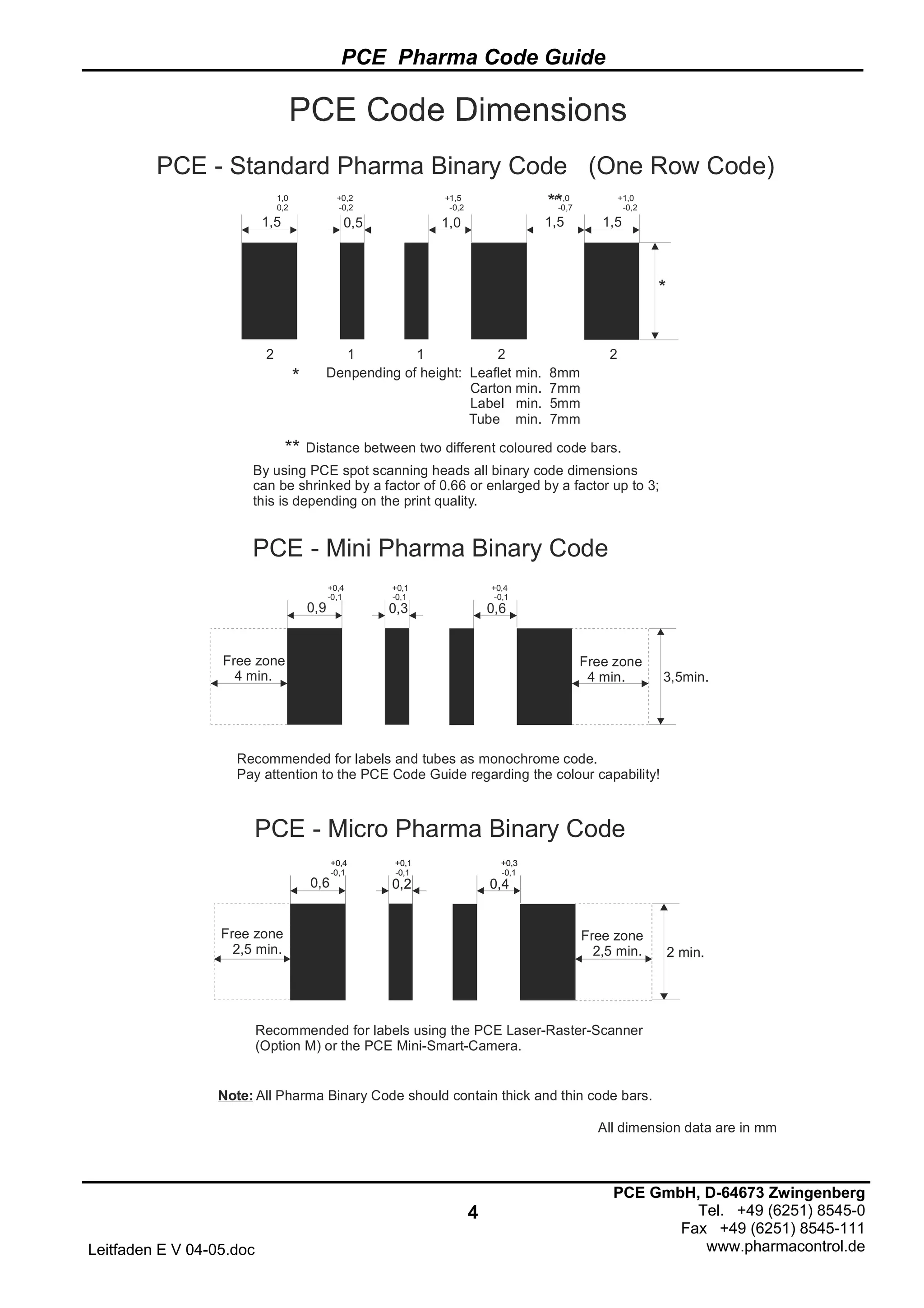
PCE - Mini Pharma Binary Code
0,9 0,3 0,6
+0,4 +0,1 +0,4
-0,1 -0,1 -0,1
Free zone
4 min.
Free zone
4 min. 3,5min.
Recommended for labels and tubes as monochrome code.
Pay attention to the PCE Code Guide regarding the colour capability!
PCE - Standard Pharma Binary Code (One Row Code)
**
1,5 0,5 1,0 1,5 1,5
1,0 +0,2 +1,5 +1,0 +1,0
0,2 -0,2 -0,2 -0,7 -0,2
2 1 1 2 2
*
*
**
Denpending of height: Leaflet min. 8mm
Carton min. 7mm
Label min. 5mm
Tube min. 7mm
By using PCE spot scanning heads all binary code dimensions
can be shrinked by a factor of 0.66 or enlarged by a factor up to 3;
this is depending on the print quality.
Distance between two different coloured code bars.
All Pharma Binary Code should contain thick and thin code bars.Note:
0,6 0,2 0,4
+0,4 +0,1 +0,3
-0,1 -0,1 -0,1
2 min.
PCE - Micro Pharma Binary Code
0,6 0,2 0,4
+0,4 +0,1 +0,3
-0,1 -0,1 -0,1
Free zone
2,5 min.
Free zone
2,5 min. 2 min.
Recommended for labels using the PCE Laser-Raster-Scanner
(Option M) or the PCE Mini-Smart-Camera.
All dimension data are in mm
PCE Pharma Code Guide
5
Leitfaden E V 04-05.doc
PCE GmbH, D-64673 Zwingenberg
Tel. +49 (6251) 8545-0
Fax +49 (6251) 8545-111
www.pharmacontrol.de
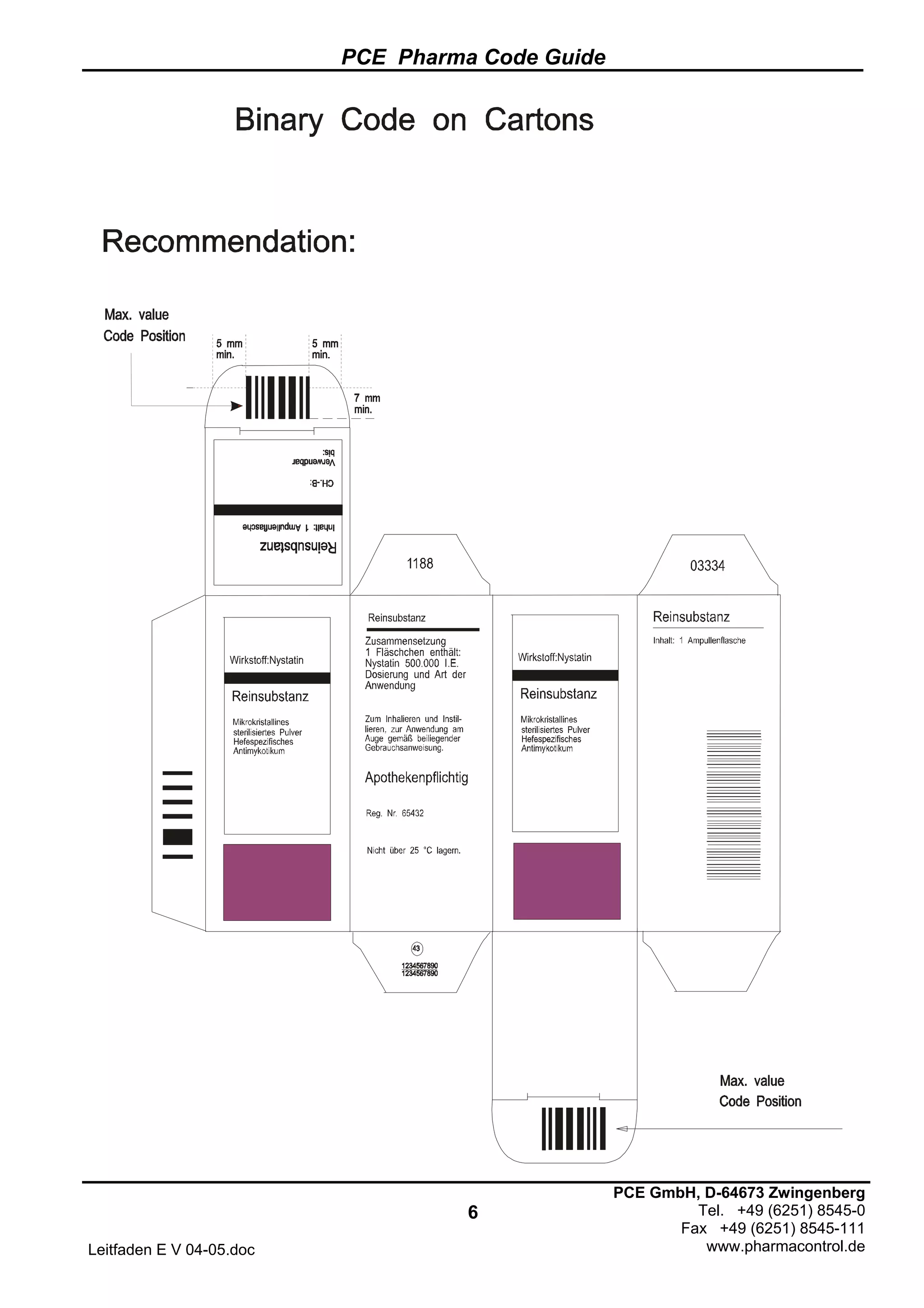
Binary Code on Cartons
Recommendations:
The code layout on cartons can be
designed with single or multi-
coloured binary codes.
When positioning the code within
the artwork, it is recommended that
the position of the highest digit of
the code will be presented (e.g. left
to right) in the same way at all other
cartons.
In multi-coloured codes, any low
contrasting colours with respect to
the background must be
represented by thick bars.
Different coloured bars should have
a separation gap of 1,5 mm. At
least three or better four bar
combinations should be used. Each
code combination should contain at
least one thick and one thin bar.
Besides using the minimum
clearance space before and after
the code combination, the code
should be placed in the middle of
the carton flap.
Remarks:
A shortage of available code combinations may occur if it is necessary to
code a higher number of small sized cartons. Cartons of different sized or
folded construction cannot be mixed, as these will not process through the
machine without being destroyed. Therefore, for clear differing sized carton
groups, the code combination set-up can be repeated.
To increase the number of code combination, available in any limited printing
area, the code sizes and tolerances can be reduced by a factor of 0.66. This
is providing that the print techniques allows for good reproduction.
On rough carton surfaces, i.e. glue flaps, the code size and tolerance can be
enlarged by a factor up to 3.
These code variations are possible with the PCE scanning heads, without any
re-calibration being required in the scanning or decoding components of the
system.
PCE Pharma Code Guide
6
Leitfaden E V 04-05.doc
PCE GmbH, D-64673 Zwingenberg
Tel. +49 (6251) 8545-0
Fax +49 (6251) 8545-111
www.pharmacontrol.de
PCE Pharma Code Guide
7
Leitfaden E V 04-05.doc
PCE GmbH, D-64673 Zwingenberg
Tel. +49 (6251) 8545-0
Fax +49 (6251) 8545-111
www.pharmacontrol.de
Binary Code on Leaflets
For the code allocation on leaflets,
positioning, guiding and printing
tolerances are more important, than
various aspects of multi-coloured
printing which is mainly required for
cartons and labels. In most cases,
only monochrome leaflets are used.
Due to greater cutting, printing and
mechanical feeding variations
experienced in producing a folded
leaflet, it is required that larger code
heights (min. 8mm) and longer quite
zones (10mm before and after the
code combination) are used.
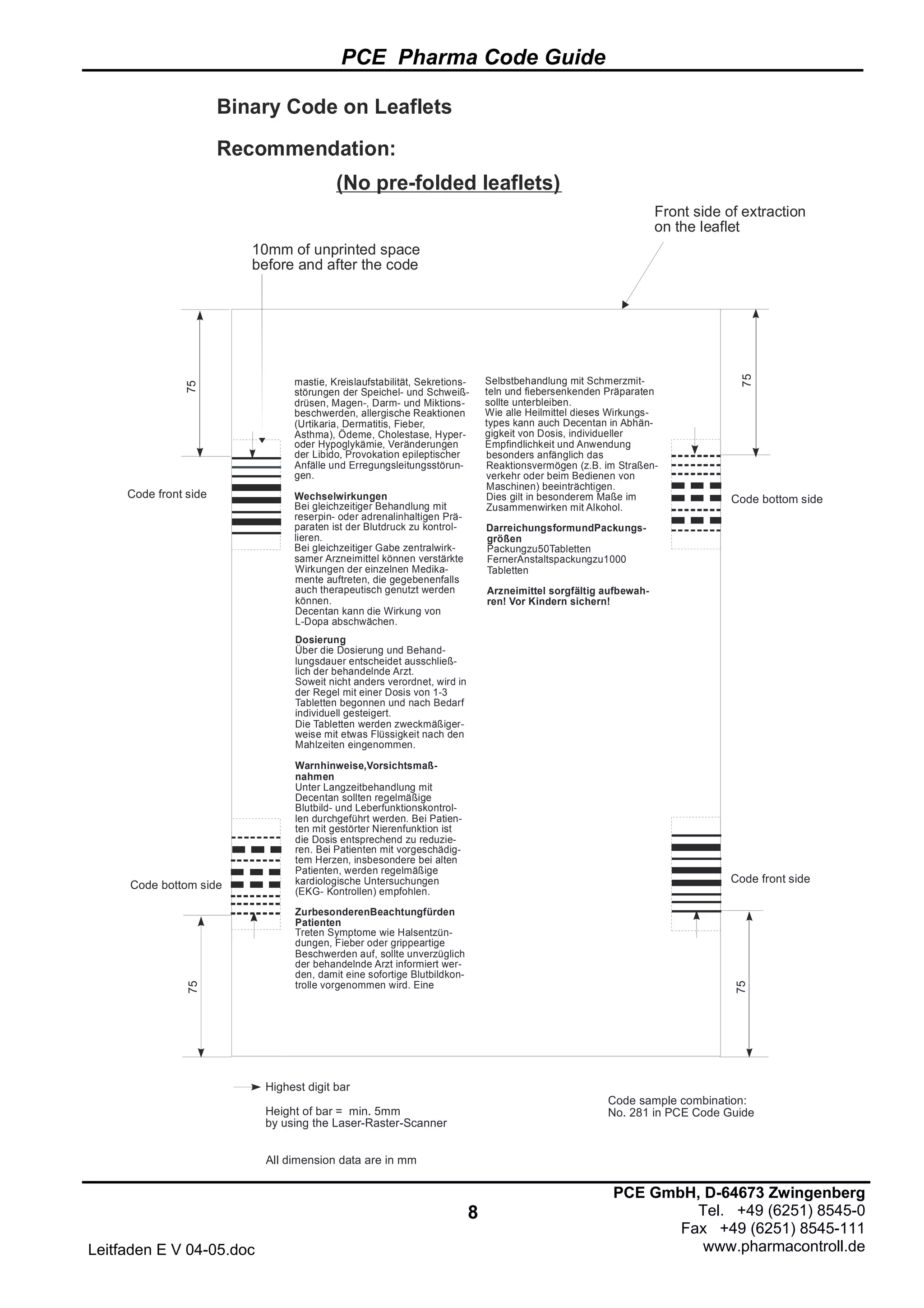
The position of the various code
bars shown on the specimen leaflet
was chosen to allow the leaflet to
be fed into the folding machine in
any direction.
The specimen leaflet is valid for
pre-cut and unfolded leaflets. It is
possible to turn the leaflet in all
sides and the code will still be in the
correct position and in-feed
direction. Therefore, it is always
important to print the highest and
the lowest digit bar at the same
position.
Leaflets travelling in only one
direction use half of the bar code
combinations.
Remark:
The spot of the reading scanning
head must cross all code bars of a
moving leaflet. It is important to
bear this in mind when designing
monochrome pre-folded leaflets,
that they can travel only in one
direction through the leaflet folding
machine.
Using pre-multi-folded leaflets, the
complete code including the quite
zones must be visible to the
scanning head. (For this application
a CCD-Scanner is often used.)
The following specimen leaflet is a
useful recommendation. However it
is also possible to read leaflets
based on existing and different
code specifications by modern code
reading equipment.
PCE Pharma Code Guide
8
Leitfaden E V 04-05.doc
PCE GmbH, D-64673 Zwingenberg
Tel. +49 (6251) 8545-0
Fax +49 (6251) 8545-111
www.pharmacontroll.de
Binary Code on Leaflets
Recommendation:
Code bottom side
75
75
Highest digit bar
Height of bar = min. 5mm
by using the Laser-Raster-Scanner
All dimension data are in mm
mastie, Kreislaufstabilität, Sekretions-
störungen der Speichel- und Schweiß-
drüsen, Magen-, Darm- und Miktions-
beschwerden, allergische Reaktionen
(Urtikaria, Dermatitis, Fieber,
Asthma), Ödeme, Cholestase, Hyper-
oder Hypoglykämie, Veränderungen
der Libido, Provokation epileptischer
Anfälle und Erregungsleitungsstörun-
gen.
Wechselwirkungen
Bei gleichzeitiger Behandlung mit
reserpin- oder adrenalinhaltigen Prä-
paraten ist der Blutdruck zu kontrol-
lieren.
Bei gleichzeitiger Gabe zentralwirk-
samer Arzneimittel können verstärkte
Tabletten begonnen und nach Bedarf
individuell gesteigert.
Die Tabletten werden zweckmäßiger-
weise mit etwas Flüssigkeit nach den
Mahlzeiten eingenommen.
Warnhinweise,Vorsichtsmaß-
nahmen
Unter Langzeitbehandlung mit
Decentan sollten regelmäßige
Blutbild- und Leberfunktionskontrol-
len durchgeführt werden. Bei Patien-
ten mit gestörter Nierenfunktion ist
die Dosis entsprechend zu reduzie-
ren. Bei Patienten mit vorgeschädig-
tem Herzen, insbesondere bei alten
Patienten, werden regelmäßige
kardiologische Untersuchungen
(EKG- Kontrollen) empfohlen.
ZurbesonderenBeachtungfürden
Patienten
Treten Symptome wie Halsentzün-
dungen, Fieber oder grippeartige
Beschwerden auf, sollte unverzüglich
der behandelnde Arzt informiert wer-
den, damit eine sofortige Blutbildkon-
trolle vorgenommen wird. Eine
Wirkungen der einzelnen Medika-
mente auftreten, die gegebenenfalls
auch therapeutisch genutzt werden
können.
Decentan kann die Wirkung von
L-Dopa abschwächen.
Dosierung
Über die Dosierung und Behand-
lungsdauer entscheidet ausschließ-
lich der behandelnde Arzt.
Soweit nicht anders verordnet, wird in
der Regel mit einer Dosis von 1-3
Selbstbehandlung mit Schmerzmit-
teln und fiebersenkenden Präparaten
sollte unterbleiben.
Wie alle Heilmittel dieses Wirkungs-
types kann auch Decentan in Abhän-
gigkeit von Dosis, individueller
Empfindlichkeit und Anwendung
besonders anfänglich das
Reaktionsvermögen (z.B. im Straßen-
verkehr oder beim Bedienen von
Maschinen) beeinträchtigen.
Dies gilt in besonderem Maße im
Zusammenwirken mit Alkohol.
DarreichungsformundPackungs-
größen
Arzneimittel sorgfältig aufbewah-
ren! Vor Kindern sichern!
Packungzu50Tabletten
FernerAnstaltspackungzu1000
Tabletten
Code bottom sideCode front side
Code front side
(No pre-folded leaflets)
Front side of extraction
on the leaflet
10mm of unprinted space
before and after the code
Code sample combination:
No. 281 in PCE Code Guide
75
75
PCE Pharma Code Guide
9
Leitfaden E V 04-05.doc
PCE GmbH, D-64673 Zwingenberg
Tel. +49 (6251) 8545-0
Fax +49 (6251) 8545-111
www.pharmacontroll.de
Binary Code on Self-Adhesive Labels
Designing Binary Codes for labels,
requires some additional
specification. Printing and cutting
tolerances are small (the height of a
bar is only approx. 5mm), but multi-
coloured codes are of interest.
In most cases, labels will be
controlled by CCD-Scanners. This
allows a positioning of the code
bars in picket fence or ladder
orientation. (See sample label.)
Using CCD-scanners and spot
scanning heads, automatic reading
is required. Therefore, a minimum
of four bars should be used in one
code combination. Each code
combination should contain one
thick and one thin bar. (By way of
exception, three bars in a code
combination can be used.)
Due to the high print quality of
labels, it is possible to reduce the
code dimensions by a factor of 0.66
and save either space on the label
or rise the number of variations per
space.
Nevertheless, the minimum
recommended height of bars is
5mm, except, better label
tolerances can be guaranteed.
Using multi-coloured code
combinations require extra attention
in one aspect:
Code combinations which can result
when one or more colours of a code
are missing. These code
combinations should not be used on
other labels to avoid a mix-up risk.
Cut wet-glue labels
For this type of label, the same specifications are valid with some exceptions.
Codes may be printed only in picket fence orientation. Due to higher
adjustment tolerances, the code combination requires a clearance space of
7mm on both sides.
The start of the first bar for all sized of this kind of label, should always be
printed at the same distance to the front edge of the label. (This edge is
discovered by the moving direction of the label through the machine.)
PCE Pharma Code Guide
10
Leitfaden E V 04-05.doc
PCE GmbH, D-64673 Zwingenberg
Tel. +49 (6251) 8545-0
Fax +49 (6251) 8545-111
www.pharmacontrol.de
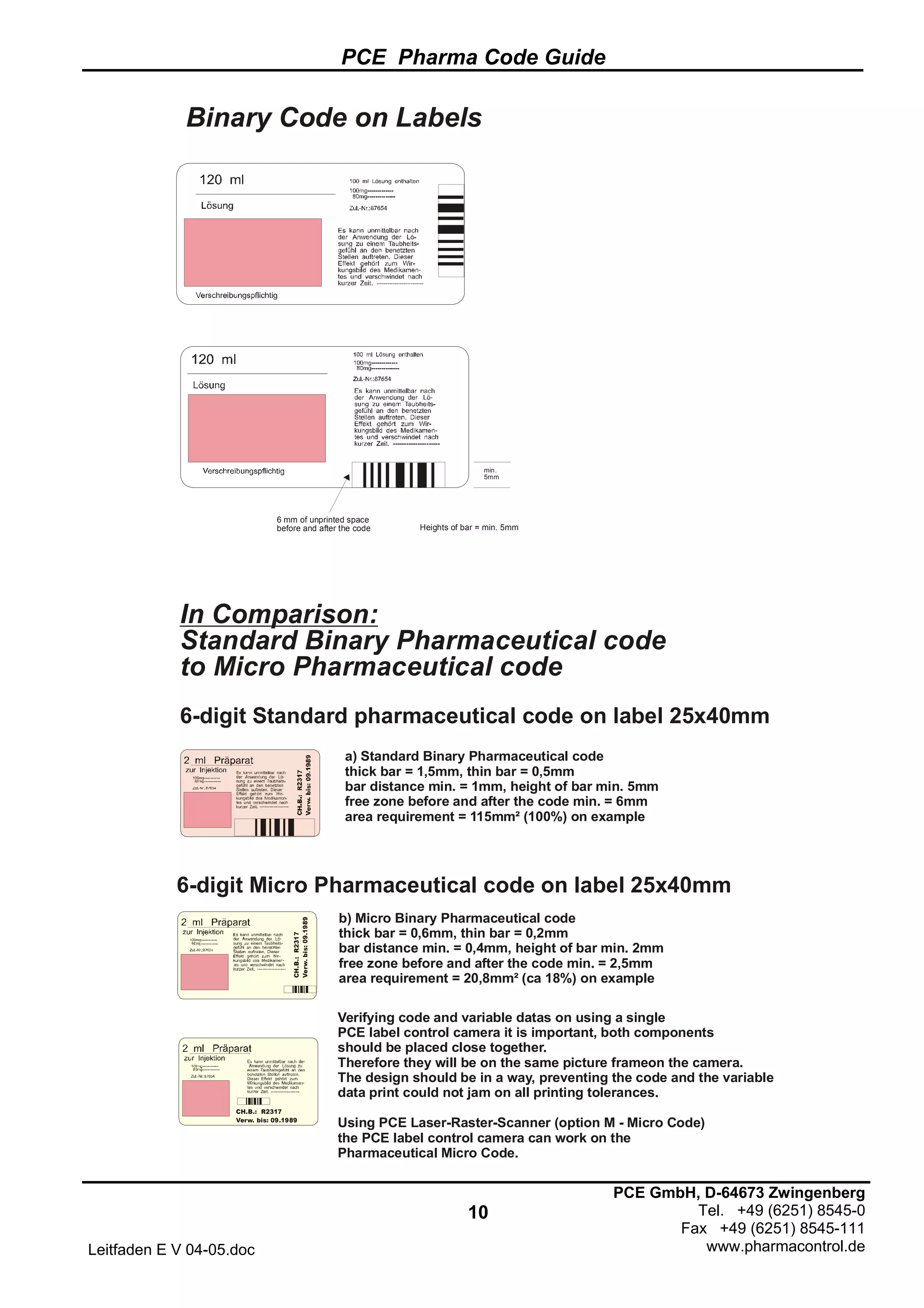
Binary Code on Labels
6 mm of unprinted space
before and after the code Heights of bar = min. 5mm
min.
5mm
In Comparison:
Standard Binary Pharmaceutical code
to Micro Pharmaceutical code
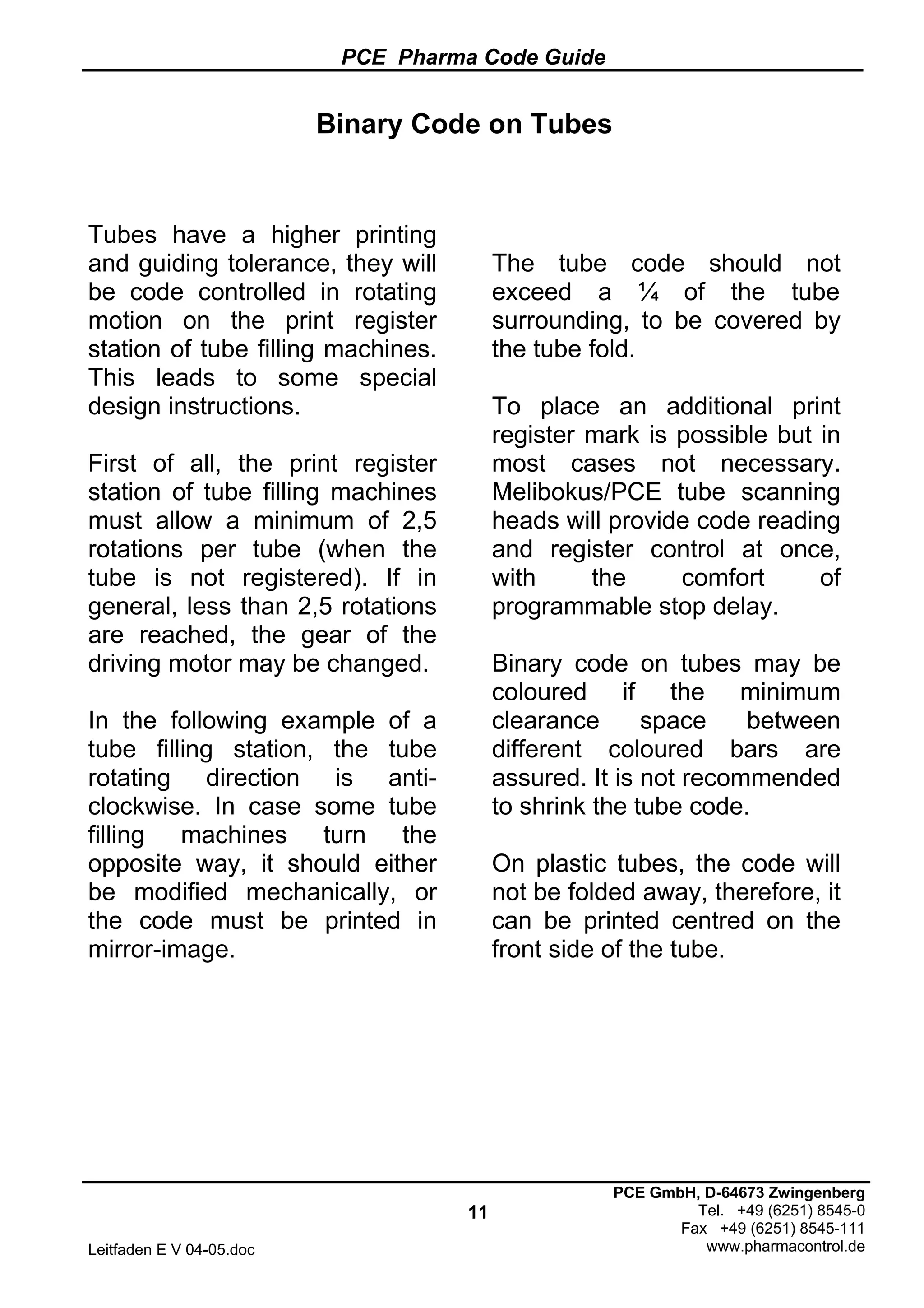
6-digit Standard pharmaceutical code on label 25x40mm
a) Standard Binary Pharmaceutical code
thick bar = 1,5mm, thin bar = 0,5mm
bar distance min. = 1mm, height of bar min. 5mm
free zone before and after the code min. = 6mm
area requirement = 115mm² (100%) on example
CH.B.:R2317
Verw.bis:09.1989
CH.B.: R2317
Verw. bis: 09.1989
6-digit Micro Pharmaceutical code on label 25x40mm
b) Micro Binary Pharmaceutical code
thick bar = 0,6mm, thin bar = 0,2mm
bar distance min. = 0,4mm, height of bar min. 2mm
free zone before and after the code min. = 2,5mm
area requirement = 20,8mm² (ca 18%) on example
Verifying code and variable datas on using a single
PCE label control camera it is important, both components
should be placed close together.
Therefore they will be on the same picture frameon the camera.
The design should be in a way, preventing the code and the variable
data print could not jam on all printing tolerances.
Using PCE Laser-Raster-Scanner (option M - Micro Code)
the PCE label control camera can work on the
Pharmaceutical Micro Code.
PCE Pharma Code Guide
11
Leitfaden E V 04-05.doc
PCE GmbH, D-64673 Zwingenberg
Tel. +49 (6251) 8545-0
Fax +49 (6251) 8545-111
www.pharmacontrol.de
Binary Code on Tubes
Tubes have a higher printing
and guiding tolerance, they will
be code controlled in rotating
motion on the print register
station of tube filling machines.
This leads to some special
design instructions.
First of all, the print register
station of tube filling machines
must allow a minimum of 2,5
rotations per tube (when the
tube is not registered). If in
general, less than 2,5 rotations
are reached, the gear of the
driving motor may be changed.
In the following example of a
tube filling station, the tube
rotating direction is anti-
clockwise. In case some tube
filling machines turn the
opposite way, it should either
be modified mechanically, or
the code must be printed in
mirror-image.
The tube code should not
exceed a ¼ of the tube
surrounding, to be covered by
the tube fold.
To place an additional print
register mark is possible but in
most cases not necessary.
Melibokus/PCE tube scanning
heads will provide code reading
and register control at once,
with the comfort of
programmable stop delay.
Binary code on tubes may be
coloured if the minimum
clearance space between
different coloured bars are
assured. It is not recommended
to shrink the tube code.
On plastic tubes, the code will
not be folded away, therefore, it
can be printed centred on the
front side of the tube.
PCE Pharma Code Guide
12
Leitfaden E V 04-05.doc
PCE GmbH, D-64673 Zwingenberg
Tel. +49 (62519 8545-0
Fax +49 (6251) 8545-111
www.pharmacontrol.de
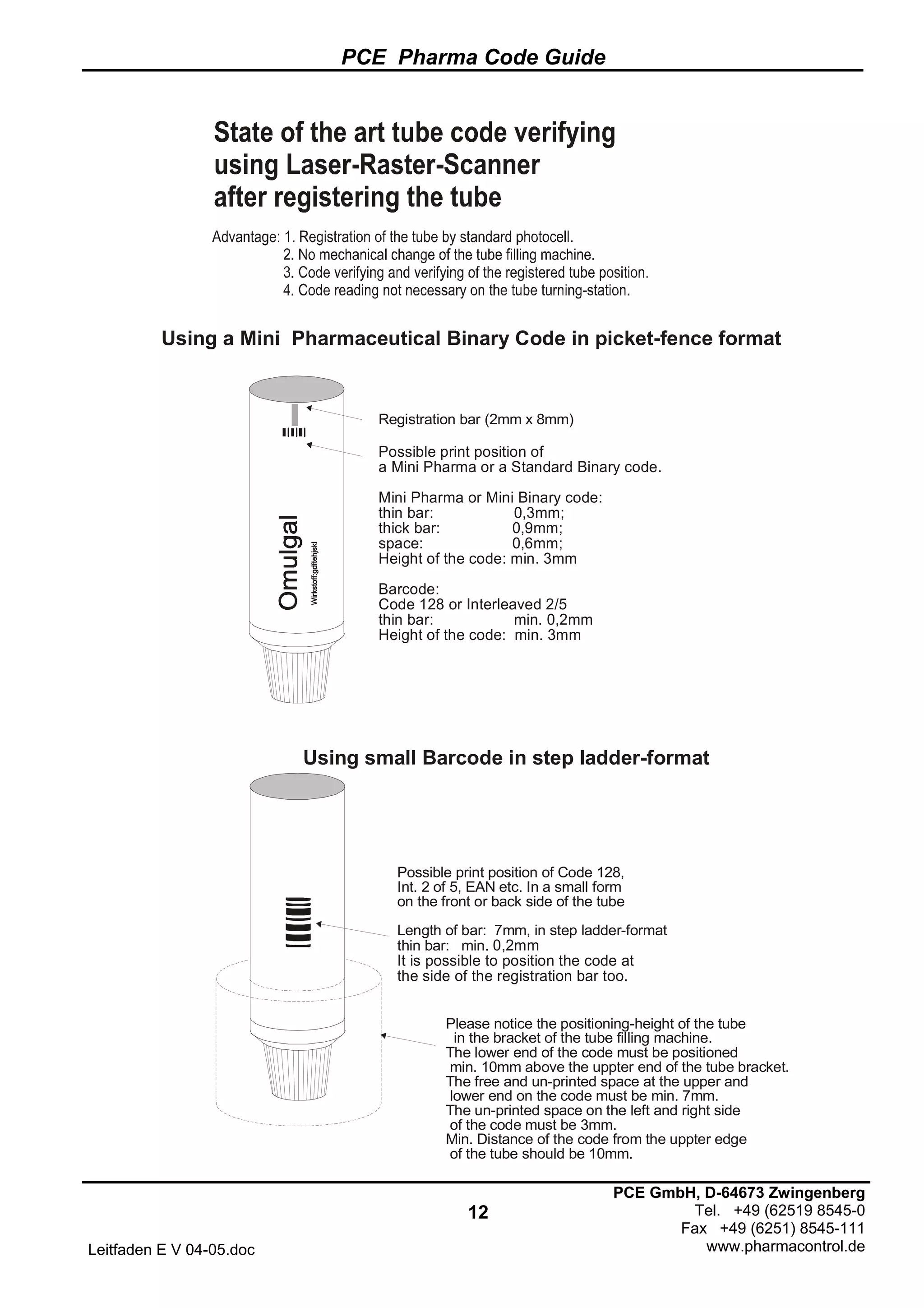
Registration bar (2mm x 8mm)
Possible print position of
a Mini Pharma or a Standard Binary code.
Mini Pharma or Mini Binary code:
thin bar: 0,3mm;
thick bar: 0,9mm;
space: 0,6mm;
Height of the code: min. 3mm
Barcode:
Code 128 or Interleaved 2/5
thin bar: min. 0,2mm
Height of the code: min. 3mm
Possible print position of Code 128,
Int. 2 of 5, EAN etc. In a small form
on the front or back side of the tube
Length of bar: 7mm, in step ladder-format
thin bar: min. 0,2mm
It is possible to position the code at
the side of the registration bar too.
Please notice the positioning-height of the tube
in the bracket of the tube filling machine.
The lower end of the code must be positioned
min. 10mm above the uppter end of the tube bracket.
The free and un-printed space at the upper and
lower end on the code must be min. 7mm.
The un-printed space on the left and right side
of the code must be 3mm.
Min. Distance of the code from the uppter edge
of the tube should be 10mm.
Using a Mini Pharmaceutical Binary Code in picket-fence format
Using small Barcode in step ladder-format
PCE Pharma Code Guide
13
Leitfaden E V 04-05.doc
PCE GmbH, D-64673 Zwingenberg
Tel. +49 (62519 8545-0
Fax +49 (6251) 8545-111
www.pharmacontrol.de
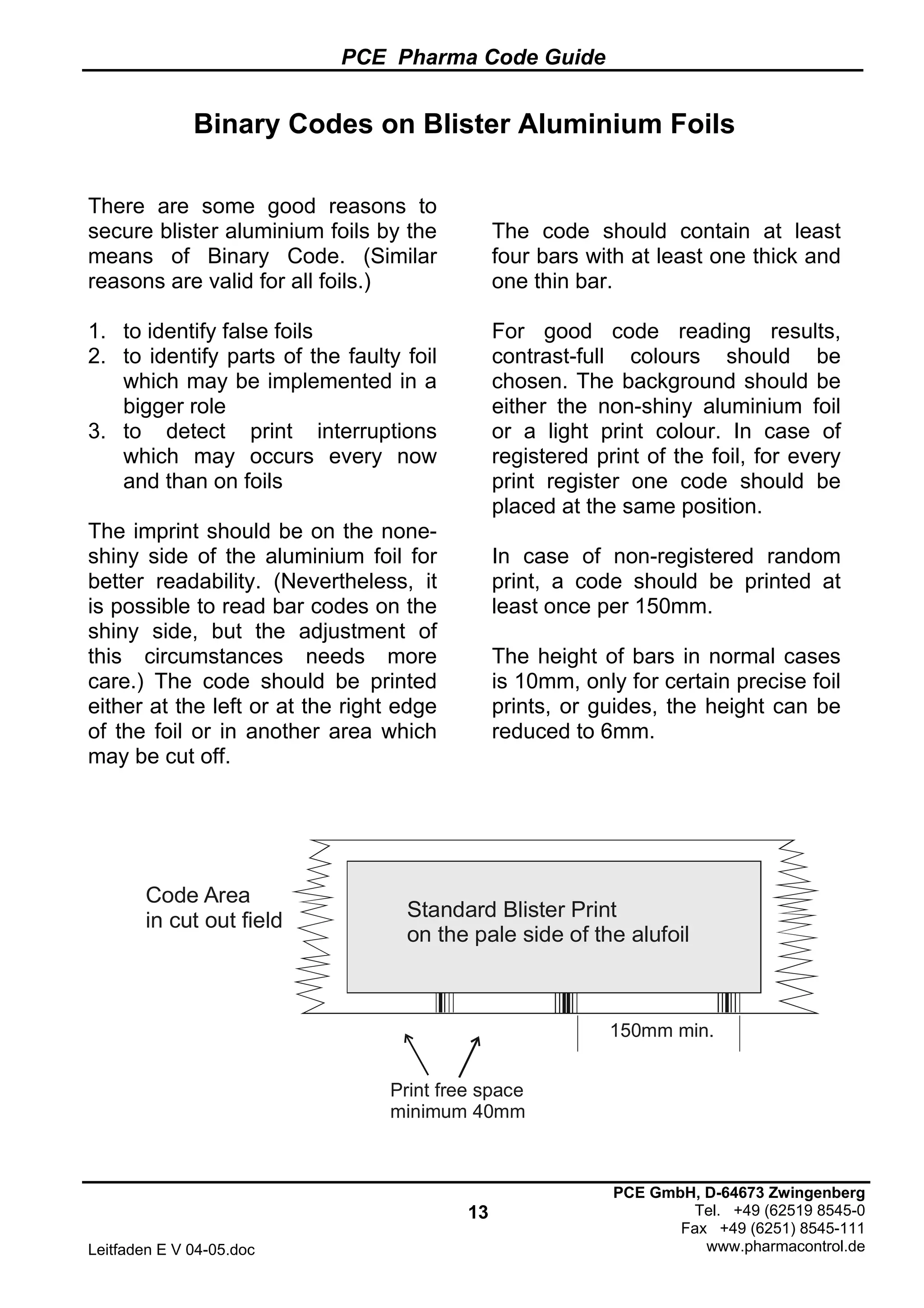
Binary Codes on Blister Aluminium Foils
There are some good reasons to
secure blister aluminium foils by the
means of Binary Code. (Similar
reasons are valid for all foils.)
1. to identify false foils
2. to identify parts of the faulty foil
which may be implemented in a
bigger role
3. to detect print interruptions
which may occurs every now
and than on foils
The imprint should be on the none-
shiny side of the aluminium foil for
better readability. (Nevertheless, it
is possible to read bar codes on the
shiny side, but the adjustment of
this circumstances needs more
care.) The code should be printed
either at the left or at the right edge
of the foil or in another area which
may be cut off.
The code should contain at least
four bars with at least one thick and
one thin bar.
For good code reading results,
contrast-full colours should be
chosen. The background should be
either the non-shiny aluminium foil
or a light print colour. In case of
registered print of the foil, for every
print register one code should be
placed at the same position.
In case of non-registered random
print, a code should be printed at
least once per 150mm.
The height of bars in normal cases
is 10mm, only for certain precise foil
prints, or guides, the height can be
reduced to 6mm.
Code Area
in cut out field Standard Blister Print
on the pale side of the alufoil
Print free space
minimum 40mm
150mm min.
PCE Pharma Code Guide
14
Leitfaden E V 04-05.doc
PCE GmbH, D-64673 Zwingenberg
Tel. +49 (62519 8545-0
Fax +49 (62519 8545-111
www.pharmacontrol.de
PCE Binary Code List
This list can be used by packaging
technologists for direct code allocation.
Code combinations with less than three
bars or containing only thick or only thin
bars are, as mentioned earlier, for code
security reasons eliminated.
In addition it is important to know that in
case of leaflets, labels or perhaps cartons
a minimum of four bars could be required.
All described codes have on the left side
the highest value and on the right side the
lowest value digit bar. At the code
allocation it must be considered that for all
sizes and types of packaging material the
highest and lowest digit will always be
placed in the same direction.
The code list contains only code
combinations with up to ten bars because
of space reasons. However,
Melibokus/PCE code reading devices
identify code combinations with up to 16
bars. (On request a complete code list
can be supplied by Melibokus.
This code list can be used for manual
designing. Per individual packing material
type a separate code list should be used.
It is possible to use per packing material
type different code lists, splitting in
various significant sizes. For the use of
multi-coloured code combinations, it is
important not to use code combinations
which could result when one coloured bar
is cut off.
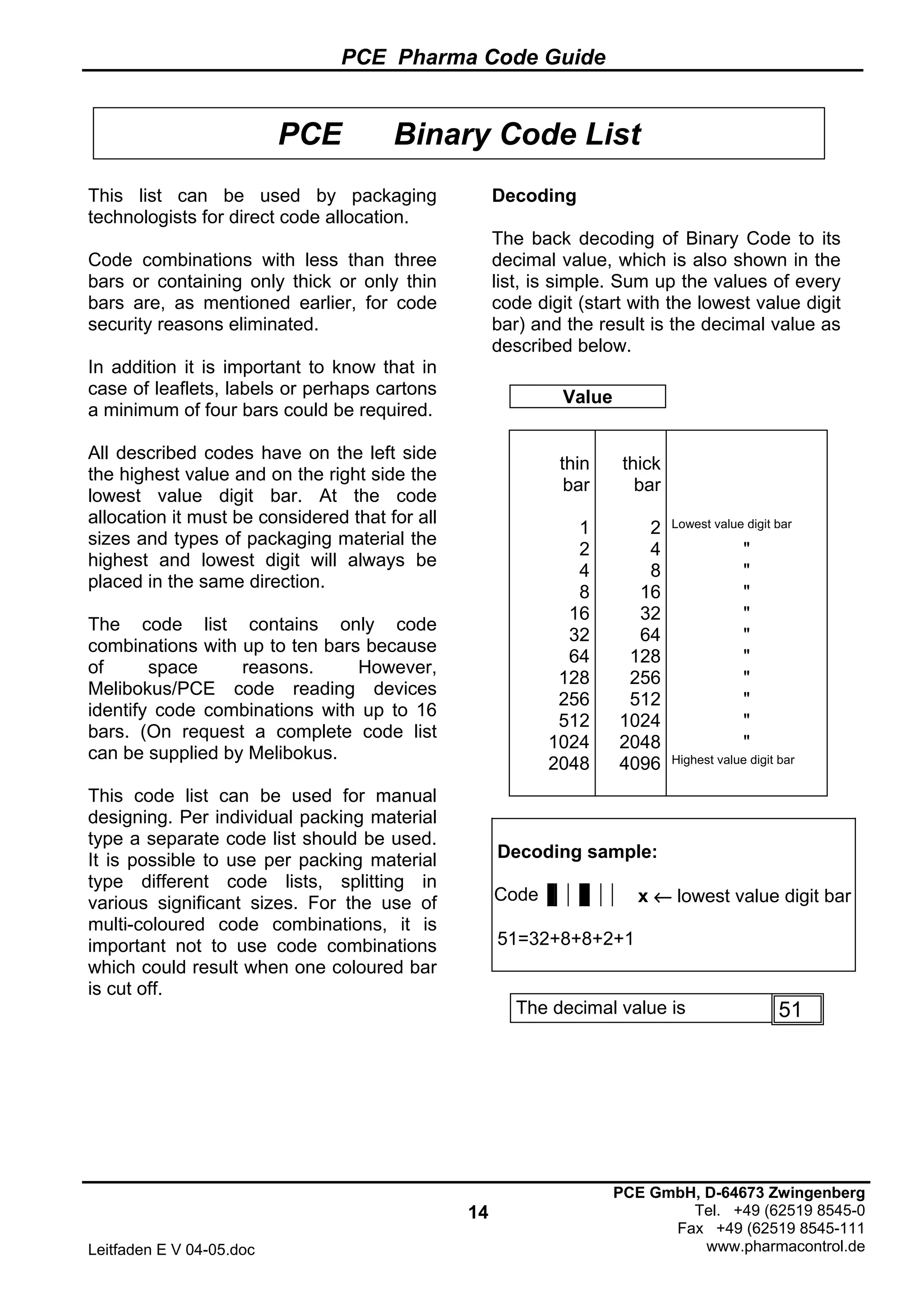
Decoding
The back decoding of Binary Code to its
decimal value, which is also shown in the
list, is simple. Sum up the values of every
code digit (start with the lowest value digit
bar) and the result is the decimal value as
described below.
Value
thin thick
bar bar
1 2 Lowest value digit bar
2 4 "
4 8 "
8 16 "
16 32 "
32 64 "
64 128 "
128 256 "
256 512 "
512 1024 "
1024 2048 "
2048 4096 Highest value digit bar
Decoding sample:
Code x ←←←← lowest value digit bar
51=32+8+8+2+1
The decimal value is 51
PCE Pharma Code Guide
15
Leitfaden E V 04-05.doc
PCE GmbH, D-64673 Zwingenberg
Tel. +49 (6251) 8545-0
Fax +49 (6251) 8545-111
www.pharmacontrol.de
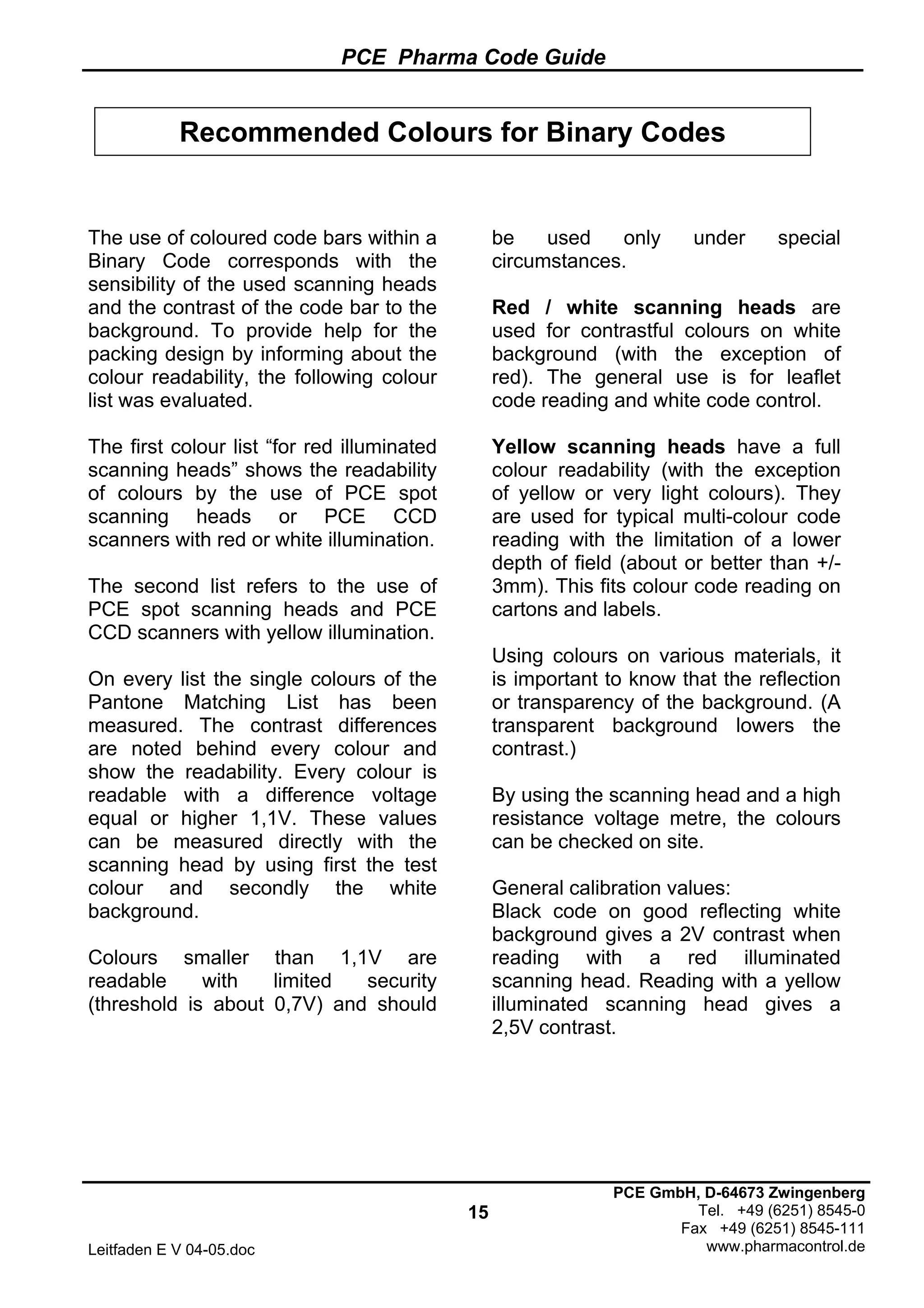
Recommended Colours for Binary Codes
The use of coloured code bars within a
Binary Code corresponds with the
sensibility of the used scanning heads
and the contrast of the code bar to the
background. To provide help for the
packing design by informing about the
colour readability, the following colour
list was evaluated.
The first colour list “for red illuminated
scanning heads” shows the readability
of colours by the use of PCE spot
scanning heads or PCE CCD
scanners with red or white illumination.
The second list refers to the use of
PCE spot scanning heads and PCE
CCD scanners with yellow illumination.
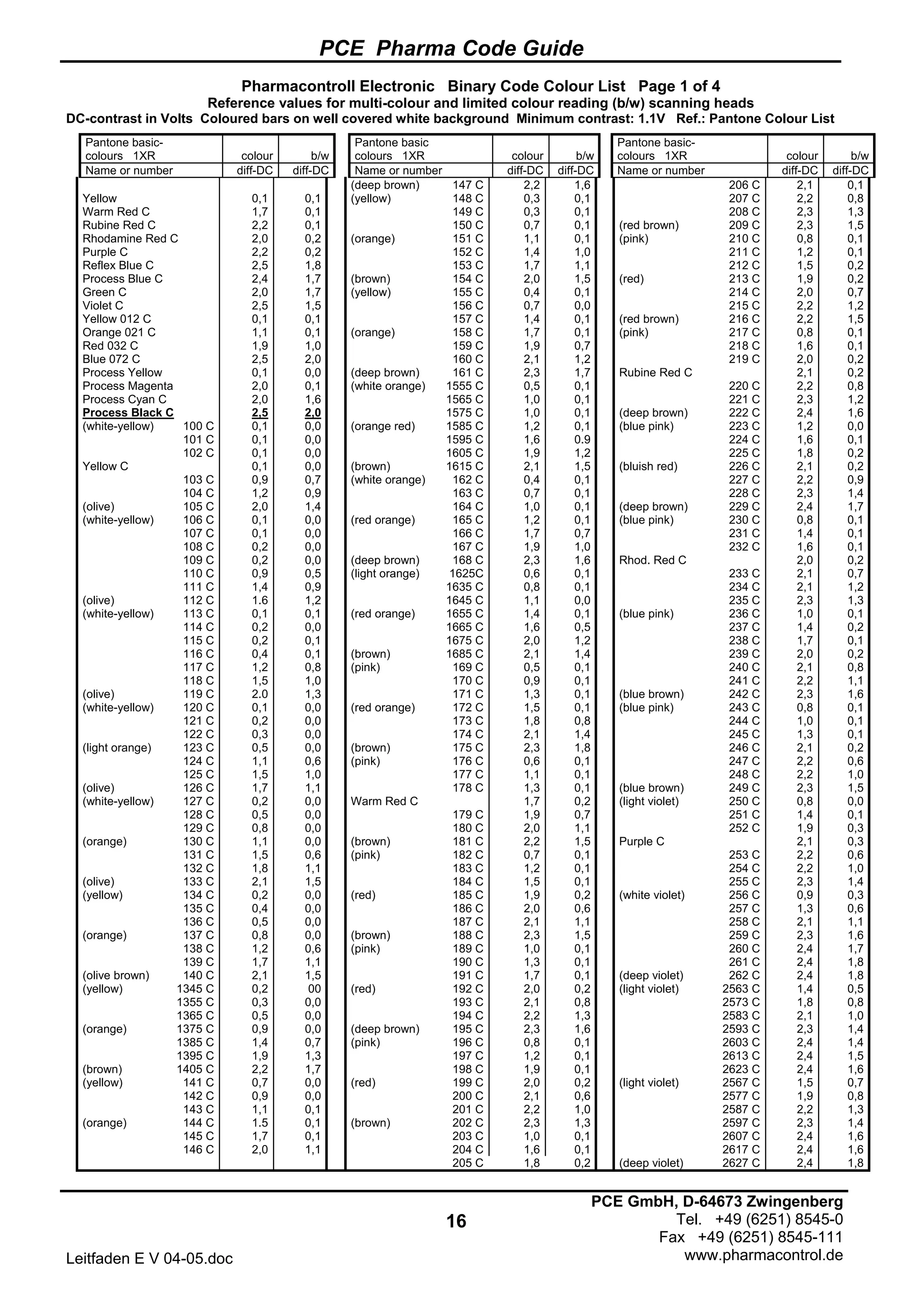
On every list the single colours of the
Pantone Matching List has been
measured. The contrast differences
are noted behind every colour and
show the readability. Every colour is
readable with a difference voltage
equal or higher 1,1V. These values
can be measured directly with the
scanning head by using first the test
colour and secondly the white
background.
Colours smaller than 1,1V are
readable with limited security
(threshold is about 0,7V) and should
be used only under special
circumstances.
Red / white scanning heads are
used for contrastful colours on white
background (with the exception of
red). The general use is for leaflet
code reading and white code control.
Yellow scanning heads have a full
colour readability (with the exception
of yellow or very light colours). They
are used for typical multi-colour code
reading with the limitation of a lower
depth of field (about or better than +/-
3mm). This fits colour code reading on
cartons and labels.
Using colours on various materials, it
is important to know that the reflection
or transparency of the background. (A
transparent background lowers the
contrast.)
By using the scanning head and a high
resistance voltage metre, the colours
can be checked on site.
General calibration values:
Black code on good reflecting white
background gives a 2V contrast when
reading with a red illuminated
scanning head. Reading with a yellow
illuminated scanning head gives a
2,5V contrast.
PCE Pharma Code Guide
16
Leitfaden E V 04-05.doc
PCE GmbH, D-64673 Zwingenberg
Tel. +49 (6251) 8545-0
Fax +49 (6251) 8545-111
www.pharmacontrol.de
Pharmacontroll Electronic Binary Code Colour List Page 1 of 4
Reference values for multi-colour and limited colour reading (b/w) scanning heads
DC-contrast in Volts Coloured bars on well covered white background Minimum contrast: 1.1V Ref.: Pantone Colour List
Pantone basic-
colours 1XR colour b/w
Pantone basic
colours 1XR colour b/w
Pantone basic-
colours 1XR colour b/w
Name or number diff-DC diff-DC Name or number diff-DC diff-DC Name or number diff-DC diff-DC
(deep brown) 147 C 2,2 1,6 206 C 2,1 0,1
Yellow 0,1 0,1 (yellow) 148 C 0,3 0,1 207 C 2,2 0,8
Warm Red C 1,7 0,1 149 C 0,3 0,1 208 C 2,3 1,3
Rubine Red C 2,2 0,1 150 C 0,7 0,1 (red brown) 209 C 2,3 1,5
Rhodamine Red C 2,0 0,2 (orange) 151 C 1,1 0,1 (pink) 210 C 0,8 0,1
Purple C 2,2 0,2 152 C 1,4 1,0 211 C 1,2 0,1
Reflex Blue C 2,5 1,8 153 C 1,7 1,1 212 C 1,5 0,2
Process Blue C 2,4 1,7 (brown) 154 C 2,0 1,5 (red) 213 C 1,9 0,2
Green C 2,0 1,7 (yellow) 155 C 0,4 0,1 214 C 2,0 0,7
Violet C 2,5 1,5 156 C 0,7 0,0 215 C 2,2 1,2
Yellow 012 C 0,1 0,1 157 C 1,4 0,1 (red brown) 216 C 2,2 1,5
Orange 021 C 1,1 0,1 (orange) 158 C 1,7 0,1 (pink) 217 C 0,8 0,1
Red 032 C 1,9 1,0 159 C 1,9 0,7 218 C 1,6 0,1
Blue 072 C 2,5 2,0 160 C 2,1 1,2 219 C 2,0 0,2
Process Yellow 0,1 0,0 (deep brown) 161 C 2,3 1,7 Rubine Red C 2,1 0,2
Process Magenta 2,0 0,1 (white orange) 1555 C 0,5 0,1 220 C 2,2 0,8
Process Cyan C 2,0 1,6 1565 C 1,0 0,1 221 C 2,3 1,2
Process Black C 2,5 2,0 1575 C 1,0 0,1 (deep brown) 222 C 2,4 1,6
(white-yellow) 100 C 0,1 0,0 (orange red) 1585 C 1,2 0,1 (blue pink) 223 C 1,2 0,0
101 C 0,1 0,0 1595 C 1,6 0.9 224 C 1,6 0,1
102 C 0,1 0,0 1605 C 1,9 1,2 225 C 1,8 0,2
Yellow C 0,1 0,0 (brown) 1615 C 2,1 1,5 (bluish red) 226 C 2,1 0,2
103 C 0,9 0,7 (white orange) 162 C 0,4 0,1 227 C 2,2 0,9
104 C 1,2 0,9 163 C 0,7 0,1 228 C 2,3 1,4
(olive) 105 C 2,0 1,4 164 C 1,0 0,1 (deep brown) 229 C 2,4 1,7
(white-yellow) 106 C 0,1 0,0 (red orange) 165 C 1,2 0,1 (blue pink) 230 C 0,8 0,1
107 C 0,1 0,0 166 C 1,7 0,7 231 C 1,4 0,1
108 C 0,2 0,0 167 C 1,9 1,0 232 C 1,6 0,1
109 C 0,2 0,0 (deep brown) 168 C 2,3 1,6 Rhod. Red C 2,0 0,2
110 C 0,9 0,5 (light orange) 1625C 0,6 0,1 233 C 2,1 0,7
111 C 1,4 0,9 1635 C 0,8 0,1 234 C 2,1 1,2
(olive) 112 C 1.6 1,2 1645 C 1,1 0,0 235 C 2,3 1,3
(white-yellow) 113 C 0,1 0,1 (red orange) 1655 C 1,4 0,1 (blue pink) 236 C 1,0 0,1
114 C 0,2 0,0 1665 C 1,6 0,5 237 C 1,4 0,2
115 C 0,2 0,1 1675 C 2,0 1,2 238 C 1,7 0,1
116 C 0,4 0,1 (brown) 1685 C 2,1 1,4 239 C 2,0 0,2
117 C 1,2 0,8 (pink) 169 C 0,5 0,1 240 C 2,1 0,8
118 C 1,5 1,0 170 C 0,9 0,1 241 C 2,2 1,1
(olive) 119 C 2.0 1,3 171 C 1,3 0,1 (blue brown) 242 C 2,3 1,6
(white-yellow) 120 C 0,1 0,0 (red orange) 172 C 1,5 0,1 (blue pink) 243 C 0,8 0,1
121 C 0,2 0,0 173 C 1,8 0,8 244 C 1,0 0,1
122 C 0,3 0,0 174 C 2,1 1,4 245 C 1,3 0,1
(light orange) 123 C 0,5 0,0 (brown) 175 C 2,3 1,8 246 C 2,1 0,2
124 C 1,1 0,6 (pink) 176 C 0,6 0,1 247 C 2,2 0,6
125 C 1,5 1,0 177 C 1,1 0,1 248 C 2,2 1,0
(olive) 126 C 1,7 1,1 178 C 1,3 0,1 (blue brown) 249 C 2,3 1,5
(white-yellow) 127 C 0,2 0,0 Warm Red C 1,7 0,2 (light violet) 250 C 0,8 0,0
128 C 0,5 0,0 179 C 1,9 0,7 251 C 1,4 0,1
129 C 0,8 0,0 180 C 2,0 1,1 252 C 1,9 0,3
(orange) 130 C 1,1 0,0 (brown) 181 C 2,2 1,5 Purple C 2,1 0,3
131 C 1,5 0,6 (pink) 182 C 0,7 0,1 253 C 2,2 0,6
132 C 1,8 1,1 183 C 1,2 0,1 254 C 2,2 1,0
(olive) 133 C 2,1 1,5 184 C 1,5 0,1 255 C 2,3 1,4
(yellow) 134 C 0,2 0,0 (red) 185 C 1,9 0,2 (white violet) 256 C 0,9 0,3
135 C 0,4 0,0 186 C 2,0 0,6 257 C 1,3 0,6
136 C 0,5 0,0 187 C 2,1 1,1 258 C 2,1 1,1
(orange) 137 C 0,8 0,0 (brown) 188 C 2,3 1,5 259 C 2,3 1,6
138 C 1,2 0,6 (pink) 189 C 1,0 0,1 260 C 2,4 1,7
139 C 1,7 1,1 190 C 1,3 0,1 261 C 2,4 1,8
(olive brown) 140 C 2,1 1,5 191 C 1,7 0,1 (deep violet) 262 C 2,4 1,8
(yellow) 1345 C 0,2 00 (red) 192 C 2,0 0,2 (light violet) 2563 C 1,4 0,5
1355 C 0,3 0,0 193 C 2,1 0,8 2573 C 1,8 0,8
1365 C 0,5 0,0 194 C 2,2 1,3 2583 C 2,1 1,0
(orange) 1375 C 0,9 0,0 (deep brown) 195 C 2,3 1,6 2593 C 2,3 1,4
1385 C 1,4 0,7 (pink) 196 C 0,8 0,1 2603 C 2,4 1,4
1395 C 1,9 1,3 197 C 1,2 0,1 2613 C 2,4 1,5
(brown) 1405 C 2,2 1,7 198 C 1,9 0,1 2623 C 2,4 1,6
(yellow) 141 C 0,7 0,0 (red) 199 C 2,0 0,2 (light violet) 2567 C 1,5 0,7
142 C 0,9 0,0 200 C 2,1 0,6 2577 C 1,9 0,8
143 C 1,1 0,1 201 C 2,2 1,0 2587 C 2,2 1,3
(orange) 144 C 1.5 0,1 (brown) 202 C 2,3 1,3 2597 C 2,3 1,4
145 C 1,7 0,1 203 C 1,0 0,1 2607 C 2,4 1,6
146 C 2,0 1,1 204 C 1,6 0,1 2617 C 2,4 1,6
205 C 1,8 0,2 (deep violet) 2627 C 2,4 1,8
PCE Pharma Code Guide
17
Leitfaden E V 04-05.doc
PCE GmbH, D-64673 Zwingenberg
Tel. +49 (6251) 8545-0
Fax +49 (6251) 8545-111
www.pharmacontrol.de
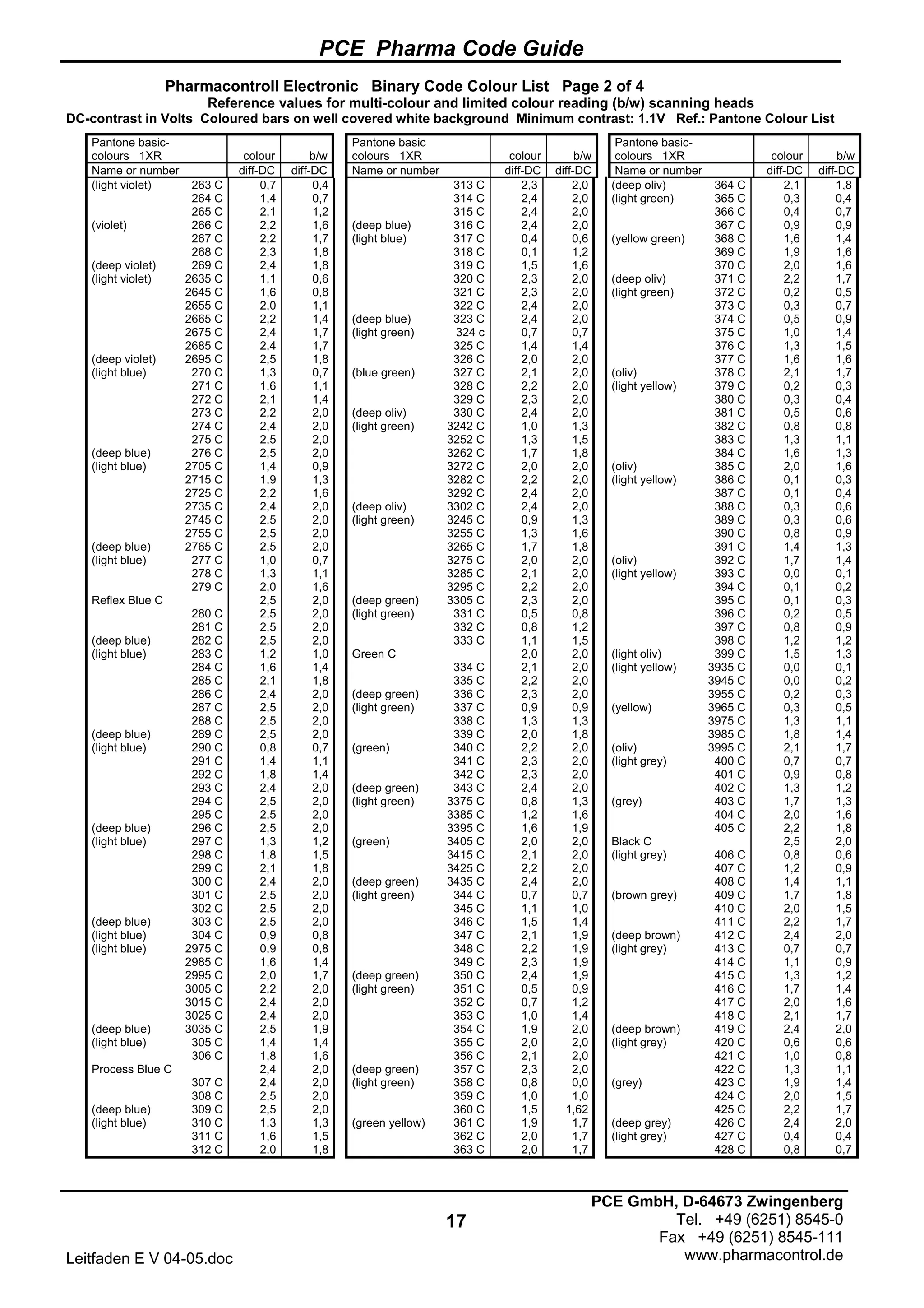
Pharmacontroll Electronic Binary Code Colour List Page 2 of 4
Reference values for multi-colour and limited colour reading (b/w) scanning heads
DC-contrast in Volts Coloured bars on well covered white background Minimum contrast: 1.1V Ref.: Pantone Colour List
Pantone basic-
colours 1XR colour b/w
Pantone basic
colours 1XR colour b/w
Pantone basic-
colours 1XR colour b/w
Name or number diff-DC diff-DC Name or number diff-DC diff-DC Name or number diff-DC diff-DC
(light violet) 263 C 0,7 0,4 313 C 2,3 2,0 (deep oliv) 364 C 2,1 1,8
264 C 1,4 0,7 314 C 2,4 2,0 (light green) 365 C 0,3 0,4
265 C 2,1 1,2 315 C 2,4 2,0 366 C 0,4 0,7
(violet) 266 C 2,2 1,6 (deep blue) 316 C 2,4 2,0 367 C 0,9 0,9
267 C 2,2 1,7 (light blue) 317 C 0,4 0,6 (yellow green) 368 C 1,6 1,4
268 C 2,3 1,8 318 C 0,1 1,2 369 C 1,9 1,6
(deep violet) 269 C 2,4 1,8 319 C 1,5 1,6 370 C 2,0 1,6
(light violet) 2635 C 1,1 0,6 320 C 2,3 2,0 (deep oliv) 371 C 2,2 1,7
2645 C 1,6 0,8 321 C 2,3 2,0 (light green) 372 C 0,2 0,5
2655 C 2,0 1,1 322 C 2,4 2,0 373 C 0,3 0,7
2665 C 2,2 1,4 (deep blue) 323 C 2,4 2,0 374 C 0,5 0,9
2675 C 2,4 1,7 (light green) 324 c 0,7 0,7 375 C 1,0 1,4
2685 C 2,4 1,7 325 C 1,4 1,4 376 C 1,3 1,5
(deep violet) 2695 C 2,5 1,8 326 C 2,0 2,0 377 C 1,6 1,6
(light blue) 270 C 1,3 0,7 (blue green) 327 C 2,1 2,0 (oliv) 378 C 2,1 1,7
271 C 1,6 1,1 328 C 2,2 2,0 (light yellow) 379 C 0,2 0,3
272 C 2,1 1,4 329 C 2,3 2,0 380 C 0,3 0,4
273 C 2,2 2,0 (deep oliv) 330 C 2,4 2,0 381 C 0,5 0,6
274 C 2,4 2,0 (light green) 3242 C 1,0 1,3 382 C 0,8 0,8
275 C 2,5 2,0 3252 C 1,3 1,5 383 C 1,3 1,1
(deep blue) 276 C 2,5 2,0 3262 C 1,7 1,8 384 C 1,6 1,3
(light blue) 2705 C 1,4 0,9 3272 C 2,0 2,0 (oliv) 385 C 2,0 1,6
2715 C 1,9 1,3 3282 C 2,2 2,0 (light yellow) 386 C 0,1 0,3
2725 C 2,2 1,6 3292 C 2,4 2,0 387 C 0,1 0,4
2735 C 2,4 2,0 (deep oliv) 3302 C 2,4 2,0 388 C 0,3 0,6
2745 C 2,5 2,0 (light green) 3245 C 0,9 1,3 389 C 0,3 0,6
2755 C 2,5 2,0 3255 C 1,3 1,6 390 C 0,8 0,9
(deep blue) 2765 C 2,5 2,0 3265 C 1,7 1,8 391 C 1,4 1,3
(light blue) 277 C 1,0 0,7 3275 C 2,0 2,0 (oliv) 392 C 1,7 1,4
278 C 1,3 1,1 3285 C 2,1 2,0 (light yellow) 393 C 0,0 0,1
279 C 2,0 1,6 3295 C 2,2 2,0 394 C 0,1 0,2
Reflex Blue C 2,5 2,0 (deep green) 3305 C 2,3 2,0 395 C 0,1 0,3
280 C 2,5 2,0 (light green) 331 C 0,5 0,8 396 C 0,2 0,5
281 C 2,5 2,0 332 C 0,8 1,2 397 C 0,8 0,9
(deep blue) 282 C 2,5 2,0 333 C 1,1 1,5 398 C 1,2 1,2
(light blue) 283 C 1,2 1,0 Green C 2,0 2,0 (light oliv) 399 C 1,5 1,3
284 C 1,6 1,4 334 C 2,1 2,0 (light yellow) 3935 C 0,0 0,1
285 C 2,1 1,8 335 C 2,2 2,0 3945 C 0,0 0,2
286 C 2,4 2,0 (deep green) 336 C 2,3 2,0 3955 C 0,2 0,3
287 C 2,5 2,0 (light green) 337 C 0,9 0,9 (yellow) 3965 C 0,3 0,5
288 C 2,5 2,0 338 C 1,3 1,3 3975 C 1,3 1,1
(deep blue) 289 C 2,5 2,0 339 C 2,0 1,8 3985 C 1,8 1,4
(light blue) 290 C 0,8 0,7 (green) 340 C 2,2 2,0 (oliv) 3995 C 2,1 1,7
291 C 1,4 1,1 341 C 2,3 2,0 (light grey) 400 C 0,7 0,7
292 C 1,8 1,4 342 C 2,3 2,0 401 C 0,9 0,8
293 C 2,4 2,0 (deep green) 343 C 2,4 2,0 402 C 1,3 1,2
294 C 2,5 2,0 (light green) 3375 C 0,8 1,3 (grey) 403 C 1,7 1,3
295 C 2,5 2,0 3385 C 1,2 1,6 404 C 2,0 1,6
(deep blue) 296 C 2,5 2,0 3395 C 1,6 1,9 405 C 2,2 1,8
(light blue) 297 C 1,3 1,2 (green) 3405 C 2,0 2,0 Black C 2,5 2,0
298 C 1,8 1,5 3415 C 2,1 2,0 (light grey) 406 C 0,8 0,6
299 C 2,1 1,8 3425 C 2,2 2,0 407 C 1,2 0,9
300 C 2,4 2,0 (deep green) 3435 C 2,4 2,0 408 C 1,4 1,1
301 C 2,5 2,0 (light green) 344 C 0,7 0,7 (brown grey) 409 C 1,7 1,8
302 C 2,5 2,0 345 C 1,1 1,0 410 C 2,0 1,5
(deep blue) 303 C 2,5 2,0 346 C 1,5 1,4 411 C 2,2 1,7
(light blue) 304 C 0,9 0,8 347 C 2,1 1,9 (deep brown) 412 C 2,4 2,0
(light blue) 2975 C 0,9 0,8 348 C 2,2 1,9 (light grey) 413 C 0,7 0,7
2985 C 1,6 1,4 349 C 2,3 1,9 414 C 1,1 0,9
2995 C 2,0 1,7 (deep green) 350 C 2,4 1,9 415 C 1,3 1,2
3005 C 2,2 2,0 (light green) 351 C 0,5 0,9 416 C 1,7 1,4
3015 C 2,4 2,0 352 C 0,7 1,2 417 C 2,0 1,6
3025 C 2,4 2,0 353 C 1,0 1,4 418 C 2,1 1,7
(deep blue) 3035 C 2,5 1,9 354 C 1,9 2,0 (deep brown) 419 C 2,4 2,0
(light blue) 305 C 1,4 1,4 355 C 2,0 2,0 (light grey) 420 C 0,6 0,6
306 C 1,8 1,6 356 C 2,1 2,0 421 C 1,0 0,8
Process Blue C 2,4 2,0 (deep green) 357 C 2,3 2,0 422 C 1,3 1,1
307 C 2,4 2,0 (light green) 358 C 0,8 0,0 (grey) 423 C 1,9 1,4
308 C 2,5 2,0 359 C 1,0 1,0 424 C 2,0 1,5
(deep blue) 309 C 2,5 2,0 360 C 1,5 1,62 425 C 2,2 1,7
(light blue) 310 C 1,3 1,3 (green yellow) 361 C 1,9 1,7 (deep grey) 426 C 2,4 2,0
311 C 1,6 1,5 362 C 2,0 1,7 (light grey) 427 C 0,4 0,4
312 C 2,0 1,8 363 C 2,0 1,7 428 C 0,8 0,7
PCE Pharma Code Guide
18
Leitfaden E V 04-05.doc
PCE GmbH, D-64673 Zwingenberg
Tel. +49 (6251) 8545-0
Fax +49 (6251) 8545-111
www.pharmacontrol.de
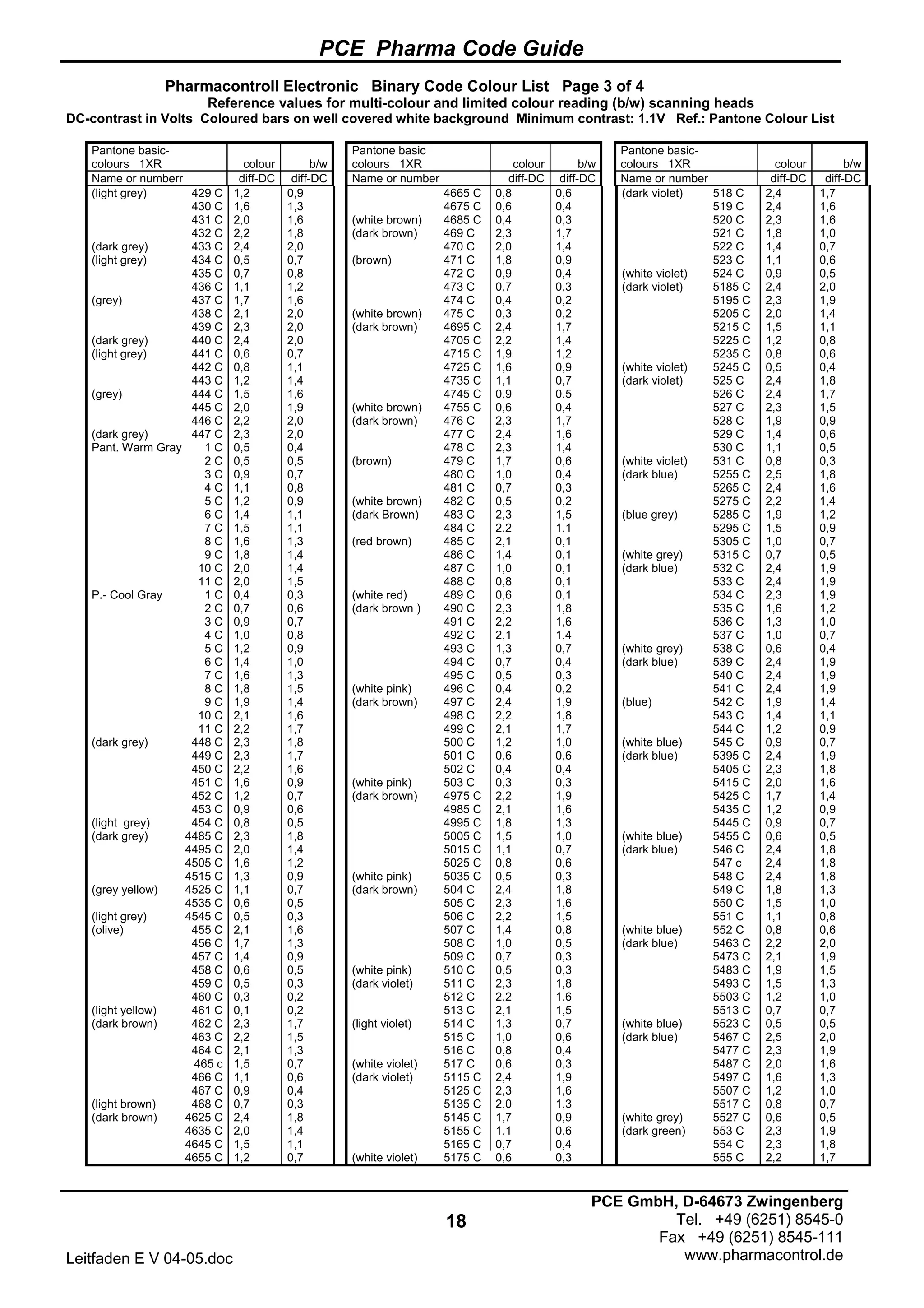
Pharmacontroll Electronic Binary Code Colour List Page 3 of 4
Reference values for multi-colour and limited colour reading (b/w) scanning heads
DC-contrast in Volts Coloured bars on well covered white background Minimum contrast: 1.1V Ref.: Pantone Colour List
Pantone basic-
colours 1XR colour b/w
Pantone basic
colours 1XR colour b/w
Pantone basic-
colours 1XR colour b/w
Name or numberr diff-DC diff-DC Name or number diff-DC diff-DC Name or number diff-DC diff-DC
(light grey) 429 C 1,2 0,9 4665 C 0,8 0,6 (dark violet) 518 C 2,4 1,7
430 C 1,6 1,3 4675 C 0,6 0,4 519 C 2,4 1,6
431 C 2,0 1,6 (white brown) 4685 C 0,4 0,3 520 C 2,3 1,6
432 C 2,2 1,8 (dark brown) 469 C 2,3 1,7 521 C 1,8 1,0
(dark grey) 433 C 2,4 2,0 470 C 2,0 1,4 522 C 1,4 0,7
(light grey) 434 C 0,5 0,7 (brown) 471 C 1,8 0,9 523 C 1,1 0,6
435 C 0,7 0,8 472 C 0,9 0,4 (white violet) 524 C 0,9 0,5
436 C 1,1 1,2 473 C 0,7 0,3 (dark violet) 5185 C 2,4 2,0
(grey) 437 C 1,7 1,6 474 C 0,4 0,2 5195 C 2,3 1,9
438 C 2,1 2,0 (white brown) 475 C 0,3 0,2 5205 C 2,0 1,4
439 C 2,3 2,0 (dark brown) 4695 C 2,4 1,7 5215 C 1,5 1,1
(dark grey) 440 C 2,4 2,0 4705 C 2,2 1,4 5225 C 1,2 0,8
(light grey) 441 C 0,6 0,7 4715 C 1,9 1,2 5235 C 0,8 0,6
442 C 0,8 1,1 4725 C 1,6 0,9 (white violet) 5245 C 0,5 0,4
443 C 1,2 1,4 4735 C 1,1 0,7 (dark violet) 525 C 2,4 1,8
(grey) 444 C 1,5 1,6 4745 C 0,9 0,5 526 C 2,4 1,7
445 C 2,0 1,9 (white brown) 4755 C 0,6 0,4 527 C 2,3 1,5
446 C 2,2 2,0 (dark brown) 476 C 2,3 1,7 528 C 1,9 0,9
(dark grey) 447 C 2,3 2,0 477 C 2,4 1,6 529 C 1,4 0,6
Pant. Warm Gray 1 C 0,5 0,4 478 C 2,3 1,4 530 C 1,1 0,5
2 C 0,5 0,5 (brown) 479 C 1,7 0,6 (white violet) 531 C 0,8 0,3
3 C 0,9 0,7 480 C 1,0 0,4 (dark blue) 5255 C 2,5 1,8
4 C 1,1 0,8 481 C 0,7 0,3 5265 C 2,4 1,6
5 C 1,2 0,9 (white brown) 482 C 0,5 0,2 5275 C 2,2 1,4
6 C 1,4 1,1 (dark Brown) 483 C 2,3 1,5 (blue grey) 5285 C 1,9 1,2
7 C 1,5 1,1 484 C 2,2 1,1 5295 C 1,5 0,9
8 C 1,6 1,3 (red brown) 485 C 2,1 0,1 5305 C 1,0 0,7
9 C 1,8 1,4 486 C 1,4 0,1 (white grey) 5315 C 0,7 0,5
10 C 2,0 1,4 487 C 1,0 0,1 (dark blue) 532 C 2,4 1,9
11 C 2,0 1,5 488 C 0,8 0,1 533 C 2,4 1,9
P.- Cool Gray 1 C 0,4 0,3 (white red) 489 C 0,6 0,1 534 C 2,3 1,9
2 C 0,7 0,6 (dark brown ) 490 C 2,3 1,8 535 C 1,6 1,2
3 C 0,9 0,7 491 C 2,2 1,6 536 C 1,3 1,0
4 C 1,0 0,8 492 C 2,1 1,4 537 C 1,0 0,7
5 C 1,2 0,9 493 C 1,3 0,7 (white grey) 538 C 0,6 0,4
6 C 1,4 1,0 494 C 0,7 0,4 (dark blue) 539 C 2,4 1,9
7 C 1,6 1,3 495 C 0,5 0,3 540 C 2,4 1,9
8 C 1,8 1,5 (white pink) 496 C 0,4 0,2 541 C 2,4 1,9
9 C 1,9 1,4 (dark brown) 497 C 2,4 1,9 (blue) 542 C 1,9 1,4
10 C 2,1 1,6 498 C 2,2 1,8 543 C 1,4 1,1
11 C 2,2 1,7 499 C 2,1 1,7 544 C 1,2 0,9
(dark grey) 448 C 2,3 1,8 500 C 1,2 1,0 (white blue) 545 C 0,9 0,7
449 C 2,3 1,7 501 C 0,6 0,6 (dark blue) 5395 C 2,4 1,9
450 C 2,2 1,6 502 C 0,4 0,4 5405 C 2,3 1,8
451 C 1,6 0,9 (white pink) 503 C 0,3 0,3 5415 C 2,0 1,6
452 C 1,2 0,7 (dark brown) 4975 C 2,2 1,9 5425 C 1,7 1,4
453 C 0,9 0,6 4985 C 2,1 1,6 5435 C 1,2 0,9
(light grey) 454 C 0,8 0,5 4995 C 1,8 1,3 5445 C 0,9 0,7
(dark grey) 4485 C 2,3 1,8 5005 C 1,5 1,0 (white blue) 5455 C 0,6 0,5
4495 C 2,0 1,4 5015 C 1,1 0,7 (dark blue) 546 C 2,4 1,8
4505 C 1,6 1,2 5025 C 0,8 0,6 547 c 2,4 1,8
4515 C 1,3 0,9 (white pink) 5035 C 0,5 0,3 548 C 2,4 1,8
(grey yellow) 4525 C 1,1 0,7 (dark brown) 504 C 2,4 1,8 549 C 1,8 1,3
4535 C 0,6 0,5 505 C 2,3 1,6 550 C 1,5 1,0
(light grey) 4545 C 0,5 0,3 506 C 2,2 1,5 551 C 1,1 0,8
(olive) 455 C 2,1 1,6 507 C 1,4 0,8 (white blue) 552 C 0,8 0,6
456 C 1,7 1,3 508 C 1,0 0,5 (dark blue) 5463 C 2,2 2,0
457 C 1,4 0,9 509 C 0,7 0,3 5473 C 2,1 1,9
458 C 0,6 0,5 (white pink) 510 C 0,5 0,3 5483 C 1,9 1,5
459 C 0,5 0,3 (dark violet) 511 C 2,3 1,8 5493 C 1,5 1,3
460 C 0,3 0,2 512 C 2,2 1,6 5503 C 1,2 1,0
(light yellow) 461 C 0,1 0,2 513 C 2,1 1,5 5513 C 0,7 0,7
(dark brown) 462 C 2,3 1,7 (light violet) 514 C 1,3 0,7 (white blue) 5523 C 0,5 0,5
463 C 2,2 1,5 515 C 1,0 0,6 (dark blue) 5467 C 2,5 2,0
464 C 2,1 1,3 516 C 0,8 0,4 5477 C 2,3 1,9
465 c 1,5 0,7 (white violet) 517 C 0,6 0,3 5487 C 2,0 1,6
466 C 1,1 0,6 (dark violet) 5115 C 2,4 1,9 5497 C 1,6 1,3
467 C 0,9 0,4 5125 C 2,3 1,6 5507 C 1,2 1,0
(light brown) 468 C 0,7 0,3 5135 C 2,0 1,3 5517 C 0,8 0,7
(dark brown) 4625 C 2,4 1,8 5145 C 1,7 0,9 (white grey) 5527 C 0,6 0,5
4635 C 2,0 1,4 5155 C 1,1 0,6 (dark green) 553 C 2,3 1,9
4645 C 1,5 1,1 5165 C 0,7 0,4 554 C 2,3 1,8
4655 C 1,2 0,7 (white violet) 5175 C 0,6 0,3 555 C 2,2 1,7
PCE Pharma Code Guide
19
Leitfaden E V 04-05.doc
PCE GmbH, D-64673 Zwingenberg
Tel. +49 (6251) 8545-0
Fax +49 (6251) 8545-111
www.pharmacontrol.de
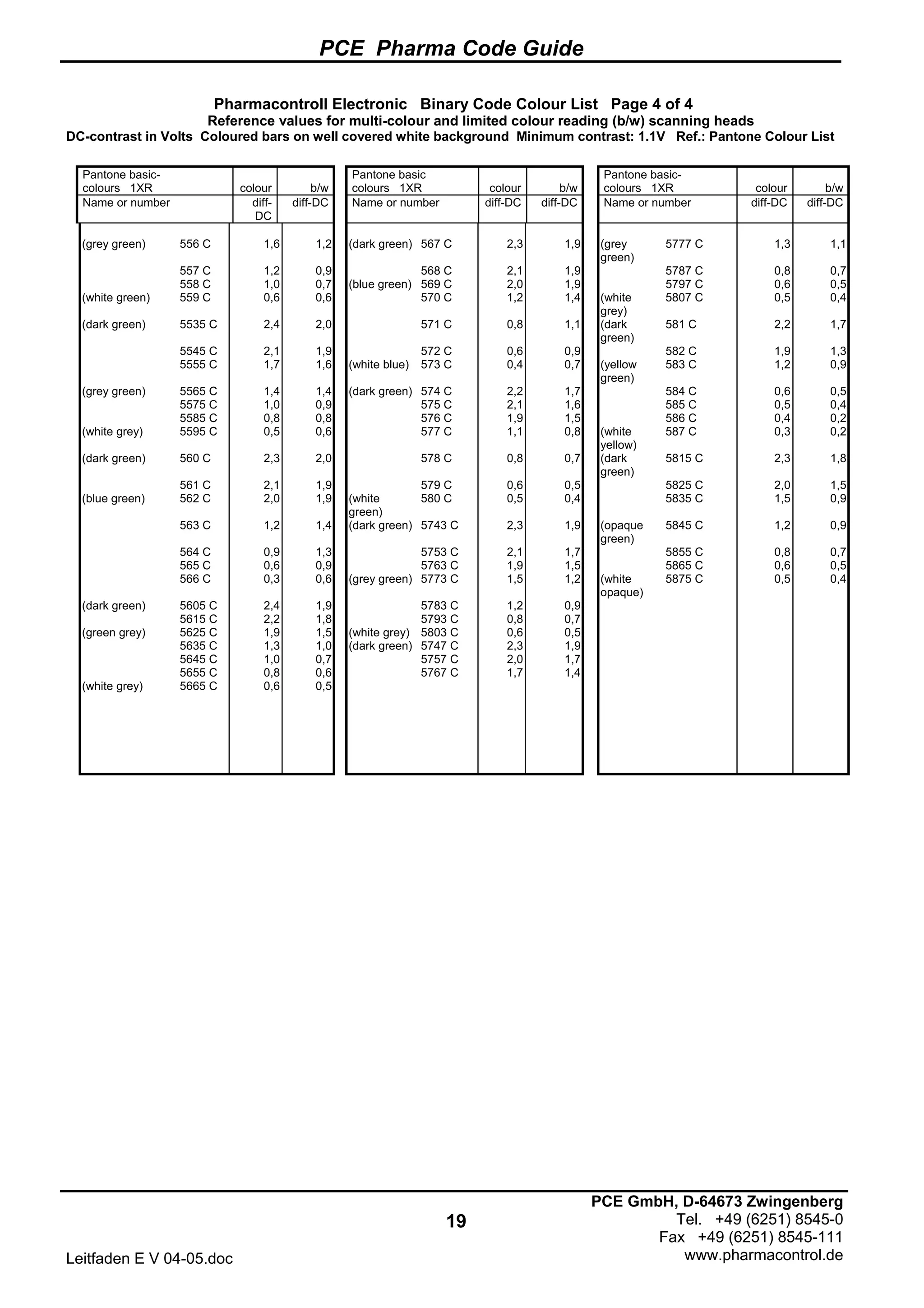
Pharmacontroll Electronic Binary Code Colour List Page 4 of 4
Reference values for multi-colour and limited colour reading (b/w) scanning heads
DC-contrast in Volts Coloured bars on well covered white background Minimum contrast: 1.1V Ref.: Pantone Colour List
Pantone basic-
colours 1XR colour b/w
Pantone basic
colours 1XR colour b/w
Pantone basic-
colours 1XR colour b/w
Name or number diff-
DC
diff-DC Name or number diff-DC diff-DC Name or number diff-DC diff-DC
(grey green) 556 C 1,6 1,2 (dark green) 567 C 2,3 1,9 (grey
green)
5777 C 1,3 1,1
557 C 1,2 0,9 568 C 2,1 1,9 5787 C 0,8 0,7
558 C 1,0 0,7 (blue green) 569 C 2,0 1,9 5797 C 0,6 0,5
(white green) 559 C 0,6 0,6 570 C 1,2 1,4 (white
grey)
5807 C 0,5 0,4
(dark green) 5535 C 2,4 2,0 571 C 0,8 1,1 (dark
green)
581 C 2,2 1,7
5545 C 2,1 1,9 572 C 0,6 0,9 582 C 1,9 1,3
5555 C 1,7 1,6 (white blue) 573 C 0,4 0,7 (yellow
green)
583 C 1,2 0,9
(grey green) 5565 C 1,4 1,4 (dark green) 574 C 2,2 1,7 584 C 0,6 0,5
5575 C 1,0 0,9 575 C 2,1 1,6 585 C 0,5 0,4
5585 C 0,8 0,8 576 C 1,9 1,5 586 C 0,4 0,2
(white grey) 5595 C 0,5 0,6 577 C 1,1 0,8 (white
yellow)
587 C 0,3 0,2
(dark green) 560 C 2,3 2,0 578 C 0,8 0,7 (dark
green)
5815 C 2,3 1,8
561 C 2,1 1,9 579 C 0,6 0,5 5825 C 2,0 1,5
(blue green) 562 C 2,0 1,9 (white
green)
580 C 0,5 0,4 5835 C 1,5 0,9
563 C 1,2 1,4 (dark green) 5743 C 2,3 1,9 (opaque
green)
5845 C 1,2 0,9
564 C 0,9 1,3 5753 C 2,1 1,7 5855 C 0,8 0,7
565 C 0,6 0,9 5763 C 1,9 1,5 5865 C 0,6 0,5
566 C 0,3 0,6 (grey green) 5773 C 1,5 1,2 (white
opaque)
5875 C 0,5 0,4
(dark green) 5605 C 2,4 1,9 5783 C 1,2 0,9
5615 C 2,2 1,8 5793 C 0,8 0,7
(green grey) 5625 C 1,9 1,5 (white grey) 5803 C 0,6 0,5
5635 C 1,3 1,0 (dark green) 5747 C 2,3 1,9
5645 C 1,0 0,7 5757 C 2,0 1,7
5655 C 0,8 0,6 5767 C 1,7 1,4
(white grey) 5665 C 0,6 0,5

Pce pharmacode guide_v04-05_en

  • 1.
    213 Color 10,8 227 Color 2 2,3 208 Color 3 1,2 201 Color 4 1,1 238 Color 5 1,8 220 Color 6 0,6 206 Color 7 1,2 240 Color 8 1,6 212 Color 9 2,1 254 Color 10 0,9 262 Color 11 1,4 Color-Liste Code-Liste
  • 2.
    PCE Pharma CodeGuide 2 Leitfaden E V 04-05.doc PCE GmbH, D-64673 Zwingenberg Tel. +49 (6251) 8545-0 Fax +49 (6251) 8545-111 www.pharmacontrol.de Tablet of contents Page Introduction 3 Code dimensions 4 Binary Code on Cartons 5/6 Binary Code on Leaflet 7/8 Binary Code on Label 9/10 Binary Code on Tube 11/12 Binary Code on Blister Foil 13 Recommended Colours 14 Binary Code Colour List 15 Binary Code List 16-19 State: November 1993 – These documentations are subject of change without further notice. Errors expected. All rights reserved. No part of the Melibokus “Binary Code Guide” publication may be reproduced or utilised in any form by any means, electronic or mechanical including photocopying or translating without permission in writing from Melibokus GmbH. In general, §823 of the BGB is effective.
  • 3.
    PCE Pharma CodeGuide 3 Leitfaden E V 04-05.doc PCE GmbH, D-64673 Zwingenberg Tel. +49 (6251) 8545-0 Fax +49 (6251) 8545-111 www.pharmacontrol.de Introduction The Binary Code Guide is written to assist the pharmaceutical industry, to design codes for cartons, leaflets, labels, tubes and blister foils. Codes for other packaging material can be printed using similar design criteria. The basis of this code guide terms from the vast experience gained from the industry over many years. It also covers the scope of reading these codes by Melibokus/PCE new high tech scanning devices and camera systems. Compared to other existing code guides, there are some minor differences. Nevertheless, most of the existing code specifications can be controlled by these modern reading equipment. The specification differences are not strictly physically, but allow in many cases a more secure and simpler handling of code reading in the pharmaceutical industry. The use of the Binary Code described in this booklet is worldwide. Its applications in the packaging industry are to detect missing prints, packaging material mix-ups, etc. The principal benefits of this code is, that it is easy to design, easy to print, simple to read and has the great advantage of containing different coloured bars in the same code. The required security of printing all colours on a packaging material is assured, by incorporating these colours on additional bars in the code. Only colours, which contain important information on the packing material (no design-colours) shall be used. To find which colours can be used. To find which colours can be coded, refer to the “recommended colours” in this booklet. On the other hand, the Standard Binary Code does not offer a great variety of code formats, redundancy and securing algorithm as in normal data capture codes. Therefore, it is not protected against misinterpretation, especially in the areas of one to three digit codes. In the pharmaceutical industry use also other codes, lie 2 of 5, EAN, ANC, AN; 3 of 9, etc. All these codes have the disadvantage of being monochrome and offer no greater print tolerance. In multi-colour code combinations, each individually used additional coloured bars should be printed with a gap of 1,5 mm to the next coloured bar. (Usually the space between equal coloured bars is 1,0 mm wide. This helps to compensate printing tolerances at a different colour process. It is recommended not to use code combinations – with less than three bars or only thick or only thin bars. Using full-automatic reading (which is possible with Melibokus/PCE scanning heads), this recommendations are important. By using non-automatic reading devices, by the means of external gating, it is still useful to use the more complicated code combinations, because in case of mix-up of foreign packaging material, random print can appear in the area to read and may show similarity with simple code combinations. By using multi-colour code combinations, it is important not to use combinations which can result when one or all additional coloured bars are missing.
  • 4.
    PCE Pharma CodeGuide 4 Leitfaden E V 04-05.doc PCE GmbH, D-64673 Zwingenberg Tel. +49 (6251) 8545-0 Fax +49 (6251) 8545-111 www.pharmacontrol.de PCE - Mini Pharma Binary Code 0,9 0,3 0,6 +0,4 +0,1 +0,4 -0,1 -0,1 -0,1 Free zone 4 min. Free zone 4 min. 3,5min. Recommended for labels and tubes as monochrome code. Pay attention to the PCE Code Guide regarding the colour capability! PCE - Standard Pharma Binary Code (One Row Code) ** 1,5 0,5 1,0 1,5 1,5 1,0 +0,2 +1,5 +1,0 +1,0 0,2 -0,2 -0,2 -0,7 -0,2 2 1 1 2 2 * * ** Denpending of height: Leaflet min. 8mm Carton min. 7mm Label min. 5mm Tube min. 7mm By using PCE spot scanning heads all binary code dimensions can be shrinked by a factor of 0.66 or enlarged by a factor up to 3; this is depending on the print quality. Distance between two different coloured code bars. All Pharma Binary Code should contain thick and thin code bars.Note: 0,6 0,2 0,4 +0,4 +0,1 +0,3 -0,1 -0,1 -0,1 2 min. PCE - Micro Pharma Binary Code 0,6 0,2 0,4 +0,4 +0,1 +0,3 -0,1 -0,1 -0,1 Free zone 2,5 min. Free zone 2,5 min. 2 min. Recommended for labels using the PCE Laser-Raster-Scanner (Option M) or the PCE Mini-Smart-Camera. All dimension data are in mm
  • 5.
    PCE Pharma CodeGuide 5 Leitfaden E V 04-05.doc PCE GmbH, D-64673 Zwingenberg Tel. +49 (6251) 8545-0 Fax +49 (6251) 8545-111 www.pharmacontrol.de Binary Code on Cartons Recommendations: The code layout on cartons can be designed with single or multi- coloured binary codes. When positioning the code within the artwork, it is recommended that the position of the highest digit of the code will be presented (e.g. left to right) in the same way at all other cartons. In multi-coloured codes, any low contrasting colours with respect to the background must be represented by thick bars. Different coloured bars should have a separation gap of 1,5 mm. At least three or better four bar combinations should be used. Each code combination should contain at least one thick and one thin bar. Besides using the minimum clearance space before and after the code combination, the code should be placed in the middle of the carton flap. Remarks: A shortage of available code combinations may occur if it is necessary to code a higher number of small sized cartons. Cartons of different sized or folded construction cannot be mixed, as these will not process through the machine without being destroyed. Therefore, for clear differing sized carton groups, the code combination set-up can be repeated. To increase the number of code combination, available in any limited printing area, the code sizes and tolerances can be reduced by a factor of 0.66. This is providing that the print techniques allows for good reproduction. On rough carton surfaces, i.e. glue flaps, the code size and tolerance can be enlarged by a factor up to 3. These code variations are possible with the PCE scanning heads, without any re-calibration being required in the scanning or decoding components of the system.
  • 6.
    PCE Pharma CodeGuide 6 Leitfaden E V 04-05.doc PCE GmbH, D-64673 Zwingenberg Tel. +49 (6251) 8545-0 Fax +49 (6251) 8545-111 www.pharmacontrol.de
  • 7.
    PCE Pharma CodeGuide 7 Leitfaden E V 04-05.doc PCE GmbH, D-64673 Zwingenberg Tel. +49 (6251) 8545-0 Fax +49 (6251) 8545-111 www.pharmacontrol.de Binary Code on Leaflets For the code allocation on leaflets, positioning, guiding and printing tolerances are more important, than various aspects of multi-coloured printing which is mainly required for cartons and labels. In most cases, only monochrome leaflets are used. Due to greater cutting, printing and mechanical feeding variations experienced in producing a folded leaflet, it is required that larger code heights (min. 8mm) and longer quite zones (10mm before and after the code combination) are used. The position of the various code bars shown on the specimen leaflet was chosen to allow the leaflet to be fed into the folding machine in any direction. The specimen leaflet is valid for pre-cut and unfolded leaflets. It is possible to turn the leaflet in all sides and the code will still be in the correct position and in-feed direction. Therefore, it is always important to print the highest and the lowest digit bar at the same position. Leaflets travelling in only one direction use half of the bar code combinations. Remark: The spot of the reading scanning head must cross all code bars of a moving leaflet. It is important to bear this in mind when designing monochrome pre-folded leaflets, that they can travel only in one direction through the leaflet folding machine. Using pre-multi-folded leaflets, the complete code including the quite zones must be visible to the scanning head. (For this application a CCD-Scanner is often used.) The following specimen leaflet is a useful recommendation. However it is also possible to read leaflets based on existing and different code specifications by modern code reading equipment.
  • 8.
    PCE Pharma CodeGuide 8 Leitfaden E V 04-05.doc PCE GmbH, D-64673 Zwingenberg Tel. +49 (6251) 8545-0 Fax +49 (6251) 8545-111 www.pharmacontroll.de Binary Code on Leaflets Recommendation: Code bottom side 75 75 Highest digit bar Height of bar = min. 5mm by using the Laser-Raster-Scanner All dimension data are in mm mastie, Kreislaufstabilität, Sekretions- störungen der Speichel- und Schweiß- drüsen, Magen-, Darm- und Miktions- beschwerden, allergische Reaktionen (Urtikaria, Dermatitis, Fieber, Asthma), Ödeme, Cholestase, Hyper- oder Hypoglykämie, Veränderungen der Libido, Provokation epileptischer Anfälle und Erregungsleitungsstörun- gen. Wechselwirkungen Bei gleichzeitiger Behandlung mit reserpin- oder adrenalinhaltigen Prä- paraten ist der Blutdruck zu kontrol- lieren. Bei gleichzeitiger Gabe zentralwirk- samer Arzneimittel können verstärkte Tabletten begonnen und nach Bedarf individuell gesteigert. Die Tabletten werden zweckmäßiger- weise mit etwas Flüssigkeit nach den Mahlzeiten eingenommen. Warnhinweise,Vorsichtsmaß- nahmen Unter Langzeitbehandlung mit Decentan sollten regelmäßige Blutbild- und Leberfunktionskontrol- len durchgeführt werden. Bei Patien- ten mit gestörter Nierenfunktion ist die Dosis entsprechend zu reduzie- ren. Bei Patienten mit vorgeschädig- tem Herzen, insbesondere bei alten Patienten, werden regelmäßige kardiologische Untersuchungen (EKG- Kontrollen) empfohlen. ZurbesonderenBeachtungfürden Patienten Treten Symptome wie Halsentzün- dungen, Fieber oder grippeartige Beschwerden auf, sollte unverzüglich der behandelnde Arzt informiert wer- den, damit eine sofortige Blutbildkon- trolle vorgenommen wird. Eine Wirkungen der einzelnen Medika- mente auftreten, die gegebenenfalls auch therapeutisch genutzt werden können. Decentan kann die Wirkung von L-Dopa abschwächen. Dosierung Über die Dosierung und Behand- lungsdauer entscheidet ausschließ- lich der behandelnde Arzt. Soweit nicht anders verordnet, wird in der Regel mit einer Dosis von 1-3 Selbstbehandlung mit Schmerzmit- teln und fiebersenkenden Präparaten sollte unterbleiben. Wie alle Heilmittel dieses Wirkungs- types kann auch Decentan in Abhän- gigkeit von Dosis, individueller Empfindlichkeit und Anwendung besonders anfänglich das Reaktionsvermögen (z.B. im Straßen- verkehr oder beim Bedienen von Maschinen) beeinträchtigen. Dies gilt in besonderem Maße im Zusammenwirken mit Alkohol. DarreichungsformundPackungs- größen Arzneimittel sorgfältig aufbewah- ren! Vor Kindern sichern! Packungzu50Tabletten FernerAnstaltspackungzu1000 Tabletten Code bottom sideCode front side Code front side (No pre-folded leaflets) Front side of extraction on the leaflet 10mm of unprinted space before and after the code Code sample combination: No. 281 in PCE Code Guide 75 75
  • 9.
    PCE Pharma CodeGuide 9 Leitfaden E V 04-05.doc PCE GmbH, D-64673 Zwingenberg Tel. +49 (6251) 8545-0 Fax +49 (6251) 8545-111 www.pharmacontroll.de Binary Code on Self-Adhesive Labels Designing Binary Codes for labels, requires some additional specification. Printing and cutting tolerances are small (the height of a bar is only approx. 5mm), but multi- coloured codes are of interest. In most cases, labels will be controlled by CCD-Scanners. This allows a positioning of the code bars in picket fence or ladder orientation. (See sample label.) Using CCD-scanners and spot scanning heads, automatic reading is required. Therefore, a minimum of four bars should be used in one code combination. Each code combination should contain one thick and one thin bar. (By way of exception, three bars in a code combination can be used.) Due to the high print quality of labels, it is possible to reduce the code dimensions by a factor of 0.66 and save either space on the label or rise the number of variations per space. Nevertheless, the minimum recommended height of bars is 5mm, except, better label tolerances can be guaranteed. Using multi-coloured code combinations require extra attention in one aspect: Code combinations which can result when one or more colours of a code are missing. These code combinations should not be used on other labels to avoid a mix-up risk. Cut wet-glue labels For this type of label, the same specifications are valid with some exceptions. Codes may be printed only in picket fence orientation. Due to higher adjustment tolerances, the code combination requires a clearance space of 7mm on both sides. The start of the first bar for all sized of this kind of label, should always be printed at the same distance to the front edge of the label. (This edge is discovered by the moving direction of the label through the machine.)
  • 10.
    PCE Pharma CodeGuide 10 Leitfaden E V 04-05.doc PCE GmbH, D-64673 Zwingenberg Tel. +49 (6251) 8545-0 Fax +49 (6251) 8545-111 www.pharmacontrol.de Binary Code on Labels 6 mm of unprinted space before and after the code Heights of bar = min. 5mm min. 5mm In Comparison: Standard Binary Pharmaceutical code to Micro Pharmaceutical code 6-digit Standard pharmaceutical code on label 25x40mm a) Standard Binary Pharmaceutical code thick bar = 1,5mm, thin bar = 0,5mm bar distance min. = 1mm, height of bar min. 5mm free zone before and after the code min. = 6mm area requirement = 115mm² (100%) on example CH.B.:R2317 Verw.bis:09.1989 CH.B.: R2317 Verw. bis: 09.1989 6-digit Micro Pharmaceutical code on label 25x40mm b) Micro Binary Pharmaceutical code thick bar = 0,6mm, thin bar = 0,2mm bar distance min. = 0,4mm, height of bar min. 2mm free zone before and after the code min. = 2,5mm area requirement = 20,8mm² (ca 18%) on example Verifying code and variable datas on using a single PCE label control camera it is important, both components should be placed close together. Therefore they will be on the same picture frameon the camera. The design should be in a way, preventing the code and the variable data print could not jam on all printing tolerances. Using PCE Laser-Raster-Scanner (option M - Micro Code) the PCE label control camera can work on the Pharmaceutical Micro Code.
  • 11.
    PCE Pharma CodeGuide 11 Leitfaden E V 04-05.doc PCE GmbH, D-64673 Zwingenberg Tel. +49 (6251) 8545-0 Fax +49 (6251) 8545-111 www.pharmacontrol.de Binary Code on Tubes Tubes have a higher printing and guiding tolerance, they will be code controlled in rotating motion on the print register station of tube filling machines. This leads to some special design instructions. First of all, the print register station of tube filling machines must allow a minimum of 2,5 rotations per tube (when the tube is not registered). If in general, less than 2,5 rotations are reached, the gear of the driving motor may be changed. In the following example of a tube filling station, the tube rotating direction is anti- clockwise. In case some tube filling machines turn the opposite way, it should either be modified mechanically, or the code must be printed in mirror-image. The tube code should not exceed a ¼ of the tube surrounding, to be covered by the tube fold. To place an additional print register mark is possible but in most cases not necessary. Melibokus/PCE tube scanning heads will provide code reading and register control at once, with the comfort of programmable stop delay. Binary code on tubes may be coloured if the minimum clearance space between different coloured bars are assured. It is not recommended to shrink the tube code. On plastic tubes, the code will not be folded away, therefore, it can be printed centred on the front side of the tube.
  • 12.
    PCE Pharma CodeGuide 12 Leitfaden E V 04-05.doc PCE GmbH, D-64673 Zwingenberg Tel. +49 (62519 8545-0 Fax +49 (6251) 8545-111 www.pharmacontrol.de Registration bar (2mm x 8mm) Possible print position of a Mini Pharma or a Standard Binary code. Mini Pharma or Mini Binary code: thin bar: 0,3mm; thick bar: 0,9mm; space: 0,6mm; Height of the code: min. 3mm Barcode: Code 128 or Interleaved 2/5 thin bar: min. 0,2mm Height of the code: min. 3mm Possible print position of Code 128, Int. 2 of 5, EAN etc. In a small form on the front or back side of the tube Length of bar: 7mm, in step ladder-format thin bar: min. 0,2mm It is possible to position the code at the side of the registration bar too. Please notice the positioning-height of the tube in the bracket of the tube filling machine. The lower end of the code must be positioned min. 10mm above the uppter end of the tube bracket. The free and un-printed space at the upper and lower end on the code must be min. 7mm. The un-printed space on the left and right side of the code must be 3mm. Min. Distance of the code from the uppter edge of the tube should be 10mm. Using a Mini Pharmaceutical Binary Code in picket-fence format Using small Barcode in step ladder-format
  • 13.
    PCE Pharma CodeGuide 13 Leitfaden E V 04-05.doc PCE GmbH, D-64673 Zwingenberg Tel. +49 (62519 8545-0 Fax +49 (6251) 8545-111 www.pharmacontrol.de Binary Codes on Blister Aluminium Foils There are some good reasons to secure blister aluminium foils by the means of Binary Code. (Similar reasons are valid for all foils.) 1. to identify false foils 2. to identify parts of the faulty foil which may be implemented in a bigger role 3. to detect print interruptions which may occurs every now and than on foils The imprint should be on the none- shiny side of the aluminium foil for better readability. (Nevertheless, it is possible to read bar codes on the shiny side, but the adjustment of this circumstances needs more care.) The code should be printed either at the left or at the right edge of the foil or in another area which may be cut off. The code should contain at least four bars with at least one thick and one thin bar. For good code reading results, contrast-full colours should be chosen. The background should be either the non-shiny aluminium foil or a light print colour. In case of registered print of the foil, for every print register one code should be placed at the same position. In case of non-registered random print, a code should be printed at least once per 150mm. The height of bars in normal cases is 10mm, only for certain precise foil prints, or guides, the height can be reduced to 6mm. Code Area in cut out field Standard Blister Print on the pale side of the alufoil Print free space minimum 40mm 150mm min.
  • 14.
    PCE Pharma CodeGuide 14 Leitfaden E V 04-05.doc PCE GmbH, D-64673 Zwingenberg Tel. +49 (62519 8545-0 Fax +49 (62519 8545-111 www.pharmacontrol.de PCE Binary Code List This list can be used by packaging technologists for direct code allocation. Code combinations with less than three bars or containing only thick or only thin bars are, as mentioned earlier, for code security reasons eliminated. In addition it is important to know that in case of leaflets, labels or perhaps cartons a minimum of four bars could be required. All described codes have on the left side the highest value and on the right side the lowest value digit bar. At the code allocation it must be considered that for all sizes and types of packaging material the highest and lowest digit will always be placed in the same direction. The code list contains only code combinations with up to ten bars because of space reasons. However, Melibokus/PCE code reading devices identify code combinations with up to 16 bars. (On request a complete code list can be supplied by Melibokus. This code list can be used for manual designing. Per individual packing material type a separate code list should be used. It is possible to use per packing material type different code lists, splitting in various significant sizes. For the use of multi-coloured code combinations, it is important not to use code combinations which could result when one coloured bar is cut off. Decoding The back decoding of Binary Code to its decimal value, which is also shown in the list, is simple. Sum up the values of every code digit (start with the lowest value digit bar) and the result is the decimal value as described below. Value thin thick bar bar 1 2 Lowest value digit bar 2 4 " 4 8 " 8 16 " 16 32 " 32 64 " 64 128 " 128 256 " 256 512 " 512 1024 " 1024 2048 " 2048 4096 Highest value digit bar Decoding sample: Code x ←←←← lowest value digit bar 51=32+8+8+2+1 The decimal value is 51
  • 15.
    PCE Pharma CodeGuide 15 Leitfaden E V 04-05.doc PCE GmbH, D-64673 Zwingenberg Tel. +49 (6251) 8545-0 Fax +49 (6251) 8545-111 www.pharmacontrol.de Recommended Colours for Binary Codes The use of coloured code bars within a Binary Code corresponds with the sensibility of the used scanning heads and the contrast of the code bar to the background. To provide help for the packing design by informing about the colour readability, the following colour list was evaluated. The first colour list “for red illuminated scanning heads” shows the readability of colours by the use of PCE spot scanning heads or PCE CCD scanners with red or white illumination. The second list refers to the use of PCE spot scanning heads and PCE CCD scanners with yellow illumination. On every list the single colours of the Pantone Matching List has been measured. The contrast differences are noted behind every colour and show the readability. Every colour is readable with a difference voltage equal or higher 1,1V. These values can be measured directly with the scanning head by using first the test colour and secondly the white background. Colours smaller than 1,1V are readable with limited security (threshold is about 0,7V) and should be used only under special circumstances. Red / white scanning heads are used for contrastful colours on white background (with the exception of red). The general use is for leaflet code reading and white code control. Yellow scanning heads have a full colour readability (with the exception of yellow or very light colours). They are used for typical multi-colour code reading with the limitation of a lower depth of field (about or better than +/- 3mm). This fits colour code reading on cartons and labels. Using colours on various materials, it is important to know that the reflection or transparency of the background. (A transparent background lowers the contrast.) By using the scanning head and a high resistance voltage metre, the colours can be checked on site. General calibration values: Black code on good reflecting white background gives a 2V contrast when reading with a red illuminated scanning head. Reading with a yellow illuminated scanning head gives a 2,5V contrast.
  • 16.
    PCE Pharma CodeGuide 16 Leitfaden E V 04-05.doc PCE GmbH, D-64673 Zwingenberg Tel. +49 (6251) 8545-0 Fax +49 (6251) 8545-111 www.pharmacontrol.de Pharmacontroll Electronic Binary Code Colour List Page 1 of 4 Reference values for multi-colour and limited colour reading (b/w) scanning heads DC-contrast in Volts Coloured bars on well covered white background Minimum contrast: 1.1V Ref.: Pantone Colour List Pantone basic- colours 1XR colour b/w Pantone basic colours 1XR colour b/w Pantone basic- colours 1XR colour b/w Name or number diff-DC diff-DC Name or number diff-DC diff-DC Name or number diff-DC diff-DC (deep brown) 147 C 2,2 1,6 206 C 2,1 0,1 Yellow 0,1 0,1 (yellow) 148 C 0,3 0,1 207 C 2,2 0,8 Warm Red C 1,7 0,1 149 C 0,3 0,1 208 C 2,3 1,3 Rubine Red C 2,2 0,1 150 C 0,7 0,1 (red brown) 209 C 2,3 1,5 Rhodamine Red C 2,0 0,2 (orange) 151 C 1,1 0,1 (pink) 210 C 0,8 0,1 Purple C 2,2 0,2 152 C 1,4 1,0 211 C 1,2 0,1 Reflex Blue C 2,5 1,8 153 C 1,7 1,1 212 C 1,5 0,2 Process Blue C 2,4 1,7 (brown) 154 C 2,0 1,5 (red) 213 C 1,9 0,2 Green C 2,0 1,7 (yellow) 155 C 0,4 0,1 214 C 2,0 0,7 Violet C 2,5 1,5 156 C 0,7 0,0 215 C 2,2 1,2 Yellow 012 C 0,1 0,1 157 C 1,4 0,1 (red brown) 216 C 2,2 1,5 Orange 021 C 1,1 0,1 (orange) 158 C 1,7 0,1 (pink) 217 C 0,8 0,1 Red 032 C 1,9 1,0 159 C 1,9 0,7 218 C 1,6 0,1 Blue 072 C 2,5 2,0 160 C 2,1 1,2 219 C 2,0 0,2 Process Yellow 0,1 0,0 (deep brown) 161 C 2,3 1,7 Rubine Red C 2,1 0,2 Process Magenta 2,0 0,1 (white orange) 1555 C 0,5 0,1 220 C 2,2 0,8 Process Cyan C 2,0 1,6 1565 C 1,0 0,1 221 C 2,3 1,2 Process Black C 2,5 2,0 1575 C 1,0 0,1 (deep brown) 222 C 2,4 1,6 (white-yellow) 100 C 0,1 0,0 (orange red) 1585 C 1,2 0,1 (blue pink) 223 C 1,2 0,0 101 C 0,1 0,0 1595 C 1,6 0.9 224 C 1,6 0,1 102 C 0,1 0,0 1605 C 1,9 1,2 225 C 1,8 0,2 Yellow C 0,1 0,0 (brown) 1615 C 2,1 1,5 (bluish red) 226 C 2,1 0,2 103 C 0,9 0,7 (white orange) 162 C 0,4 0,1 227 C 2,2 0,9 104 C 1,2 0,9 163 C 0,7 0,1 228 C 2,3 1,4 (olive) 105 C 2,0 1,4 164 C 1,0 0,1 (deep brown) 229 C 2,4 1,7 (white-yellow) 106 C 0,1 0,0 (red orange) 165 C 1,2 0,1 (blue pink) 230 C 0,8 0,1 107 C 0,1 0,0 166 C 1,7 0,7 231 C 1,4 0,1 108 C 0,2 0,0 167 C 1,9 1,0 232 C 1,6 0,1 109 C 0,2 0,0 (deep brown) 168 C 2,3 1,6 Rhod. Red C 2,0 0,2 110 C 0,9 0,5 (light orange) 1625C 0,6 0,1 233 C 2,1 0,7 111 C 1,4 0,9 1635 C 0,8 0,1 234 C 2,1 1,2 (olive) 112 C 1.6 1,2 1645 C 1,1 0,0 235 C 2,3 1,3 (white-yellow) 113 C 0,1 0,1 (red orange) 1655 C 1,4 0,1 (blue pink) 236 C 1,0 0,1 114 C 0,2 0,0 1665 C 1,6 0,5 237 C 1,4 0,2 115 C 0,2 0,1 1675 C 2,0 1,2 238 C 1,7 0,1 116 C 0,4 0,1 (brown) 1685 C 2,1 1,4 239 C 2,0 0,2 117 C 1,2 0,8 (pink) 169 C 0,5 0,1 240 C 2,1 0,8 118 C 1,5 1,0 170 C 0,9 0,1 241 C 2,2 1,1 (olive) 119 C 2.0 1,3 171 C 1,3 0,1 (blue brown) 242 C 2,3 1,6 (white-yellow) 120 C 0,1 0,0 (red orange) 172 C 1,5 0,1 (blue pink) 243 C 0,8 0,1 121 C 0,2 0,0 173 C 1,8 0,8 244 C 1,0 0,1 122 C 0,3 0,0 174 C 2,1 1,4 245 C 1,3 0,1 (light orange) 123 C 0,5 0,0 (brown) 175 C 2,3 1,8 246 C 2,1 0,2 124 C 1,1 0,6 (pink) 176 C 0,6 0,1 247 C 2,2 0,6 125 C 1,5 1,0 177 C 1,1 0,1 248 C 2,2 1,0 (olive) 126 C 1,7 1,1 178 C 1,3 0,1 (blue brown) 249 C 2,3 1,5 (white-yellow) 127 C 0,2 0,0 Warm Red C 1,7 0,2 (light violet) 250 C 0,8 0,0 128 C 0,5 0,0 179 C 1,9 0,7 251 C 1,4 0,1 129 C 0,8 0,0 180 C 2,0 1,1 252 C 1,9 0,3 (orange) 130 C 1,1 0,0 (brown) 181 C 2,2 1,5 Purple C 2,1 0,3 131 C 1,5 0,6 (pink) 182 C 0,7 0,1 253 C 2,2 0,6 132 C 1,8 1,1 183 C 1,2 0,1 254 C 2,2 1,0 (olive) 133 C 2,1 1,5 184 C 1,5 0,1 255 C 2,3 1,4 (yellow) 134 C 0,2 0,0 (red) 185 C 1,9 0,2 (white violet) 256 C 0,9 0,3 135 C 0,4 0,0 186 C 2,0 0,6 257 C 1,3 0,6 136 C 0,5 0,0 187 C 2,1 1,1 258 C 2,1 1,1 (orange) 137 C 0,8 0,0 (brown) 188 C 2,3 1,5 259 C 2,3 1,6 138 C 1,2 0,6 (pink) 189 C 1,0 0,1 260 C 2,4 1,7 139 C 1,7 1,1 190 C 1,3 0,1 261 C 2,4 1,8 (olive brown) 140 C 2,1 1,5 191 C 1,7 0,1 (deep violet) 262 C 2,4 1,8 (yellow) 1345 C 0,2 00 (red) 192 C 2,0 0,2 (light violet) 2563 C 1,4 0,5 1355 C 0,3 0,0 193 C 2,1 0,8 2573 C 1,8 0,8 1365 C 0,5 0,0 194 C 2,2 1,3 2583 C 2,1 1,0 (orange) 1375 C 0,9 0,0 (deep brown) 195 C 2,3 1,6 2593 C 2,3 1,4 1385 C 1,4 0,7 (pink) 196 C 0,8 0,1 2603 C 2,4 1,4 1395 C 1,9 1,3 197 C 1,2 0,1 2613 C 2,4 1,5 (brown) 1405 C 2,2 1,7 198 C 1,9 0,1 2623 C 2,4 1,6 (yellow) 141 C 0,7 0,0 (red) 199 C 2,0 0,2 (light violet) 2567 C 1,5 0,7 142 C 0,9 0,0 200 C 2,1 0,6 2577 C 1,9 0,8 143 C 1,1 0,1 201 C 2,2 1,0 2587 C 2,2 1,3 (orange) 144 C 1.5 0,1 (brown) 202 C 2,3 1,3 2597 C 2,3 1,4 145 C 1,7 0,1 203 C 1,0 0,1 2607 C 2,4 1,6 146 C 2,0 1,1 204 C 1,6 0,1 2617 C 2,4 1,6 205 C 1,8 0,2 (deep violet) 2627 C 2,4 1,8
  • 17.
    PCE Pharma CodeGuide 17 Leitfaden E V 04-05.doc PCE GmbH, D-64673 Zwingenberg Tel. +49 (6251) 8545-0 Fax +49 (6251) 8545-111 www.pharmacontrol.de Pharmacontroll Electronic Binary Code Colour List Page 2 of 4 Reference values for multi-colour and limited colour reading (b/w) scanning heads DC-contrast in Volts Coloured bars on well covered white background Minimum contrast: 1.1V Ref.: Pantone Colour List Pantone basic- colours 1XR colour b/w Pantone basic colours 1XR colour b/w Pantone basic- colours 1XR colour b/w Name or number diff-DC diff-DC Name or number diff-DC diff-DC Name or number diff-DC diff-DC (light violet) 263 C 0,7 0,4 313 C 2,3 2,0 (deep oliv) 364 C 2,1 1,8 264 C 1,4 0,7 314 C 2,4 2,0 (light green) 365 C 0,3 0,4 265 C 2,1 1,2 315 C 2,4 2,0 366 C 0,4 0,7 (violet) 266 C 2,2 1,6 (deep blue) 316 C 2,4 2,0 367 C 0,9 0,9 267 C 2,2 1,7 (light blue) 317 C 0,4 0,6 (yellow green) 368 C 1,6 1,4 268 C 2,3 1,8 318 C 0,1 1,2 369 C 1,9 1,6 (deep violet) 269 C 2,4 1,8 319 C 1,5 1,6 370 C 2,0 1,6 (light violet) 2635 C 1,1 0,6 320 C 2,3 2,0 (deep oliv) 371 C 2,2 1,7 2645 C 1,6 0,8 321 C 2,3 2,0 (light green) 372 C 0,2 0,5 2655 C 2,0 1,1 322 C 2,4 2,0 373 C 0,3 0,7 2665 C 2,2 1,4 (deep blue) 323 C 2,4 2,0 374 C 0,5 0,9 2675 C 2,4 1,7 (light green) 324 c 0,7 0,7 375 C 1,0 1,4 2685 C 2,4 1,7 325 C 1,4 1,4 376 C 1,3 1,5 (deep violet) 2695 C 2,5 1,8 326 C 2,0 2,0 377 C 1,6 1,6 (light blue) 270 C 1,3 0,7 (blue green) 327 C 2,1 2,0 (oliv) 378 C 2,1 1,7 271 C 1,6 1,1 328 C 2,2 2,0 (light yellow) 379 C 0,2 0,3 272 C 2,1 1,4 329 C 2,3 2,0 380 C 0,3 0,4 273 C 2,2 2,0 (deep oliv) 330 C 2,4 2,0 381 C 0,5 0,6 274 C 2,4 2,0 (light green) 3242 C 1,0 1,3 382 C 0,8 0,8 275 C 2,5 2,0 3252 C 1,3 1,5 383 C 1,3 1,1 (deep blue) 276 C 2,5 2,0 3262 C 1,7 1,8 384 C 1,6 1,3 (light blue) 2705 C 1,4 0,9 3272 C 2,0 2,0 (oliv) 385 C 2,0 1,6 2715 C 1,9 1,3 3282 C 2,2 2,0 (light yellow) 386 C 0,1 0,3 2725 C 2,2 1,6 3292 C 2,4 2,0 387 C 0,1 0,4 2735 C 2,4 2,0 (deep oliv) 3302 C 2,4 2,0 388 C 0,3 0,6 2745 C 2,5 2,0 (light green) 3245 C 0,9 1,3 389 C 0,3 0,6 2755 C 2,5 2,0 3255 C 1,3 1,6 390 C 0,8 0,9 (deep blue) 2765 C 2,5 2,0 3265 C 1,7 1,8 391 C 1,4 1,3 (light blue) 277 C 1,0 0,7 3275 C 2,0 2,0 (oliv) 392 C 1,7 1,4 278 C 1,3 1,1 3285 C 2,1 2,0 (light yellow) 393 C 0,0 0,1 279 C 2,0 1,6 3295 C 2,2 2,0 394 C 0,1 0,2 Reflex Blue C 2,5 2,0 (deep green) 3305 C 2,3 2,0 395 C 0,1 0,3 280 C 2,5 2,0 (light green) 331 C 0,5 0,8 396 C 0,2 0,5 281 C 2,5 2,0 332 C 0,8 1,2 397 C 0,8 0,9 (deep blue) 282 C 2,5 2,0 333 C 1,1 1,5 398 C 1,2 1,2 (light blue) 283 C 1,2 1,0 Green C 2,0 2,0 (light oliv) 399 C 1,5 1,3 284 C 1,6 1,4 334 C 2,1 2,0 (light yellow) 3935 C 0,0 0,1 285 C 2,1 1,8 335 C 2,2 2,0 3945 C 0,0 0,2 286 C 2,4 2,0 (deep green) 336 C 2,3 2,0 3955 C 0,2 0,3 287 C 2,5 2,0 (light green) 337 C 0,9 0,9 (yellow) 3965 C 0,3 0,5 288 C 2,5 2,0 338 C 1,3 1,3 3975 C 1,3 1,1 (deep blue) 289 C 2,5 2,0 339 C 2,0 1,8 3985 C 1,8 1,4 (light blue) 290 C 0,8 0,7 (green) 340 C 2,2 2,0 (oliv) 3995 C 2,1 1,7 291 C 1,4 1,1 341 C 2,3 2,0 (light grey) 400 C 0,7 0,7 292 C 1,8 1,4 342 C 2,3 2,0 401 C 0,9 0,8 293 C 2,4 2,0 (deep green) 343 C 2,4 2,0 402 C 1,3 1,2 294 C 2,5 2,0 (light green) 3375 C 0,8 1,3 (grey) 403 C 1,7 1,3 295 C 2,5 2,0 3385 C 1,2 1,6 404 C 2,0 1,6 (deep blue) 296 C 2,5 2,0 3395 C 1,6 1,9 405 C 2,2 1,8 (light blue) 297 C 1,3 1,2 (green) 3405 C 2,0 2,0 Black C 2,5 2,0 298 C 1,8 1,5 3415 C 2,1 2,0 (light grey) 406 C 0,8 0,6 299 C 2,1 1,8 3425 C 2,2 2,0 407 C 1,2 0,9 300 C 2,4 2,0 (deep green) 3435 C 2,4 2,0 408 C 1,4 1,1 301 C 2,5 2,0 (light green) 344 C 0,7 0,7 (brown grey) 409 C 1,7 1,8 302 C 2,5 2,0 345 C 1,1 1,0 410 C 2,0 1,5 (deep blue) 303 C 2,5 2,0 346 C 1,5 1,4 411 C 2,2 1,7 (light blue) 304 C 0,9 0,8 347 C 2,1 1,9 (deep brown) 412 C 2,4 2,0 (light blue) 2975 C 0,9 0,8 348 C 2,2 1,9 (light grey) 413 C 0,7 0,7 2985 C 1,6 1,4 349 C 2,3 1,9 414 C 1,1 0,9 2995 C 2,0 1,7 (deep green) 350 C 2,4 1,9 415 C 1,3 1,2 3005 C 2,2 2,0 (light green) 351 C 0,5 0,9 416 C 1,7 1,4 3015 C 2,4 2,0 352 C 0,7 1,2 417 C 2,0 1,6 3025 C 2,4 2,0 353 C 1,0 1,4 418 C 2,1 1,7 (deep blue) 3035 C 2,5 1,9 354 C 1,9 2,0 (deep brown) 419 C 2,4 2,0 (light blue) 305 C 1,4 1,4 355 C 2,0 2,0 (light grey) 420 C 0,6 0,6 306 C 1,8 1,6 356 C 2,1 2,0 421 C 1,0 0,8 Process Blue C 2,4 2,0 (deep green) 357 C 2,3 2,0 422 C 1,3 1,1 307 C 2,4 2,0 (light green) 358 C 0,8 0,0 (grey) 423 C 1,9 1,4 308 C 2,5 2,0 359 C 1,0 1,0 424 C 2,0 1,5 (deep blue) 309 C 2,5 2,0 360 C 1,5 1,62 425 C 2,2 1,7 (light blue) 310 C 1,3 1,3 (green yellow) 361 C 1,9 1,7 (deep grey) 426 C 2,4 2,0 311 C 1,6 1,5 362 C 2,0 1,7 (light grey) 427 C 0,4 0,4 312 C 2,0 1,8 363 C 2,0 1,7 428 C 0,8 0,7
  • 18.
    PCE Pharma CodeGuide 18 Leitfaden E V 04-05.doc PCE GmbH, D-64673 Zwingenberg Tel. +49 (6251) 8545-0 Fax +49 (6251) 8545-111 www.pharmacontrol.de Pharmacontroll Electronic Binary Code Colour List Page 3 of 4 Reference values for multi-colour and limited colour reading (b/w) scanning heads DC-contrast in Volts Coloured bars on well covered white background Minimum contrast: 1.1V Ref.: Pantone Colour List Pantone basic- colours 1XR colour b/w Pantone basic colours 1XR colour b/w Pantone basic- colours 1XR colour b/w Name or numberr diff-DC diff-DC Name or number diff-DC diff-DC Name or number diff-DC diff-DC (light grey) 429 C 1,2 0,9 4665 C 0,8 0,6 (dark violet) 518 C 2,4 1,7 430 C 1,6 1,3 4675 C 0,6 0,4 519 C 2,4 1,6 431 C 2,0 1,6 (white brown) 4685 C 0,4 0,3 520 C 2,3 1,6 432 C 2,2 1,8 (dark brown) 469 C 2,3 1,7 521 C 1,8 1,0 (dark grey) 433 C 2,4 2,0 470 C 2,0 1,4 522 C 1,4 0,7 (light grey) 434 C 0,5 0,7 (brown) 471 C 1,8 0,9 523 C 1,1 0,6 435 C 0,7 0,8 472 C 0,9 0,4 (white violet) 524 C 0,9 0,5 436 C 1,1 1,2 473 C 0,7 0,3 (dark violet) 5185 C 2,4 2,0 (grey) 437 C 1,7 1,6 474 C 0,4 0,2 5195 C 2,3 1,9 438 C 2,1 2,0 (white brown) 475 C 0,3 0,2 5205 C 2,0 1,4 439 C 2,3 2,0 (dark brown) 4695 C 2,4 1,7 5215 C 1,5 1,1 (dark grey) 440 C 2,4 2,0 4705 C 2,2 1,4 5225 C 1,2 0,8 (light grey) 441 C 0,6 0,7 4715 C 1,9 1,2 5235 C 0,8 0,6 442 C 0,8 1,1 4725 C 1,6 0,9 (white violet) 5245 C 0,5 0,4 443 C 1,2 1,4 4735 C 1,1 0,7 (dark violet) 525 C 2,4 1,8 (grey) 444 C 1,5 1,6 4745 C 0,9 0,5 526 C 2,4 1,7 445 C 2,0 1,9 (white brown) 4755 C 0,6 0,4 527 C 2,3 1,5 446 C 2,2 2,0 (dark brown) 476 C 2,3 1,7 528 C 1,9 0,9 (dark grey) 447 C 2,3 2,0 477 C 2,4 1,6 529 C 1,4 0,6 Pant. Warm Gray 1 C 0,5 0,4 478 C 2,3 1,4 530 C 1,1 0,5 2 C 0,5 0,5 (brown) 479 C 1,7 0,6 (white violet) 531 C 0,8 0,3 3 C 0,9 0,7 480 C 1,0 0,4 (dark blue) 5255 C 2,5 1,8 4 C 1,1 0,8 481 C 0,7 0,3 5265 C 2,4 1,6 5 C 1,2 0,9 (white brown) 482 C 0,5 0,2 5275 C 2,2 1,4 6 C 1,4 1,1 (dark Brown) 483 C 2,3 1,5 (blue grey) 5285 C 1,9 1,2 7 C 1,5 1,1 484 C 2,2 1,1 5295 C 1,5 0,9 8 C 1,6 1,3 (red brown) 485 C 2,1 0,1 5305 C 1,0 0,7 9 C 1,8 1,4 486 C 1,4 0,1 (white grey) 5315 C 0,7 0,5 10 C 2,0 1,4 487 C 1,0 0,1 (dark blue) 532 C 2,4 1,9 11 C 2,0 1,5 488 C 0,8 0,1 533 C 2,4 1,9 P.- Cool Gray 1 C 0,4 0,3 (white red) 489 C 0,6 0,1 534 C 2,3 1,9 2 C 0,7 0,6 (dark brown ) 490 C 2,3 1,8 535 C 1,6 1,2 3 C 0,9 0,7 491 C 2,2 1,6 536 C 1,3 1,0 4 C 1,0 0,8 492 C 2,1 1,4 537 C 1,0 0,7 5 C 1,2 0,9 493 C 1,3 0,7 (white grey) 538 C 0,6 0,4 6 C 1,4 1,0 494 C 0,7 0,4 (dark blue) 539 C 2,4 1,9 7 C 1,6 1,3 495 C 0,5 0,3 540 C 2,4 1,9 8 C 1,8 1,5 (white pink) 496 C 0,4 0,2 541 C 2,4 1,9 9 C 1,9 1,4 (dark brown) 497 C 2,4 1,9 (blue) 542 C 1,9 1,4 10 C 2,1 1,6 498 C 2,2 1,8 543 C 1,4 1,1 11 C 2,2 1,7 499 C 2,1 1,7 544 C 1,2 0,9 (dark grey) 448 C 2,3 1,8 500 C 1,2 1,0 (white blue) 545 C 0,9 0,7 449 C 2,3 1,7 501 C 0,6 0,6 (dark blue) 5395 C 2,4 1,9 450 C 2,2 1,6 502 C 0,4 0,4 5405 C 2,3 1,8 451 C 1,6 0,9 (white pink) 503 C 0,3 0,3 5415 C 2,0 1,6 452 C 1,2 0,7 (dark brown) 4975 C 2,2 1,9 5425 C 1,7 1,4 453 C 0,9 0,6 4985 C 2,1 1,6 5435 C 1,2 0,9 (light grey) 454 C 0,8 0,5 4995 C 1,8 1,3 5445 C 0,9 0,7 (dark grey) 4485 C 2,3 1,8 5005 C 1,5 1,0 (white blue) 5455 C 0,6 0,5 4495 C 2,0 1,4 5015 C 1,1 0,7 (dark blue) 546 C 2,4 1,8 4505 C 1,6 1,2 5025 C 0,8 0,6 547 c 2,4 1,8 4515 C 1,3 0,9 (white pink) 5035 C 0,5 0,3 548 C 2,4 1,8 (grey yellow) 4525 C 1,1 0,7 (dark brown) 504 C 2,4 1,8 549 C 1,8 1,3 4535 C 0,6 0,5 505 C 2,3 1,6 550 C 1,5 1,0 (light grey) 4545 C 0,5 0,3 506 C 2,2 1,5 551 C 1,1 0,8 (olive) 455 C 2,1 1,6 507 C 1,4 0,8 (white blue) 552 C 0,8 0,6 456 C 1,7 1,3 508 C 1,0 0,5 (dark blue) 5463 C 2,2 2,0 457 C 1,4 0,9 509 C 0,7 0,3 5473 C 2,1 1,9 458 C 0,6 0,5 (white pink) 510 C 0,5 0,3 5483 C 1,9 1,5 459 C 0,5 0,3 (dark violet) 511 C 2,3 1,8 5493 C 1,5 1,3 460 C 0,3 0,2 512 C 2,2 1,6 5503 C 1,2 1,0 (light yellow) 461 C 0,1 0,2 513 C 2,1 1,5 5513 C 0,7 0,7 (dark brown) 462 C 2,3 1,7 (light violet) 514 C 1,3 0,7 (white blue) 5523 C 0,5 0,5 463 C 2,2 1,5 515 C 1,0 0,6 (dark blue) 5467 C 2,5 2,0 464 C 2,1 1,3 516 C 0,8 0,4 5477 C 2,3 1,9 465 c 1,5 0,7 (white violet) 517 C 0,6 0,3 5487 C 2,0 1,6 466 C 1,1 0,6 (dark violet) 5115 C 2,4 1,9 5497 C 1,6 1,3 467 C 0,9 0,4 5125 C 2,3 1,6 5507 C 1,2 1,0 (light brown) 468 C 0,7 0,3 5135 C 2,0 1,3 5517 C 0,8 0,7 (dark brown) 4625 C 2,4 1,8 5145 C 1,7 0,9 (white grey) 5527 C 0,6 0,5 4635 C 2,0 1,4 5155 C 1,1 0,6 (dark green) 553 C 2,3 1,9 4645 C 1,5 1,1 5165 C 0,7 0,4 554 C 2,3 1,8 4655 C 1,2 0,7 (white violet) 5175 C 0,6 0,3 555 C 2,2 1,7
  • 19.
    PCE Pharma CodeGuide 19 Leitfaden E V 04-05.doc PCE GmbH, D-64673 Zwingenberg Tel. +49 (6251) 8545-0 Fax +49 (6251) 8545-111 www.pharmacontrol.de Pharmacontroll Electronic Binary Code Colour List Page 4 of 4 Reference values for multi-colour and limited colour reading (b/w) scanning heads DC-contrast in Volts Coloured bars on well covered white background Minimum contrast: 1.1V Ref.: Pantone Colour List Pantone basic- colours 1XR colour b/w Pantone basic colours 1XR colour b/w Pantone basic- colours 1XR colour b/w Name or number diff- DC diff-DC Name or number diff-DC diff-DC Name or number diff-DC diff-DC (grey green) 556 C 1,6 1,2 (dark green) 567 C 2,3 1,9 (grey green) 5777 C 1,3 1,1 557 C 1,2 0,9 568 C 2,1 1,9 5787 C 0,8 0,7 558 C 1,0 0,7 (blue green) 569 C 2,0 1,9 5797 C 0,6 0,5 (white green) 559 C 0,6 0,6 570 C 1,2 1,4 (white grey) 5807 C 0,5 0,4 (dark green) 5535 C 2,4 2,0 571 C 0,8 1,1 (dark green) 581 C 2,2 1,7 5545 C 2,1 1,9 572 C 0,6 0,9 582 C 1,9 1,3 5555 C 1,7 1,6 (white blue) 573 C 0,4 0,7 (yellow green) 583 C 1,2 0,9 (grey green) 5565 C 1,4 1,4 (dark green) 574 C 2,2 1,7 584 C 0,6 0,5 5575 C 1,0 0,9 575 C 2,1 1,6 585 C 0,5 0,4 5585 C 0,8 0,8 576 C 1,9 1,5 586 C 0,4 0,2 (white grey) 5595 C 0,5 0,6 577 C 1,1 0,8 (white yellow) 587 C 0,3 0,2 (dark green) 560 C 2,3 2,0 578 C 0,8 0,7 (dark green) 5815 C 2,3 1,8 561 C 2,1 1,9 579 C 0,6 0,5 5825 C 2,0 1,5 (blue green) 562 C 2,0 1,9 (white green) 580 C 0,5 0,4 5835 C 1,5 0,9 563 C 1,2 1,4 (dark green) 5743 C 2,3 1,9 (opaque green) 5845 C 1,2 0,9 564 C 0,9 1,3 5753 C 2,1 1,7 5855 C 0,8 0,7 565 C 0,6 0,9 5763 C 1,9 1,5 5865 C 0,6 0,5 566 C 0,3 0,6 (grey green) 5773 C 1,5 1,2 (white opaque) 5875 C 0,5 0,4 (dark green) 5605 C 2,4 1,9 5783 C 1,2 0,9 5615 C 2,2 1,8 5793 C 0,8 0,7 (green grey) 5625 C 1,9 1,5 (white grey) 5803 C 0,6 0,5 5635 C 1,3 1,0 (dark green) 5747 C 2,3 1,9 5645 C 1,0 0,7 5757 C 2,0 1,7 5655 C 0,8 0,6 5767 C 1,7 1,4 (white grey) 5665 C 0,6 0,5